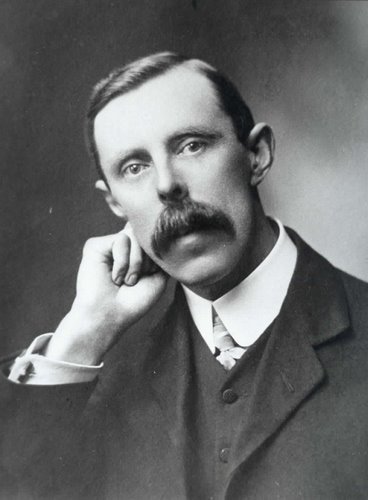
Frank William Boreham 1871-1959

Frank William Boreham 1871-1959
A photo F W Boreham took of himself in 1911

Friday, May 12, 2006

Boreham on Facing a Crisis

Most of the editorials F W Boreham selected for his book (posted on the web site 'This Day With F W Boreham') are studies of a person. In preparing the post for 20 May I note that Boreham has written a different and interesting reflection on facing a crisis, the different types of crises and it concludes with a biblical reference (rare in his newspaper editorials).

I thought it would be good to post his study on this blog site also. Here it is:

What Is A Crisis
Seeing that they cannot form a trades union, or go on strike, words get worked to death. The word "crisis" is a case in point. We should almost fancy that the world had come to an abrupt end if, on opening the paper some morning, we discovered that no "crisis" had developed during the night. In view of the flippancy with which we employ this threadbare phrase, it is worth a little examination. What is a crisis? The dictionary defines it as the point of time at which an affair must either terminate or suffer a material change: a turning point, a conjuncture. That being so, a crisis may take either of three forms.

There is the Crisis of the Summit—the crisis represented by reaching a point higher than which one cannot go and from which one is compelled to descend.

There is the Crisis of the Valley—the crisis represented by reaching a point lower than which one cannot go and from which one can only ascend.

And there is the Crisis of the Cape—the crisis represented by reaching a point from which one neither ascends nor descends, yet beyond which life assumes an entirely different aspect.

Take, for example, the Crisis of the Summit. A man reaches the zenith of his powers, the climax of his fame, the height of his ambition; and what then? He cannot remain there; he must give way to other climbers and begin the painful descent; and they alone have learned life's lessons truly who, at that stage, face the downward slope with brave hearts and with smiling faces. When we reflect that, in the nature of things, comparatively few men attain that peak of pride, we realise that it is a great thing to have been permitted to plant our feet upon that sunlit height. In the life of Sir Edward Clarke, the eminent Solicitor-General, stress is laid upon a certain June day in 1870. Sir Edward was then at the height of his immense popularity; he was earning a fabulous income; he was in excellent health; and, in his home, he enjoyed an unruffled felicity. In that June day he arranged a domestic excursion and it passed off as happily as he could desire. A week later, his mother's health collapsed: shortly afterwards he had to consult a specialist concerning his wife: and, as the years passed on, the dazzling sunshine yielded to grey skies. To the end of his days, Sir Edward thought of himself as confronting, on that beautiful June day, the Crisis of the Summit.

Art Illumines A Basic Principle Of Life
Perhaps the best illustration of the Crisis of the Valley is the famous picture entitled "The Crisis," by Sir Frank Dicksee, president of the Royal Academy. Those who are familiar with that masterpiece never tire of gazing into the haggard face of the anxious husband as he sits by the bedside of his unconscious wife. As she lies there, propped up with pillows, her thin worn hands outstretched on the white sheet, her wan, pinched face is turned away from him. We are impressed by the contrast between the pitiless indifference of her unconsciousness and the strained intensity with which all his soul is focused upon her. Life is trembling in the balance: the catching of a breath may end it. A single flutter of the tired heart may decide the fearful issue. One finds oneself pausing before the painting as though in hope that, even whilst one waits, the sickness will take a more favourable turn and the agonising suspense be relieved. Both husband and wife are negotiating the Crisis of the Valley. Her crisis is physical: his is emotional: but, with both of them, things have reached their lowest ebb.

Mark Rutherford has a fascinating essay on situations of this kind. His chosen example is a scene from "The Old Curiosity Shop," the scene in which Little Nell so suddenly and dramatically meets once more her old friend, the schoolmaster. The whole story takes a new and happier turn from that point. Mark Rutherford shows that, in the lives of Ulysses and Frederick the Great, there were similar episodes; but he likes the Dickens story best. "For," he says, "Ulysses and Frederick were great heroes, whilst Little Nell was but a tender girl."

The Long Lane That Has At Last A Turning
For the supreme illustration of the Crisis of the Cape we instinctively turn to the life of Huxley. "There is," Huxley declares," a Cape Horn in everyone's life. Those who have voyaged to the Homeland by way of Cape Horn will never forget their sudden emergence into sunnier seas after the wearisome monotony of the endless cold." As applied to himself, Huxley's parable is easy of interpretation. When visiting these southern lands as assistant surgeon on the Rattlesnake, Huxley fell in love with Miss Henrietta Heathorn, of Sydney. But never did the course of true love run less smoothly. He won fame in England, but it brought him no money. Many years passed with all the oceans of the world rolling between the two lovers. And when, at long last he was able to send for her, the doctors reported that she had not six months to live. "Six months or no," exclaimed Huxley, "she is going to be my wife!" They were married: and, from that hour, it seemed as if nothing could go wrong with them. Huxley often looked back upon that tedious struggle and likened it to the passage Home by way of the Cape. Every life, he maintained, has just such experiences.

Most people will discover, as they hold life in retrospect, that it took its colour and character from some crucial point represented by Summit or Valley or Cape. A word charged with such poignant significance should not be lightly used. It has, indeed, been sublimated by being employed as the vehicle of sublime revelation.

"For a crisis am I come into the world," exclaims the central figure of the New Testament story. He obviously means that the man who confronts Him has reached a Summit, a Valley or a Cape. The inescapable fact is that he who comes face to face with life's loftier issues may thenceforth become a better or a worse man; but he can never be quite the same again.

F W Boreham

Image: Frank Dicksee's painting, The Crisis, 1891.

This article also appears on the This Day With F W Boreham web site at:
http://thisdaywithfwboreham.blogspot.com/2006/05/20-may-boreham-on-crisis.html

Thursday, May 11, 2006

Boreham on Second Thoughts

In Malcolm Gladwell’s recently published book, ‘Blink’, he is contending that ‘first thoughts’ are often the best. The author has some caveats but he is championing the merits of snap thinking and leaping before we look. The seductiveness of such an approach might have aided this book’s popularity but several decades ago F W Boreham wrote this reflection on the pros and cons of ‘second thoughts’:

The man who can keep ahead of his second thoughts is sure of the kingdom of God. But it is almost impossible to do it. Second thoughts are fleet of foot, and if I pause but for an instant they are upon me.

The ancients were haunted by a horror of the Furies. The dreaded sisters were tall of stature; of grim and frightful aspect; each was wrapped in a black and bloody robe; serpents twined in her hair, and blood trickled from her flaming eyes. Each held a burning torch in one hand and a whip of scorpions in the other. With swift, noiseless, and unrelenting footsteps they pursued their wretched victims. No distance could tire them; no obstacles could baffle them; no tears could move them; no sacrifices could appease them. What, I wonder, was the origin of this weird myth? What was the substance that cast this hideous shadow? What were the Furies? Each of the philosophers has a theory of his own; and so have I! Basing my hypothesis upon the firm foundation of my own experience, I have no hesitation in affirming that the Furies which the ancients dreaded were their second thoughts. In many ways, indeed, my second thoughts are far more terrible than the Furies. The Furies tracked down the unhappy object of their cruel malice and slew him; that was bad enough. But my second thoughts hunt me down with resolute and dogged persistence, and, leaving me unhurt, they snatch my children from my arms and dash them to pieces before my very eyes; that is very much worse. As soon as my children are born to me—the children of my noblest impulses, the children of my happiest moods, the children of my better self—my second thoughts give me no rest until they have completed their dread work of destruction. I have been able, happily, to save a few; but they cannot console me for the lovely creatures I have lost. My fairest flowers have all been shattered my dearest children are all dead!

In all this I am not alone. Others, to my certain knowledge, have suffered in the same way. The New Testament has a great story of four travellers who, one by one, made their way down the Bloody Pass—the short cut from Jerusalem to Jericho. Of the four I find the third—the Levite—by far the most interesting, at any rate, just now. I have never been able to find in my heart much sympathy for the first. He knew perfectly well the sinister reputation held by that gloomy pass; he knew that the darksome forests on either side of the way were infested by brigands; yet he deliberately took all the risks. He was not the first man in the history of the world, and he was certainly not the last, who plunged along a path that he knew to be perilous, and then blamed the church for not helping him when the thieves had done their worst. I am not excusing the priest; he must answer for himself. But I certainly think that the first of these four travellers has something to explain.

At this moment, however, it is the third for whom I have most sympathy. I see him journeying along the pass; I see him start as he hears a moan from the unfortunate traveller lying on the other side of the way; I see him turn aside and cross to the road to the sufferer's relief; and then I see him pause! That pause spoiled everything! The instant that he paused the Furies were upon him! His second thoughts pounced upon their prey. When he heard the moan, and turned aside, he really meant to help the man. A generous purpose had been born within his breast. His second thoughts, knowing of its birth, vowed that the noble resolution should be slain. His second thoughts watched their chance; he hesitated half-way across the road; his second thoughts instantly tore the kindly impulse from his grasp; with merciless hands they killed it on the spot.

Now, no man can look on both sides of the road at the same time. If that fourth traveler—the Good Samaritan—had been able to do so, he would have seen not one Victim, but two, in the Bloody Pass. As he came down the road, he, too, heard a smothered moan. Instantly he stopped his mule, glanced in the direction from which the sound proceeded, and saw the wounded man. The thieves, we are told, had left him half-dead. That is the difference between the thieves and the Furies. Second thoughts never do anything by halves. They utterly destroy their victim. He will never moan again. The beneficent impulse that his second thoughts tore from the Levite’s breast lay stiff and stark in the stillness of death by the roadside. The Good Samaritan helped the half-dead victim of the brigands from the ditch on the one side of the pass; and he was so absorbed in his merciful ministry that he did not notice the quite dead victim of second thoughts lying in the ditch on the other. It does not matter much; the poor murdered thing was beyond all human help; yet it would have elicited a certain amount of sympathy for the bereaved Levite if the Samaritan had noticed the body and reported it. His attention was, however, fully occupied; he failed to discover the traces of the second tragedy; and, although somewhat late in the day, I am writing these lines to repair, as far as possible, his omission.

And, whilst I think of it, it is my duty to point out that the failure of the Samaritan to observe the mutilated body of the Levite's generous purpose raises a particularly interesting and important question. Is a man to be judged by his first thoughts or his second thoughts? Is the Levite who turned aside to help, and then changed his mind, any better than the priest who never swerved from his course at all? A broken-hearted father loves to think, as he lowers into the grave the little casket that holds all that is mortal of his tiny babe, that, in spite of death's apparent victory, the child is still his. The little one died almost as soon as it was born; but he somehow feels that, for ever and for ever, it belongs to him, and that he is a richer man for its coming. Now the question is: Am I entitled to cherish the same sentiment in relation to those noble purposes and generous impulses that my second thoughts tore from my breast almost as soon as they were born? Am I not entitled to some credit for the handsome things that, on first thoughts, I meant to do, even though, on second thoughts, I never did them? I cannot say. The problem is too deep for me.

Whilst we stand here, however, baffled by this uncertainty on the major issue, let us gather up such minor certainties as we can find. If we cannot secure for ourselves the loaf that we covet, we need not refuse to eat such crumbs as are lying about at our feet. And this much, at least, is clear. Most of us are a great deal better than we seem. I happen to know the Levite and the Good Samaritan very well. I do not know what they were doing in the neighbourhood of Jericho, for nowadays they both live in our suburb. I have always been polite to the Levite, but there has been no love lost between us. Our relationship has been characterized by a distinct aloofness. But I feel to-day that I owe him an apology. I have been doing him a grave injustice. I have never given him the slightest credit for that high resolve that was so quickly murdered by his second thoughts. Even though his pity came to nothing, I like to think that the man whom I have treated so coldly is capable of pity. Even though his resolve perished as soon as it was born, I like to think that this apathetic neighbour of mine once said to himself, ‘I will turn aside and rescue this poor fellow.’ I have treated him distantly, and passed him with the merest nod, and, all the while, he and I are brothers. We are brothers in affliction. For his trouble is my trouble, his grief my grief. Have I not already said that, over and over again, my second thoughts have snatched my noblest purposes, my worthiest projects, from my breast and murdered them under my very eyes? The selfsame calamity has overtaken him, and I have shown him no sympathy! And all the while he has been watching me. He has seen no lofty design fulfilled by me, and he has taken it for granted that I never cherished one. He does not know what I have suffered at the hands of second thoughts. If I meet the Levite on my way home this evening, I shall show him a cordiality that has never before marked our intercourse with one another. Having been robbed of my own spiritual children by the worst of all the furies, I must extend a helping hand to an unfortunate comrade who has been put to grief in the same way.

The Good Samaritan, too, I meet very frequently. I saw him helping a lady with her parcels only this afternoon. I see now that to him also I have been unjust. Not that I have failed to recognize his worth. Ever since he turned aside that night in the Bloody Pass, and rescued the wounded man whose chance of life was so rapidly vanishing, I have given him a conspicuous place in my gallery of heroes. He is to me a knight of the most golden order of chivalry. And yet, for all that, I have never done him justice. I have always thought very highly of him, but not so highly as he deserves. I have admired his readiness to relieve the distressed, to succour the fallen, and to befriend all who need a helping hand. But I never realized till to-day that he only does all this after a desperate struggle. I have taken it for granted that he enjoys a complete immunity from the attacks of second thoughts. But I see now that I have been mistaken. When he paused in the lane, as the Levite paused before him, a gang of second thoughts sprang upon him, and attempted to strangle the kindly thought which had been born within him. But he fought for his purpose so bravely, so tenaciously, and so successfully, that the second thoughts were scattered, the generous purpose preserved, and the heroic deed actually accomplished. When I meet the Good Samaritan in our suburban streets, I shall raise my hat to him more reverently than ever. I always thought that he was good; I see now that he is even better than he seemed.

Second thoughts were designed to be the peers of the intellectual realm. They constitute a House of Lords, a chamber of review. It was intended that they should be a check upon any hasty and injudicious legislation that my first thoughts might introduce. And, to do them justice, they often serve me excellently in that very way. My first thoughts are often moved by sentiment, by caprice, by anger, or by some gust of passion; and it is a happy circumstance for me that the project has to run the gauntlet of the Upper House. My second thoughts make short work of such rash and ill-considered devices.

Many a rash scheme, unanimously and enthusiastically approved by my first thoughts, has been contemptuously rejected in the chamber of review. But, unfortunately, that higher chamber has, in a marked degree, the weakness of all such legislative institutions. It is too cautious. It tends to conservatism. It is not sufficiently progressive. It fails to distinguish between a gust of vapid emotion and a wave of magnanimous determination. And so it comes to pass that it scornfully rejects some of the most splendid enactments that my first thoughts produce. The question of the abolition of the Upper House is always a knotty one. It is particularly so in this connexion. Would I, if I could, abolish the chamber of my second thoughts? It is very difficult to say. When I recall the wild and senseless projects from which they have saved me, I shudder at the thought of removing from my life so substantial a safeguard. Yet when I remember how often they have stood between me and moral grandeur, I feel resigned to their destruction. The finer feelings invariably express themselves through the medium of first thoughts; it is the more sordid and selfish sides of my nature that reveal themselves when the second thoughts arrive. In reality, the lightning and the thunder occur simultaneously. But the flash of the one is seen immediately, whilst the rumble of the other is only heard after an appreciable interval.

Conscience expresses itself like the lightning, instantaneously; the mutterings of reason and self-interest, like the thunder, come lumbering along later. It has been said that the men who, in the great war-days, won the Victoria Cross, won it by yielding to the impulses of the moment. Thousands of others were similarly situated, and felt that same sudden and sublime inspiration. But, unfortunately, they hesitated. During that momentary spasm of uncertainty a multitude of second thoughts surged in upon their minds; those second thoughts were, without exception, thoughts of caution, of safety, and of self-interest; and, as a result, the splendid deed was never done and the coveted distinction never won. I really believe that the heroic, the chivalrous, the sacrificial would become commonplace but for the excessive caution of that Upper House.

If ever I become a king, or a dictator, or a president, or anything of that kind, I shall establish a special Order of Merit, to be conferred upon men and women who contrive to conquer their second thoughts whenever their second thoughts threaten the realization of their best selves. The badge of the Order will consist of a representation of the Good Samaritan. And its membership will include some very knightly spirits. I shall confer the ribbon of my Order on men of the stamp of William Law. William Law—who afterwards wrote a book that changed the face of the world—was once a poor young tutor in the household of the Gibbons of Putney—the household that afterwards gave to the world its greatest historian. In those days Mr. Law used to think a great deal about the widows and orphans whom he had known so well, and helped so often, at his old home at King’s Cliffe. ‘If,’ he used to say to his new friends at Putney, ‘if only I were a rich man, those poor women and children should never again have need to beg for bread! But it was no good saying ‘if.’ He was not rich; he was scarcely less poor than the people he pitied. One day, however, he had occasion to visit the city. Standing in the doorway of a bookshop in Paternoster Row, looking at the passing crowd, a strange experience befell him. ‘A young man, in the dress and with the manners of a gentleman's servant, stepped out of the crowd and asked him if he was Mr. Law. On receiving an affirmative reply, he put a letter into his hand. When Law opened the letter, he found inside it a bank-note for a thousand pounds. No name accompanied the note, and, by the time that Law looked up from the letter, the messenger had vanished. Before Law stepped from that doorway he made his resolution. He took the first coach to King’s Cliffe, and, before he returned to Putney, had made arrangements for the erection and endowment of a residential school for fourteen poor girls.’ William Law knew that the whole pack of second thoughts were on his track. He determined at any cost to keep ahead of them; and he succeeded so well that upon him I shall certainly confer the ribbon of my Order.

It will be said, I know, that I am too severe. I am indulging, I shall be told, not in a criticism, but in a diatribe. In my fierce reprobation of second thoughts I have almost stooped to invective. I know; I know! But let it be remembered, in extenuation of my offence, that I am a minister of the everlasting gospel. And no man is so harassed and cheated and victimized by second thoughts as a minister of the gospel. Every Sunday of my life I preach a story that might move a statue to tears. It is the story of the Cross; the story of redeeming love; the greatest, sublimest love-story ever told. And I can see, as I watch the play of emotion on the faces of my hearers, that I have swayed their reasons, touched their consciences, and almost won their hearts. But it all comes to nothing. They pause for just a moment, as the Levite paused in the middle of the road. Their hearts are almost won—almost, almost, almost! But, whilst they hesitate, the second thoughts come surging in. I see the millions of them—swarming into the building whilst the congregation is singing the closing hymn. They get to work without a second’s delay. The heavenly aspiration that I marked upon the people's faces is stifled at its birth. The doors open and the crowd melts away. I have been robbed by second thoughts of the fruit of all my labours. If the people had only acted as the Good Samaritan acted, as the hero of the battlefield acted, and as William Law acted, they would have flocked to the Cross like doves to their windows. The man, I say again, who can keep ahead of his second thoughts is sure of the kingdom of God.

F W Boreham

Image: ‘Blink’ by Malcolm Gladwell.
Wednesday, May 10, 2006

Boreham and the Chair that Billy Graham Wanted

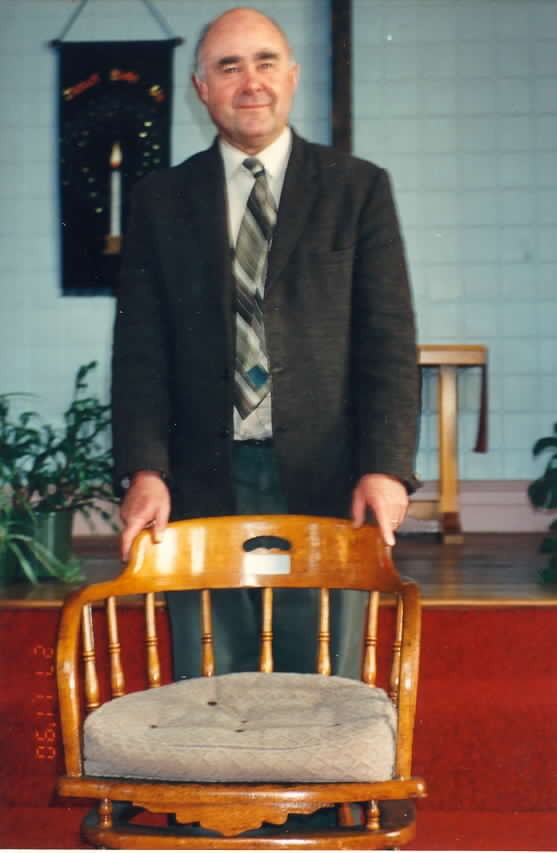
This is the chair that Dr Billy Graham wanted to buy.

Mention has already been made of the influence that F W Boreham had on Billy Graham. The American evangelist and his wife Ruth collect Boreham books and they have found them to be a great source of truth and illustrations.

When Billy visited Melbourne in 1959 he said that the one man he wanted to meet in Australia was Dr F W Boreham. He wanted to thank him for the impact he had had on his life and ministry.

Billy wanted to recognize Dr Boreham publicly and he asked him to sit with him on the platform at the Melbourne Cricket Ground. Unfortunately F W Boreham had to decline the invitation because he was not a well man (he died two months later). Billy did kneel down in Boreham’s lounge in Kew and the old man put his hands on him and blessed him.

When Dr Billy Graham visited New Zealand ten years later in 1969 he conducted evangelistic crusades in Auckland and Dunedin. Knowing that Mosgiel, the location of Boreham’s first church, was only 10 kilometres from Dunedin, he asked his hosts if he could visit Boreham’s church.

He was given a tour around the little church and shown some of the Boreham relics, including this chair belonging to the old doctor (there were two chairs‑a Preacher’s Chair behind the pulpit and Boreham’s Study Chair which was in the porch. I think this is the latter one).

When Billy asked to buy this chair and offered $US500 (a big sum in those days), the local church representative (quite possibly the pastor) was tempted! Before he shook hands on the deal and packed up the chair the local man (in good Baptist fashion) said he would need to consult with other members of the church.

A special meeting was convened that night to discuss the request. The meeting concluded that if it was worth that much to Dr Graham it must be worth at least that amount to them! They, therefore, did not accede to the evangelist’s request.

Over the years Boreham aficionados have visited Mosgiel and have called in to the church to view the old photos and memorabilia.

A year or two ago, when the Mosgiel Baptist Church closed its doors, I offered to provide a good home for the chair and other memorabilia in the F W Boreham Collection at Whitley College, in Melbourne. My offer was not accepted. I am unsure what has become of the chair and other Boreham items and would be grateful if any readers of this site from Mosgiel might inform us.

Why did Billy want Boreham’s chair? It doesn’t look highly comfortable or stylish. But like a grave, a pulpit, these items bring us closer to the one we love and appreciate.

F W Boreham wrote several times about chairs.

He wrote about Alec Fraser at Mosgiel who kept an ‘empty’ chair at the end of his bed for Jesus. The chair symbolized the presence of Christ and helped Alec to focus his prayers.[1]

An additional aspect of Boreham’s relationship with John Broadbanks is revealed in one of Boreham’s final recollections:

“We never celebrated communion with John Broadbanks but the last time we were together we set up an armchair that was open and free for the Lord [to aid us] in the consciousness of the Real Presence.[2]

In 1921 (when he was in Armadale, Melbourne) Boreham wrote lovingly about the way his chair was more than a chair:

“In this chair... I have spent hundreds of delightful hours.”...A stick is more than a stick ...If I say, this old arm-chair has not a soul, who has?... My contention is that an arm-chair is more than an armchair...if we listen with sufficient care, the old arm-chair is talking to us… It is reminding us.”[3]

To F W Boreham, his armchair was full of soul.

Listen to this final thought from Boreham on his chair:

“Every man has a genius for something or other. I have a genius for a comfortable armchair and a blazing fire...I can talk to my heart's content without seeming garrulous, and, when, in the mood, can remain as silent as the Sphinx without appearing sullen.”[4]

With all that F W Boreham could see in his chairs, no wonder Billy Graham wanted to get his hands on one of them!

Geoff Pound

Image: The chair with a former pastor of the Mosgiel Baptist Church, the Rev Laurie Rankin.

Link: The earlier posting on F W Boreham’s influence on Dr Billy Graham can be viewed at:
http://fwboreham.blogspot.com/2006/02/borehams-influence-on-billy-graham.html#links

[1] F W Boreham, Rubble and Roseleaves, 1923, 60.
[2] F W Boreham, The Fiery Crags, 1928, 147.
[3] F W Boreham, Home of the Echoes, 1921, 134, 138, 143.
[4] Boreham, Rubble of Roseleaves, 7.

Tuesday, May 09, 2006

Boreham on Second Fiddles

On my web site This Day With F W Boreham, I have posted the editorial, ‘Boreham on Second Fiddles’. This was the editorial he had appointed for 14 May in his unfinished book in which he intended to have one article for every day of the year.

You can find it at the web address below.

I am in this posting presenting a published essay entitled ‘Second Fiddles’. This was a common theme (as FWB indicates in this piece) but both postings represent the different genre of editorial and essay. The editorial which appeared in the newspaper, the Hobart Mercury, had tight word restrictions. The essay was more extensive. The editorial was written for the general public. The essay, he knew, was written for a loyal readership who had a higher theological literacy, hence, there are more references to the bible, church history and the local congregation.

Enjoy both the editorial and this Boreham essay, entitled ‘Second Fiddles’:


ONCE in a blue moon it falls to the lot of a public man to read his own obituary notice. Mr. Charles Brookfield closes his Random Reminiscences by telling of an interesting experience of the kind. He was laid up at the Isle of Wight with a sharp attack of pleurisy; one afternoon it was rumoured that the malady had proved fatal; and the evening papers rushed out the usual sketches of his character and career. Mr. Brookfield had the satisfaction of lying in bed, propped up by snowy pillows, and reading these lachrymose lamentations and candid criticisms. The latter proved by far the more entertaining. But the climax of the sick man’s enjoyment was reached when, in the columns of a leading journal, he was told that, ‘though never a great actor, he was invaluable in small parts.’ Mr. Brookfield used to say that he regarded that phrase as one of the finest compliments ever paid him.

Some of the world’s best work is done by those who, by no means great actors, are nevertheless invaluable in small parts. They are essentially second fiddles. They have not the perspicacity to see exactly what needs doing, but, once it is pointed out to them, they will exhaust all their energies in the prosecution of the task. They are eager to help, anxious to serve, grateful to be commanded. They are conscious of their own limitations. They know that they can never hope to lead; but, when they find a leader who knows how to win their hearts, they will show their delight by following him through thick and through thin. ‘Dundas is no orator,’ Pitt once said; ‘he is not even a speaker; but he will go out with you in any weather!’ He was a second fiddle. So was Jamie Greenleaf, my old Mosgiel deacon. Jamie was no great actor, but in small parts he was invaluable. I never in my life heard him make a suggestion. He had no more initiative than the chair on which he sat. When a debate was in progress, he sat bewildered and confused. His ready sympathy led him to see the best on both sides; and I have even caught him voting both for the resolution and the amendment. In such an atmosphere he was like a fish out of water. But tell him that, at its last meeting, the Church had decided on such and such a policy, and that somebody would be needed to distribute handbills, or run a message, or visit a distant member, or drive the minister to an outlying township, and Jamie instantly volunteered his services. Sunday might bring with it a snowstorm or a tornado, you would always find Jamie at the church door distributing hymn-books. Was there to be a coffee supper or a social evening? You would always find Jamie preparing the tables and stoking the fire. At the Sunday School picnic it was always Jamie who pitched the tent, hung the swings, and kept things merry. If any special service was approaching—a wedding, a funeral, a mission, or an anniversary—Jamie always gave a ‘cry roon’ at the Manse the night before to see if there were any odd jobs that he could attend to. If you suggested that he should make a speech, he looked terrified; he could not initiate a policy to save his life; yet I doubt if any one in the Mosgiel Church was held in greater affection than was he. In every club, school, society, and congregation you will find men of this fine type. They are essentially second fiddles. Never great actors, they are simply invaluable in small parts.

The cynic will say with a sneer that a second fiddle is a second fiddle because it cannot be a first. It might just as truly—perhaps more truly—be said that a first fiddle is a first fiddle because it cannot be a second. The most striking illustration of this phenomenon occurs in the political history of the nineteenth century. During the memorable period to which I refer, Gladstone was the first fiddle of the Liberals and Disraeli was the first fiddle of the Conservatives. But, at the beginning, the two men were members of the same party. And, as you read Lord Morley’s stately chapters, or any other history of the mental evolution of the two men, you are unable to resist the conviction that they were driven into hostile camps by their utter lack of affinity. Each got on the other’s nerves; each felt an unconquerable animosity for the other. Had they continued in the same party, one would have had to be first fiddle and the other second. It was out of the question. Neither could be second fiddle to the other; the idea was preposterous, inconceivable, absurd. And so, beneath the commanding influence of their gigantic personalities, parties were remodelled; the one went to the one side of the House, and the other to the other; and they remained protagonists to the end of the chapter. They stand for all time as a classical exemplification of the fact that, whilst some men are second fiddles because they can’t be first, others are first fiddles because they can’t be second.

Some men, on the other hand, are shaped by destiny to be second fiddles. It is as second fiddles that they shine. They are second, not because they cannot force their way to a leading place, but because they recognize that they can do their best work in a subordinate role. It has been said that Nelson could never have won the battle of Trafalgar but for the assistance and support that he received from Cuthbert Collingwood. On the day that determined the destinies of Europe, Nelson himself was lost in admiration of the heroic part played by his second-in-command. Collingwood, on the Royal Sovereign, led the lee line of ships towards the enemy's fleet, and, first under fire, opened the historic engagement. ‘See,’ cried Nelson, pointing to his colleague's vessel as she steered straight for the enemy's line, ‘see how that noble fellow Collingwood carries his ship into action!’ Let us grant for the sake of argument that, without Collingwood, Nelson could not have destroyed Napoleon's fleet that day. But nobody will deny that, if Nelson had not been there, Collingwood would never have destroyed it. The day was decided by the dazzling genius of ‘the greatest sailor since the world began.’ As soon as the French and Spanish admirals saw the formation of the British lines, they knew that, notwithstanding the superior size, strength, and numbers of their own ships, the battle could end only in one way. They were defeated before a shot was fired. Grant, therefore, as everybody will grant, that Collingwood could not have won the battle without Nelson; and grant, for the sake of argument that Nelson could not have won the battle without Collingwood, and you have only proved that some men are essentially first fiddles, and others, just as essentially, second fiddles. Collingwood was equipped with every qualification for becoming a second fiddle. As a second fiddle he was literally invaluable; as a first fiddle he would have whelmed a continent in appalling disaster.

Or if, preferring to see the same principle at work in less warlike surroundings, the student cares to shift the scene, he will find an identically similar illustration in the cases of Martin Luther and Philip Melancthon. Luther could never have brought the reformation into being but for the work and influence of Philip Melancthon; and, most certainly, Melancthon could never have done it without Luther. Luther was a first fiddle; who can imagine him second? Melancthon was a second fiddle; he had neither the desire nor the ability to be a first.

Everything depends upon the correct arrangement of the first and second fiddles. When, as in the case of Bright and Cobden, the men fit into their right positions at the start, the cause they represent is given an incalculable advantage. When, as in the case of Burke and Wills, the Australian explorers, the second fiddle is given first place and the first second, the situation can only end tragically. Wills was a born leader; it was the one qualification that Burke lacked. Macaulay has shown that, when Sir James Mackintosh was first fiddle and Charles Fox second, the Whig cause lost ground every day; but when they changed places it swept the country. There are men who make excellent lieutenants but poor captains; they are admirable assistants but execrable leaders. They are sent into the world to be second fiddles.

We ministers are specially sensitive at this point. We are generally regarded as first fiddles. Our position involves us in a prominence that is out of all proportion to the value of our service. Every day of our lives we become increasingly conscious that the real glory belongs to the second fiddles. The secretaries, the treasurers, the office-bearers of our churches—the men who, year in and year out, cheerfully devote their time, their energy, their wealth, and their ability to the service of the sanctuary—the men who, in many cases, bore the burden of responsibility before we ministers appeared, and will continue to bear it after we have vanished—how could the Church exist without these? They are the pride and the comfort of every minister and of every congregation.

And what of the men who are quaintly termed ‘the local preachers’? Consult the records of any congregation in Australia or New Zealand, and, before you have turned many pages, you will find yourself reading the annals of a time when a few devout souls met in a barn or a kitchen and received gratefully the ministrations of earnest laymen whose hearts had been divinely touched and whose lips had been divinely opened. In the early history of every church there were the gravest difficulties to be encountered and the fiercest prejudices to be overcome. In the nature of things, there were no ministers on the scene, and the positions were bravely and cheerfully taken by busy men—farmers, smiths, clerks, shopkeepers—who, although deeply conscious of their scanty equipment and meagre qualifications, were of faith so fine and sense so sound that no discouragement ever damped their ardour and no opposition ever daunted their determination. When the Churches look proudly round at their prosperity, and joyously recount the mercies that have crowned past years, they do but advertise their base ingratitude if they omit an eloquent allusion to the priceless spirits of these valiant men.

I am very fond of Richard Jefferies. My old friend, J J Doke, who laid down his life pioneering in Rhodesia, once advised me to sell the clothes from my back, if need be, in order to possess myself of Field and Hedgerow and the other treasures that our great naturalist has left us. My only sorrow, as I have read these classics of the countryside, has been that Jefferies hated churches and ministers. He turned his back on a church whenever he caught sight of it, and loved to look out upon the sea because there, he said, he could be sure that the horizon would be disfigured by no steeple. Yet even Jefferies found it impossible to withhold his admiration from the local preacher. In his Wild Life in a Southern County, he describes the varied phenomena of a Sussex hamlet. And how can he honestly portray the moving panorama of village life without making some reference to the cottage meeting? He pictures the quaint little room—its old-fashioned furniture and odd assortment of books. There is a Bible among them. Hardly a cottager, Jefferies says, is without his Bible. And no man can interpret that cottage Bible like the local preacher. ‘The good man has been labouring in the hayfield from dawn till dusk; but at night he faces without any sign of weariness the devout folk who gather to hear him. He opens the Bible, and, though he can but slowly wade through the book, letter by letter, word by word, he has caught the manner of the ancient writer and expresses himself in an archaic style not without its effect. There is no mistaking the thorough earnestness of this cottage preacher; he believes what he says; no persuasion, rhetoric, or force could move him one jot. Men of this kind won Cromwell's victories; but to-day they are mainly conspicuous for upright and irreproachable moral character, mingled with some surly independence; such men are not paid, trained, or organized; they labour from good will in the cause.’ Thus Richard Jefferies, scorning the Churches, doffs his cap to the local preacher. I range myself, bare-headed, beside him, and am grateful to have found another point of kinship with a teacher to whom I owe so much.

I once preached a long series of sermons on Second Fiddles. I could not help it. Paul makes so much of them. At the end of his very greatest letter he devotes a whole chapter to Second Fiddles. ‘I commend unto you Phebe our sister,’ he says; and then he goes on to a long list of people who, none of them great actors, were all of them invaluable in small parts. Take Phebe herself. In days when travelling was particularly hazardous, when means of locomotion and postal services were unknown, she, a woman, carried Paul’s letter all the way from Corinth to Rome. Only a first fiddle could have written the Epistle to the Romans; but how would that epistle have benefited the people to whom it was addressed unless a second fiddle had risked her life to deliver it? ‘Paul had a multitude of noble qualities,’ says William Brock, ‘and he had one quality which great men do not always exhibit; he never forgot a kindness, and never forsook a friend.’ And everybody knows why. It was because Paul had sat at the feet and caught the spirit of One who takes good care that no cup of cold water given in His name misses its reward. To Him the players of small parts—the Second Fiddles—are precious beyond price.

F W Boreham

Image: First and second fiddle.

Boreham's editorial on The Second Fiddle can be found at:
http://thisdaywithfwboreham.blogspot.com/2006/05/14-may-boreham-on-second-fiddles.html

Monday, May 08, 2006

Boreham on John Broadbanks

If you have read several of the books by F W Boreham you will not be the first person to have asked the question, “Who was John Broadbanks?” Helen, a frequent reader of this web log, has recently asked the question and specifically enquired as to whether I had asked the question of Dr Boreham’s son, Frank Boreham Jnr. Here is my response.

From his books these are some of the details we can glean. The Rev John Broadbanks was a neighboring minister at Silverstream when Boreham was pastor at Mosgiel,New Zealand. Both of small towns are real places (there is a photo of Silverstream in Boreham’s booklet, ‘The Empty Pitchers’) and are about 10 kilometers apart, from memory). Boreham doesn’t say but it would seem Broadbanks was a Presbyterian minister.

Boreham and Broadbanks were close friends and on their day off (Monday) they alternated their weekly meetings at each other’s manse. They went on shooting expeditions, holidayed together, visited churches in outlying areas, swapped sermon ideas and shared the deep things on their hearts.

Broadbanks appears to have been older than Boreham. He was married to Lilian and their daughter, nicknamed Goldilocks, is mentioned in one of Boreham’s essays. Boreham once wrote: “The best debater that I ever knew was John Broadbanks.” In another essay he wrote that John Broadbanks had “a superb gift of mimicry and was a fine actor.”

John Broadbanks suffered a breakdown in health (so did FWB) and came to the resolution that he would be faithful to the basics of ministry and not take on every invitation (again, Boreham’s personal resolve).

John’s death had a profound effect on Boreham, leading him to write, “With the passing of John Broadbanks I myself must pass.” This book, ‘The Passing of John Broadbanks’ was published at the time of Boreham’s retirement in 1928 and was to be his last book. A couple of years later a new book appeared (he suffered from an ‘incontinent pen’) and he went on to write another twenty books!

F W Boreham used the profits from his books and preaching to establish and fund the ‘John Broadbanks Dispensary’, in Birisiri, East Pakistan (now Bangladesh). Calling it by this name was a way of diverting attention away from himself.

What did F W Boreham say about John Broadbanks? T Howard Crago, his biographer, asked him this question and his answer was quite unclear!

When I quizzed Dr Boreham’s son, this is what Frank Boreham Jnr. said:
“I have given a lot of thought to the person of John Broadbanks and I talked to Howard Crago about it. There is a general consensus that when my father wanted to introduce a character e.g. his wife and did not want to refer to my mother she would be John Broadbanks. Sometimes he would be John Broadbanks. He talked about it. My father refers to Silverstream, the place where John Broadbanks lived, because when you go there the manse is right on Silverstream. So when he wanted to talk about himself he talked about John Broadbanks.”

I agree with this conclusion and find some support for this literary technique among some of Boreham’s literary models. Here is what I wrote a few years ago on this subject:

One of Boreham’s famous fictional characters was the enigmatic, John Broadbanks,[1] In Boreham’s development of John Broadbanks it is possible to see traces of the Dickensian “tendency toward multiple projection”[2] and the way Dickens developed “sides of himself in all the major figures in his moral and social spectrum, male and female, young and old.[3]

Boreham concealed his thinking behind the guise of ‘John Broadbanks’ and particularly in his editorials he displayed a [Mark] Rutherford-like restraint in refraining from references to himself. A [rare] example of authorial disclosure is found in an editorial about Catherine Booth which Boreham implies that he had attended her funeral.[4]

It may have been Boreham’s immersion in the Scottish province of Otago that led to his acquaintance with a variety of Scottish writers who left their mark on his writing style. Among these was James Matthew Barrie whom Boreham described, with his characteristic use of superlatives, as “the most distinctive, most outstanding and most lovable figure of his time”.[5] Perhaps it was Barrie’s popularity in immortalising obscure Kirriemuir and projecting himself in the “impish McConnachie” that led Boreham to write his essays about country town Mosgiel and project another side of his personality into the character of John Broadbanks.[6]

Like Boreham, temperamentally “shy and sensitive”, Barrie’s great gift was “the ability to invent and tell a good story”.[7] Boreham alluded to the virtues of restraint and anonymity which were most evident in his editorials when he said of Barrie, “There is a sense in which he never speaks of himself: there is a sense in which he puts himself into every word that he utters. Therein lies his charm”.[8]

For literary license and Boreham's personality makeup it would seem that John Broadbanks was a fictional character who is made to take on different personalities at different times, be a spokesperson for wisdom and an exemplar of good living. Still, John Broadbanks remains a mystery.

While the identity of John Broadbanks is enigmatic this should not prevent us from benefiting from his contribution. Jeff Cranston expressed it well in a recent posting on this site:

“There is much wisdom and insight to be gained for every minister as the reader meets Pastor John Broadbanks of Silverstream, surely one of the choicest ministers who ever lived. He and Boreham were inseparably linked in life; you will delight in learning about John. His knowledge, expertise, and sagacity will be a boon for every minister struggling with the daily challenges presented by both the ministry and people.”

Geoff Pound

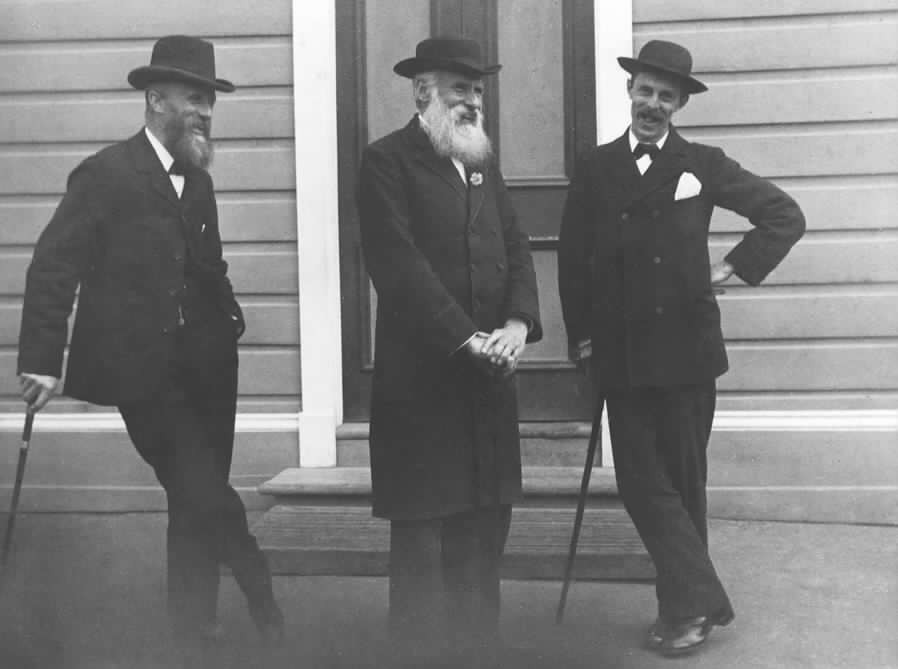
Image: Boreham is on the right but is John Broadbanks one of the other two?

[1] For examples of the way Boreham developed the Broadbanks figure see Boreham, Ships of pearl, 163, 223. An analysis of the Broadbanks phenomenon is found in Crago, The story of F W Boreham, 98, 74, 225.
[2] A Welsh, From copyright to Copperfield: The identity of Dickens (Cambridge; Harvard University Press, 1987), 28, 45.
[3] M Golden, Dickens imagining himself: Six novel encounters with a changing world (Lanham: University Press of America, 1992), 4.
[4] Boreham, Mercury, 4 October 1947.
[5] Boreham, Mercury, 9 May 1942.
[6] Boreham, Mercury, 9 May 1942.
[7] James A Roy, James Matthew Barrie: An appreciation (London: Jarrolds Publishers, 1937), 48.
[8] Boreham, Mercury, 9 May 1942.

Sunday, May 07, 2006

Boreham on Seeing the World in a Grain of Sand

This is the third of three postings by David Enticott who has been studying the early influences on the developing preaching style of F W Boreham:

The second and more pervasive impact of nature on his preaching was that it taught him to be curious. Boreham valued the instinct of curiosity highly.[1] It was to become an invaluable tool both for the preparation and content of many sermons. He was able to gain spiritual merit or value from a simple phrase or word. His sermons sought to probe the hidden depths of spiritual matters.

Therefore, more than providing illustrations, the natural world gave Boreham a curious spirit. It was detailed and contained surprises that could be unravelled. For Boreham the scriptures held a similar kind of detail. He was able to take, and sometimes even twist, a single phrase or sentence from a text into several different places and meanings. He had a photographer’s eye for minutia, for hidden shapes and colours. Of course sometimes this would not exactly accord with what the text itself was saying. For example on the 10th of December 1893 he preached a sermon at Theydon Bois[2], which was based on a simple sentence of scripture: “Beware! Lest thou forget the Lord” (Deut. 6:12). From these six words he constructed five points: “to forget God: is to miss the chief object of life, is Satan’s most subtle temptation, is to abandon hope, is to forget all that’s worth remembering, is impossible.”[3] One sentence had been not only expounded, but expanded as well, to cover a variety of topics. It had unfolded and opened up, like many things in nature.

It was only in his later years that Boreham allowed this sense of curiosity to spread from himself to his congregation. Perhaps part of the reason for his initial reluctance to feed the theme of creation into his sermons, was that Boreham believed at this stage of his ministry that nature was restricted in terms of revealing God. He said that it was “the shell and not the kernel, …the part and not the whole.”[4] It could not meet the deepest needs of a person’s soul.[5] Boreham’s earliest sermons allowed little room for the imagination. They were more often direct appeals for holy living or conversion. It was only in his later years that his messages were seasoned with truths from God’s creation when he came to view the natural world as being a place of revelation.

With time Boreham learnt to flavour his sermons with metaphors that granted room for different interpretations. [6] Nature assumed a leading role. He let the natural world speak for itself and for God. In his copy of his book Mushrooms on the Moor, Boreham wrote in his own handwriting a poem from William Blake’s Songs of Innocence that argues for the sufficiency of nature as God’s spokesperson:


“To see a world in a grain of sand
And heaven in a wild flower,
Hold
infinity in the palm of your hand
And eternity in an hour.”[7]

David Enticott

Image: Grains of Sand

[1] Boreham commented that “the world owes more than it can ever acknowledge to the instinct of curiosity, and so do I.” In: F.W.Boreham, The Home of the Echoes (London: The Epworth Press, 1921), 25.
[2] F.W.Boreham, “Beware! Lest thou forget the Lord.” Sermon, Theydon Bois, United Kingdom, 10 December, Preacher’s handwritten sermon manuscript.
[3] ibid.
[4] F.W.Boreham, The Baptist Pulpit XXIV. The Whisper of God (London: Arthur H.Stockwell, 1902), 10
[5] F.W.Boreham, The Golden Milestone and Other Bric A Brac (London: Charles H.Kelly, 1915), 121-5. Here he wrote that while “nature is very, very beautiful”, “there are things for which my soul is aching, but which neither bush nor beach can give me.” “I need a Saviour.”
[6] One of Boreham’s models for preaching, F.B.Meyer wrote in the introduction to F.W.Boreham’s first book that “nature is full of analogies to deep spiritual truth, though it needs the purged eye to behold them.” In: F.W.Boreham, Won to Glory: A Review of the 24th Chapter of Genesis (London: Marshall Brothers, 1891), introduction.
[7] This handwritten note is contained on the inside cover of Boreham’s own copy of his book Mushrooms on the Moor. In: F.W.Boreham, Mushrooms on the Moor (London: Charles H.Kelly, 1915). Copy held in the F.W.Boreham Collection in the Whitley Library, Royal Parade, Parkville.

Saturday, May 06, 2006

Boreham on Nature: Nature on Boreham

This is the second of three postings by David Enticott from his Masters Qualifying essay on the early influences on the preaching of F W Boreham.

The impact of nature on F W Boreham’s preaching, from 1891 to 1895, was borne out in two ways. Firstly there were some illustrations in his sermons that referred specifically to the creation, such as “snow on cottages.”[1] This was a pervasive image of newness in Christ that covered everything- all sins and mistakes. Another strong picture from the environment contained in these early sermon manuscripts, was called “arctic rivers.”[2] Here Boreham included a quotation to elaborate on what he meant. The quote stated: “Some Christians like the rivers which flow into the Arctic Ocean are frozen over at the mouths.”[3] Again this scene from nature may have been an effective illustration, as it could have been easy for a listener to picture what a frozen river might look like. To visualise an Arctic landscape filled with snow and icebergs.

Despite these references, it was only in his sermons after 1895 that Boreham allowed nature to have free reign.[4] As an example of this, on the 4th of February 1894 he delivered a message at Theydon Bois which was entitled “A word fitly spoken.”[5] The text for the day was Proverbs 25:11 and the headings chosen related both to the passage and the audience. It was a literal reading of the verse. By the time he reached Hobart and gave the same sermon in 1910, the title and headings had changed dramatically. The new theme was freed from a literal interpretation and modified to “Lips like Lilies.” [6] The headings read: “Some like thistles, some like poppies, some like violets, some like daisies.”[7] He thought that a person’s use of language could be thorny, misused, loving or divine. Nature was his means of explaining the point and as such it had been given its full voice. Here were the flowers and colours of the common at Tunbridge Wells coming to life. This use of the real world also allowed for the possibility of different interpretations, as a metaphor can be understood and pictured in different ways.

These relatively sparse references to the creation in his early sermons were nearly always used to illumine a theological or practical issue. When he spoke at Theydon Bois on the theme of Christians being released from condemnation,[8] Boreham used a scene from the natural world to make his point. Here there was a graphic backdrop of waves, wind and thunder, that only Christ could abate.[9] Such references to nature were still rare by the time Boreham left England in 1895. In his final four sermons at Theydon Bois in late 1894 he only used one illustration from creation.[10]

David Enticott

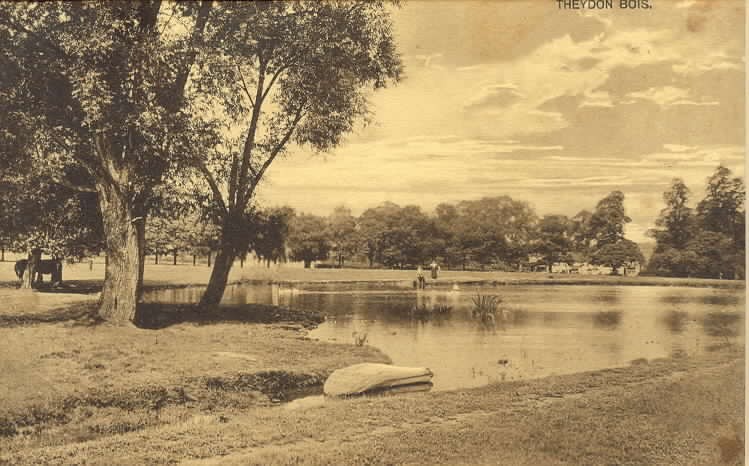
Image: From a Postcard of Theydon Bois in the F W Boreham Collection, Whitley College.

[1] F.W.Boreham. 1892. “Walk in the newness of life.” Sermon, Clapham, United Kingdom, 12 June, Preacher’s handwritten sermon manuscript. As with all of Boreham’s manuscripts, this illustration was denoted by a squiggly line underneath the key phrase of the story.
[2] F.W.Boreham. 1894. “A word fitly spoken.” Sermon, Theydon Bois, United Kingdom, 4 February, Preacher’s handwritten sermon manuscript.
[3] ibid.
[4] A notable exception, where Boreham did use nature as a guiding force, was a sermon entitled “Roots, Shoots and Fruits” from Theydon Bois in March 1894. Here he preached on a text taken from Matthew 7:20: “wherefore by their fruits ye shall know them” and said that Christians should be known not by their roots, or shoots but instead by their fruits. In this message he teased out some of these links with the natural world by holding that “it is well to be reminded that we are not saved by profession, sap brings shoots: not shoots sap.” In: F.W. Boreham. 1894. “Roots, Shoots, Fruits.” Sermon, Theydon Bois, United Kingdom, 25 March, Preacher’s handwritten sermon manuscript.
[5] ibid.
[6] F.W. Boreham. 1910. “Lips like Lilies.” Sermon, Hobart Baptist Church, Australia, 25 May, Preacher’s handwritten sermon manuscript.
[7] ibid.
[8] F.W. Boreham. 1894. “No condemnation.” Sermon, Theydon Bois, United Kingdom, 20 May, Preacher’s handwritten sermon manuscript.
[9] In this sermon Boreham said that Christians were accused but not condemned. To show what it was like to be accused he drew a mental picture for his hearers. This started with a lifeboat that was tossed about by the waves and the wind. There were clouds overhead and the sound of thunder all about. Christ was the one to bring relief in the midst of this dramatic scene. The clouds, waves and thunder may have provided his message with a convincing natural backdrop to the point he was trying to make- that Christ was able to rescue a disciple from danger, from condemnation. In: ibid.
[10] This was contained in a sermon on the second coming of Christ entitled: “Behold! I come quickly” taken from Revelation 22:12. The reference was to the impact Christ’s second coming would have on the “heavens- earth- sea.” F.W.Boreham.1894. “Behold! I come quickly.” Sermon, Theydon Bois, United Kingdom, 17 June, Preacher’s handwritten sermon manuscript.

Friday, May 05, 2006

Boreham on Tunbridge Wells

Over the past twelve months the Rev David Enticott, from the Mordialloc Baptist Church in Victoria, has been spending some time researching F.W. Boreham’s sermons. His specific task was to examine the influences prevalent in Boreham’s earliest sermons from 1891 to 1895. These messages were delivered at a variety of churches through the United Kingdom, in areas such as: Clapham (in London), Theydon Bois (on the outskirts of London and Boreham’s first placement as a pastor) and Tunbridge Wells (his childhood home.)

A number of these original sermon manuscripts are contained in the archives of the Baptist Union of Victoria. David is now undertaking a master’s thesis, with a view to examining both the influences and changes evident in Boreham’s preaching throughout his ministry career.

The following articles are excerpts from David’s Masters Qualifying essay, which I have had the privilege of supervising.

I have (with David’s permission) carved his offering into three postings. Thank you David for this contribution:

Frank William Boreham was born to Francis and Fanny Boreham on the 3rd of March 1871. He was raised in the village of Tunbridge Wells, Kent, which is located an hour’s train ride south of London. Today Tunbridge Wells remains a picturesque village, surrounded by lush English countryside. A large common, or public garden, still dominates the western side of the town, as it did in F.W. Boreham’s time.

The captivating beauty of F.W. Boreham’s surroundings in the Kent of his childhood was to have an influence upon his preaching. He encountered nature in a variety of ways. The experience of walking to church had just as profound an effect on him as did each service itself. It was a place to encounter God. His father Francis was a keen walker, and on many occasions he would find a new way to walk to the Sunday worship service. Each moment in nature was an experience to be savoured for the young F.W. Boreham.[1] It was sacramental, a place resonant with God and grandeur. The family also went out for walks on Saturdays. Francis[2] would season these hikes by means of using his “racy conversation about nature.”[3] The key was to observe one’s surroundings. F.W. Boreham was taught to cherish the natural world.

Later, when Boreham returned to Tunbridge Wells on a trip from New Zealand, he described its surrounds as follows:

“Its sylvan valleys, bespangled with primroses and bluebells and violets,
its fragrant hedgerows aglow with the hawthorn and the honeysuckle; its
exquisite parks carpeted with an infinite variety of ferns and flowers; its
verdant and undulating common…its magnificent forests; its romantic walks; its
arching avenues; its giant rocks and dainty mosses…”[4]

These are the notes of someone who as a child was an observer, who paid attention to his environment. However, although nature was an influence on his preaching, it did take time to develop.

(To be continued)

[1] He wrote that: “We always set out.. in a perfect fever of curiosity and every step of the way was made brimful of interest.” In: F.W.Boreham, The Other Side of the Hill (London: The Epworth Press, 1917), 113.
[2] His Father worked in a local legal firm and the family grew up in relative comfort. Their home at 134 Upper Grosvener Road had eight rooms and two stories. Crago, The Story of F.W.Boreham, op.cit., 19.
[3] ibid., 21.
[4] FW Boreham, Loose Leaves: From The Journal of my Voyage Round the World (Mosgiel: “Taieri Advocate” Office, 1902), 44.

David Enticott

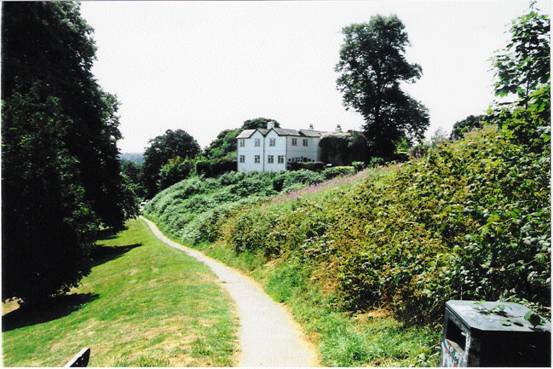
Image: Tunbridge Wells Common. Photo taken by David Enticott.

Thursday, May 04, 2006

Boreham on A First Mate

In my last article I posted the tribute I gave at the funeral of F W Boreham’s son, Frank Boreham.

In this article I present excerpts from the tribute I gave at the funeral of Betty, Frank junior’s wife (who died in 2003).

Betty was a woman given to hospitality, an interested listener, a person of prayer, intelligent and self-effacing. She was an avid reader and, with Frank in their latter years, a great traveler. Betty would write up their travels in her journal while Frank recorded scenes on his video camera.

These are portions of what I said at the Kew Baptist Church (the church FWB went to on his retirement and the church where Frank and Betty worshipped and served for most of their lives):

“They (Betty and Frank) were generous with what they had been given. Together they donated cabinets and memorabilia to the Armadale Church and Whitley College to further the work of Frank’s father.

They contributed to the establishment of the F W Boreham Training Centre at the ABMS in Auburn [Melbourne]. They had a world wide interest and God only knows the missionaries and Christian workers that they supported.

Betty’s generosity, her care, her hospitality, her positive attitude and her commitment to learning are all qualities that sprang from her deep faith in God.

While there are many that remember the literary contribution of her father in law, whom she admired greatly, there are very few who realize the work of Betty Boreham behind his manuscripts.

The proofs of one of the fifty-five Boreham books would arrive from the Epworth Publishing Company and in the few days that the ship was at Port Melbourne before returning to England, F W Boreham had to complete the proof reading. Who did he call? This author relied so many times on the services of Betty who with her eagle eye was sharp and thorough.

He so much appreciated this work she did. For me this typified the contribution that Betty made in life. Not centre of stage, her work was largely unsung yet her contribution behind the scenes was absolutely essential.

Dr Boreham entitled one of his essays to The First Mate as distinct from the skippers and the captains who usually win the accolades. In this essay in which he writes about the people who helped writers and politicians he concludes with these words:

“One of these days the worth of the world's workers will be justly and accurately assessed. It will be a day of the most startling and sensational surprises; and not least among its astonishments will be the disclosure of the immensity of the debt that the world owes to its first mates.”

On that day the full disclosure of Betty’s service will be revealed and we shall understand more fully the immensity of the gift that Betty has been to us and we shall be truly thankful!”

Geoff Pound

Image: The Kew Baptist Church in Highbury Grove, Melbourne. I am disappointed that I do not have a photo of Betty.

Tuesday, May 02, 2006

Boreham and Son

In his auto-biography, F W Boreham quotes Mark Twain when saying, that people should be careful in the choice of their parents! With this in mind I write a commendation of Frank Boreham junior, in the choice of his parents, F W and Stella Boreham.

The following is the eulogy that I gave at the funeral of Frank Boreham junior in 2001.

I wonder what things surface in your mind as you ponder today, the life of Frank Boreham? Hasn’t it warmed our hearts to recall the pleasure Frank gained through sport, film and collecting, his record in commerce, his contribution to business, his faithful commitment to the church and his devotion to his family?

I find it hard to think of Frank without thinking of Betty [his wife], because didn’t they do so much together? They enjoyed their own space and they cultivated their own interests but they extended hospitality together, they initiated social gatherings together, they coordinated holidays with friends together, they traveled with this wide eyed interest in the world together and they delighted in telling their stories together on their return.

They often invited me to their home at the Templestowe Orchards and over these times I came to know Frank as a fascinating storyteller, a person with a keen wit and a thoughtful friend.

Frank and Betty inspired me because even in their seventies they were galavanting around the world and they had this unquenchable thirst to drink in beauty, to appreciate wonder and to keep on being people who were forever learning and always growing. I found this most impressive!

For Frank and Betty their friendship with God was something that flowed naturally out of who they were. I loved the way that at lunch Frank would invariably give the same grace. A prayer that his father had often always prayed. I wonder if you know it?

Back of the loaf is the snowy flour,
And back of the flour is the mill,
And back of the mill is the wheat and the shower,
And the sun, and the Father’s will.
For mill and flour,
And sun and shower,
We give You thanks, O Lord. Amen.

This personal faith that Frank and Betty possessed was fleshed out in so many ways, not the least in their gift of time and friendship and resources. They demonstrated a breadth of concern. They gave generously to Whitley, the Baptist College, the Australian Baptist Missionary Society and other groups that trained people for Christian ministry in this land and overseas.

Having the Boreham name was to Frank a privilege and a responsibility although it wasn’t until later in life that he came to realize how famous his father had become through authoring more than 50 books, writing weekly editorials for the Otago Daily Times, the Hobart Mercury and The Melbourne Age for more than 50 years and as a much loved pastor and international speaker.

Because his father had this insatiable itch to write, there’s a lot that we know about Frank’s childhood. In fact on the day of his birth F W Boreham started a journal for young Frank that he kept going for his son for 16 years!

On the first day he tells with a great flourish of Frank’s birth in Hobart. Later he writes about the name they gave him. After several months he writes about changing his name to Francis Randolph after FW’s close friend in Christchurch.

There’s the record of holidays in the Dandenongs and playing cricket in Munro Street, Armadale, outside the family home.

While generally reserved about inserting personal and family details in his books there are several instances when Dr Boreham breaks his own rules and writes about looking up at the sky with Frank to view the shape and movement of the clouds.

On another occasion he writes about being with his young son sitting out under the inky sky and watching the stars with wonder. What a great friendship they enjoyed.

In Dr Boreham’s journal that records the last and difficult decade of his life, amid the entries that report the visit to the Boreham home of such famous people as Rita Snowden, Leslie Weatherhead and Billy Graham there are so many notes that read:

“Frank and Betty visited” or “Frank drove me to the doctor” or “Frank helped me with my tax return” and “Frank and Betty had us around for a meal” or “Frank came to get the possum out of our roof!” This last episode goes on for several weeks!

There are so many glimpses of Frank’s practical and unstinting devotion to his frail parents, a commitment that we’ve seen mirrored in Frank’s decision to take Betty to a warmer climate [Cairns, Queensland] to enjoy a better quality of life.

Earlier this morning we laid Frank to rest in the Boroondara soil and we have no need to fear. Many times, I have walked through that cemetery with Frank in search of the family grave and very calmly Frank would point to his own plot and he had a quiet peace about the inevitable. Frank Boreham was not afraid to die!

In fact he often expressed with amusement that in the 1950’s after his sister was buried there his parents would regularly take a picnic and enjoy it in the cemetery! Picnicking in the cemetery! It may sound rather macabre but the people who know that death is not a dead end can even turn a cemetery into a place of celebration!

There are very few people who have a newspaper editorial written about their birth and still fewer whose advent is written up in a book.

Listen to F W Boreham as in his autobiography he sets the scene:

“We had to wait nearly twenty years for a boy. I myself had long abandoned all thought of such a possibility; my wife, on the contrary, never for a moment wavered in her confidence that he would arrive in due course. All through the years she was constantly telling me of the things she would do ‘when our boy comes.’ He arrived just before the outbreak of war in 1914.”
F W Boreham, My Pilgrimage, p191.

Sense the exuberance with which Frank’s father records the actual event:
It’s a boy!’ The thing seemed incredible. Nobody knew what to make of it. We had
spent nearly twenty years on the cultivation of a choice little garden of girls.
But a boy! Who could have dreamed of such an astounding and sensational
development?


I was away at a committee meeting when this bolt fell from the blue. The
doctor’s car gave me the first hint of the excitement awaiting me. A feminine
form was waiting at the gate.


It’s a boy!’ she exclaimed, in breathless amazement.


It’s a boy!’ I was informed by a second emissary when half way up the path.
And, at the top of the steps, stood the nurse in consultation with the doctor,
who was just taking his departure.

It’s a boy!’ they exclaimed simultaneously, on catching sight of me. It is
with unusual confidence, therefore, that I approach my first theme in this new
volume.”
The Fiery Crags, p1.


Friends, if we can understand this earthly father’s longing for a son and if we can appreciate the sheer exuberance that was there at his birth then is it not too hard to believe the Bible when it speaks of heaven as a home and these words of Jesus?

“In my Father’s house are many rooms…And if I go and prepare a place for you I will come again and will take you to myself, so that where I am, there you may be also.”

The longing, the expectation and the love that welcomed Frank Boreham into the world is wonderful but it’s a pale shadow of the longing, the expectation and the sheer delight that has welcomed him at his death.

This is the good news that we celebrate for Frank today. This is the Gospel truth for all who believe—Heaven awaits us! There’s a right royal welcome prepared for us! Thanks be to God!

Geoff Pound

Image: Three generations. F W Boreham with son, Frank and his son Howard (outside FW's home in Kew, Melbourne).

Monday, May 01, 2006

Boreham's Grace

I found it useful listening to members of F W Boreham’s family in picking up scores of snippets about the old man’s life. At my first of many meals with Frank and Betty Boreham (FWB’s son and daughter-in-law) I discovered the prayer that F W Boreham used before meals.

Frank, his son, knew it by heart and invariably prayed this when we dined together at their home. It is sometimes called ‘The Miller’s Prayer’. I wonder if you know it?

Back of the loaf is the snowy flour,
And back of the flour is the mill,
And back of the mill is the wheat and the shower,
And the sun, and the
Father’s will.
For mill and flour,
And sun and shower,
We give You
thanks, O Lord. Amen.


This prayer was written by Maltie Davenport Babcock, who was an author ('Thoughts for Everyday Living', 1901) and a song writer (he wrote ‘This is my father’s world’).

F W Boreham refers to Babcock's grace in an essay and says that he first heard it at a New Zealand farmhouse in his Mosgiel days (F W Boreham, 'I Forgot To Say', 175).

You can find it (or at least the first verse) on many web sites that list Graces. If you want to learn to sing it the music can be found at the following Internet address:
http://gsong.ms11.net/Graces/words/bkbreadb.html

It is a grace of thanksgiving. It is a prayer that opens our eyes to all that is behind the supermarket shelves… the flour, the mill, the wheat, the rain, the sun. This verse gets us right back to the basics, even to recognizing the hand of our Creator and Provider.

Geoff Pound

Image: F W Boreham (front left), with his wife (holding down her hat in the wind), their first daughter and a couple of friends around a well. Location? Somewhere near Mosgiel, New Zealand. Date? About 1896.

Sunday, April 30, 2006

Boreham the Editorialist

Editorial Record
On 3 September 1949 readers of the leading daily paper in Hobart, Tasmania, were informed of a remarkable achievement that, “for about 37 years the scholarly editorials of Dr F W Boreham—the one published on this page today is the 2000th—have been a widely read feature of the Mercury each Saturday”.[1] The article highlighted the fact that the long series of editorials by Boreham had commenced “as a stop-gap arrangement” when the then editor died and had continued following the appointment of a new editor. When F W Boreham left Hobart in 1916 for Melbourne, he undertook to send editorials until his successor was appointed. However, the anniversary article reported, that “in the absence of such an appointment the matter has rested on that basis for 33 years”.

From 1934 until 1943, Boreham added to his responsibilities when he wrote two editorials (usually Easter and Christmas) each year for the Melbourne Argus.[2] In 1936, he commenced submitting fortnightly essays to the Literary Supplement of the Age. His writing responsibilities were extended further when in 1945, at the age of seventy-four, Boreham accepted the invitation to write weekly lead editorials for the Age. These essays and editorials to Melbourne’s major daily did not represent entirely new work for Boreham was an unashamed recycler of words and stories.[3] Boreham furnished the Mercury and the Age with weekly editorials until two weeks before his death on 18 May 1959. On the way to the Royal Melbourne Hospital Boreham handed his son a bundle of editorials which supplied the papers with weekly editorials for several months following his hospitalization and death.[4]

I was inspired by F W Boreham’s role and record as a writer for newspapers. That is why I wrote a dissertation focusing on this important part of his ministry. In my thesis I examined the almost 3,000 editorials that Boreham wrote for the Mercury and the Age between 1912 and 1959. The thesis explored the content of the editorials, identified the major themes and tried to elucidate his motivation for writing. These were some of the questions that tantalized me:

Motivation?
Why did Boreham write? What constrained his writing vocation that commenced earlier than his preaching career and continued for several years after his retirement from the pulpit? Several times in jest, Boreham spoke of his “incontinent pen”.[5] Could he not help himself? Was he motivated by a sense of self-aggrandizement and a lust to see himself in print? Did he see himself as educator or entertainer? Did he regard writing as an essential part of his vocation and the outworking of his ordination to the Christian ministry? Was Boreham following a brief established and regulated by the editors of the newspapers or did he enjoy an unshackled literary freedom?

Relationship to Other Genre?
In writing about Boreham’s published essays, Dr Ian McLaren has concluded that “most originated as sermons to responsive congregations”.[6] Similarly, what evidence is there to reveal the starting point and stimulus for Boreham’s editorial writing? Did the regular discipline of sermon writing fuel the weekly editorials or vice-versa?

When in 1954 Boreham received the Order of the British Empire, the citation that accompanied the award read, “In recognition of his distinguished services to religion and literature as preacher and essayist”.[7] This honour suggests a tantalising connection between Boreham’s primary contributions. I have tried to illumine the relationship between the sermons and essays published in Boreham’s books and his newspaper editorials. I looked for clues concerning the methods Boreham adopted in composing material that was used in these different formats.

Style?
As Boreham wrote in the various capacities of journalist, preacher, politician, lecturer, editor, biographer, autobiographer, diarist, poet[8], hymnist[9] and letter writer in addition to essayist, it is good to attempt to distil the essential Boreham literary style and, in particular, the style he adopted in the writing of newspaper editorials.

Recognising Alexander Pope’s expectation, “How the wit brightens. How the style refines”, it is important to mark the development of Boreham’s written style.[10] Boreham often wrote as a literary critic, so what clues can we find as to what he perceived to be an excellent writing style? Who are the writers that Boreham judged to be worthy of emulation and how did they shape his literary style?

Connection with Faith?
The heart of the dissertation focuses on the interplay of faith and life in Boreham’s newspaper editorials. Recognizing that he was a Baptist preacher at the same time as an editorialist, it is intriguing to explore the extent to which Boreham’s articles offer a faith or religious perspective to the readers of the newspaper in a similar way that he did in his sermons and books. Did Boreham consider it appropriate to use his columns to preach and persuade his readers to turn to God and accept spiritual truths?

Who Was His Audience?
A distinctive aspect of Boreham’s editorial writing was the audience that he was seeking to address. His published books and his submissions to Christian magazines and papers could be seen as preaching to the converted. In contrast, however, Boreham’s contributions to the Mercury and the Age were geared to a general readership. In these editorials he had in mind the thousands of people in Tasmania and Victoria who would pick up or have delivered the paper on a Saturday morning.[11] Boreham was greatly aware of the privilege and importance of his role as leader writer and in 1949, concerning his association with the Mercury, he said he was, “Unconscionably proud of the fact that, in 37 years, no article has ever been returned to him and, as far as he knows, no article has ever been altered”.[12]

In the current climate, when there are repeated calls for theology to be worked out and heard afresh in the public sphere, Boreham’s weekly editorials for the readers of two leading Australian newspapers over forty-seven years, make them worthy of attention.

Geoff Pound

Image: A page from the Hobart Mercury.

[1] F W Boreham, Mercury, 3 September 1949. The newspaper editorials are not attributed but for the purposes of this study Boreham is cited as the author of the text.
[2] The Argus was launched in 1846 (eight years before the Age commenced) and it folded in 1957. At the time when Boreham wrote occasional articles for the Argus, it was one of three morning dailies in Melbourne. Boreham wrote a total of fifteen editorials for the Argus.
[3] For further information see L L Newnham, 'Recycling by Dr F W Boreham', Our yesterdays 5 (1997): 70-79.
[4] Frank R Boreham, interview by author, Templestowe, Vic., 26 July 1996. Also C Irving Benson, ‘Dr Frank W Boreham- The man and the writer’, in F W Boreham, The last milestone (London: The Epworth Press, 1961), 10.
[5] F W Boreham, The passing of John Broadbanks (London: The Epworth Press, 1936), 7.
[6] ADB, s.v. “F W Boreham.”
[7] This medal and citation is on display at the F W Boreham Mission Training Centre, Australian Baptist Missionary Society Headquarters, Auburn, Vic.
[8] Poems written for friends and family members appear in Boreham’s personal papers, F W Boreham Collection, Whitley College Library. A patriotic poem written at the British victory in Mafeking appears in T Howard Crago, The story of F W Boreham (London: Marshall, Morgan & Scott, 1961), 86-87.
[9] Crago recalls that Boreham often wrote hymns for services at Mosgiel and Hobart in Crago, The story of F W Boreham, 190. The only published hymn that Boreham wrote is the baptismal hymn, Eternal Father, whose great love, No. 288 in The Baptist hymn book, H Martin, et al, ed., (London: Psalms and Hymns Trust, 1962), 359.
[10] Alexander Pope, An essay on criticism, l. 51.
[11] Most of Boreham’s editorials were written to be printed on a Saturday morning, apart from contributions he was asked to write for special editions geared to ‘red letter’ days such as Anzac Day, Easter or Christmas.
[12] Boreham, Mercury, 3 September 1949.