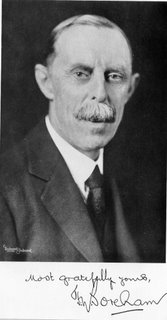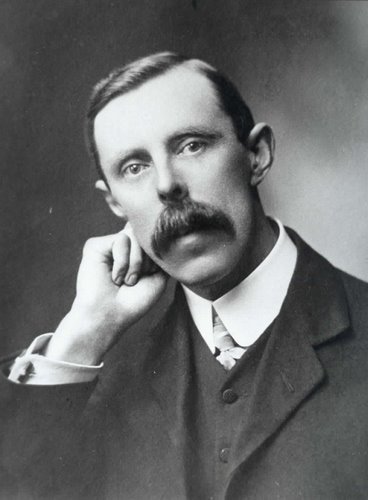
Frank William Boreham 1871-1959

Frank William Boreham 1871-1959
A photo F W Boreham took of himself in 1911

Saturday, November 11, 2006

Boreham on the British Empire

Lover of Empire
From F W Boreham’s first editorial for the Otago Daily Times, the subject of the British Empire was a constant theme throughout his editorial writings. Still expressing his fascination for the Empire in 1944, Boreham said, “Its history is, far and away, the most stately romance that has ever been written. There is nothing in legend or fable to compare with it”.[1]

Boreham’s annual editorial on Empire Day (celebrated in Australia on 24 May from 1905 to the late 1950s) gave him the chance to tell the story of Empire, to arouse readers’ appreciation and to stir aspirations about the Empire’s future. One can sense his deep feelings for the subject in the following words:

“We speak of the Empire, and, as those two glowing syllables fall from our lips, we discover that they throb with a magic peculiarly their own. They spread before the mind a broad canvas of vivid and variegated hues. These are words in our vocabulary that mean very much more than any dictionary would suggest. Such words represent fossilised poetry, petrified history, embalmed romances. All the ages have left the record of their tears and their laughter, their virtues and their vices, their passion and their pain in the words that they have coined. Among these archives of articulation no word is more rich in encrusted tradition and glittering association than the word that falls so musically and so majestically upon our ears on May 24.”[2]

British Uniqueness
Beyond sentiment, Boreham often expressed the uniqueness of the British Empire in its ability to “evoke deep-seated affection of heterogeneous citizens”.[3] It epitomized for him democracy at work as Great Britain brought together a united commonwealth of free and equal nations. Since the time that Empire Day had been established in Australia there was a minority who opposed the concept, including the editor of the Bulletin, who called it ‘Vampire Day’ and “the feast day of St Jingo”.[4] The vast majority of Australians who supported the commitment to the Empire recognised the strong ties of blood, language, history, culture and the practical link in trade.

Writing about the first Empire Day celebrations in 1905, Gavin Souter discerned that Australians had a dual perception, believing that “to praise the whole was automatically to praise the part” and not result in any diminution of the young nation.[5] Being part of the Empire also “conferred on Australians a role and significance in the world which they could not otherwise hope to attain”.[6] When some in 1914 were casting doubts on the viability and worth of the Empire, Boreham exclaimed, “To say that the British Empire has had its day is nonsense”.[7] Gibbon had taught him that what fostered the growing affection for the motherland was that in contrast to other empires that had “looted” new territories “like vampires”,[8] the British Empire had operated by the opposite principle. According to Boreham, Great Britain “has given of her best to her dependencies, and has, in the process, bound them to herself with hoops of steel”.[9] Boreham’s Empire was “not bound by red tape”[10] but by “deep affection” forged through “moral ties”.[11]

Contribution of Empire
Boreham recognized that the greatest contribution of the Empire was in its inculcation of values that had the potential to transform colonial cultures and penetrate even the remote parts of the commonwealth.[12] These values he identified as Britian’s integrity, justice, the championship of freedom, honesty in dealing with national rulers[13] and chivalry or gentlemanly spirit.[14] This attitude fostered an “attachment of people of the same stock, thinking the same thoughts, cherishing the same ideals”,[15] an approach that was vindicated, Boreham believed, in the affectionate way in which colonies regarded Great Britain. At its worst, this belief in British cultural superiority bolstered the country’s White Australia policy (1901) and with it discrimination towards Asians and aborigines.[16]

Empire During War
Imperial sympathy became most apparent during the struggle of international wars. During the Second World War, Boreham predicted the future role of the British Empire when he stated, “The guardianship of the world’s peace, must, after the war, become the supreme responsibility of the British people”.[17] Writing from Australia in 1949, Boreham said, “Never since English history began has so much affection and so much sympathy been felt for England on this side of the world”.[18]

Empire Excelling
Noting that explorers such as Captain Cook had been motivated by a love of empire, Boreham wrote that British and Australian conquests in exploration[19] and sport[20] were major peacetime methods of fostering the imperial spirit. To this end, Boreham expressed the hope in 1921, 1937 and 1947 that Mount Everest would be first climbed by a “British conqueror”[21] and writing about the link between citizenship and sport he stated, “Nothing is more to be desired than that the British peoples may continue to lead the world in the quality and the purity of their sport”.[22]

Resilience of British Throne
Boreham considered the British monarchy to be the heart and embodiment of the British Empire. His recognition in 1935 that the number of thrones that had been overturned within the lifetime of the current generation led him to conclude that “monarchy, as an abstract principle, is passing through difficult and trying days”.[23] The unique thing that explained the resilience of the British throne and the affection throughout the empire was, in Boreham’s estimation, the “personal excellence” of the monarch and the royal family. Boreham’s understanding of history led him to recall that when Queen Victoria commenced her reign there were calls for the throne to become vacant and obituaries were published announcing the death of the British monarchy. However, her influence raised the prestige of royalty and “the attractive life of Queen Victoria elevated the social conditions of the entire British people”.[24] Assessing Victoria’s personal influence Boreham continued, “She saved not only the Throne but the Empire itself”. In 1935, Boreham wrote that “King Edward and King George have splendidly maintained the shining tradition established by that noble lady” and that the interest of people in the Royal family augured well for the “happy state of things for many a long day to come”.[25] While Boreham’s descriptions of the royal visits were full of superlatives, more recent writers have detected little sign of the diminution of ‘royal worship’. Reading the accounts of the royal visits of 1920 and 1934-35, historian Michael Davie says they are written in “the tone … of breathless admiration and shameless sentimentality”.[26]

Cashing the Check
Boreham drew a distinction between the possession of the Empire and the creation of an imperial spirit, saying that such an inheritance needed to be cashed like a cheque.[27] He, therefore, encouraged the observation of Empire Day, Empire Youth Sunday, royal birthdays, anniversaries and royal visits as key occasions for expressing appreciation and arousing aspirations for the Empire and the monarchy. Boreham wrote about the importance of flags,[28] statues[29] and music[30] in awakening memories and stirring a reverential allegiance toward the monarchy.

Sway of the Crown
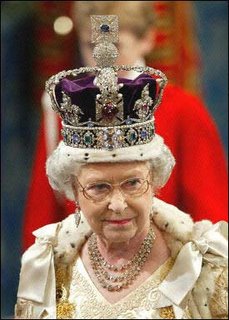
In writing about the changing role of the British monarchy, Boreham observed a gradual development of its influence and rule throughout the centuries. Despite the monarch’s decreasing involvement in the political processes of Britain and the Empire, in 1935 Boreham rejected Emerson’s simile about being “as impotent as a British monarch” saying “nothing was further from the truth”.[31] On the occasion of the visit of Queen Elizabeth II and Prince Philip to Tasmania in 1954, Boreham declared “that the sway of the Crown is today immensely more potent and more impressive than in the days when our sovereign assumed despotic and dictatorial prerogatives”.[32] Throughout his lifetime Boreham perceived an increase in affection between Australians and the royal family and regularly stated that “the Crown is never more popular than today”.[33]

Aussie Shifts
The shift in Australian’s relationship to the British Empire was apparent at the New South Wales Conference of the Labor Party in 1931 when the Education Committee recommended that Empire Day no longer be observed in the schools of NSW, the weekly ceremony of flag saluting be discontinued and the Imperialist bias be removed from school textbooks.[34] Although the acquisition of new territories in the first part of the twentieth century was slower than in the second half of the nineteenth century, Boreham did not concede that the British Empire was in decline.

Declining Empire
When after the Second World War there was a redefinition of the status of Britain’s dominions, a disintegration of a common foreign policy within the Commonwealth and independence declared by India, Ceylon and Burma, Boreham did not interpret these events as an erosion of British influence. In the 1950s, the rush towards independence by the many remaining British colonies in Africa, Asia, the Caribbean and the Mediterranean coincided with the conclusion of Boreham’s editorial career. He neither discussed these issues nor reported on a waning of the imperial spirit. One would suspect that Boreham found it hard to accept that the British Empire was in decline.

Geoff Pound

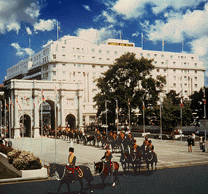
Image: 'Sway of the crown...'

[1] Boreham, Mercury, 2 September 1944.
[2] Boreham, Mercury, 20 May 1944; Age, 24 May 1947.
[3] Boreham, Mercury, 24 May 1952.
[4] A G Stephens, ‘Empire Day’, Bulletin, 18 May 1905.
[5] Gavin Souter, Lion and kangaroo: The initiation of Australia, rev. ed. (Melbourne: The Text Publishing Company, 2000), 129.
[6] Souter, Lion and kangaroo, 3.
[7] Boreham, Mercury, 17 February 1914.
[8] Boreham, Mercury, 21 May 1921.
[9] Boreham, Mercury, 20 May 1944; Age, 24 May 1947.
[10] Boreham, Mercury, 20 May 1916.
[11] Boreham, Mercury, 19 September 1914.
[12] Boreham, Mercury, 20 February 1954.
[13] Boreham, Mercury, 19 September 1914.
[14] Boreham, Mercury, 30 June 1928.
[15] Boreham, Mercury, 19 May 1928.
[16] Notions of citizenship were formed on the view of Australians as being British subjects. Asians and aborigines were excluded from voting by the 1901 constitution and excluded from the 1903 Naturalisation Act.
[17] Boreham, Mercury, 20 May 1944.
[18] Boreham, Mercury, 23 April 1949.
[19] Boreham, Mercury, 12 March 1921.
[20] Boreham, Mercury, 4 November 1919.
[21] Boreham, Mercury, 12 March 1921; Mercury, 5 November 1938; Age, 1 November 1947.
[22] Boreham, Mercury, 4 November 1919.
[23] Boreham, Mercury, 11 May 1935.
[24] Boreham, Mercury, 19 June 1937.
[25] Boreham, Mercury, 11 May 1935.
[26] Michael Davie, Anglo-Australian attitudes (London: Secker & Warburg, 2000), 92-93.
[27] Boreham, Mercury, 20 May 1916.
[28] Boreham, Mercury, 21 May 1921.
[29] Boreham, Mercury, 14 May 1921.
[30] Boreham, Mercury, 7 December 1940; Age, 17 May 1947.
[31] Boreham, Mercury, 4 May 1935.
[32] Boreham, Mercury, 20 February 1954.
[33] Boreham, Mercury, 2 June 1928; Mercury, 11 May 1935.
[34] Clark, A history of Australia vol. vi, 373; Sydney Morning Herald, 4, 6, 7 April 1931.

Friday, November 10, 2006

Boreham Remembering Special Days

Observer of Days
F W Boreham was attentive to special anniver-saries and was an avid 'observer of days'. Any ordinary event he liked to attach to some anniversary of significance. In this vein, he commences his autobiography:

"Salvoes of artillery and peals of beals echoed across Europe on the morning of my birth.... I discovered afterwards... that my advent synchronized exactly with the dramatic termination of the Franco-Prussian War. On Friday March 3, 1871, an hour before my arrival, the Prussian troops that had held Paris in a cruel strangle-hold commenced the evacuation of the capital."

Each year in his editorial columns he always included fresh ideas on regular anniversaries. One of these he addressed each year was Christmas.

Everybody’s Day
While Dr Boreham often compared the festivities of Christmas in England with the celebrations in Australia,[1] he also emphasized the universality of this anniversary when describing Christmas as “everybody’s day”.[2]

He was conscious of the breadth of religious affiliation among his readers and he highlighted the inclusive nature of Christmas with its independence of geography,[3] its cosmopolitan attraction in drawing together “men and women of all kinds, classes and conditions”[4] and its childlike simplicity and profundity as the baby “expresses the unexpressable and utters the unutterable”.[5]

Queen of Feasts
On this anniversary, described by Boreham as “the queen of feasts [and] festival of festivals”,[6] Christmas provided the occasion “for the forgetting of old feuds and grudges, [and] for the exercise of benevolence, sympathy, consideration and goodwill”.[7] Boreham named Christmas the “changeless festival”[8] whose reminder became especially important to him during years of war when readers could experience both the incongruity and comfort of “pealing bells and bursting shells”.[9]

Geoff Pound

Image: A symbol of Remembrance Day, 11 November.

[1] F W Boreham, Mercury, 17 December 1927.
[2] Boreham, Age, 21 December 1946; Argus, 24 December 1935.
[3] Boreham, Mercury, 24 December 1941.
[4] Boreham, Mercury, 22 December 1945.
[5] Boreham, Mercury, 23 December 1950.
[6] Boreham, Mercury, 23 December 1944.
[7] Boreham, Mercury, 23 December 1950.
[8] Boreham, Mercury, 24 December 1938.
[9] Boreham, Mercury, 25 December 1939.

Thursday, November 09, 2006

Boreham on Anniversaries

Retaining the Nuggets
F W Boreham’s repeated his plea to his readers to celebrate their national achievements as a sign of Australia’s growth in nationhood. This patriotic call was a strand within a larger theme in which Boreham viewed the observation of anniversaries as a collective savoring of the lessons of history and opportunities to imbibe corporately the values that such occasions marked.

“Memory is like a sieve,” he said, “and we need to let through the sand and retain the nuggets”.[1]

Communal Remembering
Boreham had a fondness for celebrating his personal anniversaries and a large proportion of his editorials were suggested by a particular one.[2] Certain editorials (including Christmas, Easter, Old Year and New Year) were designed to foster a common remembering (national and international) and to appeal to a basic human longing.

Boreham said such remembering on these anniversaries was contagious, spreading an “infection of festivity” because “we are gregarious creatures ... [with an] instinct to festivity”.[3] This next section looks at two representative types of editorials: Remembrance Days and the religious festival of Christmas.

Geoff Pound

Image: 'Memory is like a sieve'..

[1] F W Boreham, Mercury, 20 April 1935.
[2] Boreham, The silver shadow, 246. In this example, Boreham wrote about celebrating the anniversary of his ordination.
[3] Boreham, Mercury, 27 December 1919.

Wednesday, November 08, 2006

Boreham on Coincidence (9)

This is the ninth and final instalment in a series by F W Boreham from his essay The Long Arm of Coin-cidence, soon to be included in the forth-coming book, The Best Essays of F W Boreham.

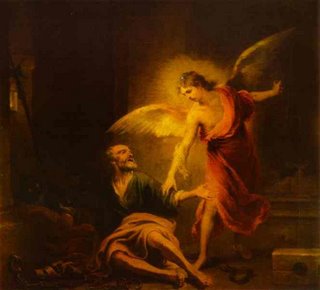
And there is a third class of coincidences. Here, for example, are a number of people gathered together in the house of John Mark in Jerusalem. Peter is in prison and these good men and women have met to pray for him. And, whilst they pray, a great light illumines the darkness of the dungeon. Angels appear: chains fall: gates fly open: Peter escapes!

Every person of any spiritual experience at all has met with such coincidences. One has prayed and things have happened. One has been profoundly moved to write a certain letter or to pay a certain visit. The letter or the visit proved to be the very thing that the grateful recipient most sorely needed. Or one has been perplexed; has sought guidance; and, 'o'er moor and fen, o'er crag and torrent', the Kindly Light has led in the most wonderful way. When we approach these sublime coincidences, we shed our sense of surprise and yield instead to adoration. We feel that we are merely beholding, on the most exalted plane, the operation of the law of cause and effect. The forces at work in producing the coinciding factors are so obvious that we no longer consider the resultant coincidences as coincidences at all.

F W Boreham, ‘The Long Arm of Coincidence’, I Forgot to Say (London: The Epworth Press, 1939), 87-96.

Image: Peter's escape from prison.

Tuesday, November 07, 2006

Boreham on Coincidence (8)

This is the eighth in a series by F W Boreham from his essay The Long Arm of Coincidence, soon to be included in the forthcoming book, The Best Essays of F W Boreham.

A pair of nuns had glided silently up the Cathedral aisles, and, the movements of the elder of the two having been arrested by a question from an attendant, the younger moved slowly on and was waiting for her companion at a spot close to Lucy's elbow.

`You are interested in Saint Teresa?' asked the young nun, in slightly foreign but strangely musical accents.

`I was wondering why she is represented as carrying flowers,' Lucy replied with diffidence.

`Saint Teresa loved flowers—roses particularly', explained the pale-faced nun. `She planted red roses all round the grounds of her Convent at Avila, and, whenever she desired to bestow any signal favour upon any of her young nuns, she invariably accompanied it with the gift of a red rose.'

By this time the elder nun had approached, and, with the softest suspicion of a smile, the pair moved on, leaving Lucy alone with the statue.

`Oh, Santa Teresa' Lucy sighed rather than prayed, for she remained standing and open-eyed, `oh, Santa Teresa, the condition of my dear, dear mother must be known to thee. If only thou could'st send me a red rose to tell me of her blessedness! If only thou could'st-and would'st!'

That afternoon, in Melbourne, Beryl was writing to her friend. Lucy was not to worry, Beryl said, everything at the shop was going well. `Make the most of your holiday; stay as long as you can; and come back all smiles.' She was just about to seal the letter when her eye fell upon the vase of flowers with which she had decorated her desk. Almost mechanically she took a small red rose, pressed it, folded it in tissue paper and slipped it into the envelope.

And when, next day, Lucy opened the letter, she was unable to read it. At sight of the red rose, she sobbed as though her heart would break. But her tears were tears of joy and gratitude. And from that moment she never grieved again.

Was it purely a coincidence purely a coincidence? Was it? I wonder! Who shall say?

(To be continued)

Source: F W Boreham, ‘The Long Arm of Coincidence’, I Forgot to Say (London: The Epworth Press, 1939), 87-96.

Image: 'An armful of flowers'.

Boreham on Coincidence (7)

This is the seventh in a series by F W Boreham from his essay The Long Arm of Coin-cidence, soon to be included in the forth-coming book, The Best Essays of F W Boreham.
After describing several coincidences and offering some reflections F W Boreham describes another amazing coincidence:

Only last night I came upon a set of circumstances so arresting and so intriguing that, for the life of me, I cannot with confidence declare that they do, or do not, represent anything more than a very remarkable coincidence.

I number among my friends two young ladies—Beryl Hamilton and Lucy Minogue—who, as partners, control one of those attractive businesses whose windows and counters are tastefully adorned with high-class bric-รก-brac—artistic pottery, pretty paintings, dainty calendars, busts, plaques, statuettes, and the like. Beryl is a Protestant, Lucy a Catholic. Both are transparently sincere, and each is the soul of courtesy and consideration in her attitude towards the faith of the other.

Some time ago, Lucy's mother, a widow, to whom she was passionately devoted, suddenly died. The cruel shock and the desolating loss shattered the daughter's nerve. Night and day, she could think of nothing but her dead mother. Where was she? Would they ever meet again and be to each other what they had been in the old days? And, above all, was her mother happy? The sacraments of her Church comforted her, but they gave her no solid satisfaction on this point. Was her mother happy? How could she ascertain? The terrible uncertainty, preying constantly upon her mind, affected her health; and Beryl, her partner, urged her to take a good rest with an entire change of scene.

`Why not go to Sydney?' Beryl pleaded. `A quiet spot in the country or beside the sea might give you too much time to brood. But Sydney is a lovely place for a holiday. You will have the city to distract your thoughts when you desire that kind of relaxation, and, whenever you feel inclined for the beach or the bush, you can find a new excursion every day. It will do you heaps of good. And I'll be quite all right here. It's the slack season, and either of us could easily be spared.'

Infected by Beryl's enthusiasm, Lucy agreed to do so. And it was during that visit to Sydney that she encountered the experience of which I am about to tell.

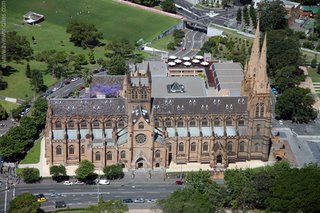
She thoroughly enjoyed her stay and was particularly appreciative of the good sense displayed by her partner in suggesting the venue of her holiday. Beneath all her pleasure, however, she was subconsciously aware of the old deep undertone of terrible loneliness and insatiable longing. If only she knew—knew for certain—that all was well with her mother! Impelled by some such mood, she one afternoon turned from the bustle of the city to rest quietly for a while amidst the green lawns and gushing fountains and colourful flower-beds of Hyde Park. Seated there, her eye carne to rest on the graceful turrets and Gothic stateliness of St. Mary's Cathedral. As though magnetized by its solemn splendour, she rose and turned her footsteps towards it.

In wandering aimlessly but meditatively about the Cathedral, she felt herself drawn—she scarcely knew why—towards a small statue of Santa Teresa. It instantly brought to mind the lovely stories that her mother had told her. Her mother always spoke of Santa Teresa as the most human, the most understanding, the most womanly of saints—a saint who radiated sympathy and courage and common sense. She used to tell Lucy of Teresa's fondness, as an old woman, for the young nuns under her charge and of her anxiety that they should all be perfectly happy. Lucy had never before seen a representation of Santa Teresa; but now that she looked into her sculptured face, she felt that there was something singularly winsome and kindly in her countenance. Teresa was represented, in the statue, as carrying a cross and an armful of roses. Why the flowers? Lucy wondered.

(Story to be continued)

Source: F W Boreham, ‘The Long Arm of Coincidence’, I Forgot to Say (London: The Epworth Press, 1939), 87-96.

Image: St. Mary's Cathedral, Sydney

Boreham on Coincidence (6)

This is the sixth in a series by F W Boreham from his essay The Long Arm of Coincidence, soon to be included in the forthcoming book, The Best Essays of F W Boreham. After describing several coincidences from different chapters of his life he gives some reflections before he describes a few more:
Confronted by Mystery
Any person who cares to ransack the pigeon-holes of their memory will find a wealthy hoard of such recollections stowed away there. They teach us charity. For, obviously, it does not follow, because several circumstances happen to point steadily in one direction, that the conclusion suggested by their unanimity is necessarily established. What seems like corroboration may be pure coincidence. And surely they make faith less difficult. For if, among the ordinary odds and ends of life, we find ourselves confronted by situations so remarkable as to be almost incredible, it is by no means surprising that, in a more august and mysterious realm, we sometimes find ourselves out of our depth.

More than Mere Coincidence
I turn from these coincidences, which are pure coincidences, to those remarkable happenings, familiar to us all, beneath the surface of which we seem to sense something that is more than mere coincidence. How often, in walking down the street, you find your thoughts suddenly and irresistibly reverting to the memory of a friend whom you have not seen for months, perhaps for years. Within five minutes you turn a corner and meet him face to face! It is easy to wave such incidents aside with an airy reference to telepathy. That blessed word `telepathy' is a hot rival to that blessed word `Mesopotamia'. What is telepathy?

And then again, the confident conclusions of the spiritualists can only be met by a frank recognition of the fact that, behind the forces that Science has investigated and classified, there are other forces, shadowy and elusive, that, so far, we have only vaguely sensed.

More than We Can Dream
I am intimate with a family—devoutly Christian and by no means superstitious—in whose home a thing occurred one evening that set every member of the household thinking of a very dear relative on the other side of the world. At the very hour of that singular happening, that relative died. Since scores of people die in England every day to whose kinsfolk in Australia no such mysterious intimation is vouchsafed, the episode was evidently the operation of no fixed law. It proves nothing. Yet the comparative frequency of such enigmatical incidents makes us feel with Hamlet that:

There are more things in heaven and earth, Horatio,
Than are dreamt of in your philosophy.

These evasive and abstruse events must be numbered among life's strange and striking coincidences; and yet they leave behind them an impression that, woven into the very texture of their being, there is something that lifts them above the level of mere coincidences.

(To be continued)

Source: F W Boreham, ‘The Long Arm of Coincidence’, I Forgot to Say (London: The Epworth Press, 1939), 87-96.

Image: Frank Boreham

Boreham on Coincidence (5)

This is the fifth in a series by F W Boreham from his essay The Long Arm of Coincidence, soon to be included in the forthcoming book, The Best Essays of F W Boreham.
With a number of cricket companions I was one Saturday afternoon watching the final football match of the winter. It was being played on the Melbourne Cricket Ground; but we ourselves were far less interested in the play that we were watching than in the Test Match that, in a few hours' time, was to be played at the Kennington Oval. It was the match on which the Ashes depended, and we were eagerly anticipating the ball-to-ball description to which we would be listening in the evening. During the half-time interval in the football, somebody suggested that, on the assumption that Australia batted first, we should each attempt to forecast the score at the close of the first day's play. A paper was passed round: each of us was to state a figure and initial it.

When the document fell into my hands, I noticed that the estimates of my predecessors ranged from 250 to 350 runs. I was just setting myself to frame some kind of conjecture when the absurdity of the whole thing broke upon me. We had no idea as to what the wicket was like, or the weather, or any of the conditions on which scoring depended. So, in the same impish and irresponsible mood in which I had feigned to count the sheep, I scribbled 475 and passed the paper on.

`Four hundred and seventy-five!' cried the man who had set us the grotesquely impossible task; `why, if Australia has four hundred and seventy-five runs on the board at the end of the first day's play, you'll be so excited that you'll announce hymn No. 475 instead of the proper hymn when you enter the pulpit tomorrow morning!'

To my sober judgement the figure seemed as fantastic as it did to his. But, believe it or not, 475 was the Australian score when stumps were drawn that night at the Oval; and, when I entered the vestry at Footscray next morning and the hymn list was handed to me, I discovered that the service was to commence with Glorious things of thee are spoken-No. 475!

(To be continued)

Source: F W Boreham, ‘The Long Arm of Coincidence’, I Forgot to Say (London: The Epworth Press, 1939), 87-96.

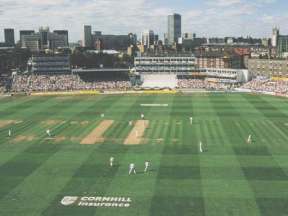
Image: Kennington Oval, where the runs were scored.

Monday, November 06, 2006

Boreham on Coincidence (4)

This is the fourth in a series by F W Boreham from his essay The Long Arm of Coincidence, soon to be included in the forthcoming book, The Best Essays of F W Boreham.

In 1936 my wife and I were occupying a room on the fourth floor of the Cumberland Hotel, facing the Marble Arch in Hyde Park, London. The Australian mail one morning brought a letter from our daughter.

`Do you know', she asked, `that Carl Fairfax is in London? I wonder if you will run across him!'

I smiled inwardly at the vast improbability, during the few days that remained to us, of our meeting this solitary Australian amidst the maze of London's millions. With the letter still in my hand I stepped out of the bedroom on to the lift. And the only person on the lift was Carl Fairfax!

(To be continued) .

Source: F W Boreham, ‘The Long Arm of Coincidence’, I Forgot to Say (London: The Epworth Press, 1939), 87-96.

Image: The Cumberland Hotel, London base for Frank and Stella's fourth coincidence.

Boreham on Coincidence (3)

This is the third in a series by F W Boreham from his essay The Long Arm of Coincid-ence, soon to be included in the forthcoming book, The Best Essays of F W Boreham.

On a beautiful summer's evening in 1924 I was enjoying, with a party of congenial friends, a delightful drive across the Devonshire moors. On the far horizon we suddenly descried a puff of dust out of which, as we drew nearer, there emerged a man with a few sheep: it must have been market-day at a nearby moorland town. As soon as we could determine the nature of the objects that had created the cloud, a mischievous mood fell upon me.

`Ah,' I observed, casually, `here comes a man with seventeen sheep!'
`Seventeen!' exclaimed my companions in astonishment. `How on earth can you count them at this distance? It is difficult to see the sheep for the dust!'

We drove on, and, in due course, met the flock. I could scarcely believe my eyes when it became clear that the sheep numbered exactly seventeen. I carried off the situation with a fine assumption of visual and mathematical superiority, deriding my companions on their pitiable blindness. But within half an hour, to my discomfiture, we made out another, and much larger, mob of sheep.

`Well,' exclaimed my friend beside me, `you were very clever in counting the animals in the first flock: how many are there in this one?' It was a case of neck or nothing and I resolved to go down with all flags flying.

`Do you mean to say', I replied, `that you really cannot count those sheep? Why, man, it's as plain as a pikestaff that there are a hundred and nineteen of them!'

Shall I ever forget the speechless stupefaction that I struggled to conceal when, on meeting the sheep, we learned from the drover that they numbered a hundred and nineteen precisely?

Source: F W Boreham, ‘The Long Arm of Coincidence’, I Forgot to Say (London: The Epworth Press, 1939), 87-96.

Image: Sheep and shepherd in Dartmoor

Boreham on Coincidence (2)

This is the second in a series of instalments by F W Boreham from his essay, 'The Long Arm of Coincidence', soon to be included in the forthcoming book, The Best Essays of F W Boreham.

Mad Dogs and Englishmen
"Or take another case. I have lived, roughly, about twenty-five thousand days. On only one of those days have I been bitten by a dog; but on that memorable day I was bitten by two. I had set out to visit a friend who lived about three miles from my own home. As I turned into his street, an infuriated dog rushed out of an open gate and savagely attacked me, fastening his teeth into my leg. Somewhat shaken, I managed to reach my friend's house, where my wound was bathed and bandaged."

'Every Dog is Allowed One Bite'
"An hour later I set out for home, and, almost within sight of it, was assailed by another dog and again bitten. Puzzled by the unwonted attention paid me that day by the canine tribe, I carefully examined everything about my person—my clothing, my walking-stick and the contents of my pockets. But everything was perfectly normal."

"People deeply versed in the mentality of dogs have suggested that the first attack had affected my nerve and that the second dog had sensed in me an attitude of apprehension and distrust which, awakening his resentment, laid me open to further victimization. I do not know. The plausible theory is sound or it is unsound. If it is sound, then the astonishing thing is that I have passed unbitten by every dog that I have since met. If it is unsound, then my brace of bites remain among life's inexplicable coincidences."

To be continued in the series of instalments on this web site entitled Boreham on Coincidence.

Source: F W Boreham, ‘The Long Arm of Coincidence’, I Forgot to Say (London: The Epworth Press, 1939), 87-96.

Image: Ferocious canine.

Sunday, November 05, 2006

Boreham on Coincidence (1)


Just By Coincidence
Do you ever think much about the coincidences that have happened in your life?

F W Boreham wrote an article about some of the amazing coincidences that happened to him and said:

Commit Coincidence to Paper
“No person should think seriously of dying until they have committed to paper a list of the most striking and extraordinary coincidences that have come under their personal observation. I do not mean those of which he has read. As I have tried to demonstrate in A Reel of Rainbow, the stately coincidences of history are tremendously impressive and dramatic. But they are common property: anyone can collate them.”

Coincidental Capital
“In the course of each person’s personal pilgrimage, however, they encounter a few combinations of circumstances so arbitrary, so fortuitous and so bewildering as to be almost freakish. Were a novelist to weave them into the web of their romance, the reviewers would charge the novelist with having transgressed all the bounds of probability. The plot would be condemned as a flagrant outrage of the literary canons. Yet these things actually happened! If each person were to recall and record such surprising experiences whilst it is still in their power to do so, some very valuable and practical purposes would be served.”

Coincidence in the Carriage
“Let me crystallize my abstract doctrine into concrete example by a few instances of the kind of thing I have in mind. I will begin with my wedding day. We were married at Kaiapoi, New Zealand, early in the morning and caught that day's express for the south. A friend, knowing of our movements, sent a congratulatory telegram to the train. The guard handed it to me—opened!
`Very sorry, sir', he murmured, `but there's another young couple of the same name in the next carriage!'”

“In view of the fact that my name is not a particularly common one, an involuntary doubt sprang to my mind; but, later on, we met our namesakes, who were most profuse in their apologies.”

If you would like to read more of this article containing Boreham’s amazing coincidences and his reflections on them, these stories will be posted on this web site over the next few days.

This entire essay will be included in the forthcoming book, The Best Essays of F W Boreham.

Source: F W Boreham, ‘The Long Arm of Coincidence’, I Forgot to Say (London: The Epworth Press, 1939), 87-96.

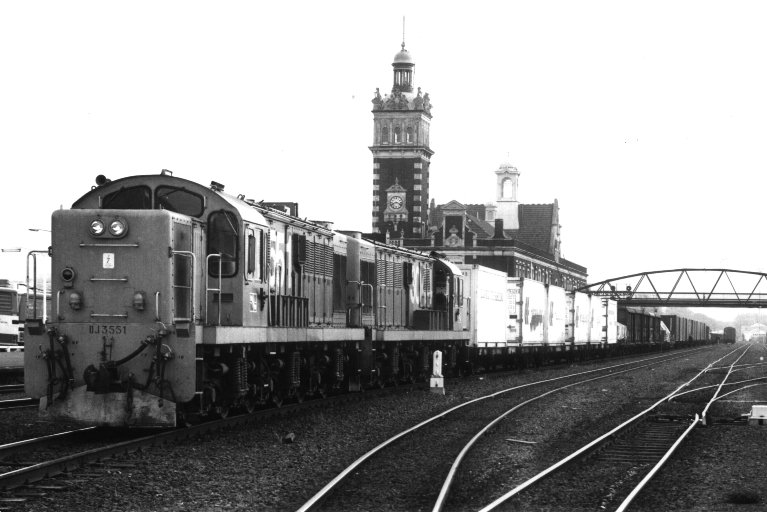
Image: Train at the Dunedin Station, NZ

Boreham writes About Memorabilia

Refreshing the Memory
F W Boreham penned many thoughts about memorabilia as a means of helping people to remember the past. Judging by the number of references in his books, photographs were an important way by which Boreham’s memory was refreshed as they helped him to recall significant people,[1] historic places[2] and interesting occasions.[3]

Tuft of Clover
Boreham kept many natural mementoes in his books, on his mantelpiece and on his desk, including a tuft of clover from Bishop Selwyn’s graveyard in Lichfield, England.[4]

References reveal Boreham’s desire to practice the wearing of a sprig of green in his buttonhole on St Patrick’s Day to perpetuate the memory of one of his heroes,[5] his enjoyment of the patriotic symbolism of the wattle[6] and the celebration of mothers through the wearing of white flowers.[7]

Magic of the Past
In writing on ‘The magic of the past’, Boreham recorded the incident when the silver candlestick from the cabin of the Victory was presented by the British Admiralty to the HMAS Sydney in commemoration of her service in the Mediterranean Sea. Writing of this memento, Boreham said: “That candlestick represents a vital link with a glorious past. As long as it remains in the Sydney it will make every Australian sailor feel that the deathless spirit of Nelson still dominates the fleet and that every modern action is but a continuation of Trafalgar. It is an illustration of the way in which our grey Todays may be glorified by contact with our golden Yesterdays”.[8]

Weaving the Web
Following this example of an object perpetuating “the magic of the past”, Boreham concluded, “The high art of managing the years lies in gathering up all that was best in Yesterday and weaving it, with Today’s additions, into the web of Tomorrow”.[9]

Geoff Pound

Image: 'symbolism of the wattle.'


[1] F W Boreham, The silver shadow (London: The Epworth Press, 1918), 214. This is a reference to a nurse who had figured in Boreham’s life story.
[2] F W Boreham, Mushrooms on the moor (London: The Epworth Press, 1915), 18. Boreham wrote of a photograph of Dundee, Scotland, which he visited while on pilgrimage to the birthplace of Robert Murray McCheyne.
[3] F W Boreham, A faggot of torches (London: The Epworth Press, 1926), 23. Boreham referred to a photograph of the village of Broadhembury , England, that reminded him of Augustus Toplady.
[4] F W Boreham, Cliffs of opal (London: The Epworth Press, 1948), 45.
[5] F W Boreham, The temple of topaz (London: The Epworth Press, 1928), 188.
[6] Boreham, Mercury, 5 October 1929.
[7] Boreham, Mercury, 7 May 1955.
[8] Boreham, Mercury, 28 December 1940.
[9] Boreham, Mercury, 28 December 1940.

Boreham on the Salvation Army

What's the Point of the Church?
I was born at Tunbridge Wells in Kent. As I sat in the old church on Mount Ephraim, sometimes following the Liturgy, sometimes listening to the sermon, and sometimes dreaming of very different things, one problem perpetually assailed me.

I cherished for the Church and all its teachings a veneration that almost amounted to awe; yet one thing puzzled me: I could see no utility in it all. I used to wonder what end was served by it. It seemed so hopelessly remote from real life and from the pleasures and pursuits of the week.

I failed to detect any practical purpose in this aspect of things. I thought my father the very personification of everything that was upright, everything that was chivalrous, everything that was noble, unselfish and true; but it never occurred to me that there was any connexion between his inflexible integrity on the one hand and his attachment to the sanctuary on the other.

Trio of Experiences
I thought my mother the sweetest and most queenly woman of whom I had ever heard or read; but I never once imagined that her affection for these sacred and awful mysteries accounted in any measure for her charm. But, after a while, three things happened, and those three things threw a new light upon everything.

My father and mother passed through a profound and poignant spiritual experience that had its repercussions in my own soul: that was the first. I heard Mr. Moody preach to an enormous gathering in the open air: that was the second. And the Salvation Army—then a sensational novelty—came to our town: that was the third.

Surprised by Religion
The uniforms—especially of the women—greatly intrigued me. It happened that several men whom I had met in ordinary life figured among the Army's earliest converts in the town; and I was electrified when I beheld them figuring in this new role. As, hovering on the fringe of the crowd at their open-air gatherings on the Tunbridge Wells Common, I listened to the testimonies of these men, I tremendously admired their courage. Religion seemed bent upon surprising me: I had never dreamed that it might assume such a form as this.

I made my way to those intriguing meetings on the Common every Sunday afternoon. And when, shortly afterwards, the Skeleton Army appeared, the whole thing seemed to throb with sensation. I several times witnessed the clash of the two armies; heard the members of the Skeleton Army drown with their ribald songs and senseless shouts the voices of the Salvationists; and more than once gazed upon scenes of actual violence.

When I saw those, of both sexes, whose appeals had so affected me, bleeding from wounds inflicted by fists or sticks or stones, my whole soul was stirred within me. I realized that religion—the religion that had seemed to me unpractical—meant so much to these men and women that, for its sake, they were ready to bear any shame, endure any suffering, or die any death.

Prophetic Stance
A few years later, when the municipal authorities at Eastbourne took it into their heads that street-corner evangelism and preaching on the sands were inconsistent with the decorum of a fashionable seaside resort, and passed a by-law prohibiting open-air meetings in the town, General Booth sent his Salvationists in their thousands to the lovely Sussex watering-place with instructions to hold open-air meetings everywhere. The Sussex gaols were soon crowded to suffocation with prisoners in Army uniform, whilst the warders were half-deafened by the rollicking Army choruses. The authorities were at their wits' ends. Moved by a sympathy born of my boyish experiences at Tunbridge Wells, I hurried down to Eastbourne as soon as I could escape from the office in which I was employed in London, and spent with the Eastbourne Salvationists one of the most exciting week-ends of my life. The obnoxious by-law was, of course, shattered to smithereens.

Courageous Confession
At about this time the Salvation Army made upon my mind an impression of a very different kind. The town of Tunbridge Wells, which prided itself on its immaculate respectability, was shocked by a horrible and dastardly murder. The manager of a local saw mills had been done to death among his own stacks of timber. The hideous crime was, of course, the talk of the town. But the perpetrators had left no clue, and, in course of time, the sordid affair faded from the public consciousness.

Then, like a bolt from the blue, the Captain of the Salvation Army announced that two young fellows of about seventeen or eighteen had attended a service at his Barracks, had made a profession of conversion and had authorized him to report to the police that they were responsible for the murder at the saw mills.

They were arrested, tried, convicted and hanged. In their last moments they testified to the joyous reality of the gracious experience that had come to them at the penitent form. And I remember feeling that the religious impressions that could lead to so courageous a confession and to so dreadful a death must be of a particularly powerful and penetrating kind.

Enjoyable Fellowship
Since those days I have myself spent sixty years preaching the everlasting gospel; and, in every part of the world, I have enjoyed the most beautiful fellowship with officers and members of the Salvation Army.

And in all my travels I was seldom more deeply moved than when Mrs. General Carpenter told me that Commissioner T. Henry Howard, old General Booth's right-hand man during the early campaigns of the Army, died clasping my own Bunch of Everlasti ngs.

Salvo Stories
May I, whilst in this vein, pay a grateful tribute to the value of the Army literature? I love the choice little biographies in The Warrior's Library, lives of men like Jean Oberlin, George Fox, Peter Cartwright, Francis of Assisi and the rest. It was with immense enjoyment, and to my permanent enrichment, that I first read the biographies of the great Salvationists—Catherine Booth, William Booth, Commissioner Howard, Staff Captain Kate Lee, and the rest. The stately records of these flaming spirits are beautifully written.

Harold Begbie, Commissioner Booth-Tucker, Mrs. General Carpenter, and others have produced works that deserve to be treasured as part of the Church's choicest board. The story that they tell—the story of the rise and progress of the Salvation Army, and the story of the deathless spirits that served and suffered under its flag—is full of pathos, full of heroism, full of true chivalry, full of consecrated nobleness. More recently I have studied with great enjoyment and profit The Father of Salvation Army Music, Campaigning in Captivity, and other of the works of Lieut. Colonel Arch. R. Wiggins. They are all very moving.

Consuming Passion
As one lays aside these inspiring volumes, it stands out crystal clear that the pioneers and pathfinders of the Salvation Army not only displayed in their own persons a consuming passion for the souls of people, but that, to the incalculable gain of the world at large, they infused that sacred intensity into the experience of all the Churches.

F W Boreham, ‘The Salvation Army’, Arrows of Desire (London: The Epworth Press, 1951), 130-133.

Image: Salvoes on the Street

Boreham on Architecture

Eloquent Stones
In 1924, Frank Boreham wrote an editorial entitled ‘Crumbling stones’, in which he considered the stones that were part of an architect’s design in an old building.[1] In this article, Boreham expressed his anxiety about old buildings that were crumbling and stimulated support for their preservation as they represented “stones [that] seem alive with the eloquence of tradition”.

Asserting their value as means by which history is preserved and presented, Boreham said, “The monuments of architecture are often the only record of the life and hopes of nations that have had their day and have ceased to be”.[2] These views about the moral power of architecture upon people are reminiscent of assertions made by John Ruskin who regarded architecture as “a vital index of a nation’s values” and “a means of enriching the nation’s values”.[3]

Impressing the Mind
In another editorial nearly two decades later, Boreham made a further claim for historic buildings to be prized. He averred: “The mind of man is more impressed by architectural than by natural grandeur ... [and] the reverence that we feel for our stateliest buildings can be attributed to our inveterate but curious habit of associating events with the places at which they happened. We transfer our esteem for a certain person to the spot that he habitually frequented or to the house in which he lived”.[4]

Value of the Cathedral
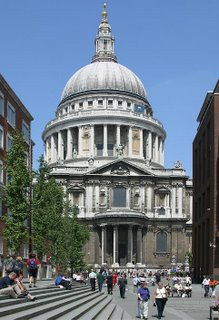
Of special note are the many articles Boreham wrote about St Paul’s Cathedral in London, its architect Sir Christopher Wren and its history. In 1925, Boreham boldly called Australian readers to give funds to “save the cathedral” believing “it is part of the priceless heritage of every British citizen” (he viewed a resident in Tasmania as “both a Tasmanian and a Briton”) and that this was the business of the whole Empire.[5] The cathedral in relation to Britain’s history, he argued, “is not only a part, and an important part; it is in itself an impressive and monumental expression and presentment. It is an epic of empire in noblest architecture”.[6]

Geoff Pound

Image: St Paul's "an epic of empire..."


[1] Boreham, Mercury, 19 January 1924.
[2] Boreham, Mercury, 19 January 1924.
[3] John Ruskin, The genius of John Ruskin: Selections from his writings ed. John D Rosenberg (George Allen & Unwin Ltd, 1963), 121-122.
[4] Boreham, Mercury, 22 March 1941; Age, 30 August 1947.
[5] Boreham, Mercury, 24 January 1925.
[6] Boreham, Mercury, 24 January 1925.

Saturday, November 04, 2006

Boreham on Monuments

Instinct Toward Stone
In an editorial entitled, ‘When ages talk to ages’, Dr F W Boreham remarked on the way sorrowing people turn instinctively towards erecting masses of stone, an impulse “born of the conviction that goodness is too precious a thing to be permitted to perish”.[1] The stonemasons who may have quarried and engraved centuries ago, have made “silent stones articulate” in that “every stone ... takes to itself a Voice, and every Voice is an ascription, a litany, a prayer”.[2]

Mystical Monuments
Boreham said that the desire to visit such stones was as mystical and as wonderful as the decision to commission and erect the monuments. Embracing Montaigne’s view that “of all human passions, there is none so persistent and characteristic as our passion for bridging chasm and for linking things up”, Boreham believed that the significance of monuments lay in their expression of the human “craving to get in touch with the great tracts of time”.[3]

Pilgrim to Sacred Sites
Counting himself as a pilgrim to many sacred sites,[4] Boreham wrote that such visitors delude themselves into thinking that they are merely bringing their tribute of honor and affection but in reality they receive far more than they bring. He elaborated: “For, from the hour of their visit to the tomb, the distinguished person who sleeps there becomes a more commanding presence in their lives. They have forged a new and singularly effective link with the life that he lived and the work that he did. Henceforth he is to them not merely a name; he is a throbbing personality; a potent force in all their experience and achievement”.[5]

Gratitude to Heroes
Boreham was appreciative of the large number of heroic statues that had been erected in the twenty-five years prior to the First World War and he was supportive of the energetic promotion of monuments in the interwar period. He did not, however, remark on the decline in the commissioning of monuments (especially following the Second World War), the change in the focus of monuments from glorifying the person to celebrating the deed and the shift in terminology from ‘monument’ (with its association with glorification) to ‘memorial’ and ‘shrine’ (which emphasized communal mourning).[6]

Imbibing the Spirit
While many modern Australian historians have been skeptical about the power of shrines and relics to help people commune with the dead,[7] Les Carlyon writes of the thousands of Australians (15,000 in the year 2000) who visit Gallipoli (‘Australia’s largest memorial’) each year to imbibe the Anzac spirit and ‘discover their past’.[8]

Geoff Pound

Image: Melbourne's Shrine of Remembrance.

[1] Boreham, Mercury, 5 July 1952.
[2] Boreham, Mercury, 5 July 1952.
[3] Boreham, Mercury, 8 February 1930.
[4] Boreham, When the swans fly high, 157.
[5] Boreham, Mercury, 8 April 1933.
[6] These changes in public consciousness and the building of monuments are extensively detailed in Ken S Inglis, Sacred places: War memorials in the Australian landscape (Melbourne: Melbourne University Press, 1998) and are briefly sketched in Davison, The use and misuse of Australian history, 37-55.
[7] Davison, The use and misuse of Australian history, 138.
[8] Carlyon, Gallipoli, 8-10, 534.

Friday, November 03, 2006

New Boreham Book

Michael Dalton and I thought readers of the Official F W Boreham Web Site might appreciate seeing a preview of the cover of the forthcoming book, Lover of Life: F W Boreham’s Tribute to His Mentor.

J J Doke’s photograph appears in the centre of the cover amid an autumn scene. This is fitting as Doke was a lover of nature and, according to FWB, was rarely seen without a camera in his hand.

Michael and I are very grateful to Laura Zugzda for her skilful and creative work on this cover design.

Do keep sending us your names and contact details if you are interested in getting a copy of this book when it comes off the printing press or simply to be kept informed. We would hate you to miss out on a first edition.

We are already incurring publishing costs and would appreciate any donations you are able to send us.

Further details about notifying us can be found on the F W Boreham Book on Mentoring web site.

Geoff Pound

Image: Front Cover of Lover of Life.

Boreham on Keeping a Journal

Diligent Diarists
F W Boreham carefully noted the diligence of people like Henry Livingstone and Captain Robert Falcon Scott who kept their diaries to the end of their days, especially under trying conditions, and remarked, “Few things are more touching or more significant than the concern that dying men display, under certain conditions, to keep their journals intact to the last”.[1] Beyond the value of a diary recording important times and events, Boreham affirmed the personal benefit of ‘reliving’ events in which “the keeping of a diary is a species of self-communing; the self of Today talking to the same self of Tomorrow”.[2]

Like Bees in Amber
F W Boreham recognized that diaries might bring benefits not only to the diarist but to the diary’s readers: “Like bees in amber, the thoughts, feelings and impressions of Today are made available to the eyes of Tomorrow”. In this way people may continue their contact with the world they left behind but their diaries enabled them to “say their say to the Ages”.[3]

Long Term Investment
Frank Boreham loved Emerson’s image of a diary being like a bank in which valuable experiences could be saved and drawn upon for future guidance.[4] Implicit was the thought that a diary can accrue value to life’s experiences as the maturity of age and the wisdom of hindsight enabled readers to reap further dividends from the events of the past. Boreham viewed diaries as a personal savings bank for the diarist and recognized the riches they could offer to others, when he observed: “Among all her priceless archives, the Church has no documents comparable in value with personal outpourings of this intimate kind. She treasures as above all price the Confessions of St Augustine, the Breviary of St Teresa, Bunyan’s Grace Abounding, Newton’s Autobiography and the self-revealing journals of men like David Brainerd and John Woolman”.[5]

Boreham the Diarist
Some of the earliest attempts by Boreham at journaling included his travelogues entitled, From England to Mosgiel, N.Z. by Frank William Boreham[6] (published in five installments in the British Courier newspaper) and Loose leaves: From the journal of my voyage round the world (published by the Taieri advocate and H H Driver). These represented a selection of experiences that Boreham culled from the personal diaries that he meticulously kept. While he extolled the virtues of keeping a diary, only eight of his annual diaries are extant and these record only the final years of his life.[7]

Geoff Pound

Image: 'Like bees in amber..' (this is a bee in a beautiful amber bracelet. You'd get a real buzz out of wearing this).


[1] F W Boreham, The last milestone (London: The Epworth Press, 1961), 43.
[2] Boreham, The last milestone, 43.
[3] Boreham, The last milestone, 43.
[4] Boreham, Mercury, 7 January 1928.
[5] Boreham, The last milestone, 43.
[6] F W Boreham, ‘From England to Mosgiel, N.Z., Five letters to the editor of the Courier’, Courier, 6 and 21 March, 1895.
[7] The diaries relate to the years 1946, 1947, 1948, 1950, 1951, 1956, 1958 and 1959. When Boreham died, many of his books (including these diaries) were gathered up by the Rev Sir Irving Benson. Boreham’s diaries and two letters were deposited with Benson’s papers in the State Library of Victoria (Ref. No. MS 11508 Boreham, Rev Dr F).

Thursday, November 02, 2006

Boreham on Autobiographies

Write Your Story
While F W Boreham wrote about the fundamental distinctions between biography and autobiography (and reckoned that “all literature divides itself into these two classes”), he encouraged all people to write down their story because of the value of preserving and passing on the inspiration and lessons of one’s experience.[1] Challenging his readers to consider what they were bequeathing, Boreham expressed his verdict in stating, “Experience—the most priceless hoard that living creatures ever amass—is bequeathed as a heritage from generation to generation”.[2]

My Pilgrimage
In 1935, at the age of sixty-four, Boreham informed his readers, with a touch of humor, that he would be doing what he had suggested that others might do before they die. He said, “I am firmly resolved, on attaining centenarian honors, to give up writing essays, idylls, sketches, and all that kind of nonsense, and to devote my powers, before they begin to decay, to the compilation of my autobiography”.[3]

Within five years Boreham had written and published his autobiography, which he clarified, was not “born of an inflated conception of my own importance. On the contrary, it is born of a delicious consciousness of my own insignificance”.[4] In perhaps his strongest claim for ordinary people leaving their story for others, Boreham continued: “The lives of the Nobodies and the Nonentities offer a virgin field of novelty and freshness .… There is no drama like the drama of reality; no lure like the lure of life; no business half as intriguing as other people’s business. The man whose biography is not worth writing has never yet been born”.[5]

Geoff Pound

Image: 'write down your own story...'

[1] F W Boreham, Ships of pearl (London: The Epworth Press 1935), 38.
[2] Boreham, Mercury, 4 January 1936.
[3] Boreham, Ships of pearl, 34.
[4] F W Boreham, My pilgrimage (London: The Epworth Press, 1940) 7-8.
[5] Boreham, My pilgrimage, 7-8.

Wednesday, November 01, 2006

Boreham on Biographies

No History, Only Biography
F W Boreham possessed a bias towards Disraeli’s decree, “Read no history: nothing but biography, for that is life without theory”[1] and Emerson’s variation, “There is properly no history; only biography”.[2] Boreham wrote of the means by which readers might experience the personalities of significant people who had died and asserted, “The biographies of the noble dead are among the most stimulating volumes in our libraries. By means of their pages we come in touch with the richest and rarest spirits of the past: and in the process, our finest impulses are quickened and our highest aspirations inflamed”.[3]

Return to Biography
F W Boreham remarked in 1912 that there were indications that there was a return to the reading of biographies, a trend that he applauded and explained was due to a protest against modern fiction and a return to real life.[4] In this editorial entitled, ‘The return to biography’, Boreham explained how the functions of historian and biographer were quite distinct, yet renewed his appeal for the element of human interest in biography as he had with the writing of history: “Happily, the biographer is coming to recognise that real life is never prosy or dull, and that the man who produces a dull or prosy book has but proclaimed his failure as a biographer”.[5]

Remembering Unsung Heroes
F W Boreham not only wrote many biographical editorials about heroes who dazzled with their brilliance but also selected “minor” characters, “second-rate poets”,[6] “first mates”[7] and “makeweights”,[8] to encourage his readers to see the best in lives that were mediocre or flawed. Valuing the stories of superstars as well as the unsung heroes, Boreham paid tribute to ‘the romance of obscurity’, saying: “If the life of the man in the street is capable of artistic and attractive biographical treatment, how much more so is the life of the man who moved the millions, discovered the poles or saved his country in the day of crisis. If the life of the ordinary man is a nugget of romance, what a literary goldmine the life of the extraordinary man should prove”![9]

Geoff Pound

Image: FWB wrote a biography on this man, George Augustus Selwyn. It is hard to pick up a copy of this book. If you do you will be paying at least $US500.00!! It is because of such ridiculous prices that John Broadbanks Publishing has been formed.

[1] Benjamin Disraeli, Contarini Fleming: An autobiography (New York: D. Appleton and Co., 1870), 34.
[2] Ralph Waldo Emerson, ‘History’, The complete works of Ralph Waldo Emerson comprising his essays, lectures, poems, and orations vol. 1 (London: Bell and Daldy, 1866), 4.
[3] Boreham, Mercury, 8 April 1933.
[4] Boreham, Mercury, 5 October 1912.
[5] Boreham, Mercury, 5 October 1912.
[6] Boreham, Mercury, 8 August 1953.
[7] Boreham, Mercury, 13 August 1949.
[8] Boreham, Mercury, 28 September 1946.
[9] Boreham, Mercury, 9 December 1933.

Monday, October 30, 2006

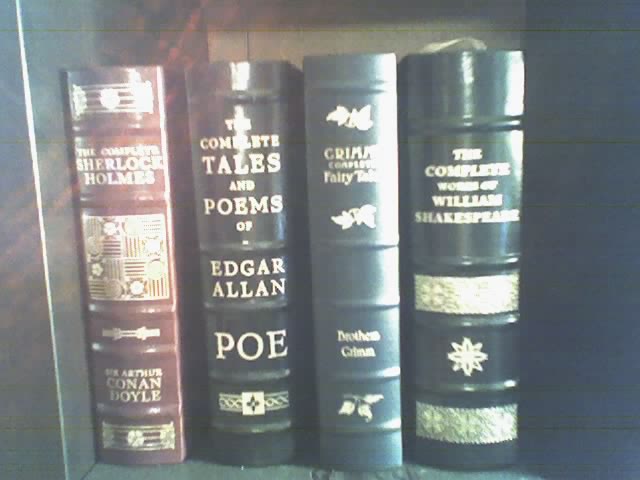
Boreham on Books as Literary Monuments

Worth of the Bookworm
Of all the repositories of history, F W Boreham believed that books have been the most valuable in dispelling the ignorance that has blocked the path of progress. In an editorial in which Boreham made this point and advocated the worth of ‘the bookworm’, he spelt out the uses of books and why their reading was superior to other ways of ‘encountering’ the author. He explained:

“But by means of books, the ordinary mind establishes direct contact with the master-mind. People love to visit the scenes amid which Shakespeare and Wordsworth and Dickens once moved. They feel that, in paying pilgrimage to Stratford and Grasmere and Gads Hill, they are getting in touch with these deathless saints. But the sentiment is ephemeral compared with the real contact established with these commanding personalities when, taking into our hands the books that they themselves actually wrote, we allow them to pour into our minds the opulent treasures of their own. It is not simply that we imbibe their ideas and are infected by their philosophy. We come into personal touch with themselves and bear the impress of their magnetic personalities for ever afterwards.”[1]

Citizens of the Ages
Boreham continued to assert the supremacy of books by imagining playfully that even if Shakespeare were still alive, interviews would be difficult to secure and even if successful, interviewers would find the conversation degenerating into “a handful of platitudes and commonplaces”. Not only did Boreham consider that the reading of books was the most effective way to benefit from the personalities of the authors but also he concurred with Macaulay’s assertion that “the invention of printing was the most notable event that took place during a thousand years of history”.[2] The invention of the printing press enabled people to become “citizens of all ages” as they availed themselves of the increasing number of books that were published.[3]

Geoff Pound

Image: Literary monuments


[1] Boreham, Mercury, 31 August 1940.
[2] Boreham, Mercury, 25 November 1922.
[3] Boreham, Mercury, 6 September 1941; Age, 25 October 1941.

Boreham on Communing With History's Figures

Encountering People
F W Boreham believed that good history writing should not only inspire people to good living as they read the stories of great people but also change readers through the direct encounter with history’s subjects.

This idea is expressed by romantic historians such as George Bancroft who wrote of “communing with antiquity”.[1] Thomas Carlyle affirmed Walter Scott’s contribution in reinterpreting the notion of ‘experience’ through reading when he said: “[History’s] faint hearsays of ‘philosophy by experience’ will have to exchange themselves everywhere for direct inspection and embodiment: this, and this only, will be counted as experience; and till once experience has got in, philosophy will reconcile herself to wait at the door. It is a great service, this that Scott has done; a great truth laid open by him”.[2]

Bringing People to Life
This goal of leading readers into the experience of ‘direct inspection and embodiment’ with people who were alive in history’s pages in turn influenced Boreham who sought to recreate scenes with imagination to heighten the power of the experience.

Boreham practised what he preached. Through the reading of books and visiting graves and other memorials he engaged in a deep communion with the subject.

Geoff Pound

Image: Grave of John Bunyan (one of FWB's favourite authors). Whenever in London, Frank Boreham would visit Bunyan's grave at Bunhill Fields Cemetery.


[1]George Bancroft, ‘Letter to Andrews Norton’, January 9, 1819, Bancroft papers (Boston: Massachusetts Historical Society), 1819.
[2] Thomas Carlyle, ‘Sir Walter Scott’, Essays, 3 Thomas Carlyle’s collected works vol. V (London: Chapman and Hall, 1869), 275.

Sunday, October 29, 2006

Boreham on the Need for Heroes

People Need Heroes
F W Boreham amplified his thoughts on the human passion for personalities when saying, “Men must have heroes, and if they cannot get the best, they will readily make shift with the best that they can get.”[1] The role of heroes in society, added Boreham, becomes more evident in turbulent times for “in days of crisis and tumult, strong personalities become emphatic, and the field of vision becomes dominated by a few commanding figures”.[2]

Boreham and Hero Worship
So important was this theme that Boreham confessed, “I had it in my heart to write a book [entitled] On heroes and hero-worship. But taking a mean advantage of the circumstance that [Thomas Carlyle] arrived on this planet nearly a century before I did, he forestalled me and published the book thirty years before I was born.”[3] Carlyle influenced Boreham’s views about the importance of heroes. However, recognizing that one’s choice of heroes is usually a matter of personal taste, Boreham said that if the task had fallen to him, “I should have given short shrift to some of his heroes, and, to redress the balance, should have included some over whom he has passed in silence”. While Boreham did not write a book entitled, On heroes, many of his editorials were written about his heroes, he devoted two biographies to two of his heroes—George Augustus Selwyn and The man who saved Gandhi (based on the life of Boreham’s mentor, J J Doke)—and five of his books are collections of essays (reworked editorials and sermons) on the lives of people whom Boreham venerated.[4]

Boreham Pantheon
Boreham’s pantheon of heroes was broad and included the warrior-heroes, navigators and sea dogs that dominated the attention of the early Victorians. However, his heroes were mainly drawn from those who had made their mark in literature, politics, the church, science and invention and exploration.[5] The people he extolled were those who represented such virtues as endurance and constancy (James Watt),[6] courage and patience (Samuel Morse),[7] magnanimity (John Motley),[8] triumph over adversity (Robert Louis Stevenson)[9] and self-effacement (Catherine Blake).[10] While Boreham was intentional about telling the stories of Australian heroes, he did not appear to be attentive to the “new race of heroes” that Australians were discovering on the sporting field and in the bush.[11]

Power of One
Writing on the anniversary of the death of Lord Lister, Boreham indicated the importance of one significant person when he said, “Men of such a mould are the glory, not only of a nation, but of all mankind; and it is fitting that on every suitable occasion, we should recall their heroic achievements and acknowledge their incalculable debt under which they have placed us”.[12] Similarly, in describing the impact of Ambrose on Augustine, Boreham acknowledged, “It often happens that the biggest thing in even the biggest city is the commanding personality of one man”.[13] Boreham added that Augustine’s “hero-worship was intensified by the intimate experience of contact and conversation”, thus demonstrating the influence of personal contact between a hero and a hero-worshipper.

Ongoing Influence
While recognising the influence of a hero while they are living, Boreham curiously remarked that “many a man does his best work AFTER he is dead…. No man likes to feel he dies when he dies”.[14] Boreham developed this thought in his writing about heroes in an editorial on the influence of John Bunyan: “In 10 days he was dead. But, as so often happens, his death made little difference to him. It was merely an episode in his triumphal progress. In reality he was never so much alive as he is today. His books represent his most imposing monument; and, in the writings of those who have modelled themselves on his perfect style, he lives a thousand lives, quite anonymously but with tremendous effect”.[15]

Lighting a Torch
As with John Bunyan, Boreham believed that “a great spirit often does his best work not in his own proper person, but by means of the disciples and students who rise up to succeed him and carry on his work”.[16] Expanding on this theme, Boreham said, “History abounds in illustrations of the way in which a master, by personal contact with a disciple, will light a torch that illumines the world with a brighter light than he himself has ever been able to radiate”.[17] Boreham believed a hero’s influence often was conveyed quite unconsciously, but at other times influential personalities such as Charles Simeon profoundly impressed John Wesley and William Wilberforce through an intentional commitment to fire the imagination of his students with a noble cause.[18]

Hero Worshippers
While Boreham wrote editorials about the need for heroes, he also addressed the subject of hero-worshippers. These are the people, who in speaking or writing about their heroes sow within their hearers and readers the seeds of heroism. Writing about Richard Hakluyt, the Oxford lecturer in geography and cosmography from the sixteenth century, Boreham said:

“And does not the hero worshipper who takes the trouble to transmit to posterity his veneration for his idol pass the spirit of heroism, like a flaming torch, from one generation to another? It is the vital principle out of which the shining web of history is spun. An earnest man conveys the fire that burns within his own breast to the pages on his desk, and, just as fire communicated to paper spreads the conflagration to everything that the paper touches, so the reader who picks up these inspired pages falls under the influence of their radiance and their warmth. How many have become pilgrims through reading the story of Bunyan’s pilgrimage? How many have made the greatest of all confessions through reading the Confessions of St. Augustine? How many apostolic acts have been inspired by the Acts of the Apostles? And, by the same token, how many gallant souls have done a brave day’s work for England through perusing the Voyages written by the sixteenth century rector?”[19]

One detects within this editorial an insight into the motivation of Boreham that in writing passionately about his heroes he was seeking to transmit “the spirit of heroism” to his readers.

National Heroes
Along with the new appreciation of history in the last quarter of the twentieth century, Davison observes that the “traditional resistance to hero-worship seems to have weakened” with interest being focused by the media and motivational agencies on ordinary Australians such as bushfire fighters.[20] This resurgence of interest appears to vindicate Boreham’s move to focus on Australian heroes whose lives were more within the reach of his readers in terms of the context of their exploits and the virtues they embodied.

Geoff Pound

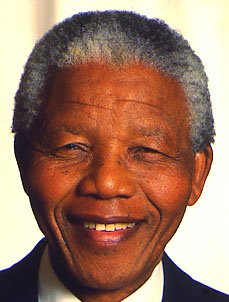
Image: Nelson Mandela, a popular hero.

[1] Boreham, Mercury, 8 December 1923.
[2] Boreham, Mercury, 8 December 1923.
[3] F W Boreham, When the swans fly high (London: The Epworth Press, 1931), 145-146. The book Boreham refers to is Thomas Carlyle, On heroes, hero-worship and the heroic in history (London: Ward, Lock & Co Ltd, 1841).
[4] These books are A bunch of everlastings, A handful of stars, A casket of cameos, A faggot of torches and The temple of topaz.
[5] A survey, undertaken by the author, taking a sample of sixty-eight biographical editorials drawn from Mercury editorials in the 1940s and 1950s, investigated the fields in which Boreham’s subjects (heroes) had made their mark. It revealed that literary heroes were most prominent—(forty-four percent), followed by political heroes (thirteen percent), heroes of the church (ten percent), inventors (nine percent) and explorers (six percent). Other heroes listed came from the spheres of art, medicine, history, war, philosophy, drama, education and social justice. (The high proportion of literary heroes in Boreham’s Mercury editorials in this period was affected by his other role as a contributor to the Literary Supplement of the Age.)
[6] Boreham, Mercury, 26 September 1925.
[7] Boreham, Mercury, 18 July 1936.
[8] Boreham, Mercury, 30 May 1925.
[9] Boreham, Mercury, 11 July 1936.
[10] Boreham, Mercury, 13 August 1949.
[11] For example, Manning Clark includes in ‘the new race of heroes’ bush people like Jim Jones and Ned Kelly who defied the authorities, Australian cricket heroes (such as Warwick Armstrong and Donald Bradman) who conquered their British opponents and AFL footballer Roy Cazaly. C Manning H Clark, A history of Australia, 1916-1935. vol. 6. (Melbourne: Melbourne University Press, 1987), 208-209.
[12] Boreham, Mercury, 10 February 1951.
[13] Boreham, Mercury, 28 August 1948.
[14] Boreham, Mercury, 10 October 1942; Age, 11 November 1950.
[15] Boreham, Mercury, 31 August 1946.
[16] Boreham, Mercury, 26 May 1945; Age, 17 March 1951.
[17] Boreham, Mercury, 28 August 1948.
[18] Boreham, Mercury, 13 November 1948.
[19] Boreham, Mercury, 23 November 1946.
[20] Davison, The use and misuse of Australian history, 25-26.

Boreham's Call for Human-Centred History

Teaching By Examples
In commem-orating the centenary of the completion of Macaulay’s History of England, F W Boreham sought to explain the “extraordinary sensation” that the book had upon its readers.[1] He believed its success could be in part attributed to Macaulay’s human-centred approach to the writing of history.[2] Borrowing Lord Macaulay’s definition, he stated, “History is Philosophy Teaching By Examples”.[3]

Communicate the Human Element
Boreham frequently called for historical writing that contained the human element that was evident in good fiction. For instance, he once commented: “One sometimes wishes that the average novelist and the average historian could be shaken up in a bag and their qualities distributed. The result would probably lend a new grandeur to fiction and a new realism to history”.[4]

Passion for the Personal
In an editorial entitled ‘Passion for the personal’, Boreham said, “We humans have an insatiable passion for personalities. It is the dominant factor in our conversation and our correspondence”.[5] The importance of ‘the personal equation’ was, according to Boreham, one of the reasons why the writing of history must deal primarily with people’s stories. The human-centred approach to history gave good scope for writing in concrete language about the admirable virtues and qualities that a person embodied. Boreham’s passion for personalities found expression in the number of historical editorials he wrote in which abstract principles were clothed and movements found expression in the colourful stories of human lives.

Individuals as Representative Figures
While Boreham wrote numerous editorials on one person, his aim was not only to inspire individual readers but also to let his subject serve as a representative figure who embodied a national aspiration or a type of the ideal human.[6] Levin elaborated upon this approach when saying, “The representative man was both an historical phenomenon and a literary device. For an age that glorified individualism, for historians who emphasised moral responsibility and to whom self-reliance was a moral duty, the historical character had to be influential”.[7] Boreham illustrated the way that the passion for personalities is the same impulse that drives people to associate the name of a person with a historical movement or tradition in the following manner:

“In recalling some impressive period of human history, we instinctively summon to the mind the face and features of some outstanding individual. Our naval traditions become incarnate in the heroic figure of Nelson; the abolition of slavery automatically recalls the dwarfish frame of William Wilberforce; the industrial revolution expresses itself in the thought of Lord Shaftesbury. In contrast with all the other sacred books, the Bible consists of a ceaseless pageant of personal records, and the redemption of the world is revealed in a thorn-crowned face.”[8]

Crystallized History
Asking the famous question, ‘What’s in a name?’ Boreham argued that if in ordinary life names are more than mere identification tags then how much more meaning do names possess in history? Referring to the way names may signify movements and personify traditions, he wrote, “Names are crystallized history; they stir the blood like trumpet calls and bugle blasts; they are pregnant with significance and challenge”.[9]

Geoff Pound

Image: Human-Centred history

[1] Boreham, Mercury, 1 October 1949.
[2] Thomas Carlyle makes a similar endorsement about the writings of Walter Scott, saying Scott’s world was “actually filled by living men… not abstraction”. Thomas Carlyle, ‘Sir Walter Scott’, Thomas Carlyle's collected works, Vol. 5 (London: Chapman and Hall, 1869) 275.
[3] Boreham, Mercury, 1 October 1949.
[4] Boreham, Age, 4 January 1947; Age, 1 October 1949.
[5] Boreham, Mercury, 8 September 1956.
[6] This was a popular historical and literary device employed by essayists and historians. Emerson, in many of his essays, focused on such representative men in articles entitled, ‘Plato, or the philosopher’, Swedenborg, or the mystic’, ‘Montaigne, or the sceptic’ and ‘Shakespeare, or the poet’. Ralph Waldo Emerson, The complete works of Ralph Waldo Emerson comprising his essays, lectures, poems, and orations vol. 1 (London: Bell and Daldy, 1866), 288-311, 311-335, 335-352, 352-365.
[7] Levin, History as romantic art: Bancroft, Motley, and Parkman, 51.
[8] Boreham, Mercury, 8 September 1956.
[9] Boreham, Mercury, 24 September 1927.