Frank William Boreham 1871-1959

Frank William Boreham 1871-1959
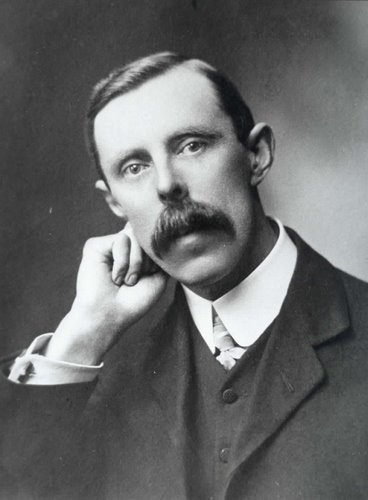
A photo F W Boreham took of himself in 1911

Thursday, September 07, 2006

Boreham Writes About Disability

Inherent in Boreham’s theme of “making the best of ourselves” was the recognition that each person has a different ability so that each must “bring to perfection the best of which he or she is capable”.[1]

In one of many editorials that valued the individual, Boreham said, “The thing that makes humanity so perennially fascinating is its infinite capacity for exceptions.”[2] While not clarifying what type of exceptions he had in mind, he wrote elsewhere of “the value of the freak” and “the black sheep”, the need to study and treasure people who are exceptions and the conviction that “different children need to be cherished”.

In an article about the life of Beethoven, Boreham said, “The glory of Beethoven was that he was essentially a rebel [and] ... to such rebels ... the world owes a debt it will never be able to compute”.[3]

Most certainly Boreham’s experience of having a physically and mentally disabled child named Stella, “the only fragile flower in our garden”,[4] gave to his writing a deep appreciation of the value that such individuals bring to the world. Writing about, ‘The care of the feeble-minded’,[5] when Stella was seven, Boreham emphasized the “long series of gradations of mental deficiency” (as distinct from being either ‘sane or insane’).

In this important statement in 1914, a few years after the Australian government had introduced the Old Age Pension (1909) and the Invalid Pension (1910), Boreham encouraged society to implement preventative and remedial measures for the disabled. He applauded the rise of specially qualified teachers and supported the move for all large centres to have Day Schools as well as Residential Schools.

Rather than keeping the disabled remote from society, Boreham hoped that they would be “saved to the community” and that “by a little sympathetic treatment [they] might be made into useful and intelligent citizens.”

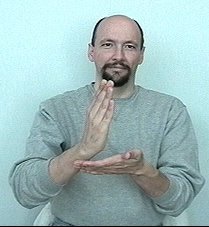
In 1924 Boreham wrote about the deaf and dumb and their experience of “the paralysis of silence”. Identifying the additional pain of public prejudice, Boreham claimed, “No country has done more to abolish it than has Australia.”[6]

Geoff Pound

Image: Experiencing “the paralysis of silence.”

[1] Boreham, Mercury, 10 September 1955.
[2] Boreham, Mercury, 20 January 1934.
[3] Boreham, Mercury, 6 March 1943.
[4] Boreham, My pilgrimage, 190-191.
[5] Boreham, Mercury, 27 February 1914.
[6] Boreham, Mercury, 19 February 1924.

Tuesday, September 05, 2006

Boreham on Babies and Education

One of the reasons why Boreham grew silent on war issues and loud on biographical sermons and editorials was, according to T Howard Crago, his biographer, because his reading of Gibbon’s Decline and fall had given him the insight:
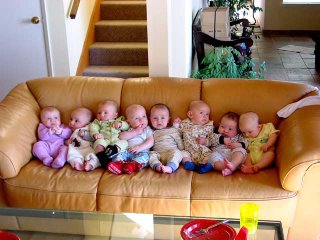
"…that the fate of peoples had been decided not so much by the outcome of wars as by the influence of strategic personalities. Creasy might write of the world’s decisive battles. But FWB saw that, in the working out of humanity’s destiny, battles were not nearly so decisive as babies. Compared with the power of a single personality, the greatest battle in history was of comparatively trifling importance."[1]

Addressing the Baptist Assembly in New Zealand in his presidential capacity, Boreham told stories about significant babies in history, building on the gospel words, “[Jesus] called a child, whom he put among them”.[2] Calling for a study of the significance of the child, Boreham said:

"You will find that in the Imperial Parliament the themes that are debated with the greatest warmth and vigour are such questions as the Education Bill and the Sale of Liquor to Young Children Bill. The little child is in the midst. Here in New Zealand we are dealing with such burning questions as Juvenile Depravity, Bible in Schools, and Technical Education—the little child still occupies his old place."[3]

In Australia, in the last decade of the nineteenth century and in the early years of the twentieth century, the growing acknowledgement of the rights of children was evident in public discussion, new laws and the emergence of societies advocating the protection of children.[4]

Increasing attention was being given to the physical welfare of children and Tasmania figured prominently in 1906 when the state pioneered the regular medical inspection of students, a practice that eventually was adopted in all states.[5] Into this climate Boreham wrote various editorials about enabling children to reach their “maximum capacity”.[6] He called for an education that stimulated curiosity and questioning,[7] engendered wonder,[8] fired the imagination[9] and encouraged “the philosophy of play”.[10]

Boreham had a high regard for the teaching profession and, judging by the number of editorials on the man, his supreme model for teaching was Thomas Arnold of Rugby, “whose personality pervaded everything”.[11]

In 1914 Boreham diplomatically criticised Australian education as being “too stereotyped and stilted” with “no room for individuality”.[12] Relaying some murmurs from the commercial and industrialised quarters, he challenged schools for “doing little to equip young people for the stress of actual life”, the result being that “the labour market is glutted with incompetence”. While being pragmatic about the need for education to be related to employment and declaring that “a man’s first duty ... is to make himself marketable”,[13] Boreham envisaged schools equipping people “for loftier citizenship and finer social influence”[14] in “a world that is being swept by a hurricane of change”[15] and training them in discernment skills “to detect the difference between the beautiful and the gaudy, between courage and bravado, between liberty and licence”.[16]

Geoff Pound

Image: “…battles were not nearly so decisive as babies.”
[1] Crago, The story of F W Boreham, 171.
[2] Matthew 18:2.
[3] F W Boreham, The whisper of God (London: A H Stockwell, 1902), 26.
[4] Dorothy Scott and Shurlee Swain detail the establishment of organisations to advance the care and protection of children. In Dorothy Scott and Shurlee Swain, Confronting cruelty: Historical perspectives on child abuse (Carlton Sth., Vic.: Melbourne University Press, 2002), 1-33.
[5] Alexander Mackie, ‘Education in Australia’, Australia economic and political studies, ed. Meredith Atkinson (Melbourne: Macmillan & Co. Ltd., 1920), 243-244.
[6] Boreham, Mercury, 21 January 1950.
[7] Boreham, Mercury, 16 July 1921.
[8] Boreham, Mercury, 29 March 1952.
[9] Boreham, Mercury, 6 January 1934.
[10] Boreham, Mercury, 7 July 1920.
[11] Boreham, Mercury, 12 January 1924.
[12] Boreham, Mercury, 26 February 1914.
[13] Boreham, Mercury, 18 February 1922.
[14] Boreham, Mercury, 23 July 1921.
[15] Boreham, Mercury, 21 January 1950.
[16] Boreham, Mercury, 5 May 1951.

Boreham on Inclusivity

Dr F W Boreham identified growth in inclusivity as a sign of a person realizing their full potential and he made his point through the use of colourful Australian imagery:

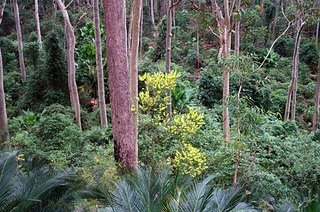
“God has room in his heart, and room in His service, for all kinds of folk .… The beauty of our Australian bush is that it is such a medley, such a riot, such a tangle. If it were all gums, or all wattles, or all ferns, or all orchids, the glory would have departed. It is the combination of so many contrasts that makes up the perfect whole”.[1]

Having been exposed to Baptists like J J North who were trenchant critics of Roman Catholicism[2] and mindful of denominational discussions proposing formal church union in Australia,[3] Boreham’s essays and autobiography reveal him as one who practised religious inclusivity through cultivating friends with Protestants of other denominations,[4] Roman Catholics[5] and Jews.[6]

In his retirement he confessed, “The secret pilgrimage of my soul has been towards Quakerism”.[7] He paid tribute to the role of books in jolting people out of their bigotry and in remarking on the diverse nature of his library he expressed his incalculable debt to people so different from himself.[8] In recommending a book by a Catholic writer he said, “We cannot allow our Protestant prejudices to blind us to the [book’s] beauty”.[9]

Geoff Pound

Image: The ‘Australian bush is … such a medley’.

[1] F W Boreham, A witch’s brewing (London: The Epworth Press, 1932), 212.
[2] J A Clifford, A handful of grain: The centenary history of the Baptist Union of New Zealand, vol. 2 (Wellington: The NZ Baptist Historical Society, 1982), 97.
[3] Ian Breward, A history of the Australian churches (St Leonards: Allen & Unwin, 1993), 99-101.
[4] Crago, The story of F W Boreham, 233-234.
[5] F W Boreham, The silver shadow (London: The Epworth Press, 1918), 234.
[6] Boreham, Rubble and roseleaves, 156.
[7] F W Boreham, The passing of John Broadbanks (London: The Epworth Press, 1936), 20.
[8] F W Boreham, Bunch of everlastings (London: The Epworth Press, 1920), 33.
[9] F W Boreham, I forgot to say (London: The Epworth Press, 1939), 23.

Monday, September 04, 2006

Boreham on Cultivating Adventure

Inspiring Books
Repeatedly F W Boreham wrote that an adventurous mind was best cultivated by the reading of books.[1] Many of his editorials were intended to inspire readers to be adventurous through stories of people who sailed uncharted waters,[2] explored new regions,[3] invented new means,[4] pushed back scientific frontiers[5] or struck out along a new literary line.[6]

Stimulate Freshness in Relationships
Beyond the value of books to foster an adventurous spirit Boreham advocated stimulating freshness in relationships. He urged young people to “preserve some point of contact with the mellowing wisdom and ripe experience of old age” and he encouraged senior adults “to resolve to spend a certain amount of their time in the society of young men and maidens, and even of little children”.[7]

Enrichment of Travel
Many times Boreham wrote about the potential for travel to open people up to new vistas.[8] One of the principal gains in travel was “the sense of contact with history and antiquity” and a “certain mental expansion and intellectual exhilaration in looking upon new horizons and drinking in visions of unfamiliar beauty”.[9] Quoting the explorers Mungo Park and Charles Darwin, Boreham said the tourist will return “enriched by moral gains” which he understood as the acquisition of wholesome character traits. During war time when international travel was restricted, Boreham spoke positively of the value of “narrowing horizons” and appreciating the territory nearby, even the parts with which people thought they were already most familiar.[10] While the practices of fostering the sense of adventure through reading, people contact and travel were mentioned by Boreham as examples of what an individual could do, there are inferences that these measures might be also encouraged by parents, educators and politicians.

Geoff Pound

Image: Yours truly, taking Boreham's advice and travelling through Italy.

[1] Boreham, Mercury, 25 January 1930.
[2] Sea explorers include James Cook, Mercury, 13 July 1935; George Bass, Mercury, 4 January 1941; John Franklin, Mercury, 4 April 1936.
[3] Land explorers included Thomas Mitchell, Mercury, 13 June 1936; Hamilton Hume, Mercury, 11 October 1924.
[4] Inventors include Thomas Edison, Mercury, 1 February 1947; James Watt, Mercury, 27 September 1940.
[5] Scientists include Lord Kelvin, Mercury, 18 December 1937; Antoine Lavoisier, Mercury, 15 May 1954.
[6] Boreham, Mercury, 15 March 1924.
[7] Boreham, Mercury, 16 August 1941.
[8] Boreham, Mercury, 27 March 1954.
[9] Boreham, Mercury, 29 November 1930.
[10] Boreham, Mercury, 28 June 1919.

Sunday, September 03, 2006

Boreham On Living Adventurously

Everlasting Explorers
From an experience at an auction in Hobart in which Boreham bought six books that he wanted and got saddled with thirty-six books that he did not want but of which he later found many to be “charmers of the soul”, he warned against settling into ruts, sticking with pet themes and spurning new interests.[1] He urged communicators “to be always forcing your minds along unfamiliar tracks, to be constantly breaking fresh ground, to be everlastingly exploring new worlds”.[2]

Like a Dog on a Country Road
Boreham believed that one’s sense of adventure was closely related to the development of curiosity. Describing life as “the endless quiz”, it is interesting to note that his editorial that appeared in the Mercury on the Saturday immediately following his death bore this title and commenced with his words, “From the cradle to the grave man is an animated note of interrogation, the growth of his questions corresponding in impressiveness with the growth of his stature”.[3] Boreham throughout his life called for people to take “adventures of the mind” in order to “keep the mind fresh and vigorous and healthy” and said, “Like a dog on a country road, the mind must poke into as many holes as it can”.[4]

Geoff Pound

Image: “Life… the ‘endless quiz.’”

[1] F W Boreham, Mushrooms on the moor (London: The Epworth Press, 1915), 17-18.
[2] F W Boreham, The blue flame (London: The Epworth Press, 1930), 248.
[3] Boreham, Mercury, 23 May 1959.
[4] Boreham, Mercury, 16 August 1941.

Saturday, September 02, 2006

Boreham on The Will to Grow

The Will to Grow
Approaching a new season of the year we take stock of things. Are we getting on? Are we advancing? Are we growing? And with that question of growth another query starts to life. Has anybody elaborated the laws that govern mental growth? When does such development cease? By what rules is it regulated? Why, in some cases, does the body leave the mind so far behind whilst, in others, the intellect continues to expand long after physical growth has ceased? Some years ago Sir William Osler, one of the most eminent professors of medicine that the world has ever known, was particularly fond of discussing such subjects with his students. Sir William was concerned less with the academic than with the practical aspect of the matter. He was desperately anxious that the young medicos under his charge should regard the capture of a diploma, not as the climax of mental development, but as a mere beginning.

As everybody knows, the human adds little or nothing to its stature after attaining its majority. Rich or poor, sickly or strong, men and women of all kinds, classes, colours, and conditions come to the age of twenty-one and cease to grow. But the human mind scorns such hard-and-fast regulations. After a brief period either of lightning or languid growth it may become suddenly stunted and grow no more; or it may continue to develop with steadfast and irresistible persistence until the hair is white and the back bent with age. Is it not on record that:

Cato learned Greek at eighty;
Sophocles

Wrote his grand oedipus, and
Simonides

Bore off the prize of verse from his
compeers.

When each had numbered more than four-score
years;

And Theophrastus at four-score and
ten

Had but begun his "Characters of
Men."

Chaucer at Woodstock, with the
nightingales,
At sixty wrote the "Canterbury
Tales."

Goethe at Weimar, toiling to the
last,

Completed "Faust" when eighty years were past.

And yet in contrast with all this there are those who, however long they live, never show any sign of mental progress after leaving school or university.

Send The Patriarchs Back To The Playground
The question inevitably arises: What are we to regard as normal? At what age does intellectual development usually cease? Sir William Osler would have replied that it should not cease at all. In season and out of season, he urged his students to guard against such a calamity. He advised doctors to take every opportunity of renewing their student days. General practitioners should return, as often as possible, to the university classroom and to the hospital ward. Old doctors should get into touch with young beginners fresh from college. Any opportunity of travel should be eagerly embraced. New hobbies should be taken up. No opportunity should be lost of keeping the brain fresh and keen and vigorous. Minds should grow to the very last.

In his lecture on Bassett, Osler hints that, in this respect British doctors have something to learn from their brethren across the Channel. Nothing impressed Bassett more than the incessant industry, even in old age, of the French physicians. And in all his lectures, Osler pours out the vials of his wrath upon those practitioners who, after a few years, divide their patients into about a dozen classes, applying in each case one or other of a dozen stereotyped prescriptions. Such a man has lost the rapture of his calling; he has sacrificed the joy of living; he has become the victim of ruts and routines. In a word, he has committed intellectual suicide! He has ceased to grow. And the trouble is, of course, by no means confined to the distinguished profession of which Sir William Osler was so conspicuous an ornament.

The Men Who Command The Sun To Stand Still
When is a man most in danger of allowing growth to cease? Lord Morley thought that it is in the early thirties that the average man is most tempted to surrender his birthright. In his able analysis of the character of Voltaire, Morley speaks of the thirty-third year as "that earlier climacteric when the men with vision first feel conscious of a past and reflectively mark its shadow. It is then that they either press forward eagerly with new impulse in the way of their high calling, knowing the limitations of circumstance and the hour, or else, fainting, draw back their hand from the plough, and ignobly leave to another or to none the accomplishment of the world." Lord Morley urges men at that critical climacteric not to tremble beneath this grey and ghostly light, but, taking a renewed hold upon life and thought, to make the crisis the precursor of a long, industrious day. Osler, in warning his students of the approach of such a climacteric, was discreetly silent as to the exact period at which such a crisis could be expected.

In the same connection, the professor emphasised the fact that the brilliant findings of Koch in relation to the tuberculosis bacillus, and of Lord Lister in connection with, antiseptics, were acclaimed almost exclusively by the younger men. Growth, in the physical realm, is not a matter of volition; in the intellectual realm it is. Such, tragedies as these need not have occurred and should not have occurred. In the somewhat grotesque literature of epitaphs there are few records finer than the inscription on the tomb at Mentone of John Richard Green, the historian: "He died learning." "If there is anything of interest in my story," writes Mark Pattison in his memoirs, "it is as a story of mental development. I have never ceased to grow, to develop, to discover, up to the very last. While my contemporaries, who started so far ahead of me, fixed their mental horizon before they were thirty-five, mine has been ever enlarging and expanding. Slow as the steps were, they have all been forward." The words seem to smack of a certain smug self-satisfaction; but they were written in old age; and when old age can truthfully make so proud a claim, it may be pardoned for finding the achievement an occasion for some little self-congratulation.

F W Boreham

Image: Boreham in his 80s

This article also appears on the This Day With F W Boreham site---(18 August entry)

Boreham On Attuning Oneself To The Team

Dovetailing Personality
Boreham often pleaded to his readers and hearers to aspire to full individual expression. Such a tendency could easily result in self-centredness, however, a balancing strand in the development of this theme by Boreham was the importance of attuning oneself to the crowd. Recalling his painful experience of controversy, Boreham wrote an editorial about the “dovetailing of personality” in which he said that “our ability to get along comfortably with one another” was one of the greatest sources of personal happiness and the condition that made for the well-being of society.[1]

In Step
Variously he pictured this art of life as “keeping in step with other people”, matching the mood of companions in domino style and “discovering and stressing points of affinity”. Boreham wrote other editorials on this theme, dealing with the nature and importance of friendship[2] and the way that war demonstrated that loyalty to a higher goal was the ingredient that developed a quality of comradeship transcending differences of religion, class and race.[3]

One of a Team
According to Boreham, the attuning of one’s personality to others was essential for achieving both “personal enjoyment and the greater good”. Putting this theme into its widest perspective he wrote: “We are living in a world in which each individual must recognize that he is an instrument in a vast orchestra, a member of a colossal team. Every man is an integral part of a Universe that includes God and Man, time and eternity, and only so far as he can try to attune his personality to everyone and everything in that superb scheme can he hope to attain to happiness himself or to radiate it to those around him”.[4]

Geoff Pound

Image: Each person “is an instrument in a vast orchestra.”

[1] Boreham, Mercury, 19 May 1951.
[2] Boreham, Mercury, 20 February 1943.
[3] Boreham, Mercury, 18 January 1919.
[4] Boreham, Mercury, 10 December 1921.

Friday, September 01, 2006

Boreham on Being Yourself

Boreham asserted the need for each person to value and grow in our sense of our uniqueness.

He said, “He sees as nobody else sees. He must therefore paint or preach or pray or write as nobody else does. He must be himself: must see with his own eyes and utter that vision in the terms of his own personality”.[1] It is likely that this theme had been impressed on Boreham by F B Meyer who championed this thought, and, in turn, had learned from D L Moody that “to do good work in the world he must be himself, not becoming a mere copy of somebody else”.[2]

In calling his readers to become themselves, Boreham was aware of the pressure of expectations saying, “The truth is that man, like a fly in a cobweb, has become entangled in a perfect network of artificialities and affectations. He is continually victimized by custom, habit and precedent. He is a child of fashion. He feels that he must do as everybody does.”[3] Boreham was short on explaining ways that people might overcome the power of conventions, choosing rather to tell inspirational stories of people who had overcome timidity in the quest to become themselves.

Becoming oneself, according to Boreham, involved three main things. First, it involved “seeing through [one’s] own eyes”.[4] In pleading for the development of the individual view, Boreham contended that “most of us do our seeing through other men’s eyes”. Judging paintings by the critics and books by their reviewers, people become like fish that “have lived in the dark so long that they have lost their sight”.[5]

The second component of becoming oneself was to form one’s own opinions. In the practice of seeing with one’s own eyes, Boreham defended his readers against any charge of egotism and encouraged his readers to form their own opinions reckoning that “the most vital opinion a man ever forms is the opinion of himself”.[6] He bolstered the faith of his readers in their unique opinions with the encouragement that each person’s “view of God, Man and of the universe is essentially an individualistic view, he sees as nobody else sees”.[7]

The final step in becoming oneself was that a person seeing through their own eyes and developing their own views “must therefore express himself with the technique of his craft”.[8] Boreham sought to instill within his readers the understanding that because a person’s expression was unique it was, therefore, vital, and even a duty, that it be expressed as only that person can do.[9]

Many of the biographical editorials that Boreham wrote were stories that gave flesh to this truth of a person giving their individuality full expression. He commended Walt Whitman,[10] Thomas Hardy[11] and Hendrik Ibsen[12] for being “outstanding originals”, he lauded Thomas De Quincy whose “every phrase bore originality”[13] and he attributed the popularity of the art of John Constable to the way he “insisted on seeing every object through his own eyes and in depicting it as he himself saw it”.[14]

Boreham also developed the implications of this theme vocationally, as he wrote editorials about the novelist,[15] the biographer,[16] the artist,[17] the botanist,[18] the scientist,[19] the inventor[20] and the explorer.[21] In all these areas Boreham challenged those who thought that the chances of a return to the golden age in their particular sphere were poor by expressing a confidence that if people trusted and exercised their individual talents, then the world would witness an advance on all that has come before.

Always urging people to seize fresh, brighter possibilities for the common good Boreham wrote: “There is a thrill in feeling that the dizziest pinnacles have yet to be climbed; the sweetest songs have yet to be sung; the stateliest poems have yet to be penned; the finest books have yet to be written, the most heroic exploits have yet to be achieved. The peaks still beckon, the top-most crags are calling, a golden age has yet to be ushered in.”[22]

Geoff Pound

Image: Blind Cave Fish--"like fish that have lived in the dark so long that they have lost their sight"...

[1] F W Boreham, Mercury, 9 September 1950.
[2] W Fullerton, F B Meyer: A biography, 32.
[3] Boreham, Mercury, 24 April 1920.
[4] Boreham, Mercury, 20 April 1940.
[5] Boreham, Mercury, 21 January 1922.
[6] Boreham, Mercury, 24 July 1937.
[7] Boreham, Mercury, 9 September 1950.
[8] Boreham, Mercury, 9 September 1950.
[9] Boreham, Mercury, 9 September 1950.
[10] Boreham, Mercury, 2 July 1938.
[11] Boreham, Mercury, 5 June 1920.
[12] Boreham, Mercury, 23 May 1936.
[13] Boreham, Mercury, 9 July 1921.
[14] Boreham, Mercury, 6 March 1937.
[15] Boreham, Mercury, 27 March 1926.
[16] Boreham, Mercury, 9 December 1933.
[17] Boreham, Mercury, 3 July 1920.
[18] Boreham, Mercury, 29 June 1940.
[19] Boreham, Mercury, 10 January 1948.
[20] Boreham, Mercury, 19 November 1921.
[21] Boreham, Mercury, 1 September 1951.
[22] Boreham, Mercury, 1 September 1951.

Thursday, August 31, 2006

Boreham on Lifelong Learning

Full Expression
Boreham once wrote, “The most solemn trust committed to each of us is his personality—the self—the ego—call it what you will. It is the thing that makes me me, a creation quite unique, having no duplicate in all of God’s eternities. And the supreme thing that we each have to do in the theatre of life is to give that individuality its full and natural expression”.[1]

Lifelong Task
Boreham understood that coming to a full expression of one’s individuality was a lifelong task. He had taken adult educational courses through the Tunbridge Wells Mechanics’ Institute[2] that, along with the establishment of friendly societies, represented a response to Enlightenment values and were designed to satisfy many with the “desire to improve themselves and so to push forward the advance of civilization”.[3] In his formative years in London, mentors such as F B Meyer were renowned for their commitment to ongoing learning.[4]

Hares and Tortoises
Boreham frequently invoked Sir William Osler’s injunction to “keep on learning”[5] and, in modernising Aesop’s fable of the hare and the tortoise, he warned readers of brilliant yet tragic ‘hares’ such as Pitt, Macaulay, Dickens[6] and Sheridan.[7] Boreham urged people who had stopped developing or had been distracted to “get running again” by telling stories, as of the novelist, Henry Fielding, whose “laurels only came later, not during his life”,[8] the poet John Dryden who “only really developed after he was fifty”[9] and the historian John Richard Green (another person “who fell under the spell of Gibbon”) whose life was summed up in the three words inscribed on his gravestone at Mentone—“he died learning”.[10]

Every Stage of Life
A further development of the theme of ‘lifelong learning’ was Boreham’s regular reflections on the different stages of life: childhood,[11] youth[12] and the “autumnal stage of life”.[13] At the age of fifty, without disclosing his own age, Boreham began to write editorials on significant points in a person’s life—‘Life at fifty’, the age of entry to “the gates of a new world” where people should be encouraged to do their best work,[14] the age of sixty which signalled the “years of harvest, years of fruitage, the best years of all”[15] and seventy, when “the average man only begins to feel himself master of his chosen task”.[16] Repeatedly throughout these articles Boreham was asking the question, “When is a man at his best?”[17]

Geoff Pound

Image: F B Meyer, a early influence on FWB

[1] F W Boreham, When the swans fly high, (London: The Epworth Press), 131.
[2] T Howard Crago, The story of F W Boreham (London: Marshall, Morgan & Scott, 1961), 23. D J Palmer says that these institutes were founded in 1823 to give working men an understanding of the scientific principles underlying their new mechanical trades, but from the beginning the appetite for useful knowledge, and for self-improvement, took other forms as well, such as the teaching of English studies. By 1850 there were 500 institutes in England. In D J Palmer, The rise of English studies (London: Oxford University Press, 1965), 31-32.
[3] D Bebbington, Patterns in history: A Christian perspective on historical thought, 84.
[4] W Y Fullerton, F B Meyer: A biography (London: Marshall, Morgan & Scott, 1929), 10.
[5] Boreham, Mercury, 10 May 1919.
[6] Boreham, Mercury, 19 July 1947.
[7] Boreham, Mercury, 17 March 1934.
[8] Boreham, Mercury, 27 November 1920.
[9] Boreham, Mercury, 31 July 1926.
[10] Boreham, Mercury, 10 May 1919.
[11] Boreham, Mercury, 1 January 1921.
[12] Boreham, Mercury, 21 November 1942.
[13] Boreham, Mercury, 29 April 1950.
[14] Boreham, Mercury, 5 March 1921.
[15] Boreham, Mercury, 29 April 1950.
[16] Boreham, Mercury, 8 January 1944.
[17] Boreham, Mercury, 11 February 1939.

Tuesday, August 29, 2006

Boreham on the Worth of the Individual

F W Boreham saw that an essential ingredient of growing in self-recognition was coming to a truthful assessment of one’s worth. Perhaps it was his recollection of “the greatest sensation that I have ever known” that underscored the importance of this lifelong theme of Boreham’s ministry when, at the age of sixteen, he arrived in London and under the shadow of St Paul’s found himself “shivering in the thick of the crowd at [his] own utter loneliness”.[1] Later he wrote about the law by which “the entity of the tree is lost in the immensity of the forest” and the challenge of how one makes “the individual tree conscious of its importance as an integral unit in the forest”.[2]

Usually on the occasion of a national census, Boreham would remind his readers that the government’s “national stocktaking” was a “terrific leveller” yet “superficial” for “the strength of a nation is in the intrinsic worth of each citizen”.[3] While politicians were exultant in 1950 over the record-breaking news that the population of Australia had exceeded 8 million people, Boreham conceded that there was some value in a census but said “of individuality the statistician ... knows nothing” and that reporting on the growth of numbers “tends to undermine the sense of individual responsibility”.[4]

Boreham repeatedly ridiculed the counting of heads, recalling the story of Gideon to expose “the futility of numbers”[5] and emphasising the limitations of a census in being unable to classify “a nation’s greatest asset [which] is in the fibre and quality of its manhood”.[6] Scoffing yet again at Australia’s national “tape measure”, Boreham asserted his convictions about the “essential immeasurability of Man”, the “refusal of humanity to be pigeon-holed” and the truth that “things are not to be judged by the noise they make or the space they occupy”.[7]

Moving into poetic mode, Boreham conveyed to his readers a sense of their individual worth and their centrality in the cosmic scope of things when writing:

"If he regards himself as being about six feet high, he will be content to live a six-foot life and to go down at last to a six-foot grave. But if he thinks of himself as striding through immensities, with solar systems revolving around his ankles and his head in eternity, he instinctively feels it would be an unthinkable desecration of the boundless potentiality of his wondrous being to degrade them by harnessing them to unworthy or ignoble ends."[8]

Geoff Pound

[1] F W Boreham, My pilgrimage (London: The Epworth Press, 1940), 58-59.
[2] Boreham, Mercury, 22 May 1943.
[3] Boreham, Mercury, 2 April 1921.
[4] Boreham, Mercury, 12 August 1950.
[5] Boreham, Mercury, 12 August 1950.
[6] Boreham, Mercury, 28 June 1947.
[7] Boreham, Mercury, 15 October 1938.
[8] Boreham, Mercury, 4 June 1949.

Boreham on the Value of Mirrors

Life in a Looking Glass
It was on or about July 2, 1835, that it flashed on the mind of Baron Justus Liebig that, if one side of a sheet of glass were coated with an ammoniacal solution of nitrate of silver, the other side would fling back the image presented to it instead of allowing it to pass through.

Nature, as any astronomer will testify, achieves many of its most lustrous triumphs by cunning processes of reflection. Anybody who has admired the indescribable beauty of a night on which sea and shore are bathed in silver, knows how much we owe to an orb whose effulgence is purely a reflected splendour. Nor can anyone journey up the Derwent to New Norfolk under favourable atmospheric conditions without being entranced by the exquisite loveliness of the reflections on either side of the river. Like the graceful bird on St. Mary's Lake that Wordsworth described as "floating double, swan and shadow," every object is presented in colourful duplicate. Such pleasing effects are among Nature's masterpieces.

One of the most thrilling episodes in Sir Hall Caine's "Scapegoat" is the scene in which Naomi, the blind girl, who has recently recovered her sight, sees her own fair image in the water. Her father tries to explain the phenomenon; but it is not easy. "There was something ghostly in this thing that was herself and yet not herself." But when at last she had overcome her terror, the vision fascinated her. She could scarcely tear herself away from the beauteous apparition. If John Milton is to be believed—and he assumes the air of an eyewitness—something of the kind occurred in the Garden of Eden. Eve, to her rapturous delight, came upon a tranquil lake in whose crystalline waters she was able, while seated on the grassy bank, to admire her own comely reflection. She herself tells the story:


As I bent down to look, first opposite
A shape within the watery gleam
appeared,
Bending to look on me: I started back,
It started back; but,
pleased, I soon returned.
Pleased it returned as soon with answering
looks
Of sympathy and love.

From that time to this, looking glasses have been fairly popular contrivances.

We Get From Life What We Give
The reason is obvious. In his "Fair as the Morn," Temple Bailey tells of a quaint old Swedish inn, on the wall of which the landlord had inscribed the legend: "You will find here excellent meat, excellent bread, and excellent wine—provided you bring it with you!" The words represent the law of the looking glass. Bring beauty to it, and it will present you with a picture of loveliness; bring ugliness and you will find ugliness confronting you. Life is like that. Mr. A. C. Benson tells of a holiday that he spent in a tiny English village as the guest of the local schoolmaster. In walking about the little place with his genial host, Mr. Benson was impressed by the delightful manners of all the children that they chanced to meet. On making inquiries, Mr. Benson was told that, when the dominie first settled in the district, the behaviour of the young people was appalling. Realising that scolding would be useless, the new master was careful to treat all the inhabitants, young and old, with the most charming politeness; and the conduct that Mr. Benson so much admired was simply the reflection of the schoolmaster's old-world courtesies.

In his "La Sagesse et la Destinee," Maeterlinck declares that nothing befalls us that is not of the nature of ourselves. "Go where you will, none but yourself shall you meet on the highway of fate. If Judas go forth tonight, it is towards Judas that his steps will tend, nor will chance for betrayal be lacking; but let Socrates open his door and he shall find Socrates asleep on the threshhold before him and there will be occasion for Wisdom." And Emerson argues that, if we meet no gods, it is because we harbour none; if there is grandeur in a man, he adds, that man will find grandeur in porters and in sweeps.

Literature Holds Its Mirror To Life
The ideal friend, by his unaffected sincerity, delights us and rebukes us. But they rebuke us as the mirrors do. Bret Harte has told us how the proprietor of Tuttle's store spruced up the rough miners of Roaring Camp. He said not a word; but he hung looking glasses round the store. And when the men, lounging round the place, caught sight of their reflections, they resolved to pay some attention to their personal appearance. Books exercise the same subtle and valuable ministry. By his story of the ewe lamb, Nathan held a mirror to the face of David, and brought that monarch to his knees. Shakespeare has told us how Hamlet did the same thing, by means of the travelling players, for King Claudius. Our best novelists and dramatists invariably render us this service. It is good for a man, lounging with his novel beside a cheerful fire, to see his own little hypocrisies reflected in the hypocrisies of Uriah Heep; to see his own petty selfishness in the selfishness of Mr. Dombey; to see his own vacillations and inconsistencies exaggerated but reflected in the oddities of Mr. Micawber; and to see the possibilities of his own retrieval and redemption in the noble self-sacrifice of Sydney Carton.

No man has come in sight of the sublime possibilities that life holds for him until he has looked straight into his own eyes and peered down into the abysmal depths of his inner being. It is at this crucial point that the idyll of the Prodigal Son becomes so startlingly significant and revealing. When the fortunes of the Wanderer had fallen to their lowest ebb, and starvation seemed inevitable, he suddenly came to himself. At that magic touchstone, the real tragedy stands exposed. His alienation was an alienation from himself. He had neglected himself, forgotten himself, lost himself. Then, like one who abruptly confronts his own image in a mirror, he was for the first time introduced to his real self. The statement that he immediately arose and returned to his father represents the natural corollary and felicitous climax of that self-revealing process.

F W Boreham

This editorial also appears on the This Day With F W Boreham blog site at:
http://thisdaywithfwboreham.blogspot.com/2006/08/2-july-boreham-on-lifes-mirrors.html

Monday, August 28, 2006

Boreham and Life in all its Fulness

‘Realising full expression’ was a major theme in F W Boreham’s writings and it was shaped by his understanding of the Bible and the social climate of Victorian England. Dickens in his novels preached a doctrine of self-improvement and Macaulay in his History of England charts the social, moral and intellectual progress of the nation.

Here is an example of Boreham sounding this theme of becoming in his New Year editorial of 1921:

“Each individual life is a sublime experiment. Each personality on the planet is a novelty; it is absolutely unique; nothing like it has ever appeared before. The highest attainment in life lies in making the best of ourselves .… Australia ... is in the plastic stage of its history .… Many problems have to be solved and much work done. The nation needs the buoyant enthusiasm of her young citizens and the ripe wisdom of those more experienced.[1]

While Boreham was often liberal in his use of superlatives, he underlined the importance of this theme by stating, “The highest attainment in life lies in making the best of ourselves.” In a staccato style and with an ecstatic mood, Boreham presented this major theme pointing to its two related foci—the importance of each individual reaching their potential and the essential need for the nation to become all that it is meant to be.

You are a ‘sublime experiment’. You are a ‘novelty’. Nothing like you has ever appeared before. So let’s make the best of ourselves and help our world to become all that it was created to be.

Geoff Pound

[1] F W Boreham, Mercury, 1 January 1921.

Saturday, August 26, 2006

LIst of Books by F W Boreham

This is a comprehensive list of books written by F W Boreham. Each is a book of essays and sermons unless otherwise indicated. It does not include the numerous booklets that were published that usually consisted of printing an essay that previously had appeared in one of his books.

1891 Won to Glory (with foreword by F.B. Meyer)
1902 Loose Leaves (travelogue)
1903 From England to Mosgiel (travelogue)
1903 The Whisper of God (The Baptist Pulpit series)
1911 George Augustus Selwyn (biography)
1912 The Luggage of Life
1914 Mountains in the Mist
1915 The Golden Milestone
1915 Mushrooms on the Moor
1916 Faces in the Fire
1917 The Other Side of the Hill
1918 The Silver Shadow
1919 The Uttermost Star
1920 A Bunch of Everlastings
1920 A Reel of Rainbow
1921 The Home of the Echoes
1922 A Handful of Stars
1922 Shadows on the Wall
1923 Rubble and Roseleaves
1924 A Casket of Cameos
1924 Wisps of Wildfire
1925 The Crystal Pointers
1926 A Faggot of Torches
1926 A Tuft of Comet's Hair
1927 The Nest of Spears
1928 The Temple of Topaz
1928 The Fiery Crags
1929 The Three Half Moons
1930 The Blue Flame
1931 When the Swans Fly High
1932 A Witch's Brewing
1933 The Drums of Dawn
1934 The Ivory Spires
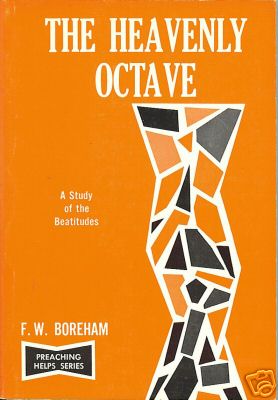
1935 The Heavenly Octave
1935 Ships of Pearl
1936 The Passing of John Broadbanks
1939 I Forgot to Say
1940 My Pilgrimage (Boreham’s autobiography)
1941 The Prodigal
1944 Boulevards of Paradise
1945 A Late Lark Singing
1948 Cliffs of Opal
1948 The Man Who Saved Gandhi (a short biography of J J Doke)
1951 Arrows of Desire
1953 My Christmas Book
1954 Dreams at Sunset
1954 In Pastures Green
1955 The Gospel of Robinson Crusoe
1956 The Gospel of Uncle Tom's Cabin
1958 The Tide Comes In
1961 The Last Milestone

Any others that I have missed?

Books written by others about Boreham or reprinting his writings
1937 Day by Day with F.W. Boreham ed. Leslie Church
1961 The Story of F.W. Boreham by T. Howard Crago
1974 Daily Readings from F.W. Boreham selected and arranged by Frank Cumbers, Hodder
1984 A Frank Boreham Treasury compiled by Peter F. Gunther
1994 Life's Verses (5 vols) republication by Kregel Publishing of series Texts that Made History. 2003 F W Boreham: The Public Theologian (unpublished doctoral thesis by Geoff Pound)

Friday, June 09, 2006

Blog Break

Thanks for taking the time to read the postings on this blog.

I am having a break from blogging over the northern hemisphere summer.

Geoff

Thursday, June 08, 2006

Boreham's Editorial Purposes

Motivation and Purpose
This posting seeks to identify the aims that Boreham possessed in writing editorials. What motivated his editorial writing and what was he trying to do?

Delivering Literary Delight
In reflecting on the genre of the essay, literary critic Robert Aswan says: “An essay is a thing of the imagination. If there is information in an essay, it is by-the-by, and if there is an opinion in it, you need not trust it for the long run. A genuine essay has no educative, polemical, or sociopolitical use; it is the movement of a free mind at play”.[1]

Boreham’s acknowledgment of playful delight in the writing and reading of literature is captured well in one of his Mercury articles: “He reads the books as he eats strawberries; not to attempt the creation of a record but for the sheer enjoyment of the thing”.[2] The examination of Boreham’s writing style has revealed the personal pleasure he experienced from the appearance and the sound of words in an editorial. While Boreham’s editorials bore evidence of a ruminative, playful imagination, Aswan’s summation is insufficient to describe Boreham’s editorial goals. His editorials neither lacked a purpose not conveyed a free mind at play. Boreham agreed with Crago’s statement that “he had never written an article for the sake of writing an article. Unless a topic could convey a message it never tempted his pen”.[3]

Editorials to Enlarge and Enrich
Boreham’s aim that his writing might both inform and provide relief and consolation is summed up when he expressed the function of drama “to broaden life’s horizon, to tint it with bright colours and to provide busy people pressed by many cares with an escape from the swords and the common place”.[4] His fondness for editorials that introduced literary figures arose from his contention that “all through the ages, ignorance has blocked the path of progress” but “books, more than anything else, have tended to dispel that ignorance”.[5] Writing in his restrained style, one detects an autobiographical confession and yearning that readers might connect fully with life in all times and places when he stated, “By means of books we escape, live in all lands, sail over all seas and become the citizens of the ages. Enlargement and enrichment must come to the mind of the man who reads Gibbon’s Decline and fall”.[6]

Awakening to the Treasures of History
In the editorials that developed historical themes, Boreham was seeking to awaken his readers to an appreciation of history. His editorials that captured the history of Australia and the British Empire were written in the hope that readers could grow to appreciate their ‘citizenship of the ages’. Boreham believed that telling of the beginnings and the significant chapters in the Australian story would develop social cohesion, national identity and patriotism. The concentration on biographical editorials sprang from Boreham’s view that readers would receive stimulation and inspiration from heroes, not simply by imbibing the ideas of his subjects but by being infused by their philosophy for “we come into personal touch with themselves and bear the impress of their magnetic personalities for ever afterwards”.[7]

Holding a Literary Mirror
Moreover, Boreham believed that readers and congregations “resent the didactic tone, the hortatory attitude” yet “yield instinctively to the suggestive and persuasive touch ... that leads them to answer their own questions, and talks, rather than orates”.[8] Rather than ‘preaching at’ his readers, Boreham’s editorial style was better understood as holding up a mirror to life. Explaining this with examples, Boreham wrote, “By his story of the ewe lamb, Nathan held a mirror to the face of David and brought that monarch to his knees. Shakespeare told us how Hamlet did the same thing by means of the travelling players, for King Claudius”.[9] Recognising that “the Divine voice, wherever and whenever heard, is invariably marked by softness, calmness and restraint ... [and] the most convincing and compelling exhibitions of super human power come to men not in the earthquake nor in the fire, but in a still small voice”, Boreham communicated in undertones.[10] He described this understated style as “poking the fire”[11] and on another occasion he likened his writings to the stars acting as pointers to the Southern Cross saying, “The papers that I have written possess no value or importance of their own; but they point to things that no man can afford to miss: that is their only glory”.[12]

Editorial Writing as Storytelling
Whether Boreham was seeking to inculcate some value or urge readers towards some commitment, he invariably adopted the storytelling method. Stories, Boreham believed, were more likely to hook and hold the attention of readers if they were about life. Of good novels Boreham wrote, “We love them for the sake of the life that is in them”.[13] He maintained that “the best illustrations of conversion are to be found, not in theology, nor even in religious biography, but in fiction”.[14] In a word directed to preachers but containing insight into Boreham’s view of the most effective style he wrote:

"I would, if I could only muster up the courage, say a word to preachers before laying down my pen. Is there any better way of preaching than by storytelling? Indeed, is there any other way of preaching? As soon as the terminology of the pulpit becomes technical and abstract, the tired mind declines to follow; only so long as a picture is being painted or a story told will the hearer maintain an eager pursuit. And, after all, has not the preacher been called to the service of the Most Sublime Story-teller of all the ages?"[15]

This statement is another expression of Boreham’s advocacy for pictures and stories and his abhorrence of technical, abstract thought which he believed was unhelpful for ordinary people seeking to understand ideas. While this assessment may have come from Boreham’s own experience, other writers who promulgated this view included the influential Thomas Macaulay who said, “Logicians may reason about abstractions. But the great mass of men must have images…. Doctrines … must generally be embodied before they can create a strong public feeling”.[16]

Geoff Pound

Image: High Street, the main street of Armadale, Melbourne. A stone's throw from the Armadale Baptist Church. Photo taken through car window at 30 mph!

[1] Robert Aswan, ‘Introduction’, The best American essays ed. Cynthia Ozick (Boston: Houghton Mifflin Co. 1998), xv.
[2] Boreham, Mercury, 21 March 1942.
[3] Crago, The story of F W Boreham, 248.
[4] Boreham, Mercury, 4 November 1950.
[5] Boreham, Mercury, 31 August 1940.
[6] Boreham, Mercury, 31 August 1940.
[7] Boreham, Mercury, 31 August 1940.
[8] Crago, The story of F W Boreham, 167.
[9] Boreham, Mercury, 23 July 1949.
[10] Boreham, Mercury, 19 February 1949.
[11] F W Boreham, Rubble and roseleaves (London: The Epworth Press, 1923), 118.
[12] Boreham, The crystal pointers, 8.
[13] Boreham, Mercury, 13 August 1955.
[14] Crago, The story of F W Boreham, 180.
[15] F W Boreham, The ivory spires (London: The Epworth Press, 1925), 113.
[16] Thomas B Macaulay, “Milton,” in Critical and historical essays by Lord Macaulay (London: Longmans, Green, and Co., 1874), 10-11.

Wednesday, June 07, 2006

Boreham and Controversy

While Boreham’s decision to distance himself increasingly from the issues of his time weakened the prophetic dimension of his editorial writing, his fear of controversy further diminished his ability to address the difficult issues of his day.

Fresh and Fearless
The first eight years of Boreham’s ministry in New Zealand were characterised by a fearless outspokenness on theological doctrine and issues of national and international importance. Within six months of arriving in Mosgiel Boreham preached a sermon in which he launched a stinging attack on a Presbyterian minister, the Rev McKerrow. In this sermon (later published in the local newspaper and subsequently printed as a booklet), Boreham condemned the Presbyterian practice of infant baptism and drew on the insights of biblical scholars to set forth the case for believers’ baptism.[1]

Boreham advocated the reading of the Bible in New Zealand schools,[2] led a vigorous temperance campaign,[3] attacked city leaders whose policy led to a desecration of the Sabbath[4] and advocated compulsory military training.[5] During the Boer War, he slammed those of the anti-militarist school and countered their influence by writing, “The nervous politicians of the present day who nurse this nightmare [the tendency towards militarism] should be able to estimate the real difference between the military necessity of a great empire and the foundation of that empire itself”.[6] On the enemy itself, Boreham wrote, “When the deluded Boers come to discern that life is more tolerable under the British rule than under the corrupt Boer oligarchy, they will very soon become fit to participate in self-government”.[7] In this early phase of Boreham’s career, he exhibited courage and engaged in a range of public questions with apparent effectiveness.

Once Bitten
In a letter to the Otago Daily Times, Boreham was criticised for a statement that he had made in his capacity as President of the Baptist Union. The criticism, made by the Rev J T Hinton, a friend and retired Baptist minister, concerned the exact wording and extent of the support for a motion considered by the Baptist Union at its previous assembly on the subject of Bible reading and “ethical and religious instruction” in schools.[8] For the next week Boreham and Hinton exchanged letters through the paper, at first pleasantly until Boreham called Hinton’s misrepresentation of him “criminal”.[9] When after a week the matter had not been resolved, a reader William Hutchinson wrote to the paper about this feud between “two of our reverend gentlemen” saying, “What can ordinary folks think when the minister of the gospel writes of another that he has convicted him of ‘gross misrepresentation of vital and fundamental facts, in order to mislead public opinion on a grave moral issue at an important crisis daring to contribute the utterly, admittedly and unpardonably false assertion?”[10] He then concluded, “The Bible is sometimes as conspicuous by its absence from the pulpit as from the public school”.

Reflecting on this “bitter experience which left its mark upon the whole of my ministry”, Boreham acknowledged how his attack had “mortally offended” this senior minister and had resulted in a breakdown of their friendship.[11] Eventually reconciliation was made but Boreham said, “I secretly vowed that I would never again allow myself to become entangled in public controversy. During the years, I have often listened to animated debates in which I longed to intervene, and have followed newspaper discussions into which my pen itched to plunge”.[12] Boreham was not always faithful to his vow. He was vociferous in denouncing George Bernard Shaw and his disciples who were critical of the British involvement in the First World War,[13] he was filled with anti-German sentiment during the Great War[14] and he was scathing in his criticism of the proposals by “workers” and unionists to get a “higher education”.[15] On only one other occasion did Boreham become embroiled in a public feud, when in 1915, he attacked the Roman Catholic church in its bid to gain State aid for Roman Catholic schools.[16]

Controversy Within Limits
In writing about controversy, Boreham recognised the spirit of conflict as “a sign of health” and he encouraged people not to denounce controversy as an unqualified evil but “to define the limits within which it might be utilized to national ends”.[17] He stated that reformers “often fail us because they rely too exclusively on the negative approach ... they attack this; they condemn that; they denounce the other”. Many times Boreham was to summarise his approach to criticism and controversy by saying, “The best way of showing that a stick is crooked is by laying a straight one beside it”.[18]

Peace at all Costs
Boreham was praised in many quarters for his irenic spirit and was well known as “the friend of all and the enemy of none”.[19] J J North acknowledged that Boreham “clashed with the Presbyterians in his callow days [but] we have not seen his name associated with a controversy since. With Fundamentalist and Modernist, with High Church and Low, with Catholic and Protestant, he has no discernible quarrel”.[20] Boreham’s positive and diplomatic style marked his editorial writing to such an extent that only a handful of published letters to the editor regarding his articles were written, most of which were letters of appreciation[21] with only two questioning Boreham’s interpretation of literary figures.[22]

Through the pages of the Mercury and the Age, Boreham was not critical of the government nor did he provoke theological controversy as contemporary editorialist, Edward Kiek, did through the pages of the Advertiser.[23] Boreham lacked the provocative, pugnacious style of the Rev Alan Walker who, in a later era, wrote editorials for the Sydney Morning Herald and whose active campaigns against apartheid, the Vietnam War, nuclear weapons, alcohol and gambling embroiled him in regular controversy.[24] Boreham’s personality was of a more peaceful kind and earned him enormous public respect across all parties. However, his decision in 1902 to avoid controversy and write benign editorials severely limited his effectiveness as an interpreter of public issues, a public theologian and a conscience to his constituency. Boreham knew this, for reflecting on this decision thirty-three years later he wrote, “I think I have been wrong. I think ... I may have shirked my duty”.[25]

Geoff Pound

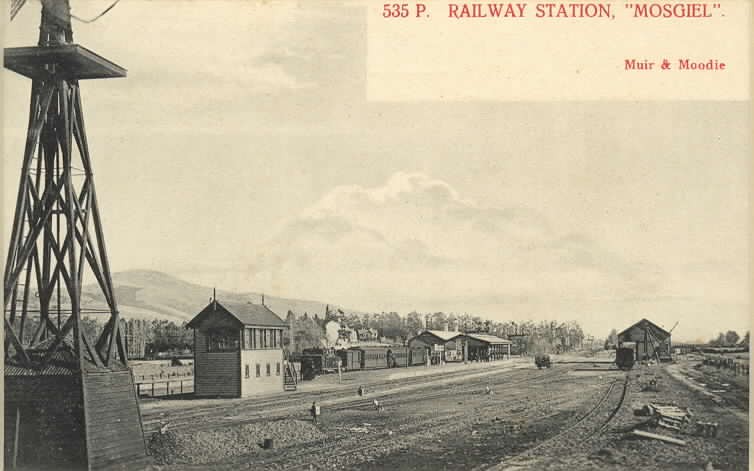
Image: Mosgiel Train Station. A photo of a postcard in FWB’s memorabilia.

[1] Frank W Boreham, Christian baptism (Dunedin : H H Driver, 1895).
[2] Boreham, Otago Daily Times, 5 July 1899.
[3] Boreham, Otago Daily Times, 30 August 1899.
[4] Boreham, Otago Daily Times, 30 August 1900; 12 April 1901.
[5] Boreham, Otago Daily Times, 18 March 1901.
[6] Boreham, Otago Daily Times, 7 September 1901.
[7] Boreham, Otago Daily Times, 29 October 1901.
[8] J T Hinton and F W Boreham, Otago Daily Times, 25 August 1902; 29 August 1902; 30 August 1902; 1 September 1902; 2 September 1902; 3 September 1902; 4 September 1902; 5 September 1902.
[9] Boreham, Otago Daily Times, 2 September 1902.
[10] Boreham, Otago Daily Times, 12 September 1902.
[11] Boreham, Ships of pearl, 154-155.
[12] Boreham, My pilgrimage, 171.
[13] Boreham, Mercury, 5 December 1914.
[14] Boreham, Mercury, 13 February 1915; 20 February 1915.
[15] Boreham, Mercury, 17 April 1915.
[16] Boreham, Mercury, 8 April 1915; 13 April 1915; 14 April 1915; 21 April 1915.
[17] Boreham, Mercury, 30 June 1934.
[18] Boreham, Mercury, 4 August 1956.
[19] Australian Baptist, 29 April 1941.
[20] Australian Baptist, 16 February 1926. It would appear that North’s mention of Boreham’s ‘clash with the Presbyterians’ is a reference to the baptismal controversy mentioned earlier.
[21] Letter to the editor by H R N, Mercury, 4 August 1934; Letter to the editor by J H R, Age, 26 October 1940. Letter to the editor by W J R, Mercury, 5 September 1949.
[22] Letter to the editor by J S D, Age, 6 July 1940. This relates to Boreham’s article on Richard Blackmore in the Age, 23 June 1940; Letter to the editor by ‘M L E’, Age, 28 September 1940. This relates to Boreham’s article on the Bronte sisters in the Age, 21 September 1940.
[23] Walter Phillips, Edward S Kiek: Liberal churchman his life and thought (Adelaide: Uniting Church Historical Society, 1981), 18. Phillips gives an example of Kiek’s criticism of the welfare state in Advertiser, April 1945.
[24] Don Wright, Alan Walker: Conscience of the nation (Adelaide: Open Book Publishers, 1997), 114, 134, 162, 163, 165. Walker wrote Christmas and Good Friday editorials for the Sydney Morning Herald from the early 1970s.
[25] Boreham, Ships of pearl, 160.