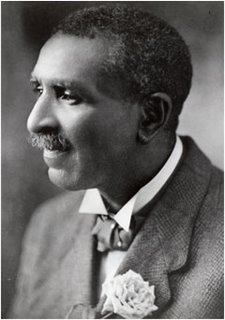
Frank William Boreham 1871-1959

Frank William Boreham 1871-1959
A photo F W Boreham took of himself in 1911

Thursday, September 21, 2006

Boreham on Nature's Therapy

Nature as Therapist
A further role of nature in Boreham’s writings that developed the linkage between beauty and health was nature’s therapeutic service. The capacity of nature to cure physical ailments was extolled by Boreham. He included testimonies of famous people such as Robert Louis Stevenson who, with his poor health and frail body, felt that the return of spring “gave him a new hold upon existence, and he delighted in compelling his sickly friends to drink of the same invigorating tonic”.[1] In this 1935 editorial, Boreham said that the response of a sick body to the life and warmth of the sun was a principle of nature upon which religion itself is based in which “the frailty of humanity [is] regenerated and revitalized by living contact with the unseen”.

Immersion in Nature
In addition to physical renewal, Boreham wrote revealingly of the wholesome psychological benefits he and his family had gained from an immersion in nature when after the birth of their first two children his wife was afflicted with depression and the family, on doctor’s advice, spent some weeks recuperating at Otago’s Taieri Mouth (named in his books ‘Piripiki Gorge’).[2] Similarly, in 1916 when Boreham’s health broke down his doctor prescribed some weeks at Tasmania’s Wedge Bay.[3]

Tonic of Big Things
In one of his early essays entitled, ‘A tonic of big things’, Boreham wrote of the contribution of nature to one’s mental health: “Immensity is magnificent medicine; that is one reason ... why the doctors send us to the seaside. We forget the tiddley-winking in the contemplation of the tremendous; we lose life’s shallow worries in the vision of unplumbed depths”.[4]

Nature As Nurse
Boreham quoted poet John Greenleaf Whittier’s view of “Nature as a nurse”[5] and the “baffled and frustrated” Mark Rutherford who exclaimed, “I loved to walk until I could see the open water ... The sea was a corrective to the littleness around me”.[6] In one of the few editorials in which Boreham lifted the curtain on his own experience he wrote: “When we miss a train, or mislay a letter or find a social program spoilt by rain, it exercises a steadying effect upon the nerves to reflect that Orion and Pleiades still roll, Niagara still flows, Mt. Everest still wraps his clouds about him, daring a conqueror to tread his summit. The big things are as the big things always were”.[7]

Stellar Therapy
The experience of extreme homesickness had led Boreham to prove that “stars are an excellent medicine for homesick hearts”[8] especially during winter when spirits were often low but when “the early dusk ... provides ample opportunity to survey the stars”.[9] Adding the endorsement of novelist Mark Rutherford, Boreham recommended stellar therapy for soldiers during wartime, suggesting that as they surveyed the galaxies from wherever they were posted the glittering “comrades of the night” would unite them with their loved ones at home.[10]

Prescription for Homesickness
The large number of Boreham’s nature editorials suggests he was seeking to encourage his readers to experience nature’s therapy especially, during the worries of war.[11] However, Boreham was diagnosing a prevalent and deep-seated displacement, homesickness and alienation in the Australian psyche that the war only accentuated. He, like many of his readers, was seeking to feel at home in a country that was strange, harsh and inhospitable. Nature provided familiar reference points that could link people with the home from which they had come while helping them establish a new life in an unfamiliar country and call Australia home.

Geoff Pound

Image: “to the seaside”

[1] Boreham, Mercury, 3 September 1949.
[2] Boreham, My pilgrimage, 167; F W Boreham, The blue flame (London: The Epworth Press, 1930), 160.
[3] Boreham, My pilgrimage, 201-206.
[4] F W Boreham, The luggage of life (London: The Epworth Press, 1912), 178.
[5] Boreham, Mercury, 7 June 1941; Age, 11 May 1946.
[6] Boreham, Mercury, 28 May 1955.
[7] Boreham, Mercury, 10 September 1949.
[8] F W Boreham, The silver shadow (London: The Epworth Press, 1918), 77.
[9] Boreham, Mercury, 8 June 1935.
[10] Boreham, Mercury, 24 July 1915.
[11] Boreham, The luggage of life, 184.

Wednesday, September 20, 2006

Boreham on Nature's Contribution

There was a great interest and a rich tradition in Australian papers of articles on nature themes when Boreham wrote his many editorials on the contribution that nature made to life.[1] This post and those over the next few days consider the various roles of nature addressed in Boreham’s editorials.

Banquet of Life
In an article published as the First World War was commencing its destructive work, Boreham asserted that, “the relationship between beauty and civilization has never been defined”.[2] His frequent discussions about beauty and the role of aesthetics to the human condition[3] reveal his agreement with Fyodor Dostoevsky’s high claim that “beauty will save the world”.[4] Boreham announced, “Beauty is the banquet of life,” and was swift to declare that nature was the major sphere at which humanity might sumptuously dine.[5] He did not regard beauty as a nutritional supplement but as an indispensable element for the survival and well-being of society. On another occasion he stated, “Health and beauty go together … they are life’s inseparables”.[6]

Beauty in the Eye…
Boreham compared statements from early explorers who had written glowingly of Australia’s beauty with those who concluded that the country was ugly and uninteresting to illustrate the different views that people have about beauty. If health and beauty go together, Boreham’s health card for Australians in the mid-1920s was grim. Writing about the neglect of the local landscape by Australian artists and their preference for the English landscape, Boreham said, “Australians are blind to beauty … The Australian public is as yet unprepared to realize the beauty of the land of its adoption”.[7]

Impatience With Definitions
While he asked, “What is beauty?” Boreham had difficulty in answering the question in great detail.[8] Confessing his impatience with definitions and his preference for experiencing nature and beauty with all his senses, Boreham said, “How can I set down in words the pleasure that I find in the perfume of a violet, in the song of a thrush, or in the graceful poise of a deer”.[9]

Sight was the major avenue by which Boreham experienced nature and he often remarked on its beauty in “the restfulness of a green lawn”[10] or “the pageantry of autumn [in its] gorgeous colour scheme”.[11] His sensitivity towards beauty was heightened by the places where he had lived—Tunbridge Wells, which he said that for “sheer, downright prettiness ... stands without a rival in the wide, wide world”,[12] that New Zealand was “a land of luxurious vegetation ... broad and fertile plains ... sky-piercing summits glistening with eternal snows; a land of rushing rivers and thunderous cataracts”[13] and of Australia he wrote that “no continent can offer to the eyes of men a fauna so wealthy and so varied”.[14] As well as celebrating the predictable sources, Boreham urged people to contemplate beauty in the dullness of rocks,[15] the drabness of mud[16] and the starkness of midwinter.[17]

Geoff Pound

Image: “the pageantry of autumn.”

[1] Drew Hutton and Libby Connors, A history of the Australian environmental movement (Cambridge: Cambridge University Press, 1999), 30-31.
[2] F W Boreham, Mercury, 12 June 1926.
[3] Boreham, Mercury, 21 February 1920.
[4] Fyodor Dostoevsky, The idiot (1869; reprint, New York: Everyman’s Library, 2001), 382. These words are expressed by Dostoevsky’s characters Ippolit and Aglaya Epanchin.
[5] Boreham, Mercury, 6 March 1954.
[6] Boreham, Mercury, 24 April 1926.
[7] Boreham, Mercury, 24 April 1926.
[8] Boreham, Mercury, 21 February 1920.
[9] F W Boreham, Casket of cameos (London: The Epworth Press, 1924), 285.
[10] Boreham, Mercury, 17 February 1934.
[11] F W Boreham, A witch’s brewing (London: The Epworth Press, 1932), 18.
[12] F W Boreham, Loose leaves: From the journal of my voyage round the world (Mosgiel: Taieri advocate, 1902), 44.
[13] F W Boreham, My pilgrimage (London: The Epworth Press, 1940), 134.
[14] Boreham, Mercury, 15 July 1933.
[15] Boreham, Mercury, 27 June 1925.
[16] F W Boreham, The other side of the hill, (London: The Epworth Press, 1917), 152.
[17] Boreham, Mercury, 21 June 1941.

Tuesday, September 19, 2006

Boreham and His Passion for Nature

Reverence for Life
Readers of F W Boreham’s books of essays, many of which bear titles drawn from the realm of nature, would not be surprised to learn that one of the major themes of his editorials and essays was ‘Reverence for nature’.[1] In the development of Boreham’s flexible cycle of editorial themes, a nature topic was often prompted by an anniversary (of an explorer, naturalist, scientist, geologist or nature poet), seasonal changes and events (including holiday periods, Arbor Day and Wattle Day), celebrations of nature (annual flower show, agricultural show) and news (of explorations or natural disasters). However, Boreham never needed an excuse to indulge his passion for writing about nature and many of his nature editorials did not seem to be related to any particular event. Aspects of nature were used in abundance by Boreham to illustrate a principle or to buttress an argument.

Young Naturalist
Recalling the early impact of nature upon him, Boreham said, “As a small boy, I found among my treasures three things that filled me with ceaseless wonder and admiration—the skin of my horse-chestnuts, the cocoons of my silkworms and the shells of the birds’ eggs that I brought home from the lane”.[2] The role of Boreham’s parents was crucial in developing this sense of wonder by introducing their son to nature books and taking him on walks around the beauty trails of Tunbridge Wells.

Shaped by Romantic Spirit
Boreham’s numerous references to nature reflect the age in which he was raised, a period that was imbued with the Romantic spirit, which gained momentum because it represented a protest movement against “the far reaching thrusts of modernization”.[3] In tracing the influence of Romanticism upon English evangelicalism in the last quarter of the nineteenth century, David Bebbington writes, “It was as though Wordsworthian pantheism had become an additional article of the evangelical creed .… The educated public was turning to Romantic sensibilities as an escape-route from the urban, industrial present and the holiness movement was part of the process”.[4] Christians like Boreham resonated with the Romantic writers who fostered an appreciation of nature, challenged the despoliation of the environment and cultivated a contemplation of the relationship between the natural and spiritual realms.

A Lifelong Enchantment
As an old man, Boreham testified to the intensification of his love of nature when saying, “The longer we live, the more [nature’s] loveliness enchants us”.[5] Boreham read widely in naturalism and natural science but the two whom he acknowledged as his special teachers were Charles Darwin (1809-1882) and Richard Jeffries (1848-1887).[6] His involvement with the Royal Society of Tasmania, which had a long and rich history in environmental preservation and political lobbying for national parks, was a further context for Boreham to learn and refine his thinking about nature.

Geoff Pound

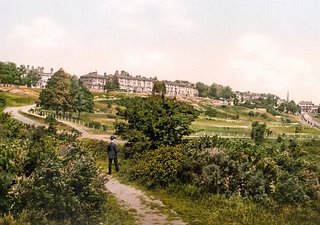
Image: Tunbridge Wells Common

[1] Boreham’s books with titles drawn from nature include Loose leaves, Mountains in the mist, Mushrooms on the moor, The silver shadow, The uttermost star, A reel of rainbow, A handful of stars, Rubble and roseleaves, Wisps of wildfire, The crystal pointers, A tuft of comet’s hair, The fiery crags, The three half-moons, The blue flame, When the swans fly high, A late lark singing, In pastures green and The tide comes in.
[2] F W Boreham, Rubble and roseleaves (London: The Epworth Press, 1923), 19.
[3] Karl-Werner Brandt, ‘New social movements as a meta-political challenge: The social and political impact of a new historical type of protest’, Thesis eleven, no. 15, 1986, 66-7.
[4] David Bebbington, Evangelicalism in modern Britain: A history from the 1930's to the 1980's (London: Unwin Hyman, 1989), 168.
[5] F W Boreham, When the swans fly high (London: The Epworth Press, 1931), 244.
[6] F W Boreham, The crystal pointers (London: The Epworth Press, 1925), 163. For more information on the famous naturalist Charles Robert Darwin, see Dictionary of National Biography eds. Leslie Stephen & Sidney Lee vol. V (London: Oxford University Press, 1921), 522-534. For more information on Richard Jeffries see Bloomsbury guide to English literature ed. Marion Wynne-Davies (London: Bloomsbury Publishing, 1989), 633-634. Sometimes the name ‘Jeffries’ is spelt as ‘Jefferies’.

Monday, September 18, 2006

Boreham and His Theology of Inclusivity

F W Boreham’s call to inclusivity through recognizing the value of children, the disabled, women and the racially oppressed was predominantly sounded through stories of audacious men and women who struggled against great odds and challenged the dehumanizing forces in society.

Later, comparing those in the foremost positions in society with those less advanced, Boreham said, “The religion that has nothing to say to the hindmost is no religion for a world like this”.[1] While Boreham called for specific social, political and educational measures, this call was a whisper compared with the voice of many of the lives he extolled. The courage of Jane Austen or the tenacity of Mahatma Gandhi did not translate into the same intensity in the writings of Boreham.

His editorials about Australian aborigines revealed an unconscious racism as he did not convey the uniqueness, the value and the potential towards them that his more general statements exhibited. For one who was a student and advocate of history, Boreham’s silence on the atrocities committed towards aborigines illustrate that like most Australians he was part of the “history of forgetting, a tradition of disremembering, an affliction of collective amnesia”.[2]

Boreham’s theological convictions about the human uniqueness and the worth of an individual took on a national dimension when he urged his readers to recognise the uniqueness of Australia. Boreham’s call to Australia to celebrate its achievements, find its voice and exploit its resources were aspects of the corporate responsibility of its citizens or, as expressed by Vance Palmer, “To discover ourselves—our character, the character of our country and the particular kind of society that has developed here”.[3] The theological foundations of these convictions were not always visible and his views also seemed to have been inspired by what Boreham had learned about national identity from the lessons of history.

Geoff Pound

Image: ‘to discover the character of our country…’


[1] Boreham, Mercury, 17 January 1948.
[2] Ken S Inglis, Observing Australia: 1959 to 1999 (Melbourne: Melbourne University Press, 1999), 155.
[3] Vance Palmer, ‘Future of Australian literature’, Age, 9 February 1935.

Sunday, September 17, 2006

Boreham and His Theology of Beauty

F W Boreham’s conviction that books, art and theatre are the major avenues through which people might connect with the richness of life resonates with J R R Tolkien’ assertion that fairy-stories (and other imaginative literature) satisfy “certain primordial human desires” including the desire to “survey the depths of space and time” and the desire “to hold communion with other living things”.[1]

His contention that the arts provide a “broadening of life’s horizon”[2] is akin to the thoughts of contemporary Roman Catholic theologian Tony Kelly who, in extolling the re-creative role of art says, “It refreshes human experience, helping us to make and see things in their originality. The creativity of the artist works to clean the windows of perception, lest the vision be blurred by interior drabness, triteness, familiarity and possessiveness.”[3] Expressions of adventure and imagination were for Boreham manifestations of a divine urge and a participation in divine creativity.

Boreham’s early hesitation about attending plays and movies in the 1920s reflected not only “the neglect of beauty”[4] by the church but the more disastrous condition expressed in the damning words of the Welsh poet R S Thomas: “Protestantism—the adroit castrator of art; the bitter negation of song and dance and the heart’s innocent joy”.[5] While recognizing the danger pursuing aesthetics without reference to God, Boreham affirmed the artist’s role “to increase the world’s stock of beauty”. He sought to restore within the church and in society the essential relationship between a love of God and a love of beauty. Boreham’s thinking is captured well by Richard Harries when writing, “There is a resemblance, a relationship, between the beauty we experience in nature, in the arts, in a genuinely good person and in God; and that which tantalizes, beckons and calls us in beauty has its origin in God himself”.[6]

Geoff Pound

Image: “to increase the world’s stock of beauty”.

[1] J R R Tolkien, Tree and leaf. London: Unwin, 1964), 18. This thought is amplified by Tony Kelly, in ‘Faith seeking fantasy: Tolkien on fairy-stories’. Pacifica 15 (2002): 190-208.
[2] Boreham, Mercury, 4 November 1950.
[3] Kelly, ‘Faith seeking fantasy: Tolkien on fairy-stories’, 201.
[4] Richard Harries, Art and the beauty of God (London: Mowbray, 1993), 1.
[5] R S Thomas, ‘The minister’, Collected poems 1945-1990 (London: Phoenix, 1993), 54.
[6] Harries, Art and the beauty of God, 6.

Saturday, September 16, 2006

Boreham and His Theology of Fulness

In examining the major theme in F W Boreham’s writings—‘Realizing full expression’—it is interesting to see that the theological dimensions were not explicitly drawn until his editorials took on a greater religious content in the 1940s. When an editorial on this subject was reworked into an essay for a Christian readership Boreham said:

"The supreme thing that we each have to do in the theatre of life is to give that individuality its full and natural expression .… For that very purpose it was divinely created ... each man’s individuality is itself a message to mankind, a message which he, and he alone, can faithfully deliver. And the whole art of life lies in giving such genuine and accurate and rational expression to that unique individuality of mine, that ... men may receive a message from my Father that could have come to them in no other way."[1]

In contrast to the Puritan doctrine of human depravity, Boreham was optimistic about the potential of human beings. Perhaps it reflected the influence of the Quaker writers upon him about whom “this intrinsic worth of the individual sprang for them out of the divine possibilities inherent in the soul of man” and their belief in “the divine right of every soul”.[2] Boreham viewed the uniqueness and novelty of an individual as an act of a creative God. The human challenge of ‘making the best of oneself’, Boreham believed, was the rightful response to one’s creator and a divine statement to other human beings. While in his editorials Boreham avoided biblical terms like ‘salvation’, the act of ‘discovering oneself’ and ‘making the best of oneself’ represented the language by which his theology of salvation was expressed.

In his editorials to a mixed faith readership, Boreham wrote of realizing one’s full expression as “the highest attainment in life” and as a way to “attain to happiness” in life.[3] Individuals would also be motivated by the knowledge of each doing things in their own way, developing a perfection of form and the satisfaction of doing things which bore “the stamp of one’s individuality”.[4] While the uniqueness and value of the individual were central to Christian theology, Boreham in his editorials did not adopt explicit religious language or claim biblical authority in asserting these truths until the 1940s. The realization of one’s full potential through ongoing learning, becoming oneself and expressing one’s own opinions were offered by Boreham as life wisdom attested through the personalities of significant historical figures rather than as biblical imperatives.

Geoff Pound

Image: In ‘the theatre of life’.

[1] Boreham, When the swans fly high, 131-134.
[2] Rufus M Jones, The faith and practice of the Quakers (London: Methuen, 1927), 89.
[3] Boreham, Mercury, 1 January 1921.
[4] Boreham, Mercury, 8 April 1922.

Friday, September 15, 2006

Boreham on Australian Advancement

F W Boreham recognised that one of the major challenges facing Australia and the first business of its politicians in the “plastic stage of its history”[1] was “the discovery and exploitation of her immense resources”.[2] In particular, he advocated further exploration and increased mining of Australia’s mineral resources.[3]

Scientific Advancement
In 1915, when Prime Minister William M Hughes accepted responsibility for national scientific research urging that “science … must do its utmost to win the war and to develop a great continent when the war is over”, Boreham devoted five editorials to scientific themes.[4] In these editorials he noted science’s harmony with religion, its ethical demands, its ability to increase agricultural production and other ways that science might serve humanity.[5] Boreham did not uncritically embrace science and technology for, as stated at the commencement of this chapter, he expressed his awareness of the way new inventions could threaten important social values such as the uniqueness and worth of the individual. He criticised on a number of occasions the country’s lethargy in failing to seize the fish market opportunities, especially in 1919 when the northern hemisphere fishery stocks were depleted in contrast to Australia where “the great harvest of the sea is waiting for reapers”.[6]

White Elephant
Boreham was convinced that the exploitation of resources required the nation to have a greater population. In the midst of the First World War he said, “The one peculiarity about Australia—the feature that distinguishes it from every other country on the face of the planet—is the fact that we have here a sparse population scattered around the fringes of an enormous continent [making it] a … white elephant”.[7] In 1921, there was a bitter public debate about the sustainability of the continent to support a huge population. One side, some of whom dreamt of a population of 100 million, saw possibilities of British investment that needed a greater population to develop these markets. The other side, led by journalists and trade unionists, voiced the skepticism that many Australians felt about the possibility of increasing unemployment through an over-supply of workers.[8]

Populate or Perish
Under the leadership of Prime Minister Stanley M Bruce, the 1920s were deemed to be years that saw a new imperial partnership expressed in the press statement, “The United Kingdom had a surplus population; Australia had the empty spaces. All the people in high places agreed that as far as possible the newcomers should be Britishers.”[9] A few people, such as Weather Service physiographer and academic, Thomas Griffith Taylor, challenged the rhetoric of ‘boosterism’ believing that the nation’s arid climate meant that 20 million was a more realistic population level.[10] In 1921, Boreham, with an eye for further British emigration and growth in the local market, called politicians to “make Australia more populous”.[11] Even though the onset of the depression pricked the dream for large-scale immigration and agricultural schemes, Boreham repeatedly issued his plea. After the Second World War, Boreham viewed the need for population increase as being so critical that despite the influx of immigrants his watchword in a 1948 editorial was the political slogan “populate or perish”.[12]

Sentimental Motivation
While Boreham’s push for scientific advancement and population increase represented a way of Australia realising economic fulfilment and fostering international partnership, he admitted to possessing a sentimental motivation.[13] His plea for British clergy to migrate to Australia indicated that he shared Gladstone’s approach to British emigration to the colonies that was also motivated by a desire to “form the character of their inhabitants”.[14]

Geoff Pound

Image: Advance Australia Fair

[1] Boreham, Mercury, 1 January 1921.
[2] Boreham, Mercury, 3 February 1921.
[3] Boreham, Mercury, 3 February 1921.
[4] William J Lines, Taming the great south land: A history of the conquest of nature in Australia (North Sydney: Allen & Unwin, 1991), 165.
[5] Boreham, Mercury, 20 February 1915; 11 September 1915; 16 October 1915; 6 November 1915.
[6] Boreham, Mercury, 14 June 1919.
[7] Boreham, Mercury, 18 March 1916; 6 August 1938.
[8] Michael Roe, Australia, Britain, and migration 1915-1940: A study of desperate hopes (Cambridge: Cambridge University Press, 1995), 10.
[9] Argus, 12 May 1923; Clark, A history of Australia vol. 6, 224.
[10] J M Powell, A historical geography of modern Australia (Cambridge: Cambridge University Press, 1988), 129-137.
[11] Boreham, Mercury, 16 April 1921.
[12] Boreham, Mercury, 24 January 1948.
[13] Boreham, Mercury, 2 May 1914.
[14] Bebbington, William Ewart Gladstone, 107.

Thursday, September 14, 2006

Boreham On Finding Your Voice

Following the First World War there were numerous calls for an Australian voice. In his poem entitled ‘Echoes’, Frank Wilmot urged Australia to resist foreign influences when he said, “Australia, speak! … Speak in a voice of your own.”[1]

In an essay published in 1920 the British-born historian G Arnold Wood noted the development of a distinctly Australian voice when he said, “Australian ideas are the expression of a civilization and a temperament that have become distinct from the civilization and temperament of Britain.”[2]

Boreham participated in the conversation about the unique features of an Australian artistic expression, which the literary critic, Vance Palmer said, involved Australians making a “spiritual adjustment” to their surroundings.[3] Offered as a possible direction for Australian artists to pursue, Boreham said that the distinctive “self-expressing and self-revealing” style of New Zealand literature was largely attributable to the influence of its indigenous people on those active in the arts.[4]

In noting that the Australian “outdoors climate” was not conducive to developing the “indoor” arts, Boreham pleaded for the writing of Australian music. He asked, “Since [Australia] is less hampered and trammeled by antique traditions, why should not ‘a land of lovely voices’ go one step further and give the world the music for which it is wistfully wanting?”[5] His was not a lone plea, for others such as Henry Tate had put forward ideas for “an Australian line of expression in music”.[6]

One area in which Boreham hoped Australia would increasingly find its full expression was in the field of literature. In 1927 he lamented: “A great deal of Australian literature is simply English literature that happens to have been written in Australia. It is not essentially Australian; it is not descriptive of Australia; and a time may come when the fact that it was penned beneath the Southern Cross will pass from the minds of men”.[7]

The outlook was not entirely bleak for in an editorial two months earlier to commemorate Australian Authors Week he cited poets such as C J Dennis whose writings were signaling “the beginning of things ... the outbursts of Australian poesy ... a new minstrelsy”.[8]

In one of his many articles written for the commencement of the annual Tasmanian Art Festival, Boreham asked, “Is there such a thing as Australian art?”[9] Others were asking the same question and the first exhibition of Australian Modern Art in Sydney in 1926 and the return to Australia of artist Tom Roberts in the same year began to provide a positive answer. Echoing the concerns of Australian artists such as Frederick McCubbin,[10] Boreham called for the emergence of a confident style that was drawn from the Australian landscape saying, “The artists fear to depict Australia as it is ... our colours and landscapes are painted like English scenes”.[11] Writing again on the subject in 1942, shortly after the first exhibition of aboriginal art works,[12] Boreham asserted that Australians must avoid the British inferiority complex regarding its art and encouraged artists to develop a confidence in depicting Australian scenes in an Australian way.[13]

Geoff Pound

Image: The kookaburra (laughing bird), a symbol of the Australian voice

[1]Furnley Maurice [Frank Wilmot], ‘Echoes’, in Poems by Furnley Maurice, ed. Percival Serle (Melbourne and Sydney: Lothian Publishing Co. Pty. Ltd., 1944), 42-43.
[2] G Arnold Wood, ‘Australia and Imperial politics’, in Australia economic and political studies, ed. Meredith Atkinson (Melbourne: Macmillan & Co. Ltd., 1920), 402.
[3] Vance Palmer, ‘Future of Australian literature’, Age, 9 February 1935.
[4] Boreham, Mercury, 29 May 1943.
[5] Boreham, Mercury, 6 July 1935.
[6] Clark, A history of Australia vol. 6, 292.
[7] Boreham, Mercury, 12 November 1927.
[8] Boreham, Mercury, 12 September 1927.
[9] Boreham, Mercury, 24 April 1926.
[10] Clark, A history of Australia vol. vi, 81.
[11] Boreham, Mercury, 24 April 1926.
[12]Albert Namatjira’s art was exhibited at the Fine Art Society Gallery in Melbourne in December 1938.
[13] Boreham, Mercury, 17 January 1942.

Wednesday, September 13, 2006

Boreham on Australia and Britain

While the Australian poet, Henry Lawson, had called on the “sons of the south [to] make a choice between ... the old dead tree and the young tree green”,[1] Boreham offered an alternative twist on the metaphor when he likened Australia’s relationship to England “as a new shoot on an old tree”.[2]

Boreham’s view of Australia was typical of many people who “looked to the old land as the land of their birth and to the dominions as the land of their adoption”.[3] Manning Clark has stated that the conscription debate of the First World War revealed that there were two Australias, those with “their slogan—loyalty to King and Empire [with] ... their culture—British culture in Australia” and those who believed “Australia would achieve nothing so long as her aim was to be an ‘outlandish suburb of England or Europe’”.[4] While the two referenda on conscription severely divided Australia, its decision not to follow the lead of Britain, New Zealand and Canada in embracing conscription demonstrated an independence of thought and a resoluteness that were significant signs of its growing maturity as a nation.

While encouraging Australia to mature as a nation, Boreham never lost his “loyalty to King and Empire”. He invariably compared Australian life with the British standard, bemoaning Australia’s indifference towards antiquity and its weakness “on the domestic side ... [where] the authority and influence of the home is scarcely what they used to be”.[5] In various ways he depicted Australia “in its infancy”[6] with the “sturdy privileges enjoyed by young nations permitted to erect their distinctive civilisation on the sturdy foundations laid by people whose annals run back into antiquity”.[7]

Boreham believed that it was the suffering and the service of the First World War that forged in Australia a sense of its indebtedness to Britain as “mother and daughter, with all the oceans of the world rolling between them finding their hearts beating in perfect union”.[8] In this same Anzac Day editorial, Boreham adopted the religious imagery of baptism to recognize the way the war had aided Australia’s emergence as a nation:

"About Anzac Day, as it is celebrated in Australia, there is something startlingly unique. It is the commemoration, not of the great military victory, or of the final struggle of a long and memorable campaign, but of the birth of a young nation and of its baptism of blood. Anzac marks the solemn self-recognition of the Australian people. For the first time since the pioneers blazed the first trails across the continent, Australia knew herself for what she was. The world has never known anything remotely resembling Anzac Day. It is a festival of proud, pathetic memories, and, by those memories, all life is touched to finer issues. It is because of this that, as the years come and go, Anzac Day becomes more deeply rooted in the reverence and affection of the Australian people."[9]

Boreham had reflected upon news from the Australian Imperial Force in 1915 that had been shaped by commentators and politicians into the Gallipoli legend “in which Australians were still loyal to the Empire but mature enough to be full partners in it”.[10] Historian Ken Inglis said that not only had Australians proved, along with those from other colonies, that they were capable of taking their place on the international battlefield but they demonstrated some unique features such as the way the Australian army was “composed entirely of volunteers, men who could be celebrated for having freely offered their lives in the service of their country”.[11] Recognizing the crucial timing of Gallipoli, historian Paul Kelly says, “Australia was a constitutional entity with a spiritual void at its core. It longed for a test of national character. That came at Gallipoli …”[12] Journalist Les Carlyon said that Australians saw the Anzac Landing as “a piece of nation-building” and their courage and tenacity at Gallipoli “gave Australia a sense of the worth of its people”.[13]

Even though Australia depended on Britain financially[14] and for its defence, following the First World War there was a significant “change of outlook” involving a tempering of Australia’s loyalty to Britain and the move toward Australian self-determination.[15] Historians interpreting the unravelling of British influence in Australian life have identified important milestones in this process which included the Boer War,[16] federation,[17] Gallipoli,[18] the fall of Singapore[19] and Britain’s steady drift towards a relationship with Europe and membership in the European Economic Community in the early 1960s.[20] Despite this almost imperceptible process in the decline of the Anglo-Australian relationship and the demise of Imperial ideals, Boreham remained steadfast in calling for Australia to draw upon its British foundations. At the same time he encouraged in different ways the emergence of a unique Australian style.

Geoff Pound

[1] Henry Lawson, ‘A song of the republic’, A camp-fire yarn: Henry Lawson complete works 1855-1900 compiled & edited Leonard Cronin (Sydney: Lansdowne, 1984), 39.
[2] Boreham, Mercury, 8 May 1926.
[3] Boreham, Mercury, 23 August 1941.
[4] Clark, A history of Australia vol. 6, 41.
[5] Boreham, Mercury, 7 May 1938.
[6] Boreham, Mercury, 11 March 1933.
[7] Boreham, Mercury, 10 May 1941.
[8] Boreham, Mercury, 21 April 1956.
[9] Boreham, Mercury, 21 April 1956.
[10] Ken S Inglis, Sacred places: War memorials in the Australian landscape (Melbourne: Melbourne University Press, 1998), 83.
[11] Inglis, Sacred places: War memorials in the Australian landscape, 461.
[12] Paul Kelly, The end of certainty: The story of the 1980s (St Leonards, NSW: Allen & Unwin, 1992), 11.
[13] Les Carlyon, Gallipoli (Sydney: Macmillan, 2001), 532-533.
[14] By 1919, Australia had come to rely less on Britain for its imports with thirty-four percent of total imports coming from Britain compared with sixty-two percent in 1901. Souter, Lion and kangaroo: The initiation of Australia, 362.
[15]Meredith Atkinson, ‘The Australian outlook’, Australia economic and political studies, ed. Meredith Atkinson (Melbourne: Macmillan & Co. Ltd., 1920), 1-56.
[16] Michael Davie records that “nearly 600 Australians died on South African soil, helping Britain in a doubtful cause.” In Michael Davie, Anglo-Australian attitudes (London: Secker & Warburg, 2000), 36.
[17] Paul Kelly has noted that the emergence of an Australian identity following federation was focussed upon and fostered by the formulation of new laws and institutions and distinct nationalistic ideas such as White Australia, industry protection, wage arbitration, state paternalism and imperial benevolence. In Kelly, The end of certainty, 1-2.
[18] Davie notes that the ‘sourer ingredients’ of the Gallipoli legend included Churchill’s self-indulgent strategy that was doomed to failure, Britain’s use of ‘expendable colonials’ to undertake a mission its own commanders wished to avoid and the high casualty rates among the ANZAC troops which was partly due to the incompetence of British officers. Davie, Anglo-Australian attitudes, 38.
[19]David Day writes about the ‘great betrayal’ when Britain failed to give Australia adequate protection, leaving it at the mercy of Japan and reliant on US defence. David Day, The great betrayal: Britain, Australia & the onset of the Pacific War 1939-1942 (North Ryde, NSW: Angus & Robertson, 1988), 351-353.
[20] Stuart Ward argues that Britain’s search for accommodation with the European community in the 1950s and 1960s fatally undermined the persisting assumptions about organic Anglo-Australian unity. Stuart J Ward, Australia and the British embrace: The demise of the Imperial ideal (Carlton South, Vic.: Melbourne University Press, 2001), 10-12.

Tuesday, September 12, 2006

Boreham on Developing Nationhood

F W Boreham regularly developed his major theme of “making the best of oneself” in relation to the nation of Australia, expressing these thoughts particularly in his Australia Day and Anzac Day editorials.

Not only had Boreham applied the idea of progress nationally but growing up amid imperialistic fervor he had imbibed the belief espoused by Gladstone and other influential writers “that colonies should be planted throughout the world in order to advance civilization” and more specifically “to spread a superior civilization”.[1] The major strand of Boreham’s thinking is focused on his call to celebrate a nation’s achievements.

While Boreham recognised of Australia that “no country in the world is depicted in literature in terms so inconsistent and contradictory”,[2] he also wrote that “no continent has a record of exploration so thrilling, so romantic and so tragic as that which Australia can boast”.[3] Boreham identified contradictions in the Australian pysche saying:

"Among the virtues generally attributed to the typical Australian, modesty does not always find a conspicuous place; yet swinging like a pendulum to the opposite extreme, he occasionally carries his diffidence to such a point that it actually becomes a vice. For some inexplicable reason the Australian is singularly reluctant to emphasise and commemorate the magnificent exploits that adorn his own history. The omission cannot be placed to his credit. If his silence is due to bashfulness it is by no means a commendable bashfulness."[4]

Believing that the Australian ‘bashfulness’ concerning its exploits could be rectified, if not explained, Boreham responded with many inspirational editorials recording the adventures of Australian explorers,[5] the sacrifice of the Australian Anzacs,[6] the wealth and variety of the Australian fauna[7] and the emergence of Australians in the arts.[8] In 1933, Boreham expressed pleasure at a news report that indicated “a growing disposition to heap tardy honours in the hitherto neglected names of our Australian pioneers”.[9] During the 1920s and 1930s aviators such as Charles Kingsford Smith and sports people such as Roy Cazaly and Donald Bradman became heroes of the Australian people.[10] Despite his efforts to highlight the achievements of Australians a survey of his biographical editorials in the 1940s and 1950s revealed that the majority (seventy percent) of his articles focused on British personalities while a much smaller proportion (four percent) featured Australians.[11]

Perhaps if Boreham had written more editorials about Australians he would have detected a growing pride shown by his readers in regard to their national heroes.

Geoff Pound

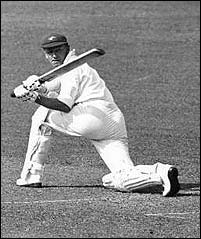
Image: Donald Bradman, an Aussie icon

[1] D W Bebbington, William Ewart Gladstone: Faith and politics in Victorian Britain (Grand Rapids, Michigan: Eerdmans, 1993), 106-107.
[2] Boreham, Mercury, 16 April 1921.
[3] Boreham, Mercury, 14 June 1919.
[4] Boreham, Mercury, 17 June 1939.
[5] Editorials on explorers included Joseph Banks, Mercury, 29 January 1938; Thomas Mitchell, Mercury, 13 June 1936; Burke and Wills, Mercury, 13 November 1920.
[6] Boreham, Mercury, 23 April 1949.
[7] Boreham, Mercury, 15 July 1933.
[8] Editorials Boreham wrote on Australian writers and poets included Adam Gordon, Mercury, 16 June 1930; C J Dennis, Mercury, 17 June 1939.
[9] Boreham, Mercury, 2 December 1933.
[10] Clark, A history of Australia vol. vi, 208-9, 275, 357.
[11] This survey involved a sample of sixty-eight biographical editorials drawn from the 1940s and 1950s. The major countries from which Boreham’s editorial’s subjects originated were Britain (seventy percent), USA (twelve percent) and Australia (four percent). Other countries represented included Italy, France, Germany, India and Spain.

Monday, September 11, 2006

Boreham Writes About Racial Oppression

F W Boreham reflected on the theme of fulfilling one’s potential amid racial oppression.

He wrote and revised articles that specifically addressed the threatened extinction of the North American Indians,[1] the problems facing the New Zealand Maori[2] and the abuse of power experienced by the West Indians.[3] Boreham’s main approach was to inspire readers by telling the story of individuals who had risen from racial struggles and who had overcome difficulties by themselves.

Notable Afro-American examples of racially oppressed people included George Carver whose awareness of being made in the image of God led him to “reach his potential in soil and agriculture”[4] and Booker T Washington who “did his main work as an educationalist rather than an abolitionist”.[5]

Boreham’s attempt to relate these stories to contemporary issues was shallow. He described the problems that followed the abolition of slavery, saying care must be exercised in the period when legislators have authorized equal rights for blacks. He concluded that blacks “must learn to do something” and that leaders dealing with plight of African-Americans “have got a problem but in the meantime they have the inspiration of Booker T Washington”.[6]

In another editorial about the progress of black Americans towards their freedom, Boreham was cautious about them “running before they could walk” and stated that the ills of forceful protest counseled the “darkies” to “turn the handle not batter down the door”.[7]

A more thoughtful response to the problem of racial oppression is found in Boreham’s account of William Knibb’s fight against slave owners in Jamaica and the way Knibb convinced the British government to give a sizeable amount of money to meet the cost of liberation.[8]

Boreham was a great admirer of Mahatma Gandhi and in the editorial, ‘The Evolution of a Mahatma’, he traced Gandhi’s development from representing Indians against their oppressors in South Africa to his campaigns in India, redeeming the untouchables, pleading for India’s freedom from British rule, fighting for sobriety among people, advancing the equality of women and developing cooperation between Hindus and Moslems.[9] This editorial in 1951 reveals the evolution of Boreham’s thought from his writings during the Boer War when he championed British domination in South Africa to a view that recognized India’s need to be “free from British domination and independent of British patronage, and yet in friendly and inalienable alliance with Britain”.[10]

Boreham was not a full participant in ‘The great Australian silence’, a term used by the anthropologist W E H Stanner to describe the ‘cult of forgetfulness’ or distinct lack of interest shown by historians in aboriginal issues from the early 1900s to the 1960s.[11] Boreham was pessimistic about the future of Australian aborigines although his knowledge of history led him to be astonished at the “extraordinary facility with which native races, under new and congenial influences, enter upon a fresh lease of life”.[12] His thinking was shaped by the anthropologist, Professor Baldwin Spencer, who said that the only hope of aborigines being preserved from extinction due to disease “lies in forming large reserves in which the tribes may be segregated and permitted, with some assistance in the way of education, to work out their own destiny”.[13]

In one of his first editorials about aboriginal issues, Boreham said, “The chances of the Australian natives ever becoming anything more than hewers of wood and drawers of water seem to be very remote.”[14] Boreham uncritically expressed Arthur Keith’s assessment of aborigines who, in criticizing the absence of agriculture in the aboriginal culture, stated, “They have dreamed no dreams, developed no arts, produced no literature and invented nothing but the boomerang.”[15] Showing that his views towards aborigines had not changed markedly, Boreham expressed his most damning criticism of the indigenous people as late as 1948 when he declared, “For centuries this huge continent was in the hands of aboriginal peoples who failed to make anything of it. And why? ‘They will not cultivate the ground,’ wrote Darwin in 1836’”.[16]

Many times Boreham drew paternalistic parallels between the Maori of New Zealand and the Australian aborigines saying, “Of all aboriginal races the Maori is quite easily the most attractive and the most intriguing. Compare him, for example, with our Australian native, and you feel that you are passing from one world to another.”[17] In this editorial Boreham revealed that he possessed, in common with most compatriots, a “racial scale” in which his racist and patriotic views put Anglo-Saxons at the top and aborigines at the bottom.[18]

In another article Boreham wrote of the Maori, many of whom had earned university degrees and were serving in all the leading professions, but “our Australian aboriginals have as yet given no indication of a similar adaptability”.[19] Furthermore, “the Australian aborigine is seldom credited with a superlative degree of intelligence”.[20]

About ownership, Boreham wrote, “We Australians cannot forget that the land in which it is our privilege to live is a second-hand possession”.[21] He reminded his readers several times that the land “belonged to Australia’s aboriginal inhabitants before we received it at their hands, and only by exploiting its resources and giving it a standing among the nations can we justify its transfer from their hands to ours”.[22]

Boreham was silent about atrocities carried out by the early European settlers upon aborigines, adopting the approach of Baldwin Spencer and Frank Gillen who in their book, Across Australia, wrote in 1912 that it was sometimes necessary “to draw a veil over the past history of the relationship between the blackfellow and the white man”.[23] Boreham was silent over the massacres of aborigines at Forrest River in 1926 and Coniston in 1928. His endorsement of laws to segregate aborigines was based on population reports heralding the need to protect them from disease and extinction.[24] Boreham did not write about the unjust and discriminating aspects of the law that restricted the rights of aborigines in relation to voting, employment, marriage and possession of property.

It is interesting that as an ‘observer of days’ Boreham neglected to recognize the centenary of the abolition of slavery in the British Empire in August 1933. His article in July 1933 on the centenary of William Wilberforce’s death praised the reformer’s efforts in the emancipation of slaves throughout the Empire but lacked local reference concerning the oppression of aborigines in Australia.[25] Contemporary historian Henry Reynolds said that such appeals for justice came from members of the Aborigines Protection Society and the Anti-Slavery Society that merged in 1907 who found that reports to Britain were their most successful avenue for protest. Reynolds observes that the agitation of these humanitarians incurred much wrath: “At best they appeared to be unbalanced—self-righteous, obsessive and fanatical. At worst they seemed to be disloyal, unpatriotic, un-Australian in both their activities and their excessive fervour in a hopeless cause”.[26]

Despite his more general concerns for the oppressed and disadvantaged, Boreham did not expose or denounce violence done towards aborigines. While expressing hope that aborigines might be saved from extinction, Boreham neither championed their rights nor called for a spirit of inclusivity in attitudes towards the indigenous people of Australia.

Geoff Pound

Image: George Carver

[1] Boreham, Mercury, 11 March 1922.
[2] Boreham, Mercury, 17 February 1923.
[3] Boreham, Mercury, 25 March 1921.
[4] Boreham, Mercury, 3 April 1948.
[5] Boreham, Mercury, 16 November 1940.
[6] Boreham, Mercury, 16 November 1940.
[7] Boreham, Mercury, 8 February 1919.
[8] Boreham, Mercury, 5 November 1947.
[9] Boreham, Mercury, 16 June 1951.
[10] Boreham, Mercury, 16 June 1951.
[11] W E H Stanner, After the dreaming (Sydney: ABC, 1969), 7, 24-25. Examples Stanner cites include Ernest Scott, A short history of Australia 8th ed. (Melbourne: Oxford University Press, 1950) and Gordon Greenwood, ed., Australia: A social and political history (Sydney: Angus & Robertson, 1955).
[12] Boreham, Mercury, 4 March 1914.
[13] Boreham, Mercury, 4 March 1933.
[14] Boreham, Mercury, 4 March 1914.
[15] Boreham, Mercury, 4 March 1933.
[16] Boreham, Age, 25 September 1948.
[17] Boreham, Mercury, 6 July 1940.
[18] Souter, Lion and kangaroo, 233-234.
[19] Boreham, Mercury, 4 March 1914.
[20] Boreham, Mercury, 10 May 1924.
[21] Boreham, Age, 17 January 1948.
[22] Boreham, Mercury, 9 June 1934.
[23] B Spencer & F J Gillen, Across Australia vol.1 (London: MacMillan & Co., 1912), 189.
[24] Major population records were published in leading papers in 1921, 1925 and 1933, all indicating that the aboriginal population was at a record low.
[25] Boreham, Mercury, 29 July 1933.
[26] H Reynolds, This whispering in our hearts (St Leonards: Allen & Unwin, 1998), 247-250.
Sunday, September 10, 2006

Boreham Writes About Women

F W Boreham’s close relationship with his mother and his deep appreciation of his wife went a long way towards explaining the many articles and references he wrote in affirming the contribution of women to society.[1] His Mothers’ Day editorials gave him a regular opportunity to extol the values of motherhood and the attributes of women.[2] He wrote on “the ethics of feminine charm”,[3] “the beauty of women”[4] and “womanly intuition”.[5]

Many of Boreham’s articles on women depicted their primary role as being in the home, as was his own wife, commonly referred to in his writings as “the mistress of the manse” and “the heart and soul of his home”.[6] These editorials, which portrayed women as the “colonial helpmate”,[7] were illustrated by the wives, sisters or mothers of significant writers and statesmen and recognized the debt of men to women in their hidden influence as “wirepuller”,[8] “first mate” or “right hand man”.[9]

Boreham’s editorials also focused on the contribution that women might make to society in their own right and in a public role. At a time when many Australian clergy were preoccupied with issues of intemperance, impurity and gambling,[10] it is heartening to read Boreham’s timely calls to remember “the women of the war”[11] and to draw attention to the plight of deserted women.[12] While Boreham did not make any specific responses to feminism in different spheres of society, he was attuned to the way that by the 1920s Australian culture had become “feminized”.[13] He observed this change in the growing electoral power of women as they had been granted suffrage in the last decade of the nineteenth century and in their exercise of political power.[14] Women’s suffrage was instrumental in achieving a number of what Boreham considered worthy goals: temperance, laws against gambling, control of prostitution, an increase in the age of consent and prevention of domestic violence.[15] Boreham was encouraging of the changing role of women, as he discussed the effects of “the emergence of women in public life”.[16] These moves initially had been fostered by the Women’s Christian Temperance Union (founded in 1882) and later encouraged by the establishment of the Housewives’ Progressive Association in 1917 and the recommendations from the Conference of the Australian Federation of Women Voters (especially those in 1921 and 1924).[17] Others like Edith Cowan, who became the first woman to enter federal parliament in 1921, indicated that the mood was changing.

Boreham’s loudest calls for the equality of women came through his numerous biographical editorials, particularly those about women writers. Focusing on writers drawn from the Victorian era, Boreham highlighted the suspicion and distrust in which “publishers fought shy of petticoats”[18] and ridiculed the prejudice that compelled women to write anonymously.[19] In a variety of stories highlighting the courageous leadership of Queen Victoria[20] and Catherine Booth,[21] the justice of Elizabeth Fry[22] and Josephine Butler,[23] the compassion of Florence Nightingale[24] and the generosity of the Countess of Huntingdon,[25] Boreham sought to inspire women to seek political leadership, to fight for justice and to ‘make the most of themselves’.

Geoff Pound

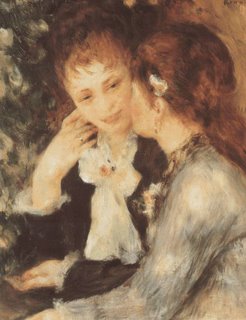
Image: Renoir's Young Women Talking

[1] The survey (referred to earlier in this chapter), undertaken by the author, from a sample of sixty-eight biographical editorials drawn from the 1940s and 1950s revealed that ten percent of Boreham’s editorials focussed on women.
[2] Boreham, Mercury, 7 May 1932.
[3] Boreham, Mercury, 24 October 1931.
[4] Boreham, Mercury, 14 August 1954.
[5] Boreham, Mercury, 7 May 1932.
[6] Crago, The story of F W Boreham, 75.
[7] This term is from Patricia Grimshaw, ‘Only the chains have changed’, in Staining the wattle: A people’s history of Australia, eds. Verity Burgmann and Jenny Lee (Ringwood, Vic.: Penguin, 1988), 77.
[8] Boreham, Mercury, 19 May 1934.
[9] Boreham, Mercury, 13 August 1949.
[10] Michael McKernan, Australian churches at war: Attitudes and activities of the major churches 1914-1918 (Sydney: Catholic Theological Faculty and Australian War Memorial, 1980), 2.
[11] Boreham, Mercury, 30 November 1918.
[12] Boreham, Mercury, 29 June 1914.
[13] Marilyn Lake, ‘The politics of respectability: Identifying the masculinist context’, Historical Studies 22 (4 1986): 129-130.
[14] Boreham, Mercury, 3 March 1916.
[15] S Macintyre, A concise history of Australia (Cambridge: Cambridge University Press, 1999), 134.
[16] Boreham, Mercury, 31 May 1924.
[17] Clark, A history of Australia vol. vi, 231-232.
[18] Boreham, Mercury, 11 November 1944.
[19] Boreham, Mercury, 27 April 1946.
[20] Boreham, Mercury, 24 May 1952.
[21] Boreham, Mercury, 4 October 1947.
[22] Boreham, Mercury, 12 October 1946.
[23] Boreham, Mercury, 13 April 1946.
[24] Boreham, Mercury, 18 August 1945.
[25] Boreham, Mercury, 18 June 1949.