Frank William Boreham 1871-1959

Frank William Boreham 1871-1959
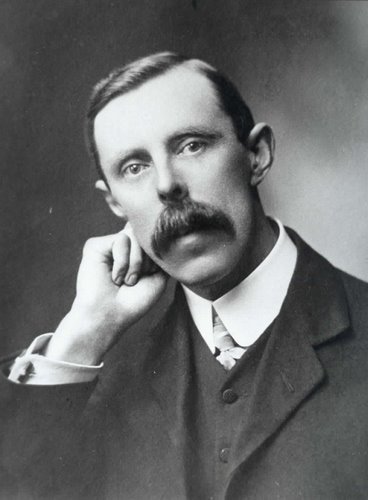
A photo F W Boreham took of himself in 1911

Wednesday, October 04, 2006

Boreham on Leisure

Specializing in Margins
Advancing the concept that ‘Nature specializes in margins’, Boreham clothed this principle in compelling imagery before offering the punch line. For example, in 1952, he penned: “She [Nature] wants a bird, so a dozen are hatched. She knows perfectly well that eleven out of the twelve are merely margin .… She wants a tree, so she plants a hundred. Ninety-nine are mere margin; but she wants to make sure of one. It is the margin that makes all the difference”.[1]

Broadening the Margins
In an editorial entitled ‘The broadening of the margin’ Boreham stated his argument particularly for politicians and employers that “work must leave us with a reasonable margin” for leisure.[2] In a climate of employment legislation defining reasonable work hours and the wartime measure of the 6 o’clock closing of hotels, Boreham asserted that “leisure is a national asset” which must be valued by society but “as the hours of labour contract ... the imperative need for some force that shall shape the conscience and behaviour of the people becomes greater and greater”.[3] Recognizing the trend towards more free time, Boreham stated (a view also held by Thomas Macaulay)[4] that “one of the highest arts in life is the wise use of leisure. Leisure is the supreme test of character. A man is what he is in his leisure hours”.[5]

If the House were on Fire
As examples of what a person’s leisure hours might contain, Boreham commended “the habit of reading aloud”[6] and watching cricket, the later of which was such an irresistible fascination for Boreham that his wife declared that “if the house were on fire, [Frank] would leave it to burn if there happened to be a cricket match in progress within twenty miles”.[7]

Find Time for Yourself
Commending leisure and exposure to nature, Boreham said to a new minister at his ordination service:

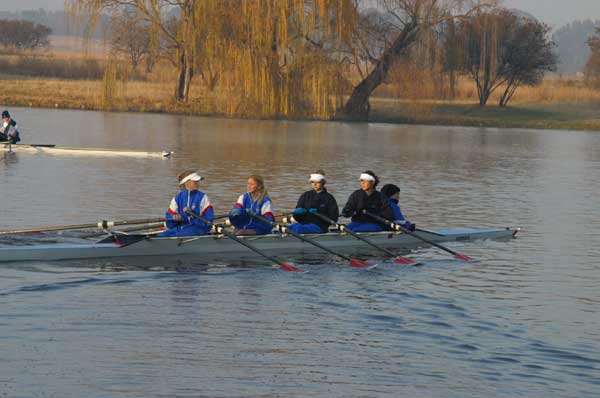
Find time for yourself. Feel it no shame at proper periods to be doing nothing. Make seasons for leisure and for recreation. Climb the hills; scour the valleys; row on the river; stroll along the beach. Cultivate the friendship of the fields and the ferns and the flowers. Laugh with the young folk and romp with little children. Be at your ease. Let the mind swing into an easy balance, a natural poise, an attitude of perfect repose. The restless soul, eternally doing something, never accomplishes anything. It is the man who can sometimes be at rest who produces the finest work in the long run. Find time for yourself![8]

Geoff Pound

Image: “row on the river…”


[1] Boreham, Mercury, 22 March 1952; Boreham, The last milestone, 132-134.
[2] Boreham, Mercury, 10 April 1937; Age, 8 December 1945.
[3] Boreham, Mercury, 7 August 1920; 22 March 1952; The last milestone, 132-134.
[4] Boreham, The luggage of life, 90.
[5] Boreham, When the swans fly high, 192.
[6] Boreham, Mercury, 7 August 1920.
[7] F W Boreham, The drums of dawn (London: The Epworth Press, 1933), 168; also quoted in Who’s who in Australia 8th edition 1933-34, ed. Errol G Knox, (Melbourne: The Herald Press, 1934), 62, which says of F W Boreham that he “never misses a cricket match unless the house happens to be on fire”.
[8] Boreham, The drums of dawn , 62.

Tuesday, October 03, 2006

Boreham on Retreat

Mirroring Nature
At a personal level F W Boreham recommended a lifestyle that mirrored the rhythm of nature. Mindful that those in public life are more apt to commit “the high crime of doing things”, Boreham said that “half the art of life lies in being able on occasions to do nothing and to do it easily ... to smoke a pipe of tobacco ... to develop the capacity for idleness ... to ruminate like a cow”.[1] He commended the “science of sleep”,[2] the enrichment of dreams,[3] the art of relaxation,[4] and the practice of withdrawal[5] akin to the way that “nature herself provides most of her furry and feathered clients with places of refuge”.[6] When Boreham wrote about “the psychology”[7] and “the mysticism of a holiday”, he had in mind the regular break from one’s routines, responsibilities and familiar surroundings so that “by contact with Nature our spent and flagging frames are thrilled by a glorious inrush of new life”.[8]

Law of Sanctuary
In the writings of Boreham there are glimpses that he diligently observed “the law of sanctuary”[9] through his early afternoon sleep,[10] his evening recourse to the armchair for his “scallop-shell of quiet”[11] and his retreat to Melbourne’s Botanical Gardens “under the shadow of a noble old cypress on a seat to which I make it a practice to repair once a week or so”.[12] Boreham’s many references to the beach at Taieri Mouth,[13] the vista from Mt Wellington,[14] the flora and fauna of Wedge Bay[15] and the delights of the Dandenongs[16] revealed a man whose holidays gave him “a vision of life [that] ... stimulated his own vitality”.[17]

Geoff Pound

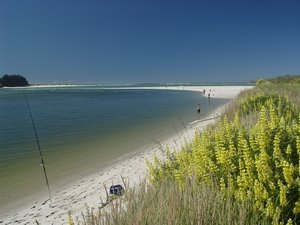
Image: Taieri Mouth, FWB’s favorite sanctuary when at Mosgiel.

[1] Boreham, The other side of the hill, 248.
[2] Boreham, Age, 3 April 1948; Mercury, 14 May 1949.
[3] Boreham, Mercury, 9 June 1956.
[4] Boreham, Mercury, 20 January 1940.
[5] Boreham, Mercury, 28 February 1925.
[6] Boreham, Mercury, 31 October 1942; Age, 8 February 1947.
[7] Boreham, Mercury, 22 December 1934; Age, 3 January 1948.
[8] Boreham, Mercury, 18 January 1941; Age, 12 January 1946.
[9] Boreham, Mercury, 31 October 1942; Age, 8 February 1947.
[10] Boreham, My pilgrimage, 225.
[11] Boreham, The passing of John Broadbanks, 11.
[12] F W Boreham, The three half moons (London: The Epworth Press, 1929), 43.
[13] F W Boreham, The heavenly octave (London: The Epworth Press, 1935), 63-64.
[14] Boreham, The luggage of life, 242.
[15] Boreham, The nest of spears, 165.
[16] Boreham, A witch’s brewing, 62.
[17] Boreham, Mercury, 18 January 1941; Age, 12 January 1946.

Monday, October 02, 2006

Boreham and His Philosophy of Play

Legislation and Leisure
In an era when labor strikes were common and Australian parliaments were transacting labor legislation concerning workers’ wages and hours, Boreham’s articles about the importance of play in society were a variation on nature’s principle of rest, rhythm and retreat.[1]

Game of Life
His editorials addressing ‘A philosophy of play’ were pitched not only towards politicians but teachers and parents to encourage them to realize that toys and play were equipping children with the skills for “the game of life”.[2]

Education for Play
As an interesting development of this theme in a later editorial, Boreham suggested that teaching children to play well was preparing them “to enjoy to the utmost the majestic merriments of the eternities”.[3] In one of his earliest Tasmanian editorials, Boreham expressed the “need for more parks and reserves in Hobart” and called upon politicians to ensure that further playgrounds were provided for its people.[4]

Geoff Pound

Image: ‘…need for more parks.”

[1] The miners’ strike for maximum daily working hours in 1916 was an example of turbulence in the labour scene. The NSW parliament passed the Eight Hour Act in April 1916.
[2] Boreham, Mercury, 10 March 1913; 28 July 1923; 16 May 1936.
[3] Boreham, Mercury, 7 December 1946.
[4] Boreham, Mercury, 10 March 1913.

Sunday, October 01, 2006

Boreham the Conservationist

Replenish the Soil
Boreham repeatedly called for the conserv-ation and replenish-ment of the soil,[1] the care of the world’s rivers[2] and the conserv-ation of water in the dryness and heat of Australia,[3] particularly in the 1930s and 1940s when drought and overuse of the land in many states caused severe erosion. In describing the intellectual conflict over land use, Drew Hutton and Libby Connors write, “Wise resource use and nature protection were thus two strands of early conservation that capitalized on nationalistic progressivism. On the other hand, the mastery of those resources by human scientific and technical skills was doubly praised”.[4] Boreham’s encouragement of the nation’s greatness through increasing the population and markets indicated that he sometimes resolved this tension by arguing in favor of production rather than protection.

All People not Fanatics
While Boreham applauded the establishment of National Parks and wilderness areas by government, he also called all his readers to care for the properties where they lived. This was and continues to be an important combination as Sydney ecologist Martin Mulligan, in reflecting on the issues facing conservationists in Australia in the twenty-first century, says: “The concern for preservation of wilderness … sets up a conceptual separation between people living mainly in cities and towns and the remote ‘pristine’ areas deemed worthy of preservation. This helped create a perception that nature conservation is a matter for fanatics, eccentrics and experts; not a concern for ‘ordinary’ people”.[5]

Priority for Politicians
Boreham called politicians to exercise respect and responsibility towards the land but his view “that we are all naturalists” highlights that he understood that the tasks of conserving and replenishing nature were incumbent on every citizen in their locality.[6]

Geoff Pound

Image: “replenishing the soil.”

[1] Boreham, Mercury, 5 March 1914; Mercury, 11 October 1941; Age, 20 September 1947.
[2] Boreham, Mercury, 23 November 1940; Age, 15 March 1941.
[3] Boreham, Mercury, 29 May 1914.
[4] Hutton and Connors, A history of the Australian environmental movement, 21.
[5] Martin Mulligan, Re-enchanting conservation work: Reflections on the Australian experience http://www.uws.edu.au/serg/ReConservation_mulligan.html, February, 2001, 2.
[6] Boreham, A witch’s brewing, 197.

Saturday, September 30, 2006

Boreham on Preserving Nature

Life That We Love
In response to the lavish outpouring of life, yet mindful of the human potential to waste and spoil and upset nature’s balance, F W Boreham, in many editorials, highlighted the social responsibilities of protecting and preserving nature. [1] Working from the premise that “it is life that we love ... therefore we should not kill animals”,[2] Boreham wrote editorials calling for the prevention of cruelty to animals[3] and he attacked the “blood lust of the British” and “the vogue of the big game hunter” that resulted in certain animal species being in danger of extinction.[4]

Preserve the Birds
Boreham’s concern for birds led to his plea for the saving of hedges[5] and, writing from Tasmania, the most wooded state of the country, he sounded the urgency of preserving the habitats of birds that were in peril of extinction.[6] He lambasted the installation of air beacons around the world that “have wrought havoc among the vast flights of migratory birds”,[7] he claimed that “the rapid increase of population [in some countries] is threatening the extermination of the loveliest and most valuable of the feathered species” and he denounced “the havoc wrought by the insatiable demands of the milliner”.[8]

Save the Forests
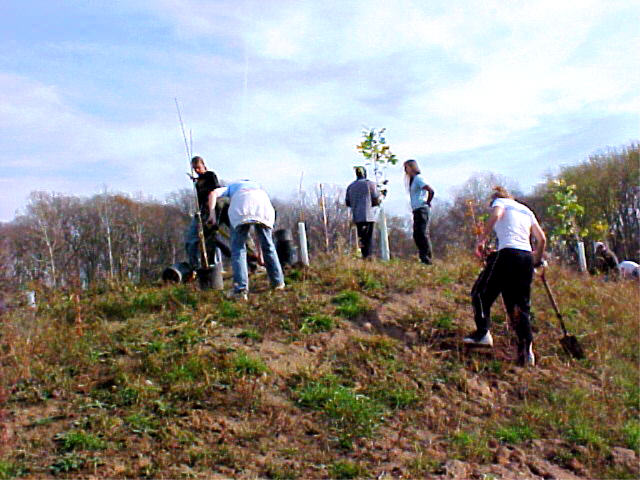
Calling the forest “man’s oldest and most faithful friend, and one towards whom he is inclined to turn with increasing reverence and affection as the ages go by”,[9] in 1920 Boreham joined a growing number of people[10] in castigating those who carelessly cleared the forests and bush, saying, “Australia cannot afford to part with its trees”.[11] While mindful of the instinct for chopping to which Boreham’s heroes, W E Gladstone and Richard Jeffries, succumbed, he expressed in 1928 his pleasure at “the popularisation of Arbor Day” and other government initiatives, saying to his readers that “we should all of us apply ourselves to a wholesale orgy of tree-planting”.[12]

Geoff Pound

Image: “a wholesale orgy of tree-planting.”

[1] Boreham, Mercury, 25 September 1917.
[2] Boreham, Mercury, 9 June 1917; F W Boreham, The home of the echoes (London: The Epworth Press, 1921), 82.
[3] Boreham, Mercury, 26 June 1915.
[4] Boreham, Mercury, 21 March 1914.
[5] Boreham, Mercury, 5 July 1930.
[6] Boreham, Mercury, 13 September 1913; 26 October 1940.
[7] Boreham, Mercury, 20 April 1929.
[8] Boreham, Mercury, 26 October 1940.
[9] Boreham, Mercury, 28 June 1924.
[10] Ann R M Young, Environmental change in Australia since 1788 (Melbourne: Oxford University Press, 1996), 74-75.
[11] Boreham, Mercury, 10 July 1920.
[12] Boreham, Mercury, 9 June 1928.

Friday, September 29, 2006

Boreham on Nature As Silent Preacher

Silent Yet Articulate
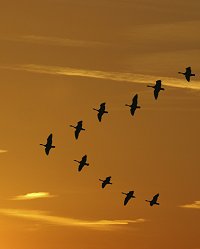
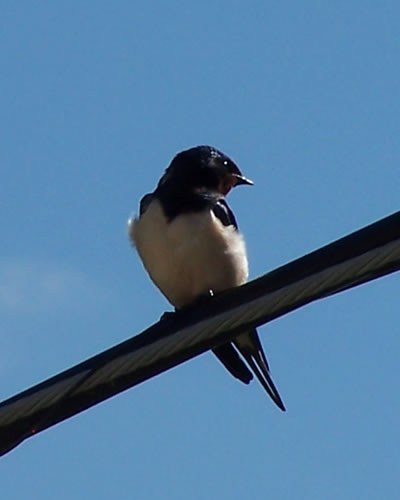
F W Boreham viewed nature as a preacher of truth not in a brash or intrusive style but by being “silent yet articulate”.[1] An example of nature’s propensity to preach by hinting was the migratory instinct of birds, of which Boreham suggested that “we are all affected more than we know by forces that we cannot see” and by stirring up the human conscience to the “boundless, the illimitable, the eternal”.[2]

Signaling Through Semaphore
Symbolism was another of nature’s preaching techniques in which the compelling message of sacrifice could be conveyed through a red poppy[3] or one’s love of country could be declared through a sprig of wattle.[4] Recognizing nature’s preaching ability to transcend barriers of culture and language, Boreham asserted that the coming of the swallow[5] and the emergence of a green shoot from a dead husk[6] were examples of the way the “sublimest messages [were] semaphored” through “the language of gesture”.[7]

Saying It In Signals
Explaining further ‘the science of signals’, Boreham pointed to the fine homiletical tradition in which nature stood. Thus, he affirmed:

"Revelation makes it clear, that, even when Almighty God has something really vital to say, He says it in a language that requires no translation or interpretation. He says it in a way that all men everywhere can comprehend. “The veil of the temple was rent in twain from the top to the bottom.” No man can mistake the awful and profound significance of such a gesture. No man may be able to grasp the doctrine of the atonement; but where is the heart that does not respond to the mute eloquence of the Cross?"[8]


Saying It With Flowers
Nature’s preaching method, according to Boreham, was that of declaration rather than explanation, not the pronouncement of glib answers but the evocation of surprise, earnest questions and child-like wonder. Hence his statement about the human response to nature’s appeal: “We find ourselves saying to the seed and the soil what Tennyson said to the flower in the crannied wall; if we could understand what it is in the seed and in the soil that produces the ears of corn, we should know what God Himself is”.[9]

Geoff Pound

Image: “the migratory instinct of birds.”

[1] Boreham, Mercury, 20 August 1955.
[2] Boreham, Mercury, 7 October 1939; Age, 22 November 1947.
[3] Boreham, Mercury, 10 November 1923.
[4] Boreham, Mercury, 10 November 1934; Age, 9 November 1946.
[5] Boreham, Mercury, 16 March 1940.
[6] Boreham, Mercury, 11 April 1941.
[7] Boreham, Mercury, 20 August 1955.
[8] Boreham, Mercury, 20 August 1955.
[9] Boreham, Mercury, 20 October 1951.

Thursday, September 28, 2006

Boreham on Nature As Educator

Educator Par Excellence
In a statement reminiscent of Benjamin Disraeli, Boreham viewed nature as one of the greatest educational influences in life,[1] and in an editorial he wrote, “We have the trees as teachers and preachers, and many a man has learned the deepest lessons of his life at the feet of these shrewd and silent philosophers”.[2]

Free Education
Boreham paid numerous tributes to nature as his teacher,[3] saying, “All we have learned has increased our reverence for nature”.[4] In writing of the “maxims of the mud”,[5] the “stones articulate”,[6] the “rhetoric of the rocks”,[7] rocks as “the manuscripts of God”[8] and the universe as “the archives of the ages”,[9] Boreham reinforced the educational role of nature for those who were keen to be its students.

Use of Imagery
In writing of the “magpie habit of collecting”[10] or “the mimicking behaviour of the lyrebird”,[11] Boreham was demonstrating ways that nature had taught him to use its imagery. His writings were replete with nature’s parables, including nature’s camouflage,[12] lessons in adapting and adjusting,[13] the way to break bad news,[14] the principle of the undertow[15] and the ‘dead’ Easter-like kernel that “has the latent genius for resurrection”.[16] Moreover, Boreham was discriminating about nature’s teaching style. He encouraged his readers to discover the value of nature’s unattractive features saying, “It is by vipers as well as by violets that God reveals His wondrous ways to men”,[17] but Boreham did not commend nature’s propensity to ignore the weak[18] or its unsympathetic brutality.[19]

Regular Exposure
Boreham often attributed his inspiration to a renewed exposure to nature.[20] Nature had taught him to wonder[21] and to ask questions[22] yet, despite all the learning and resources of religion, he concluded, “We are only on the fringes of things”.[23] The importance of nature’s teaching role for the world was underscored when, in writing about the impact of the trade winds and the way they had compelled human beings to move, Boreham stated that, “It is only by dancing to the tune that Nature plays that civilization can advance and humanity continue its triumphant march”.[24]

Geoff Pound

Image: “the mimicking behavior of the lyrebird”


[1] Boreham, Mercury, 6 October 1923. Benjamin Disraeli, the Earl of Beaconsfield said, “Nature is more powerful than education”. Benjamin Disraeli, Contarini Fleming: An autobiography (New York: D Appleton & Co, 1870), 19.
[2] Boreham, Mercury, 11 June 1932.
[3] Boreham, A tuft of comet’s hair, 63.
[4] Boreham, Mercury, 5 May 1917.
[5] Boreham, The other side of the hill, 152.
[6] Boreham, Mercury, 5 July 1952.
[7] Boreham, Mercury, 25 May 1957.
[8] Boreham, When the swans fly high, 63.
[9] Boreham, Mercury, 26 October 1957; Age, 5 September 1953.
[10] F W Boreham, The nest of spears (London: The Epworth Press, 1927), 10.
[11] Boreham, Rubble and roseleaves, 181.
[12] Boreham, Mercury, 27 July 1918.
[13] Boreham, Mercury, 15 November 1919.
[14] Boreham, Mercury, 16 September 1922.
[15] Boreham, Mercury, 17 April 1915.
[16] Boreham, Mercury, 11 April 1941.
[17] Boreham, Mercury, 3 April 1954.
[18] Boreham, Mercury, 27 May 1922.
[19] Boreham, Mercury, 21 June 1941.
[20] Boreham, When the swans fly high, 7, 187.
[21] Boreham, Mercury, 9 February 1946.
[22] Boreham, When the swans fly high, 87.
[23] Boreham, Mercury, 28 June 1941.
[24] Boreham, Mercury, 1 August 1925.

Wednesday, September 27, 2006

Boreham on Nature as Hope Bearer

Messenger of Hope
According to F W Boreham, a prominent aspect of nature was its rhythm in which “like a gigantic wheel, the cycle of the seasons revolve without apparently achieving anything by its revolutions”,[1] but despite this ‘illusion of futility’ “high ends are being compassed .… Nature was making progress all the time”.[2] Boreham perceived the purposefulness of nature in the turning of the tides,[3] the return of the swallow[4] and the day when “the elms ... having attired themselves in all their bravery of their new spring dresses, have curtained from me every object lying beyond themselves”, a day which he recorded for many years with precision.[5]

Indomitable During Tragedy
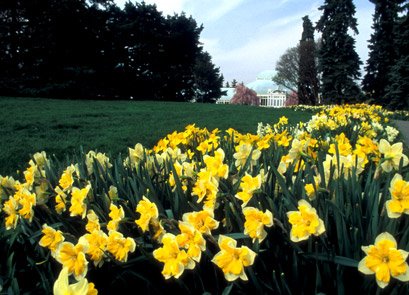
While he observed the irregularity of nature in the variegated patterns of flowers in contrast to the boring predictability of linoleum,[6] the relentless momentum and indomitability of nature was never more evident to Boreham than in the years of the Second World War. For example, during this period he observed: “Crocuses break through the snow; nodding daffodils smother the bank; yellow primroses carpet the leafy woods; bluebells swarm along the hedgerows; and the birds sing their mating-songs in utter indifference to the horror of the world’s stark tragedy”.[7]

Eloquent and Articulate
Boreham interpreted this death-defying messenger of hope as “the eloquent articulation of all those dumb forces that are struggling to tell of the light that breaks from the gloom of midnight, of the peace that issues from the terrors of war, of the good that triumphs at last over the mightiest evil and of the redemption that comes to men through the darkness and dereliction of the Cross”.[8]

Geoff Pound

Image: “nodding daffodils smother the bank”


[1] Boreham, Mercury, 1 December 1951.
[2] Boreham, Mercury, 5 June 1943; Age, 6 December 1947.
[3] F W Boreham, The uttermost star (London: The Epworth Press, 1919), 264.
[4] F W Boreham, The last milestone (London: The Epworth Press, 1961), 135.
[5] Boreham, The passing of John Broadbanks (London: The Epworth Press, 1936), 261.
[6] Boreham, Faces in the fire, 54.
[7] Boreham, Mercury, 23 October 1943; Age, 6 April 1946.
[8] Boreham, Mercury, 3 May 1947.

Tuesday, September 26, 2006

Boreham on Nature's Wellspring


NEW BOREHAM BOOKS

Supply of Vitality
One of the reasons why F W Boreham wrote passionately about nature was because of nature’s capacity to exude life in a full and endless supply. Inviting readers to share his exultation of life at Wedge Bay, Boreham wrote:

"He will find himself in a world that is simply overflowing with life. He will be bewildered by its teeming abundance, its confusing multiplicity, its endless prodigality. He will find life, in every possible and impossible phase and form, swarming and scurrying, flapping and fluttering, rustling and crawling, whispering and twittering, bounding and splashing, everywhere and all the time! He will see life peeping forth from every crack and crevice. Life is breaking out and bursting up and bubbling over everywhere ... If they really want to see life, let them go to Wedge Bay!"[1]

Marvel of Spring
The experience of life in its essential form was never more evident for Boreham than in Spring. “However commonplace the year might be”. he told his southern hemisphere readers, “[September] holds for each of us one month of marvels”.[2] Saluting this season as “the sweet o’ the year”, Boreham continued: “The gladness of Springtime is the sheer joy of being alive. The assumption is sound. The rapture and intentness with which we watch the return of the swallows, the gilding of the wattle, the bursting of the bulbs. The vernal roaming of the elms, the oaks and the poplars, and all the familiar signs of the passing of Winter and the approach of summer days, is simply an integral phase of our passionate love of living”.[3]

Joy of Life
Boreham’s love of life and his views about Spring were shaped by Richard Jeffries. “Nobody has written with more precision on the subject of Spring”, declared Boreham, “than has Richard Jefferies”.[4] Boreham shared Jeffries’ ecstasy in waiting for the coming of Spring. The naturalist was fascinated by “the joy of life” and his love of Spring was “not so much for its own sake, as for the sake of the life that the Spring so abundantly produces”.[5]

Geoff Pound

Image: “the coming of Spring”

[1] Boreham, The golden milestone, 114.
[2] Boreham, Mercury, 2 November 1946.
[3] Boreham, Mercury, 3 September 1949.
[4] Boreham, Mercury, 2 November 1946.
[5] Boreham, Mercury, 2 November 1946.

Sunday, September 24, 2006

New Boreham Books in the Pipeline

Press Release: New Books By F W Boreham

New Boreham Publishing Initiative
Michael Dalton (USA) and Geoff Pound (UAE) have teamed up to establish John Broadbanks Publishing. Both enthusiasts of the writings of Boreham their dismay at the general unavailability of these writings due to their being out of print has led to this exciting decision.

Despite a resurgence of interest in the life and books of Dr F W Boreham no contemporary publisher has yet been willing to risk republishing the books of a preacher and essayist who has been in his grave for almost 50 years.

Prolific Writer
F W Boreham lived in England, New Zealand and Australia between 1871 and 1959. He authored 55 books, wrote 3,000 editorials in major papers and was a premiere preacher. Epworth Press, which published and reprinted most of the Boreham books said his book sales went into the millions and that “Boreham was the biggest catch since John Wesley.” He was introduced at an international conference of pastors in 1936 as “the man whose name is on all our lips, whose books are on all our shelves and whose illustrations are in all our sermons.”

First Book
This new vision is to republish some of the Boreham books that are not only out of print but are exceedingly scarce in the second hand market. The first reprint will be Boreham’s tribute to his mentor. It was first printed in 1948 with the title: The Man Who Saved Gandhi and will be given the new title Lover of Life: F W Boreham’s Tribute to His Mentor.

It is hope this book will be available by the end of 2006. Further information has been posted and will be added at the following site F W Boreham On Mentoring.

Further Books Planned
The plan also involves repackaging some of the Boreham essays and sermons into two new books, The Best Essays of F W Boreham and The Best Stories of F W Boreham.

It is hoped these books will emerge in 2007. Further information has been posted and some of the stories will be added to the following site The Best Stories of F W Boreham.

Michael and Geoff are grateful to have the permission of Whitley College which has held the copyright to Boreham books since this was passed over by the Boreham family in 1996. A proportion of any profits arising from this new publishing venture will continue to be donated to Whitley College for the training of pastors and missionaries, two ministries that were dear to the heart of F W Boreham.

As this is a ‘self-publishing’ activity donations are being sought to assist in the seeding of this venture.

If you would like to invest in this exciting project you can donate money by writing your check, payable to ‘Michael Dalton’ and send to:

Michael Dalton
2163 Fern Street
Eureka, CA 95503
USA

The selection process of the best essays and stories is happening now. If you would like to put in a recommendation for a favorite essay or a story to be included in the new books do write to Geoff Pound geoffpound@yahoo.com.au

If you desire more information or if you would like to register your interest in purchasing these books do write to
Michael Dalton at dalton.michael@sbcglobal.net or
Geoff Pound at geoffpound@yahoo.com.au

Geoff Pound
Michael Dalton

Boreham on Nature as Evocator

Packet of Surprises
F W Boreham wrote many editorials about ‘the infinities of nature’ because this was the feature that had the greatest potential to evoke surprise and wonder within human society.

According to Boreham: “A world that could no longer surprise us would be a world that had run out of bombshells .… Half the fun of waking up in the morning is the feeling that you have come upon a day that the world has never seen before, a day that is certain to do things that no other day has ever done. Half the pleasure of welcoming a new-born baby is the absolute certainty that here you have a packet of amazing surprises ... here is novelty, originality, an infinity of bewildering possibility”.[1]

Impact of Nature on Boreham
Reviewing his life, Boreham recounted a childhood experience of nature’s surprises when on his first expedition to the spot where he could glimpse the sea. Remembering the longing that drew him he wrote, “A cat has nine lives but a child’s expectancy has a thousand”.[2] In recording his many first encounters of nature, Boreham often remarked on its personal impact, detailing how, upon arrival in London, he was “hungry for fresh experiences”[3] and “specializing in novelties”.[4] Later in Australia, he was fascinated by the way he could never return to a familiar spot in the bush “without discovering some fresh delight”.[5]

Restlessness of the Boundless
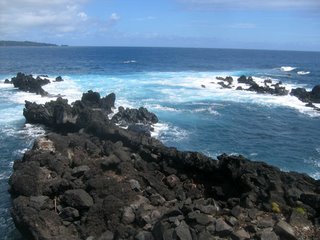
The instinct for the new that he had experienced was part of the human consciousness of “the boundless, the illimitable, the eternal” in nature and was Boreham’s explanation for the unseen pull that lured explorers on their journeys of discovery.[6] He alluded to this in his many editorials on the poetry of the sea[7] and the stories of naval explorers[8] who were drawn by “the lure of blue water”,[9] “the magnetism of the masts”[10] and “the thought of beyond”.[11] Seeking to explain the human passion for undertaking lonely and often painful expeditions over land and sea, Boreham said: “Man is fevered with the restlessness of infinity .… He is ceaselessly magnetized by the beyond. What is beyond the mountains, beyond the oceans, beyond the utmost bounds of space? What is beyond time, beyond life, beyond death? It is his contemplation of these august and stately problems that, in the long run, shapes his personality and moulds his destiny”.[12]

Geoff Pound

Image: “the lure of blue water.”

[1] F W Boreham, Faces in the fire (London: The Epworth Press, 1916), 14.
[2] Boreham, My pilgrimage, 15.
[3] Boreham, My pilgrimage, 63.
[4] Boreham, My pilgrimage, 61.
[5] F W Boreham, A tuft of comet’s hair (London: The Epworth Press, 1926), 199.
[6] Boreham, Mercury, 7 October 1939; Age, 22 November 1947.
[7] Boreham, Mercury, 6 October 1928.
[8] Boreham, Mercury, 21 March 1925.
[9] Boreham, Mercury, 19 January 1929.
[10] Boreham, Mercury, 4 February 1939.
[11] Boreham, Mercury, 1 January 1940.
[12] Boreham, Mercury, 19 April 1958; Age, 23 January 1954.

Saturday, September 23, 2006

Boreham on Nature's Mediation

Nature as Mediator
F W Boreham recognized that one of the endearing features of nature was its ability to unify disparate parts of creation in ways that mediated peace. Beyond the steadying role of the stars in linking home with home and land with land, Boreham perceived that the night skies united the present age with other ages. Writing during the First World War, he said: “The stars unite us, at one and the same time, to the stateliest traditions of a splendid past, and to that new world which must arise, Phoenix-like, out of the lurid conflagration that we at present witness”.[1]

Celestial Links
These celestial monuments renewed hopeful memories and radiated life in a similar way to the terrestrial monuments that Boreham applauded as discussed in chapter six. In an editorial entitled, ‘The unities of the universe’, Boreham suggested that stars not only reminded but tangibly linked readers to the pioneers who endured similar struggles in early Australia. Upon his return to the pristine bush of Tasmania’s Wedge Bay, his reflection led him back further in time: “Here as it was in the beginning it is now and ever shall be world without end and it is restful to saturate oneself in the brooding silence of the primeval forest. I like to sit in this quiet cove where I picnicked two years ago and to reflect that it is today exactly as it was in the days of Caesar”.[2]

Brooding Silence
In 1901, the silence of the bush had become the context about which the Bulletin editor A G Stephens had coined the idea of “the Great Australian silence”[3]—an emerging myth that denoted colonial conquest, emptiness, unfamiliarity towards the new land and alienation from nature.[4] In contrast, imagining the perfection of Eden, Boreham was alluding to the capacity of nature’s ‘brooding silence’ to unite Australians with each other and to reconcile them with creation’s source.

Glittering Orbs
Not wanting to remain focused on some Arcadia, further consideration of the “ageless”[5] quality of the stars caused Boreham to project forward the minds of his Australian readers when saying, “Those glittering orbs unite us with the millions who will populate these Southern lands in the great days when all our dreams for Australia have splendidly come true”.[6] In a similar way to the role of history, Boreham emphasized nature’s gift of connecting people in the present age with all the ages. This linking could be achieved privately and individually but nature was also able to forge communal connections. The delight of witnessing the first swallow, thereby signaling the arrival of another summer, united Boreham with others who relished this experience. “The pleasure I get out of something shared,” he said, “I share it with all the world and all the ages”.[7]

Geoff Pound

Image: “the first swallow”

[1] Boreham, Mercury, 24 July 1915.
[2] F W Boreham, The golden milestone (London: The Epworth Press, 1915), 109.
[3] A G Stephens, ‘Voices from the basket’, Bulletin, 28 December 1901.
[4] Jane Belfrage, ‘The great Australian silence: Inside space, May 1994,
[5] Boreham, Mercury, 15 June 1940.
[6] Boreham, Mercury, 8 June 1935.
[7] Boreham, The golden milestone, 34.

Friday, September 22, 2006

Boreham Blog Question

Now for something lighter:

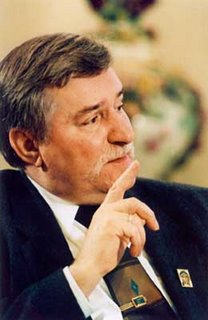
What do Margaret Atwood (novelist), Harry Belafonte (singer), John Kenneth Galbraith (economist), Kenneth Scott Latourette (historian), David Lloyd George (British Prime Minister), Bernard Lonergan (Catholic theologian), Gustav Nossal (Australian scientist), John Ralston Saul (author-philosopher), David Suzuki (geneticist-environmentalist), Lech Walesa (Polish politician-human rights activist-Nobel Prize winner) and F W Boreham all have in common (and it is not the same birthday!)?

No right answers in the Comments section.

For the answer, scroll down below.

Geoff Pound

Image: Lech Walesa


Answer:

They are all recipients of honorary doctoral degrees from McMaster University.
F W Boreham was awarded (in absentia) his doctorate in June 1928 (on the same occasion that George Truett and Boreham’s best man, NZ Baptist leader, J J North were awarded theirs. For more description regarding this award read F W Boreham, My Pilgrimage, 230-232.

For the full list of people awarded honorary doctorates from McMaster check the following web address.

http://www.mcmaster.ca/univsec/lists/S_HD_Recipients.pdf

Thursday, September 21, 2006

Boreham on Nature's Therapy

Nature as Therapist
A further role of nature in Boreham’s writings that developed the linkage between beauty and health was nature’s therapeutic service. The capacity of nature to cure physical ailments was extolled by Boreham. He included testimonies of famous people such as Robert Louis Stevenson who, with his poor health and frail body, felt that the return of spring “gave him a new hold upon existence, and he delighted in compelling his sickly friends to drink of the same invigorating tonic”.[1] In this 1935 editorial, Boreham said that the response of a sick body to the life and warmth of the sun was a principle of nature upon which religion itself is based in which “the frailty of humanity [is] regenerated and revitalized by living contact with the unseen”.

Immersion in Nature
In addition to physical renewal, Boreham wrote revealingly of the wholesome psychological benefits he and his family had gained from an immersion in nature when after the birth of their first two children his wife was afflicted with depression and the family, on doctor’s advice, spent some weeks recuperating at Otago’s Taieri Mouth (named in his books ‘Piripiki Gorge’).[2] Similarly, in 1916 when Boreham’s health broke down his doctor prescribed some weeks at Tasmania’s Wedge Bay.[3]

Tonic of Big Things
In one of his early essays entitled, ‘A tonic of big things’, Boreham wrote of the contribution of nature to one’s mental health: “Immensity is magnificent medicine; that is one reason ... why the doctors send us to the seaside. We forget the tiddley-winking in the contemplation of the tremendous; we lose life’s shallow worries in the vision of unplumbed depths”.[4]

Nature As Nurse
Boreham quoted poet John Greenleaf Whittier’s view of “Nature as a nurse”[5] and the “baffled and frustrated” Mark Rutherford who exclaimed, “I loved to walk until I could see the open water ... The sea was a corrective to the littleness around me”.[6] In one of the few editorials in which Boreham lifted the curtain on his own experience he wrote: “When we miss a train, or mislay a letter or find a social program spoilt by rain, it exercises a steadying effect upon the nerves to reflect that Orion and Pleiades still roll, Niagara still flows, Mt. Everest still wraps his clouds about him, daring a conqueror to tread his summit. The big things are as the big things always were”.[7]

Stellar Therapy
The experience of extreme homesickness had led Boreham to prove that “stars are an excellent medicine for homesick hearts”[8] especially during winter when spirits were often low but when “the early dusk ... provides ample opportunity to survey the stars”.[9] Adding the endorsement of novelist Mark Rutherford, Boreham recommended stellar therapy for soldiers during wartime, suggesting that as they surveyed the galaxies from wherever they were posted the glittering “comrades of the night” would unite them with their loved ones at home.[10]

Prescription for Homesickness
The large number of Boreham’s nature editorials suggests he was seeking to encourage his readers to experience nature’s therapy especially, during the worries of war.[11] However, Boreham was diagnosing a prevalent and deep-seated displacement, homesickness and alienation in the Australian psyche that the war only accentuated. He, like many of his readers, was seeking to feel at home in a country that was strange, harsh and inhospitable. Nature provided familiar reference points that could link people with the home from which they had come while helping them establish a new life in an unfamiliar country and call Australia home.

Geoff Pound

Image: “to the seaside”

[1] Boreham, Mercury, 3 September 1949.
[2] Boreham, My pilgrimage, 167; F W Boreham, The blue flame (London: The Epworth Press, 1930), 160.
[3] Boreham, My pilgrimage, 201-206.
[4] F W Boreham, The luggage of life (London: The Epworth Press, 1912), 178.
[5] Boreham, Mercury, 7 June 1941; Age, 11 May 1946.
[6] Boreham, Mercury, 28 May 1955.
[7] Boreham, Mercury, 10 September 1949.
[8] F W Boreham, The silver shadow (London: The Epworth Press, 1918), 77.
[9] Boreham, Mercury, 8 June 1935.
[10] Boreham, Mercury, 24 July 1915.
[11] Boreham, The luggage of life, 184.

Wednesday, September 20, 2006

Boreham on Nature's Contribution

There was a great interest and a rich tradition in Australian papers of articles on nature themes when Boreham wrote his many editorials on the contribution that nature made to life.[1] This post and those over the next few days consider the various roles of nature addressed in Boreham’s editorials.

Banquet of Life
In an article published as the First World War was commencing its destructive work, Boreham asserted that, “the relationship between beauty and civilization has never been defined”.[2] His frequent discussions about beauty and the role of aesthetics to the human condition[3] reveal his agreement with Fyodor Dostoevsky’s high claim that “beauty will save the world”.[4] Boreham announced, “Beauty is the banquet of life,” and was swift to declare that nature was the major sphere at which humanity might sumptuously dine.[5] He did not regard beauty as a nutritional supplement but as an indispensable element for the survival and well-being of society. On another occasion he stated, “Health and beauty go together … they are life’s inseparables”.[6]

Beauty in the Eye…
Boreham compared statements from early explorers who had written glowingly of Australia’s beauty with those who concluded that the country was ugly and uninteresting to illustrate the different views that people have about beauty. If health and beauty go together, Boreham’s health card for Australians in the mid-1920s was grim. Writing about the neglect of the local landscape by Australian artists and their preference for the English landscape, Boreham said, “Australians are blind to beauty … The Australian public is as yet unprepared to realize the beauty of the land of its adoption”.[7]

Impatience With Definitions
While he asked, “What is beauty?” Boreham had difficulty in answering the question in great detail.[8] Confessing his impatience with definitions and his preference for experiencing nature and beauty with all his senses, Boreham said, “How can I set down in words the pleasure that I find in the perfume of a violet, in the song of a thrush, or in the graceful poise of a deer”.[9]

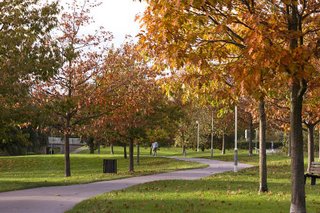
Sight was the major avenue by which Boreham experienced nature and he often remarked on its beauty in “the restfulness of a green lawn”[10] or “the pageantry of autumn [in its] gorgeous colour scheme”.[11] His sensitivity towards beauty was heightened by the places where he had lived—Tunbridge Wells, which he said that for “sheer, downright prettiness ... stands without a rival in the wide, wide world”,[12] that New Zealand was “a land of luxurious vegetation ... broad and fertile plains ... sky-piercing summits glistening with eternal snows; a land of rushing rivers and thunderous cataracts”[13] and of Australia he wrote that “no continent can offer to the eyes of men a fauna so wealthy and so varied”.[14] As well as celebrating the predictable sources, Boreham urged people to contemplate beauty in the dullness of rocks,[15] the drabness of mud[16] and the starkness of midwinter.[17]

Geoff Pound

Image: “the pageantry of autumn.”

[1] Drew Hutton and Libby Connors, A history of the Australian environmental movement (Cambridge: Cambridge University Press, 1999), 30-31.
[2] F W Boreham, Mercury, 12 June 1926.
[3] Boreham, Mercury, 21 February 1920.
[4] Fyodor Dostoevsky, The idiot (1869; reprint, New York: Everyman’s Library, 2001), 382. These words are expressed by Dostoevsky’s characters Ippolit and Aglaya Epanchin.
[5] Boreham, Mercury, 6 March 1954.
[6] Boreham, Mercury, 24 April 1926.
[7] Boreham, Mercury, 24 April 1926.
[8] Boreham, Mercury, 21 February 1920.
[9] F W Boreham, Casket of cameos (London: The Epworth Press, 1924), 285.
[10] Boreham, Mercury, 17 February 1934.
[11] F W Boreham, A witch’s brewing (London: The Epworth Press, 1932), 18.
[12] F W Boreham, Loose leaves: From the journal of my voyage round the world (Mosgiel: Taieri advocate, 1902), 44.
[13] F W Boreham, My pilgrimage (London: The Epworth Press, 1940), 134.
[14] Boreham, Mercury, 15 July 1933.
[15] Boreham, Mercury, 27 June 1925.
[16] F W Boreham, The other side of the hill, (London: The Epworth Press, 1917), 152.
[17] Boreham, Mercury, 21 June 1941.

Tuesday, September 19, 2006

Boreham and His Passion for Nature

Reverence for Life
Readers of F W Boreham’s books of essays, many of which bear titles drawn from the realm of nature, would not be surprised to learn that one of the major themes of his editorials and essays was ‘Reverence for nature’.[1] In the development of Boreham’s flexible cycle of editorial themes, a nature topic was often prompted by an anniversary (of an explorer, naturalist, scientist, geologist or nature poet), seasonal changes and events (including holiday periods, Arbor Day and Wattle Day), celebrations of nature (annual flower show, agricultural show) and news (of explorations or natural disasters). However, Boreham never needed an excuse to indulge his passion for writing about nature and many of his nature editorials did not seem to be related to any particular event. Aspects of nature were used in abundance by Boreham to illustrate a principle or to buttress an argument.

Young Naturalist
Recalling the early impact of nature upon him, Boreham said, “As a small boy, I found among my treasures three things that filled me with ceaseless wonder and admiration—the skin of my horse-chestnuts, the cocoons of my silkworms and the shells of the birds’ eggs that I brought home from the lane”.[2] The role of Boreham’s parents was crucial in developing this sense of wonder by introducing their son to nature books and taking him on walks around the beauty trails of Tunbridge Wells.

Shaped by Romantic Spirit
Boreham’s numerous references to nature reflect the age in which he was raised, a period that was imbued with the Romantic spirit, which gained momentum because it represented a protest movement against “the far reaching thrusts of modernization”.[3] In tracing the influence of Romanticism upon English evangelicalism in the last quarter of the nineteenth century, David Bebbington writes, “It was as though Wordsworthian pantheism had become an additional article of the evangelical creed .… The educated public was turning to Romantic sensibilities as an escape-route from the urban, industrial present and the holiness movement was part of the process”.[4] Christians like Boreham resonated with the Romantic writers who fostered an appreciation of nature, challenged the despoliation of the environment and cultivated a contemplation of the relationship between the natural and spiritual realms.

A Lifelong Enchantment
As an old man, Boreham testified to the intensification of his love of nature when saying, “The longer we live, the more [nature’s] loveliness enchants us”.[5] Boreham read widely in naturalism and natural science but the two whom he acknowledged as his special teachers were Charles Darwin (1809-1882) and Richard Jeffries (1848-1887).[6] His involvement with the Royal Society of Tasmania, which had a long and rich history in environmental preservation and political lobbying for national parks, was a further context for Boreham to learn and refine his thinking about nature.

Geoff Pound

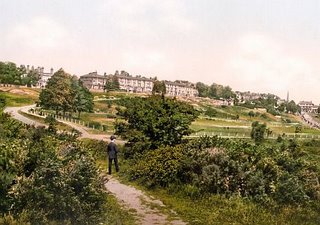
Image: Tunbridge Wells Common

[1] Boreham’s books with titles drawn from nature include Loose leaves, Mountains in the mist, Mushrooms on the moor, The silver shadow, The uttermost star, A reel of rainbow, A handful of stars, Rubble and roseleaves, Wisps of wildfire, The crystal pointers, A tuft of comet’s hair, The fiery crags, The three half-moons, The blue flame, When the swans fly high, A late lark singing, In pastures green and The tide comes in.
[2] F W Boreham, Rubble and roseleaves (London: The Epworth Press, 1923), 19.
[3] Karl-Werner Brandt, ‘New social movements as a meta-political challenge: The social and political impact of a new historical type of protest’, Thesis eleven, no. 15, 1986, 66-7.
[4] David Bebbington, Evangelicalism in modern Britain: A history from the 1930's to the 1980's (London: Unwin Hyman, 1989), 168.
[5] F W Boreham, When the swans fly high (London: The Epworth Press, 1931), 244.
[6] F W Boreham, The crystal pointers (London: The Epworth Press, 1925), 163. For more information on the famous naturalist Charles Robert Darwin, see Dictionary of National Biography eds. Leslie Stephen & Sidney Lee vol. V (London: Oxford University Press, 1921), 522-534. For more information on Richard Jeffries see Bloomsbury guide to English literature ed. Marion Wynne-Davies (London: Bloomsbury Publishing, 1989), 633-634. Sometimes the name ‘Jeffries’ is spelt as ‘Jefferies’.

Monday, September 18, 2006

Boreham and His Theology of Inclusivity

F W Boreham’s call to inclusivity through recognizing the value of children, the disabled, women and the racially oppressed was predominantly sounded through stories of audacious men and women who struggled against great odds and challenged the dehumanizing forces in society.

Later, comparing those in the foremost positions in society with those less advanced, Boreham said, “The religion that has nothing to say to the hindmost is no religion for a world like this”.[1] While Boreham called for specific social, political and educational measures, this call was a whisper compared with the voice of many of the lives he extolled. The courage of Jane Austen or the tenacity of Mahatma Gandhi did not translate into the same intensity in the writings of Boreham.

His editorials about Australian aborigines revealed an unconscious racism as he did not convey the uniqueness, the value and the potential towards them that his more general statements exhibited. For one who was a student and advocate of history, Boreham’s silence on the atrocities committed towards aborigines illustrate that like most Australians he was part of the “history of forgetting, a tradition of disremembering, an affliction of collective amnesia”.[2]

Boreham’s theological convictions about the human uniqueness and the worth of an individual took on a national dimension when he urged his readers to recognise the uniqueness of Australia. Boreham’s call to Australia to celebrate its achievements, find its voice and exploit its resources were aspects of the corporate responsibility of its citizens or, as expressed by Vance Palmer, “To discover ourselves—our character, the character of our country and the particular kind of society that has developed here”.[3] The theological foundations of these convictions were not always visible and his views also seemed to have been inspired by what Boreham had learned about national identity from the lessons of history.

Geoff Pound

Image: ‘to discover the character of our country…’


[1] Boreham, Mercury, 17 January 1948.
[2] Ken S Inglis, Observing Australia: 1959 to 1999 (Melbourne: Melbourne University Press, 1999), 155.
[3] Vance Palmer, ‘Future of Australian literature’, Age, 9 February 1935.

Sunday, September 17, 2006

Boreham and His Theology of Beauty

F W Boreham’s conviction that books, art and theatre are the major avenues through which people might connect with the richness of life resonates with J R R Tolkien’ assertion that fairy-stories (and other imaginative literature) satisfy “certain primordial human desires” including the desire to “survey the depths of space and time” and the desire “to hold communion with other living things”.[1]

His contention that the arts provide a “broadening of life’s horizon”[2] is akin to the thoughts of contemporary Roman Catholic theologian Tony Kelly who, in extolling the re-creative role of art says, “It refreshes human experience, helping us to make and see things in their originality. The creativity of the artist works to clean the windows of perception, lest the vision be blurred by interior drabness, triteness, familiarity and possessiveness.”[3] Expressions of adventure and imagination were for Boreham manifestations of a divine urge and a participation in divine creativity.

Boreham’s early hesitation about attending plays and movies in the 1920s reflected not only “the neglect of beauty”[4] by the church but the more disastrous condition expressed in the damning words of the Welsh poet R S Thomas: “Protestantism—the adroit castrator of art; the bitter negation of song and dance and the heart’s innocent joy”.[5] While recognizing the danger pursuing aesthetics without reference to God, Boreham affirmed the artist’s role “to increase the world’s stock of beauty”. He sought to restore within the church and in society the essential relationship between a love of God and a love of beauty. Boreham’s thinking is captured well by Richard Harries when writing, “There is a resemblance, a relationship, between the beauty we experience in nature, in the arts, in a genuinely good person and in God; and that which tantalizes, beckons and calls us in beauty has its origin in God himself”.[6]

Geoff Pound

Image: “to increase the world’s stock of beauty”.

[1] J R R Tolkien, Tree and leaf. London: Unwin, 1964), 18. This thought is amplified by Tony Kelly, in ‘Faith seeking fantasy: Tolkien on fairy-stories’. Pacifica 15 (2002): 190-208.
[2] Boreham, Mercury, 4 November 1950.
[3] Kelly, ‘Faith seeking fantasy: Tolkien on fairy-stories’, 201.
[4] Richard Harries, Art and the beauty of God (London: Mowbray, 1993), 1.
[5] R S Thomas, ‘The minister’, Collected poems 1945-1990 (London: Phoenix, 1993), 54.
[6] Harries, Art and the beauty of God, 6.