Frank William Boreham 1871-1959

Frank William Boreham 1871-1959
A photo F W Boreham took of himself in 1911

Thursday, November 02, 2006

Boreham on Autobiographies

Write Your Story
While F W Boreham wrote about the fundamental distinctions between biography and autobiography (and reckoned that “all literature divides itself into these two classes”), he encouraged all people to write down their story because of the value of preserving and passing on the inspiration and lessons of one’s experience.[1] Challenging his readers to consider what they were bequeathing, Boreham expressed his verdict in stating, “Experience—the most priceless hoard that living creatures ever amass—is bequeathed as a heritage from generation to generation”.[2]

My Pilgrimage
In 1935, at the age of sixty-four, Boreham informed his readers, with a touch of humor, that he would be doing what he had suggested that others might do before they die. He said, “I am firmly resolved, on attaining centenarian honors, to give up writing essays, idylls, sketches, and all that kind of nonsense, and to devote my powers, before they begin to decay, to the compilation of my autobiography”.[3]

Within five years Boreham had written and published his autobiography, which he clarified, was not “born of an inflated conception of my own importance. On the contrary, it is born of a delicious consciousness of my own insignificance”.[4] In perhaps his strongest claim for ordinary people leaving their story for others, Boreham continued: “The lives of the Nobodies and the Nonentities offer a virgin field of novelty and freshness .… There is no drama like the drama of reality; no lure like the lure of life; no business half as intriguing as other people’s business. The man whose biography is not worth writing has never yet been born”.[5]

Geoff Pound

Image: 'write down your own story...'

[1] F W Boreham, Ships of pearl (London: The Epworth Press 1935), 38.
[2] Boreham, Mercury, 4 January 1936.
[3] Boreham, Ships of pearl, 34.
[4] F W Boreham, My pilgrimage (London: The Epworth Press, 1940) 7-8.
[5] Boreham, My pilgrimage, 7-8.

Wednesday, November 01, 2006

Boreham on Biographies

No History, Only Biography
F W Boreham possessed a bias towards Disraeli’s decree, “Read no history: nothing but biography, for that is life without theory”[1] and Emerson’s variation, “There is properly no history; only biography”.[2] Boreham wrote of the means by which readers might experience the personalities of significant people who had died and asserted, “The biographies of the noble dead are among the most stimulating volumes in our libraries. By means of their pages we come in touch with the richest and rarest spirits of the past: and in the process, our finest impulses are quickened and our highest aspirations inflamed”.[3]

Return to Biography
F W Boreham remarked in 1912 that there were indications that there was a return to the reading of biographies, a trend that he applauded and explained was due to a protest against modern fiction and a return to real life.[4] In this editorial entitled, ‘The return to biography’, Boreham explained how the functions of historian and biographer were quite distinct, yet renewed his appeal for the element of human interest in biography as he had with the writing of history: “Happily, the biographer is coming to recognise that real life is never prosy or dull, and that the man who produces a dull or prosy book has but proclaimed his failure as a biographer”.[5]

Remembering Unsung Heroes
F W Boreham not only wrote many biographical editorials about heroes who dazzled with their brilliance but also selected “minor” characters, “second-rate poets”,[6] “first mates”[7] and “makeweights”,[8] to encourage his readers to see the best in lives that were mediocre or flawed. Valuing the stories of superstars as well as the unsung heroes, Boreham paid tribute to ‘the romance of obscurity’, saying: “If the life of the man in the street is capable of artistic and attractive biographical treatment, how much more so is the life of the man who moved the millions, discovered the poles or saved his country in the day of crisis. If the life of the ordinary man is a nugget of romance, what a literary goldmine the life of the extraordinary man should prove”![9]

Geoff Pound

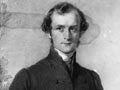
Image: FWB wrote a biography on this man, George Augustus Selwyn. It is hard to pick up a copy of this book. If you do you will be paying at least $US500.00!! It is because of such ridiculous prices that John Broadbanks Publishing has been formed.

[1] Benjamin Disraeli, Contarini Fleming: An autobiography (New York: D. Appleton and Co., 1870), 34.
[2] Ralph Waldo Emerson, ‘History’, The complete works of Ralph Waldo Emerson comprising his essays, lectures, poems, and orations vol. 1 (London: Bell and Daldy, 1866), 4.
[3] Boreham, Mercury, 8 April 1933.
[4] Boreham, Mercury, 5 October 1912.
[5] Boreham, Mercury, 5 October 1912.
[6] Boreham, Mercury, 8 August 1953.
[7] Boreham, Mercury, 13 August 1949.
[8] Boreham, Mercury, 28 September 1946.
[9] Boreham, Mercury, 9 December 1933.

Monday, October 30, 2006

Boreham on Books as Literary Monuments

Worth of the Bookworm
Of all the repositories of history, F W Boreham believed that books have been the most valuable in dispelling the ignorance that has blocked the path of progress. In an editorial in which Boreham made this point and advocated the worth of ‘the bookworm’, he spelt out the uses of books and why their reading was superior to other ways of ‘encountering’ the author. He explained:

“But by means of books, the ordinary mind establishes direct contact with the master-mind. People love to visit the scenes amid which Shakespeare and Wordsworth and Dickens once moved. They feel that, in paying pilgrimage to Stratford and Grasmere and Gads Hill, they are getting in touch with these deathless saints. But the sentiment is ephemeral compared with the real contact established with these commanding personalities when, taking into our hands the books that they themselves actually wrote, we allow them to pour into our minds the opulent treasures of their own. It is not simply that we imbibe their ideas and are infected by their philosophy. We come into personal touch with themselves and bear the impress of their magnetic personalities for ever afterwards.”[1]

Citizens of the Ages
Boreham continued to assert the supremacy of books by imagining playfully that even if Shakespeare were still alive, interviews would be difficult to secure and even if successful, interviewers would find the conversation degenerating into “a handful of platitudes and commonplaces”. Not only did Boreham consider that the reading of books was the most effective way to benefit from the personalities of the authors but also he concurred with Macaulay’s assertion that “the invention of printing was the most notable event that took place during a thousand years of history”.[2] The invention of the printing press enabled people to become “citizens of all ages” as they availed themselves of the increasing number of books that were published.[3]

Geoff Pound

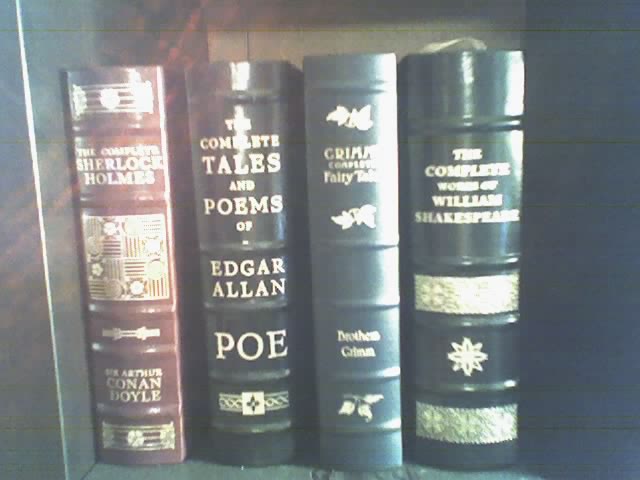
Image: Literary monuments


[1] Boreham, Mercury, 31 August 1940.
[2] Boreham, Mercury, 25 November 1922.
[3] Boreham, Mercury, 6 September 1941; Age, 25 October 1941.

Boreham on Communing With History's Figures

Encountering People
F W Boreham believed that good history writing should not only inspire people to good living as they read the stories of great people but also change readers through the direct encounter with history’s subjects.

This idea is expressed by romantic historians such as George Bancroft who wrote of “communing with antiquity”.[1] Thomas Carlyle affirmed Walter Scott’s contribution in reinterpreting the notion of ‘experience’ through reading when he said: “[History’s] faint hearsays of ‘philosophy by experience’ will have to exchange themselves everywhere for direct inspection and embodiment: this, and this only, will be counted as experience; and till once experience has got in, philosophy will reconcile herself to wait at the door. It is a great service, this that Scott has done; a great truth laid open by him”.[2]

Bringing People to Life
This goal of leading readers into the experience of ‘direct inspection and embodiment’ with people who were alive in history’s pages in turn influenced Boreham who sought to recreate scenes with imagination to heighten the power of the experience.

Boreham practised what he preached. Through the reading of books and visiting graves and other memorials he engaged in a deep communion with the subject.

Geoff Pound

Image: Grave of John Bunyan (one of FWB's favourite authors). Whenever in London, Frank Boreham would visit Bunyan's grave at Bunhill Fields Cemetery.


[1]George Bancroft, ‘Letter to Andrews Norton’, January 9, 1819, Bancroft papers (Boston: Massachusetts Historical Society), 1819.
[2] Thomas Carlyle, ‘Sir Walter Scott’, Essays, 3 Thomas Carlyle’s collected works vol. V (London: Chapman and Hall, 1869), 275.

Sunday, October 29, 2006

Boreham on the Need for Heroes

People Need Heroes
F W Boreham amplified his thoughts on the human passion for personalities when saying, “Men must have heroes, and if they cannot get the best, they will readily make shift with the best that they can get.”[1] The role of heroes in society, added Boreham, becomes more evident in turbulent times for “in days of crisis and tumult, strong personalities become emphatic, and the field of vision becomes dominated by a few commanding figures”.[2]

Boreham and Hero Worship
So important was this theme that Boreham confessed, “I had it in my heart to write a book [entitled] On heroes and hero-worship. But taking a mean advantage of the circumstance that [Thomas Carlyle] arrived on this planet nearly a century before I did, he forestalled me and published the book thirty years before I was born.”[3] Carlyle influenced Boreham’s views about the importance of heroes. However, recognizing that one’s choice of heroes is usually a matter of personal taste, Boreham said that if the task had fallen to him, “I should have given short shrift to some of his heroes, and, to redress the balance, should have included some over whom he has passed in silence”. While Boreham did not write a book entitled, On heroes, many of his editorials were written about his heroes, he devoted two biographies to two of his heroes—George Augustus Selwyn and The man who saved Gandhi (based on the life of Boreham’s mentor, J J Doke)—and five of his books are collections of essays (reworked editorials and sermons) on the lives of people whom Boreham venerated.[4]

Boreham Pantheon
Boreham’s pantheon of heroes was broad and included the warrior-heroes, navigators and sea dogs that dominated the attention of the early Victorians. However, his heroes were mainly drawn from those who had made their mark in literature, politics, the church, science and invention and exploration.[5] The people he extolled were those who represented such virtues as endurance and constancy (James Watt),[6] courage and patience (Samuel Morse),[7] magnanimity (John Motley),[8] triumph over adversity (Robert Louis Stevenson)[9] and self-effacement (Catherine Blake).[10] While Boreham was intentional about telling the stories of Australian heroes, he did not appear to be attentive to the “new race of heroes” that Australians were discovering on the sporting field and in the bush.[11]

Power of One
Writing on the anniversary of the death of Lord Lister, Boreham indicated the importance of one significant person when he said, “Men of such a mould are the glory, not only of a nation, but of all mankind; and it is fitting that on every suitable occasion, we should recall their heroic achievements and acknowledge their incalculable debt under which they have placed us”.[12] Similarly, in describing the impact of Ambrose on Augustine, Boreham acknowledged, “It often happens that the biggest thing in even the biggest city is the commanding personality of one man”.[13] Boreham added that Augustine’s “hero-worship was intensified by the intimate experience of contact and conversation”, thus demonstrating the influence of personal contact between a hero and a hero-worshipper.

Ongoing Influence
While recognising the influence of a hero while they are living, Boreham curiously remarked that “many a man does his best work AFTER he is dead…. No man likes to feel he dies when he dies”.[14] Boreham developed this thought in his writing about heroes in an editorial on the influence of John Bunyan: “In 10 days he was dead. But, as so often happens, his death made little difference to him. It was merely an episode in his triumphal progress. In reality he was never so much alive as he is today. His books represent his most imposing monument; and, in the writings of those who have modelled themselves on his perfect style, he lives a thousand lives, quite anonymously but with tremendous effect”.[15]

Lighting a Torch
As with John Bunyan, Boreham believed that “a great spirit often does his best work not in his own proper person, but by means of the disciples and students who rise up to succeed him and carry on his work”.[16] Expanding on this theme, Boreham said, “History abounds in illustrations of the way in which a master, by personal contact with a disciple, will light a torch that illumines the world with a brighter light than he himself has ever been able to radiate”.[17] Boreham believed a hero’s influence often was conveyed quite unconsciously, but at other times influential personalities such as Charles Simeon profoundly impressed John Wesley and William Wilberforce through an intentional commitment to fire the imagination of his students with a noble cause.[18]

Hero Worshippers
While Boreham wrote editorials about the need for heroes, he also addressed the subject of hero-worshippers. These are the people, who in speaking or writing about their heroes sow within their hearers and readers the seeds of heroism. Writing about Richard Hakluyt, the Oxford lecturer in geography and cosmography from the sixteenth century, Boreham said:

“And does not the hero worshipper who takes the trouble to transmit to posterity his veneration for his idol pass the spirit of heroism, like a flaming torch, from one generation to another? It is the vital principle out of which the shining web of history is spun. An earnest man conveys the fire that burns within his own breast to the pages on his desk, and, just as fire communicated to paper spreads the conflagration to everything that the paper touches, so the reader who picks up these inspired pages falls under the influence of their radiance and their warmth. How many have become pilgrims through reading the story of Bunyan’s pilgrimage? How many have made the greatest of all confessions through reading the Confessions of St. Augustine? How many apostolic acts have been inspired by the Acts of the Apostles? And, by the same token, how many gallant souls have done a brave day’s work for England through perusing the Voyages written by the sixteenth century rector?”[19]

One detects within this editorial an insight into the motivation of Boreham that in writing passionately about his heroes he was seeking to transmit “the spirit of heroism” to his readers.

National Heroes
Along with the new appreciation of history in the last quarter of the twentieth century, Davison observes that the “traditional resistance to hero-worship seems to have weakened” with interest being focused by the media and motivational agencies on ordinary Australians such as bushfire fighters.[20] This resurgence of interest appears to vindicate Boreham’s move to focus on Australian heroes whose lives were more within the reach of his readers in terms of the context of their exploits and the virtues they embodied.

Geoff Pound

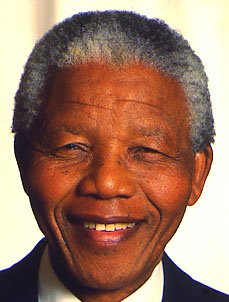
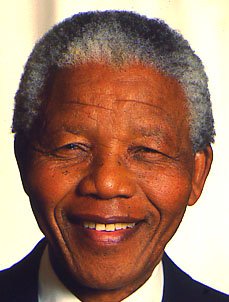
Image: Nelson Mandela, a popular hero.

[1] Boreham, Mercury, 8 December 1923.
[2] Boreham, Mercury, 8 December 1923.
[3] F W Boreham, When the swans fly high (London: The Epworth Press, 1931), 145-146. The book Boreham refers to is Thomas Carlyle, On heroes, hero-worship and the heroic in history (London: Ward, Lock & Co Ltd, 1841).
[4] These books are A bunch of everlastings, A handful of stars, A casket of cameos, A faggot of torches and The temple of topaz.
[5] A survey, undertaken by the author, taking a sample of sixty-eight biographical editorials drawn from Mercury editorials in the 1940s and 1950s, investigated the fields in which Boreham’s subjects (heroes) had made their mark. It revealed that literary heroes were most prominent—(forty-four percent), followed by political heroes (thirteen percent), heroes of the church (ten percent), inventors (nine percent) and explorers (six percent). Other heroes listed came from the spheres of art, medicine, history, war, philosophy, drama, education and social justice. (The high proportion of literary heroes in Boreham’s Mercury editorials in this period was affected by his other role as a contributor to the Literary Supplement of the Age.)
[6] Boreham, Mercury, 26 September 1925.
[7] Boreham, Mercury, 18 July 1936.
[8] Boreham, Mercury, 30 May 1925.
[9] Boreham, Mercury, 11 July 1936.
[10] Boreham, Mercury, 13 August 1949.
[11] For example, Manning Clark includes in ‘the new race of heroes’ bush people like Jim Jones and Ned Kelly who defied the authorities, Australian cricket heroes (such as Warwick Armstrong and Donald Bradman) who conquered their British opponents and AFL footballer Roy Cazaly. C Manning H Clark, A history of Australia, 1916-1935. vol. 6. (Melbourne: Melbourne University Press, 1987), 208-209.
[12] Boreham, Mercury, 10 February 1951.
[13] Boreham, Mercury, 28 August 1948.
[14] Boreham, Mercury, 10 October 1942; Age, 11 November 1950.
[15] Boreham, Mercury, 31 August 1946.
[16] Boreham, Mercury, 26 May 1945; Age, 17 March 1951.
[17] Boreham, Mercury, 28 August 1948.
[18] Boreham, Mercury, 13 November 1948.
[19] Boreham, Mercury, 23 November 1946.
[20] Davison, The use and misuse of Australian history, 25-26.
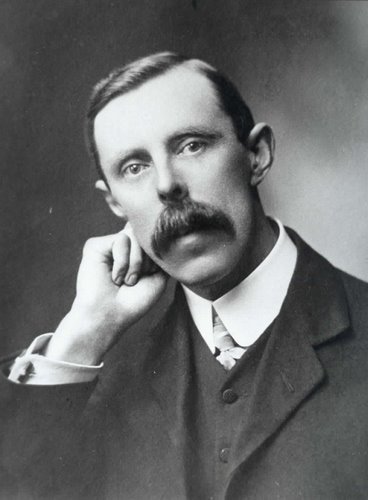
Boreham's Call for Human-Centred History

Teaching By Examples
In commem-orating the centenary of the completion of Macaulay’s History of England, F W Boreham sought to explain the “extraordinary sensation” that the book had upon its readers.[1] He believed its success could be in part attributed to Macaulay’s human-centred approach to the writing of history.[2] Borrowing Lord Macaulay’s definition, he stated, “History is Philosophy Teaching By Examples”.[3]

Communicate the Human Element
Boreham frequently called for historical writing that contained the human element that was evident in good fiction. For instance, he once commented: “One sometimes wishes that the average novelist and the average historian could be shaken up in a bag and their qualities distributed. The result would probably lend a new grandeur to fiction and a new realism to history”.[4]

Passion for the Personal
In an editorial entitled ‘Passion for the personal’, Boreham said, “We humans have an insatiable passion for personalities. It is the dominant factor in our conversation and our correspondence”.[5] The importance of ‘the personal equation’ was, according to Boreham, one of the reasons why the writing of history must deal primarily with people’s stories. The human-centred approach to history gave good scope for writing in concrete language about the admirable virtues and qualities that a person embodied. Boreham’s passion for personalities found expression in the number of historical editorials he wrote in which abstract principles were clothed and movements found expression in the colourful stories of human lives.

Individuals as Representative Figures
While Boreham wrote numerous editorials on one person, his aim was not only to inspire individual readers but also to let his subject serve as a representative figure who embodied a national aspiration or a type of the ideal human.[6] Levin elaborated upon this approach when saying, “The representative man was both an historical phenomenon and a literary device. For an age that glorified individualism, for historians who emphasised moral responsibility and to whom self-reliance was a moral duty, the historical character had to be influential”.[7] Boreham illustrated the way that the passion for personalities is the same impulse that drives people to associate the name of a person with a historical movement or tradition in the following manner:

“In recalling some impressive period of human history, we instinctively summon to the mind the face and features of some outstanding individual. Our naval traditions become incarnate in the heroic figure of Nelson; the abolition of slavery automatically recalls the dwarfish frame of William Wilberforce; the industrial revolution expresses itself in the thought of Lord Shaftesbury. In contrast with all the other sacred books, the Bible consists of a ceaseless pageant of personal records, and the redemption of the world is revealed in a thorn-crowned face.”[8]

Crystallized History
Asking the famous question, ‘What’s in a name?’ Boreham argued that if in ordinary life names are more than mere identification tags then how much more meaning do names possess in history? Referring to the way names may signify movements and personify traditions, he wrote, “Names are crystallized history; they stir the blood like trumpet calls and bugle blasts; they are pregnant with significance and challenge”.[9]

Geoff Pound

Image: Human-Centred history

[1] Boreham, Mercury, 1 October 1949.
[2] Thomas Carlyle makes a similar endorsement about the writings of Walter Scott, saying Scott’s world was “actually filled by living men… not abstraction”. Thomas Carlyle, ‘Sir Walter Scott’, Thomas Carlyle's collected works, Vol. 5 (London: Chapman and Hall, 1869) 275.
[3] Boreham, Mercury, 1 October 1949.
[4] Boreham, Age, 4 January 1947; Age, 1 October 1949.
[5] Boreham, Mercury, 8 September 1956.
[6] This was a popular historical and literary device employed by essayists and historians. Emerson, in many of his essays, focused on such representative men in articles entitled, ‘Plato, or the philosopher’, Swedenborg, or the mystic’, ‘Montaigne, or the sceptic’ and ‘Shakespeare, or the poet’. Ralph Waldo Emerson, The complete works of Ralph Waldo Emerson comprising his essays, lectures, poems, and orations vol. 1 (London: Bell and Daldy, 1866), 288-311, 311-335, 335-352, 352-365.
[7] Levin, History as romantic art: Bancroft, Motley, and Parkman, 51.
[8] Boreham, Mercury, 8 September 1956.
[9] Boreham, Mercury, 24 September 1927.

Saturday, October 28, 2006

Boreham the Song Writer

F W Boreham was a pastor, preacher, essayist, editorialist, biographer, poet, photo-grapher and also a song writer.

Sometime F W Boreham wrote the following lines intended to be sung at services of baptism. They were published in The Baptist Hymn Book (green edition). Note the Trinitarian structure of this hymn:

Eternal Father, whose great love
Encircles us where’er we rove—
By peak or plain, by sea or shore,
By crowded street or lonely moor—
Enfold within Thy sleepless care
Those who this day their faith declare.

Eternal Saviour, whose rich grace
Did anguish, dark and drear, embrace;
Whose sweet compassions never fail;
Whose intercessions must prevail;
Uphold, we pray Thee, gracious Lord,
Those who this day obey Thy word.

Eternal Spirit, whose still voice
Hath prompted every gracious choice;
Who taught our souls to loathe our sin,
And at the Cross new life begin;
Preserve and lead for Jesus’ sake,
Those who this day the world forsake.

It is sung to the tune Melita, made famous as The Navy Hymn ('Eternal Father Strong to Save').

If you want to listen to the tune check it out on the following address:

http://www.cyberhymnal.org/htm/e/t/eternalf.htm

Geoff Pound

Image: Obviously reading one of F W Boreham's books!

Thursday, October 26, 2006

Boreham and the Last Tour

In 1935 Boreham received an invitation from Epworth Press to tour Britain and undertake a further preaching tour.

They left from Port Melbourne in March 1936. It was on this trip that Boreham addressed the large gathering of pastors in Edinburgh, when he was introduced as “the man whose name is on all our lips, whose books are on all our shelves, and whose illustrations are in all our sermons.”

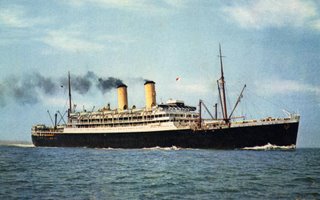
In September of that year they boarded the Orontes at Tilbury and from the deck and through their tears, Frank and Stella took their last look at England and sailed for home.

Geoff Pound

Image: The Orontes.

Boreham the Freelancer

In 1924 (while at the Armadale church in Melbourne) Frank and Stella returned to England on board the Majola.

At the commencement of their retirement in 1928 they went on a preaching tour of England aand North America, this time traveling on the Mooltan.

On this visit they returned to Tunbridge wells and this was the last time they saw Boreham’s parents.

Geoff Pound

Image: The Mooltan

Boreham Back Across the Tasman

When F W Boreham was in Mosgiel he became involved in local politics, primarily in the cause of the Temperance Movement.

Soon after he arrived in Australia he returned to NZ for a month to conclude his part of the campaigning.

He went on board the Maheno, which in WWI became a hospital ship and years later went aground on Fraser Island (the second of the ships Boreham traveled on that sank!)

Geoff Pound

Image: The hospital ship, the Maheno.

Boreham to Australia

The Boreham’s returned from their visit to England via South Africa and got back into their work at Mosgiel with renewed vigour.

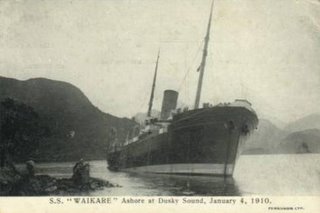
In 1906 Frank was called to the city pulpit of the Hobart Baptist Tabernacle. They left from Bluff (near Invercargill) on the Waikare.

When the ship berthed the church officers all came on board and were surprised that their new pastor was able to greet them all by name.

Interestingly, the Waikare struck a rock in the waters of Fiordland, NZ, in 1909. All 226 passengers were saved.

Geoff Pound

Image: The Waikare, too near the rocks on Dusky Sound.

Boreham and Visiting Home

After being busy as a pastor and adding two children to the Boreham family (Ivy and Wroxie), the Mosgiel Church did two wonderful things: They passed a motion of appreciation to their pastor and they gave him six months leave on full salary.

In 1903 the family took a train to Wellington and commenced their journey ‘home’ on the ship, the Tongariro.

Having come to NZ via South Africa they decided to return by the Cape Horn.

Geoff Pound

Image: The Tongariro.

Boreham and the Urge to Merge

For six weeks Frank Boreham was aboard the Tainui. It went to New Zealand via South Africa. By the time he got to Capetown he had felt the geographical distance between him and Stella and he sent to her father a letter telling him that he would like to marry his daughter.

FWB got to Wellington, NZ on 11 March 1895 and went by another boat to Christchurch and then by train to Dunedin.

On 24 March 1896 Boreham’s bride arrived in Wellington on the Ruapehu and the two were reunited and married a few days later (13 April) in a home in Kaiapoi, Christchurch.

Geoff Pound

Image: The Ruapehu

Boreham to the Uttermost Parts...

Thomas Spurgeon returned from his tour of New Zealand with a ‘shopping list’ from churches that were wanting pastors from Spurgeon’s College. On 15 November 1894 Frank Boreham was called into Professor Marchant’s office to be told that the College staff had considered a request for the Mosgiel Church in Otago, NZ and would Boreham go? A conversation was arranged that evening when a glowing picture was painted by Spurgeon of the opportunities of ministry in NZ. FWB had only done two years of a four year course. I wonder if a reduced course was a motivating factor?

Letters flowed between Frank and his parents. His mother had vowed to God after her son’s train accident that if God spared her son she would dedicate him to God’s service wherever that might lead him. She and Francis, her husband, gave their blessing.

The new Sunday at Boreham’s student pastorate, Theydon Bois, his call to Mosgiel was announced. At a Monday night service at Spurgeon’s Tabernacle where hundreds of people were gathered, Thomas Spurgeon introduced the pastor-designate of the Mosgiel Church and FWB gave an address outlining his personal testimony.

Interestingly, Boreham concluded his talk with the oft-quoted statement: “And it is my hope that in the course of my ministry I shall hold three pastorates, and then be free to travel in many lands preaching the everlasting Gospel among all denominations.” This hope was fulfilled so accurately.

On 13 January FWB was farewelled at Theydon Bois. On 24 January 1895 he and his family took the train to the Royal Albert Docks. Thomas Spurgeon was among the well wishers. So was his girlfriend, Stella, to whom he rather publicly planted a kiss upon her lips.

F W Boreham went on board the Royal Mail steamer, the Tainui and set sail for New Zealand.

Geoff Pound

Source: T Howard Crago, The Story of F W Boreham, 55-59.

Image: The Tainui.

Boreham and that Locomotive

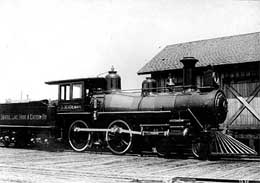
At the age of fourteen—on December 5, 1884—Frank Boreham came home with the news that the office of the High Brooms Brick Company was wanting the services of a boy.

After a sleepless night Frank and his father walked from their Tunbridge Wells home for the interview, the boy got the job and he started right away.

It was an office job but whenever a train pulled out of the siding, Frank had to hurry down to check the number of trucks of bricks as they left the works.

All went well for a year. Then came that fateful Saturday morning. Frank went to the siding and began recording his entries in his book. Where the siding joined the main line, the points were operated by a pair of levers at the side of the track. Here the guard was standing, hands on lever, ready to throw the points as the train shunted off the siding.

But the junior clerk’s absent-mindedness, for which he had become so notorious at school, had not yet left him, for although he had long known of the danger, he stood directly in front of the second lever hard by the track.

As the engine slowly drew across the points, the movement of the rails flung the lever behind Frank’s back suddenly forward, hurling him under the grinding wheels of the locomotive. The wonder was not that he was so badly smashed, but that he was lifted out alive.

He was hospitalised and his right leg (just below the knee) was amputated. Septicaemia set in as well as other complications. Upon his departure from hospital months later Frank Boreham had to get about on crutches. Later he had a number of artificial legs made for him and he walked with a limp. His son, Frank, said that growing up as a boy and teenager he never knew his father had an artificial leg for it had never stopped his father from being such a great walker. In Boreham’s diaries in the 1950s there are entries about the pain in his legs (due to the primitive surgery in 1885) which caused many sleepless nights.

F W Boreham did not return to the Brick Company but as he had learned Pitman’s Shorthand in hospital he had a short career working as a journalist for the local Advertiser and the Kent and Sussex Courier.

Geoff Pound

Sources: T Howard Crago, The Story of F W Boreham, 24-25; F W Boreham's Unpublished Diaries.

Image: An 1885 locomotive

Boreham on Measuring Progress

Heirs of the Ages
F W Boreham encouraged his readers to recognize that they were “heirs of all the ages” by alerting them to the valuable perspectives that come through acquiring a historical consciousness, particularly a sense of human progress.[1] He illustrated this by setting the difficulties of the economic depression in their historical context saying that “most of the ordeals and distresses that we have experienced in recent years are growing pains”.[2] Similarly, when writing of the troubled times of the Second World War he drew upon the examples of history to observe that “in every realm, progress and pain are inseparable”.[3] To some of his readers Boreham’s interpretation of the reality of human evil may have appeared simplistic and glib. While recognizing the horrors of war, Boreham made little effort to voice the questions readers may have been pondering about the problem of evil, the suffering of the innocent and whether humankind was making progress in the moral realm.

Spur to Progress
In 1925, when Australian readers were bombarded with the political slogan, ‘Keep your eye on 1950’, Boreham alluded to the important role of history by advising people to “glance back to the world in 1900”.[4] His contention was that in thinking back twenty-five years to the time when there were “no aeroplanes and no picture-shows” people might be inspired to consider that new inventions or amazing feats, such as the conquest of Mount Everest, might be achievable.

Take the Long View
Boreham believed that acquiring an historical perspective in regard to inventions would encourage people to consider that “the rate of progress is accelerating with the years”.[5] However, in 1921, when reconstruction after the First World War appeared to be too slow for many and when Boreham perceived that “pessimism is uniformly and invariably popular”, he encouraged his readers to take “the long view” through the lens of history to see that civilization “is a story of steady progress” and “the progress even of a nation is only visible to those who will exercise infinite patience and take long, long views”.[6]

Apply the Tape Measure
While Boreham did not write explicit editorials on the subject of progress, he viewed its significant measures to include growth in character and virtues, the possession of national pride, the honoring of a nation’s leaders and servants and the increase of learning. Progress in these spheres would bear fruit in the economic, educational and religious richness of a nation. Levin elaborated further on this concept or ‘law’ when saying, “Progress meant an increase in political and intellectual liberty, a movement toward … ‘humanity,’ a movement away from artificiality or formality toward simplicity, away from torpor and disease toward vigor and health”.[7]

Geoff Pound

Image: 'apply the tape measure...'


[1] Boreham, Mercury, 3 January 1948.
[2] Boreham, Mercury, 9 March 1935.
[3] Boreham, Mercury, 24 August 1946.
[4] Boreham, Mercury, 7 February 1925.
[5] Boreham, Mercury, 19 November 1921.
[6] Boreham, Mercury, 26 November 1921.
[7] Levin, History as romantic art: Bancroft, Motley, and Parkman, 43.

Wednesday, October 25, 2006

Boreham Books Borne Again


Birth of Boreham Books
When F W Boreham’s writing took off internationally he received practical help from others. Although Hodder & Stoughton sent him a rejection slip, Boreham was undaunted and his bundle of essays to C H Kelly, Publishing received a more promising response.

C H Kelly (later to become Epworth Press) said they would publish the proposed volume of essays, on a royalty basis, if FWB himself would place an advance order for 300 copies at half price. “But what would a man do with 300 copies of your own book?” wrote T Howard Crago (Boreham’s biographer). The idea was unthinkable!

Try With A Little Help From My Friends
That night, as Boreham was about to drop his negative reply into the letter box he ran into Robert Morris, a well known bookseller in Hobart. He mentioned to him the contents of the letter in his hand. Mr. Morris saved the situation—and Boreham’s literary future. He would be glad, he said, to take the 300 copies at half price, and was sure that he could arrange with Robertson’s of Melbourne, to take at least 1,000 copies at that figure. So the letter was never posted and four months later The Luggage of Life was being unloaded on hundreds of eager readers and being praised throughout the religious world.

Boreham Revival
Michael Dalton and I are looking at reprinting some of F W Boreham’s books and publishing The Best Stories of F W Boreham. Just as FWB received help from Mr. Morris to launch his career we are asking for financial help to kick start a new edition of Boreham books to reach a new generation of readers.

We are looking for sponsorship for two publishing projects: Lover of Life (formerly The Man Who Saved Gandhi) which deals with the important story of how he was mentored by J J Doke and The Best Stories of F W Boreham.

I have recently reread all of Boreham’s books (a Boreham book marathon) and have scanned scores of stories prior to making a final selection. This book will contain the best stories Boreham told and be attractive for new readers and prove we are sure to be a great resource for teachers and preachers.

Gentle Prod
Take this as a gentle prod. If you can make a financial donation follow this link to the F W Boreham on Mentoring site for further information and details about sending your gift.

Geoff Pound

Image: 'A gentle prod'

Tuesday, October 24, 2006

Boreham on the Value of History

Developing a Consciousness of History
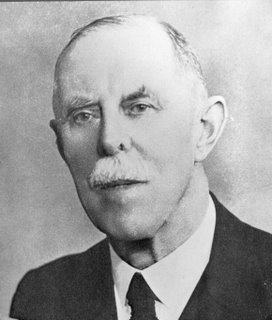
While F W Boreham challenged historians to write in a more appealing manner, he also addressed the reluctance of readers to develop a historical consciousness. Since 1888 when Henry Lawson complained about the abysmal historical knowledge of children and the failure of the education system, Australian patriots and historians have regularly deplored the neglect of the nation’s history.[1]

Addressing this neglect sometimes meant for Boreham dispelling the common notion “to let bygones be bygones”,[2] but what disturbed him most was Edward Gibbon’s indictment of the Athenians whose decline was apparent in their “indifference to antiquity”.[3] Boreham judged that “to such a depth of degradation Australians have not fallen”;[4] however, the disinterest of most Australians towards history puzzled Boreham in respect of both the Australian personality and the quality of the Australian heritage. With characteristic tact, Boreham explained, “Among the virtues generally attributed to the typical Australian, modesty does not always find a conspicuous place”.[5] Why was it that Australians were, therefore, bashful or diffident about their past? He continued, “For some reason or other, the Australian is singularly reluctant to emphasize and commemorate the magnificent exploits which adorn his history”.

Boreham was not a lone voice on this theme. After their marathon trek across Australia, Baldwin Spencer and Frank Gillen expressed in 1912 their disgust over the lack of recognition for the early explorers, saying, “Australia cannot be congratulated in the way in which she has treated their memory”.[6] Historian Geoffrey Serle offered an insight into Australian attitudes towards heroes when saying, “No outstanding twentieth-century Australian leader … has retained full acknowledgement as a great man. Australians are not given to praising famous men or making legendary heroes of many, other than bushrangers and sportsmen”.[7]

Give Them The Facts
In another editorial on the same theme Boreham concluded that Australians “are guilty of want of thought rather than want of heart” and in order to escape this judgment “they will have to pay a little more attention to, and take a little more pride in, those glowing records that illumine the initial pages of Australian history”.[8] In an article commemorating the centenary of the exploits of Hamilton Hume, Boreham reiterated his view that the problem lay in a lack of information. He said, “Australians may have their faults; but if they are placed in possession of the facts, they never fail in appreciation of the splendid intrepidity and dauntlessness of those brave men who blazed the first trails across the continent”.[9]

Tide Turning
In the last two decades of the twentieth century commentators have observed the growing appreciation of history and the increasing role of historians in Australian public life.[10] Bruce Wilson offered examples to illustrate how this shift in attitude has been taking shape:

"The past two decades have seen an unprecedented interested in our national history …. Books on every conceivable aspect of Australian life, culture and the natural environment have poured from the presses. The Australian film industry has resurrected our past as well as itself. Nostalgia has recreated ‘living history’ at old Sydney Town, Sovereign Hill, Timbertown and elsewhere …. Women have begun to stake their claim to a place in the new national myth, rediscovering legendary figures like Caroline Chisholm and Miles Franklin."[11]

National History Needed
Boreham would have been heartened to see a new era of national myth-making emerge but Wilson’s comments suggest that the early Australian reluctance towards history that Boreham identified may not only be attributed to a lack of information but also to a lack of information about Australian history. Boreham was realistic about the task of awakening Australians to their past but his knowledge of history encouraged him—particularly the example of Sir Walter Scott who, when faced with the Scottish national spirit needing to be revived, “convinced himself that the torpid and lethargic Present needed to be brought in contact with a splendid and stately Past”.[12]

Reminding People of their Past
Boreham viewed his editorial responsibility as reminding Australians of their past and thus increasing their pride about their national heritage. His recognition that this task had importance for the future was revealed in his frequent reference to Macaulay’s axiom that “a people who takes no pride in the noble achievements of its ancestors will never achieve anything worthy to be remembered by its remote descendants”.[13] He elaborated on this thought when, in an editorial marking the achievements of the South Australian explorer John Billiatt[14] he asserted, “The more people know of the struggles and conquests of the past the more will they be willing to sacrifice and suffer in order that their spacious land may enjoy a destiny worthy of her monumental traditions”.[15]

Remembering our Debts
Boreham regularly addressed this theme in editorials commemorating those who had died in war and in writing of “the incalculable debt” that the living owed to its ancestors.[16] He said that “our solemn obligation to remember” is incumbent upon readers because “in the memory of survivors the dead live on”.[17] Enlarging on this thought, he said that by being remembered, such people, “fulfil their destiny” or “complete their life work”, an idea he attributed to Paul of Tarsus who “averred that his life work consisted in ‘filling up that which is lacking in the sufferings of Christ’”.[18]

Freedom From Apron Strings
While keen to extol the value of acquiring a knowledge of history, Boreham did concede some negative aspects. On Australia Day in 1951, he said that Australia’s challenge in creating a distinctly indigenous literature was “not because of aesthetic deficiency or intellectual poverty, but because of the extreme difficulty of shaking herself free of the monumental traditions that she had inherited”.[19] This observation, however, did not prevent Boreham from stating in the same article that Australia should recall at every opportunity that “the best life of the younger nations—America and Australia—is rooted in the spiritual pulsation that swept the Motherland”. In another article on developing a unique Australian style of music, Boreham alluded to the same limitation but said that Australia, compared with other countries, “is less hampered and trammelled by antique traditions”.[20]

Geoff Pound

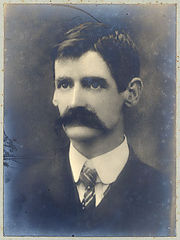
Image: Henry Lawson

[1] Henry Lawson, ‘A neglected history’, Henry Lawson: Collected verse, ed. Colin Roderick, vol. 2, Autobiographical and other writings 1887-1922 (Sydney: Angus & Robertson, 1972), 6-8.
[2] Boreham, Mercury, 22 June 1946.
[3] Boreham, Mercury, 14 June 1919.
[4] Boreham, Mercury, 10 October 1925.
[5] Boreham, Mercury, 13 June 1936.
[6] B Spencer and F J Gillen, Across Australia vol. 1 (London: MacMillan & Co., 1912), 29-30.
[7] Geoffrey Serle, John Monash: A biography (Melbourne: Melbourne University Press, 1982), 529. In writing about Simpson and his donkey in the Anzac legend, Les Carlyon adds a further insight to this theme when he said, “Australia likes quirky heroes”. Les Carlyon, Gallipoli (Sydney: Macmillan, 2001), 267.
[8] Boreham, Mercury, 10 October 1925.
[9] Boreham, Mercury, 13 January 1923.
[10] Graeme Davison writes, “History is often in the headlines. Never before, perhaps, have historians occupied as prominent a place in Australian public life”. Davison, The use and misuse of Australian history, 1.
[11] Bruce Wilson, Can God survive in Australia? (Sutherland: Albatross, 1983), 108.
[12] Boreham, Mercury, 9 February 1946; Age, 16 December 1950.
[13] Boreham, Mercury, 11 October 1924.
[14] John W Billiatt was one of ten men led by the famous explorer, John McDouall Stuart, who were part of the team that successfully completed the ‘South Australian Great North Exploring Expedition’. The team left Adelaide during October 1861, and, crossing the entire continent, reached the Indian Ocean on 21 January 1862. Details of Billiatt’s life including his birth date are scanty; however, he was the last surviving member of Stuart’s successful party and he died in England in 1919. More information can be found at www.northernexposure.com.au/stuart.html
[15] Boreham, Mercury, 16 August 1919.
[16] Boreham, Mercury, 27 January 1951.
[17] Boreham, Mercury, 6 November 1948.
[18] Col. 1:24.
[19] Boreham, Mercury, 27 January 1951.
[20] Boreham, Mercury, 6 July 1935.

Boreham on Writing History

No More Sterile Histories
Many of Boreham’s editorials reflected the Romantic historians’ commitment to literary technique. Like Macaulay, Boreham condemned the sterile work of the philosophical historians.[1] He often said that the paucity of good historical writing was because so many writers were “at their wits end for a subject [and were] driven to history because history is ready made”.[2]

Furthermore, he reckoned that the character of the historian’s task had been underrated and reduced to the mere recital of events.[3] “History,” he continued, “for the most part is wooden, stilted, lifeless, unconvincing. It is dignified but dull”. He launched his criticisms upon historians who wrote too abstractly and failed to pitch their ideas towards the average reader. In so doing, he noted: “The average historian takes us too seriously. He proceeds on the somewhat embarrassing assumption that we are all very learned, very erudite, very scholarly. He adopts the classical accents of the academy and the forum. He talks ponderously and philosophically. He misunderstands us. In reality, we are mere children”. [4]

Reflection of Real Life
Boreham’s criticism of most historians and his demanding standards arose from his conviction of the importance of the historian’s task. He believed that “history is the reflection of real life, and we have a right to demand that it shall be lifelike”.[5] Again, adopting the reflective imagery, Boreham said, “Life, whether past or present, is a most intriguing affair, and all that we ask is that the historian shall enable us to see it clearly in the crystal mirror of his story”.[6]

Colorful and Picturesque
Boreham’s many references to his editorial writing as a ‘sketch’, ‘portrait’ or an ‘idyll’ were more than metaphorical. According to Levin, “the romantic historian considered himself a painter” and Boreham saw himself in this tradition.[7] Always attentive to the impact of writing on its readership, Boreham added, “Nothing appeals to men like the pictureque. We are inveterate sightseers. We love to see things .… Did they wear red breeches or grey?”[8] In writing about pleasing historical style Boreham indulged his fondness for the attention-grabbing power of stories, colourful imagery that enabled readers to see the history and the ‘passion for trifles’, agreeing with the literary historian, Arthur Compton-Rickett, that “no detail is unworthy of mention”.[9] In the tradition of the romantic historian, Boreham “compared history to drama almost as often as [he] compared it to painting”.[10]

Vivid and Accurate
Boreham was aware that the historian must not yield to the temptation to “make his pages a wearisome recital of uninteresting and unimportant events” nor to the opposite temptation “to make his chronicle readable by spicing it up”. In order to achieve historical writing that is truthful yet interesting, Boreham outlined the following essential gifts: “The historian needs the vivid imagination of the novelist; he needs the mathematical accuracy of the scientist; he needs the penetrating insight of the philosopher; and he needs the musical temper and graceful diction of the poet. He needs all these in combination, and he needs them all at every turn”.[11]

Skipping Over the Dry and Dusty?
One wonders how often facts were ignored to enhance the drama of the story and how many historical themes Boreham shelved, like William Prescott (another person switched on to writing history by reading Gibbon) who only chose subjects that could be made “novel, elegant, useful and very entertaining”[12] and George Bancroft who “combined all the elements necessary in his History to make it the most popular literary and scholarly embodiment of the optimistic, democratic faith of nineteenth century America”.[13]

History Forging Connections
Boreham showed little evidence of a critical approach to history which “interrogates and condemns” the past or studies the past to evaluate the significant aspects of the lives of people who lived in a former age.[14] He understood history’s primary use in the way it connects peoples with forgotten ages and inspires them with their spirit.

Geoff Pound

Image: Victorian State Library in Melbourne, where F W Boreham read and researched many of his historical essays.

[1]Thomas Macaulay, The works of Lord Macaulay ed. Lady Macaulay, vol. 5 (London: Longmans, Green & Co, 1866), 152-56.
[2] Boreham, Mercury, 20 November 1920.
[3] Boreham, Mercury, 26 February 1938; Age, 4 January 1947; Age, 1 October 1949.
[4] Boreham, Mercury, 20 November 1920.
[5] Boreham, Mercury, 1 October 1949.
[6] Boreham, Mercury, 26 February 1938.
[7] Levin, History as romantic art: Bancroft, Motley, and Parkman, 12.
[8] Boreham, Mercury, 20 November 1920.
[9] Boreham, Mercury, 26 February 1938. Arthur Compton-Rickett (1869-1937) is best remembered for his History of English literature from earliest times to 1916 (London: Nelson, 1964) and Lost chords: Some emotions without morals (London: A D Innes & Co., 1895).
[10] Levin, History as romantic art: Bancroft, Motley, and Parkman, 19.
[11] Boreham, Age, 4 January 1947.
[12] William H Prescott, Notebooks IV, Prescott Papers (Boston: Massachusetts Historical Society), 80-81.
[13] David B van Tassel, ‘George Bancroft 1800-1891’, in Encyclopedia of American biography 2nd ed., eds. John A Garraty and Jerome L Sternstein, vol. 1 (New York: HarperCollinsPublishers, 1996), 59.
[14] Graeme Davison, The use and misuse of Australian history (St Leonards, NSW: Allen & Unwin, 2000), 14.

Monday, October 23, 2006

Boreham's Passion for History

Pouring the Past Into the Present
While F W Boreham had a profound reverence for life in the world of nature, his editorials reveal that he also had an intense fascination for the historical study of human nature. His conversion to history took place at Mosgiel in 1900 when, through the reading of Gibbon’s Decline and fall of the Roman Empire, Boreham was hooked on history. Boreham’s voracious appetite for history and his views about historical method and style were nurtured by his reading of other historians besides Gibbon, including Britisher Thomas Macaulay and the American, Eurocentric historians George Bancroft[1] and William Hickling Prescott.[2] Boreham contended that “the art of life consists in compelling the past to pour its enrichment into the present in such a way as to ensure a still more roseate future”.[3]

Childhood Influences
While the Gibbon experience was significant Boreham’s regard for history was being shaped much earlier. Childhood influences upon Boreham background included the industrial expansion, the development of the rail, the discoveries in science and the burgeoning imperialism all of which contributed to Britain’s sense of advancement. These were examples of human progress, a conviction that was foundational to Boreham’s understanding of the role and value of history. Shaping his views about the upward march of history was the ‘Christian optimism’ fostered by the church and a theological education that typically presented history “as a straight line of God’s purpose running from creation through his chosen people to the present. History was moving forward”.[4] One cannot underestimate the significance of Boreham’s ‘conversion’ to historical study for in tracing the development of evangelicalism (Boreham’s early tradition) Bernard Reardon said, “Of religion as a historical and cultural phenomenon, to be studied as such, it [evangelicalism], needless to say, had no conception. Even the history of Christianity as a major phase in the education of the human race did not interest it”.[5]

Inevitably, Boreham’s understanding of history was shaped by several popular writers. With Gibbon and Macaulay providing a historical framework for the notion of human progress (intellectually and morally), Spencer and Darwin presenting their social theories about the evolving life of humanity and Dickens “who preached in many of his novels a doctrine of improvement” there was a rising optimism that characterized the mood of Victorian England.[6] These writers interpreted and heightened the temper of the times in which Boreham’s views about history were being formed.

Whilst Boreham’s view on history may not be universally accepted by professional historians today, David Levin’s History as romantic art, in which he focuses on the histories of George Bancroft, William Prescott, John Motley and Francis Parkman, is useful for helping to understand the historical tradition that Boreham sought to emulate. Levin portrays “the historian as romantic man of letters”, as one who is attentive to literary style and artistry, exhibiting the romantic preference for ‘heart over head’ and a discerner of national progress.[7]

Geoff Pound

Image: F W Boreham: 'hooked on history'.

[1]George Bancroft (1800-1891) was a historian, politician, author of the 10-volume History of the United States and US minister to Great Britain (1846-1849). More information about Bancroft may be found in the DAB ed. Allen Johnson vol. 1 (London: Humphrey Milford-Oxford University Press, 1935), 564-570.
[2] William Hickling Prescott (1796-1859) was a historian known for his works on Mexico, Peru and Spanish rulers. More information about Prescott can be found in the DAB ed. Dumas Malone vol. 15 (London: Humphrey Milford-Oxford University Press, 1935), 196-200.
[3] F W Boreham, Mercury, 22 June 1946; Age, 6 January 1951.
[4] David W Bebbington, Patterns in history: A Christian perspective on historical thought (Leicester: Apollos, 1979), 49-50.
[5] Bernard M G Reardon, From Coleridge to Gore: A century of religious thought in Britain (London: Longman, 1971), 30.
[6] Bebbington, Patterns in history, 83.
[7] David Levin, History as romantic art: Bancroft, Motley, and Parkman (Stanford, California: Stanford University Press, 1959), 3-22.