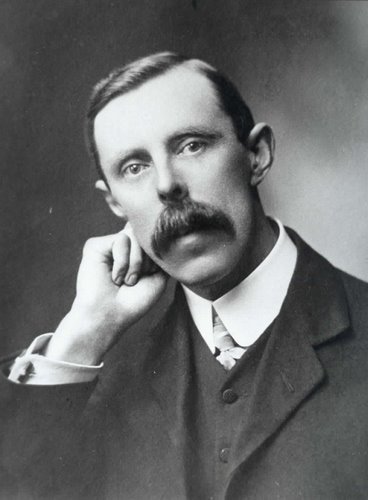
Frank William Boreham 1871-1959

Frank William Boreham 1871-1959
A photo F W Boreham took of himself in 1911

Saturday, April 22, 2006

So This Is Boreham: Part Seven

Perhaps one of the greatest gifts Boreham shares with preachers is his ability of story-telling. For those of us who stand in the pulpit on a weekly basis, we know the necessity of being able to communicate interesting stories.

Boreham excelled at this. Reading his works and catching the spirit of the man will benefit every preacher.

Boreham's use of the language excels most of what is available to the general reader today.

You will gain a deeper appreciation for the turn and twist of a phrase, the use of a properly presented adjective, and the spiritual truths that spring from the paragraphs near the close of a chapter.

Heed Dr. Warren Wiersbe's advice: "If at first Boreham does not excite you, give him time. He grows on you. He has a way of touching the nerve centers of life and getting to that level of reality that too often we miss. Some may consider him sentimental; others may feel he is a relic from a vanished era. They are welcome to their opinions. But before you pass judgment, read him for yourself and read enough to give him a fair trial."

Jeff Cranston

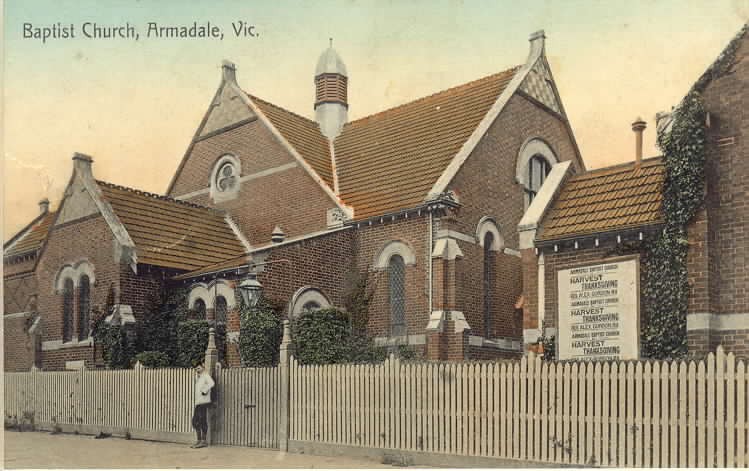
Image: A photo of the Armadale Church, in Melbourne (taken in the Boreham era 1916-1928).

Friday, April 21, 2006

So This Is Boreham: Part Six

Into the life of every pastor come M.G.R. (More Grace Required) parish-ioners. Boreham presents the minister with a stellar example of how to deal with his critics. His close friend, C. Irving Benson, tells us how one day Boreham handed over a very strongly worded letter commanding him to preach the gospel.

Benson said, "[The writer] was apparently misled by one of his intriguing titles. All who heard Frank Boreham knew full well that, however far away on the circumference he began, he always came to the very heart of the gospel. The letter hurt him and I advised he consign it to the waste-paper basket and forget it. 'I have already answered it,' he said. 'I wrote and told her that I appreciated her concern for the preaching of Christ's Gospel and asked her to pray for me that I may be a faithful minister of the Word.'" Every minister needs some of that spirit.

Although he lived a busy life, Boreham was always in control of his schedule and nothing stood in the way of him spending each and every morning in writing and study. His preaching and his writing were closely linked but his books are not necessarily collections of sermons.

Once he was asked which he liked better: to write or to preach? He answered without hesitation that preaching and pastoring held the upper hand. He went on to add, "Of course, it is like asking a man which of his two children he loves best! I glory in my pulpit--the greatest moments of my life have been spent there--but I am scarcely less fond of my pen. I do not like to choose between them. I want to be a preacher and a scribbler to the end of the chapter."

There is much wisdom and insight to be gained for every minister as the reader meets Pastor John Broadbanks of Silverstream, surely one of the choicest ministers who ever lived. He and Boreham were inseparably linked in life; you will delight in learning about John. His knowledge, expertise, and sagacity will be a boon for every minister struggling with the daily challenges presented by both the ministry and people.

Jeff Cranston

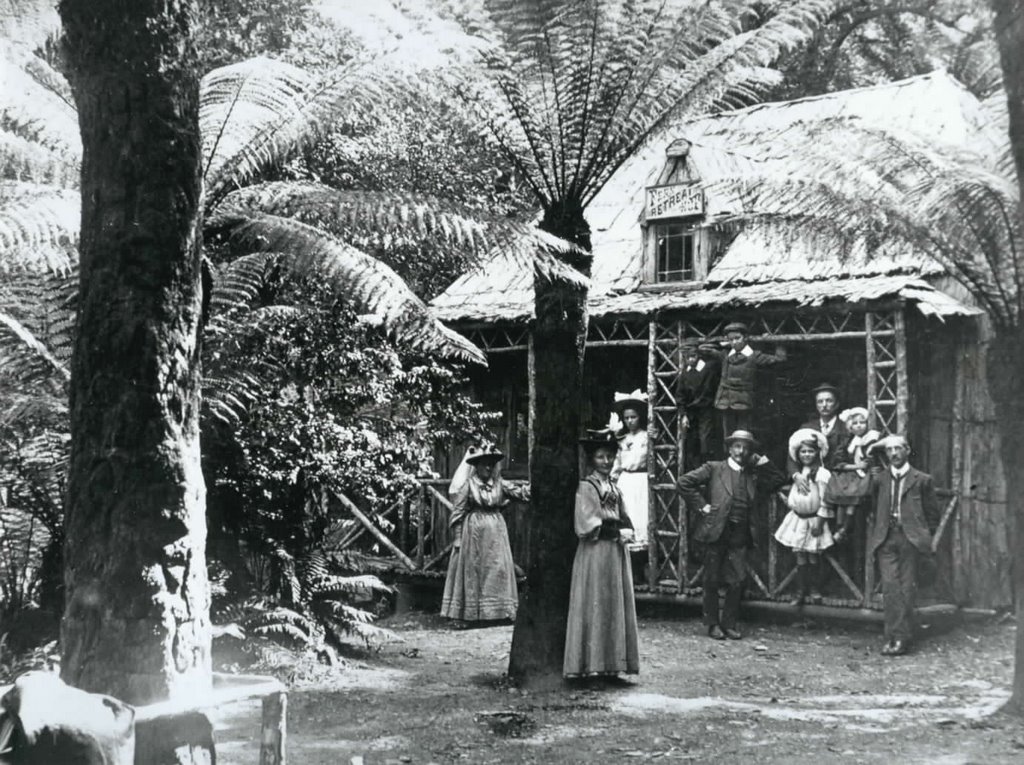
Image: This photo was taken by Boreham. It is of a bush scene near Hobart with family (Stella is in the front and the children are theirs) and friends.

Thursday, April 20, 2006

So This Is Boreham: Part Five

His most well-known sermon series came about in a unique way. He tells it best. If you're able, secure a copy of A Temple of Topaz and you shall find printed there, in the foreword, these words:
"One Sunday evening...I was standing in my pulpit in Hobart, Tasmania. The occasion was special and the church was crowded. I was commencing that night my Winter Series of Addresses. The addresses, as the printed syllabus showed, were to be delivered at fortnightly intervals. During the hymn before the announcements, I was deliberating on the precise phraseology in which I should refer to the course on which I was embarking. It suddenly flashed upon me that, by emphasizing the address that was to be delivered a fortnight hence, I was virtually inviting the more casual members of the congregation to absent themselves on the following Sunday. Could I not say a word that would make the intervening Sundays attractive? It happened that, during the week, I had been reading the Life of Luther, and had been impressed by the way in which the Reformation sprang from a single text."

"Whilst I was still engrossed in this brown study, the hymn came to an end and the people resumed their seats. I announced my fortnightly addresses according to the printed syllabus; and then astonished myself by intimating that, on the following Sunday evening, I should commence an alternating series of fortnightly addresses entitled Texts That Made History. 'Next Sunday evening,' I added with extraordinary temerity, 'I shall deal with Martin Luther's Text!'

"At the close of the service, one of my most trusted officers came to me in great delight.’That's a noble idea,' he exclaimed enthusiastically; 'it will be the best series that you have ever preached!' It has certainly been the longest, and the most evangelistic, and the most effective. And it has been the series in which I myself have found the most delight."

This series is composed of 125 messages Boreham delivered on fortnightly Sunday evenings. As a result of these compelling messages, scores of people placed their trust in the Saviour. Kregel Publishing in Grand Rapids, Michigan, has recently reprinted these addresses. Included are the salvation accounts, with the Scripture texts God used, of such notable figures as Abraham Lincoln, Catherine Booth, John Wesley, Robinson Crusoe, Blaise Pascal, John Milton, David Brainerd, William Penn, and Everybody's Text (Jn. 3:16). These delightful histories are readily available and should be in every minister's library.

Jeff Cranston

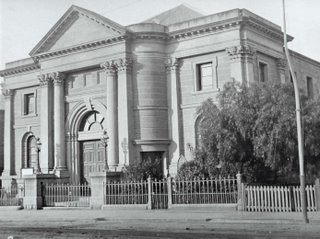
Image: The Hobart Baptist Tabernacle. Photo taken in the Boreham era by FWB. It is a huge auditorium and was regularly packed out in Boreham's ministry (GP).

So This Is Boreham: Part Four

After twelve fruitful years, the Borehams left Mosgiel and moved to Hobart, Tasmania, to accept the leading Baptist pulpit there.

During his years at Hobart, his writing found an even greater readership. More articles and books flowed from his pen.

His final pastorate was in Armadale, a prosperous suburb of Melbourne, Australia. He settled in nicely there and it was in Armadale where he spent his remaining pastoral years. As his writing became increasingly well known, invitations to speak began to come his way. He ministered all over the world addressing denominational councils and Bible conferences. He maintained his Baptistic convictions but in his heart his outlook was ecumenical. In his autobiography, My Pilgrimage, he writes, "During these years I have preached an almost exactly equal number of times in the pulpits of the various denominations and have felt equally at home in each. Indeed I like to think of myself as a kind of shuttle, moving to and fro, between the Churches and, perhaps binding them a little closer together." He added that he felt his sermons were equally accepted in all the churches. Moving between various denominational traditions fulfilled a lifelong dream of his. He stated at his commissioning service prior to sailing for New Zealand and embarking on his ministerial career, "...it is my hope that in the course of my ministry, that I shall hold three pastorates, and then be free to travel in many lands preaching the everlasting gospel among all denominations."

While speaking at the Church of Scotland's General Assembly in 1936, the moderator, Dr. Daniel Lamont, welcomed him as "the man whose name is on all our lips, whose books are on all our shelves, and whose illustrations are in all our sermons." His heart's desire had come to fruition.

Jeff Cranston

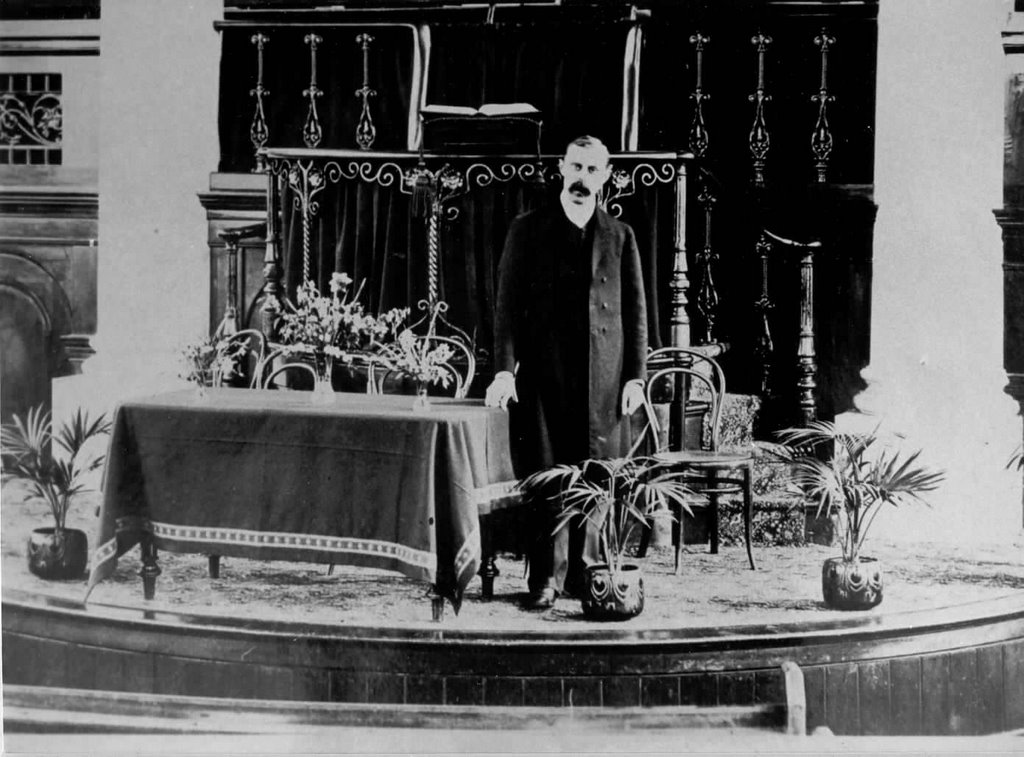
Image: F W Boreham on the platform of the Hobart Tabernacle. Note his traditional preaching coat (GP).

Tuesday, April 18, 2006

So This Is Boreham: Part Three

Believing God was indeed calling him to ministry of some sort, Boreham enrolled at Spurgeon's College. He was among the last students personally accepted by C. H. Spurgeon himself. In 1894, Thomas Spurgeon, who had been ministering in New Zealand but was returning to London to assume some of his father's responsibilities, issued a call for men to immigrate to New Zealand. There was a need for pastors in this newly opened Dominion, especially for someone to minister in the South Island, who would assume the pastorate of the Mosgiel Baptist Church. After conferring with his parents, Frank declared that he would go.

He set sail in January 1895, not even 24 years old and with a full year of school yet to complete. While en route, he cabled back to the little country village, Theydon Bois, where he had served a student pastorate. He asked for the hand of a young lady to whom he had become rather attached. Her father gave his approval and Frank's teen-age fiancé arrived in New Zealand later that year. They were married by their close friend, Rev. J. J. Doke, who later was instrumental in saving the life of Mahatmas Ghandi while both were in South Africa.

Mosgiel was settled primarily by Scots who had left the Old Country not many years prior. Within a matter of months they had built a manse for their new minister and his wife. It stands there still today. Oh, the stories that poured out of the lives of those to whom he ministered! Read his essays and learn of Tammas the church treasurer. Boreham writes, "The man who got Church money out of Tammas was regarded in the light of a genius." You will get to know Gavin and Wullie, Saddle Hill, and the engaging love story of Seth and Emily. Boreham himself played match-maker--partnering with a pressed nasturtium!

It was in Mosgiel that Boreham's pen started to make its presence known. He began to write on the many ordinary things in life that he observed, peculiarly different from others. He wrote as few others have. His command of language is impressive but the truths behind the words are what really capture the reader. Most of his writings are of the "devotional essay" style; they are engrossing and moving. He often enjoyed telling of the old gypsy crone who told his nanny, while she was taking him for a stroll one day, "Put a pen in his hand and he'll never want for a living." From childhood, he began his "scribbling," sending in submissions to children's magazines. In his later years he would be a household name among the Christian community of the British Commonwealth and North America.

Jeff Cranston

Image: Photo taken in 1898 of some of the members of the church at Mosgiel. F W Boreham is standing on the left holding his first-born baby. His wife Stella is in the back row, second from the right (with her eyes on her husband and child!). Unfortunately the Mosgiel Baptist church declined in vitality and about two to three years ago, wound up as a church. (GP)

Monday, April 17, 2006

So This Is Boreham: Part Two

One day in Tunbridge Wells, it was announced that the American evangelist, D.L. Moody, would be preaching that Sunday afternoon at the Village Green. Young Frank and his siblings were escorted to the village center by their aunt, she with strong evangelical leanings, and no doubt hoping for the salvation of her nieces and nephews. Upon arrival, they discovered the Green packed with people. There was no hope of getting close enough to the portly preacher to hear him. As they were resigning themselves to this fact, there was a sudden commotion behind them. The wind had shifted and a makeshift platform was being erected. Frank had a front row spot from which to listen to Mr. Moody!

Frank learned a great deal about preaching that day. It is a lesson every preacher must learn and of which he should be constantly reminded. Boreham writes, "...the astonishment of that afternoon lay in the circumstance that I could understand every word! I had somehow assumed that preachers of eminence must be very abstruse, recondite, and difficult to follow. I had hoped that, by intense concentration, I might occasionally catch the drift of the speaker's argument. But Mr. Moody took a text in which there was no word containing more than one syllable: The Son of Man is come to seek and save that which was lost. He used the simplest and most homely speech: he told stories that interested and affected me: he became sometimes impassioned and sometimes pathetic: he held my attention spellbound until the last syllable had died away. I could scarcely believe my ears. It was all so different - so delightfully different - from what I had expected the utterance of a world-renowned preacher to be." Moody was not the only great man of God used to mold Boreham's life.

Taking leave of home and moving to London for work at age 16, Frank was first employed in a clerical capacity. He later found a better paying job with a railway company. While working there, he suffered a serious accident that almost cost him his life and affected him through his remaining years. Living in a boarding house introduced him to many temptations only a metropolis like London could offer. Frank decided he needed to join a church and seek further spiritual training and teaching. The great Bible teacher, Dr. F.B. Meyer, pastored a church in London and offered a Saturday afternoon Bible class for young men. As Frank sat under Dr. Meyer's expository teaching week after week, he sensed God's call to the ministry. In order that he might test this tugging at his heart, he joined a group of young men from C. H. Spurgeon's Preacher's College and assisted them in evangelistic street meetings. Soon he found himself standing on a London street corner preaching the gospel.

Jeff Cranston

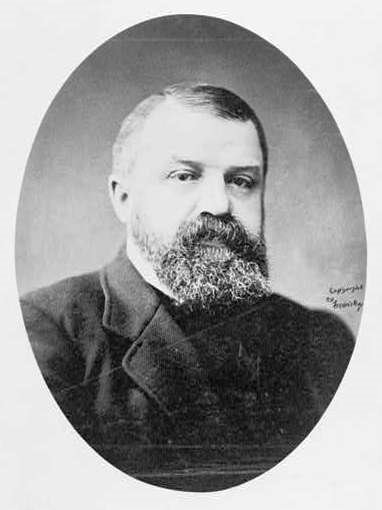
Image: D L Moody

So This Is Boreham: Part One

"For all of his life, he was a person apart. His Saviour was all important to him." So runs the descriptive phrase of a son about his father. The son is Frank Boreham, Jr. and his father is the man I wish for you to meet.

Frank William Boreham was a prolific author, penning more than 45 books, the composer of numerous booklets and approximately 2,000 newspaper articles. He served as pastor to three Baptist congregations in Mosgiel, New Zealand, Hobart, Tasmania and Armadale, Australia. His name is still spoken of with reverence in these locales today. As a minister, there is much to learn from him. As a writer, he leaves few equals in his wake. He was a consummate story-teller and every preacher can garner useful illustrations and acquire the knowledge on how to tell a good story simply be sitting at his feet and observing. He is a favorite of Mrs. Ruth Bell Graham, Warren Wiersbe, and Ravi Zacharias, along with countless others through the years.

F. W. Boreham was born in Tunbridge Wells, Kent, England on March 3, 1871. He says of that day, "Salvoes of artillery and peals of bells echoed across Europe on the morning of my birth." He was speaking, of course, not about his advent, but about the culmination of the Franco-Prussian War "that self-same day." It was the days of Victorian England and a wonderful setting in which a boy could grow up. "Wroxton Lodge," as his childhood home was called, held within its walls Frank and his nine brothers and sisters. He often recalled one of his favorite childhood memories: those Sunday nights when his mother would gather her brood around the fireplace and read a chapter or two from a classical book and then tell a personal story. Their perennial favorite was of their mother when she was a young girl visiting Canterbury Cathedral. She was to tour the grand old cathedral with her cousin, but her cousin failed to materialize. His mother was turning away, "disgusted and dejected," when a kindly gentleman, "with a short, pointed beard, brown hair going gray, a very fine forehead and wonderfully lustrous eyes," approached and offered to personally guide her through the Cathedral. She received a delightful tour and was later embarrassed to find out, upon receiving her escort's card as they departed, that her tour guide had been none other than Charles Dickens! Years later, Boreham related that perhaps the greatest developments in his heart and mind took place at that fireside, "...and, of all the stories that I have ever heard or read, none ever moved me like those stories that, in the flickering firelight, mother told!"

Jeff Cranston

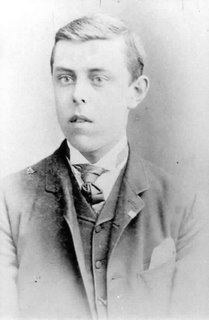
Image: Boreham as a boy.

Time for an F W Boreham Overview

Many readers of this blogsite have a long term interest in the life and writings of F W Boreham. I have received, however, one or two letters from readers who have little acquaintance with Boreham’s life. I thought it would be good to offer an overview of the life and ministry of Dr Boreham. To present this I have sought and gained permission from Dr Jeff Cranston, to republish a fine article he wrote for Preaching Magazine in Winter 1998.

Jeff Cranston is the Senior Pastor of the Low Country Community Church in South Carolina where he has served since June, 1999. Prior ministry experience includes serving with Ravi Zacharias International Ministries; he also ministered for seventeen years as a senior pastor and youth pastor with the Christian and Missionary Alliance and Southern Baptist Convention. You can find out more about Jeff’s church at:
http://www.lowcountrycc.org/

In addition to serving as Senior Pastor, Jeff also serves as an Associate Trainer with EQUIP, (http://www.iequip.org/), training Christian leaders in Manchester, England, bi-annually.

I have carved this article So This is Boreham, into ten parts so sit back over these next two weeks and enjoy all the work Jeff has put into its research and presentation. Grateful thanks to you Jeff.

Geoff Pound

Image: Jeff Cranston

Saturday, April 15, 2006

Boreham on Travel

F W Boreham wrote many times about the value of travel and two of his published books were travel diaries‑ Loose Leaves (1902) and From England to Mosgiel (1903). He loved to cite the story in which Lord Chesterfield was asked about the best way to acquire a good education. He answered, “There are three main ways, travel, travel and travel.”[1]

The enrichment of travel was another legacy that Boreham’s mentor passed on to the young minister. Boreham later wrote, “J J Doke was an incorrigible traveler….What had impressed him most in his travels? The unstinted kindness one meets with from everyone, everywhere.”[2]

Frank Boreham took this advice to heart and there are many ways in which it is clear that his understanding and his writing was enriched through travel. For instance he alludes to his travels to the Australian outback,[3] the gold mines of Western Australia,[4] the village of Captain Cook,[5] the garden of naturalist, Gilbert White[6] and The Isle of Wight.[7] In his retirement Boreham was able to travel more extensively to places like North America, Jamaica[8] and Canada.[9]

Boreham wrote of the way his eyes were opened to the treasures of London when after years of absence he returned to the United Kingdom. He said, “I never saw London until I left it.”[10] Inherent in this quote is the truth that travel per se will not extend our education. One needs to have the eyes to see or as Boreham learned from James Cook, the secret “lies in the traveler’s ability to detect the treasures that are best worth gathering.”[11]

Boreham’s essays reveal that there is a world of difference between being a tourist and traveling as a pilgrim. In the Drums of Dawn Boreham writes about one holiday he spent, “exploring the road along which Bunyan’s pilgrims traveled.”[12] He visited the Bunhill Fields burial ground as a pilgrim at the grave of Susannah Wesley[13] and at Westminister Abbey he spent some sacred moments at the tombs of famous people.[14] How much of the spirit of the pilgrim is summed up in Boreham’s words, “When in England recently I spent a good deal of my time with John Bunyan.”[15]

In this present age when there is a reaction to things that are fast (fast food etc.) and a turning to doing things that are slow (see Carl Honore’s In Praise of Slow) it is clear that Boreham was an early advocate of slow travel. He said we must travel “slowly enough to evoke the value of wonder.”[16] He enjoyed the quotation of Richard Jeffries who said, “The best way to see is to stand still.”[17] Like Gilbert White, Boreham advocated micro travel (not his words) or the taking of time to travel around one’s backyard or local patch.[18] It is not essential, Boreham often said in war time when travel was restricted, to travel great distances but you can be a traveller in your own familiar area.

Geoff Pound

[1] F W Boreham, The Passing of John Broadbanks, 195; The Prodigal, 35.
[2] Boreham, The Passing of John Broadbanks, 200.
[3] F W Boreham, Boulevards of Paradise, 98.
[4] F W Boreham, Bunches of Everlasting, 55, 98.
[5] F W Boreham, When the Swans Fly High, 101.
[6] Boreham, When the Swans Fly High, 105.
[7] Boreham, Bunches of Everlastings, 211.
[8] Boreham, Bunches of Everlastings, 188.
[9] Boreham, When the Swans Fly High, 12.
[10] Boreham, When the Swans Fly High, 75-79.
[11] Boreham, The Passing of John Broadbanks, 204.
[12] F W Boreham, Drums of Dawn, 198.
[13] F W Boreham, I Forgot to Say, 113.
[14] F W Boreham, The Silver Shadow, 159.
[15] Boreham, When the Swans Fly High, 156.
[16] F W Boreham, A Witch’s Brewing, 233.
[17] Boreham, A Witch’s Brewing, 242.
[18] Boreham, When the Swans Fly High, 105.

Monday, April 10, 2006

Your Comments About F W Boreham

Geoff, I first heard about FWB while working with Dr. Ravi Zacharias. He asked me to peruse a certain book by an author I had never heard of, and glean any illustrations which were biblical in nature. I enjoyed reading and so I thought, "Why not? Maybe I can learn something here."

I started leafing through this little worn book and began to read "Hatpins and Button Hooks." I was hooked! I never imagined that one afternoon of reading would propel me to New Zealand, Australia and the U.K. and while in these locales, spend so much time scouring used bookshops!

FWB's use of the English language is second-to-none and his obvious love for life shines through his writings. I always enjoy reading the stories from his early days regarding some of the characters that were a part of his life.

I find much commonality with him, as I serve as a pastor. He's been a mentor to me.

Thanks for the opportunity to share these few thoughts.

Regards,
Jeff Cranston

Jeffrey S. Cranston, D. Min.
Senior Pastor LowCountry Community Church
---------------
You are also invited to share your thoughts on the questions:

When and how did you first learn about F W Boreham?

What is it about his books/sermons/essays etc. that you particularly like?

Please hit the comment button or email me with your words and I can post them on this site
geoffpound@yahoo.com.au

Geoff Pound

F W Boreham Interaction

I thought it would be timely to hear from those of you who frequently peruse this Official F W Boreham web site.

I am not expecting long or polished contributions but I/we would like to hear from you.

Here's a question to get you thinking:

When and how did you first learn about F W Boreham?

What is it about his books/sermons/essays etc. that you particularly like?

Please hit the comment button and make your contribution or email me with your words and I can post them on this site.
geoffpound@yahoo.com.au

Geoff

Saturday, April 08, 2006

Boreham on Wedge Bay

Boreham always thought of himself as a generalist yet in the following quotes from one of his early books he boasts of being an expert:

“There is just one spot on God's fair earth that I fancy I know better than
anyone else...It is a landlocked bay a couple of square miles across. I have
spent about six months of my life poking about this solitary place trying to woo
its favour and win its golden secrets and I really think that if one of the
trees about the waters edge were to fall in my absence I should miss it and
mourn it next time I go…”

“I rowed one day recently into a shady little inlet and was surprised to find it exactly as I had left it a couple of years before..... It was here, as it was in the beginning it is now and ever shall be world without end and it is restful to saturate oneself in the brooding silence of the primeval forest. I like to sit in this quiet cove where I picknicked two years ago and to reflect that it is today exactly as it was in the days of Caesar. It is like closing your tired eyes when at the cinematograph you can bear the flicker no longer....”

“The local inhabitants have never awakened to the charms of the beauty-spots around them.”[1]

These excerpts are further illustrations of the way F W Boreham took time out for leisure and silence. It reveals his love of nature which he possessed from childhood. These lines contain some of his signature themes‑the importance of beauty to the world, the way nature links us to the ages, his disdain for the artificial (viz. the cinema) and the importance of cultivating an appreciation for the commonplace and the familiar.

Geoff Pound

Image: One of Boreham’s photos of Wedge Bay, Tasmania, Australia.

[1] F W Boreham, The Golden Milestone, 109.

Friday, April 07, 2006

Boreham the Biographer

F W Boreham was an essayist, an editorialist, a sermon writer, a poet, a hymn writer and also a biographer. It is interesting that Boreham, a Baptist, wrote his full length biography on an Anglican, the famous Bishop to New Zealand, George Augustus Selwyn. The book illustrates Boreham’s love of biography and his ecumenical spirit.

Boreham finished the book while he was in Tasmania but he said that in moving around New Zealand, “I had ample opportunities of observing the supreme veneration in which the people of these romantic islands have enshrined the illustrious memory of Bishop Selwyn.”[1] [The old black, wooden churches in Auckland’s Howick and Mission Bay and Selwyn College in Glendowie, are all reminders of Selwyn’s amazing influence]

Boreham attributed Selwyn’s influence to his ability to identify with his people whether they were European settlers or Maori. He took the time to learn the Maori language and “this was a master stroke in identifying with his people.”[2]

A major stuff up had been caused in England before Selwyn was sent out to New Zealand. His superiors got their latitude and longitudes mucked up and instead of making Selwyn responsible for New Zealand he found out that he was the Bishop for the whole of the Pacific! Undaunted, he set about visiting the islands and he established an important strategy of inviting one representative from every island country to come and train at the Theological College in Auckland.

Selwyn was a person who worked for justice and reconciliation. The Maori were literally in a battle with the government over land rights. The indigenous people incorrectly thought the Bishop was siding with the British troops so Selwyn called a conference with the Maori leaders, saying he would come and visit them on their land. The Maori leaders agreed among themselves that if the bishop came they would not let him onto their marae (meeting place). When he arrived near evening they barred him from their meeting house but said he could spend the night in the pigsty. That is exactly what he did and where he slept! This act of humility had such an impact on the Maori that the next day they agreed to talk but for years afterwards they said, “You cannot ‘whakatatua’ this man or in English, “You cannot degrade the dignity of this man.”

F W Boreham wrote many times about Selwyn[3] and in one essay he told this story and then went on to recall the way Jesus of Nazareth was draped in mock purple and given a mock crown and a mock scepter. Boreham concluded that Jesus did not have his dignity degraded as he led the procession.[4]

Geoff Pound

Image: George Augustus Selwyn

Because of its theme this posting appears today on these two web sites:
The Official F W Boreham web site: http://www.fwboreham.blogspot.com/
Stories for Speakers web site: http://www.storiesforspeakers.blogspot.com/

[1] F W Boreham, George Augustus Selwyn, 5.
[2] Boreham, George Augustus Selwyn, 52.
[3] F W Boreham, Mountains in the Mist, 125; F W Boreham, The Crystal Pointers, 118.
[4] F W Boreham, Cliffs of Opal, 135.

Tuesday, April 04, 2006

The Mistress of the Manse

F W Boreham lovingly referrred to his wife as 'The Mistress of the Manse'.

Reference has been made in an earlier posting to the fact that Stella Boreham got severe post natal depression after having each of her five babies and almost died after the birth of one of their children.

The church at Mosgiel released the Borehams so that they were able to spend months away from ministry recuperating in Piripiki Gorge (Taieri Mouth). It was here that they realized how nature is such a tonic.[1] After that the Borehams spent a month each year holidaying and “exploring this panoramic paradise.”[2] When they went to Hobart they made the same practice, but this time at Wedge Bay. In Melbourne they often holidayed in the Dandenong Mountains.

Stella Boreham was a quiet retiring person and from accounts did not appear to take an upfront, leading role in church or community life. Perhaps Boreham’s chapter on ‘The Minister’s Wife’ reveals how they both understood this role.[3]

Many people who knew her have said to me that she was a lovely person with a beautiful nature. The photo indicates that Stella and Frank had lots of fun and laughter.

Geoff Pound

Image: Photo taken by F W Boreham of Stella dressed in a kimono.

[1] F W Boreham, The Blue Flame, 160.
[2] F W Boreham, Home of the Echoes, 36.
[3] F W Boreham, The Silver Shadow, 50.

Mrs Stella Boreham

Frank and Stella met when he was the student pastor at Theydon Bois. Stella Cottee was only sixteen and her parents invited him home for lunch. She came from good evangelical stock. In his Bunch of Everlastings F W Boreham wrote of visiting William Cottee (Stella’s grandfather) who was over ninety years of age at the time. Boreham must have found him rather daunting for the student pastor said: “He had no respect for any theological opinions of mine. He was a sturdy old hyper Calvinist, my doctrines were milk and water.”[1] What did Frank and Stella do in their courtship in their Theydon Bois days? Who knows but one of the things they did was read to each other. In some of Boreham’s books that he had acquired he wrote (with the date), ‘Read to Stella & Mrs Cottee’ or ‘Read to Stella and Mr Cottee.”[2]

Stella was young when she arrived in Christchurch, NZ to get married to Frank and set up their new life together. Reading between the lines it seems that they both experienced extreme homesickness. Writing more than fifty years later Boreham lets down his guard and speaks honestly of how they felt and the most painful times:

“Although I have spent nearly three score Christmases under the Southern Cross,
I have never completely resigned myself to celebrating Christmas at midsummer
and have never quite recovered from the shock that I sustained when that strange
experience first befell me.”

“As we approached the first Christmas after our wedding, my second Christmas in
New Zealand, my wife's first thought of spending the festive season by our two
homesick selves grew increasingly intolerable. But whom could we invite?”[3] They sought to alleviate their homesickness by inviting
friends such as J J Doke.[4]

In this posting there is a photo taken by Frank of Stella posing as a nun!

Geoff Pound

[1] F W Boreham Bunch of Everlastings, 173.
[2] These books are in the F W Boreham Collection, Whitley College, Melbourne and include a book of sermons by F B Meyer.
[3] F W Boreham, My Christmas Book, 12.
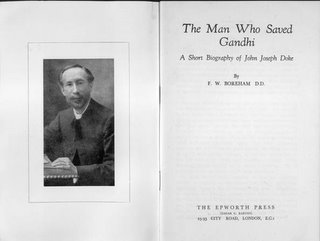
[4] F W Boreham, The Man Who Saved Gandhi, 3

Sunday, April 02, 2006

Boreham the Photographer

Boreham Family Photos
Helen, a regular reader of this site, asked a question about the availability of photographs of the Boreham family. Her question has prompted this posting and some others to follow. I mentioned to her that there are portraits of Frank Boreham in many of his books and My Pilgrimage contains one of his wife Stella. Boreham tried to keep his wife (The Mistress of the Manse) and his children out of his books. Apart from his autobiography he is very restrained in writing about what he gets up to.

Life Through a Lens
“The photographs hanging here and there around the room transport my mind
to
other days and other places .... the pictures transform it [the
apartment] into
an observatory and I am able to survey the entire
universe."
F.W. Boreham, Rubble and Roseleaves

For F.W. Boreham there were no uninteresting subjects, only uninterested persons. He had an observant eye which took in every detail and stored them in an unusually retentive memory. It was as if he saw life through a camera lens which concentrates on its subject and ignores the rest.

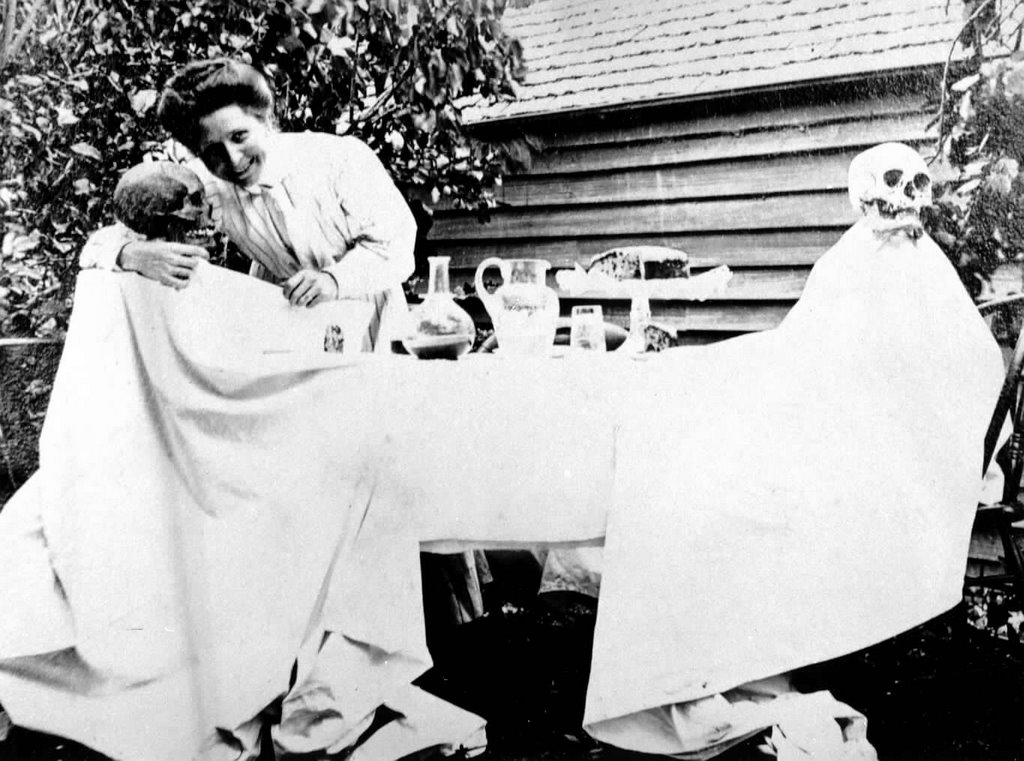
In recent years, some boxes of glass negatives that were taken and developed by F.W. Boreham have come to light and are now part of the Tasmanian Baptist historical records. Among the plates are shots of the Hobart Tabernacle and its officers, many family pictures, scenes of his much loved Wedge Bay on the Tasman Peninsula and some trick photography which includes a portrayal of a ghost on the steps of the Hobart manse! I will continue to post these on this site.

His children, Joan Lincoln of Hobart and Frank Boreham of Templestowe, remember their father's hooded camera requiring a black sheet so that the image could be clearly seen in the glass plate on top of the camera and the shutter was operated by a length of string. In this way and by using a tripod, Dr. Boreham took several self-portraits and group photographs with him in the frame. Joan and Frank remember their father developing the glass plate negatives in the cellar under the Armadale Baptist church manse. The cellar had a small window which he covered with red paper when making prints. Once he started work the children were not allowed in. [Joan and Frank junior are now dead but these insights were passed on to me when I interviewed them in the mid 1990s]

Photographer and editor of the Tasmanian Baptist Advance, Laurie Rowston says:
"Boreham's photographic work is all the more compelling when we consider that the business of photography in the early years of the twentieth century was a very different affair to that of the present day. There were no point-and-shoot automatic cameras then. A photographer needed a high degree of skill which included knowing how to measure the light and develop and print the film. All this before even considering what he wanted to photograph. Boreham must have been a perfectionist because he chose to use a photographic method (the dry glass plate) which was far more complex than what was being offered when he commenced and which became popular. In taking photographs Boreham also became a wordless writer. But more importantly his photographs, like his books, make you see."

(These notes are adapted from an article written by Laurie Rowston for the Tasmanian Baptist Advance. Appreciation is expressed to Laurie for his willingness for this to be reprinted).

Geoff Pound

Image: Boreham’s photo of his wife and two ghosts!? He found these human skulls on the Otago (NZ) beach of Taieri Mouth and kept them through his Tasmanian days.

Saturday, April 01, 2006

Boreham at Scots' Church


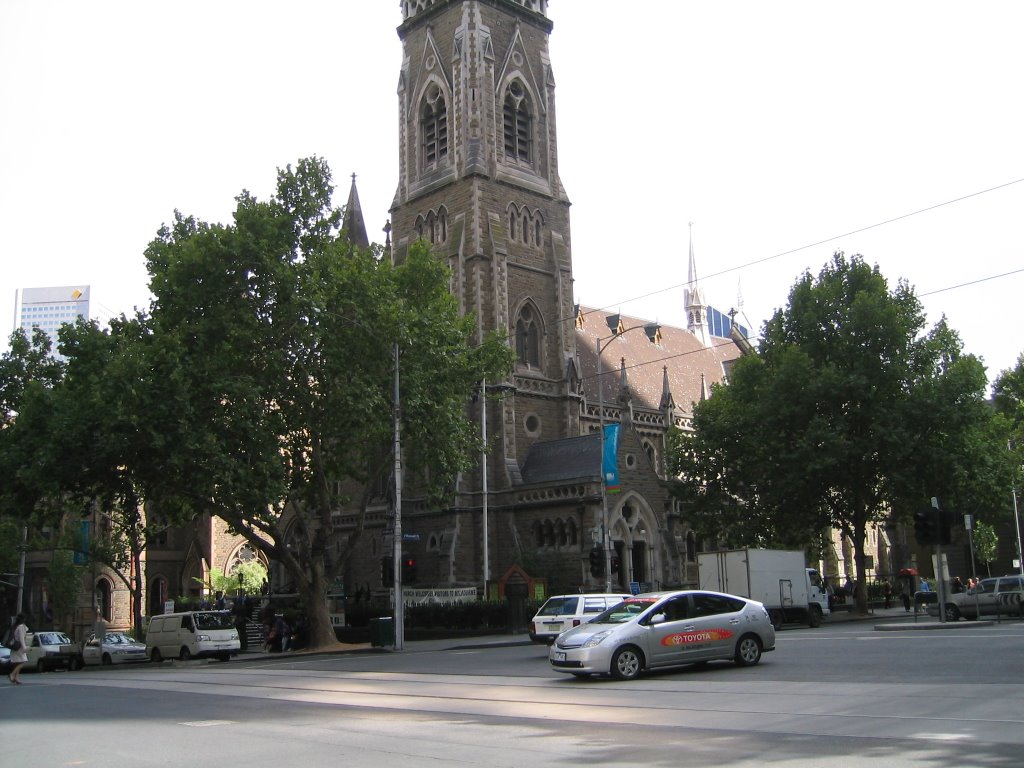
I have recently returned from Melbourne where during my travels I revisited some key sites connected with the ministry of F W Boreham. One of these is Scots’ Church on the corner of Russell and Collins Street. Let me quote from a chapter I wrote elsewhere about the emergence of Boreham’s significant ministry at Scots’ Church:

“At his farewell address to Spurgeon’s College Boreham said, “I should like to go out to the ends of the earth, to hold three pastorates, and then to be in a position to preach, as I might be led, in all lands and among all denominations”.[1] His dream was fulfilled accurately when after twelve years at Armadale Boreham retired in 1928, at the age of fifty-seven, to undertake an itinerant ministry across many denominations and in different parts of the world. Fulfilling a lifelong dream that had probably been fired through his contact with Hudson Taylor and “Dr Meyer, the ubiquitous”, Boreham toured Great Britain and North America in 1928 and 1936 preaching in distinguished pulpits and visiting many sites that related to people about whom he had written.[2] When in Melbourne he regularly served as a guest preacher in city and suburban churches. By 1945, the Age reported that “Dr Boreham has preached for almost every Protestant denomination here and overseas, helping to emphasize the fundamental unity of the churches”.[3] His one long-standing commitment was his weekly sermon at the Wednesday lunch hour service at Scots’ Presbyterian Church in Melbourne, a task that he commenced in 1936 for a month but “was impelled to carry on for the next eighteen years”.[4] With Boreham’s fame and international reputation these services were judged to be “one of the most effective religious influences in the city”.[5] The services attracted large congregations which frequently included many tourists from overseas and interstate who had learned of the preacher through his books. Boreham’s sermons were reported in the columns of the Age and the Argus and such was his drawing power that the Collins Street Independent Church dismissed the idea of scheduling their own mid-week service, claiming that the Scots’ mid-week service was for the entire city of Melbourne and that Boreham “belongs to every denomination”.[6]

When I moved to Melbourne I encountered so many people who regularly spent their lunch hour at Scots’ Church being nourished by the brief period of worship and the sermon by Dr Boreham. I also met many people who could remember stories that Boreham told and sermon themes he delivered from the Scots’ pulpit sixty years earlier!

Boreham saw himself as a shuttle weaving different denominational threads together to create something of unity and beauty. Some Baptist pastors were peeved that Boreham was not as available to speak in their pulpits because he was in churches of other denominations. They also were irritated by Boreham’s preaching fee that was too steep for many of the Baptist churches but within the capacity of churches of other denominations. They thought Boreham was rather mercenary in this request but little did they know that his preaching fees (and royalties from his books) went to fund the John Broadbanks’ Dispensary in Birisiri, East Pakistan (now Bangladesh) which is still operating today.

Of great significance is that F W Boreham preached at the Scots’ Church throughout the years of the Second World War. Whatever did Boreham say to the people who flocked to that packed church every week in those difficult and dark days? You would be surprised! I wish someone would research this further and write about Boreham’s preaching ministry at Scots’ Church. There is a thesis waiting to be written on this topic. Anyone interested?

Geoff Pound
geoffpound@yahoo.com.au

For more information about Scots’ Church see:
http://www.scotschurch.com/

Image: Scots’ Church, taken during the recent Commonwealth Games, March, 2006.

[1] Age, 26 March 1955.
[2] Fullerton, F B Meyer: A biography, 196. This description was given by Dr John Clifford, a prominent English Baptist minister of the day.
[3] Age, 15 March 1945.
[4] New life, 17 July 1986.
[5] Scots’ Church Leaflet, February 1946.
[6] Scots’ Church Leaflet, November 1947.

Wednesday, March 08, 2006

Boreham Blog Update from Geoff Pound

I am having to return to Melbourne for a family funeral (my son-in-law's sister died tragically in London a few days ago) and then to NZ where my mother is facing heart surgery this week.

Consequently, my blogs will be off air or rather not added to until I return on the end of the month.

Sorry about this. I hope to commence again early in April.

Geoff Pound

Monday, March 06, 2006

The Man Who Saved Gandhi: Part 9

The amazing thing is that, in defiance of the physical frailty that had dogged his days, Mr. Doke laid his bones in a missionary grave after all! His brother's resting-place on the banks of the Congo always held a conspicuous place in the landscape of his life. I cannot stifle a suspicion that it was one of the factors that lured him to the adventure that glorified the close of his career.

He conceived the idea that it would enormously enrich the spirituality and increase the effectiveness of his own church at Johannesburg, and of all the South African churches, if they had a specific missionary objective, and especially an African objective. He talked it over with Fred Arnot, the renowned explorer and evangelist. Arnot told him of a lonely mission-station away up in the interior‑not far from the upper reaches of the Congo‑that might be taken over by the South African churches and made the centre from which a vast unevangelized territory might be worked. The idea captivated Mr. Doke's imagination, and he felt sure that it would appeal to all the heroic instincts in the young men and women of the churches. With boyish excitement he resolved to set out on a great trek into the heart of the continent. Clement, his son, agreed to, accompany him. “We are off for the Congo Border,” he wrote enthusiastically. “Is it a holiday trip? It seems a long way to go for a holiday. I would claim that we are prospectors, but it would be misunderstood. Yet that is really what we are‑prospecting for missions.” They set out on July 2, 1913. Infected by his ardour, his people crowded down to wave their affectionate farewells, and eagerly anticipated the stirring story that he would have to tell on his return.

His journal, carefully kept to the last, reads like a section of Livingstone's Missionary Travels or Stanley's In Darkest Africa. Here, as in those classics, we have the swamp and the jungle, the long grass and the winding trails, the lions and the hyenas, the zebras and the impalas, the mosquitoes and the tse-tse flies. His attempts to make the natives of the various villages understand his message are strangely reminiscent of Livingstone. The travellers reached their objective and were given a boisterous welcome: “Clement was almost overpowered and our ears tingled with the noise.” They spent some days in conference with the missionaries; explored the entire area; and Mr. Doke formulated his plans for the establishment of his new scheme.

The return journey was more trying. But they bravely survived the ordeal of the long march, and, on August 5, reached the railway. Here father and son separated. Mr. Doke had promised, before terminating his travels, to visit a mission-station at Umtali, in Eastern Rhodesia. At Bulawayo, therefore, the two reluctantly parted, Clement taking the train home to Johannesburg and Mr. Doke turning his face towards Umtali.

And at Umtali he suddenly collapsed and died. “This is the time,” he murmured, “when a man wants his wife.” “Yes,” replied Mr. Wodehouse, his missionary-host, “but One is near you who is better than wife or mother.” “Yes,” he replied. “I know that the Everlasting Arms are around me.” He asked Mr. Wodehouse to pray with him; then to stroke his hair; and, later still, to hold his hand. And on Friday evening, August 15, 1913, he quietly and peacefully passed away.

His life-work was, however, splendidly complete. His dream was more than realized. The work of that mission-station in the far north‑to which his own children were among the first to dedicate their lives has prospered and developed in most unexpected ways. And, to this day, his memory, like a fragrance, pervades hundreds of homes on all five of the world's great continents.

F W Boreham

The Man Who Saved Gandhi: Part 8


It was after he left New Zealand‑to the great sorrow of us all‑that he made history. And, characteristically, he did it in such a way that, to this day, very few people realize the effect of his behaviour on world affairs. He settled as minister at Johannesburg; and it so happened that, shortly afterwards, Mr. Gandhi went to South Africa as the legal representative of the Indian population, who, just then, were involved in a serious clash with the authorities. Mr. Doke's sympathies were with the Indians, and he immediately got into touch with Mr. Gandhi. Each were astonished at the other's diminutive stature. They did not look like a pair of champions. Mr. Doke says that he expected to see ‘a tall and stately figure and a bold masterful face’. Instead of this, a small, little, spare figure stood, before me, and a refined, earnest face looked into mine. “The skin was dark, the eyes dark, but the smile which lighted up the face, and that direct, fearless glance, simply took one's heart by storm. I judged him to be about thirty-eight years of age, which proved correct. But the strain of his work showed its traces in the sprinkling of silver hairs on his head. He spoke English perfectly, and was evidently a man of great culture”.

On the wall of Mr. Gandhi's office hung a beautiful picture of Jesus; and the moment that Mr. Doke's eyes rested upon it, he felt that he and his new friend were bound by a most sacred tie. “I want you,” he said to Mr. Gandhi, “to consider me your friend in this struggle. If,” he added, with a glance at the picture on the wall, “if I have learned any lesson from the life of Jesus it is that one should share and lighten the load of those who are heavenly laden.”

The days that followed were full of anxiety and even of peril. Indeed, they almost culminated in a tragedy that would have shocked the world. “I distinctly remember,” Mr. Doke says, “that, as I went through the streets that morning, I was led to pray that I might be guided completely to do God's will; but I little thought what the answer would be.” A few minutes later, a young Indian dashed up, gesticulating excitedly: “Come quick!” he cried. “Coolie, he hit Mr. Gandhi!” Following the Indian's footsteps, Mr. Doke found Mr. Gandhi lying in a pool of blood, looking half dead. It turned out that a party of Pathans, taking it into their heads that Mr. Gandhi was seeking to betray the Indian cause, had plotted to destroy him. After bathing and bandaging his wounds, Mr. Doke asked the wounded man whether he would prefer to be taken to a hospital or to the manse. Mr. Gandhi gratefully accepted the latter alternative.

“Mr. Doke and his good wife,” writes Mr. Gandhi, in telling the story, “were anxious that I should be perfectly at rest. They therefore removed all persons from near my bed. I made a request that their daughter, Olive, who was then only a little girl, should sing for me my favourite English hymn, Lead kindly Light. Mr. Doke liked this very much. He called Olive and asked her to sing in low tone. The whole scene passes before my eyes as I recall it. How shall I describe the service rendered me by the Doke family?

“Every day marked an advance in our mutual affection and intimacy. Naturally, after I was injured, all classes of Indians flocked to the house, from the humblest street-hawker, with dirty clothes and dusty boots, to the highest Indian officials.”

“Mr. Doke would receive them all in his drawing-room with uniform courtesy and consideration. The whole family gave their time, either to nursing me or else receiving the hundreds of Indian visitors who came to see me. Even at night Mr. Doke would twice or thrice tiptoe into my room to see if I wanted anything.”

Some years later, J.J.D. having died in the interval, Mr. Gandhi revisited South Africa in the company of the Rev. C. F. Andrews. “As we approached Johannesburg,” says Mr. Andrews, Mr. Gandhi turned to me and said: “Charlie, I want to take you on a pilgrimage.” “What do you mean?” I asked him, not following his line of thought.” I want you,” he said, “to go with me to the house of Mrs. Doke, where I was nursed back to life.”

“When we came to the house it was difficult for him to restrain his emotion, as he for the first time saw Mrs. Doke in her widow's dress and tried to comfort her. She, on her part, treated him with all the tenderness of a mother, forgetting her own sorrow in her anxiety about his health and that of Mrs. Gandhi, who was very ill.”

“Mrs. Doke then related to us the story of the death of her husband in the interior of Africa.” And the story that Mrs. Doke unfolded to her visitors is the story that I must myself set down before I lay aside my pen.

F W Boreham