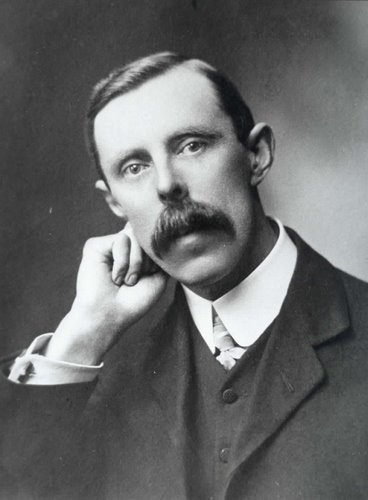
Frank William Boreham 1871-1959

Frank William Boreham 1871-1959
A photo F W Boreham took of himself in 1911

Saturday, August 26, 2006

LIst of Books by F W Boreham

This is a comprehensive list of books written by F W Boreham. Each is a book of essays and sermons unless otherwise indicated. It does not include the numerous booklets that were published that usually consisted of printing an essay that previously had appeared in one of his books.

1891 Won to Glory (with foreword by F.B. Meyer)
1902 Loose Leaves (travelogue)
1903 From England to Mosgiel (travelogue)
1903 The Whisper of God (The Baptist Pulpit series)
1911 George Augustus Selwyn (biography)
1912 The Luggage of Life
1914 Mountains in the Mist
1915 The Golden Milestone
1915 Mushrooms on the Moor
1916 Faces in the Fire
1917 The Other Side of the Hill
1918 The Silver Shadow
1919 The Uttermost Star
1920 A Bunch of Everlastings
1920 A Reel of Rainbow
1921 The Home of the Echoes
1922 A Handful of Stars
1922 Shadows on the Wall
1923 Rubble and Roseleaves
1924 A Casket of Cameos
1924 Wisps of Wildfire
1925 The Crystal Pointers
1926 A Faggot of Torches
1926 A Tuft of Comet's Hair
1927 The Nest of Spears
1928 The Temple of Topaz
1928 The Fiery Crags
1929 The Three Half Moons
1930 The Blue Flame
1931 When the Swans Fly High
1932 A Witch's Brewing
1933 The Drums of Dawn
1934 The Ivory Spires
1935 The Heavenly Octave
1935 Ships of Pearl
1936 The Passing of John Broadbanks
1939 I Forgot to Say
1940 My Pilgrimage (Boreham’s autobiography)
1941 The Prodigal
1944 Boulevards of Paradise
1945 A Late Lark Singing
1948 Cliffs of Opal
1948 The Man Who Saved Gandhi (a short biography of J J Doke)
1951 Arrows of Desire
1953 My Christmas Book
1954 Dreams at Sunset
1954 In Pastures Green
1955 The Gospel of Robinson Crusoe
1956 The Gospel of Uncle Tom's Cabin
1958 The Tide Comes In
1961 The Last Milestone

Any others that I have missed?

Books written by others about Boreham or reprinting his writings
1937 Day by Day with F.W. Boreham ed. Leslie Church
1961 The Story of F.W. Boreham by T. Howard Crago
1974 Daily Readings from F.W. Boreham selected and arranged by Frank Cumbers, Hodder
1984 A Frank Boreham Treasury compiled by Peter F. Gunther
1994 Life's Verses (5 vols) republication by Kregel Publishing of series Texts that Made History. 2003 F W Boreham: The Public Theologian (unpublished doctoral thesis by Geoff Pound)

Friday, June 09, 2006

Blog Break

Thanks for taking the time to read the postings on this blog.

I am having a break from blogging over the northern hemisphere summer.

Geoff

Thursday, June 08, 2006

Boreham's Editorial Purposes

Motivation and Purpose
This posting seeks to identify the aims that Boreham possessed in writing editorials. What motivated his editorial writing and what was he trying to do?

Delivering Literary Delight
In reflecting on the genre of the essay, literary critic Robert Aswan says: “An essay is a thing of the imagination. If there is information in an essay, it is by-the-by, and if there is an opinion in it, you need not trust it for the long run. A genuine essay has no educative, polemical, or sociopolitical use; it is the movement of a free mind at play”.[1]

Boreham’s acknowledgment of playful delight in the writing and reading of literature is captured well in one of his Mercury articles: “He reads the books as he eats strawberries; not to attempt the creation of a record but for the sheer enjoyment of the thing”.[2] The examination of Boreham’s writing style has revealed the personal pleasure he experienced from the appearance and the sound of words in an editorial. While Boreham’s editorials bore evidence of a ruminative, playful imagination, Aswan’s summation is insufficient to describe Boreham’s editorial goals. His editorials neither lacked a purpose not conveyed a free mind at play. Boreham agreed with Crago’s statement that “he had never written an article for the sake of writing an article. Unless a topic could convey a message it never tempted his pen”.[3]

Editorials to Enlarge and Enrich
Boreham’s aim that his writing might both inform and provide relief and consolation is summed up when he expressed the function of drama “to broaden life’s horizon, to tint it with bright colours and to provide busy people pressed by many cares with an escape from the swords and the common place”.[4] His fondness for editorials that introduced literary figures arose from his contention that “all through the ages, ignorance has blocked the path of progress” but “books, more than anything else, have tended to dispel that ignorance”.[5] Writing in his restrained style, one detects an autobiographical confession and yearning that readers might connect fully with life in all times and places when he stated, “By means of books we escape, live in all lands, sail over all seas and become the citizens of the ages. Enlargement and enrichment must come to the mind of the man who reads Gibbon’s Decline and fall”.[6]

Awakening to the Treasures of History
In the editorials that developed historical themes, Boreham was seeking to awaken his readers to an appreciation of history. His editorials that captured the history of Australia and the British Empire were written in the hope that readers could grow to appreciate their ‘citizenship of the ages’. Boreham believed that telling of the beginnings and the significant chapters in the Australian story would develop social cohesion, national identity and patriotism. The concentration on biographical editorials sprang from Boreham’s view that readers would receive stimulation and inspiration from heroes, not simply by imbibing the ideas of his subjects but by being infused by their philosophy for “we come into personal touch with themselves and bear the impress of their magnetic personalities for ever afterwards”.[7]

Holding a Literary Mirror
Moreover, Boreham believed that readers and congregations “resent the didactic tone, the hortatory attitude” yet “yield instinctively to the suggestive and persuasive touch ... that leads them to answer their own questions, and talks, rather than orates”.[8] Rather than ‘preaching at’ his readers, Boreham’s editorial style was better understood as holding up a mirror to life. Explaining this with examples, Boreham wrote, “By his story of the ewe lamb, Nathan held a mirror to the face of David and brought that monarch to his knees. Shakespeare told us how Hamlet did the same thing by means of the travelling players, for King Claudius”.[9] Recognising that “the Divine voice, wherever and whenever heard, is invariably marked by softness, calmness and restraint ... [and] the most convincing and compelling exhibitions of super human power come to men not in the earthquake nor in the fire, but in a still small voice”, Boreham communicated in undertones.[10] He described this understated style as “poking the fire”[11] and on another occasion he likened his writings to the stars acting as pointers to the Southern Cross saying, “The papers that I have written possess no value or importance of their own; but they point to things that no man can afford to miss: that is their only glory”.[12]

Editorial Writing as Storytelling
Whether Boreham was seeking to inculcate some value or urge readers towards some commitment, he invariably adopted the storytelling method. Stories, Boreham believed, were more likely to hook and hold the attention of readers if they were about life. Of good novels Boreham wrote, “We love them for the sake of the life that is in them”.[13] He maintained that “the best illustrations of conversion are to be found, not in theology, nor even in religious biography, but in fiction”.[14] In a word directed to preachers but containing insight into Boreham’s view of the most effective style he wrote:

"I would, if I could only muster up the courage, say a word to preachers before laying down my pen. Is there any better way of preaching than by storytelling? Indeed, is there any other way of preaching? As soon as the terminology of the pulpit becomes technical and abstract, the tired mind declines to follow; only so long as a picture is being painted or a story told will the hearer maintain an eager pursuit. And, after all, has not the preacher been called to the service of the Most Sublime Story-teller of all the ages?"[15]

This statement is another expression of Boreham’s advocacy for pictures and stories and his abhorrence of technical, abstract thought which he believed was unhelpful for ordinary people seeking to understand ideas. While this assessment may have come from Boreham’s own experience, other writers who promulgated this view included the influential Thomas Macaulay who said, “Logicians may reason about abstractions. But the great mass of men must have images…. Doctrines … must generally be embodied before they can create a strong public feeling”.[16]

Geoff Pound

Image: High Street, the main street of Armadale, Melbourne. A stone's throw from the Armadale Baptist Church. Photo taken through car window at 30 mph!

[1] Robert Aswan, ‘Introduction’, The best American essays ed. Cynthia Ozick (Boston: Houghton Mifflin Co. 1998), xv.
[2] Boreham, Mercury, 21 March 1942.
[3] Crago, The story of F W Boreham, 248.
[4] Boreham, Mercury, 4 November 1950.
[5] Boreham, Mercury, 31 August 1940.
[6] Boreham, Mercury, 31 August 1940.
[7] Boreham, Mercury, 31 August 1940.
[8] Crago, The story of F W Boreham, 167.
[9] Boreham, Mercury, 23 July 1949.
[10] Boreham, Mercury, 19 February 1949.
[11] F W Boreham, Rubble and roseleaves (London: The Epworth Press, 1923), 118.
[12] Boreham, The crystal pointers, 8.
[13] Boreham, Mercury, 13 August 1955.
[14] Crago, The story of F W Boreham, 180.
[15] F W Boreham, The ivory spires (London: The Epworth Press, 1925), 113.
[16] Thomas B Macaulay, “Milton,” in Critical and historical essays by Lord Macaulay (London: Longmans, Green, and Co., 1874), 10-11.

Wednesday, June 07, 2006

Boreham and Controversy

While Boreham’s decision to distance himself increasingly from the issues of his time weakened the prophetic dimension of his editorial writing, his fear of controversy further diminished his ability to address the difficult issues of his day.

Fresh and Fearless
The first eight years of Boreham’s ministry in New Zealand were characterised by a fearless outspokenness on theological doctrine and issues of national and international importance. Within six months of arriving in Mosgiel Boreham preached a sermon in which he launched a stinging attack on a Presbyterian minister, the Rev McKerrow. In this sermon (later published in the local newspaper and subsequently printed as a booklet), Boreham condemned the Presbyterian practice of infant baptism and drew on the insights of biblical scholars to set forth the case for believers’ baptism.[1]

Boreham advocated the reading of the Bible in New Zealand schools,[2] led a vigorous temperance campaign,[3] attacked city leaders whose policy led to a desecration of the Sabbath[4] and advocated compulsory military training.[5] During the Boer War, he slammed those of the anti-militarist school and countered their influence by writing, “The nervous politicians of the present day who nurse this nightmare [the tendency towards militarism] should be able to estimate the real difference between the military necessity of a great empire and the foundation of that empire itself”.[6] On the enemy itself, Boreham wrote, “When the deluded Boers come to discern that life is more tolerable under the British rule than under the corrupt Boer oligarchy, they will very soon become fit to participate in self-government”.[7] In this early phase of Boreham’s career, he exhibited courage and engaged in a range of public questions with apparent effectiveness.

Once Bitten
In a letter to the Otago Daily Times, Boreham was criticised for a statement that he had made in his capacity as President of the Baptist Union. The criticism, made by the Rev J T Hinton, a friend and retired Baptist minister, concerned the exact wording and extent of the support for a motion considered by the Baptist Union at its previous assembly on the subject of Bible reading and “ethical and religious instruction” in schools.[8] For the next week Boreham and Hinton exchanged letters through the paper, at first pleasantly until Boreham called Hinton’s misrepresentation of him “criminal”.[9] When after a week the matter had not been resolved, a reader William Hutchinson wrote to the paper about this feud between “two of our reverend gentlemen” saying, “What can ordinary folks think when the minister of the gospel writes of another that he has convicted him of ‘gross misrepresentation of vital and fundamental facts, in order to mislead public opinion on a grave moral issue at an important crisis daring to contribute the utterly, admittedly and unpardonably false assertion?”[10] He then concluded, “The Bible is sometimes as conspicuous by its absence from the pulpit as from the public school”.

Reflecting on this “bitter experience which left its mark upon the whole of my ministry”, Boreham acknowledged how his attack had “mortally offended” this senior minister and had resulted in a breakdown of their friendship.[11] Eventually reconciliation was made but Boreham said, “I secretly vowed that I would never again allow myself to become entangled in public controversy. During the years, I have often listened to animated debates in which I longed to intervene, and have followed newspaper discussions into which my pen itched to plunge”.[12] Boreham was not always faithful to his vow. He was vociferous in denouncing George Bernard Shaw and his disciples who were critical of the British involvement in the First World War,[13] he was filled with anti-German sentiment during the Great War[14] and he was scathing in his criticism of the proposals by “workers” and unionists to get a “higher education”.[15] On only one other occasion did Boreham become embroiled in a public feud, when in 1915, he attacked the Roman Catholic church in its bid to gain State aid for Roman Catholic schools.[16]

Controversy Within Limits
In writing about controversy, Boreham recognised the spirit of conflict as “a sign of health” and he encouraged people not to denounce controversy as an unqualified evil but “to define the limits within which it might be utilized to national ends”.[17] He stated that reformers “often fail us because they rely too exclusively on the negative approach ... they attack this; they condemn that; they denounce the other”. Many times Boreham was to summarise his approach to criticism and controversy by saying, “The best way of showing that a stick is crooked is by laying a straight one beside it”.[18]

Peace at all Costs
Boreham was praised in many quarters for his irenic spirit and was well known as “the friend of all and the enemy of none”.[19] J J North acknowledged that Boreham “clashed with the Presbyterians in his callow days [but] we have not seen his name associated with a controversy since. With Fundamentalist and Modernist, with High Church and Low, with Catholic and Protestant, he has no discernible quarrel”.[20] Boreham’s positive and diplomatic style marked his editorial writing to such an extent that only a handful of published letters to the editor regarding his articles were written, most of which were letters of appreciation[21] with only two questioning Boreham’s interpretation of literary figures.[22]

Through the pages of the Mercury and the Age, Boreham was not critical of the government nor did he provoke theological controversy as contemporary editorialist, Edward Kiek, did through the pages of the Advertiser.[23] Boreham lacked the provocative, pugnacious style of the Rev Alan Walker who, in a later era, wrote editorials for the Sydney Morning Herald and whose active campaigns against apartheid, the Vietnam War, nuclear weapons, alcohol and gambling embroiled him in regular controversy.[24] Boreham’s personality was of a more peaceful kind and earned him enormous public respect across all parties. However, his decision in 1902 to avoid controversy and write benign editorials severely limited his effectiveness as an interpreter of public issues, a public theologian and a conscience to his constituency. Boreham knew this, for reflecting on this decision thirty-three years later he wrote, “I think I have been wrong. I think ... I may have shirked my duty”.[25]

Geoff Pound

Image: Mosgiel Train Station. A photo of a postcard in FWB’s memorabilia.

[1] Frank W Boreham, Christian baptism (Dunedin : H H Driver, 1895).
[2] Boreham, Otago Daily Times, 5 July 1899.
[3] Boreham, Otago Daily Times, 30 August 1899.
[4] Boreham, Otago Daily Times, 30 August 1900; 12 April 1901.
[5] Boreham, Otago Daily Times, 18 March 1901.
[6] Boreham, Otago Daily Times, 7 September 1901.
[7] Boreham, Otago Daily Times, 29 October 1901.
[8] J T Hinton and F W Boreham, Otago Daily Times, 25 August 1902; 29 August 1902; 30 August 1902; 1 September 1902; 2 September 1902; 3 September 1902; 4 September 1902; 5 September 1902.
[9] Boreham, Otago Daily Times, 2 September 1902.
[10] Boreham, Otago Daily Times, 12 September 1902.
[11] Boreham, Ships of pearl, 154-155.
[12] Boreham, My pilgrimage, 171.
[13] Boreham, Mercury, 5 December 1914.
[14] Boreham, Mercury, 13 February 1915; 20 February 1915.
[15] Boreham, Mercury, 17 April 1915.
[16] Boreham, Mercury, 8 April 1915; 13 April 1915; 14 April 1915; 21 April 1915.
[17] Boreham, Mercury, 30 June 1934.
[18] Boreham, Mercury, 4 August 1956.
[19] Australian Baptist, 29 April 1941.
[20] Australian Baptist, 16 February 1926. It would appear that North’s mention of Boreham’s ‘clash with the Presbyterians’ is a reference to the baptismal controversy mentioned earlier.
[21] Letter to the editor by H R N, Mercury, 4 August 1934; Letter to the editor by J H R, Age, 26 October 1940. Letter to the editor by W J R, Mercury, 5 September 1949.
[22] Letter to the editor by J S D, Age, 6 July 1940. This relates to Boreham’s article on Richard Blackmore in the Age, 23 June 1940; Letter to the editor by ‘M L E’, Age, 28 September 1940. This relates to Boreham’s article on the Bronte sisters in the Age, 21 September 1940.
[23] Walter Phillips, Edward S Kiek: Liberal churchman his life and thought (Adelaide: Uniting Church Historical Society, 1981), 18. Phillips gives an example of Kiek’s criticism of the welfare state in Advertiser, April 1945.
[24] Don Wright, Alan Walker: Conscience of the nation (Adelaide: Open Book Publishers, 1997), 114, 134, 162, 163, 165. Walker wrote Christmas and Good Friday editorials for the Sydney Morning Herald from the early 1970s.
[25] Boreham, Ships of pearl, 160.

Tuesday, June 06, 2006

Boreham's Writing During His Retirement: 1928-59

Retired From Obligations
At his retirement in 1928 Boreham absolved himself from the obligation of preparing new material, and, while he wrote some new sermons and editorials, the last thirty-one years saw Boreham drawing largely upon the great fund of manuscripts he had produced in his working life.[1] In 1929, the first year of his retirement, thirty-four percent of Boreham’s editorials were new but by 1939 only seventeen percent of his manuscripts were being submitted to his readers for the first time. J T Soundy’s words to his minister that “you’ll have very few fresh ideas after you’re forty” proved prophetic if not entirely accurate.[2] Writing his autobiography at sixty-nine years of age, Boreham confessed that the diminution of his creative powers came when he was “well past fifty” thus requiring a more regular requisition of manuscripts written in his “livelier years”.[3] His literary output was great until the early 1950s only because of the wealth of the manuscripts from which he was able to draw.

Arrested Progress
Throughout these last thirty years of his life Boreham’s editorials revealed a paucity of fresh ideas and a repetition of old examples and illustrations. He was criticised for constantly referring to old books and appearing to ignore the new ones being written.[4] Boreham had repeatedly warned his readers about the peril of settling down, citing Pitt, Macaulay and Chesterton as examples of significant people who in their latter years displayed “no evidence of mental growth”.[5] When in 1957 he recycled an editorial for the third time under the title ‘Arrested progress’, it appeared that Boreham had unknowingly succumbed to that same danger.[6]

Editorial Stockpiling
A practical matter that affected Boreham’s subject matter was his tendency to stockpile material. He commenced this practice in 1903 when preparing for a six-month trip to England during which he continued his literary commitments with the Otago Daily Times. In the 1920s, F W Boreham made three long overseas trips and prior to the first in 1924 he despatched a year’s supply of editorials to the Mercury. The other reason for stockpiling material was J T Soundy’s comment in 1907 about a person becoming creatively sterile around the age of forty. These words stung Boreham into action for he said, “I began to write as if my very life depended on the number of manuscripts I produced .… I despatched, week by week, the articles needed for that week’s use, and the balance I packed away in boxes .… In spite of my regular output these superfluous screeds accumulated amazingly until there were hundreds of them!”[7] While the stockpiling of editorials enabled Boreham to maintain his literary commitments for a long time this practice meant he increasingly developed an essay style rather than writing editorials that were closely related to time and place.

Writing During WWII
Boreham’s emotional strain and “shattered nerves” in 1916, brought on by stress and anxiety about the war, resulted in him rarely addressing war issues again in his editorials.[8] The articles that did address wartime subjects were mainly recycled editorials.[9] Evidence of “nerves so severely shattered” appeared again during Boreham’s demanding overseas tour in 1928.[10]

In 1942, during the Second World War, Boreham showed further signs of personal stress in editorials on the ‘Art of worrying wisely’[11] and his references to “nature’s shock absorbers in times of stress”.[12] Continuing this theme two months later he wrote, “Never, since this world began, have so many people sought some sort of sanctuary from the pressure of life as at this moment”.[13] A year later he wrote, “Never since the world began have so many people groped frantically for a sane and satisfying philosophy in relation to life’s losses as today .… What is a man to say to himself in the hour of his desolation?”[14] While Boreham’s silence was understandable in view of his emotional frailty and the horrors of war, it was not acceptable in terms of his responsibility as a theologian. Had Boreham been able to voice the questions, the loss, the disempowerment and the desolation of war, he might have better helped the many of whom he spoke who were seeking ‘a sane and satisfying philosophy in relation to life’s losses’ and he might have also found more solace and meaning for himself.

Wounded Editor
While the 1950s were for many Australians a time of growth and hope, but for Boreham this was a despondent time in which he was coping with the death of his daughter, the conclusion of his preaching ministry and the ill health of his wife and himself. Boreham’s mental state affected his editorial writing. The only topical matters he addressed in this decade were the coronation of Queen Elizabeth II,[15] the scaling of Mount Everest (‘Everest conquered a gift to the Queen’),[16] the visit to Hobart of the Queen and Duke[17] and Princess Anne’s love of puppets.[18]

Important news in the Mercury that did not rate a mention in Boreham’s editorials included the installation of the automatic telephone exchange,[19] the emergence of the atomic bomb and the protest movements (which received extensive coverage in the Mercury and the Age in 1954),[20] the federal elections,[21] John Landy’s record running of the mile (28 June 1954),[22] the Korean War,[23] the Empire Games,[24] the waterfront strike[25] and the Olympic Games in Australia, an event which dominated Australian newspapers in November 1956.[26] These examples lead to the impression that Boreham was getting increasingly out of touch.

An inordinate number of Boreham’s editorials in 1955 were written in the minor key in which he spoke about worry,[27] growing old,[28] the need for sanctuary,[29] the loss of children,[30] the pressure of life,[31] healing,[32] death[33] and heaven.[34] It was obvious that Boreham was projecting many of his personal burdens into his writing.

The books that Boreham constantly referred to in his columns were mainly those written prior to or during the Victorian era. It was not that Boreham was living ‘off the overflow’ for he continued to read voraciously, but these were mainly what his biographer called ‘classical novels’. In 1947, he read a vast number of classical novels he had not read before including many by Joseph Conrad. Crago writes, “He had turned to some of the modern novelists, such as Lloyd Douglas—but found little that appealed to him. This was unfortunate, for a remark was now occasionally heard that Boreham’s literary articles were obviously the work of an ageing author, quoting the writers of a past generation little read by the present”.[35]

There are references in his editorials in this later period to events, means of transport and objects that were peculiar to an earlier period. While there is no record of negative responses from his editorial readers such references caused some of Boreham’s published writings to become dated and evoked warnings by homiletical historian Warren Wiersbe to potential readers of Boreham books that they “may consider him sentimental; others may feel he is a relic of a vanished era”.[36]

Geoff Pound

Image: Fellows Street, the street of Boreham’s retirement home in Kew, Melbourne

[1] Boreham, My pilgrimage, 102.
[2] Boreham, My pilgrimage, 198.
[3] Boreham, My pilgrimage, 199.
[4] Crago, The story of F W Boreham, 239.
[5] Boreham, Mercury, 14 March 1925.
[6] Boreham, Mercury, 16 November 1957.
[7] Boreham, My pilgrimage, 199.
[8] Crago, The story of F W Boreham, 164-165.
[9] In 1939 Boreham wrote one article with a war theme, Mercury, 23 December 1939; in 1940 there were five articles; two in 1941, none in 1942 (with only three brief references); two in 1943; none in 1944; one oblique reference in 1945.
[10] Crago, The story of F W Boreham, 211-213.
[11] Boreham, Mercury, 15 August 1942.
[12] Boreham, Mercury, 22 August 1942.
[13] Boreham, Mercury, 31 October 1942.
[14] Boreham, Mercury, 28 August 1943.
[15] Mercury, 30 May 1953.
[16] Mercury, 3 June 1953.
[17] Mercury, 20 February 1954.
[18] Mercury, 13 August 1955.
[19] Mercury, 5 December 1953.
[20] This dominated the news in 1954 and received special coverage in the Mercury, 5 December 1953.
[21] Mercury, 29 May 1954.
[22] Mercury, 28 June 1954.
[23] Mercury, 24 July 1954.
[24] Mercury, 7 August 1954.
[25] Mercury, 6 November 1954.
[26] Mercury, 22 November to 6 December 1956.
[27] Boreham, Mercury, 9 July 1955.
[28] Boreham, Mercury, 3 December 1955.
[29] Boreham, Mercury, 12 March 1955.
[30] Boreham, Mercury, 2 July 1955.
[31] Boreham, Mercury, 21 May 1955; 28 May 1955.
[32] Boreham, Mercury, 19 February 1955; 21 May 1955.
[33] Boreham, Mercury, 1 January 1955.
[34] Boreham, Mercury, 26 February 1955.
[35] Crago, The story of F W Boreham, 241.
[36] Warren W Wiersbe, Moody Monthly, October 1974, 83-87.

Monday, June 05, 2006

Boreham's Writing During the Armadale Period: 1918-28

Changing literary priorities
By 1922 only two percent (one article) of Frank Boreham’s writing in the Mercury was addressing issues of the day and a marked increase of editorials dealt with what he called “unchanging values”.[1] At this stage Boreham was no longer exercising leadership in Tasmania, a public role that had earlier bolstered his forthrightness in addressing current issues in his columns. Furthermore, writing from Melbourne increased his remoteness from the local issues in ‘the apple isle’. The dramatic increase in his published books which were enjoying popularity with an international readership appeared to be a factor in Boreham writing Mercury editorials that would neither date nor be parochial—editorials that could easily be transformed into essays for his books.[2] By 1936 (eight years into his retirement) this trend had increased with Boreham showing little interest in addressing current issues in his Mercury editorials. His new commission to write for the Literary Supplement of the Age affected his Mercury editorials with an increase of articles taking a literary theme.[3]

While such factors as his remoteness from Hobart, his growing withdrawal from religious leadership and the increasing demands of publishing books led to his editorials becoming more detached from the context, Boreham developed convictions to justify the distancing of an author relatedness to the time in which they lived. Contrasting diarist John Evelyn, who was “immersed in the spirit of his age”, with Izaak Walton, who “kept free from it”,[4] Boreham sided with Walton, who “lived through some of the most turbulent years of British history” but did not refer to these events in his writing and “never for a moment caught the spirit of the storm”.[5]

The views he expressed in 1924 about Victorian poet Sydney Dobell signalled the direction Boreham was seeking to avoid in his own literary career:

“He found it difficult, if not impossible, to keep cool amidst such bewildering excitements. His spirits rose and fell with the tide of each day’s happenings. Classical poetry should be marked by a certain detachment; the poet must dwell in his own age, but he must be a citizen of all the ages. It was here that Dobell failed. He was a child of his own day. There is always something precarious about the fame of the literature that catches and embalms the spirit of a particular period.[6]

The increasing detachment from his age that Boreham displayed in his editorial writing was influenced by his increasing popularity as a published essayist who was intent on achieving for all his writing a high degree of timelessness.

Geoff Pound

Image: FWB's house in Munro Street, Armadale.

[1] Editorials in 1922 dealing with ‘unchanging issues’ jumped to twenty-four percent compared with sixteen percent in 1913. There was an increase in historical/biographical articles (thirteen percent to twenty-one percent) as well as those dealing with literature and the arts (seventeen percent to twenty-one percent).
[2] The decade of the 1920s was the most prolific in terms of the publication of Boreham books. In this decade, he published sixteen books compared with nine between 1910-1919, nine in the 1930s, six in the 1940s and seven (four of which were small) in the 1950s.
[3] In 1936 Boreham wrote no articles dealing with current Tasmanian or global issues. This same year forty percent of his articles focussed on literary themes (this compares with seventeen percent in 1913 and twenty-one percent in 1922).
[4] Boreham, Mercury, 5 May 1934.
[5] Boreham, Mercury, 7 August 1943.
[6] Boreham, Mercury, 5 April 1924.

Sunday, June 04, 2006

Boreham's Writing During the Hobart Period: 1912-18

This posting looks at the way Boreham’s writing changed through his time at Hobart. As David Enticott addressed Boreham’s preaching and writing during the First World War, this article will not cover comprehensively this period.

The span of time within which Boreham wrote suggests significant changes in the society that he was addressing. He had left the northern hemisphere as a patriotic Englishman. The element of distance, his regular return visits and a diligent reading of English history developed his enchantment with the motherland. Many times Boreham reflected on the changes he had witnessed in his lifetime. In 1945, on the fiftieth anniversary of his ordination, he “indulged in a mental contrast” by saying, “Fifty years is not a huge slice of history, yet I remind myself today that, when I settled at Mosgiel, Queen Victoria was at the height of her tremendous popularity. Since then four kings have reigned over us. Three wars have been fought, each more terrible and more devastating than its predecessor”.[1] The changes that occurred across this wide time span raise questions as to whether Boreham stayed in touch with the times and to what extent his writings related to his readership over these years. While Boreham was keen to link people with the events and personalities that had dominated the broad sweep of history, in what way were his editorials addressing the important issues of his time?

Changing times
A survey by the author of the subjects that Boreham selected reveals some interesting changes of emphasis concerning his role in tackling the news items of his day and addressing the perennial concerns of every age. Following his initial stint in 1912 as a daily editor for the Mercury when his editorials were topical and related to the news, the first full year of Saturday articles in 1913 reveal his themes can be categorised in the following way:

THEMES IN THE EDITORIALS OF F W BOREHAM
THE MERCURY 1913
Unchanging values 16%
History/Biography 13%
Arts (literature, theatre, painting) 17%
Anniversaries (New year) 9%
Nature (seasons) 17%
Science & exploration 7%
Religion 1%
Sport 0%
Topical issues (current social concerns) 20%

The popularity of his preaching series (and subsequently the books of sermons) that commenced in 1911 and ran for 125 Sunday nights on Texts that made history was repeated in Armadale in the 1920s and led to an increase of editorials taking a historical or biographical theme. It is interesting to note that only thirteen percent (seven articles) of the editorials he wrote for the Mercury in 1913 had a reference to Tasmania or Australia; the rest had a distinctly British focus in the treatment of personalities and events. Boreham often referred to British newspapers and quoted from northern hemisphere journals such as the Edinburgh Review and Harper’s Magazine. While Boreham’s British bias could explain the paucity of Australian related editorials, he wrote in 1913, “We have overseas news but not much Australian news. Why? The bottom has fallen out of everything Australian”.[2]

Geoff Pound

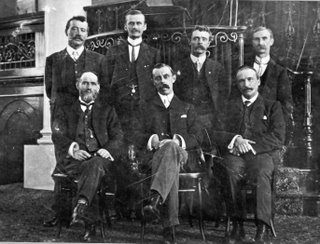
Image: FWB and a group of six of his leaders. Elders? Deacons?

[1] Australian Christian World, 9 March 1945.
[2] Boreham, Mercury, 18 October 1913.

Saturday, June 03, 2006

Boreham Speaking and Writing During WWI

The Rev David Enticott is a pastor and staff member of Whitley College in Melbourne. He is writing a thesis on the preaching of F W Boreham, having already written a long essay on the influences which shaped Boreham's preaching from 1891-1894 (the English period). David recently gave a lecture on F W Boreham in a lecture series at Whitley College entitled, Faith in the Public Sphere. Here is an excerpt from his lecture in which David focuses on Boreham's preaching and writing from Hobart during the First World War:
At the start of 1914 Boreham’s sermons were predominantly about timeless values. They were optimistic and filled with notes of “attractiveness, expectancy and triumph.” He preached one in January 1914 called; The Deep and the Shallows that was then turned into an article for the Australian Baptist.

In this sermon manuscript he drew from his love of nature and spoke of the rapture of the sea-side. He painted a picture for his listeners of picnickers by the sea and said that they were “ENTIRELY DETACHED FROM THE ACCIDENTS OF ANY PARTICULAR AGE. THE WORLD COULD CHANGE AS IT WILL AND THEY WOULD NOT KNOW IT.”[1]

In August 1914 the world did change. The seas of conflict swept the globe. And just as he did in his newspaper editorials for the Hobart Mercury, Boreham sought to ask the question of: where is God in the midst of war?

He engaged in deep theological reflection. On the 2nd of August 1914 he preached on the topic of the Comforter Divine. On the back of his sermon manuscript was the note: “preached on occasion of great crisis. Germany declared war on Russia.” He spoke to this uncertainty and offered a vision of a God of hope, strength and love.

For the remainder of 1914, his sermons took on more of a focus around the themes of: duty and obligation. While Howard Crago might have commented that Boreham’s sermons “were not flamboyant or jingoistic” the evidence suggests otherwise. Instead they were filled with fervour for the battle ahead.

A message preached on the 13th of September was something of a call to arms, that was given the title: The Second Mile. He used the example of Christ to show that Jesus not only fulfilled his duties by going the first mile, but he went on doing good by going the second.

One sermon took up President Woodrow Wilson’s favourite text and another spoke of the King’s faith. The latter spoke of: the importance of enlisting, wearing the uniform and then adorning the uniform with medals and meritorious service. Howard Crago writes that during this time “recruiting was in full swing and some of the Tabernacle’s best young men were appearing in khaki.”

While we may not share his conclusions, these messages were: up to date, engaging, fresh, relevant and sharp. They were a mixture of the newspaper and the Bible. They were sharp, just like his editorials at the time. Then in 1915 the flavour of his sermons started to shift.

As families felt the full toll and cost of the war, he uttered words of comfort and consolation. Two months prior to the Gallipoli landing he brought a reflection upon Micah 7:8 that says: “When I sit in darkness, the Lord shall be a light unto me.”

He spoke of the problem of pain and started with an evocative story from the front line. It was told by Canon D.J.Stather-Hunt who was the Vicar of the Holy Trinity Church in Boreham’s birth-place- Tunbridge Wells. The story was of a soldier who had been shot across the eyes, with sight then being lost permanently in one eye.

The Chaplain upon seeing the soldier was moved with compassion, delved into his satchel and drew something from it. The contents were a small bag of lavender with a note that Stather Hunt read to the wounded soldier: It was Micah’s passage- when I sit in darkness, the Lord shall be a light unto me. The chaplain said to the soldier: “that sweet smell will remind you of home.”[2]

Boreham was unsure about whether to include this narrative and even added a question within his manuscript asking: “Is it morbid?” He believed though that it was evidence of an incarnational God able to turn terror to triumph. People needed such stories of comfort from the front-lines of battle.

But then as the war progressed Boreham became increasingly silent, just as he did in his editorials. Perhaps war fatigue had set in both for him and for his congregation. His sermons lost their spark, their sense of vital engagement.

As he looked out on regiments marching through the streets, broke bad news to families and comforted the bereaved, Boreham’s enthusiasm for the war and for engaging with the issues of his time, died down.

In Winter 1915, he preached a series called: The Happy Warrior- His Struggles, Reverses and Triumphs. The series ran from April to September and considered themes such as: “The Enemy- seen through the eyes of a savage”, “Buckling on the Sword”, “Decoy and Ambush” and the “Fight of the Foe.” However, this war was spiritual not physical. It took place upon an eternal battlefield rather than those in France and Africa.

By the end of the year Boreham’s messages returned to the timeless themes of spiritual satisfaction and stories from Samuel Wesley, Livingstone, C.H.Spurgeon and Dickens. He had moved from the public sphere to the eternal.

Something had been lost. In his autobiography he looked back on the First World War (ironically in 1941) and commented:

“My health was going from bad to worse. The trouble began with the outbreak of war. People said that I took things too seriously….I formed the conviction that at such a time a minister should remain among his own people…When hearts were breaking, and the comfort of the gospel was most sorely needed, I felt it my duty to be on the spot…such concentration..wore me down.”(My Pilgrimage, p.201)

Boreham’s story is a reminder that to engage in public issues theologically is to bear a certain cost. Boreham, early in the war, said in one of his sermons: “we must go so far, whether we will or no. You can never say, ‘thus far and no further.”[3]

Sadly Boreham himself found the cost of the war and of visiting families with the horrific news that their sons had just died on a foreign battlefield, too great.

His public theology could go so far and no further. It struggled under the weight of the war. A recent example of a similar cost is presented by the Melbourne Age cartoonist Michael Leunig, who in the midst of drawing many images against the Iraq War, found himself entered (against his wishes) in an Anti-Semitic Cartoon Competition. In the days following the furore Leunig found his peaceful farm invaded by television helicopters and crews.

In a sense he took up his cross, for daring to speak out against government policies. Yet he has continued to draw bravely and courageously! He has counted the cost, and kept going. This is not always easy, but it is an essential ingredient for a public theologian to have a thick skin!!!

[1] F.W.Boreham. 1914. “The Deep and the Shallows,” Sermon Manuscript, 11th of January, Hobart Tabernacle.
[2] F.W.Boreham. 1915. “The Luminous Dark”, Sermon Manuscript, 28th of Februuary, Hobart Tabernacle.
[3] F.W.Boreham. 1914. “The Second Mile”, Sermon Manuscript, 13th of September, Hobart Tabernacle.

Source: David Enticott. Many thanks David for allowing us to publish this part of your lecture on the Boreham Blog.

Image: David Enticott

Friday, June 02, 2006

Where Did F W Boreham Get His Ideas?

Ideas?
Where did F W Boreham get his ideas for the subjects of his articles? The following answer relates to his editorials but as his newspaper contributions and sermon proclamations had connections this answer has implications for all his work.

Was Boreham told by the newspaper managers what subjects he should and should not address? How much was his editorial subject shaped by events and issues in the news?

Editorial freedom
An investigation of Boreham’s private papers has failed to discover whether there were specific directions and guidelines given to him by the owners and editor of the Mercury and the Age about his editorial writing. The editorial constraints on writing a Saturday leader appeared minimal, for Boreham exclaimed that he had “ample scope” for developing articles on “all kinds of historical, scientific and literary themes” and he researched topics for editorials that could also be worked into his sermons and books of essays.[1] Keeping a long list of themes upon which some day he thought he might write,[2] and revelling in his authorial freedom, Boreham stated: “An essayist is a privileged scribe: he is under no obligation to explain his choice of a theme .... his work is apropos de rien: it has no connexions or relationships. He may open his lips whenever he likes on any subject that takes his fancy. Nobody, therefore, has any right to ask my reason for selecting my present subject. And certainly nobody will guess it”.[3]

While it is unclear whether the above statement referred to his Saturday editorials as well as to his published essays, Boreham was largely unrestricted as an editorialist and he prided himself on never having an editorial rejected or altered by an editor.[4]

Observer of days
Throughout his writing career Frank Boreham regularly returned to address the familiar subjects from his developing editorial ‘lectionary’. Most years he wrote articles for the following days, events and seasons (as recognised in the southern hemisphere):
New Year
The holiday season (summer holidays in December-January)
Australia Day (Waitangi Day, when writing in New Zealand)
Return to work (January-February)
Easter
Anzac Day (from 1916 onwards)
Autumn
Mothers’ Day (May)
Empire Day (celebrated on 24 May since 1905 until 1953 when it was replaced by Queen Elizabeth’s birthday and observed on 11 June)
Empire Youth Day (May)
Mid-winter’s Day
Wattle Day (observed on 1 September from 1910 and on 1 August from 1916 although observance has weakened since WWII)
August
Spring (September)
Show Day (In Tasmania the Agricultural show day is celebrated in October.)
Armistice or Remembrance Day (November)
Bible Sunday (first Sunday in Advent)
End of school year (December)
Christmas
End of Year

The regularity of these articles gave structure, predictability and a rhythm to Boreham’s writing. He believed with Montaigne in the universal “passion for linking” so to dispel any sense of living in a vacuum, Boreham highlighted connections with the past and helped readers to feel related to others around the country or the world who were also recognising the special day.[5] Boreham saw Edinburgh Professor George Saintsbury’s assertion that “the Englishman is but a sparing and infrequent observer of days” as even more apt for Australians and believed with him that “every commemoration of the past, every linking of the common, dying things that are, with the immortal and stable things that have been, is an infinite gain for the health and the life, the pleasure and the profit of the soul”.[6]

Eye for anniversaries
Boreham consulted almanacs and developed a perpetual almanac to plan editorials that commemorated the anniversaries of heroes from the spheres of literature, science, exploration, politics and religion.[7] These biographical editorials, the regular articles about Anzac and Armistice days and the reverence with which Boreham wrote, exemplified the way he sought to instil patriotic pride within his readers.

Saying it again
From preachers Joseph Parker and F B Meyer and from essayist Thomas Macaulay, Boreham learned “the high art of repeating [him]self”.[8] Remembering “the slippage” between writer and readers, Boreham took comfort in the Gospel record that ‘Jesus said a third time’ and he unashamedly preached the same sermons and submitted the same editorials many times.[9] While in his first five years, everything he wrote was new, after this milestone he began to enjoy the freedom that came through using revamped material.

Geoff Pound

[1] F W Boreham, The man who saved Gandhi (London: The Epworth Press, 1948), 12.
[2] F W Boreham, A reel of rainbow (London: The Epworth Press, 1920), 19.
[3] F W Boreham, A witch’s brewing (London: The Epworth Press, 1932), 14-15.
[4] Boreham, Mercury, 3 September 1949.
[5] Boreham, Mercury, 17 April 1920.
[6] Boreham, Mercury, 26 October 1918.
[7] Crago, The story of F W Boreham, 160.
[8] Boreham, My pilgrimage, 98.
[9] F W Boreham, The uttermost star (London: The Epworth Press, 1919), 202.

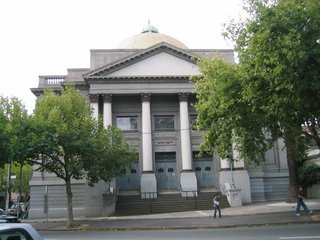
Image: Photo of the main Jewish synagogue in Toorak, Melbourne. This is in the neighbouring suburb to Armadale where FWB was pastor. Boreham developed a friendship with the Rabbi who came to Boreham's farewell from the local church and retirement celebration in 1928. FWB was broad in his interests and ecumenical in his relationships.

Thursday, June 01, 2006

Boreham and Editorial Expectations

What Would You Say?
“The leading article for to-morrow’s paper has yet to be written. If you had to write it, what would you say?”[1] This question posed by Otago Daily Times editor, George Fenwick, must have focussed Boreham’s mind every time he sat down to write a lead editorial. Of the things that helped to answer that question, the editorial expectations which will be explored in this section were important factors.

Word Limit
One editorial expectation that influenced Boreham’s subject and style was word limit. The 1,500 word limit that Boreham was given when he started as a lead writer for the Mercury gave scope for developing a theme. By 1930, when his word limit was reduced to 1,000 words, there is evidence of him eliminating illustrative paragraphs to meet the new constraint. In February 1958, when editorials in the Mercury were reduced to 500 words, Boreham’s biographical style was hampered because of the difficulty of introducing and telling a life story within the limitations of space.

Guest editorials
It is difficult to distinguish between the editorial expectations of the newspaper and the personal expectations of Boreham, however, throughout his career there were discernible phases. When Boreham commenced writing for the Otago Daily Times in 1900, he contributed as a guest editorialist. These articles, either requested or submitted, were written at an irregular frequency (about two per month) and consisted mainly of eulogies, anniversaries and articles concerning the visit of prominent people to the city. Occasionally Boreham expressed opinions on current national issues such as compulsory military training,[2] militarism,[3] poverty[4] and education.[5] Already there is evidence of articles devoted to Boreham’s passion for the British Empire.[6] Boreham’s contribution to Melbourne’s Argus of an Easter and a Christmas article most years from 1934 to 1943 represented a later phase as a guest editorialist.[7]

Weekday editorials
The sudden death of the editor of the Mercury in August 1912 was the event that launched Frank Boreham’s editorial career with the leading Tasmanian newspaper. Slipping into the breach, Boreham wrote daily editorials and sometimes two each day from 23 August 1912 until 9 November 1912. In this three-month period Boreham wrote the most topical editorials of his entire career. It was chiefly the news of the day that prompted the ideas for these articles. During this time he discussed many international events including the construction of the Panama Canal,[8] the Titanic disaster,[9] the suicide of a Japanese politician,[10] the upheaval in China[11] and politics in India.[12] He viewed his role as informing readers about world events and interpreting global trends. His attempt to bring the lesser known issues into focus was evident for when writing about the ‘derelict empire of Persia’, Boreham said, “It is never safe to assume that the matters that loom most largely in our columns of cablegrams are of necessity the most important factors on the international horizon”.[13] In addition to his ‘stock in trade’ biographical editorials,[14] during this period Boreham wrote editorials that dealt with national issues such as the economy,[15] “the problem of the [mentally] unfit”,[16] employment[17] and immigration.[18]

Saturday editorials
When a new editor was appointed to the Mercury, the proprietor, Mr C E Davies requested continuing contributions from Boreham, to which he responded by agreeing to write a leader for the Saturday issue. These Saturday articles, which represent the vast majority of Boreham’s editorials, had a different character from the weekday editorials. Discussing this ‘Saturday spirit’ in an article entitled, ‘The end of the week’, Boreham agreed with Norman Lindsay that Saturday was “Australia’s great day”. He continued, “It is certainly the day on which Australia most freely expresses herself” with “paper shops infected by the Saturday spirit”. For Boreham Saturday was “Saturday all the world over”, his inference being that the weekend enabled a consideration of the valuable link that this day gave to Tasmanians with people around the world. “Memories of childhood”, he added, “foster the Saturday spirit”.[19] The Saturday editorial gave a freedom to depart from the weekday, temporal issues that dominated the paper and to address issues that were more reflective, unchanging and universal in nature.

Geoff Pound

Image: This is the cover of the Bibliography that Melbourne University bibliographer, Ian McLaren wrote in which he describes the books of F W Boreham and where the different editions can be found. A technical book, available from Whitley College, but it has some interesting insights within it. Ian got to know FWB when Boreham was pastor at Armadale and staged lectures on books.

[1] F W Boreham, My pilgrimage (London: The Epworth Press, 1940), 150.
[2] F W Boreham, Otago Daily Times, 18 March 1901.
[3] Boreham, Otago Daily Times, 28 March 1901.
[4] Boreham, Otago Daily Times, 15 June 1901.
[5] Boreham, Otago Daily Times, 11 December 1901.
[6] Boreham, Otago Daily Times, 15 June 1900; 7 September 1901; 29 October 1901.
[7] Boreham contributed fifteen editorials to the Argus, seven of which were Easter editorials, seven were Christmas editorials and one took the theme of diary writing.
[8] F W Boreham, Mercury, 28 August 1912.
[9] Boreham, Mercury, 14 September 1912.
[10] Boreham, Mercury, 20 September 1912.
[11] Boreham, Mercury, 7 October 1912.
[12] Boreham, Mercury, 14 October 1912.
[13] Boreham, Mercury, 7 November 1912.
[14] Boreham, Mercury, 7 September 1912; 9 September 1912.
[15] Boreham, Mercury, 23 August 1912.
[16] Boreham, Mercury, 18 September 1912.
[17] Boreham, Mercury, 28 September 1912.
[18] Boreham, Mercury, 10 October 1912.
[19] Boreham, Mercury, 16 September 1933.

Wednesday, May 31, 2006

Boreham in the Editorialist Tradition

Crucial Platform
While the influence of the press as an educative instrument was waning in the first two decades of the twentieth century when Boreham’s editorial career was flourishing, the press continued to exercise a dominant role in providing information, educating and influencing thought in society.

The Australian press had long been considered an agent of social improvement and community cohesion through its promotion of family values, its pro-Imperial stance, its advocacy of the British way of life and its loyalty to the royal family. The power of the press to influence political opinion could be seen in the unashamed stance of most Australian dailies in cultivating support for wars, promoting allegiance to England, urging support for conscription and challenging the value of strikes and riots. Commenting on the first two decades of the Australian commonwealth, communication academics Graeme Osborne and Glen Lewis said, “The press was the dominant media of the day. The major papers and magazines took the leading role in communicating political news and forming public opinion”.[1] As to whether the press accurately reflected society, Osborne and Lewis stated that the press “was often anti-Catholic and opposed Irish Home Rule. It excluded women and ignored Aboriginals. Most papers were anti-Asian”.[2]

The editorials appeared to be the major source of ideas and opinions in the twelve to sixteen pages of the paper when Boreham wrote between 1912-1920, a period when the Mercury experienced no competition from any other daily. Australian academic Imne Salvsinszky’s assertion that “the familiar essay ... had few outlets in Australia in the first half of the nineteenth century” highlights the importance of the editorial.[3]

Even by 1930, Sydney Morning Herald writer Henry M Green observed that “in essays, Australian literature is even weaker than in drama”,[4] and believed this was due to a “lack of leisure and lack of a market”.[5] This observation underscores the continuing importance of the editorial in society. In spite of the advance of books and magazines in Australia, a survey undertaken in 1950 indicated that readers of the Mercury were spending an average of forty-five minutes each day (compared with an Australian average of thirty-five minutes) and that the editorial columns were being regularly read by fifty-eight percent of the readers.[6]

Always Throwing Light on Things
It is important to view Boreham’s editorial contributions in the context of the tradition in which he wrote. The earlier phases of his writing career with the Otago Daily Times (1899-1906) and the Mercury (1912-1918) fitted the description once given to editorial writer, Dr Rutherford Waddell: “Always to be throwing light on things, to stimulate thought and aspiration, and conduct them along desirable channels, to interpret to the younger and less informed the world of men, of books, and of things, and in doing this to give them the surest and most wholesome interpretations”.[7] In the first, impromptu, editorial that Boreham wrote for the Otago Daily Times, he offered a Gibbonese analysis of the Roman Empire to assess the current health of the British Empire. He laced his argument with quotations from Lord Tennyson and Robert Louis Stevenson and then pressed home his conclusion with an analogy drawn from nature.[8] This maiden editorial not only bore the Boreham editorial signature but it distinguished his writing from the paper’s regular editorials chiefly by the way it provided a historical and literary lens through which readers could interpret the present and find encouragement for the future.

Christians and the Press
In sketching the sphere of Christian influence in Australia between 1836 and 1901, Ian Breward observed the significant “number of Christians, lay and clerical, [who] owned and edited local and urban newspapers” including the Syme brothers in Melbourne, “who had been educated for the Congregational ministry [but] found a wider platform through the Age”.[9] Breward further observes that, “religion’s importance was underlined by extensive reporting in both metropolitan and local papers”.[10]

The educated voice of a local religious leader was highly valued during Boreham’s career and editorial staff of Australasian dailies hired church representatives with literary skills to express a religious or moral voice. The occasional editorial took on a public chaplaincy role especially at times of national emergency or international crisis. These sometimes took the form of a eulogy with statements of comfort, such as in the editorial, ‘Mr Gladstone is dead’,[11] a message of hope such as the editorial that launched the Mercury in 1915, ‘A New Year—and The World at War!’[12] or an expression of civic celebration as stated on the occasion of Queen Elizabeth’s arrival in Hobart, ‘Great Day Dawns’.[13] The regular religion editor usually expressed a viewpoint on Christian festivals—Easter and Christmas—and other red-letter days, such as New Year, Australia Day, Empire Day (later Queen’s Birthday) and End of Year. The Saturday editorial in the Mercury and the Age developed a different style from the rest of the week, and was usually designed to uplift, provoke or inspire. This thesis will seek to ascertain whether there were any specific expectations, directions or constraints that were imposed on Boreham by the managers and editors of the papers to which he contributed.

Standing in the Editorial Tradition
While Boreham undertook the religious editorial role in the Mercury between 1912-1959 and the Age from 1936-1959, others provided this function at different times and in various papers. Contemporaneous with Boreham was the Presbyterian minister, the Rev Thomas Jollie Smith (1858-1927), who was a leader-writer for the Argus and the Australasian from 1907 to 1927. He studied as an undergraduate at the University of Melbourne and did his theological education at Ormond College where he later trained ministers for the church. After ordination, he had a distinguished pastoral ministry in South Australia before undertaking a “brilliant” academic career.[14] Like Boreham he was “a voracious and retentive reader” which, combined with his ability as a “pithy and substantial preacher”,[15] equipped him to be “an erudite critic and plain-speaking leader-writer”.[16] Professor Rentoul asserted that Jollie’s editorial writing “did much to ensure a more serious hearing for the Christian message than in earlier decades”.[17]

The Rev Edward Sidney Kiek (1883-1959) wrote for the Adelaide Advertiser at a later period than Thomas Jollie. Kiek trained ministers in his Congregational tradition and was an active, liberal church leader who, according to Breward, “revitalized the South Australian theological world in the 1920s”.[18] Assessing the significance of his Saturday leaders in the Advertiser from 1937 to 1959, Walter Phillips writes: “It was a magnificent feat to sustain that effort weekly to the end of his life ... the variety of topics he dealt with is most impressive. He reflected on many aspects of life and thought in the modern world, bringing to bear on them his wide knowledge of literature and history. Through them he conveyed a common sense morality and spirituality”.[19]

Following Boreham at the Age was the Rev Dr Alan Watson, a prominent church leader whose editorials reveal a thinker who “loved literature and … loved words” and was able to relate to the ordinary person.[20] Watson continued the Saturday editorial tradition on 25 July 1959 and wrote for the next seventeen years until 24 January 1976. From March 1996 the Age gave this editorial the heading, ‘A Saturday Reflection’.

From 1976, the role was assumed by Boreham’s biographer, the Rev T Howard Crago. Later, when Crago could not continue at a weekly frequency, the editorial, on alternate Saturdays, bore the initials of THC and the new writer JD—Jim Darling. When this arrangement concluded, the Age employed the Rev Robert Brown (the third Baptist in succession) and ‘the motor bike preacher’, John Smith, who wrote on alternate Saturdays. During this time the editorial became known as the ‘Faith’ column and in 1998 authorship was widened to incorporate people from traditions other than Christian and people without a faith in God. The anonymous religious lead editorial no longer exists in the newspapers in which Boreham wrote and has been replaced by religious or faith opinion columns written by named authors.

F W Boreham discovered an important platform in the leading papers of the state and countries where he lived. He contributed to these newspapers for an extremely long period and saw this as an important part of his ministry.

Geoff Pound

Image: A recent edition of the Melbourne Age, to which FWB contributed for decades.

[1] Osborne and Lewis, Communication traditions in Australia, 63.
[2] Osborne and Lewis, Communication traditions in Australia, 64.
[3] Imne Salvsinszky, The Oxford book of Australian essays (Melbourne: Oxford University Press, 1997), 1.
[4] Cited in Salvsinszky, The Oxford book of Australian essays, 1.
[5] Salvsinszky, The Oxford book of Australian essays, 2.
[6] Mayer, The press in Australia, 228-233. In contrast, the section of the Mercury that drew the greatest number of regular readers was the Letters to the Editor (eighty-one percent and the least attention, the Radio Programmes (forty-one percent).
[7] Mr Wilson, Otago Daily Times, 28 April 1900.
[8] Otago Daily Times, 15 June 1900; Mercury, 15 August 1914.
[9] Breward, Australia: ‘The most godless place under heaven’, 30.
[10] Breward, Australia: ‘The most godless place under heaven’, 31.
[11] Otago Daily Times, 20 May 1898.
[12] Mercury, 1 January 1915.
[13] Mercury, 20 February 1954.
[14] Ian Breward, ‘Thomas Jollie Smith’, ADB, vol. 2, 1891-1939, ed. Geoffrey Serle (Melbourne: Melbourne University Press, 1988), 663.
[15] Breward, ADB, 664.
[16] Breward, ADB, 664.
[17] Breward, ADB, 664.
[18] Ian Breward, ‘Edward Sidney Kiek’, ADB, vol. 9, 1891-1939, eds. Bede Nairn and Geoffrey Serle (Melbourne: Melbourne University Press, 1983), 587-588.
[19] Walter Phillips, Edward Sidney Kiek: His life and thought (Adelaide, SA: Uniting Church Historical Society, 1981), 17.
[20] Duncan Watson and Nigel Watson, eds. Alan Watson's Saturday reflections: A selection from his writing for 'The Age' over seventeen years (Melbourne: Mullaya, 1976), xiii.