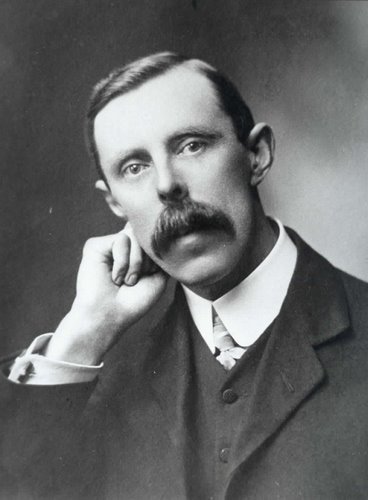
Frank William Boreham 1871-1959

Frank William Boreham 1871-1959
A photo F W Boreham took of himself in 1911
Showing posts with label Hymns. Show all posts

Thursday, June 07, 2007

Boreham on 'When I Survey'

I want you, if you kindly will, to peep over this gentleman's shoulder and take a swift glance into the room that he is just about to enter. You say that, before doing so, you would like to know something of the gentleman himself. I assure you that your objection is quite beside the point.

As a matter of fact, the well-groomed gentleman tapping softly at the door is the Right Hon. Arthur Onslow, Speaker of the House of Commons. Having heard that Dr. Isaac Watts is nearing his end, he feels somewhat ashamed of the circumstance that he has never made it his business to meet so good and so eminent a man. He has, therefore, made up his mind, before it is too late, to repair the omission.

And here he is! But see, the door is opening! And there, not in bed, but hunched up in his big study-chair, is a tiny, bony, pinch-faced wisp of humanity, almost hidden in the ample folds of a gaily-flowered dressing-gown, and looking for all the world like a little wizened Chinese mandarin! As his visitor enters, the shrivelled and dwarfish creature looks up and smiles, not unpleasantly, and, although his voice is a trifle squeaky, the general impression is a distinctly agreeable one. This, if you please, is the greatest hymn-writer of all time, the man whose songs are destined to be sung, always with enjoyment and often with ecstasy, by all the Churches as long as the language endures!

I

To his life-long chagrin, he was pitifully small. He loathed the sight of his diminutive figure whenever he glimpsed it in a mirror. Nothing stung him more than to hear somebody refer to him as little Dr. Watts. He simply squirmed. It was in self-defence that he sang:

Were I so tall to reach the pole,
Or grasp the ocean with my span,
I must be measured by my soul,
The mind's the standard of the man.

The torture of his physical insignificance frayed his nerves. It wove itself into his dreams. And, in times of serious illness, his delirium turned the horror topsy-turvy. He raved of his colossal proportions! He was too big to pass through any doorway! He could not squeeze himself into his pulpit! The chairs crumpled like matchwood under his weight! No cab or carriage would hold him! His fevered brain had converted the pygmy into a giant!

And, in some respects, a giant he was! `He stands absolutely alone,' says Thomas Wright. 'He has no peer. He is the greatest of the great.' Mr. Wright adds that if nothing from his pen has attained to the popularity of Toplady's Rock of Ages, or is quite so affecting as Cowper's God Moves in a Mysterious Way; if he lacks the mellifluence of Charles Wesley or the equipoise of John Newton: the fact remains that he has written a larger number of hymns of the first rank than any other hymnist.

He was literally a born poet. Even as a small boy there were times when he could not express himself other than in verse. His father—a stern and puritanical soul who had endured several terms of imprisonment for conscience' sake—looked askance on this propensity in his boy. But Isaac could not repress it. On one occasion the household was engaged in family worship. Isaac, sad to say, was on his knees with eyes wide open. Whilst the priest-like father lifted up his voice in fervent supplication, a mouse scampered across the room and ran up the bell-rope. Isaac burst into laughter. Prayers over, the horrified father indignantly demanded an explanation. Isaac told in his own way what had happened:

There was a mouse for want of stairs
Ran up the rope to say his prayers.

This was piling crime on crime. The father seized his rod and ordered Isaac to follow him out of the room. The boy, however, threw himself on his knees. `O father,' he cried,

‘O father, father, pity take
And I will no more verses make!’

His mother, more sympathetic, once offered a farthing to the boy who should write the best verses. Isaac entered for the prize, but attached to his manuscript the couplet:

I write not for a farthing; but to try
How I your farthing writers can outvie.

As he made his way through his teens, he became extremely serious. The salvation of his own soul became to him the thing above all others to be desired and sought. Among his papers there is a memorandum in which he tells us that he fell under considerable conviction of sin in his fifteenth year. Twelve months later he says: `I was taught to trust in Christ, I hope.' The two words, `I hope', introduce a palpable note of uncertainty. But there is no uncertainty about a later record. `An heir of glory has been born!' he joyously declares. And this transfiguring experience turned his gift for poesy into a new channel.

II

At the age of twenty-one, he accompanied his father one day to a Nonconformist chapel at Southampton. In discussing the service on the way home, Isaac remarked that he had carefully examined the hymn-book and had found it very disappointing. There was not, he sweepingly declared, a decent hymn in the collection. Without an exception, they were all lacking in dignity and beauty.
`Then, my boy,' replied the philosophical father, who had come to realize, by this time, that his son's poetic impulses were in capable of restraint, `the best thing that you can do is to write some better ones!'
On reaching home, Isaac sat down and called on his best powers to respond to his father's challenge. He wrote:

Behold the glories of the Lamb,
Amidst his Father's throne;
Prepare new honours for His name
And songs before unknown!

And thus commenced, on that very day, the fruitful career of `the father of our English hymnody'.

Many of the hymns that immediately followed were composed in the saddle in the course of long country rides, and those who are familiar with the swing and the cadence of his verses will find it easy to match the metre with the rhythm of the horse's feet.

In his monumental trilogy—Clayhanger, Hilda Lessways and These Twain—Arnold Bennett twice describes the public holiday on which the centenary of the Sunday School movement was celebrated in the Five Towns. Moved by curiosity, his hero and heroine, Edwin and Hilda, join the throng in the streets. They follow the proceedings—the procession, the speeches, the singing, and all the rest of it—with languid and almost cynical interest, until suddenly the assembled multitude joins in a hymn that changes the entire atmosphere:

When I survey the wondrous cross
On which the Prince of Glory died,
My richest gain I count but loss,
And pour contempt on all my pride.

Hilda, to whom religion had made no profound appeal, was overwhelmed: she could not tell why. To conceal her emotion, she turned her face.
'What's the matter?' asked Edwin.
Hilda was disgusted at his tactlessness in embarrassing her; but, for the sake of saying something, and easing the tension, she asked him who wrote the hymn. In spite of his pretensions to bookishness, Edwin did not know; and she despised him for his ignorance.
'Dr: Watts wrote it,' she flashed, `and it would be worth anything on earth to be able to sing those words—and mean them!'

A novelist of a very different type, Mrs. L. T. Meade, has devoted one of her books, Hepsy, Gipsy, to showing how the same hymn met the aching need and irradiated the young life of her principal character.
Hepry, Gipsy, is a story of two cavities. The first cavity is the hole in the druid oak from which Giant Lee's gold has been stolen. The second cavity is the empty heart of Hepsy, the gipsy girl, when she found her childish faith in ruins. The last chapter in the book is entitled Full and tells how both vacuums ceased to exist.

Hepsy chanced to discover that Giant Lee was going once more to the oak in the depths of the wood to grope for his lost treasure. Hepsy herself was mothering the baby boy that, in dying, Nancy Lee had presented to her husband. The Giant would have nothing to do with his child, and, but for Hepsy, it must have perished. Hepsy made up her mind that Lee should care for his boy, and she compassed her end by guile. She reached the druid oak before him and hid the baby where he had once hidden the gold. When he reached the spot, he climbed the tree, and, in doing so, thought he heard a strange sound in the heart of the oak. When he peered into the cavity, he was startled. For a very fair face, a face that was surrounded by an aureole of gold, a sweet, soft baby face that seemed the very image of poor Nancy's, peeped out of the ivy and looked straight at him. And, in the end, Giant Lee took his neglected baby to his heart; and his boy was a greater comfort to him than all his gold could have been.

And Hepsy? How was that empty heart of hers filled and satisfied? She one day heard a sweet voice singing:

When I survey the wondrous cross
On which the Prince of Glory died,
My richest gain I count but loss,
And pour contempt on all my pride.

Were the whole realm of nature mine,
That were an offering far too small:
Love so amazing, so divine,
Demands my soul, my life, my all.

`What's "love so amazing"?' Hepsy asked the singer.
And then, for the first time, Hepry heard the story of the Wondrous Cross. Poor Hepsy's empty heart drank it all in. She was thirsty for it. It was just what she wanted. It filled the aching void. The Cross was the substance of which her girlish dreams were the shadow.
Later on, Hepsy rescued the baby from a blazing tent; and, in doing so, was herself terribly burned.
`But what's the pain?' she murmured. `What's the pain? It's nothing when the heart's full—full of love so amazing, so divine! My heart is like a cup when you take it to the well and fill it to the brim!'

III

And, turning from fiction to fact, was not George Eliot fond of telling how her aunt, Mrs. Samuel Evans—‘the fiery little Methodist heroine of Adam Bede'—recited the hymn with rapturous fervour during her last sickness?

Nor can we forget Matthew Arnold. On a beautiful Sunday morning in the spring of 1888, Arnold, when visiting Liverpool in order to meet his daughter on her return from America, went to hear Dr. John Watson—better known as Ian Maclaren—at Sefton Park. Dr. Watson preached on `The Shadow of the Cross', using an illustration borrowed from the reports of the Riviera earthquake. In one village, he said, everything was overthrown but the huge wayside crucifix, and to it the people, feeling the very ground shuddering beneath their feet, rushed for shelter and protection. The service closed with Dr. Watts' When I Survey the Wondrous Cross. Matthew Arnold walked quietly back to the home of his brother-in-law, with whom he was staying; and, as he came down to lunch half an hour later, a servant heard him crooning the verses softly to himself. `Ah, yes,' he remarked to Mr. and Mrs. Cropper at table, after repeating Dr. Watson's earthquake story and telling of the deep impression left upon his mind by the service; 'Ah, yes; the Cross still stands, and, in the straits of the soul, makes its ancient appeal!' Glancing at his watch, he excused himself: hurried to catch a tram; collapsed of heart failure on the street; and was gone!

I am not surprised that the hymn appealed to a mind as coldly critical as Matthew Arnold's, for, like so many of the hymns of Isaac Watts, it is marked, not only by intense devotion, but by profound philosophy. Take the last verse for example:

Were the whole realm of nature mine,
That were an offering far too small:
Love so amazing, so divine,
Demands my soul, my life, my all.

It means, if it means anything, that a million universes are of smaller worth than a single human soul. The whole realm of nature is too paltry an offering: love so amazing, so divine, demands my soul! Arnold would appreciate a point like that.

Isaac Watts was a choice spirit. His people at Mark Lane—afterwards Bury Street—were devotedly attached to him, and although, during his later years, his health would only permit of fitful visits to his pulpit, they would not hear of any severance of the tie. Perhaps the finest testimony to the sweetness and charm of his disposition is found in the fact that, in 1714, he went to spend a week with Sir Thomas and Lady Abney; the visit extended until he died in I748; and Lady Abney said that he became more honoured and beloved of the household with every day that passed. I often think that his inner self is best reflected in that verse of his best-known hymn—When I Survey—which is usually omitted from our collections;

His dying crimson, like a robe,
Spreads o'er His body on the tree.
Then am I dead to all the globe
And all the globe is dead to me.

Blaming his petite stature for his rejection at the hands of the beautiful Elizabeth Singer—a highly-gifted young lady of comely form, rich auburn hair, and dark blue eyes that sparkled with animation—he remained a bachelor to the end of the chapter. He continued in secret to write amatory verses concerning his lost love who, some time later, married a minister thirteen years younger than herself. Dr. Watts retained her friendship to the last, and, when she died at the age of sixty-three, there was found in her desk a packet of manuscript with a letter addressed to him, assuring him of her sincere admiration and begging him to revise her work and, if he deemed it wise, publish it.

The good old man died in Lady Abney's beautiful home at the age of seventy-four. He was visited in his last illness by men like Philip Doddridge and by women like the Countess of Huntingdon. A monument marks his resting place in Bunhill Fields, where he lies in company with William Blake, John Bunyan, John Owen, Susanna Wesley, Daniel Defoe, and a multitude of other celebrities, with John Wesley himself and George Fox, the sturdy Quaker, nearby.

Another monument is to be found in Westminster Abbey. In Abney Park Cemetery, which marks the site of the stately home that showed him such extended hospitality, there is a statue by E. H. Bailey, R.A., erected by public subscription, whilst in the Watts' Memorial Park at Southampton there is another statue—a particularly fine one—by Mr. R. T. Lucas. At the Civic Centre in Southampton, too, a carillon rings out the tune of his O God, Our Help in Ages Past, every four hours. But his most fitting and most eloquent memorial is the stained-glass window at Freeby in Leicestershire which represents him as still surveying the Cross—that Wondrous Cross on which the Prince of Glory died.

F W Boreham, ‘When I Survey’ A Late Lark Singing (London: The Epworth Press, 1945), 29-36.

Words and Tunes of When I Survey

Image: Isaac Watts.

Tuesday, June 05, 2007

Boreham on 'Jesus, Lover of my Soul'

It is Monday morning. And, as I review the services of the past day, the memory that rushes most pleasantly upon my mind is the memory of the last hymn:

Jesus, Lover of my soul,
Let me to Thy bosom fly,
While the nearer waters roll,
While the tempest still is high:
Hide me, O my Saviour, hide,
Till the storm of life be past!
Safe into the haven guide,
O receive my soul at last!

As I stood in the pulpit during those closing moments of the day's worship, I was profoundly impressed by the fervour and intensity with which the people sang it. There was something about it. I asked myself what that something was. And to that problem I address myself this morning.

I

In pursuing this fascinating study, I propose, as the lawyers say in Court, to put in a number of exhibits.

My first exhibit is a photograph of a monument in Westminster Abbey. It is the only monument to a pair of brothers to be found there. The brothers thus memorialized are, of course, the brothers Wesley. At the top are the two names, with the dates of their births and deaths. In the centre is a plaque representing their two faces; with, beneath it, John's triumphant death-bed boast: `The best of all is, God is with us!' And, at the foot, is a bas-relief, depicting John preaching to a motley multitude in the open-air, with the inscription: `I look upon all the world as my parish.'

On Friday evening in an idle moment, I turned the dial of my wireless set, wondering what I should find on the air. I chanced upon a debate on the question of the limitation of families. Into the pros and cons of that delicate problem I shall not now enter. I am only reminded of it by the circumstance that John Wesley was the fifteenth child of his parents and Charles the eighteenth, whilst Susannah, their mother, was her father's twenty-fifth child. One shudders to think of what would have happened—or not happened—if the Wesleys of the seventeenth and eighteenth centuries had believed in the limitation of families.

For, in the eighteenth century, England, under the inspired leadership of these two brothers, was swept by a religious revival so overwhelming, so dynamic, so irresistible that it affected—vitally, fundamentally, and permanently—every phase of our national life. In days when ancient thrones were tottering and hoary institutions crumbling, it preserved for us, as Lecky has shown, our national integrity and respect. The country was born again. Apart from the direct spiritual fruitage of the revival, the by-products of that transfiguring cataclysm were literally legion. Social reforms were effected: slavery was abolished: industrial wrongs were righted: the plague—the spectre of the centuries—was banished by purer standards of living and saner systems of sanitation: whilst philanthropic and benevolent institutions sprang up like mushrooms on a misty morning. If Susannah Wesley, that twenty-fifth child, had never appeared; or if John and Charles, the two boys at the tail-end of her own enormous family, had never been born, the world would never have known what it had missed; but its loss would have been stupendous.

II

My second exhibit is a newspaper cutting. Unhappily, it is not dated; but the journal from which I snipped it went out of existence many years ago, and the extract itself is yellow with age. It says that Mr. Charles Wesley was one day sitting by an open window of his home, enjoying the fresh spring air and the fragrant breath of the garden below. All at once, the element of tragedy disturbed the tranquillity around him. His attention became focused upon the frantic flutterings of a sparrow that was attempting to elude the pursuit of a hawk. In its terror, the tiny creature darted hither and thither, always to be followed by its tormentor. Then, just as Mr. Wesley thought that the little bird's strength was exhausted, and that it must miserably succumb, it flew straight towards him and buried itself in the folds of his ample coat. Mr. Wesley, according to this newspaper-cutting, was himself in circumstances of grave anxiety at the moment, and fancied that he saw in the incident that had so deeply moved him a parable of his own deliverance. Reaching for a sheet of paper, he wrote:

Jesus, Lover of my soul,
Let me to Thy bosom fly!

And thus was born the hymn that my congregation sang so feelingly last night—the hymn that has been a comfort and inspiration to millions.

I notice that the modern experts on hymnology declare this dainty narrative to be of doubtful authenticity. I sometimes wonder on what their scepticism is based. I have reasons of my own for clinging to the story until it is absolutely torn from my grasp. And this brings me to my third and fourth exhibits.

During my college days, more than fifty years ago, it was my good fortune to preach on Sundays at a pretty little village in Epping Forest, a pretty little village from which, incidentally, I brought away a pretty little villager as a souvenir. But she was not the only souvenir. For here on my desk at this moment are a paperknife and a little casket, both of solid oak. In the construction of the casket there is no joint anywhere; it is a masterpiece of exquisite carving. It chanced that, in that village congregation of mine, there was a carpenter named Somner who was good enough to tell me that my poor 'prentice ministry had been a means of grace to him. On the night before I sailed for New Zealand he brought me these gifts.

'Some time ago,' Mr. Somner said, `I was employed on structural alterations to the house that was once occupied by Mr. Charles Wesley. The window-sill on which Mr. Wesley was leaning when the sparrow flew to his breast had to be removed, and, unhappily, was broken in the process. I managed to obtain a large splinter of it from which I have carved this paper-knife and casket. You will make me very happy if you will accept them and take them with you to New Zealand!' And, as a consequence, here they still are!

This, of course, proves nothing. But it serves to remind me that, fifty years ago, the story of the sparrow and the hawk was generally accepted; and, on the face of it, it would appear probable that those who lived fifty years nearer than we do to Mr. Wesley's time were as likely to know the facts as those who stand half a century farther away.

III

I confess frankly that I do not understand the Wesleys, and I think the more of them because of my failure in that respect. I should think less of Almighty God if I could understand Him.

I am completely mystified, for example, by their missionary adventure. As soon as they were ordained, they both sailed for America, John as a missionary to the Red Indians, and Charles, although nominally as secretary to General Oglethorpe, with the same high end in view. Yet they both assure us that they were utterly unregenerate at the time; they were not Christians; they had little or nothing to do with the Indians; they spent all their time at cross purposes with the authorities and the settlers; they were like square pegs in round holes; they simply did not fit. They realized that they were pitifully out of their element. Charles returned to England almost at once; John followed him eighteen months later.

This brings me to my fifth exhibit—a copy of John Wesley's Journal. `It is two years and four months', John says, on his arrival home, `since I left my native country to teach the Indians of Georgia the nature of Christianity; but what have I myself learned in the meantime? Why, what I least suspected, that I, who went to America to convert others, was never myself converted to God!' This is a terrible piece of self-condemnation; and John afterwards felt that it was too positive and too drastic; for, in revising his Journal, he adds the footnote: 'I am not sure of this.'

But whether we regard John as a converted or as an unconverted man at the time of his return from America, there can be no doubt about Charles. And this brings me to my sixth exhibit—the journal of Charles Wesley. At the time of John's return from America, Charles, who had been more than a year in England, was very ill. He was visited by Peter Bohler.
'Do you hope to be saved?' Bohler inquired.
'I do!' replied Charles, and Bohler asked him on what ground.
'On the ground that I have used my best endeavours to serve God,' poor Charles answered. Bohler shook his head, obviously dissatisfied. `I thought him', writes Charles, `very uncharitable, saying in my heart, "What, are not my endeavours a sufficient ground of hope? Would he rob me of my endeavours? I have nothing else to trust to!”’

This speaks for itself. Whether or not any work of grace had gone forward in the soul of John, it is clear that Charles, at any rate, is still in darkness. He was a very long, long way as yet from:

Thou, O Christ, art all I want,
More than all in Thee I find.

He had not begun to realize that desperate need which was to wring from his lips the heartbroken cry:

Jesus, Lover of my soul,
Let me to thy bosom fly!

But the day of his redemption was drawing near.

It was upon Charles that the light first broke. On WhitSunday, 1738, he was still desperately ill. He was staying with a Mr. Bray, whose sister, a simple and devout soul, was doing her best to nurse him. All at once it was borne in upon this good woman that she should speak plainly to her guest about the salvation of his soul. She shrank in horror from the suggestion. He was a clergyman: she was but a servant. What right had she to presume so far?

In an outbreak of emotion which almost rendered her voice inaudible, she told her brother of her perplexity. The two prayed together. Mr. Bray then told his sister that she had no option: she must follow the gleam. Trembling under a consciousness of her own unworthiness, she approached the minister's bedside: pointed him to the Saviour; and led him into the life everlasting.

That was on Sunday, May 21, John's deliverance soon followed. For it was on the Wednesday of that same week that John attended the memorable meeting at Aldersgate Street and passed through that transfiguring experience, the record of which has become one of the spiritual landmarks of our history. Charles, of course, was not present: he was still sick in bed. But, as soon as the meeting at Aldersgate Street broke up, John, with a number of kindred spirits, hurried to the bedroom of Charles and excitedly told the good news. Charles made it the occasion of the re-dedication of his own life; and the two brothers, with their friends, sang together the hymn which Charles had written a day or two earlier to celebrate his own conversion, and which I will make my seventh and last exhibit:

Where shall my wondering soul begin?
How shall I all to heaven aspire?
A slave redeemed from death and sin,
A brand plucked from eternal fire,
How shall I equal triumphs raise,
Or sing my great Deliverer's praise?

O how shall I the goodness tell,
Father, which Thou to me hast showed?
That I, a child of wrath and hell,
I should be called a child of God,
Should know, should feel my sins forgiven,
Blest with this antepast of heaven!

And so the work of grace was complete. The two brothers whose names appear on this monument at Westminster Abbey had clasped each other's hands in the brotherhood of the Kingdom of God.

IV

During the years that followed, without any organization or collaboration, these two brothers changed the face of England. They seldom met; they saw little of each other; yet the work of each dovetailed most perfectly with the work of the other. From early morning until late at night, John rode up and down the country, preaching three or four times a day the everlasting Gospel. And, as the consequent revival swept across the land, Charles caught its spirit and perpetuated it in song. He wrote more than six thousand hymns, including Jesus, Lover of My Soul, of which Henry Ward Beecher said that he would rather have written that hymn than enjoy the glory of all the kings that have ever reigned. John set the country weeping, Charles set it singing, and those tears of bitter repentance and those songs of plenteous redemption were the outward and visible evidence of the mightiest spiritual surge in the nation's experience.

Charles Wesley's place in history is typical. Every religious quickening in the history of the ages has immortalized itself in song. To take an illustration from the happenings of our own time, we have forgotten all that Mr. Moody said, but we still sing the hymns that Mr. Sankey taught us. The principle has always held. The spirit of Hebrew devotion lingers in the Book of Psalms; the faith of the early Christians lives in the Te Deum; the choicest life of the medieval monasteries is bequeathed to us in the hymns of men like Bernard of Clairvaux; the age of the Puritans is revived in the stately melody of Milton. And, in the same way, the movement that brought new life to the world in the eighteenth century stands crystallized in the throbbing verse of Charles Wesley. His ministry, as Dr. J. W. Bready says in his Before and After Wesley, his ministry went to the very heart and core of human life. `It pointed the relationship between Earth and Heaven, between Time and Eternity; it radiated an atmosphere of peace and progress; it fostered human fellowship and gladness; it symbolized the triumph of faith and the immortality of the soul. All this was expressed in music at once lyrical, dignified, soulful, and sweet. It gave the English-speaking world its richest heritage of sacred song.' The minstrelsy of Charles Wesley was, in a word, the epoch-making revival set to deathless music.

V

This explains the mystery that captivated my mind last night as I listened to the people singing:

Jesus, Lover of my soul,
Let me to Thy bosom fly,
While the nearer waters roll,
While the tempest still is high:
Hide me, O my Saviour, hide,
Till the storm of life be past!
Safe into the haven guide,
O receive my soul at last!

Consciously or unconsciously, the people, as they sang the hymn, were caught in the sweep of the tremendous movement that gave it birth, whilst each individual worshipper found it the perfect expression of his own deep need. On the wings of that inspired song tempest-tossed souls find the heavenly shelter that offers perfect peace.

F W Boreham, ‘Jesus, Lover of My Soul’, A Late Lark Singing (London: The Epworth Press, 1945), 99-107.

Words of the Hymn and Tune Aberystwyth

Words of the Hymn and Tune Hollingside

Image: The Wesley Memorial that FWB refers to:

“On 30 March 1876 the Dean of Westminster, Arthur Stanley, unveiled a white marble memorial, by J.Adams-Acton, to Methodists John and Charles Wesley on the wall of the south choir aisle. The profile portraits of the brothers appear in a roundel at the top and below is a relief of John preaching from his father’s tombstone in Epworth churchyard (Lincolnshire) to a large congregation. The top inscription reads:

JOHN WESLEY. M.A. BORN JUNE 17. 1703: DIED MARCH 2.1791
CHARLES WESLEY. M.A. BORN DECEMBER 18.1708: DIED MARCH 29.1788
Two quotations by John follow:
“THE BEST OF ALL IS, GOD IS WITH US”
“I LOOK UPON ALL THE WORLD AS MY PARISH”

and, at the base, Charles’ words:
“GOD BURIES HIS WORKMEN, BUT CARRIES ON HIS WORK”