
At the Melbourne Art Gallery this afternoon my attention was captivated and monopolized by a noble painting by the late John Pettie, R.A. It is entitled Challenged, and once adorned the walls of the Royal Academy in London. A gay young aristocrat has been called from his sumptuous couch in the early morning by a challenge to a duel. There he stands, attired in his blue dressing gown, holding the momentous document in his hand. His old serving-man, who has delivered the missive to his master, is vanishing through the distant door; a sword reposes suggestively upon a chair. But the whole artistry of the picture is concentrated in the face. It is the face of a thoughtless, shallow, self-indulgent young man-about-town suddenly startled to gravity and something like nobleness. By means of that face, the artist has skilfully portrayed the fact that life becomes smitten with sudden grandeur the moment it is challenged by stupendous issues. Life and death confront this young lord, and he becomes a new man as he realizes their stately significance.
No man amounts to much until all his faculties have been challenged. There must come a moment when a trumpet-blast, a pistol-shot, a bugle-call stirs all his pulses. And, this being so, life takes good care that, sooner or later, we shall each find ourselves dared by some tremendous situation. Therein lies the secret of that thirst for adventure which is the hall-mark of humanity.
I was listening last night to Dr. Adrian Carter, the principal of Clarendon House. Dear old Dr. Carter-'Magna Charta' as the boys irreverently call him! I would not miss the old gentleman's Speech Day oration for a king's ransom. His very appearance is a sight for sore eyes. He looks for all the world like a reincarnation of Mr. Pickwick. Everything about him—his chubby face, his prominent glasses, his expansive waistcoat, and even his trick of keeping his left hand, when speaking in public, under his coat—tails and flicking those coat-tails to emphasize his crucial points—intensifies the similarity to Mr. Pickwick. In his Speech Day deliverances, Dr. Carter lays down the law in such a way that every sentence seems a crystallization of the ultimate wisdom. On the theme with which he is dealing, there appears to be nothing more to be said. And yet, on the way home, you often catch yourself wondering.
This year, in his Speech Day address, the little old gentleman deplored the decay, in the rising generation, of the spirit of adventure. The world has been knocked into shape, he said, by people who scorned comfort and courted hardship. Anybody, he declared, flicking his coat-tails with special energy, anybody can follow the line of least resistance; anybody can settle down to the first job that comes; anybody can hug the coast. `I trust,' he impressively observed in conclusion, `I trust that the boys of Clarendon House will seek life's distant and more difficult tasks and thus maintain the most splendid traditions of the glorious past! 'He resumed his seat, I need scarcely say, amidst a storm of tumultuous applause.
This is excellent—as far as it goes; the only trouble is that it does not carry us very far. For, to begin with, it is evident that it is some little time since the doctor himself was a boy. He has forgotten one or two things pertaining to his boyhood. For, in point of fact, no boy needs to have revived within him the spirit of adventure. It pulses in his blood all the time. No boy could have presented to the world a less adventurous appearance than did I. I do not recall one solitary occasion on which I became involved in censure through any daring escapade such as those of which the writers of school-boy stories love to tell. To my parents and teachers my life must have appeared utterly placid, utterly tranquil, utterly commonplace. Yet, looking back, I can see that, all unsuspected, the spirit of adventure was throbbing within me. The worst crime ever laid to my charge was the crime of being absent-minded. The headmaster stigmatized me as 'an incorrigible wool-gatherer.' I distinctly remember a certain Examination Day. We had been told overnight that the Inspector was coming. We were to arrive at school next morning in our best Sunday clothes, with clean collar, brightly polished boots and finger-nails destitute of any funereal suggestion.
All went well until the Inspector tested our class in matters of geography. He asked some question about Western Canada which sent my mind hurtling off on eventful journeys of its own. All at once, the boy sitting next me, giving me a dig with his elbow that almost fractured my ribs, whispered 'Java.' I then realized to my dismay that the Inspector was looking straight at me. Taking my school-fellow's violent but well-intentioned hint, I shot up my hand and said `Java!'
`Exactly,' the great man replied with a patronizing smile,' and now perhaps you will repeat the question that I asked you!'
I was floored, for the question had completely eluded me. His previous inquiry concerning Western Canada had despatched my mind on a personally-conducted tour to the Rocky Mountains, and I was in the midst of a titanic struggle with a grizzly bear at the very moment at which he asked his further question relating to Java. Reviewing my boyhood, I can see that this sort of thing happened frequently. My unimaginative teachers obstinately insisted on asking their most ridiculous questions concerning Latin conjugations and recurring decimals at exciting moments when I was engaged in snatching a beautiful girl from the horns of an angry bull, or pursuing, single-handed, a powerful tribe of Iroquois Indians, or delivering a charming princess from a blazing palace or winning the Victoria Cross under circumstances of unprecedented gallantry.
The doctor was anxious, he said, to awaken in his boys the spirit of adventure. Has it never occurred to him, I wonder, that, in itself, the spirit of adventure is a pitifully poor thing? Two of the best books ever written—books that all the boys at Clarendon House will read before they are many days older—were written to show that, in itself, the spirit of adventure is worthless and even dangerous. It only becomes sublime when consecrated by a noble aim.
In the early pages of Hereward the Wake, Kingsley describes his hero as he first becomes conscious of his insatiable craving for adventure. Longing for a hectic and perilous career, he looks this way and that way in search of some opportunity of performing desperate and doughty deeds. He wearies of the humdrum of home. Out in the wide, wide world, beyond the borders of the too-familiar Bruneswald, he fancies that every hill and valley is swarming with dragons, giants, dwarfs, ogres, satyrs and similar weird and fantastic creatures. Where shall he go? To Brittany where, in the depths of the forest, beautiful fairies may be seen bathing in the fountains, and possibly be won and wedded by a sufficiently bold and dexterous knight? To Ireland, and marry some beautiful princess with gray eyes and raven locks and saffron smock and enormous bracelets made from the gold of her own native hills? No, he will go to the Orkneys and join Bruce and Ranald and the Vikings of the northern seas! Or he will go up the Baltic and fight the Letts upon the water and slay the bisons on the land! Or he will go South; see the magicians of Cordova and Seville; beard the Mussulman outside his mosque and perhaps bring home an Emir's daughter! Or he will go to the East, join the Varanger Guard, and, after being thrown to the lion for carrying off a fair Greek lady, will tear out the monster's tongue with his own hands and show the Orient what an Englishman is made of! At this stage, it will be observed, Hereward is seeking adventure for its own sake. The purpose of the exploit may be admirable or execrable: it does not matter. It may leave him a hero or a cut-throat: he does not care.
Happily, Hereward discovered, comparatively early in his career, that a deed can only derive its lustre from its motive and its aim. No deed, however audacious, is worth while unless it relieves the oppressed, raises the fallen, and makes the world a better place for everybody. This discovery represents the spiritual development of Kingsley's massive hero; and it is to trace this subtle evolution in Hereward's character that Kingsley wrote the book.
Pretty much the same may be said of Don Quixote. Cervantes saw to his sorrow that chivalry was running wild. The stories told by the men who were returning from the wars were inflaming the imagination of the youth of Castile to a positively dangerous degree. Hot-headed young enthusiasts were swept off their feet by an insatiable desire to cover themselves with glory. They would fight something or somebody, whether that something or somebody needed to be fought or not. Cervantes wrote his book to show that it is better to stay at home breaking stones by the roadside than to rush forth and hazard one's life in tilting at windmills.
It is not enough, therefore, to urge boys to develop the spirit of adventure. The spirit of adventure, undirected and unconsecrated, made Hereward the Wake a ruffian, made Don Quixote a clown; and has made many a boy a criminal. Dr. Carter must go one step further.
He must show that, provision having been made in the eternal scheme of things for the gratification of every legitimate appetite, provision has been made to gratify the thirst for adventure. In a quaint, fantastic and vivacious little play entitled The Squirrel's Cage, Tyrone Guthrie has demonstrated that each of us is like a squirrel shut up in a twirling prison. The very globe on which we live revolves continually. The year follows the same law: spring, summer, autumn, winter: the cycle goes round and round and round. A babe is born, a child develops, a youth matures, a man marries, a babe is born; and so the circle is again completed. Within this revolving cage it is natural that everything should tend towards monotony. All things go round and round and round!
Now, if I had been writing Tyrone Guthrie's play, I should have pointed out that, just beside the whirling cage, there is a small box-like compartment in which the squirrel sleeps. The little creature's antics in the open may be wonderfully spectacular; but, to me, his dreams in the sleeping compartment are much more enticing. Curled up there, he dreams—dreams every night the same dream—a dream of felicities that might have been. It is a dream of the vast woods, the swaying tree-tops, the arching boughs that look like bridges specially constructed to make easy a squirrel's progress from one end of the forest to the other. It is a dream of rich clusters of tawny filberts, of the greensward littered with beechnuts, of oak trees twinkling with innumerable acorns, and of a wondrous abundance of sweet forest seeds. It is a dream of a cosy little nest, lined with fur and fibre and leaves and moss, high up in the fork of the fir tree; it is a dream of the sweetest, shyest, daintiest little squirrel that ever hid coyly behind the bole of an elm tree; and of four tiny wee squirrels, scarcely to be recognized as squirrels, nosing and jostling each other in the secrecy of the quiet nest. But when he gets to this part of his dream the sleeper wakes up with a quiver and a start, stretches himself, passes out into the revolving cage, and, partly in sheer desperation, partly to throw off the memory of his dream, and partly to make himself believe that he is racing madly about the forest, he twirls his treadmill like a thing bewitched. Lookers-on laugh when they see him doing it: but he himself is not laughing. He has come back to the monotony of his treadmill after his dream of a wonderful and romantic escape.
The whole point of Tyrone Guthrie's play is that, at least once in every squirrel's life, the cage door is left open. And everything depends upon his behaviour in that critical hour. Will he dare to pass out into the world to enjoy the actual realization of his dreams. Will his adventurous visions crystallize at last into actual experience? Or will he tremble in the presence of the unknown, and, terrified, creep back into his cage once more? That hour is the hour of his challenge; the greatest epoch in his life. Such a challenge comes, at some time and in some form, to each of us. We are presented with a sensational opportunity of escape. As a rule, when that sublime opportunity comes, we shrink from the unknown, hug the familiar cage, and allow the door to shut us in again. Tyrone Guthrie's hero, Henry Wilson, had the chance, in early youth, of going out to Africa. It appealed to all the adventurous instincts that tingled through his frame. But, on second thoughts, he felt that the exploit was extremely risky; his father pointed out the assured comforts that would accrue from his succeeding to the business; and so Henry, letting the cage-door close, went off to town every morning by the 9.23 and returned by the 6.13. Round and round and round!
The Church's evangel presents people with the most sublime of all those challenges. In his Everlasting Man, Mr. Chesterton says that life is a great game of Noughts and Crosses. The Nought—the circle—represents the basic monotony of life. Like the squirrel's cage, it goes round and round and round. Oriental religions, Mr. Chesterton points out, became infected by the dreariness of this fundamental monotony. The most typical and most eloquent symbol on an Eastern temple is a serpent with its tail in its mouth—a complete circle—a round that ends where it begins—a grind, a routine, a treadmill.
But beside the Nought, Mr. Chesterton says, stands the Cross. And, to play the game rightly, you must put the Cross inside the Nought. The four extremities of the Cross will pierce the Nought at four separate points, and, by the Cross, the monotony of life will be shattered into fragments and shattered for ever.
It is a perfect parable, needing neither elaboration nor application. But, having begun with a famous painting, I will close with another. Just two hundred years ago, Stenburg at Dusseldorf painted his Gipsy Girl. As his model posed upon the dais, her black eyes wandered round the studio. They were arrested by an altar-piece painted for Father Hugo of the Church of St. Jerome—a representation of the thorn-crowned face of Jesus. When the gipsy stepped down from her platform, she begged the artist to explain the picture to her. He tried, but found it difficult; for the thought of Christ stirred no profound emotion within him. When he had finished, the girl remarked simply: 'You must love Him very much, Signor, when He has done all that for you!'
The artless words pierced the painter's soul. They filled him with shame, for, in point of fact, he did not love Christ at all. But he soon did. And, when he did, he painted another picture—a picture of the Christ he now adored. Underneath the thorn-crowned face on the new canvas he inscribed the words:
All this I did for thee;
What hast thou done for Me?
He then presented it to the public gallery at Dusseldorf. And one day Count Zinzendorf was among the visitors who stood before it. Young, rich, gay and impressionable, the picture powerfully appealed to him, whilst the question beneath it rang through his soul like a challenge. It was a challenge, and he accepted it. He went out to serve his Saviour. He became the founder of Moravian Missions. Within a few months missionaries were sent to the Esquimaux and to the people of the West Indies. In a year or two, evangelists of the Cross were despatched to all parts of the world. The Moravian Brethren became, in 1738, the means of the conversion of John Wesley, and thus the amazing revival of the eighteenth century was initiated. The Cross had shattered the indolent monotony of Zinzendorf's life. He became a new man; the Church became a new Church; the world became a new world! The soul-stirring challenge had been accepted: the great escape had been made: and, as long as the world endures, people will rejoice in the sensational developments that followed.
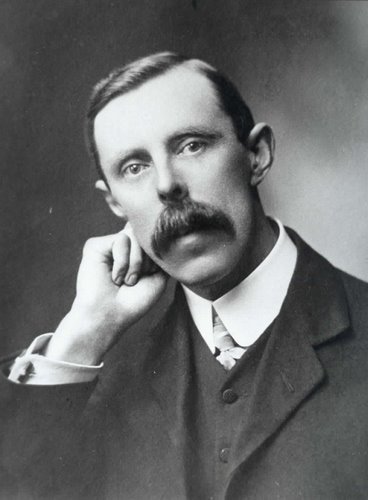
F W Boreham, ‘The Squirrel’s Dream’,
A Witch’s Brewing (London: The Epworth Press, 1932), 89-99.
Dr Geoff Pound


.jpg)

 I
I


