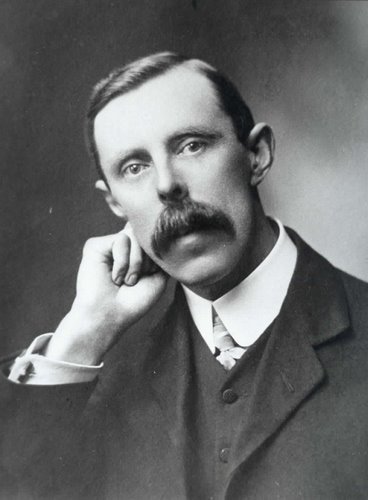
I was interviewed recently by an American newspaper. I thought in this and one or two subsequent articles I would post the questions of the journalist and my answers for a wider readership.
How did you first learn about Boreham's writings?
I started off as a Baptist pastor, working in a church in Dunedin, New Zealand. As a new communicator I did not have much of a problem coming up with content but I struggled to find clear and relevant stories with which to illustrate my talks. I used to go to the local public and seminary libraries and that is where I came across some books by F W Boreham. They were essays or sermons, which had a deeper meaning. As I got hooked into these books I discovered he had been pastor of a nearby church in Mosgiel, just outside of Dunedin. He had served as a pastor there from 1894-1906. I was intrigued with the way he wrote about life in his community.
I found as a pastor that I could use or adapt his illustrations for my own communication and I found this particularly helpful in my work as chaplain of the local prison. Sure they represented a captive audience but they didn’t want to be locked away. I discovered in those years that the telling of stories was an excellent way of attracting and holding the attention of prison inmates and also a crucial key in communicating with children.
F W Boreham was a captivating storyteller and this is the reason why his books are so relevant and still so popular. He despised abstract language and technical jargon, especially theological terminology which he thought confused people and was often used by theologians to parade their knowledge. Much better he thought to wrap a truth in an attractive story as nature wraps its seeds and kernels in beautifully presented fruit.
F W Boreham was a pastor who he had ‘an itch to write’ and he often spoke about his ‘incontinent pen’! Everywhere he went to serve as a pastor he developed a friendship with the editor of the major daily newspaper and was soon asked to write regular editorials. He wrote for the
Otago Daily Times when he was in New Zealand (1894-1906), the
Hobart Mercury, when he was in Hobart (1906-1916) and
The Age (1916-1959), when he was in Melbourne.
I was inspired at the way Frank Boreham wrote 3,000 editorials (at least one per week) for two major dailies between 1912 and 1959. These editorials were unattributed and they appeared on the editorial page with other editorials not in a separate column marked ‘Religion’. This symbolized the way he exploded the usual compartments and sought to reflect in fascinating ways on the spirituality of everyday life. The thing that challenged me was the way as a Christian he addressed issues beyond the garden gate and he was interested in things outside the bounds of the church. He was interested in nature, culture, scientific inventions, the emergence of Australia as a nation but he was also interested in the ordinary everyday things like letter writing and the liquid spirituality that is involved in drinking a cup of tea.
After pastoring in two churches in NZ I went to Melbourne to be a consultant with the Baptist churches of the state of Victoria, Australia. In my travels I met up with the son of F W Boreham and developed a close friendship with him and his wife. It was great to get deeper insights into his father’s life especially regarding such highlights as what F W Boreham was like as a father and grandfather and about the time when Dr Billy Graham visited Boreham’s home in Melbourne to thank the old man for the influence of his writings on the young evangelist’s ministry. Frank Boreham Jnr. shared with me photographs and memorabilia, including some old film footage of Billy Graham striding down the path to greet Dr. and Mrs. Boreham.
I later taught in the Baptist seminary in Melbourne (1994-2005) and became its President. Ferreting around in the seminary archives one day I stumbled across two big boxes of books. I discovered they were a collection of books written by F W Boreham with his signature in them and some hand-written notes. These had been given to the seminary after Dr Boreham died in 1959 but nothing had been done with them. Looking later I discovered the plan of a book Boreham had been working on at the time of his death—the structure of the book involved one newspaper editorial for every day of the year. Often an anniversary suggested a topic for his newspaper article for that day of publication and Boreham had gone through his editorial scrapbooks assigning articles to 75 percent of the 365 slots. Unfortunately he died before this book was finished.
Over the next few years I finished this book, conducted F W Boreham Bus Tours around the major sites in Melbourne and wrote a doctoral dissertation on F W Boreham, focusing on his newspaper articles, to discover what he said over the long span of years and exploring how his faith interplayed with his writing on the issues of the day.
Geoff Pound
Image: Geoff Pound takes off his masks—in Venice.