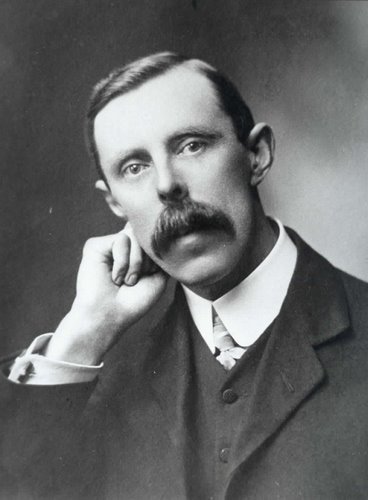
Frank William Boreham 1871-1959

Frank William Boreham 1871-1959
A photo F W Boreham took of himself in 1911
Showing posts with label Pointer. Show all posts

Wednesday, April 25, 2007

Boreham Pointing to Art

F W Boreham’s many references to artists and paintings indicated that art was a significant sphere to which he pointed and encouraged his readers to gaze.[1] His convictions that “art has a special ministry”[2] and “we owe more to pictures than we suspect,”[3] hint at the spiritual dimension of art.

The capacity of art to serve as a subtle ‘pointer’ to God is helpfully discussed by author Richard Harries, when he said:

"True art always has a spiritual dimension. Yet, if religion tries to turn it into propaganda the spiritual would slip away. Works of art inescapably witness, by their truth and beauty to their fount and origin in God himself. Yet religion, always in danger of being corrupted and corrupting does not have this at its beck and call …. It cannot use it for its own ends. It can, however, recognize and praise both the artist and the artist’s God, and, where appropriate seek to express its own deepest truth in works of truth and beauty, regardless of whether the artist has a professed religious faith or not."[4]

Geoff Pound

Image: “Art has a special ministry.” The iconic triptych, ‘The Pioneer’, by the Australian artist, Frederick McCubbin.

[1] References to many of the painters and paintings cited in Boreham’s editorials are listed in an earlier posting, entitled F W Boreham on Art.
[2] F W Boreham, The other side of the hill, 31.
[3] F W Boreham, Rubble and roseleaves (London: The Epworth Press, 1923), 227.
[4] Richard Harries, Art and the beauty of God (London: Mowbray, 1993), 113-114, 139.

Tuesday, April 24, 2007

Boreham Pointing to History and Literature

In thinking about the communicator’s role as a ‘pointer’, the “shining web of history”[1] represented for F W Boreham a source by which people might be enriched from its “priceless hoard.”[2] The historic ‘vaults’ to which he directed his readers included books, shrines, monuments and anniversaries.

Boreham also pointed people towards books because he recognized literature to be “a mirror to the face of life.”[3] When reading, Boreham said, a character in a book “delights us and rebukes us”, thus saving the author from needless moralizing or sermonizing.[4]

Geoff Pound

Image: Boreham recognized literature to be “a mirror to the face of life.” Bernado Strozzi’s painting, ‘Old woman at the mirror’.

[1] F W Boreham, Mercury, 23 November 1946.
[2] Boreham, Mercury, 20 November 1926.
[3] Boreham, Mercury, 14 August 1948.
[4] Boreham, Mercury, 23 July 1949.

Sunday, April 22, 2007

Boreham on Pointing Toward Something More

A major theological idea that undergirded Frank Boreham’s communication was Boreham’s view that theology was seeing something more in ‘ordinary’ things.

He revealed an important insight into his role of encouraging his readers to see beyond the surface of things and experiences when he noted, “The papers that I have written possess no value or importance of their own; but they point to things that no man can afford to miss: that is their only glory.” Boreham went on to link the origin of the ‘pointer’ image to his experience on an ocean voyage, when someone exclaimed, “There are the pointers of the Southern Cross.”[1]

Although, many years later, Archbishop Donald Coggan used the image of a ‘pointer’ as a metaphor for preaching, Boreham drew his analogy from the nocturnal vistas with which his readers would have been familiar—the southern skies.[2]

Geoff Pound

Image: Pointers to the Southern Cross.

[1] F W Boreham, The crystal pointers, 8.
[2] Donald Coggan, Preaching: The sacrament of the word (New York: Crossroad, 1988), 109-110.