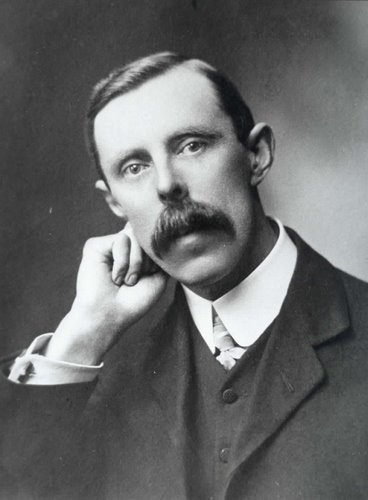

Frank William Boreham 1871-1959

Frank William Boreham 1871-1959
A photo F W Boreham took of himself in 1911
Showing posts with label Public theology. Show all posts

Wednesday, May 30, 2007

F W Boreham Communicating Theology to a Public Audience

F W Boreham enjoyed two significant public platforms in the daily newspapers that gave him an opportunity to communicate theology. However, the medium also shaped his theological content and style.

Immersed in the Culture
Boreham’s articles appeared alongside columns about politics, finance, industry, entertainment, sport, births, deaths and marriages. The symbolic placement of his editorials within secular newspapers, amidst the issues of life, expressed the concern of people like Dietrich Bonhoeffer who called not for “reserving some space for God [at] the boundaries ... but recognizing God ... in the middle of the human village.”[1] These were unattributed articles that made no reference to Boreham’s clerical title and were not marked ‘religion’ or ‘faith’. These factors of language and integration countered the common marginalization of theology.

Literary Style Adjusted to the Readership
Frank Boreham’s editorials differed in theological content and style from his essays and sermons which endorses the view that he was writing to attract a general public audience. While he was motivated to write editorials for a number of reasons, Boreham’s paramount concern was to convey theology, that is, to reflect on the person and presence of God and to encourage his readers to do the same.

Public Issues Shaping His Writing
The public context shaped Boreham’s ‘editorial theology’ by suggesting topics, although reference has been made to the factors that loosened his connection to the local context. Over the years, Boreham settled into a rhythm in which the context of time, season and annual festival prompted many of his subjects.

Reminiscent of the plaudit once paid to the contemporary Australian cartoonist, Michael Leunig, Boreham was “never ‘relevant’, ‘socially aware’ or narrowly political”.[2] At a significant period in the development of Australia as a nation, Boreham contributed to the public conversations about Empire, war, the Anzac legend, the role of women, the care and contribution of the disabled, the stewardship of natural resources, the quest for an Australian identity, the need for an Australian voice and the importance of the arts.

Boreham’s major themes focused on the public spheres of nationhood, nature, history and everyday life. Boreham looked to public affirmation rather than churchly authorities to give his editorials validation.

Expressing Theology Attractively
F W Boreham’s abhorrence of theological jargon and abstract language was linked to his desire to express theology attractively to a public audience. His generous use of visual imagery, characterization and stories were ways Boreham sought to win audience interest and assist their comprehension. His approach was to popularise theology by addressing down-to-earth subjects and everyday issues that he judged to be of interest to a general audience.

While the limitations of space placed major constraints on his ability to provide comprehensive theology, Boreham’s role as a ‘pointer’ allowed his readers to think and act theologically rather than to relegate this task to professional theologians.[3] This trust of his readers was indicative of the friendly stance and the reserved, suggestive tone that Boreham adopted towards his audience. The downside of Boreham’s irenic demeanor was that his theology lacked a pungency borne of courage, thus limiting the prophetic element.

In his editorials F W Boreham was a public theologian who addressed theological issues beyond the personal and outside the garden gate. His childhood puzzlement concerning the purpose of religion was transformed into a passionate commitment to discovering and helping other people to understand how religion connected with all aspects of life.

In his last decade, Boreham restated his conviction about the relationship of religion to life when he wrote, “Religion, to be piquant and satisfying must stand directly related to human life and human labor, human laughter and human tears.”[4] This insight clearly indicated that Boreham believed that the rightful place of religion and the focus of theology were neither bracketed at the margins, nor in pride of place at the centre but on the same level and inextricably connected with all aspects of life.

Geoff Pound

Image: “Religion, to be piquant and satisfying must stand directly related to human life and human labor, human laughter and human tears.”


[1] Dietrich Bonhoeffer, Letters and papers from prison, ed. Eberhard Bethge, Enlarged ed. (New York: MacMillan Publishing Company, 1972), 282.
[2]This compliment was paid to Leunig by Barry Humphries. Barry Humphries, introduction, The Penguin Leunig, by Michael Leunig (Ringwood: Penguin Books, 1974).
[3] Boreham’s editorials in 1912 were limited to 1,500 words, 1,000 words in 1930 and 500 by 1958.
[4] Boreham, Mercury, 5 June, 1954.

Saturday, April 21, 2007

F W Boreham: Theology Connecting with Human Need

F W Boreham wrote newspaper editorials in which he called for compassion and just laws for those disadvantaged by age, gender, disability and race. These articles reflected Boreham’s conviction that theology must connect with acts of freedom and justice. He said that a theology that was disconnected from human need was dead and, writing about the less fortunate in life, he contended, “The religion that has nothing to say to the hindmost is no religion for a world like this.”[1]

Not only did Boreham write articles that discussed the link between different activities of life and religion, but he also suggested connections between one part of life and another. His call to break out from one’s specialty and develop an all-roundedness stemmed from his belief about ‘life’s oneness.’ For instance, he drove this point home in a 1954 editorial when he declared:

"And life is one .… Each realm impinges upon the others, and everything in each stands related to everything in the universe. The philosopher must have eyes and ears for all things everywhere. He must study the ways of grubs but he must study also the ways of God. Eternity is not too vast nor microscopic atoms too small for his attention. Physical life is not too sordid for his research nor spiritual life too sublime. And if some things can only be perceived through a veil, indistinctly, that veil, like the tantalizing gossamer, must serve to pique the philosopher’s curiosity and lure him to his ultimate triumphs."[2]

In a world that is overly-compartmentalized and disconnected, Boreham called for his readers to recognize the integration that exists in life by valuing both the ‘spiritual’ and the ‘physical’, ‘grubs’ as well as ‘God,’ the ‘vast’ and the ‘small’, that which is perceived to be ‘sordid’ as well as that which is ‘sublime’.

Geoff Pound

Image: “He must study the ways of grubs but he must study also the ways of God.”

[1] F W Boreham, Mercury, 17 January 1948.
[2] Boreham, Mercury, 9 January 1954.

Thursday, April 12, 2007

Boreham and For Whom Does One Write?

In these last couple of posts I have suggested that F W Boreham lost (or gave up?) a sense of writing to his local context (Hobart and Melbourne) because his international publishing was taking off. This caused him to cut out local references he earlier would have included and omitting references that if left in, would cause his writing to date over time.

It must be recognized that this practice probably has meant that his writing has not dated like many of his contemporary writers. Yes, there are still some phrases he used that have gone out of fashion and objects and activities he alluded to that have been superseded in the 21st century but the essays and sermons he penned 100 years ago are still immensely readable.

The challenge of disengaging from the local context through acquiring a wider audience is a significant contemporary issue for theologians and other writers in the public sphere.

If you are writing a column for a local or city paper you might find in today’s electronic age that your article can appear with scarcely a delay in other newspapers across the country and throughout the world.

I am writing articles on a number of blogs and web sites. Even the one which has the most distinct geographical focus, Experiencing the Emirates, is read by people in other countries. I am aware of this when I write. Today I have had comments about my articles from Hobart, Melbourne and Singapore.

Addressing this issue, over which authors and publishers have little control, public intellectual Edward Said asks, “For whom then does one write, if it is difficult to specify the audience with any sort of precision?”


Said identifies the dangers of making assumptions about the imagined readership and expecting that the virtual readers will immediately understand the writer’s language and allusions.


Addressing writers and intellectuals about their public role, Edward Said concludes, “All of us should therefore operate today with some notion of very probably reaching much larger audiences than we could conceive of even a decade ago, although the chances of retaining that audience are by the same token quite chancy. This is not simply a matter of optimism of the will; it is in the very nature of writing today.”[1]


People who write theology in this newly expanded public space are also confronted by questions about the context of their subject, the focus of their readership and the risks of communicating with an unknown audience.

Any thoughts or comments on this?

Geoff Pound

Image: Times have changed. The transport Boreham was using when he commenced his writing career. Photo taken by FWB of his wife, a friend and his daughter, Mosgiel, NZ.

[1] Edward W Said, ‘The public role of writers and intellectuals’, The Alfred Deakin lectures: Ideas for the future of a civil society (Sydney: ABC Books, 2001), 470-471.