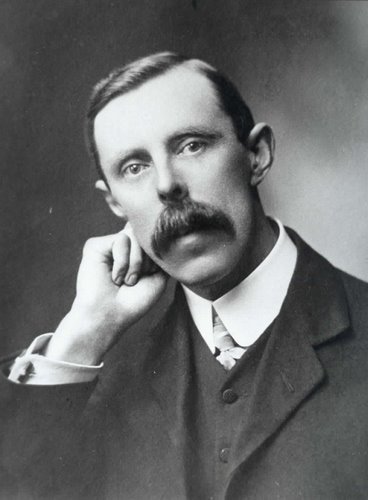
 Donald Grey Barnhouse, for many years pastor of Tenth Presbyterian Church in Philadelphia, was the founder of the Evangelical Foundation that later became Evangelical Ministries, parent organization of The Bible Study Hour radio program. Dr. Barnhouse was speaker on The Bible Study Hour and editor of Eternity magazine. He was renowned as a Bible expositor and teacher and was recognized as one of American's great preachers and conference speakers.
This letter to F W Boreham from Barnhouse appeared in 1941 in the magazine he edited called Revelation.
THE EDITOR WRITES A CONTRIBUTOR
An Open Letter to a Beloved Writer
DEAR DR BOREHAM:
An Open Letter to a Beloved Writer
DEAR DR BOREHAM:
Something tells me that you are a man who has not been scolded many times during your long life. But I have something to scold you for. You have written a book which kept me up till after two o'clock in the morning.
It came about this way. I was holding special meetings down in Florida and a friend of long standing handed me a book, and as he did so he had a glint in his eye. I have learned to be careful when men have a glint in their eye as they hand me a book. Generally I am in for a loss of sleep. The book was your recent autobiography.'
I took it back to the hotel and set it gingerly on my bureau. I had preached twice that day, and had put in some eight hours in reading and writing. I was going to get a good night's sleep. So I firmly got ready for bed. And then I thought it would do no harm to pick the book up and glance at it to see what I was going to have to read the next day. I sat down in an easy chair, and when I came to, I had finished the book and I was a bit muscle-bound because I had remained in the same position for so long. A man should be scolded for writing a book like that.
I will admit that there is one page I would have left out. Please give orders to your publishers to omit your adventure with the python. You say it left you in a perspiration for weeks. Have a little pity on your readers. You teach them to love you from the moment you tell of your great head start in life in being able to have wonder and amazement on the day of your birth when the rest of us didn't even have our eyes open. And then when we are all tangled up with you and your rich ministry you take us out into the Australian bush and prod a sleeping python!
There are many pleasant duties associated with the work of being an Editor. I remember when I picked up one of your books for the first time. I was in China, a guest in a missionary home. The hostess had placed several books in the guest room. If I am alone in any room in the world I inevitably gravitate to any book that is there. That is the first time you ever took me with your seductions. You will remember that I sat down and wrote you a letter. I asked you for contributions for REVELATION and told you what we could pay for their publication-never what they were worth. I didn't know whether you were Methodist, Baptist, Anglican, Presbyterian or Plymouth Brother. All I knew was—well, I can tell it best by an illustration. Mrs. Barnhouse and I have developed, as any couple does over the course of the years, a private vocabulary that may or may not convey much thought to those who hear it. We saw at a World's Fair a pitchman who was selling shots in his game. If you paid your dime you were given a large mallet which you swung over your head like an axe and which you landed with all your force on a block which caused an iron ring to fly up a rod towards a bell. The pitchman would send it up and ring the bell with ease, then take your dime and smile while you tried to ring the bell. Mrs. Barnhouse and I were talking about a certain person whom we had recently met and she said, "If you know what I mean, she rings my bell!" So in our family, new acquaintances either ring our bell or they do not ring our bell.
You swung your mallet in Australia and rang my bell in China. That was good hitting, and I wrote you that first letter. I didn't know whether you were young or old, British or aborigine—we get strange ideas about far off places!—but I kept hearing the resonance of my bell after it had been struck, and so I wrote you.
Two or three months passed, and I reached Southern India. There was your gracious letter and the first packet of manuscripts. Since that time I, and the readers of REVELATION, have read everything you have written for us with the greatest of interest. I suppose that a hundred people have come to me after meetings in various parts of the country to thank me for publishing your messages on the Prodigal Son. Sometimes it is a little disconcerting to preach my own sermon and to have someone in the audience rush up and thank me for having published yours.
I wish that I had been able to have more of an editorial correspondence with you. I blushed when I came to the pages that told of your relationships with your London publisher, and how he had never changed a line in what you wrote, and I remembered how I had had the temerity to ask you to re-end something. But even as I read, I knew you would have forgiven me, even if you had not known that I was twenty-five years your junior.
Every part of your book enchanted me (except the python). Your home, your childhood, your meeting with Charles Dickens. Your romance, courtship and marriage. But you know, sir, when you slipped in that little story about her criticism of your portrait of Robert Moffatt, you gave away a good deal of the credit for your life and ministry. I have long since learned that behind every good man there is generally a good woman—or two or three—and I could see that a girl who could speak so tartly to a possible suitor had, in the language of our American young people, ‘what it takes.’ I want you to introduce us to Mrs. Boreham when we get to Heaven.
Your call to New Zealand, and the gracious tokens of God's guiding along all the way from London to Mosgiel, your ordination (which, by the way, took place almost on the day of my birth), your twelve years at Mosgiel, all fascinated me. Many of us feel that we know some of those people almost as well as we know some of our own congregation, because you have so revealed God's workings in their lives in some of your books.
I liked your story of how you proposed to Elsie Hammond for Seth Draper. A minister can get real sermon illustrations from such things. Poor bashful Seth, dropping his red nasturtium in the path only to see Elsie kicking it. And then you found it pressed in her Bible, taxed her with returning to retrieve it, and found her covered with blushes. And then you married them and watched over them and their growing family. I am going to tell that incident some time to illustrate the story of the son who said to his father, "I go not," but, nevertheless, he went. All this is the stuff of which life is made.
That is what kept me up so late at night reading your book. This is life. It is the story of your life but it is everyone else's life tied into yours. And it makes splendid reading.
There is no use going on and on. Your move to Australia, your growing, world-wide ministry, are all enchanting to a brother minister. But there is one more thing I want to say. I wish that every minister could read your paragraph on writing. I mean the following: "in my own case I can claim no credit for having spent so much of my life at my desk. It has been a form of self-indulgence. But, knowing what I now know, I should still write even if I loathed the sight of a pen. For I have discovered in the course of my pilgrimage that the exercise of writing helps a man to marshal his ideas and to present them in the most forceful and attractive way. The preacher who finds the use of the pen irksome and even detestable will display real heroism in chaining himself to his desk; but, depend upon it, he will reap his reward in due time. For sooner or later—sooner rather than later—he will discover with delight that the laborious hours devoted to such slavery have done much to make him a skilful and effective speaker and a good minister of Jesus Christ."
That is all very true, Dr. Boreham, and if you can write such a good paragraph to help young ministers to get down to work, can you write another one to prevent them from rushing out to print everything they write!
But you—we want you to print it all. There is one thing in your book that I do not think is true, though I am glad the falsehood was told to you. It was when you were thirty-six that your friend, Mr. J. T. Soundy, told you that you would have few fresh ideas after you were forty. You set to work feverishly and began to pour out work at your highest capacity for production. You produced so much more than you could print that you packed the rest away in boxes, and you tell us that when you went away on vacations, for fear that the house might burn down you wrapped your precious manuscripts in water-tight coverings and buried them in the garden.
Now, Dr. Boreham, some of us are sure that your ideas are still fresh; even if you have passed three-score years and ten this Spring (Autumn in Australia!). We want some of those Australian autumn ideas. They will fit well into our spring time. And if you feel that you can not write more, will you please take the boat over to Tasmania where you were living at the time you buried your surplus manuscripts in the garden, get a good spade and go over that garden to be sure that the very last package is brought to light. We need them.
And thank you, dear Dr. Boreham, for letting us read you--Dr. Boreham—“whose name is on all our lips, whose books are on all our shelves and whose illustrations are in all our sermons."
And I am hoping that this letter to you, when ministers read it over my shoulder, will sell many copies of your books.
Yours faithfully,
The Editor
Source: Donald Barnhouse, ‘The Editor Writes a Contributor’, Revelation, June 1941, 315-316.
Thanks to Jeff Cranston for sending me this article.
Image: Donald Barnhouse


