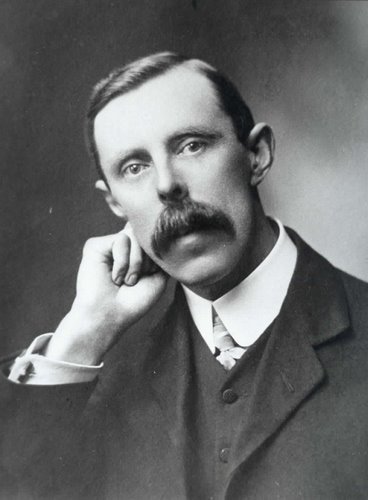
Frank William Boreham 1871-1959

Frank William Boreham 1871-1959
A photo F W Boreham took of himself in 1911

Saturday, March 03, 2007

Boreham Writings into Chinese?

I have discovered this week through Read/WriteWeb that the Chinese web site, YeeYan, translates articles from English language blogs into Chinese so that Chinese language readers can enjoy and make comments.

The goal of YeeYan is “to discover valuable contents in foreign languages and to provide high quality Chinese translations for them.”

Calling Chinese Readers
I am aware that some of the readers of The Official F.W. Boreham Blogsite are from China, Singapore, Malaysia and Taiwan. I wonder if there is a demand and an interest for articles on this web site to be translated into the Chinese language.

F. W. Boreham Publications into Chinese?
I haven’t had time to discuss this matter with my John Broadbanks Publishing partner, Michael Dalton (he is so busy responding to people’s orders for Lover of Life, which is hot off the press).

I wonder if translating Boreham's 55 books into the main Chinese languages might be the next step for taking Boreham into a new dimension?

Do let me know if you are interested in seeing (and helping to get!) Boreham books translated into Chinese.

Geoff Pound

Image: YeeYan logo

Boreham: 'One of the Best Preachers Ever'

Admirers of the preaching of F. W. Boreham might be interested to read a reference to him and other great preachers on Rowland Croucher's posting on this the birthday of FWB.


Click on this link:


http://victoriaconcordiacrescit.blogspot.com/index.html


Thanks Rowland for your stimulating and resourceful articles.


Geoff Pound


Image: A photo of F W Boreham in his early days of preaching when a preacher's coat was the order of the day.

Boreham: So It's Your Birthday!

Today, the 3rd March, is the birthday of F. W. Boreham. Without making any reference to the fact, Dr. Boreham, submitted this editorial to the Hobart Mercury, on one 3rd March and later it was published in a collection of his essays and sermons.


This is one of the essays that will be included in the forthcoming book of Boreham essays entitled The Chalice of Life, a collection in which F W Boreham deals with life at its various stages.


Every day is somebody's birthday. It is reasonable to suppose that, here in Australia, about twenty thousand people are celebrating the great event today. In every city, town and settlement in the Commonwealth:

This is somebody's birthday,
Just as sure as fate;
Some little twins are exactly two—
Some little girl is eight.
Someone is eating his birthday cake
And laughing over the plums;
Someone is counting her birthday dolls
On all her fingers and thumbs.
Someone is bouncing his birthday ball,
Or winding his birthday watch,
Someone is not too wise or tall
For birthday butter-scotch.

To all such, the birthday is a notable occasion. However long we live, we never quite lose the romance of the birthday fuss and frolic. And the very fact that each of us, of whatever age or rank, is susceptible to the birthday sentiment, forges a bond of sympathy between us all. One touch of Nature makes the whole world kin. A birthday represents that element of essential humanness which unites a monarch on her throne with the lowliest of her subjects. Each of us has a birthday once a year: each has but one; kings and queens can have no more.

Yet, when all is said and done, birthdays are mere records of time, not registers of distance. They are chronometers, not speedometers. They tell us how long we have been upon the road, not how far we have travelled.

The distinction is fundamental. It will never do to judge of our progress by the time we have taken. It will never do to suppose that because we have been many days on the highway, we have therefore covered an enormous stretch of country. It is possible, like the tortoise, to go a very short distance in a very long while.

The fact is that the soul has milestones of its own. It declines to measure its advance by any of our artificial standards. The importance that is attached to birthdays, for example, implies that my pilgrimage began at birth, and that all my progress is to be reckoned from that point. But that is ridiculous upon the face of it. The soul laughs at such an absurd method of calculation. We might as well tell a man to walk from London to Edinburgh, and begin to count his progress from York. For the soul reckons that it has got over the worst and most ticklish bit of the road by the time that birth comes about.

I am well on my way when I am born. Oh, the thrilling adventures and the hair-breadth escapes that befell me on that first stretch of the road! When I come to think of all the loves and the hates, the births and the deaths, the comedies and the tragedies, that had to take place through the long agony of the ages in order to produce me, I am astounded that I did not lose my way along that difficult and dangerous stretch of the road. When I think of what might have happened if some old forebear of mine, away back in the age of the cave-men, had taken it into his head to marry the woman whom he murdered, or to murder the women whom he married, it seems to me a perfect miracle that I got here.

When I read of the barbarous ages of slaughter and carnage and brutality through which my long line of ancestors threaded its fearsome way, it is perfectly astounding to me that not one of them got stabbed or clubbed or shot until they had duly taken their places in that long genealogical list. When I think of the wars and famines and pestilences through which those forebears of mine came unscathed, I catch my breath.

In view of all this, you will never convince me that birth was merely a starting-place. It was my first milestone; and I had got over by far the roughest and most perilous stretch of the road when I had safely passed it.

I cannot leave this subject of birthdays without reminding myself that life presents every person with two supreme and indispensable imperatives. It says: You must be born! and it says: You must be born again!
Unless he be born, he simply is not: there is nothing more to be said about him.

And, unless, having been born, he is born again, he cannot hope to see the Kingdom of God. It is the milestone that must be passed: there is no other way Home. To make the attempt would be to court the fate of poor Ignorance, who, from the heights of heaven, was hurled into the depths of hell. He had never been to the Cross; had never seen the three shining ones; had never known the rapture of being loosed of his burden. `Except you be converted and become as little children, you shall not enter into the kingdom of heaven.'

Paul never forgot the milestone that he passed on the road to Damascus. Augustine never forgot that wonderful day in his garden at Milan. Hugh Latimer never forgot that talk with little Bilney in the confessional box. Luther never forgot that scene on Pilate's staircase. Bunyan never forgot the four poor women sitting in the sun. Wesley never forgot how his heart was `strangely warmed' at Aldersgate Street. Mr Spurgeon never forgot the little chapel at Artillery Street, Colchester.

The man who has passed such a milestone is more than half-way Home, however many years he may yet spend upon the road.

F W Boreham, ‘So It’s Your Birthday!’ The Tide Comes In (London: The Epworth Press, 1958), 14-16.

Image: Birthday Blessing.

Friday, March 02, 2007

New Boreham Book Now Available!

Read the letter from Michael Dalton that so many of us have been longing for.

Click on the following link:

New Books of F. W. Boreham.

Geoff Pound

Thursday, March 01, 2007

Thou Shalt Not Steal Boreham's Sermons

In an article in 1944, J J North, the New Zealand Baptist leader, proclaimed these thoughts about the stealing of sermons and other ‘intellectual property’.

"Thou Shalt Not Steal."
That was one of the ten precepts written on granite and intended to bind in social peace the chosen people. It is the commandment that defends private property. It confronts the cattle raider, the sneak thief, the commercial thief—thieves, in short, of every breed and brood. It is very lately, indeed, that another sort of property was declared by international law to be sacred against thieves. Shakespeare has his piece about the man who steals a purse and who steals trash. He suffered himself from literary thieves who pinched his plays and told the drolleries as though their own wit had begotten them. But at long last a preacher's sermon, a poet's hymn, an author's novel argument are all alike "property." So says the law.

The Victorian writers were shamefully robbed by the Yankees. America refused to recognise literary property as property at all. When Dickens went to America with not too much money in his pockets, he found that twenty publishers had printed "Pickwick Papers," and "Boz" and the rest of his prodigious novels, and had sold hundreds of thousands of them without paying him a dollar. He invoked Sinai and called them a pack of thieves—which they were. But the law has now been tightened up, and it is international. Look at your hymnbook and see that permission was given, or secured by payment, for the publication of the best and specially of the newest hymns. Look at recent books and remark that for every long quotation from another author permission to quote has been asked for and often paid for.

Ministers have been shameless thieves. C. H. Spurgeon's penny sermons circulated by the 100,000. But local preachers and bankrupt regular preachers read them from hundreds of pulpits without a thank you. That can't be done now. Occasionally it is done.

We remember when Morrison was the last pulpit sensation that a minister of a large church gave one of his sermons verbatim. One of his elders went home, reached down the book, and was too ashamed of his minister to look up.

We have heard of Boreham being actually used by a preacher who was detected by one who was fond of our gentle friend who actually read his books. This of course is a crime. Men have been unfrocked for it. We can't expect and never get absolute originality. All people borrow from other writers. What is expected is that they shall digest what they read and treat it from their own, and not from their neighbour's standpoint.

Tell me what I knew before
But paint the prospect from thy door.

A person preaching another person’s sermon is David waddling about in Saul's armour. It never fits.

Source: J.J.North, New Zealand Baptist, May 1944, 99

Image: J. J. North. This picture is from the front cover of the New Zealand Baptist, November 1949, the time of North's retirement as editor of the Baptist.

Ruth Graham Visits Borehamland


This is a photo of Ruth Graham visiting Mosgiel in 1969. Published in the New Zealand Baptist, here is the brief report:


MRS RUTH GRAHAM (right), wife of the American evangelist, Dr Billy Graham, paid a brief visit to Mosgiel on March 8, to inspect the Baptist Church. Mrs Graham is a reader of books by the late Dr F. W. Boreham, the first Baptist pastor at Mosgiel, and she expressed the wish to visit his old church while in Dunedin.

After spending some time at the church, Mrs Graham was taken for a drive around the town. Here she is shown with a member of the church, Mrs M. McLennan (left), and Mrs
Grady Wilson, wife of Dr Graham's associate minister.

Source: New Zealand Baptist, May 1969, 11.

Boreham's Embarrassment in the Desert

F W Boreham tells this story from his travels through the Arabian desert:

One incident of the drive across the desert comes forcefully to mind today. For its water supply Arabia is largely dependent upon sea water—salt water that has been condensed. Out beside the desert road we saw the great works in which the condensing is done, with the mountains of salt standing near by. I looked at those heaps of salt and wondered. Our driver was an Arab; but fortunately he could speak English well.

‘I suppose,' I said, leaning forward and addressing him, 'I suppose that this is salt of a crude kind to be used for agricultural purposes, or something of the kind?'

‘No,' he replied, looking quite pained, 'it's beautiful salt; what's wrong with it.’

I felt very humiliated and half resolved to drop the subject; but I was still puzzled, and decided to venture once more. ‘This salt,' I said, 'will probably have to go through several processes yet before it is ready to be shipped away as table salt?'

‘No,' he answered, looking even more hurt than before, 'it's perfect. What's wrong with it?'

I felt crushed but eventually made up my mind to make one more attempt to satisfy my curiosity. ‘You must really forgive me,’ I pleaded, humbly, ‘but if this salt is such beautiful salt, how do you account for its strange browny colour?’

And then my wife, whom I always carry with me to deliver me from such embarrassments, nudged me gently, and enquired, ‘Have you forgotten that you are wearing those amber glasses?’

Indeed I had! Before setting out across the desert a friend had warned me that the glare of the sun would blind me unless I wore coloured glasses. He gave me his. They fitted so perfectly that I had forgotten that they were there; and so the salt, that was really as white as driven snow, looked brown and unclean in my sight.

And ever since that drive across the desert, whenever I hear people complaining that there is something wrong with the world, or the _____________ (fill in the gap), I have remembered my own experience with the amber glasses, and have thought my own thoughts."

Source: F. W. Boreham, Arrows of Desire.

Image: Salt in the desert

Wednesday, February 28, 2007

Boreham and His Ordination

The distinguished New Zealand Baptist leader, J. J. North, wrote this article about the ordination of F W Boreham on the fiftieth anniversary of the occasion. His article that appeared in the NZ Baptist is entitled, ‘Dunedin Fifty Years Ago and a Certain Event’:

Fifty to sixty years ago, Dunedin was the largest and most impressive city in what was then a colony. Most of the mercantile houses had their headquarters there. Earthquakes prevented their flitting to Wellington. Auckland was isolated and still stunned by Maori wars. Yet Dunedin was a small town of rough streets and horse trams and very dull street lamps, lit by men carrying poles, as R.L.S.'s Edinburgh also was.

On an afternoon in March 50 years ago there was a trek of Dunedin Baptists to their shabby railway station, en route for Mosgiel. In the group, and leading it, was the Hanover Street minister, Alfred North, that sage and evergreen H. H. Driver, a rising lawyer. A. S. Adams, and, we think, J. G. Fraser, George Calder, H. Fawcett, and William Ings were there.

The occasion was the induction of a "Spurgeon man" to the Mosgiel pastorate. He was the first Spurgeon man (we think) to invade the religious placidity of Otago. The ministers of the city were of other colleges. H.H., of course, had been a Spurgeon man. and he was very elated (we remember) by the occasion. It was a lovely autumn day, and the Taieri Plains were carpeted in the gold of harvest. The humble little church had never had a minister before. All sorts of folk drove out on Sunday mornings, behind a lamentable horse, to preach. But now a minister had come. C.H.S., the unmitred Bishop of the Baptist world, had sent F. W. Boreham, raw and untried, yet full of an adventurous faith.[1]

On the evening of March 15, 1895 the newcomer was ordained. The writer of these lines was a student in his last year, and a very curious spectator of the proceedings. We did not know, we could not know, that we were making history and that the neophyte, by reason of an adroit pencil and an observant curiosity was to write and preach his way into widespread fame. But such has been the case.

He saw what no one else saw, all sorts of poetry in Mosgiel and its folk and of course, in the Bible, and wrote it all into 20 volumes of very much appreciated essays.[2] Indeed, so popular did some of them become that wholesale thefts have occurred. We heard of an F.W.B. sermon given by an Auckland minister over IYA [radio station] without any acknowledgment at all. That, of course, might be argued as a compliment to our friend, but it was also shameless theft.

But to go back to March 15, 1895. We remember the vestry door opening and in the midst of a long array of the black-coated fraternity there strode the new man. He seemed to us to be very tall, for he was arrayed in a full dress coat, and he had a very unusual and very placid face, a face that became and becomes very animated in speech. We re-read in an old file the searching ordination address by the Rev. Alfred North, and a very competent word to the people by the Rev. M. J. B. Bennett. We still remember, though it is not in print, the eager and modest reply. People passed toward the station at the meeting's end feeling that the beginnings were most promising. So they were, and so they continued, till on an evil day for us the minister transported himself to the Continent, where the bulk of his ministry has been spent.

Our readers will be interested to know that the lady of his choice followed him from England and is still blooming. He has a son and four daughters, most of whom, naturally enough, are married. He has, therefore, grandchildren.

He sends affectionate greetings to New Zealand friends, but wrote us that John Dicker and John Outram were the only remaining officers of his first church. Alas, before the letter came, John Dicker had gone into the land o' the leal.

Dr Boreham was honoured by MacMaster University with his title. For six years now he has given dinner hour addresses to the business men of his city. We thank God at every remembrance of him. His heart has always lain in a pool of honey. Was he ever involved in a controversy? Once in Mosgiel with the Presbyterians, but never again so far as we know. He has a matchless courtesy and "wears without reproach the good old name of gentleman." We are not writing his obituary, and hope we never shall.

Source: J. J. North, New Zealand Baptist, March 1945, 51

Image: A more recent aerial view of Mosgiel with the township in the foreground and Saddle Hill (often mentioned by FWB) in the background.

[1] In the next edition (April 1945, 75) of the NZ Baptist, the editor, J J North, makes this amendment: “In our last issue we credited C. H. S. with directing F. W. B. to New Zealand. But C. H. S. died in 1892, and F. W. B. sailed for New Zealand in 1895. It was under the impulse of Pastor Thomas Spurgeon that Boreham came. . .”
[2] The editor also notes (April 1945, 75) this change: “F. W. B. pleads guilty to writing 40, not a mere 20, books, as we said. A man who does that sort of thing has something to answer for. . .

Monday, February 26, 2007

Boreham on Surprise Power

In writing about a certain lack in many sermons, F W Boreham says:

"Half the art of life lies in possessing effective explosives and in knowing how to use them.

Surprise in the Wild
In the best of his books, Jack London tells us that the secret of White Fang's success in fighting other dogs was his power of surprise. `When dogs fight there are usually preliminaries—snarlings and bristlings, and stiff-legged struttings. But White Fang omitted these. He gave no warning of his intention. He rushed in and snapped and slashed on the instant, without notice, before his foe could prepare to meet him. Thus he exhibited the value of surprise. A dog taken off its guard, its shoulder slashed open, or its ear ripped in ribbons before it knew what was happening, was a dog half whipped.'

Power to Startle
Here is the strategy of surprise in the wild. Has it nothing to teach me? I think it has. I remember going for a walk one evening in New Zealand, many years ago, with a minister whose name was at one time famous throughout the world. I was just beginning then, and was hungry for ideas. I shall never forget that, towards the close of our conversation, my companion stopped, looked me full in the face, and exclaimed with tremendous emphasis, 'Keep up your surprise-power, my dear fellow; the pulpit must never, never lose its power of startling people!' I have very often since recalled that memorable walk; and the farther I leave the episode across the years behind me the more the truth of that fine saying gains upon my heart.

Lacking Sting
Let me suggest a really great question. Is it enough for a preacher to preach the truth? In a place where I was quite unknown, I turned into a church one day and enjoyed the rare luxury of hearing another man preach. But, much as I appreciated the experience, I found, when I came out, that the preacher had started a rather curious line of thought. He was a very gracious man; it was a genuine pleasure to have seen and heard him. And yet there seemed to be a something lacking. The sermon was absolutely without surprise. Every sentence was splendidly true, and yet not a single sentence startled me. There was no sting in it. I seemed to have heard it all over and over and over again; I could even see what was coming. Surely it is the preacher's duty to give the truth such a setting, and present it in such a way, that the oldest truths will appear newer than the latest sensations. He must arouse me from my torpor; he must compel me to open my eyes and pull myself together; he must make me sit up and think. `Keep up your surprise-power, my dear fellow,' said my companion that evening in the bush, speaking out of his long and rich experience. ‘The pulpit,' he said, 'must never, never lose its power of startling people!' The preacher, that is to say, must keep up his stock of explosives. The Bishop of London declared the other day that the Church is suffering from too much 'dearly beloved brethren.' She would be better judiciously to mix it with a few bombshells.

Recapturing Wonder
If only I can renew the romance of my childhood, and recapture that early sense of wonder, the world will suddenly become as marvellous as the prince's palace in the fairy stories, and the ministry of the Church will become life's most sensational sensation."

F W Boreham, ‘The Baby Among the Bombshells’, Faces in the Fire (London: Charles H Kelly, 1916), 20-23.


Image: Explosions.

Sunday, February 25, 2007

Boreham the Romantic Minister

Contribution to the Boreham Biography
J J North was a contemporary of F W Boreham and they shared many things in common. Their personalities were very different. North could be caustic and cutting while Boreham was kindness and peace personified. J J North was never lavish in throwing out the bouquets and these reflections on F W Boreham are brimming with insight. They were published in the New Zealand Baptist newspaper in 1943:


Unknown Minister in Crude Colony
The late years of the nineteenth century are as far away from us as the flood. Three wars have intervened since our letter headings registered 1900. Hoary empires have crumbled. A hermit nation has become the pest of the East. Napoleon has been outmoded. All things are strangely different. They have undergone and are undergoing a "sea change." It was in those distant and somnulent years that an unknown minister landed at Port Chalmers, and looked with some astonishment at a very crude colony, scarcely out of its swaddling clothes. He had been sent from "Spurgeons" to be minister of an insignificant church situate on the margin of the Taieri Plain.

Request to Spurgeon’s College
It was rather a custom in those distant days for small churches to appeal to that unmitred bishop of the Baptists, C. H. S., for young and fervent ministers to lead them withal. [It was Charles Spurgeon’s son, Thomas, who received most of the requests for the NZ churches]. Spurgeon had encouraged "Son Tom" to settle in Auckland. He also sent Dallaston to Christchurch. Some of his sendings made no mark at all on Church life in the colony: but these made history, and to them must be added F. W. Boreham.

Crude Colonial Church
Mosgiel was a queer little rectangular church, on which not a penny had been spent for reasonable adornment—cottage windows, a square porch, and uncomfortable seats for 150 people at a squeeze. Its people were a mixture, basically Scotch, with a tincture from Yorkshire mill towns. They sang vociferously in their graceless synagogue, and they prayed the fervent prayers of saintly men. They put their faith in "Spurgeons" to find them a minister. They put down money enough to bring out a bachelor, and they provided £150 a year for his keep and asked help of no benevolent Union. In the providence of God their faith was honoured. The strange young man who stepped ashore did not turn up his nose, as some have done, at colonial crudity and poverty. He did not book a return passage to the Motherland, He brought with him a romantic mind.

"The poem hangs on the berry bush where comes the poet's eye,
And the whole street is a masquerade when Shakespeare passes by."

Possessing the Poet’s Eye
Boreham had the poet's eye. That is an endowment few share. We make no claims at all in such high matters. We were very well acquainted with Mosgiel before Boreham was heard of. Many a painful journey we made, as a raw student, in a one-horse dray, shared with the Methodist "local" to preach to its people. We never dreamed that romance lived on those plains. Nothing had ever happened at Mosgiel. There had been no Maori war. The natives had vanished before the Scotch pioneers drove in their stakes. The sturdy people had merely transferred Scotch farm life to the large freedom of the Presbyterian settlement. Life was simple, and as flat as the plains they ploughed. It was a New Zealand "Thrums," a New Zealand "Drumtochty." F. W. B. was an understudy of Barrie and Maclaren, from whom no doubt he learned his craft. Be that as it may, that obscure hamlet acquired fame both in the Mother Country and in the U.S.A. entirely through the penwork of this strange young minister.

Dud or Gem?
We happened on him, we seem to remember, on the day of his arrival, for he was a guest in the Dunedin Manse. We certainly went over the hill to his induction service. We marked his goodly stature, exaggerated by his clerical attire, and his very unusual eyes. We can still see that untried colt showing his paces to those farm folk. He lifted a soft, persuasive voice and said his first say to the people who had brought him over seven seas. They sat tight, appraising their import and reflecting that "Spurgeons" had played the game and sent, not a dud, but a gem to be ground and polished in a life of service in the very young colony.

Congregation Shaped Pastor
That certainly is what happened. They altered him. For they were angular and sometimes raspy. He transfigured them, as his quality shone out under the discipline of the pastorate. In a way, what happened in England in Spurgeon's early days happened there. His young preachers came to stodgy towns and into rutty churches as flashes of light and bearers of confidence. So was F. W. B. in his first adventure. Mosgiel was not used to such lithe preaching, it heard from him amazingly little about the old shibboleths, and a great deal about the living Christ and about the actualities of life. Conversions happened and baptisms, which sometimes perturbed the Presbyterians, with whom otherwise he was always on good terms. His ugly little church was made even more ungainly by an addition. It was something to hear a man fresh from London town who could preach on the inner meaning of test matches and hit your middle wicket, who, as the Boer war came on, could give a series on David's valiant men who slew bears in pits on snowy days.

Rumours of Romance
Then presently rumours were afoot that someone else was facing the seven seas, bound for Mosgiel. A very young, and, we always thought, a very beautiful English girl reached Wellington after a lonesome journey. Marriage followed almost at once. We very well remember a very frosty day on the Canterbury plains, when with J. J. Doke, who was afterwards a dear friend of Gandhi, whose life he saved, we drove in a high perched dogcart to Kaiapoi. There was no publicity, a handful of folk stood in a small drawing room. I stood at Boreham's right hand and found the ring, and J. J. Doke pronounced them man and wife. One of the romantic weddings was so consummated.

In the Making
To say that marriage made our friend might be exaggeration. It certainly released a great deal. We have recently glanced over one or two of his early literary ventures, and found them dull, and long-worded. The terse Boreham had not arrived. He soon did. He came to New Zealand very poorly equipped in scholarship. He brought one of the poorest collection of books we remember on a minister's shelves. But he felt a spur. Whether his lady applied it or not he may care to say. He began to read voraciously, and to collate what he read industriously.

Editor and Editorialist
The Denomination asked him to edit the New Zealand Baptist. High brows were more than a little concerned by his tone. They preferred heavy footed stuff that hides poverty in the robes of solemnity. But F. W. B. made hits in his chatty accounts of Union Conferences. Then he very astutely got on the literary staff of the "Daily Times," and wrote them leaders often fashioned on Gibbon, and on the anniversary of great men and great battles. It was Kipling's day of a fervent Imperialism.

Loss and Gain
His departure from New Zealand was a heavy loss to us. Certain churches which should have called him failed to call him, and as his term on the Taieri drew to a close he looked overseas and responded to Tasmania. What he has meant to Australian church life, Australians will be forward to say. He developed the essay habit with great zest additionally to fervent preaching and pastoral work. Mosgiel, seen across the Tasman waters, became increasingly romantic.

Artistic not Photographic
The figures drawn by him are artistic and not photographic. The blend of what ought to be with what actually was is often very pronounced. Bewildered people saw themselves "in a mirror darkly." They did not know themselves, and sometimes resented the publicity accorded them. John Broadbanks and the Silverstream manse have never been identified. They never actually existed, but they did ideally and have been welcomed accordingly. Fame and a competency came to him through his 25 books, but he has never lost his modesty. His welcome, both in England and Scotland, was astonishing, and specially in Scotland, for his Scotch was borrowed from his Mosgiel parishioners, and was not native to the soil of his life. Barrie could do it, Maclaren could do it, it was in their blood as it could not be in the blood of this Englishman.

Modest, Gentle and Courteous
In his early days he was famed for losing things. He was once at our manse in Christchurch, en route for a conference
and armed with his pencil and writing pad. He strode away to catch his tram. The lady of the manse found his pyjamas under the pillow, and his Sunday go-to-meetings in the wardrobe, and shaving apparatus in the bathroom. We understand that the guard in the Mosgiel train made regular collections of the left behinds. But whatever this embryo poet lost he certainly never lost his head. It has remained in its place and his hat is the old size. So modest and gentle, and so engagingly courteous is this great Australian figure, that we feel we shall never look on his likes again.

Source: J J North, NZ Baptist, April, 1943, 81.


Image: J J North.

Saturday, February 24, 2007

Boreham Blogsite: Treasury for Preachers

It is great to discover that this Official F W Boreham Blog Site is the Link of the Week on the popular preacher’s resource site, Preaching.Com.

Welcome to those who have reached this site from Preaching.Com.

That site in its introduction says:

LINK OF THE WEEK
The March-April issue of Preaching will contain a Past Masters feature on the great Australian preacher (by way of Britain and New Zealand) F.W. Boreham. If you'd like to dig a bit deeper into all things Boreham, a good starting point is The Official F.W. Boreham Blog Site managed by Geoff Pound, an Australian preacher and Boreham scholar. You'll find the site at:
http://fwboreham.blogspot.com/

Some popular postings from this site for preachers include:
Jeff Cranston’s (10 short installment) overview entitled So, This is Boreham. Start with the Introduction to Jeff Cranston.
List of Books by F W Boreham
Boreham’s Call to Connect with Ordinary Life
An example of F W Boreham’s popular biographical sermons is Adoniram Judson’s Text
Warren Wiersbe’s Rap on Boreham

Geoff Pound

Image: Preaching.Com Banner

Thursday, February 22, 2007

Boreham on The News

In this era when newspapers are declining because readers are finding their news on the Internet, I wonder how F W Boreham would have viewed the trend of reading the news online.

Boreham had an aversion to his personal use of technology. His biographer reports that in 1906 he did have a try on a new item of technology:

“Christmas brought a welcome break after the past few months' exertions, and also one of the most remarkable innovations that ever invaded the Boreham study. It was a strange black device on the table, known as a portable typewriter. Induced largely by the facility with which the machine could produce carbon copies, he had laid aside a strong prejudice against writing with anything but his trusty pen and bought himself this "Buck" as a Christmas present, and after a little practice was soon turning out neatly typed manuscripts and letters.”

Two pages later, however, Howard Crago reports:

“Meanwhile, that typewriter had been causing him considerable concern. He had struggled with it for weeks. Although the thing turned out readable copies, preoccupation with the keyboard stultified the flow of thought that used to drive his pen with such effortless ease. So the "Buck" went among the household effects that were offered for sale. And never again would such a machine cast its shadow upon the desk of F. W. Boreham. From now on every line he wrote would flow from his faithful pen.”

F W Boreham wrote for many newspapers and magazines, many of which like the Argus, have gone under.

Wherever people got their news from, F W Boreham was aware of people’s hunger:

“No feature of modern life is more arresting than the hunger for news….The great event of the day is the arrival of the newspaper.”

“The individual wants the world, and his appetite for the world expresses itself in his insatiable thirst for news. The Australian bushman sits outside his lonely humpy and hungers for Europe, Asia, America, Africa, and all the scattered islands of the rolling seas. He wants the equator and he wants the poles. He must have the Atlantic and he cannot do without the Pacific. He must feel the throb of every revolution and upheaval. He must know of every invention and discovery. He must be kept abreast of sport and politics. He must peep into every Court and every Cabinet. He must follow the movements of all earth's travelers and explorers. He must be kept in touch with the fluctuations of commerce and industry. He must peruse the lists of births, marriages, and deaths. He hates to feel that any scrap of gossip has eluded him.”

“Our hunger for news is one of the sublimest things about us. It is one of humanity's master-passions.

Sources: T H Crago, The Story of F W Boreham, (London: Marshall, Morgan & Scott, 1961), 111, 113.
F W Boreham, ‘The Hunger for the News’, Hobart Mercury, 14 June, 1941; Melbourne Age, 15 October, 1949.

Image: Not the exact brand but a 1908 portable typewriter.

Boreham on the Value of Mess

Cleanliness Next to Godliness?
We have all been exasperated by the people who tell us with wearisome reiteration that cleanliness is next to godliness. They seem to think that their favorite aphorism was inscribed upon the Decalogue or included among the pearl-like phrases of the Sermon on the Mount. They must learn that the proposition boasts no such sublime authority. It may or may not have figured among the millions of sagacious observations that Confucius is supposed to have made, or that he intended to make, or that he would have made if it had been his good fortune to think of them. However that may be, the Bible is not responsible.

Admiration of Grime
Cleanliness, we are told, is next to godliness. It sometimes is. And sometimes, on the contrary, it is as far from godliness as Pole is from Pole. Those who fancy that the familiar quotation is to be found in the pages of Holy Writ should reflect that, so far from chanting a psalm in praise of cleanliness, the inspired writers have a good deal to say in admiration of the grimy hands of the tired toiler, the stains and smudges on the person and apparel of a healthy child, and the flurry of dust necessarily created by the busy housewife. One of the old prophets picturesquely describes the horrors of famine as a time of cleanness of teeth, whilst another formulates the striking epigram: Where no oxen are, the crib is clean.

No Ox, Crib Clean
The ox is the dynamo of an oriental farm. With his oxen the husbandman ploughs his fields, leads in his harvest, and transports his produce to market. If, through some tragic loss or devastating pestilence, the farmer is left without oxen, the cattle sheds may be a model of cleanliness—the harness and the gear all in their proper places, and the floor impeccably speckles—but look at the farm! Everything is going to rack and ruin. With no oxen, the crib is clean; but it is the cleanness of a dire and terrible catastrophe.

Deathly Orderliness
A home in which everything is in apple-pie order is not of necessity a matter for congratulation. The rooms are silent; there are no signs of childish romp and revelry. In the nursery, the toys are all in their proper places; everything is orderly and shipshape; all is spick and span. But the father and mother are heartbroken; their child is dead.

Confusing Office
When at the height of his renown, Sir Henry Hawkins, the most successful criminal advocate of all time, contrasted the bewildering confusion of his office in 1859 with the flawless tidiness of his official apartment in 1839. In 1839, when he was just starting, he took a tiny room in Elm Court. It was on the fifth floor. The papers were faultlessly arranged in the pigeonholes; a virgin sheet of white blotting paper adorned the brand-new desk; the pen nibs fairly glistened. In those days Hawkins spent most of his time in surveying the forest of chimney pots from the window and in listening at the top of the stairs in the frantic hope that one wonderful day, somebody would actually climb to the fifth floor. In his spacious rooms in 1859 there are piles of papers everywhere; messengers rush in and out; the waiting room is thronged with clients and witnesses; attorneys flit to and fro; clerks fly hither and thither; everything seems in a whirl and a flurry. But, with all its neatness, 1839 spelt worry and anxiety, whilst, with all its disorder, 1859 spelt prosperity and popularity. The upstairs office to which no client ever comes can readily be kept tidy.

Being Thankful for Mess
Let every minister be thankful that his study needs tidying; let every barrister be thankful for the confusion in his office; let every carpenter be thankful for the shavings on the floor; let every mother be thankful for the tumult in the nursery; let every farmer be thankful that the crib needs cleaning out. It all goes to show that there is something doing.

And, lifting the principle to a higher plane, let every man be thankful when his conscience cries out against him; the evil day is the day on which his conscience resolves to speak no more.

Coughing in the Cemetery
We have all heard of the old grave-digger whose terrible cough elicited the sympathy of a visitor to the cemetery. Straightening himself up, the sexton pointed with a sweeping gesture to the tombs around. `There's plenty here,' he tellingly observed, `who'd be glad of my cough!'

Catalyst for a Clean
But, although the cough is a sign of life, it must be cured or it will drag the old man down to a grave of his own. The litter in the office is suggestive of a prosperous business; but it is, at the same time, a clamant call for some tidying hand. The soiled stall is a wholesome spectacle; but it cries aloud to the farmer for water and broom. The torments of an aroused conscience are symptoms of spiritual vitality for which a wise man will give thanks on bonded knees; but they are useless and worse than useless unless they drive him, in his desperation, to the fountain open for all sin and for all uncleanness.

F W Boreham, ‘A Limited Virtue’, The Last Milestone (London: The Epworth Press, 1961), 62-64.

Image: “Be thankful for the tumult in the nursery.”

Boreham on Being Real

Desire to Taste Life’s Delicacies
The insatiable appetite to taste life’s delicacies was interpreted by F W Boreham as one of the drives behind the human capacity to realize its full expression. Moreover, it explained his passion for history which he regarded as “the reflection of real life”. He did not consider the lust for life as a selfish desire that resulted in a hoarding of life’s treasure. On the contrary, Boreham testified that the pursuit of life triggered a further desire to share life’s wealth, saying, “Life has been so sweet to me that I like to mark the relish with which others tell their enjoyment of it”.[1]

Intoxicated by Life’s Joys
This need to share and experience the joy of readers’ response may explain the motivation and the endurance that Boreham exhibited in his marathon literary career. Although rejoicing in the generosity of life that ensured there was always an abundant supply for all, it is surprising to find Boreham, the ardent teetotaler and prohibition campaigner, writing about the “intoxicating”[2] joy of life and declaring “the richest wine in the chalice of life still waits their thirsty lips”.[3]

Keep in Touch With Reality
One of the dominant notes in F W Boreham’s editorials was stimulated by the deeper theme of the magnetism of life. Announcing that “Drama can only hold the hearts so long as it keeps in touch with reality,”[4] Boreham then turned from the stage and sounded this call and warning to all the professions:

“If it be true, as it undoubtedly is, that the actor tends to become artificial, it is no less true that the poet tends to become fanciful, the philosopher hypothetical, the scientist chimerical, the schoolmaster theoretical, the artist technical, and the clergyman cloistral”.


Religion Must Deal With Realities
Reserving his harshest warning for the religious sphere, Boreham said, “The Church cannot afford to lose herself ... in a golden haze of nebulous speculation. Religion is of use to a real world only so far as it deals with realities”.

Concluding his editorial with an affirmation about life’s magnetism, Boreham said, “‘We were made by Thee and for Thee,’” cried Augustine, “‘and our hearts can only find rest when they find their rest in Thee’”.[5]

Geoff Pound

Image: “Drama can only hold the hearts so long as it keeps in touch with reality.”

[1] F W Boreham, The other side of the hill, 173.
[2] F W Boreham, Mercury, 21 May 1932.
[3] F W Boreham, Mushrooms on the moor (London: The Epworth Press, 1915), 105.
[4] F W Boreham, Mercury, 24 September 1955.
[5] F W Boreham, Mercury, 24 September 1955.

Wednesday, February 21, 2007

What F W Boreham and Mark Twain Had in Common

An interesting episode occurred in the life of F W Boreham soon after World War II had finished and Melbourne was still buzzing with people dancing, singing, and shouting in the streets.

Those celebrations in the streets were at their height as F.W.B. mounted the pulpit steps of Scots Church for the weekly midday service, to face the church packed with grateful worshippers. It was a memorable service as the vast congregation, led by the preacher they so highly esteemed, gave humble thanks to God.

That evening, only a few hours later, among the radio bulletins reporting the progress of the surrender negotiations, came the words:

'We regret to announce the death today of the Reverend Doctor Boreham, of Melbourne. Dr. Boreham was widely known for his long ministry at the Scots Church. A memorial service in his honor will be held at Scots tomorrow.'

F.W.B.'s vast company of friends could scarcely credit the news which came with such dramatic suddenness. And many of them had sent their condolences to Mrs. Boreham before learning that, as with Mark Twain, the report of her husband's death was greatly exaggerated.

A corrected announcement that evening explained that the obituary referred, not to Dr. Boreham, but to Dr. Borland, a former minister of Scots Church.

Source: T H Crago, The Story of F W Boreham (London: Marshall, Morgan & Scott, 1961), 234-235.

Image: Mark Twain

Boreham on Life's Magnetism

Lust for Life
One of the ingredients in F W Boreham’s philosophy about ‘All the blessings of life’ involved the magnetism between human life and all living things. Boreham often wrote of this mutual attraction, saying, “It is only man’s quenchless lust of life that enables him to live.”[1] He discerned this persistence in the human capacity to “cling with amazing tenacity” to life, “to endure when all things band together for his destruction” and “to endure any torture to retain [life]”.[2]

Attraction to Life
Dr. Boreham recognized the human attraction towards life, in the “infatuation that we see so much beauty in the dawning of a new day and find so wealthy a romance in the unfolding of the Spring,”[3] the fascination with books[4] and delight in humor.[5]

Underlying Passion
Casting his mind about for other pursuits that captivated his attention, Boreham said, “The same hunger underlies my passion for biography and even my fondness for the Bible .… It appeals to my love of life”.[6]

New Forms of Life Startle
Recognizing humanity’s attraction towards all expressions of life, Boreham dilated, “We love the city because it swarms with life; we love the bush because new forms of life startle us everywhere; we love the play, the film, the novel and the art gallery because, by means of them, we are able to explore new twists and turns of the life we love.” Continuing on the same tack, Boreham explained the thrill with which people greet Easter, saying, “In celebrating Easter we are unconsciously giving three cheers for life itself”.[7]

Geoff Pound

Image: “We love the city because it swarms with life.” Taken on a recent visit to Kolkata: city of joy and life.

[1]F W Boreham, Mercury, 11 July 1936.
[2] Boreham, Mercury, 5 April 1947.
[3] Boreham, Mercury, 21 August 1948.
[4] Boreham, Mercury, 31 July 1920.
[5] F W Boreham, The other side of the hill (London: The Epworth Press, 1917), 173.
[6] Boreham, The other side of the hill, 173.
[7] Boreham, Mercury, 5 April 1947.

Boreham Plagiarized

In Detective Novel
“Among the popular detective novels published in 1942 was Angus MacVicar's Strangers from the Sea -a story of a Scottish minister who, whilst under suspicion of the murder of one of his elders, "laid down the exercise book in which he had been scribbling notes for a sermon-notes based on his reading of the latest book by Dr. F. W. Boreham -and prepared to light his pipe", for ‘the minister, like many another in Scotland, relied for his illustrations almost exclusively upon the books of Dr. F. W. Boreham, the great Australian preacher and writer.’”

Looking Boreham in the Eye
“Nor was it only by fictitious characters that F.W.B. was plagiarized. An American chaplain in World War I, on meeting an Australian chaplain who mentioned that he was a friend of F. W. Boreham's, exclaimed, ‘My, I'd hate to meet that man! I've plagiarized so many of his sermons, I couldn't bear to look him in the eye!’”

Boreham Broadcast Thief
“Perhaps one of the most flagrant instances of plagiarism had occurred in I932, in London, when a service was being broadcast over the B.B.C. from a well-known London church. Down in Tunbridge Wells, Francis Boreham, now too infirm to go to St. John's at night, sat listening to the radio with daughter Jeanie. As the sermon on The Building of the Bridge proceeded, Francis Boreham exclaimed, "I'm sure I've heard that before!" and stepping over to the bookcase, took down son Frank's book Mountains in the Mist, and opening it at page 108 followed the rest of the sermon word for word. He waited for the acknowledgement of its source, and when it did not come, the old gentleman was furious. Indignantly turning to his desk, he penned a straight letter to the preacher about the matter. Not only did the preacher reply to Mr. Boreham in apologetic terms, but also wrote to F.W.B. himself, explaining what he had done and justifying his action on the grounds that, if a sermon were worth printing in a book, surely it ought to be broadcast for all to hear!”

“Not only in the pulpit was he so plagiarized, but also by numerous authors-including some well-known essayists, who would lift whole paragraphs, and even his chapter headings, without acknowledgement. F.W.B. bore none of them any ill-will, but only strengthened his own invariable practice of giving credit for everything he borrowed from others.”

Copyright was passed to me by the Boreham family in the 1990s and I passed it on to Whitley College. Permission to reprint significant portions of Boreham material can be sought from Whitley College Principal, Dr. Frank Rees at frees@whitley.unimelb.edu.au

Source: T H Crago, The Story of F W Boreham (London: Marshall, Morgan & Scott, 1961), 1961.

Image: Quotation marks

Tuesday, February 20, 2007

Boreham on the 'Comrades of the Night'

A recent note from Boreham enthusiast, Les Nixon, who oversees Australia’s Outback Patrol, prompted the posting of this essay by F W Boreham in which he shares some truths he discovered on a trip to the outback.

Tea at the End of the World
We had come to the End of the World; at least, that is what they called it. In point of fact, it was an Australian sheep station, away in the Never-Never country. The nearest neighbors were twenty miles away. All through that golden autumn afternoon our car had been making its way as rapidly as the condition of the road would permit, between the barbed-wire fences that seemed to stretch from one end of the continent to the other. We had been assured, when we left the run at Seldom Seen, that, with luck, we could reach the End of the World by dusk. Perhaps the luck was lacking; at any rate, we were getting nervous about things. The mists were settling down upon the hills; the nip of evening was laying hold of our ears and finger-tips; yet still there was no sign of a settlement. We were gloomily speculating on our chances of getting back to Seldom Seen before mid-night when, all at once, we detected a suspicion of smoke curling up from behind a distant ridge. A moment later we distinctly heard the barking of dogs. Involuntarily we increased the speed of the car, and then, as we swept round the bend of the grassy road, the homestead broke suddenly upon us. We reached the End of the World in time for tea; and tea at the End of the World is a noble meal.

Whole Galaxy of Heaven
After tea we sat around the great log-fire. At the End of the World they build fires such as civilization never dreams of. We talked and laughed together for awhile; and then the experiences of the day began to tell upon me. The fierce glow of the huge fire and the genial atmosphere of the cosy room, following upon the long drive in the strong bracing air of the hills, proved too much for me, and I felt as drowsy as a tired child. Before retiring, however, I stepped out on to the verandah to have a look at the night. There is something very captivating about a lonely Australian scene by starlight. And this particular night seemed to have called out the whole galaxy of heaven. Every star was in its place. I stepped off the verandah in order to get a better view of the skies. Sauntering down towards the great white gate I discovered that I was not alone. The little governess whom they all called Grace was standing with her elbow resting on the top bar of the gate, and her chin resting on her hand. I hesitated to disturb her, but she turned on my approach, and we were soon engaged in conversation. And either the conversation or the night air made me forget my sleepiness. For she said a very interesting thing:

Cure for Homesickness
`I always come out here on a night like this,' she said. `It does me good, and cures my homesickness. My home is in Melbourne, and I have always been used to the city. But they wanted a governess at the End of the World. They pay well; I needed the money; and so it suited me to come. But, oh, it's so different from Melbourne in the daytime, and home seems an eternity away. But at night this gate seems just like the gate at home. Everything strange is wrapped up in the darkness, so that I shall not see it. And the stars come out, the very same stars that I used to watch from our dear old front garden. It is lovely to see them. They seem so companionable, and when I stand here and look at them I forget that I am at the End of the World. I sometimes think I could never stay here but for them!'

Odd Coincidence
I left her musing by the gate and went to my room. And then a strange thing happened, one of those odd coincidences that stamp truth as stranger far than fiction. At the last post-town through which we had passed I received a letter from a young fellow away at the war. He came out from England to these new lands five years ago; but, when the war broke out, he heard the call of the flag and marched away with the rest. I glanced over his letter in the car coming along, but in the quietude of my room I was able to read it more carefully. And, to my astonishment, I came upon this:

'It sometimes happens, 'he writes from Flanders, 'it sometimes happens that we really wonder if we are living on the same planet as that which we formerly inhabited. There is absolutely nothing here to connect us with the quiet life we once lived. But at night-time it is different. One by one the stars come out, and we trace the same constellations that we used to watch as we strolled up the old lane or trudged along the great high-road; and when we see them taking their old places in the skies above us, the link with the old land and the old life seems to have been suddenly restored.'

I rather wish I could introduce these two—our little governess at the End of the World and our young officer in Flanders. You never know what night come of it. They evidently have a good deal in common.

Excellent Medicine
But let neither of them suppose that they were the first to think along this line. It is thousands of years since it was first discovered that the stars make an excellent medicine for homesick hearts. Many an empire has risen and declined since one of the ancient prophets was commanded to direct the attention of an exiled and dejected people to the stars that circled peacefully above their heads.

Lift your eyes on high,' he exclaimed, 'and behold who hath created these things, that brings out their host by number; He calls them all by names by the greatness of His might, for that He is strong in power; not one, fails.' And when, lifting their downcast faces, the captives observed that the stars that looked down upon the land of their banishment were the same as those with which they had become familiar in the country from which they had been cruelly snatched, they instinctively felt that there were ties to the old land that no conqueror could break, and possibilities of restoration of which no tyrant could deprive them.

Eyes to the Skies
From time immemorial disconsolate men and women have turned their eyes to the skies at night and have felt precisely as our lonely little governess felt by the gate the other evening. The stars have always seemed to be speaking some consoling and heartening message to suffering nations and to distracted individuals. How they soothed the mental the mental anguish of Mark Rutherford! ‘The provision of infinity in Nature,' he says, 'is an immense help to me. No person can look up to the stars at night and reflect upon what lies behind them without feeling that the tyranny of the senses is loosened. The beyond and the beyond, turn it over as we may, is a constant visible warning not to make our minds the measure of the universe. This understanding of ours whose function it seems to be to imprison us, is manifestly limited.’ And, in his Autobiography, the stars appear to have been his comforters.

There is Room
On one occasion he is oppressed by his conviction—the most distressing and unmanning of all the convictions that sometimes seizes us—the conviction that there is nothing in him. He walks beneath the stars, and feels that, in a universe of such inconceivable immensity, there is room for every creature born, and, therefore, a place for him. `I sought refuge in the idea of God, the God of a starry night with its incomprehensible distances; and I was at peace, content to be the meanest worm of all the millions that crawl upon the earth.' Again, he is aflame with anger. He strolls beneath the stars, and, reflecting on the great idea of God, and on all that it implies, his animosities are softened and his heat against his brother is cooled.'

Stars Spoken Again
On a third occasion he is worried almost to death, and utterly disheartened. `But just before I reached home the clouds rolled off with the south-west wind into detached, fleecy masses, separated by liquid blue gulfs, in which were sowed the stars. The effect upon me was what that sight, thank God, always has been—a sense of the infinite, extinguishing all mean cares.' The stars had spoken, and his hurt was healed.

Linking the Ages
But standing beside the great white gate at the End of the World, our sad little governess did not see everything. When you turn your eyes starward you are apt to miss something. And both she and our young officer in Flanders missed the best part of the celestial vision. For the stars not only link the lonely station on which poor Grace now lives with the great city she has left behind; they not only link those trenches in Flanders with the tranquil English meadows; but they link up all the ages. Had our young officer who felt that the stars reunited him to his native village and his childhood's home given the matter a second thought, he would have seen that, along a similar line of reasoning, those same stars immediately related him to all the moving drama of the Empire's story. The stars that shine on the British regiments this evening are the selfsame stars that looked down upon the campaigns of Marlborough and Wellington. The stars that must seem to our people in the North Sea to be sharing with them their long and tedious vigil are the self-same stars that gazed upon the destruction of the Spanish Armada and upon Nelson's famous victory ill Trafalgar Bay. The stars link the reality of an age with the romance of all the ages; they unite the prose of the present with the poetry of the past. As Mr. Edward Shillito recently pointed out, the heavens upon whose wealth of wonder the average Londoner gazes with stolid indifference are:

The heavens, beneath which Alfred stood, when he
Built ramparts by the tide against his foes;
The skies men loved when in eternity
The dream-like Abbey rose;

The heavens whose glory has not known increase
Since Raleigh swaggered home by lantern-light,
And Shakespeare, looking upwards, knew the peace,
The cool deep peace of night.

Under those heavens brave Wesley rose betimes
To preach ere daybreak to the tender soul;
And in the heart of Keats the starry rhymes
Roll, and for ever roll.

Selfsame Stars
I fancy that this was the idea in the prophet's mind. It was not merely that the stars that looked down on Israel's captivity were the same that they had seen from the streets of Jerusalem; it was that the stars that they saw were the selfsame stars upon which Abraham gazed when lie received thee promise of the future glory of his race. 'Like the stars of the sky for multitude,' he repeated to himself as his eye scanned the radiant arch above him. And it was something for the stricken people in the day of their adversity to rest their eyes upon the selfsame spectacle that the father of their race had dwelt upon with such deep and mystic rapture.

When Napoleon's army, under Desaix, came within sight of the Pyramids, the men stood still in breathless admiration, and then, quite spontaneously, they rent the stillness of the desert with a shout of wonder and delight, Here was posterity cheering antiquity; the modern cheering the ancient; the world's newest today cheering the world's oldest yesterday. The fine deed was inspired by precisely the same emotions as those with which the captive Hebrews feasted their eyes upon the stars that had greeted the eyes of Abraham. It is good at times to catch sight of the things that abide, the things that filled the first person on this planet with wonder, and that will seem just as magnificent to the man who hears the crack of doom.

Life’s Immutabilities
Which things, besides being helpful and stimulating in themselves, are an allegory, a figure of things still greater. Life needs its fixed quantities, its immutabilities, its things that shine unchangingly. Was it for this reason that, in the Apocalypse, ministers are likened to the stars? `Coming home through the wood last night,' writes Dr. Andrew Bonar in his journal, 'I was refreshed and comforted in looking at the stars. Ministers, like those stars, are set to give light through the night. We shine on, whether travelers will make use of our light or not.' The Christian ministry passes on from age to age the things that abide. If a broken heart is comforted in a church today, it is because the minister gave a message that healed a stricken soul, long centuries ago. If into the broken and contrite spirit of some lowly penitent there flows tonight the rapture of sin forgiven, it is because the minister told an old, old story that has been the light of all the ages. .’I, Jesus, am the Bright and Morning Star,’ said the Risen Saviour, in the sentences with which the Bible closes; and tired eyes will rest steadily on Him until tie stunning tides and shifting scenes of time and sense have ceased for ever to confuse them.

F W Boreham, ‘Comrades of the Night’, The Silver Shadow (London: The Epworth Press, 1918), 77-86.

Image: ‘Comrades of the Night.’
Boreham and The Pull of Things

The people of Lochlee were very fond of Davie McPhail. The little lad was stone blind; yet, despite his heavy affliction, he showed as keen and as blithe a spirit as any on that Scottish country-side. The villagers said that there was a far-away look in his sightless eyes, as though, seeing nothing that they saw, he nevertheless peered into things that they were not permitted to behold.

When, in the summer of1871, Dr. Thomas Guthrie and Dr. John Ker were spending their holiday among the Grampians, they fell in love with Davie. They came upon him several times, and, each time, he furnished them with some fresh cause for wonder. They were tramping one afternoon across a rugged and romantic mountain-side. For hours they reveled in the varied panorama of crag and torrent, wood and waterfall, and saw no sign of life except the herds of red deer browsing down in the glen. All at once they were astonished at seeing, in the distance, a boy's kite. Their surprise was intensified when, on drawing near, they found Davie crouching among the fern on the hillside, holding the string. Clasping the twine firmly, he moved his hands to and fro, sometimes pressing them to his breast and sometimes holding them out at arm's length. His face shone as with secret ecstasy. 'Why, Davie lad,' exclaimed Dr. Ker, 'what's the good of your having a kite? You can't even see it!'
'No, sir,' replied Davie,' but I like to feel it pull!'

The incident has often struck me as being profoundly significant. We are affected more than we know by forces that we cannot see, but of which we feel the pull. It is by the pull of things that our destinies are shaped.

F W Boreham, ‘The Pull of Things,’ The Three Half-Moons (London: The Epworth Press, 1929), 216-217.

Image: Kite

Boreham Unforgettable

Writer Appreciated
At an age when so many prominent men drop into the background and are soon forgotten, it was no small satisfaction to know, at seventy-eight, that one's work was still not only being done, but appreciated.

Radio Tribute
In fact, a further appreciation was to come a few weeks later, which would move F.W.B. even more deeply than the tribute of the Mercury. An old friend, judge C. H. Book, of the Victorian County Court, had been invited, by radio station 3KZ in Melbourne, to deliver a 250-word contribution to a program of Christmas-night broadcast talks on The Most Unforgettable Character I Have Met. The judge now wrote saying that he proposed, if the subject himself approved, to speak about Dr. Boreham. To which, F.W.B. characteristically replied:

“I cannot adequately express my bewildered appreciation of the great honor that you so kindly propose for me. But, truth to tell, you completely took my breath away. Now, however, that I have to some extent regained my balance, let me say that, even if the 3KZ studio is burned down during the week, or a stroke of light­ning puts the station off the air on Christmas Day, I shall cherish to my last hour the thought that, for some reason entirely beyond my comprehension, you had accorded me so lofty a place in your esteem. I can only add that I know of no man living from whom so great a compliment would have meant so much to me....”

Christmas Around the Radio
On Christmas night, at Wroxton Lodge, the Boreham family was around the radio at 7.30 p.m. In his talk, Judge Book said

“It is not an easy task to select the most unforgettable character I have ever met. There are so many people to whom I could say, "I shall never forget you!" For example, there is my dear mother. I could never forget her; and there are others dearly loved: but to speak of any of them would be too personal and intimate for the present occasion.

So I have chosen one whom no one who has been privileged to meet him could possibly forget; someone I have known for many years and to whom I am much indebted.

He is the Rev. Dr. F. W. Boreham, preacher, poet and saint. Eloquent, friendly, a man with a gift of humour, humble with the divine humility of his Master, he is a great man in the best sense of the word.

I have read his essays, listened many times to his sermons, de­livered in that well-loved voice and in a manner all his own; and by these I have been uplifted, strengthened and inspired. But above all, I rejoice that I have often spoken with him face to face, and then he makes you feel that it is you who have his interest and his love.

It is a person's character which makes him unforgettable, be­cause it is character alone which is eternal.

And so, with a loving and a grateful heart, I salute Dr. Boreham, and I say to him, "You are a character I shall never forget!"

The next day, F.W.B, wrote:

“What can I possibly say? You have certainly set me something to live up to! Surrounded by Mrs. Boreham, the family, and one or two guests, I listened with incredulous emotion to all that you so kindly said. With heart overflowing, I then bade the company a silent farewell and slipped away to bed. I felt that I wanted to be, for awhile at least, alone.”

“In the nature of things, a day must soon come in which you will be aware that graceful and generous tributes are being paid to my memory. When that hour strikes, I trust that it will be a secret satisfaction to you that you spoke your beautiful piece whilst my hungry but astonished ears drank in every precious syllable ...”

No Turning Head
Such tributes of appreciation as he had been receiving might have turned the head of a smaller man. But although Dr. Boreham would not have been human had he not enjoyed every one of them, he still maintained that "divine humility" and that same unspoiled friendliness which "makes you feel that it is you who have his interest and his love".

Source: T H Crago, The Story of F W Boreham, (London” Marshall, Morgan and Scott, 1961), 243-245.

Image: 'around the radio.'