Frank William Boreham 1871-1959

Frank William Boreham 1871-1959
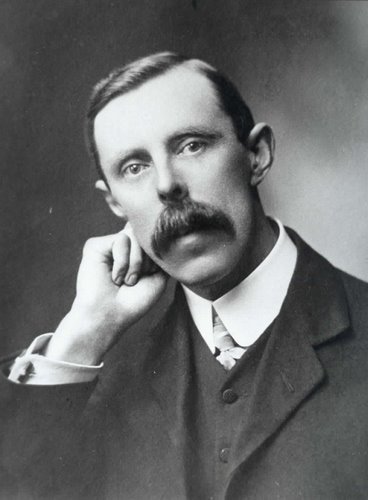
A photo F W Boreham took of himself in 1911

Friday, March 30, 2007

Boreham Arrives in Dunedin, New Zealand

This is an excerpt from the very rare and early book by F W Boreham entitled, From England to Mosgiel. We would love to republish this and are hoping that sufficient donations might make this possible. If you can contribute to the amount needed please let me know. Geoff Pound.

Here F W Boreham records the last part of his sea voyage from England and he writes his first observations of his new province, Otago, New Zealand.

As the evening drew on we were nearing the Otago capital. And the last hour of my voyage was, I think, the most enjoyable of all. Since leaving London I have seen nothing more delightful than the beautiful harbour running up from Port Chalmers to Dunedin, lying calm and still in the quiet of that lovely summer’s evening, the harbour lights reflected in the mirror beneath, and the pale moon shimmering beautifully upon the whole scene. Like Wellington, Dunedin is very hilly, and herein lies its beauty. To ascend some of the hills, and look away over the harbour or across the heights on every side is to survey a landscape which might tempt an R.A., or inspire a poet. The city itself is beyond all doubt or dispute by far the finest in New Zealand. Princes Street is the principal thoroughfare, and consists of series of tall well built shops and offices. The Grand Hotel is probably one of the largest buildings in the city. Knox Presbyterian is also a fine sample of colonial architecture.

Mosgiel, my destination and future home is situated about ten miles south west of Dunedin on the beautiful and fertile Taieri Plain. Within easy driving distance of the sea-coast at Brighton on the one hand, and of the city on the other, it is most pleasantly and conveniently situated, whilst the hills which surround the township, contribute largely to its beauty. A more delightful spot it would be difficult to find. Mosgiel is noted for its large wool factory, which forms the chief industry of the borough, whilst a number of coal mines are dotted about on the slope of the surrounding hills.

So ends my journey from London to Mosgiel. It has occupied exactly fifty days, and the voyage has been both enjoyable and profitable (certainly from a physical aspect) not to use the too thread-bare adjectives—“amusing and instructive.”

To express an opinion on the colony on so short an acquaintance would be obviously premature. And yet, perhaps there are some things which one would naturally notice at first more than after a prolonged stay.

Familiarity is apt to breed contempt. My firm impression was that the colonists are very proud of their island home. On being introduced, the remark, “It’s a grand country you’ve come to,” is expressed almost as regularly as the usual comments on the weather. And I think their pride is a justifiable one. I was certainly charmed with what I saw of the colony in my tour from Wellington to Dunedin, and I suppose the south island is only a shadow of which the north is the substance.

My second impression, I think, was that education is at a much higher standard in the colonies than at home. It may be difficult to account for this, but the fact stands out in defiance of all dispute. I have made careful enquiries as to the correctness of this impression, and find it verified on the best authority.

The telephone is a great institution in the colony. I remarked the same at Hobart. Everybody has a happy knack, on the slightest provocation, of ringing up everybody, and everybody takes it in remarkably good part.

Photography is also a decidedly popular business and seems to have reached a high stage of perfection.

The climate is, of course, impossible to judge on so brief an experience. Suffice it to say that during the ten days that I have been here (March 11-21) the weather has been exactly like our English midsummer, and I am told that this is by no means exceptional. This, considering that December is the colonial midsummer, would seem very promising. One peculiarity, very noticeable to a stranger, is the shortness of the twilight. There is no lingering betwixt light and darkness—day and night as at home. It is light—there is a sudden overcast which is quickly deepened into darkness and it is night. This seems to be atoned for, to some extent, by the additional beauty of the southern sky. On a fine starlit night the heavens are decked in surpassing splendour, and an evening stroll through the tall groves of fir and blue gum trees, is a treat indeed.

But, as a new comer, I have no right whatever to write at greater length on a subject on which I am not qualified to express an accurate opinion. If ever long colonial experience tinges my locks with grey, and long travel in New Zealand, causes my feet to totter feebly on her coasts, I may presume again to test your patience. Till then, let me don the simple garb of a novice, and quietly and gracefully retire to hide my head in the silent regions of unassuming ignorance. Adieu!
Yours truly,
FRANK Wm. BOREHAM
Mosgiel,
New Zealand,
March 21st, 1895.

Image: "I have seen nothing more delightful than the beautiful harbour running up from Port Chalmers to Dunedin, lying calm and still in the quiet of that lovely summer’s evening, the harbour lights reflected in the mirror beneath, and the pale moon shimmering beautifully upon the whole scene."

Boreham on White Elephants

This essay by F W Boreham comes from his book, The Other Side of the Hill:

I cannot exactly claim the reverence and attention which we all accord without stint or question to the hunter of big game. I have never shaken the dust of civilization from my feet and set off for the interior of Africa, the jungles of Bengal, the Western prairies, or the hills of Ceylon. I have, however, read all that Sir Samuel Baker, Major Stevenson-Hamilton, Mr. Stewart White, and other big-game hunters have to say; and some of the most exciting moments I have ever known have been spent in their very excellent company. It is great sport to sit in a cosy chair in a sheltered corner of a shady verandah and to experience, one by one, all the glorious thrills and indescribable sensations of the chase. You hear the distant trumpeting of the herd; you share all the hopes and fears of the hunter as he creeps nearer and nearer to his quarry; you hear the great trees bend and break as the angry monsters rush and charge; and then, with a flush of excitement that almost makes your heart stand still, you see the huge beast roll over beneath the sportsman's magnificent aim. This is as near as I have ever got—or ever expect to get—to adventure of this heroic kind. Yet I have been doing a little big-game hunting on my own account. I have been on the track of white elephants; and certainly I have no reason to complain of lack of sport. None of the herds that I have ever seen described by visitors to Africa or Ceylon can compare with those upon which I have come in the course of my recent quest.

Let me, after the approved fashion of literary sportsmen, begin by describing the creature. And here the subject becomes instantly complicated, for there are, I must explain, several varieties of the beast. There are white elephants and white elephants. In its original setting the term connoted `a gift which occasions the recipient more trouble than it is worth; a white elephant being a common gift of the Kings of Siam to a courtier they wished to ruin.' Nobody would suggest that, in this sinister form, the phenomenon is particularly conspicuous among us. At the opposite pole, it may be reasonably maintained that all the operations of the ordinary commercial world resolve themselves into a perfectly innocuous bartering and marketing of white elephants. Here is a grocer with tons of sugar in his cellar. What does he want with tons of sugar? Considered only in relation to himself, his stock is a white elephant; but he deliberately finds houseroom for that white elephant in order that he may serve his customers and enrich himself in the process. The same thought inevitably occurs to one on being shown the prodigious stores of any other tradesman. The miles of neatly folded materials on the shelves of the draper; the casks of drugs and powders in the storeroom of the chemist; the formidable array of carcases displayed by the enterprising butcher,—these represent so many reminders of the fact that the commerce of life is largely manipulated by the wholesale purchase of white elephants. But between these two interpretations of the phrase—the one as repugnant as the other is serviceable—there is another phase of the matter; and it is this aspect of the question that has brought me to my desk. It is this particular variety of white elephant that I have just been hunting.

Surprising as it may seem, I came upon a very large herd of white elephants almost under the shadow of Windsor Castle. A newspaper lying at this moment on my desk tells of a White Elephant Exchange, inaugurated under royal auspices and opened by Princess Alexander of Teck, which was the other day conducted at Windsor. The white elephants concerned consisted of various articles which the donors found in their possession but for which they had no real use. Each donor received as he entered the exchange a ticket bearing a number, which entitled him to somebody else's white elephant; and if he did not fancy the gift which fell to his lot, he returned it, and it was sold for the augmentation of the patriotic funds. It is averred that when those who desired to assist in this original form of philanthropy ransacked their homes in search of white elephants, they were astonished at the multiplicity and variety of those animals to be found among their household goods. I can easily believe it. Some time ago the residents of the city in which I dwell were invited to search their homes in a very similar quest, and to donate to patriotic purposes any goods or chattels for which they had no further use. Carts passed along the streets to convey these articles to the auction rooms. You never saw such a procession of white elephants! No menagerie since the world began could hold a candle to it. Comedy and tragedy jostled each other in the roadway. Here were the toys of little children who had passed beyond the need of all such entertainment; here was an old-fashioned mangle and a still older spinning-jenny; and here were ramshackle old bits of furniture that had long ago given place to successors of a later pattern, and had since their displacement, only littered up the house.

As I passed, in the course of my hunt, from one herd of white elephants to another, I was driven to the conclusion that our haphazard and somewhat ridiculous etiquette of gift-making has something to do with the enormous quantities of game that I discovered. There are certain occasions—weddings, birthdays, Christmas, and the like—when, according to our present social usage, decency demands that a present shall be sent. Nobody would rebel very bitterly against this engaging custom if only his mind could be entirely emancipated from the torturing apprehension that, sooner or later, the dainty gift which he is at such pains to purchase will take its place among the melancholy ranks of the white elephants. Nine times out of ten the unwritten law that renders a present mandatory forbids any sane investigation as to the desires or requirements of the prospective recipient. It is equally indelicate, if not actually impossible, to ascertain the intentions of other donors. The result is inevitable. One has to determine between the dreamily aesthetic or the severely utilitarian. He purchases, in the one case, a beautifully bound édition-de-luxe, knowing that it will be rapturously admired and eternally unread; or, in the other, he fixes his choice on some eminently useful article, feeling as he does so that in all human probability half a dozen other articles almost exactly like it will be simultaneously received. And, in either instance, the danger of adding to the stock of white elephants is sufficiently grave to awaken embarrassing anticipations.

We ministers are sinners above all men on the face of the earth in this respect. We allow white elephants to multiply about us like rabbits in a district to which a gun never comes. Unless we take care, we shall be trampled to death by them. Look at our libraries—at least, look at mine! All round the room, into which I should be ashamed to show a lady, there are uncomely stacks of books that ought to find hospitality on the shelves. But the walls are crowded with shelves, and the shelves are packed with books. At least, it looks like it. But it is purely an optical illusion, and deceives everybody but myself. As a matter of fact, however, these latest arrivals, packed up so unceremoniously on the floor, are being cheated out of their rightful places on the shelves by an enormous herd of white elephants. There are books that we bought by mistake; books that we know to be valueless; books whose room is of much more value than their company. Yet, by an odd trick that books play upon us, we let them stay on the shelves whilst their superiors sprawl in undignified debasement on the floor! `I have read,' says Sir W. Robertson Nicoll, `I have read, and I find it to be true, that a man who loves books, unless he is exceptionally rich, is always more and more tormented to find room for them. They grow and grow, and the wall space does not grow, and the shelves do not grow. There is only one course possible, and it cannot be postponed for very long. The library must be weeded, and the weeding must be of a ruthless character.' This has driven me to make for myself a good resolution. I happen to have a birthday once a year. I intend for the rest of my life, whenever that auspicious date comes round, to set off after breakfast hunting white elephants. I shall go to the study first of all, and anybody who listens at the door will hear the thud, thud, thud, as the beasts fall upon the floor, and he will know that I am having good sport. And for a few days thereafter it will be reasonably safe for a lady to enter the room.

The problem is, however, capable of still larger implications. Looking round us here in Australia, it is impossible to blink the fact that the greatest problem in the development of the Commonwealth faces us just at this point. It is all very well for me to be sitting here beneath the Southern Cross calmly discussing the subject of white elephants. But what about Australia itself? Australia is a huge continent, only the southern fringe of which is at present being exploited. The remainder is to all intents and purposes a white elephant. How is it to be delivered from that obnoxious classification? The man who can satisfactorily answer that question is the statesman for whom the Empire is anxiously waiting.

And just once more. My friend Arthur Jenkinson is a good fellow. He is exceedingly popular in the office; he is always welcome at the club and in other places where men do mostly congregate. His wife thinks there is nobody like him, and his children clap their hands as they hear him come whistling up the gravel path. But that is as far as it goes. You never see him at church; he is doing no work for which the world will bless him when he is gone; and, as far as one can judge, he is laying up for himself no treasure in the world invisible. Years ago he sat spellbound at his mother's knee while she unfolded to him that sweet and gracious story with which no other story can compare; and in those days his unspoiled heart responded to its charm. The treasure of the ages was poured into his soul, but he has never made use of it. He has allowed the holy faith of his childhood to take its place among the ranks of the white elephants. It is like the family Bible on the whatnot—very precious, but never used.

F W Boreham, ‘White Elephants’, The Other Side of the Hill (London: Charles H Kelly, 1917), 198-205.


Image: Eye of a white elephant

Wednesday, March 28, 2007

Boreham on Experiencing Life through Reading

The aim of educating his readers is too limited a summary of what F W Boreham was seeking to achieve in his writing. He encouraged them to expect the full benefit from the reading of a good biography, saying, “It is not merely that we are imbibing information: it is that we are brought into living contact with a brave soul.”[1]

The examination of the major themes of Boreham’s writings reveals that the experience of nature or being brought “in touch with real men and real women and real life” through history and literature or perceiving the radiance that shines from ordinary life were among the outcomes he hoped his editorials might spark.[2]

English scholar Terry Eagleton has highlighted the stress on the experiential nature of literature in Victorian England because, despite the impoverishment of social conditions, people could have “a kind of vicarious self-fulfillment” and experience life “second hand by reading.”[3] Authors who subscribed to this notion and people who gave books to others did so with a sense of the service of enriching people’s lives.

Geoff Pound

Image: The earliest photo we have of F W Boreham.

[1] F W Boreham, Boulevards of paradise (London: The Epworth Press, 1944), 58.
[2] F W Boreham, The crystal pointers (London: The Epworth Press, 1925), 7-8, 15-16.
[3] Terry Eagleton, Literary theory: An introduction, 26-27.

Boreham and the Sampling of Appetising Wares

F. W. Boreham recognised the role of entertainment[1] in his writing but he believed that merely to present a display of ‘literary acrobatics’ was an insufficient motivation for a writer.[2]

The desire to educate was another underlying aspect of Boreham’s editorials. His regular urgings to his readers to avail themselves of the educative treasures that were to be found in nature, literature and travel were indicative of a general influence that pervaded Victorian Britain. Literature was regarded as an important means by which people could appreciate different viewpoints, develop national pride and it “could serve to place in cosmic perspective the petty demands of working people for decent living conditions or greater control over their own lives.”[3]

According to John Collins’ study on English literature written in 1891, the people “need political culture, instruction, that is to say, in what pertains to their relation to the State, to their duties as citizens; and they need also to be impressed sentimentally by having the presentation in legend and history of heroic and patriotic examples brought vividly and attractively before them.”[4]

Having extended his own education at a Mechanics’ Institute in Tunbridge Wells, Frank Boreham frequently used his editorials to meet these needs, by encouraging his readers to broaden their education and commending the avenues where his life had been enriched. This motivation is well illustrated in his editorial on the author Oliver Wendell Holmes, in which Boreham entices his readers, whets their appetites and concludes that Holmes’ birthday offers us an excuse “to sample afresh his appetising wares.”[5]

Geoff Pound

Image: Popular tourist attraction in Tunbridge Wells, FWB’s home town. These are the Pantiles, a parade of colonnaded shops whose name derives from the method of manufacture of the original paving slabs.

[1] F W Boreham, Cliffs of opal (London: The Epworth Press, 1948) 101.
[2] F W Boreham, A faggot of torches (London: The Epworth Press, 1926), 7.
[3] Terry Eagleton, Literary theory: An introduction (Oxford: Basil Blackwell, 1983), 25.
[4] John C Collins, The study of English literature (n.p., 1891), 25.
[5] F W Boreham, Mercury, 29 August 1953.

Tuesday, March 27, 2007

Boreham and the Itch to Write

Instrument of Escape
Like many writers, F W Boreham was afflicted with what Juvenal called “the itch to write.”[1] Boreham humourously blamed this compulsion on his “incontinent pen”[2] or “this truant pen of mine [and] its inordinate garrulity”.[3] From his childhood days, his pen had been an instrument of escape, a means of self-expression,[4] as it provided him with “a form of self-indulgence.”[5]

Throbbing with Passion
In discussing the subject of communication, Dr Boreham was prepared to excuse a manuscript’s stylistic deficiencies and structural crudities so long as it “throbs with passion.”[6] To lose the “faith and the rapture” was for him the worst tragedy that could befall any communicator.[7] Even though he confessed to “a pride such as Lucifer can never have known”[8] when he gazed at his first editorial in print, Boreham did not suffer from what sociologist Robert Merton, called the “itch to publish.”[9] Boreham knew that it was different to write “with the knowledge that the sentences that flow from your pen will soon appear in the bravery of print and quite another to write for the sheer sake of writing.” He also testified to his joy in writing with no thought of publication or simply to improve the ability to “marshal his ideas and to present them in the most forceful and attractive way.”[10] Boreham’s passion to write was borne out of the pleasure he got out of something shared.[11] The communication passion so that he instilled his readers with a love for literature and history was an important motivation behind Boreham’s editorials. His hope was “to make people enjoy life.”[12]

Geoff Pound

Image: “this truant pen of mine…”

[1] Juvenal Satires 7.1.51. The Latin term is ‘scribendi cacoethes’.
[2] F W Boreham, The passing of John Broadbanks (London: The Epworth Press, 1936), 7.
[3] F W Boreham, The golden milestone (London: The Epworth Press, 1914), 9.
[4] F W Boreham, A witch's brewing (London: The Epworth Press, 1932), 100.
[5] F W Boreham, My pilgrimage (London: The Epworth Press, 1940), 153.
[6] F W Boreham, Ships of pearl (London: The Epworth Press, 1935), 30.
[7] F W Boreham, The other side of the hill (London: Charles H. Kelly, 1917), 244.
[8] F W Boreham, My pilgrimage, (London: The Epworth Press, 1940), 151.
[9] Robert K Merton, ‘The Matthew effect in science’, Science 159 (1968): 61.
[10] Boreham, My pilgrimage, 152-153.
[11] Boreham, The golden milestone,37.
[12] Boreham, The golden milestone, 9.

Monday, March 26, 2007

Boreham and His Public Platforms

While F W Boreham communicated through the religious media of pulpits and magazines, he was fortunate to share for many years two significant public platforms as a regular editorial writer for the Mercury and the Age. In his day the newspaper was important in informing the public, especially in these days before the emergence of radio and television. Within the papers, the role of the editorial was strategic in shaping public opinion.

Although Boreham enjoyed a considerable freedom in subject and style, his editorial role was exercised within the constraints of word limits, weekly frequency and the style of the Saturday editorial.

He had a spat with the editor of the Age in the 1940s concerning his use of overt religious language. This revealed the pressure of expectations on Boreham from the owners and managers of the newspapers and the changing religious mores of the general public. In his later years Boreham tagged a moralistic appendage on the end of his editorials—something he warned others not to do, when he was in his prime.

As an editorialist for the Mercury and the Age, Boreham communicated from two major public platforms. It is interesting to ask, “Was he seeking to express theology and teach his public audiences?” This raises questions as to his motivation for writing articles in the newspapers of his day.

Geoff Pound

Image: Article in the Age.

Thursday, March 22, 2007

Boreham News Flash

Australasians can now purchase the new Boreham publication, Lover of Life: F.W. Boreham’s Tribute to His Mentor, from an online bookshop based in Brisbane, Australia.

More information about this development is available from the New Boreham Books web site.

Geoff Pound

Image: Cover of Boreham’s Book on Mentoring.

Boreham and the Straight Stick

On a beautiful Sunday evening in midsummer, I walked through St James's Park, past Buckingham Palace, to hear Dr John A. Hutton at Westminster Chapel. It was the only occasion on which I ever enjoyed that privilege. His text was: ‘I judge no one ... but if I judge.’

His point was that the gentle and gracious souls who would never dream of criticizing us are the very people whose silent and unconscious condemnation is the most devastating. A straight stick, lying beside a crooked one, does not judge its twisted neighbor, yet its very straightness is the crooked stick's most terrible exposure.

Dr Hutton employed a homely but singularly effective illustration. A man sits grimly in a crowded tram whilst a girl stands near him, clutching at the strap. He mutters to himself that he has paid his fare just as she has, that he is probably quite as tired as she is, and that he is in every way entitled to his seat. She, of course, neither utters a word nor casts a glance in his direction. Yet her very presence makes him thoroughly miserable and covers him with shame. ‘I judge no one ... but if I judge.’

…It seems to vindicate the contention of Francis of Assisi, who held that he who lives a beautiful Christian life has no need to resort to words in order to rebuke the iniquities that disfigure the Church and the world around him.

F W Boreham, The Tide Comes In (London: The Epworth Press, 1958), 21-22.

Image: Straight and crooked sticks.

Wednesday, March 21, 2007

Boreham and New Zealand

The transition from New Zealand to Australia helped to develop the writing ministry of F. W. Boreham.

J. J. North said, “He had to cross the Tasman to be fully appreciated and find a wider sphere for his spiritual gifts in his Master's vineyard—a service which God has owned and blest in the passing years.”

Although he has left New Zealand he did not forget his friends and the foundation that the New Zealand chapter had formed in his ministry. Here is a greeting that F.W. Boreham wrote on the occasion of the Jubilee of the NZ Baptist Union which reveals Boreham’s indebtedness:

A JUBILEE GREETING TO NEW ZEALAND BAPTISTS. From Dr F. W. BOREHAM.

Nearly 30 years have passed since, with a heavy heart, I left New Zealand. Why I should now be honoured with an invitation to greet the Baptists of the Dominion on the exalted occasion of their Jubilee, I cannot for the life of me imagine. And yet, perhaps, I may be qualified to say a modest word on behalf of those who, coming to New Zealand, have remained for a few memorable years, and then have sailed away, bearing the fragrant influence of the country with them.

Coming to Mosgiel nearly 40 years ago, a raw and callow youth, fresh from college, the new land captivated my whole soul, and I gave myself to it for good and all. That, however, was not to be. But I have lost no opportunity of bearing witness to the incalculable debt that I owe to New Zealand in general, and to Mosgiel in particular. I came out from the Homeland with an eager and a hungry mind, and New Zealand taught me much. I have since visited the Conferences of all the Australian States; but —tell it not in Gath!—I still find myself judging these dignified assemblies by the high standard of the Conferences that I attended in New Zealand long years ago!

To have lived and ministered in Mosgiel in the old days, when the earliest pioneers were still among us, and when one could catch the heroic spirit of their sublime adventure, was an experience so rich and so romantic that it has coloured all my days. I loved every stick and stone in Mosgiel—to say nothing of the sturdy souls who dwelt there—and my admiration and affection have deepened with the years.

Others, more competent than I, will testify to the invaluable contribution of the Baptists of New Zealand to the development of the vigorous young nationhood of a Dominion that occupies a place so singularly its own in the economy of the Empire and in the variegated life of the world. Those who, like Dr North, have spent the entire span of the 50 years in consecrated service within New Zealand's coasts, will be in a position to speak authoritatively of the thousands and thousands of lives that have been irradiated and transfigured through the instrumentality of our Churches and of their ministers. And representatives of the mission field will enlarge upon the story of the beautiful and fruitful impact of our New Zealand people upon the teeming millions of Bengal. To these eloquent testimonies this is merely a negligible postscript. For I, who simply came to New Zealand to be ordained, and then to spend a dozen happy years in an obscure country pastorate, can only speak for those who, leaving New Zealand, have carried New Zealand with them, and have felt its gracious and inspiring impress on the life of every subsequent day.

On behalf of those who cherish such choice memories, I send this heartfelt benediction. May the jubilee commemoration crown a glorious past and inaugurate a still more golden future! For, depend upon it, proud and grateful as you will be, in reviewing the 50 years that have slipped away, the best—God's very, very best—is yet to be!”[1]


At the 75th anniversary of the NZ Baptist Union, F. W. Boreham sent this final greeting to NZ Baptists:

Greetings from our Oldest Past President

THE BAPTIST UNION OF NEW ZEALAND was 13 years old when I joined the ranks of its ministers. And now, as it completes the 75th year of its history, I find peculiar satisfaction in sending my warmest felicitations and best wishes.

One of the outstanding pleasures of the years has been the gratification of marking the growth and prosperity of the New Zealand Churches. The churches that I knew have grown amazingly whilst many new churches have come into existence. I pray that such gratifying developments may continue to manifest themselves during the closing quarter of the first century.

It is a red letter day in each month when "The New Zealand Baptist" arrives. We read with deep interest the news that it brings and congratulate the Editor on the fact that the paper is generally regarded as one of the most readable of religious newspapers.
With warmest greetings and affectionate benedictions,

F. W. BOREHAM.

President, 1902.[2]

Geoff Pound

Image: FWB with some of his New Zealand Baptist friends.

New Zealand Baptist, October 1944, 227-228.
[1] New Zealand Baptist, October 1932, 294.
[2] New Zealand Baptist, November 1957, 225.

Tuesday, March 20, 2007

Best Boreham Book for a Beginner

Somebody recently asked me, “If I was to read one Boreham book, which one would you recommend?” I said this was like trying to nominate your favorite child, a practice I wasn’t wanting to commence. As I thought about this question further I thought this was more about suggesting a good place to begin.

My suggestion to this person was to begin with F.W. Boreham’s autobiography, My Pilgrimage (which was subsequently published after his death with the title, Pathway of Roses). One cannot separate the person from his style. Although sentimental in places (typical of his age), My Pilgrimage has passion and through the pages Boreham connects powerfully with his readers.

This is a good book for pastors to read. As I wrote in an earlier posting Leslie Weatherhead described My Pilgrimage as, “the most inspiring ministerial autobiography I have ever read.” But any person would find the reading of this book to be interesting and rewarding.

When the first draft reached his old friend, J.J. North in New Zealand, North identified Boreham’s propensity for linking, which occurs in the opening paragraph of the book:

“Dr F. W. Boreham is publishing an autobiography. His first chapter tells of his birthday. Salvoes of cannon (by chance) were fired in every capital in Europe. It was not, however, because of his birth, but because in Europe the Franco-German War end coincided with an interesting friend's arrival on this planet.”[1]

Six months later New Zealand Baptist editor, Dr. North, added this article entitled, ‘Dr. Boreham's Honour’:

“We are delighted to hear that a fresh honour has befallen Dr. F. W. Boreham. It will be remembered that having completed somewhere about 25 volumes [it was 36], each with a considerable circulation both in U.S.A. and in Britain, he concluded (rashly it seems) that he had nothing else to say to his world. His last book, he said, had been published. But ideas continued to visit his receptive mind, and last year he broke his vow with a volume called "I Forgot to Say." This "paraleipomena" has been a great success, and the Religious Book Clubs of Britain have selected it as their book for January, and they have ordered a special edition of 5000.”

North continues:
“Dr Boreham is now producing his autobiography, and it is appearing in A.C. World every fortnight, and is to be published both in U.S.A. and in Britain. The last chapter we read described his unusual courtship. His lady, his "Stella," caught his eye when she was fifteen. He kissed her on the wharf when she was seventeen as he was sailing for New Zealand. She came out to this country when she was barely nineteen, and has been his "star" ever since, a woman greatly beloved by all who have known her, and (if we may say so) by this writer also, who was "best man" at the wedding in Kaiapoi in 1896. What a career the past editor of the New Zealand Baptist has had!”[2]


Six months later, when the book had come off the presses, North writes this commendation:

“The old and much-remembered editor of the New Zealand Baptist, Dr F. W. Boreham, has published the most dangerous sort of book, an autobiography. In no region of literature is failure more easy. The dangers imposed by natural egoism and triviality threaten shipwreck. This is the more probable in the case of a minister, whose whole life is immersed in the comparative obscurity of pulpit and pastoral work. Yet Boreham has made a success. He has developed an unstrained and lucid style, and he tells the simple details of his life with unfailing charm.”[3]

The major New Zealand bookshop chain printed this advertisement:

"MY PILGRIMAGE"—By F. W. Boreham. An Autobiography.
This is a choice book that every Baptist should read, full of memories that stretch back into Victorian England with its Spurgeon and its F. B. Meyer, and brings us across the Seven Seas to Australia and New Zealand, whose life he has done so much to mould. 7s 6d.
——Postage Extra——
WHITCOMBE AND TOMBS, LIMITED,
CASHEL STREET, CHRISTCHURCH.[4]

And another advertisement later in the year:

"MY PILGRIMAGE." By F. W. Boreham.
An autobiography full of irrestible inspiration. 7/6.
— POSTAGE EXTRA —
WHITCOMBE & TOMBS LIMITED
CASHEL STREET, CHRISTCHURCH.[5]

It is a pity this good book is no longer available for such a price.

Geoff Pound

Image: Stella, “a woman greatly beloved by all who have known her.”

[1] J. J. North, New Zealand Baptist, August 1939, 234.
[2] J. J. North, New Zealand Baptist, February 1940, 37.
[3] J. J. North, New Zealand Baptist, August 1940, 247.
[4] New Zealand Baptist, July 1942, 206.
[5] New Zealand Baptist, December 1942, 325.

Sunday, March 18, 2007

Republishing Boreham Books

I received a letter recently from a new F. W. Boreham fan whose enthusiasm for reading books by FWB has been stimulated by Ravi Zacharias.

He wrote: “Where can I get a copy of Boreham’s Boulevards of Paradise?

Michael Dalton and I have lots of ideas about reprinting Boreham books but would like to hear from you.

What Boreham book would you like to see reprinted and why?

Geoff Pound

F. W. Boreham and J. J. North

F. W. Boreham was a prolific letter writer and although he had friends in different parts of the world he sought to maintain these relationships through regular correspondence.

One of his friends was J. J. North, who served as the Principal of the New Zealand Baptist Theological College and trained an entire generation of pastors.

This first letter F.W. Boreham wrote to Dr. North on the occasion of North’s seventieth birthday. Although North was the editor of the
NZ Baptist, Boreham managed to get this letter printed in that magazine for all to see:

AN OPEN LETTER TO THE EDITOR.
My Dear Dr North,—On the 26th of July you will be 70! Will you allow an old friend, who has himself attained that venerable age, to offer you affectionate felicitations and to wish you a wonderfully rich and radiant eventide? Lives like yours are capable of the most glorious sunsets. I extend these fond wishes not only on behalf of Mrs Boreham and myself, but in the name of thousands of people beyond the shores of New Zealand, who have been incalculably enriched by your brave and stimulating ministry.

The strands of our two lives are closely interwoven. We were born at about the same time. You were at my ordination at Mosgiel, in company with your honoured father, who delivered the charge to myself—a copy of which I still treasure. You were best man at my wedding. In my early days you were my cruellest, kindest critic, and during all the years we have preserved an inspiring sense of comradeship, which has been robbed of none of its charm by the physical fact that we have seldom seen each other's faces. It is particularly pleasant, too, to reflect that our wives, who were girls when they first formed each other's friendship, have been mercifully spared to us.

The good people of New Zealand, whom I still remember with gratitude and admiration, will deluge you with richly merited congratulations; but, whilst the crowd surges tumultuously around you on the great day, you must allow an old friend to press you hand, look into your eyes, and breathe upon you heaven's choicest benedictions.

The Lord bless thee and keep thee: the Lord make His face shine upon thee and be gracious unto thee: the Lord lift up His countenance upon thee and give thee peace!
[1]

On the fiftieth anniversary of J. J. North’s ordination, this snippet is found in the publication of North's reminiscences:

These Fifty Years.
A DOSE OF ANECDOTAGE. VALEDICTORY ADDRESS DELIVERED ON COLLEGE NIGHT BY DR J. J. NORTH.

In 1895 three men entered the ministry of the Church. F. W. Boreham, R. S. Gray and myself. It was given to all three of us to render long service. Boreham, after a ministry in the then remote township of Mosgiel, transferred his large literary talents to Australia. Gray, a very vital man, after two distinguished ministries became the first permanent secretary of the Union and Missionary Society. You have chosen at this Assembly to honour my poor doings, at which I shall be the first to throw a stone.

It was the good fortune of both Boreham and myself to live among pioneers, for the southern provinces were very young in our day. Boreham has written his romances on the old identities of the Taieri. I have failed the equally interesting folk among whom I settled on the Canterbury Plains.[2]

The final letter is written by F.W. Boreham on the occasion of the death of J. J. North:

DR. F. W. BOREHAM WRITES.
It is in my heart to tell my old friends in New Zealand of our own deep sorrow at the passing of my dear old comrade, and of our intense sympathy with them in their irreparable loss. Dr. North, then a theological student, sat beside me on the platform at Mosgiel on the night of my induction, early in 1895. His father delivered the charge. A year later J. J. North officiated as best man at our wedding, assisting the Rev. J. J. Doke at that memorable service.

My wife feels as sad to-day as I do. Although we parted when we were both about five and thirty, he remaining in New Zealand and I crossing the Tasman, we corresponded regularly to the end. His last letter, written on Good Friday, is scarcely legible, but it told me, as clearly as though it were inscribed in copperplate, that my dear old friend was preparing to cross the stream and that the trumpets would soon be sounding for him on the other side.

Near my home in Melbourne is a lovely green bank sloping gently down to the river. Among the trees is a pleasant seat. When Dr. North was here a few years back, he and I sat chatting on that seat during the last hour that we were to spend on earth together. We still call it "Dr. North's seat," and, whenever I occupy it, he seems wonderfully near.

I wave my hand to him in loving and grateful farewell, and I wave my hand to any in New Zealand who remember me, in affectionate greeting and benediction.[3]

Geoff Pound

Image: A picture of FWB at sunset.

[1] F. W. Boreham, New Zealand Baptist, July, 1941, 199.
[2] J. J. North, New Zealand Baptist, December 1945, 303-304.
[3] F. W. Boreham, New Zealand Baptist, September 1950, 265.

Boreham and "Are you his daughter?"

When the Boreham family arrived in Hobart they spent a month in Ivy Lodge before moving to their first Hobart address in Jordan Hill Rd.

Howard Crago recounts a humorous incident:

“F.W.B. and his young wife had interviewed a solicitor in the city regarding this house, and received by the next mail a letter informing them that the place was available, which began, ‘With reference to the conversation which I had today with your daughter and yourself…’”

Crago says: “Nor would it be the last time the girls would chuckle over their mother being mistaken for their sister!”

Source: T Howard Crago, The Story of F.W. Boreham (London: Marshall, Morgan & Scott, 1961), 120.

Image: Stella, wife of F.W. Boreham, looking glamorous on the steps of their first home at Jordan Hill Road, Hobart.

Saturday, March 17, 2007

Boreham and this Photograph

This photograph was valuable in tracking down one of the Hobart homes in which the Boreham family lived. The Hobart church initially lleased at house in Elizabeth Street, just over from the church. This home has since been demolished and has been replaced by a petrol station.

I visited Tasmania (about 1996), with Frank Boreham (Junior) and his wife Betty, to look up the F. W. Boreham sites. During the visit we looked up and down a road to spot the second Boreham family home in Hobart but we did not have the street number. We looked in vain.

About two hours before we had to be at the airport we decided to have another try at finding the home. Walking up and down the street, this photograph and another one taken on these steps and against this wooden paneling provided us with the clue.

I knocked on the door and told them of our mission. They said, “When we purchased this home we were told that it once belonged to a famous author.”

They welcomed us in and we discovered that they were New Zealanders who had previously lived in Mosgiel! The old kitchen table and other furniture that came with the home had been made from beautiful New Zealand kauri wood.

Geoff Pound

Image: Family photo in Hobart.

F.W. Boreham Blogged

Google offers a useful facility if you want to know what other bloggers are writing about F.W. Boreham or the people who are quoting him. It is called Google Blog Search.

By entering F.W. Boreham’s name you are able to discover the most relevant results and you are given the option of searching by date. Sometimes you will find flogs (a place for selling Boreham books) rather than blogs.

If you really want to be advanced you can search for the postings that have been posted in the last hour, 12 hrs, day, week etc.

If you are writing about F.W. Boreham (or any topic) and your postings are not being listed in the Search or you have other questions, the answer might be discovered in the page entitled About Google Blog Search.

FWB would have been amazed!

Geoff Pound

Image: Google Blog Search logo.

Boreham the Editor

F W Boreham was the sixth editor of the New Zealand Baptist and he served from 1899 until he left for Australia in 1906.[1]

New Zealand Baptists were proud of their newspaper. Writing at the time of the NZ Baptist Union’s Jubilee, Dr. J. J. North said:

“No Church has been more consistently served by its denominational organ than has ours. The New Zealand Baptist is the oldest religious paper in this country, with the possible exception of the Catholic Tablet. Every other Church has seen its paper rise and fall and rise again. Ours has kept steadily on.”[2]

Editorial Rating
F.W. Boreham’s contemporaries judged that he maintained and increased the high standard of this publication. Stanley Jenkin said:

“When the century was yet very young, F. W. Boreham, with his journalistic flair and his wealth of literary illustration began to make the "Baptist" conspicuous.[3]

J. J.North wrote of the contribution that the editorial role made to Boreham’s career when he said, “That very brilliant journalist, F. W. Boreham, then of Mosgiel, succeeded to the chair in 1899, and carried his duties with entire success till 1906. He began to find himself as a writer by writing leaders for the New Zealand Baptist.”

“He had a new and novel touch. We remember how he shocked some sober brows by making test cricket a subject for a "leader." "Ipecacuanha" was another. As "Wrox" he wrote the cleverest description of Conference that we have ever had. Some entirely important articles written for the paper by ministers and laymen during his and Dewdney's reigns have their value still.”

“In 1906 F. W. B. went to Australia, to our lasting loss, and the editorial pen was entrusted to H. H. Driver.”

Boreham’s Self-Evaluation
It is interesting to note that in retrospect F. W. Boreham did not think he did a very good job as an editor. He shares his reflections in this published essay (1916) entitled, ‘The Editor.’

THE EDITOR by F. W. Boreham

I APPROACH my present theme with considerable diffidence, for reasons obvious and for reasons obscure. For one thing, I was for some years an editor myself, and I cannot satisfy myself that the experiment was even a moderate success. Everything went splendidly, so far as I was concerned, as long as I wrote everything myself; but I was terribly pestered by other people. They worried me year in and year oat, morning noon, and night. They would insist on sending me manuscripts that I had neither the grace to accept nor the courage to decline. They wrote the most learned treatises, the most pathetic stories, and the most affecting little sonnets. The latter, they explained, were for Poet's Corner. They actually deluged me with letters, intended for publication, dealing with all sorts of subjects in which I took not the slightest glimmer of interest. They sometimes even presumed, in some carping or captious way, to criticize or review things that I had myself written-as though such things were open to question! At other times they wrote to applaud the sentiments I had expressed—as though I needed their corroboration! They were an awful nuisance. The stupid thing was only a monthly, and how they imagined that there would be any room for their contributions, by the time I had been a whole month writing, passes my comprehension. Then came the awakening, and it was a rude one. I suddenly realized that I was a fraud, a delusion, and a snare. I was not an editor at all. I was simply masquerading, playing a great game of bluff and make-believe. As a matter of fact, I was nothing more than an objectionably garrulous contributor who had gained possession of the editor's sanctum, usurped the editor's authority, and commandeered the editor's chair. I felt so ashamed of myself that I precipitately fled, and, although I have several times since been invited to assume editorial responsibilities, I have shown my profound respect for journalism by politely but firmly declining. It does not at all follow that, because a man can make a few bricks, he can therefore build a mansion. A chemist may be very clever at making up prescriptions, but that does not prove his ability to prescribe.

During the years to which I have referred, that paper really had no editor. An editor would have done three things. He would have written a few wise words himself. He would have pitilessly repressed my unconscionable volubility. And he would have given the public the benefit of some of those carefully prepared contributions which I, with savage satisfaction, hurled into the waste-paper basket. It would have been a good thing for the paper if the editorials had been so few and so brief that people could have been reasonably expected to read them. They would then have attached to them the gravity and authority that such contributions should normally carry. And it would have been good for the world in general, and for me in particular, if liberal quantities of my manuscript had been substitutionally sacrificed in redemption of some of those rolls of paper, whose destruction I now deplore, which I consigned to limbo with so light a heart. Since then I have had a fairly wide experience of editors, and the years have increased my respect. `O Lord,' an up-country suppliant once exclaimed at the week-night prayer-meeting, 'O Lord, the more I sees of other people the more I likes myself!' I do not quite share the good man's feeling, at any rate so far as editors are concerned. The more I have seen of the ways of other editors the less am I pleased with the memory of my own attempt. The way in which these other editors have treated my own manuscript makes me blush for very shame as I remember my editorial intolerance of such packages. Very occasionally an editor has found it necessary to delete some portion of my contribution, and, nine times out of ten, I have admired the perspicacity which detected the excrescence and strengthened the whole by removing the part. I say nine times out of ten; but I hint at the tenth case in no spirit of resentment or bitterness. I am young yet, and the years may easily teach me that, even in the instances that still seem doubtful to me, I am under a deep and lasting obligation to the editorial surgery.

The editor is the emblem of all those potent, elusive, invisible forces that control our human destinies. We are clearly living in an edited world. We may not always agree with the editor; it would be passing strange if we did. We may see lots of things admitted that we, had we been editor, would have vigorously excluded. The venom of the cobra, the cruelty of the wolf, the anguish of a sickly babe, and the flaunting shame of the street corner; had I been editor I should have ruthlessly suppressed all these contributions. But my earlier experience of editorship haunts my memory to warn me. I was too fond of rejecting things in those days. I was too much attached to the waste-paper basket. And I have been sorry for it ever since. And perhaps when I have lived a few eons longer, and have had experience of more worlds than one, I shall feel ashamed of my present inclination to doubt the editor's wisdom. Knowing as little as I know, I should certainly have rejected these contributions with scorn and impatience. The fangs of the viper, the teeth of the crocodile, and all things hideous and hateful, I should have intolerantly excluded. And, some ages later, with the experience of a few millenniums and the knowledge of many worlds to guide me, I should have lamented my folly, even as I now deplore my old editorial exclusiveness.

And, on the other hand, we sometimes catch a glimpse of the editor's waste-paper basket, and the revelation is an astounding one. The waste of the world is terrific. And among these rejected manuscripts I see some most exquisitely beautiful things. The other day, not far from here, a snake bit a little girl and killed her. Now here was a curious freak of editorship! On the editor's table there lay two manuscripts. There was the snake—a loathsome, scaly brute, with wicked little eyes and venomous fangs, a thing that made your flesh creep to look at it. And there was the little girl, a sweet little thing with curly hair and soft blue eyes, a thing that you could not see without loving. Had I been there, I should have tried to kill the snake and save the child. That is to say, I should have accepted the child-manuscript, and rejected the snake-manuscript.

But the editor does exactly the opposite. The snake-manuscript is accepted; the horrid thing glides through the bush at this moment as a recognized part of the scheme of the universe. The child-manuscript is rejected; it is thrown away; have we not seen it, like a crumpled poem, in the editor's waste-paper basket? How differently I should have acted had I been editor! And then, when I afterwards reviewed my editorship, as I today review that other editorship of mine, I should have seen that I was wrong. And that reflection makes me very thankful that I am not the editor. We shall yet come to see, in spite of all present appearances to the contrary, that the editor adopted the kindest, wisest, best course with each of the manuscripts presented. We shall see

That nothing walks with aimless feet;
That not one life shall be destroyed,
Or cast as rubbish to the void,
When God hath made the pile complete;

That not a worm is cloven in vain;
That not a moth with vain desire
Is shrivelled in a fruitless fire,
Or but subserves another's gain.

Everybody feels at liberty to criticize the Editor; but, depend upon it, when all the information is before us that is before Him, we shall see that our paltry judgement was very blind. And we shall recognize with profound admiration that we have been living in a most skilfully edited world. For, after all, that is the point. The Editor knows so much more than I do. He has eyes and ears in the ends of the earth. His sanctum seems so remote from everything, and yet it is an observatory from which He beholds all the drama of the world's great throbbing life.

When I was a boy I was very fond of a contrivance that was called a camera-obscura. I usually found it among the attractions of a seaside town. You paid a penny, entered a room, and sat down beside a round white table. The operator followed, and closed the door. The place was then in total darkness; you could not see your hand before you. It seemed incredible that in this black, hole one could get a clearer view of all that was happening in the neighbourhood than was possible out in the sunlight. Yet, as soon as the lens above you was opened, the whole scene appeared like a moving coloured photograph on the white table. The waves breaking on the beach; the people strolling on the promenade; everything was faithfully depicted there. Not a dog could wag his tail but there, in the darkness, you saw him do it. An observer who watched you enter, and saw the door close after you, could be certain that now, for awhile, you were cut off from everything. And yet, as a fact, you only went into the darkness that you might see the whole scene in the more perfect perspective. What is this but the editor's sanctum? He enters it and, to all appearances, he leaves the world behind him as he does so. But it is a mere illusion. He enters it that he may see the whole world more clearly from its quiet seclusion.

In the same way, when I look round upon the world, and see the things that are allowed to happen, the Editor seems fearfully aloof. He seems to have gone into His heaven and closed the door behind Him. `Clouds and darkness are round about Him,' says the psalmist. And if clouds and darkness are round about Him, is it any wonder that His vision is obscure? If clouds and darkness are round about Him, is it any wonder that He acts so strangely? If clouds and darkness are round about Him, is it any wonder that He rejects the child-manuscript and accepts the snake-manuscript? And yet, and yet; what if the darkness that envelops Him be the darkness of the camera-obscura? The psalmist declares that it is just because clouds and darkness are round about Him that righteousness and judgement are the habitation of His throne. It is a darkness that obscures Him from me without in the slightest degree concealing me from Him.

So there the editor sits in his seclusion. Nobody is so unobtrusive. You may read your paper, day after day, year in and year out, without even discovering the editor's name. You would not recognize him if you met him on the street. He may be young or old, tall or short, stout or slim, dark or fair, shabby or genteel-you have no idea. There is something strangely mysterious about the elusive individuality of that potent personage who every day draws so near to you, and yet of whom you know so little.

One of these days I shall be invited to preach a special sermon to editors, and, in view of so dazzling an opportunity, I have already selected my text. I shall speak of that Ideal Servant of Humanity of whom the prophet tells. `He shall not scream, nor be loud, nor advertise Himself,' Isaiah says, `but He shall never break a bruised reed nor quench a smouldering wick.' That would make a great theme for a sermon to editors. "There He is, so mysterious and yet so mighty; so remote and yet so omniscient, so invisible and yet so eloquent; so slow to obtrude Himself and yet so swift to discern any flickering spark of genius in others. He shall not advertise Himself nor quench a single smouldering wick.

There are two great moments in the history of a manuscript. The first is the moment of its preparation; the second is the moment of its appearance. And in between the two comes the editor's censorship and revision. I said just now that I had noticed that editorial emendations are almost invariably distinct improvements. The article as it appears is better than the article as it left my hands. Now let me think. I spoke a moment ago of the child-manuscript and the snake-manuscript; but what about myself? Am not I too a manuscript, and shall I not also fall into the Editor's hands? What about all the blots, and the smudges, and the erasures, and the alterations? Will they all be seen when I appear, when I appear? The Editor sees to that. The Editor will take care that none of the smudges on this poor manuscript shall be seen when I appear. 'For we know,' says one of the Editor's most intimate friends, 'we know that when we appear we shall be like Him—without spot or wrinkle or any such thing!' It is a great thing to know that, before I appear, I shall undergo the Editor's revision.

Charlie was very excited. His father was a sailor. The ship was homeward bound, and dad would soon be home. Thinking so intently and exclusively of his father's coming, Charlie determined to carve out a ship of his own. He took a block of wood, and set to work. But the wood was hard, and the knife was blunt, and Charlie's fingers were very small.
`Dad may be here when you wake up in the morning, Charlie!' his mother said to him one night.

That night Charlie took his ship and his knife to bed with him. When his father came at midnight, Charlie was fast asleep, the blistered hand on the counterpane not far from the knife and the ship. The father took the ship, and, with his own strong hand, and his own sharp knife, it was soon a trim and shapely vessel. Charlie awoke with the lark next morning, and, proudly seizing his ship, he ran to greet his father; and it is difficult to say which of the two was the more proud of it. It is an infinite comfort to know that, however blotted and blurred this poor manuscript may be when I lay down my pen at night, the Editor will see to it that I have nothing to be ashamed of when I appear in the morning.

F.W. Boreham, ‘The Editor,’ Faces in the Fire (London: The Epworth Press, 1916), 57-67.

[1] The editors of the New Zealand Baptist who preceded F. W. Boreham were: Rev. W. C. Spencer (1881-82); Rev. C. Bright (1883,-84); Rev. A. North (1883-87); Rev. L. Shackleford (1887-89); Rev. A. Dewdney (1889-99) in L. A. North, ‘We Editorial Succession,’ New Zealand Baptist, August 1966, 201.
[2] J. J. North, ‘The New Zealand Baptist: Jubilee Retrospect,’ New Zealand Baptist, October 1932, 304-305.
[3] Stanley Jenkin, ‘A Bit from the Heart of a Friend and Fellow-Worker,’ New Zealand Baptist, January 1949, 3.

Image: One editor under pressure and still looking for a story.
Friday, March 16, 2007

Boreham and the Lamplighter

The following is the text of an essay by F W Boreham that appeared in a brochure distributed by the British and Foreign Bible Society [now The Bible Society].

A LAMPLIGHTER

By the Rev. F. W. Boreham, D.D.

How heartily and incredulously Harry Walsh would have laughed if some little bird had whispered in his ear that, in centuries to come, men would speak of William Tindale as a grave and austere scholar, a stern and gloomy reformer, a severe and unbending controversialist! And Humphrey Monmouth would have felt very similarly. For Harry Walsh, a sunny little fellow of six, living at Little Sodbury, and Humphrey Monmouth, an alderman and well-known merchant of the city of London, knew Mr. Tindale as one of the most winsome, one of the most genial and one of the most lovable of men. Their happiest hours were spent in his society. Harry was the elder son of Sir John Walsh, a knight of Gloucestershire, and Mr. Tindale was his private tutor. Here they are, sitting together beside a stile under a giant chestnut tree, surveying from this green and graceful hillside the quaint little hamlet nestling in the hollow! Harry, in all the bravery of his trim velvet suit, with silk stockings and silver buckles, is perched on the top of the stile. His tutor, a young man of thirty, of well-knit frame and thoughtful but pleasant face, with nut-brown hair and deep-set hazel eyes, is seated on the foot-step below him. A little brown squirrel eyes them suspiciously from a branch overhead and a cuckoo is calling from the copse near by. Harry carries an armful of bluebells.

"What wonderful times we are living in" exclaims Mr. Tindale, his eyes sparkling with enthusiasm. "Why, you and I ought to thank God every day, Harry, that he has sent us into the world just now! Every morning brings news of some fresh wonder!"

It was no exaggeration. The air literally tingled with sensation and romance. The world was being made all over again. The very planet was assuming a fresh shape. It was an age of thrills! One day Bartholomew Diaz gave Africa to the world; the next, Columbus presented it with America, and then Vasco da Gama unveiled India! Continents were springing up like mushrooms! And, whilst Columbus was discovering a new world in the West, Copernicus was discovering a new universe in the skies, and William Caxton was introducing a new age with his printing presses! It was the age, too, of the Renaissance and the Reformation!

"What wonderful times we are living in!" exclaimed Mr. Tindale, partly to himself and partly to his young charge perched on the rustic stile. Harry's golden hours are the hours that he spends rambling across the fields or through the woods in Mr. Tindale's delightful company. For he knows that, as soon as they warm to their stride, his tutor will tell him the latest wonder of which the coach from London had brought word.

He goes to London
All things come to an end, however, as Harry discovers to his sorrow. As long as he lived he always declared that the deepest shadow that darkened his happy boyhood was his tutor's resignation. He never forgot the evening on which Mr. Tindale told him that he must leave Little Sodbury.

The candles having been lit, Mr. Tindale, as is his custom, read to the two boys—Harry and Richard—a few verses from his Greek Testament, translating and commenting as he goes along.

"We must read our favourite verses tonight," he had said, with a smile of singular sweetness in which, however, a suspicion of sadness seemed to linger. The boys know exactly the passage to which he refers. They know how dear to him are the verses that he has taught them, too, to love.
"You are of God, little children," he begins, and reads on till he comes to the words We love Him because He first loved us." Those words, he used to tell the boys, were the pearly gate through which be entered the kingdom.
"I used to think," he said, "that salvation was not for me, since I did not love God; but those precious words showed me that God does not love us because we first loved Him. No, no; we love Him because He first loved us. It makes all the difference!"
The familiar passage having been read once more, Mr. Tindale tells them that he is leaving them. The boys are soon in tears and the tutor's voice is husky.

“But why,” demands Richard, in a passion of childish grief, "why must you go?" He draws them to him and attempts to explain.
“I must go," he says quietly, "because I have found the work that God has sent me into the world to do. You have heard the things that have been said at dinner. Great and wise men, even preachers and prelates of the Church, come to dine with your father and mother, and say things that they could not possibly say if they knew aught of the Scriptures. If learned doctors and eloquent preachers are so ignorant of the Divine Word, is it any wonder that the people are it in darkness? A new day is dawning, the people are reading and thinking , it is time they had the Bible in their own tongue; and so, as I told your father and Doctor Hampton at dinner last night, I have resolved that, if God spare my life, I will cause every ploughboy in England to know the Scriptures better than the priests and prelates know them now; but it cannot be done here. I must go to London, and there, I trust, Bishop Tunstall will counsel and assist me." And so, after taking a sorrowful farewell of the household at Little Sodhury, Mr. Tindale turns his face towards London.

He becomes an Exile
But London receives him with a scowl. He soon discovers that he has poked his hand into a hornet's nest. On his first appearance at the palace, the Bishop gives him the cold shoulder; and, when he persists in his overtures, he is threatened with all the thunderbolts that the Church can hurl. By every ship that glides up the Thames, the writings of Martin Luther are being surreptitiously imported into England, and men are being hurried to prison and to death for reading them. The disappointed young tutor never dreams that, in centuries to come, his statue will hold a place of honour on the Victoria Embankment, and that, at its unveiling, princes and peers will bare their heads in reverence to his illustrious memory

And yet, while Church and State frown upon his project and eye him with suspicion, those who come into intimate touch with him are captivated by his charm. From his old employer at Little Sodbury he brings letters of introduction to some of the merchant princes of the metropolis, and in their homes he soon becomes a loved and honoured guest. With Alderman Humphrey Monmouth he stayed for more than six months. On week days he worked quietly at his translation. "But," as an old chronicler says, "when Sunday came, then went he to some merchant's house or other, whither came many other merchants, and unto them would he read some one parcel of Scripture, the which proceeded so sweetly, gently and fruitfully from him that it was a heavenly comfort to the audience to hear him read the Scriptures. He particularly loved the writings of St. John." Harry and Richard Walsh must have smiled knowingly if that last sentence ever came under their notice: "He particularly loved the writings of St. John." They would see again the glowing face of their old tutor and hear him repeat with rapture the words: We love Him because He first loved us.

Two things, however, are now clear. The first is that the people of England are hungry for the Word of God in their mother tongue; the second is that it is out of the question to attempt such a publication in London. This being so, he must brace himself for another painful wrench. Tearing himself from the homes in which so many delightful hours have been spent, he sets sail for the Continent.

He Translates the Scriptures into English
And on the Continent he knows of at least one kindred spirit. Martin Luther is hard at work translating the Scriptures. "Would to God," Luther cried, "that this book were in every language and in every home!" Mr. Tindale decides to hasten to Wittenberg and talk things over with the man who was shaking the very foundations of Europe. It is a pity that we have no classical painting of their historic meeting.

Luther and Tindale! The German Bible of today is the most enduring and most glorious monument to Martin Luther; the English Bible of today is the most enduring and most glorious monument to William Tindale! And here, in 1524, we see the two men spending a few memorable days together!

The rest of the story is well known. We have all chuckled over the way in which Tindale outwitted his old antagonist, the Bishop of London. The New Testament in English is at last complete. But how is it to reach England? The ports are closed against it! The book is contraband! Yet, in crates and casks and cases, in boxes and barrels and bales, in rolls of cloth and sacks of flour and bundles of merchandise, the Testaments come pouring into the country!

“Very well!" retorts the Bishop, "if we cannot ban the books, we'll buy the books and burn them!" He does so, only to discover, as soon as the flames of his famous fire have died down, that, in buying them, he has provided Tindale with the wherewithal to print a larger and better edition!

We have all experienced the thrill of this brave adventurous career. He was harassed; he was excommunicated; he was driven from pillar to post; he was hunted from country to country; he was shipwrecked he was betrayed; he was imprisoned; he was tortured; and, at last, he was sentenced to a shameful death.

And we have all felt the pathos of that last letter of his. He is still in the prime of life; but he is worn out and decrepit. Lying in his damp cell at Vilvorde, awaiting the stroke that is to emancipate his soul for ever, he reminds his friends that the date of his execution has not been fixed and that winter is coming on. "Bring me," he begs, "a warmer cap, something to patch my leggings, a woollen shirt, and, above all, my Hebrew Bible!"
"Above all, my Bible!

The words are eminently characteristic. He lived for the Bible; he died for the Bible; and he mounted the scaffold, and, looking forward into the future, he saw the time when the Bible would be read in every city, town and village throughout the land.

Tindale died a martyr's death on 6th October, 1536, and at the four hundredth anniversary of his passing we do well to honour his glorious memory.

BRITISH AND FOREIGN BIBLE SOCIETY
146 QUEEN VICTORIA ST., L.C. 4
GREAT BRITAIN
No. 686 June 1938

Source: This essay is a slight adaptation of F. W. Boreham's ‘William Tyndale’s Text’, A Temple of Topaz (London: The Epworth Press, 1928), 262-272. [Tyndale is the spelling used in this essay while the brochure uses Tindale].

Image on pamphlet: The Manor House, Little Sodbury, where Tindale was tutor.

Thanks to Michael Dalton for sending me a copy of this pamphlet.

Wednesday, March 14, 2007

Boreham Book Contest

Your Chance
Here’s you chance to win a free, postage-paid copy of Lover of Life: F. W. Boreham’s Tribute to His Mentor. This is the new book published by John Broadbanks Publishing.

John Broadbanks publisher, Michael Dalton says: “The word “romance” comes to mind when I think of Boreham’s writings. He has such a wonderful and fanciful way of expressing himself. Though this might be considered a religious book, I think that anyone could appreciate the winsome spirit in which he writes.”

“This is a story of how one man played a pivotal role in the life of a young minister starting out. There are lessons here for everyone.”

Your Task
All you have to do to win a copy is tell the publisher in your own words what books or authors have meant the most to you and why. If you are familiar with Boreham’s writings, let us know what they have meant to you. Anyone can enter.

The entry (or entries) we like the most get a free copy of the new Boreham book.

Timetable
Just submit your entry by the end of March. Our favorite entries may be posted on line along with the name of the winner (or winners) at The Official F. W. Boreham Blog Site: http://fwboreham.blogspot.com/.

You can send your entries directly to:

Mike Dalton
2163 Fern Street
Eureka, CA 95503
Email address: dalton.michael@sbcglobal.net

Boreham and The Total Eclipse

I am grateful to Jeff Cranston who has sent me his reflection on a recent television program which recalled for him, F. W. Boreham’s essay on The Total Eclipse [this follows].

The Discovery Channel recently stepped into the realm of the fantastic, claiming through its recent broadcast, The Lost Tomb of Jesus, that the graves of Jesus Christ and his family have been uncovered.

The program was watched by over four million viewers, the highest ratings for the network since September 2005.[1] The New York Times stated in a review entitled, Leaning on Theory, Colliding with Faith:

“The documentary, which carries the seal of approval from its executive producer James Cameron (‘Titanic’), has already caused some ado, however, with bold assertions that clash with conventional Christian doctrine. Jesus was married to Mary Magdalene and had a son, Judah, according to the filmmakers. And all three were laid to rest in a family tomb that is now buried deep beneath a Jerusalem apartment complex. And, of course, the filmmakers’ claim that they identified the burial remains of Jesus of Nazareth — including traces of DNA — suggests that he was not bodily resurrected, after all.”[2]

In recent days the propositions of these claims have been met with skepticism and opposition from scholars of all stripes. Historians and archeologists, Christian and non-Christian, have called into question everything surrounding the fanciful assertions of the producers.

Dr. Jodi Magness, an archaeologist at the University of North Carolina at Chapel Hill (USA), expressed irritation that the claims were made at a news conference rather than in a peer-reviewed scientific article. By going directly to the media, she said, the filmmakers "have set it up as if it's a legitimate academic debate, when the vast majority of scholars who specialize in archaeology of this period have flatly rejected this," she said.[3]


This reminds me of F. W. Boreham’s essay, “A Total Eclipse” in his book Dreams at Sunset. He relates a fictional story about a man caught in a web of financial bondage who treks off to the Middle East, purportedly discovering a tomb containing the words of Joseph of Arimathea which relate that he took Jesus' body and hid it in the tomb. In a matter of weeks, the resurrection of Christ is soon pronounced a hoax. The indebted man has created this hoax to pay off his debt to a powerful man who wanted to destroy Christianity. As the news spread around the world, Boreham wrote, "Those whose religion is of the formal, superficial kind abandon it; the bubble has burst; they feel ashamed of their gullibility.”


Similar sentiments have been echoed in recent days as many read about the find of the ossuary supposedly containing the bones of Christ. Someone once said, “The more things change, the more they stay the same.” As we face yet another heresy storming the gates of Faith, Boreham’s essay reminds us that the Scriptural account of Christ’s’ resurrection is an anvil that has worn our yet another hammer.


A Total Eclipse by F. W. Boreham

AMONG the minor sensations of the nineteenth century were the thrillers of Guy Thorne. His most dynamic and explosive production, When It Was Dark, was proclaimed as the most daring and original novel of the period, and enjoyed the distinction of being glowingly commended by the Bishop of London from the pulpit of Westminster Abbey.

I

It tells how Constantine Schuabe, a millionaire, loathing Christianity with a venomous hatred, resolves, at any cost, to destroy it. Discovering that Professor Sir Robert Llwellyn, the most brilliant antiquarian and archaeologist of his day, is leading a double life and is up to his ears in debt, Schuabe cultivates his acquaintance, lends him fourteen thousand pounds, and, shortly afterwards, demands repayment under penalty of having the whole vile story of Llwellyn's private life exposed.

Whilst Llwellyn is grovelling at the feet of the plutocrat, begging for time, Schuabe startles him by remarking that it would be easy for him to wipe out the debt and become a wealthy man. How? Schuabe tells Llwellyn that he must, on the excuse of ill-health, get a year's leave from the British Museum; he must then go to Palestine and discover that the record of the Resurrection is just a pious fraud.

Backed by his unimpeachable reputation, his verdict will be readily accepted, and Christianity will be an exploded myth. What could be more simple?

II

A few months later the world learns with speechless amazement that a new cave has been unearthed in the Holy Land. It contains a slab inscribed, 'I, Joseph of Arimathea, took the body of Jesus from the tomb and hid it in this place.' On a ledge nearby a slight mould is spread, probably all that remains of a decomposed body.

The announcement creates a sensation such as the nation has never previously known. Llwellyn's name carries weight. Press, Parliament and people are alike dumbfounded. Stocks and shares collapse. With the decline of public confidence, commerce is reduced to stagnation and industry is paralysed. Bankruptcy and unemployment become the order of the day. Depression reigns everywhere.

When Cyril Hands, whom Llwellyn had employed to do the spadework of the expedition, returns to England, he is overwhelmed by remorse. A servant finds his body on the hearth rug: a newspaper, with its terrifying columns of wretchedness, desolation and ruin, is clutched in his dead hand.

Those whose religion is of the formal, superficial kind, abandon it: the bubble has burst: they feel ashamed of their own gullibility. But there are others. In churches, chapels and mission—halls up and down the country, there are thousands of simple souls whose personal experience of the Saviour's transforming grace has been so vivid, so profound and so convincing that the wave of unbelief fails to affect them.


Among these immovable optimists is Gertrude Hunt, the pretty dancing-girl with whom Sir Robert Llwellyn had become involved. Just before Llwellyn's departure for Palestine, she was taken ill. To Sir Robert Llwellyn's ineffable disgust, Basil Gortre, a young curate visited her, leading her to repentance and faith.

Later on, her sickness having taken a more serious turn, she confronts the bombshell in the newspaper. But it makes no difference. How, with a life as radically changed as hers had been, can she possibly doubt?

Later still, strange thoughts occur to her. Llwellyn was given leave to go to Palestine on the grounds of failing health; yet she, who knew him so intimately, saw no signs of weakness. Why, too, did he brag, before going, that he would startle the world by his discoveries? And why, instead of worrying about his debts, as he used to do, was he now so affluent and reckless of expense?

Moved by a sudden inspiration, she goes to him, pretends that she is tired of being good, and wants everything to be as it once was.

In the surprise of this unexpected denouement, he flings to the winds the forebodings that have increasingly oppressed him, and, in a burst of half-drunken confidence, tells her everything.

As soon as Gertrude leaves him, Llwellyn realizes the enormity of his indiscretion. To relieve his own mind of the intolerable agony, he rushes to Schuabe, the millionaire, and confesses his incredible folly. The two men stare aghast at one another. What is to be done? Nothing can be done: for Gertrude has gone straight to Basil Gortre, the curate who had been the instrument of her regeneration, and put it in his power to hurl into the world a second bombshell.

The general relief is indescribable. Humanity is emancipated. But in the universal rejoicing the principal actors in the drama have no share. Gertrude dies of the malady that has so long afflicted her. Llwellyn, wretched beyond words, completely collapses and passes away whilst confessing to his wife his sordid infidelity. And Schuabe, his immense fortune wrecked by the depression that he has himself created, loses his reason and vanishes from sight. But the world at large is once more bathed in the brightness of the Easter triumph.

F. W. Boreham, ‘A Total Eclipse,’ Dreams at Sunset (London: The Epworth Press, 1954), 27-30.


Image: Total eclipse of the sun.

[1] TV Week.com, James Hibberd, March 8, 2007.
[2] The New York Times, Alessandra Stanley, March 3, 2007.
[3] The Washington Post, Alan Cooperman, February 28, 2007.