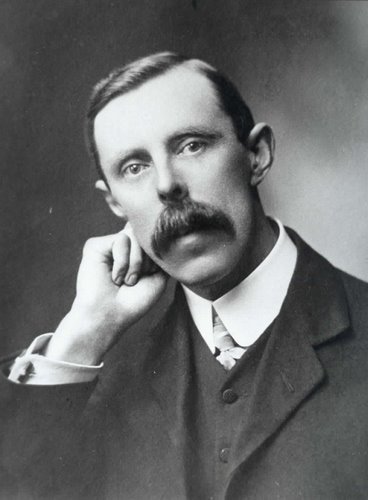

DR. FRANK W. BOREHAM: THE MAN AND THE WRITER
A Biographical Essay by Rev. Dr. C. Irving Benson
Here was a man for whom life never lost the halo of wonder—that is the abiding impression of my long friendship with Frank Boreham. What a relish he had for living and how vastly he enjoyed being alive! He was interesting because he was interested in everybody and everything.
His forty books won for him a multitude of friends across the seven seas. But the man himself was greater than all that he wrote. His books were only the ‘fancies that broke through language and escaped’.
There was more in him than could be uttered in one lifetime. ‘If there is anything in the doctrine of reincarnation,’ he said, ‘I intend to spend at least one of my future spans of existence as a novelist, working up into thrilling romances the plots that I have collected in the course of my life as a minister.’
There was a Dickensian quality in his mind, a quickness to sense the possibilities of a story, a situation or a scene. But the chief charm of his books lies in their rich veins of autobiography. Pick up any one of them and you will not read far before striking some personal experience, confession or adventure. He poured himself into his writing. When the French King Henry III told Montaigne that he liked his books, the essayist replied: ‘I am my books.’ So it was with Frank Boreham.
His work is distinguished by a quiet insight, a gentle humor, a homely philosophy and a charming literary grace, but supremely he was a man with a message. He wrote because he had something to say.
When he was a baby in arms his mother took him for a walk on a summer afternoon along the Southborough Road out of Tunbridge Wells. She rested awhile on a seat in the shade of a hedge. A gipsy caravan came along and trudging beside it was a wrinkled old crone. Catching sight of the mother with her baby, she hobbled across to the seat. Lifting the white veil she looked into the child's face, and holding the tiny hand she said in a husky voice: ‘Put a pen in his hand and he'll never want for a living.’
He was a born teller of stories, with a perennial freshness and an ingenious, inventive, imaginative mind. He was scarcely out of school when he began sending articles to London papers and magazines. Had he kept to his youthful ambition to be a journalist he would have been a first-rate interviewer. It was amazing what he drew out of unlikely people.
When you met him you were impressed by his quietness, modesty and fine courtesy. There was no hint that here was a writer and preacher with a world reputation. His gentle, sensitive face seemed rather shy but became expressive as he talked. His voice was clear and kindly, with a lingering Kentish flavour.
If the word ‘genius’ may be used of him, it should be applied in the realm of friendship. You find it in his many essays on John Broadbanks, but he bestowed it upon a host of people, indeed he offered it to everybody he met. As a brother minister he was an apostle of encouragement and as a pastor he had a rare skill in the art of comforting.
To know him was to love him. He went through life scattering benedictions. I never heard him say an unkind or a mean thing about anybody. He did not attack people, always maintaining that the best way of proving that a stick is crooked is to lay a straight one beside it. ‘People want helping and you don't help them by scolding them.’
I do not remember his name being associated with any controversy. With Fundamentalist, with High Church and Evangelical, with Roman Catholic and Protestant, he had no discernible quarrel. With true catholicity of spirit he moved among them with the easy grace of a man who picked flowers from all their gardens.
Early on, Sir Robertson Nicoll raised the question in the British Weekly as to whether it was as easy as it looked to write in Boreham's style. But the truth was that the apparent ease with which he wrote was only seeming, for what appeared to be spontaneous was the result of sustained hard work.
Every morning he was in his study at eight o'clock writing down every idea and fancy and experience that came to him. They might not appear in sermons or articles for years, but he accumulated a vast store of material on which he drew as he needed it. His fingers itched to write, and he loved to have a pen in his hand. He always reveled in writing and he could not stay his hand even when he tried. When he told me that The Passing of John Broadbanks would be his last book, I smiled. It was not long before another volume appeared with the title I Forgot to Say, and he kept on remembering themes he had forgotten through half a dozen more books.
For all his understanding, he was incapable of understanding why a man should dictate to a secretary or—worse still—use a typewriter. His clear, flowing handwriting never made a compositor swear. Until he was an old man he refused to have a telephone in the house, maintaining that he could not have accomplished all he did if there had been the constant interruptions of phone calls.
Many a man envied his dispatch, his punctual attention to affairs so that he was never overwhelmed. And yet he seemed to be leisurely, and his methodical habits reminded me of Beau Brummel's definition of a well-dressed man—so well-dressed that you do not notice it.
His essays were grown—not manufactured. A story, an idea, a fancy came to him and he quickly captured it with his pen. Then, in living and reading, a host of associated ideas gathered round it until the theme ripened in his mind.
Look, for example, at his essay on ‘Strawberries and Cream’. Strawberries are delicious. Cream is also very nice. But it is strawberries and cream that make an irresistible appeal. He muses on that unrecorded yet fateful day when some audacious dietetic adventurer took the cream from his dairy and poured it on the strawberries from his garden, and discovered with delight that the whole was greater than the sum of its parts. Then you see the idea growing that things are enhanced by being brought together. Away he goes writing of husband and wife; William and Dorothy Wordsworth; new potatoes and mint. Maybe it took years for all these ideas to grow together in his mind.
Read his paper on ‘Dominoes’. He begins by telling how he was unexpectedly invited to have a game of dominoes. Now dominoes, he sees, stand for sympathy—the game is to match your neighbor's piece—and one of the delightful things about life is that the most unlikely people are found to play at dominoes. Working out this thesis he instances one of O. Henry's whimsicalities, in which a burglar, on discovering that his victim, like himself, is liable to rheumatism, drops his nefarious intention, and eagerly discusses symptoms and remedies with the astonished householder—in short, they play at dominoes. A sequence of illustrations, each piercing deeper into the heart of the subject, follows this opening until we come to Paul, the master of dominoes, who knew how to become all things to all people, and to One greater than Paul. Finally, he tells how a woman missionary showed a hundred magic lantern slides to a gathering of Japanese mothers. Not a flicker of response did she find until at last she threw on the sheet the picture of Christ toiling with His Cross. Instantly, the room was alive with interest and quick tears flowed. They felt that here was One who had suffered as they suffered, One whose deep and terrible experience answered to their own. These Japanese mothers felt that the scene fitted their lives as key fits lock, as glove fits hand, as domino fits domino.
The discerning can see how the idea suggested by the dominoes came first, how he then read O. Henry by the fireside, and so on until he lighted on the missionary story. The ideas grew together over a period until he gathered them all in the essay.
The essays would appear at intervals in a succession of newspapers and magazines to which he contributed. Then, after much revision, they were prepared for a book. But even then the book would be ready and under critical observation for two or more years before it went to the publisher.
Near the end, on the day his son drove him to the Royal Melbourne Hospital, Dr. Boreham first took him into the study and entrusted to him a bundle of articles—enough to supply the editors of the various papers for which he wrote for six months! Was there ever such a man?
Although his style was his own, he confessed the lasting influence that Mark Rutherford had upon him. His earlier tendency to glittering alliteration mellowed into a graceful, engaging style. There was an exuberance about his adjectives and he always had more than he could use. A man's adjectives are often more characteristic than his nouns. His nouns are names for common objects which he is more or less forced to use; his adjectives are the distinguishing marks he places upon them, and reveal his individuality. There is much to be learned of the spirit of Frank Boreham from a study of his adjectives.
Always he kept his values adjusted, and the evangelist was never lost in the genial fireside essayist. John Wesley's Journal had a permanent place on his desk, and day by day he traveled through the year with the great itinerant who was ever about his Master's business.
Frank Boreham preached a great Gospel. There was fancy and artistry, but all his paths led to the Cross. The preacher of small subjects is doomed, he said. ‘The pulpit is the place for magnificent verities. It is the home of immensities, infinities, eternities. We must preach more upon the great texts of Scripture; we must preach on those tremendous passages whose vastnesses almost terrify us as we approach them.’
One day he tossed over to me a tart letter from a woman commanding him to preach the Gospel. She was apparently misled by one of his intriguing titles. All who heard Frank Boreham knew full well that, however far away on the circumference he began, he always came to the very heart of the Gospel. The letter hurt him and I advised him to consign it to the waste-paper basket and forget it. ‘I have already answered it,' he said. ‘I wrote and told her that I appreciated her concern for the preaching of Christ's Gospel and asked her to pray for me that I may be a faithful minister of the Word.’ As I have already mentioned, he had no secretary to handle the considerable flow of letters that came into his box from many lands. Each letter was answered expeditiously, either briefly on a post card or at length, as it deserved.
When asked whether he found his main satisfaction as a writer or a preacher, without any hesitation he answered, ‘As a preacher and a minister. Of course,’ he added quickly, ‘it is like asking a man which of his two children he loves best! I glory in my pulpit—the greatest moments of my life have been spent there—but I am scarcely less fond of my pen. I do not like to choose between them. I want to be a preacher and a scribbler to the end of the chapter.’ He was more interested in souls than subjects.
He browsed among many books, but the atmosphere he breathed was of one Book. You set out with him and he lured you through pleasant valleys, plucking flowers by the way, but he never mistook the by-path meadow for the King's high road, and finally he led you to the uplands of God. In his preaching he worked from the surface of a text to its deep heart.
‘I have been on a visit to the uttermost star’ is the exciting beginning of an essay, but before he is through he has you listening to the Good Shepherd telling: ‘A bruised reed shall He not break; a smoking lamp shall He not quench.’
Emma Herman, the mystic, said after hearing him preach, that there was something about his treatment of a theme that was reminiscent of the great Dutch manner of painting which, by the magic play of light and shade, can make a peasant's kitchen romantic as a fairy palace.
When in 1936 he was invited to address the General Assembly of the Church of Scotland in Edinburgh, the Moderator, Professor David Lamont, introduced him as ‘the man whose name is on all our lips, whose books are on all our shelves, and whose illustrations are in all our sermons’—which recalls the vicar who was heard to say that he hoped he would never meet Boreham for he would be ashamed to look him in the face because he had preached so many of his sermons!
No man can be at the top of his form in every line that trickles from his pen. The clock only strikes twelve twice a day. In writing thousands of essays a man must sometimes fall below his standard of attainment. Nobody knew better than he that it was so in his case. The high standards he set for himself kept him critical of his own work. He would try and try again, but sometimes he failed and there must be a pile of essays which he did not regard as worth a place in his books.
He found it good to form a set of friendships outside the circle in which he habitually moved, and his other great interest, after preaching and writing, was revealed in an illuminating sentence: ‘I only miss a cricket match when the house is on fire.’ No member of the Melbourne Cricket Club was more regularly in his place than he. He loved the game and found it a perfect holiday. When he went to the beach or the bush his mind chased quarries for sermons or articles, but watching cricket he forgot everything but runs and wickets.
On nights when sleep was hard to come by, instead of counting sheep he would replay cricket matches in his mind. Lying awake in the darkness, he saw again the green oval ‘fanned by the balmy breath of summer and fragrant with the peculiar but pleasant odor of the turf’. He relived the fluctuations and fortunes of the game and thus, so long as he remained awake, remained awake pleasantly, and in the process generated a state of mind in which it was easy to fall asleep.
His royalties must have been considerable, but he gave much of his income away. I learned, for example, in one of his unguarded moments, that he provided the capital cost to establish a Mission Dispensary with wards at Birisiri in Eastern Bengal and had given a capital sum for its maintenance. But it was unusual for anyone to discuss anything about his gifts. In the spirit of generosity, he followed the admonition: ‘Let not thy left hand know what thy right hand doeth.’ He knew that the best way to do good is not to tell anyone—not even oneself. He had little stomach for committees, but he served for years on the Baptist Mission Board.
Dr. Boreham usually sported a flower in his buttonhole, but riding into Melbourne one day on a crowded tram he realized that he had forgotten it. In Swanston Street, a large, lame old lady climbed on board with difficulty and all eyes turned to the bunch of golden wattle she carried. It was in the winter month of July and the sight of the bright blossom was like the promise of sunshine on a rainy day. As she alighted a few streets further on she plucked off a handful of lovely blossom and gave it to a newspaper boy. He took them without a word of thanks, and while she watched the tram beginning to move he tossed it on the floor. Dr. Boreham was horrified. Diving down among the feet of the passengers he rescued it and asked the boy, ‘Don't you want it? ‘No,’ he muttered contemptuously, ‘what's the good?’ So Dr. Boreham stuck it in his own buttonhole and wore it proudly. All that afternoon people remarked on the wattle. ‘The wattle's out!’ said one with brightening face. ‘Like the breath of spring!’ said another. The posy sang to everyone he met of the coming spring. He thought of the woebegone face of the old lady as she stood looking after the vanishing car. She had tried to do a nice thing, and although her gift had been thrown away she had succeeded.
At many a gathering of ministers Dr. Boreham told this incident and warmed the hearts of his hearers. Though love's labor often seemed lost, he said, it had results that would surprise them. Lift up your hearts!
Characteristically, Dr. Boreham used to say that he was born on the day when bells pealed across Europe announcing the dramatic termination of the Franco-Prussian War. That was March 3, 1871.
His education at the local school was plain and practical, and he became a clerk in the office of a nearby brickworks. There he had an accident which left him with a limp through all his days.
Three months before he was seventeen he went up to London in answer to an advertisement and joined the office staff of the South London Tramways Company. Proficiency in shorthand, which he had mastered during his convalescence in Tunbridge Wells, brought him quick promotion. The office years were, he always said, of incalculable importance. He learned to be methodical, to be systematic in the handling of correspondence, and to be courteous, tactful and discreet in handling people.
The impact of London on his young spirit was the turning point of his life. London appalled him. He stood one day under the shadow of St. Paul's, shivering in the crowd at his own utter loneliness. Amid the hops and clover and the orchards of his native Kent he could shout as he wished and never a soul would hear him. That was a tranquil loneliness in which he reveled, but the loneliness of the surging crowd seemed intolerable.
In those first days in London there fastened on his mind a conviction that he needed Something or Someone to nerve him to live in London to some purpose, and in that mood of wistfulness his situation dramatically changed. There in his solitude, he said, ‘Christ laid His mighty hand upon me and made me His own.’ He could not recall any sermon or book, any minister or missionary, any church or society that played any part in this vital experience which changed his life.
The young Christian became acquainted with a group of city missionaries whose friendship fortified and energized the new life that had sprung up within him. They took him to their mission halls and their open-air meetings, sometimes inviting him to speak. Then in the late summer of 1890 he went with them to Brenchley in Kent to work and witness among the hop-pickers. He always said that was the most delightful holiday he ever had in England. Through those soft September days he reveled in the charming old village, the rambles through the poppy-splashed fields and through woods showing their first autumn tints. But his most vivid memory was of the great tent in which the missioners held their evening meetings. The appeals for personal decision—‘wooingly persuasive but never tediously protracted’—brought to his eager mind a powerful realization of the realities of which they spoke.
His first enthusiasm was to be a foreign missionary with the China Inland Mission. Dr. Hudson Taylor did not encourage him and tenderly pointed out the opportunities of doing missionary work at home. The injury sustained in boyhood which had left him with a limp would, he feared, seriously hamper him in China.
Under the guidance of a saintly, scholarly Baptist minister who befriended him, he applied to Charles Haddon Spurgeon for admission to his Pastor's College and was accepted. He was the last student Spurgeon personally chose. His college course lasted for two and a half years. Then Thomas Spurgeon, who had ministered at the Auckland Baptist Tabernacle in New Zealand, returned to succeed his father at the Metropolitan Tabernacle. Before leaving, the Church at Mosgiel had commissioned him to send them a suitable minister. The college tutors recommended Boreham, and so it came about that at four and twenty he sailed in January 1895 for New Zealand.
Mosgiel, a few miles from Dunedin, was a Scottish settlement. Save for a small woollen mill, it belonged to the cow and the plough and the pleasant murmur of bees. The original settlers were still there. The people were largely Scottish and he was very English, but from the first he loved them. He did what love does—he discovered them. There was a wealth of human tenderness behind their faces rugged as granite cliffs. They furnished him with as many characters as James Barrie saw through the ‘window in Thrums’ or Ian Maclaren found in Drumtochty, and he described them in a style worthy to be mentioned in the same breath with theirs.
There was Gavin, one of the Deacons, who ‘fairly squirmed under a quotation from Dante or Browning’, and Tammas, the Church Treasurer, a massive old man of wrinkled countenance who looked searchingly at you over his spectacles. ‘The man who got Church money out of Tammas was regarded in the light of a genius.’ There was a night when Gavin and Tammas quarreled at a Deacons' meeting and then woke him up in the middle of the night to apologize and asked him to pray with them.
Oh peaceful Mosgiel! There were no cinemas, motor cars, planes or wireless, and in that tiny town free from distractions, he was able to fill the church on a week night with a Bible class. Instead of being run off his feet with a thousand fatiguing but futile engagements, he had time for reflection, for learning how to preach, and for pursuing the art of reading. He resolved to buy a book a week and to read a book a week, and he faithfully kept his pact.
It was at Mosgiel that Boreham learned to be a writer, for it was in that quiet manse among the farms of that far-away parish that he made his first literary ventures. He began a weekly column in the local paper and very quickly became a regular contributor to the Dunedin city newspaper.
Looking back upon his first ministry, he would say that from attending a criminal on the gallows to being asked by a bashful lover to propose to a blushing maid on his behalf, he tasted every pain and pleasure of a minister's life.
After twelve years at Mosgiel he was called in 1906 to the Hobart Tabernacle, the leading Baptist church in Tasmania. From the first time he entered the pulpit he realized that he was preaching with a self-possession, and with an enjoyment that made his ministry, as he said, ‘a perfect revelry’. Ten of the happiest and most satisfying years of his life were spent there. Hobart was a popular tourist resort, and at almost every service there were men and women whose names were household words throughout the Commonwealth.
When Boreham decided to publish a book of his essays, he looked round his shelves to choose a book the format of which appealed to him. His choice fell upon Percy Ainsworth's minor classic The Pilgrim Church. Thus he sent off the manuscript to the publisher of it. Dr. A. J. Sharp liked it but knew nothing about the author. Tasmania seemed a far cry and it was rather risky to take on this unknown F. W. Boreham. Still, he wanted to publish it, so he wrote asking if the author would pledge himself to take 300 copies. Boreham felt himself unable to accept such responsibility and wrote to say so. But on the way to post the letter he met a leading Hobart bookseller who asked if he had sent the manuscript.
‘Yes, he replied, ‘and here's my answer.’ When he had told the whole story, the bookseller asked if the Publishing House would be likely to offer his firm the same terms. The upshot was that the first letter was destroyed and another written. The same offer was made to the bookseller. The Luggage of Life appeared, and Boreham was launched upon his career as a writer. Every year thereafter he brought forth a new book which went through edition after edition and sold by the hundreds of thousands. Dr. Sharp once made the interesting remark to me that Boreham was the Publishing House's ‘greatest catch’ since John Wesley's day.
In June 1916 he accepted the invitation to the Armadale Church. Armadale is an attractive suburb of Melbourne between the river Yarra and Port Phillip. His great preaching –attractive, interesting and evangelistic—drew crowds of eager hearers. Trams and trains set down a constant stream of people bound for Dr. Boreham's church. Some of them became members, others were inspired to be more devoted members of their own Churches, all were confirmed in the Faith. Dr. Boreham became a spiritual power in the life of Melbourne and, indeed, throughout Australia.
A Bunch of Everlastings carries this dedication: ‘At the Feet of Those Three Elect Ladies, the Churches at Mosgiel, Hobart and Armadale, I desire, with the Deepest Affection and Respect, to lay this Bunch of Everlastings.’
Retirement in 1928 did not close but extended his ministry. ‘I must preach!’ he wrote to me urgently when he left Armadale, and Churches everywhere welcomed him. He liked to think of himself as a kind of shuttle, going to and fro between the Churches, weaving them closer to each other.
Through all the ministering years, he was loved and companioned by the lady—Stella Cottee—whose love he had won during his student pastorate at the village of Theydon Bois in Epping Forest. She was not out of her teens when she voyaged alone across the world to become the first mistress of the Mosgiel Manse. Her quiet grace and lovely serenity, blended with good sense, imaginative thoughtfulness and steadfast courage, inspired and sustained, protected and defended him, and smiled away his fears. He knew more than all of us how much she gave to make him the man we admired and loved. They walked and worked together and she was beside him on ‘the long last mile’. This must be said of him—that he was at his brightest and best with his wife and children around him in the blessed peace of his home.
Frank Boreham had his share of sorrows, but they were never wasted sorrows, for ‘aye the dews of sorrow were lustered by His love’.
He needed no honors, but his friends rejoiced when McMaster University conferred upon him the degree of Doctor of Divinity in 1928 and Queen Elizabeth made him an Officer of the Order of the British Empire in 1954.
The man whom Billy Graham wanted to meet in Australia above all others was F. W. Boreham. So one fine summer morning I drove him out to Wroxton Lodge in Kew overlooking the valley of the river Yarra. It was a day to remember—the young evangelist greeting the revered old minister in his 88th year.
Dr. Boreham's mind was alert as ever, and as we settled down he said pointedly: ‘What interests me in you, Dr. Graham, is the way in which you preach. You break all the laws of oratory and yet you succeed. We were always taught to begin quietly and slowly, winning interest, developing an argument, gathering force and proceeding to a climax. But you begin with a climax and sustain it.’
Dr. Graham smilingly explained that he had listened to speakers in pulpits and on platforms, studied them on the radio and television, and had come to the conclusion that with people who were listening and viewing in their homes it was necessary to win them in the first two minutes.
I coaxed Dr. Boreham to tell Dr. Graham some of his best stories—particularly his memories of Dwight L. Moody with his rugged personality like a volcano in ceaseless eruption, a miracle of tireless energy with his flaming evangelism and zeal for souls.
Before we left I asked the dear old Doctor to bless us, and there Dr. Billy Graham and I knelt, while with face uplifted to Heaven and his hands on our heads, he poured out his great heart in a consecrating prayer which will follow us through the years like the sound of a grand Amen.
His day was then far spent. On a May day in 1959 he came to the end of the earthly road, ready to explore what he knew lay on ‘the other side of the Hill’. We gathered in the Armadale church knowing that our company represented a multitude of friends the world over whose lives he had blessed. After we had thanked God for the gift of this good and gracious and gifted man and his fruitful life, we laid all that was mortal of him in a plot of earth in the Boroondara burying ground not far from the resting place of John G. Paton, the apostolic missionary to the New Hebrides.
As I walked slowly away on that Australian autumn day, the golden poplars were like great torches of clear yellow flame and the lawns were strewn with scarlet and russet and bronze leaves blown by the clean wind. Yet I thought not of Autumn, but of Christ's gay springtime that sang in this man's heart. And that night as I sat by the fire with the long deep thoughts that such a day brings, there came to me the words of Dante: ‘If the world might know the heart he had within him, much as it praiseth, it would praise him more.’
C Irving Benson was a friend of Frank Boreham, a leading church leader in Melbourne and pastor of the Wesley Church.
This biographical essay on F W Boreham was first published as the preface to the ‘memorial volume’: F W Boreham, The Last Milestone (London: The Epworth Press, 1961), 7-20.
Here was a man for whom life never lost the halo of wonder—that is the abiding impression of my long friendship with Frank Boreham. What a relish he had for living and how vastly he enjoyed being alive! He was interesting because he was interested in everybody and everything.
His forty books won for him a multitude of friends across the seven seas. But the man himself was greater than all that he wrote. His books were only the ‘fancies that broke through language and escaped’.
There was more in him than could be uttered in one lifetime. ‘If there is anything in the doctrine of reincarnation,’ he said, ‘I intend to spend at least one of my future spans of existence as a novelist, working up into thrilling romances the plots that I have collected in the course of my life as a minister.’
There was a Dickensian quality in his mind, a quickness to sense the possibilities of a story, a situation or a scene. But the chief charm of his books lies in their rich veins of autobiography. Pick up any one of them and you will not read far before striking some personal experience, confession or adventure. He poured himself into his writing. When the French King Henry III told Montaigne that he liked his books, the essayist replied: ‘I am my books.’ So it was with Frank Boreham.
His work is distinguished by a quiet insight, a gentle humor, a homely philosophy and a charming literary grace, but supremely he was a man with a message. He wrote because he had something to say.
When he was a baby in arms his mother took him for a walk on a summer afternoon along the Southborough Road out of Tunbridge Wells. She rested awhile on a seat in the shade of a hedge. A gipsy caravan came along and trudging beside it was a wrinkled old crone. Catching sight of the mother with her baby, she hobbled across to the seat. Lifting the white veil she looked into the child's face, and holding the tiny hand she said in a husky voice: ‘Put a pen in his hand and he'll never want for a living.’
He was a born teller of stories, with a perennial freshness and an ingenious, inventive, imaginative mind. He was scarcely out of school when he began sending articles to London papers and magazines. Had he kept to his youthful ambition to be a journalist he would have been a first-rate interviewer. It was amazing what he drew out of unlikely people.
When you met him you were impressed by his quietness, modesty and fine courtesy. There was no hint that here was a writer and preacher with a world reputation. His gentle, sensitive face seemed rather shy but became expressive as he talked. His voice was clear and kindly, with a lingering Kentish flavour.
If the word ‘genius’ may be used of him, it should be applied in the realm of friendship. You find it in his many essays on John Broadbanks, but he bestowed it upon a host of people, indeed he offered it to everybody he met. As a brother minister he was an apostle of encouragement and as a pastor he had a rare skill in the art of comforting.
To know him was to love him. He went through life scattering benedictions. I never heard him say an unkind or a mean thing about anybody. He did not attack people, always maintaining that the best way of proving that a stick is crooked is to lay a straight one beside it. ‘People want helping and you don't help them by scolding them.’
I do not remember his name being associated with any controversy. With Fundamentalist, with High Church and Evangelical, with Roman Catholic and Protestant, he had no discernible quarrel. With true catholicity of spirit he moved among them with the easy grace of a man who picked flowers from all their gardens.
Early on, Sir Robertson Nicoll raised the question in the British Weekly as to whether it was as easy as it looked to write in Boreham's style. But the truth was that the apparent ease with which he wrote was only seeming, for what appeared to be spontaneous was the result of sustained hard work.
Every morning he was in his study at eight o'clock writing down every idea and fancy and experience that came to him. They might not appear in sermons or articles for years, but he accumulated a vast store of material on which he drew as he needed it. His fingers itched to write, and he loved to have a pen in his hand. He always reveled in writing and he could not stay his hand even when he tried. When he told me that The Passing of John Broadbanks would be his last book, I smiled. It was not long before another volume appeared with the title I Forgot to Say, and he kept on remembering themes he had forgotten through half a dozen more books.
For all his understanding, he was incapable of understanding why a man should dictate to a secretary or—worse still—use a typewriter. His clear, flowing handwriting never made a compositor swear. Until he was an old man he refused to have a telephone in the house, maintaining that he could not have accomplished all he did if there had been the constant interruptions of phone calls.
Many a man envied his dispatch, his punctual attention to affairs so that he was never overwhelmed. And yet he seemed to be leisurely, and his methodical habits reminded me of Beau Brummel's definition of a well-dressed man—so well-dressed that you do not notice it.
His essays were grown—not manufactured. A story, an idea, a fancy came to him and he quickly captured it with his pen. Then, in living and reading, a host of associated ideas gathered round it until the theme ripened in his mind.
Look, for example, at his essay on ‘Strawberries and Cream’. Strawberries are delicious. Cream is also very nice. But it is strawberries and cream that make an irresistible appeal. He muses on that unrecorded yet fateful day when some audacious dietetic adventurer took the cream from his dairy and poured it on the strawberries from his garden, and discovered with delight that the whole was greater than the sum of its parts. Then you see the idea growing that things are enhanced by being brought together. Away he goes writing of husband and wife; William and Dorothy Wordsworth; new potatoes and mint. Maybe it took years for all these ideas to grow together in his mind.
Read his paper on ‘Dominoes’. He begins by telling how he was unexpectedly invited to have a game of dominoes. Now dominoes, he sees, stand for sympathy—the game is to match your neighbor's piece—and one of the delightful things about life is that the most unlikely people are found to play at dominoes. Working out this thesis he instances one of O. Henry's whimsicalities, in which a burglar, on discovering that his victim, like himself, is liable to rheumatism, drops his nefarious intention, and eagerly discusses symptoms and remedies with the astonished householder—in short, they play at dominoes. A sequence of illustrations, each piercing deeper into the heart of the subject, follows this opening until we come to Paul, the master of dominoes, who knew how to become all things to all people, and to One greater than Paul. Finally, he tells how a woman missionary showed a hundred magic lantern slides to a gathering of Japanese mothers. Not a flicker of response did she find until at last she threw on the sheet the picture of Christ toiling with His Cross. Instantly, the room was alive with interest and quick tears flowed. They felt that here was One who had suffered as they suffered, One whose deep and terrible experience answered to their own. These Japanese mothers felt that the scene fitted their lives as key fits lock, as glove fits hand, as domino fits domino.
The discerning can see how the idea suggested by the dominoes came first, how he then read O. Henry by the fireside, and so on until he lighted on the missionary story. The ideas grew together over a period until he gathered them all in the essay.
The essays would appear at intervals in a succession of newspapers and magazines to which he contributed. Then, after much revision, they were prepared for a book. But even then the book would be ready and under critical observation for two or more years before it went to the publisher.
Near the end, on the day his son drove him to the Royal Melbourne Hospital, Dr. Boreham first took him into the study and entrusted to him a bundle of articles—enough to supply the editors of the various papers for which he wrote for six months! Was there ever such a man?
Although his style was his own, he confessed the lasting influence that Mark Rutherford had upon him. His earlier tendency to glittering alliteration mellowed into a graceful, engaging style. There was an exuberance about his adjectives and he always had more than he could use. A man's adjectives are often more characteristic than his nouns. His nouns are names for common objects which he is more or less forced to use; his adjectives are the distinguishing marks he places upon them, and reveal his individuality. There is much to be learned of the spirit of Frank Boreham from a study of his adjectives.
Always he kept his values adjusted, and the evangelist was never lost in the genial fireside essayist. John Wesley's Journal had a permanent place on his desk, and day by day he traveled through the year with the great itinerant who was ever about his Master's business.
Frank Boreham preached a great Gospel. There was fancy and artistry, but all his paths led to the Cross. The preacher of small subjects is doomed, he said. ‘The pulpit is the place for magnificent verities. It is the home of immensities, infinities, eternities. We must preach more upon the great texts of Scripture; we must preach on those tremendous passages whose vastnesses almost terrify us as we approach them.’
One day he tossed over to me a tart letter from a woman commanding him to preach the Gospel. She was apparently misled by one of his intriguing titles. All who heard Frank Boreham knew full well that, however far away on the circumference he began, he always came to the very heart of the Gospel. The letter hurt him and I advised him to consign it to the waste-paper basket and forget it. ‘I have already answered it,' he said. ‘I wrote and told her that I appreciated her concern for the preaching of Christ's Gospel and asked her to pray for me that I may be a faithful minister of the Word.’ As I have already mentioned, he had no secretary to handle the considerable flow of letters that came into his box from many lands. Each letter was answered expeditiously, either briefly on a post card or at length, as it deserved.
When asked whether he found his main satisfaction as a writer or a preacher, without any hesitation he answered, ‘As a preacher and a minister. Of course,’ he added quickly, ‘it is like asking a man which of his two children he loves best! I glory in my pulpit—the greatest moments of my life have been spent there—but I am scarcely less fond of my pen. I do not like to choose between them. I want to be a preacher and a scribbler to the end of the chapter.’ He was more interested in souls than subjects.
He browsed among many books, but the atmosphere he breathed was of one Book. You set out with him and he lured you through pleasant valleys, plucking flowers by the way, but he never mistook the by-path meadow for the King's high road, and finally he led you to the uplands of God. In his preaching he worked from the surface of a text to its deep heart.
‘I have been on a visit to the uttermost star’ is the exciting beginning of an essay, but before he is through he has you listening to the Good Shepherd telling: ‘A bruised reed shall He not break; a smoking lamp shall He not quench.’
Emma Herman, the mystic, said after hearing him preach, that there was something about his treatment of a theme that was reminiscent of the great Dutch manner of painting which, by the magic play of light and shade, can make a peasant's kitchen romantic as a fairy palace.
When in 1936 he was invited to address the General Assembly of the Church of Scotland in Edinburgh, the Moderator, Professor David Lamont, introduced him as ‘the man whose name is on all our lips, whose books are on all our shelves, and whose illustrations are in all our sermons’—which recalls the vicar who was heard to say that he hoped he would never meet Boreham for he would be ashamed to look him in the face because he had preached so many of his sermons!
No man can be at the top of his form in every line that trickles from his pen. The clock only strikes twelve twice a day. In writing thousands of essays a man must sometimes fall below his standard of attainment. Nobody knew better than he that it was so in his case. The high standards he set for himself kept him critical of his own work. He would try and try again, but sometimes he failed and there must be a pile of essays which he did not regard as worth a place in his books.
He found it good to form a set of friendships outside the circle in which he habitually moved, and his other great interest, after preaching and writing, was revealed in an illuminating sentence: ‘I only miss a cricket match when the house is on fire.’ No member of the Melbourne Cricket Club was more regularly in his place than he. He loved the game and found it a perfect holiday. When he went to the beach or the bush his mind chased quarries for sermons or articles, but watching cricket he forgot everything but runs and wickets.
On nights when sleep was hard to come by, instead of counting sheep he would replay cricket matches in his mind. Lying awake in the darkness, he saw again the green oval ‘fanned by the balmy breath of summer and fragrant with the peculiar but pleasant odor of the turf’. He relived the fluctuations and fortunes of the game and thus, so long as he remained awake, remained awake pleasantly, and in the process generated a state of mind in which it was easy to fall asleep.
His royalties must have been considerable, but he gave much of his income away. I learned, for example, in one of his unguarded moments, that he provided the capital cost to establish a Mission Dispensary with wards at Birisiri in Eastern Bengal and had given a capital sum for its maintenance. But it was unusual for anyone to discuss anything about his gifts. In the spirit of generosity, he followed the admonition: ‘Let not thy left hand know what thy right hand doeth.’ He knew that the best way to do good is not to tell anyone—not even oneself. He had little stomach for committees, but he served for years on the Baptist Mission Board.
Dr. Boreham usually sported a flower in his buttonhole, but riding into Melbourne one day on a crowded tram he realized that he had forgotten it. In Swanston Street, a large, lame old lady climbed on board with difficulty and all eyes turned to the bunch of golden wattle she carried. It was in the winter month of July and the sight of the bright blossom was like the promise of sunshine on a rainy day. As she alighted a few streets further on she plucked off a handful of lovely blossom and gave it to a newspaper boy. He took them without a word of thanks, and while she watched the tram beginning to move he tossed it on the floor. Dr. Boreham was horrified. Diving down among the feet of the passengers he rescued it and asked the boy, ‘Don't you want it? ‘No,’ he muttered contemptuously, ‘what's the good?’ So Dr. Boreham stuck it in his own buttonhole and wore it proudly. All that afternoon people remarked on the wattle. ‘The wattle's out!’ said one with brightening face. ‘Like the breath of spring!’ said another. The posy sang to everyone he met of the coming spring. He thought of the woebegone face of the old lady as she stood looking after the vanishing car. She had tried to do a nice thing, and although her gift had been thrown away she had succeeded.
At many a gathering of ministers Dr. Boreham told this incident and warmed the hearts of his hearers. Though love's labor often seemed lost, he said, it had results that would surprise them. Lift up your hearts!
Characteristically, Dr. Boreham used to say that he was born on the day when bells pealed across Europe announcing the dramatic termination of the Franco-Prussian War. That was March 3, 1871.
His education at the local school was plain and practical, and he became a clerk in the office of a nearby brickworks. There he had an accident which left him with a limp through all his days.
Three months before he was seventeen he went up to London in answer to an advertisement and joined the office staff of the South London Tramways Company. Proficiency in shorthand, which he had mastered during his convalescence in Tunbridge Wells, brought him quick promotion. The office years were, he always said, of incalculable importance. He learned to be methodical, to be systematic in the handling of correspondence, and to be courteous, tactful and discreet in handling people.
The impact of London on his young spirit was the turning point of his life. London appalled him. He stood one day under the shadow of St. Paul's, shivering in the crowd at his own utter loneliness. Amid the hops and clover and the orchards of his native Kent he could shout as he wished and never a soul would hear him. That was a tranquil loneliness in which he reveled, but the loneliness of the surging crowd seemed intolerable.
In those first days in London there fastened on his mind a conviction that he needed Something or Someone to nerve him to live in London to some purpose, and in that mood of wistfulness his situation dramatically changed. There in his solitude, he said, ‘Christ laid His mighty hand upon me and made me His own.’ He could not recall any sermon or book, any minister or missionary, any church or society that played any part in this vital experience which changed his life.
The young Christian became acquainted with a group of city missionaries whose friendship fortified and energized the new life that had sprung up within him. They took him to their mission halls and their open-air meetings, sometimes inviting him to speak. Then in the late summer of 1890 he went with them to Brenchley in Kent to work and witness among the hop-pickers. He always said that was the most delightful holiday he ever had in England. Through those soft September days he reveled in the charming old village, the rambles through the poppy-splashed fields and through woods showing their first autumn tints. But his most vivid memory was of the great tent in which the missioners held their evening meetings. The appeals for personal decision—‘wooingly persuasive but never tediously protracted’—brought to his eager mind a powerful realization of the realities of which they spoke.
His first enthusiasm was to be a foreign missionary with the China Inland Mission. Dr. Hudson Taylor did not encourage him and tenderly pointed out the opportunities of doing missionary work at home. The injury sustained in boyhood which had left him with a limp would, he feared, seriously hamper him in China.
Under the guidance of a saintly, scholarly Baptist minister who befriended him, he applied to Charles Haddon Spurgeon for admission to his Pastor's College and was accepted. He was the last student Spurgeon personally chose. His college course lasted for two and a half years. Then Thomas Spurgeon, who had ministered at the Auckland Baptist Tabernacle in New Zealand, returned to succeed his father at the Metropolitan Tabernacle. Before leaving, the Church at Mosgiel had commissioned him to send them a suitable minister. The college tutors recommended Boreham, and so it came about that at four and twenty he sailed in January 1895 for New Zealand.
Mosgiel, a few miles from Dunedin, was a Scottish settlement. Save for a small woollen mill, it belonged to the cow and the plough and the pleasant murmur of bees. The original settlers were still there. The people were largely Scottish and he was very English, but from the first he loved them. He did what love does—he discovered them. There was a wealth of human tenderness behind their faces rugged as granite cliffs. They furnished him with as many characters as James Barrie saw through the ‘window in Thrums’ or Ian Maclaren found in Drumtochty, and he described them in a style worthy to be mentioned in the same breath with theirs.
There was Gavin, one of the Deacons, who ‘fairly squirmed under a quotation from Dante or Browning’, and Tammas, the Church Treasurer, a massive old man of wrinkled countenance who looked searchingly at you over his spectacles. ‘The man who got Church money out of Tammas was regarded in the light of a genius.’ There was a night when Gavin and Tammas quarreled at a Deacons' meeting and then woke him up in the middle of the night to apologize and asked him to pray with them.
Oh peaceful Mosgiel! There were no cinemas, motor cars, planes or wireless, and in that tiny town free from distractions, he was able to fill the church on a week night with a Bible class. Instead of being run off his feet with a thousand fatiguing but futile engagements, he had time for reflection, for learning how to preach, and for pursuing the art of reading. He resolved to buy a book a week and to read a book a week, and he faithfully kept his pact.
It was at Mosgiel that Boreham learned to be a writer, for it was in that quiet manse among the farms of that far-away parish that he made his first literary ventures. He began a weekly column in the local paper and very quickly became a regular contributor to the Dunedin city newspaper.
Looking back upon his first ministry, he would say that from attending a criminal on the gallows to being asked by a bashful lover to propose to a blushing maid on his behalf, he tasted every pain and pleasure of a minister's life.
After twelve years at Mosgiel he was called in 1906 to the Hobart Tabernacle, the leading Baptist church in Tasmania. From the first time he entered the pulpit he realized that he was preaching with a self-possession, and with an enjoyment that made his ministry, as he said, ‘a perfect revelry’. Ten of the happiest and most satisfying years of his life were spent there. Hobart was a popular tourist resort, and at almost every service there were men and women whose names were household words throughout the Commonwealth.
When Boreham decided to publish a book of his essays, he looked round his shelves to choose a book the format of which appealed to him. His choice fell upon Percy Ainsworth's minor classic The Pilgrim Church. Thus he sent off the manuscript to the publisher of it. Dr. A. J. Sharp liked it but knew nothing about the author. Tasmania seemed a far cry and it was rather risky to take on this unknown F. W. Boreham. Still, he wanted to publish it, so he wrote asking if the author would pledge himself to take 300 copies. Boreham felt himself unable to accept such responsibility and wrote to say so. But on the way to post the letter he met a leading Hobart bookseller who asked if he had sent the manuscript.
‘Yes, he replied, ‘and here's my answer.’ When he had told the whole story, the bookseller asked if the Publishing House would be likely to offer his firm the same terms. The upshot was that the first letter was destroyed and another written. The same offer was made to the bookseller. The Luggage of Life appeared, and Boreham was launched upon his career as a writer. Every year thereafter he brought forth a new book which went through edition after edition and sold by the hundreds of thousands. Dr. Sharp once made the interesting remark to me that Boreham was the Publishing House's ‘greatest catch’ since John Wesley's day.
In June 1916 he accepted the invitation to the Armadale Church. Armadale is an attractive suburb of Melbourne between the river Yarra and Port Phillip. His great preaching –attractive, interesting and evangelistic—drew crowds of eager hearers. Trams and trains set down a constant stream of people bound for Dr. Boreham's church. Some of them became members, others were inspired to be more devoted members of their own Churches, all were confirmed in the Faith. Dr. Boreham became a spiritual power in the life of Melbourne and, indeed, throughout Australia.
A Bunch of Everlastings carries this dedication: ‘At the Feet of Those Three Elect Ladies, the Churches at Mosgiel, Hobart and Armadale, I desire, with the Deepest Affection and Respect, to lay this Bunch of Everlastings.’
Retirement in 1928 did not close but extended his ministry. ‘I must preach!’ he wrote to me urgently when he left Armadale, and Churches everywhere welcomed him. He liked to think of himself as a kind of shuttle, going to and fro between the Churches, weaving them closer to each other.
Through all the ministering years, he was loved and companioned by the lady—Stella Cottee—whose love he had won during his student pastorate at the village of Theydon Bois in Epping Forest. She was not out of her teens when she voyaged alone across the world to become the first mistress of the Mosgiel Manse. Her quiet grace and lovely serenity, blended with good sense, imaginative thoughtfulness and steadfast courage, inspired and sustained, protected and defended him, and smiled away his fears. He knew more than all of us how much she gave to make him the man we admired and loved. They walked and worked together and she was beside him on ‘the long last mile’. This must be said of him—that he was at his brightest and best with his wife and children around him in the blessed peace of his home.
Frank Boreham had his share of sorrows, but they were never wasted sorrows, for ‘aye the dews of sorrow were lustered by His love’.
He needed no honors, but his friends rejoiced when McMaster University conferred upon him the degree of Doctor of Divinity in 1928 and Queen Elizabeth made him an Officer of the Order of the British Empire in 1954.
The man whom Billy Graham wanted to meet in Australia above all others was F. W. Boreham. So one fine summer morning I drove him out to Wroxton Lodge in Kew overlooking the valley of the river Yarra. It was a day to remember—the young evangelist greeting the revered old minister in his 88th year.
Dr. Boreham's mind was alert as ever, and as we settled down he said pointedly: ‘What interests me in you, Dr. Graham, is the way in which you preach. You break all the laws of oratory and yet you succeed. We were always taught to begin quietly and slowly, winning interest, developing an argument, gathering force and proceeding to a climax. But you begin with a climax and sustain it.’
Dr. Graham smilingly explained that he had listened to speakers in pulpits and on platforms, studied them on the radio and television, and had come to the conclusion that with people who were listening and viewing in their homes it was necessary to win them in the first two minutes.
I coaxed Dr. Boreham to tell Dr. Graham some of his best stories—particularly his memories of Dwight L. Moody with his rugged personality like a volcano in ceaseless eruption, a miracle of tireless energy with his flaming evangelism and zeal for souls.
Before we left I asked the dear old Doctor to bless us, and there Dr. Billy Graham and I knelt, while with face uplifted to Heaven and his hands on our heads, he poured out his great heart in a consecrating prayer which will follow us through the years like the sound of a grand Amen.
His day was then far spent. On a May day in 1959 he came to the end of the earthly road, ready to explore what he knew lay on ‘the other side of the Hill’. We gathered in the Armadale church knowing that our company represented a multitude of friends the world over whose lives he had blessed. After we had thanked God for the gift of this good and gracious and gifted man and his fruitful life, we laid all that was mortal of him in a plot of earth in the Boroondara burying ground not far from the resting place of John G. Paton, the apostolic missionary to the New Hebrides.
As I walked slowly away on that Australian autumn day, the golden poplars were like great torches of clear yellow flame and the lawns were strewn with scarlet and russet and bronze leaves blown by the clean wind. Yet I thought not of Autumn, but of Christ's gay springtime that sang in this man's heart. And that night as I sat by the fire with the long deep thoughts that such a day brings, there came to me the words of Dante: ‘If the world might know the heart he had within him, much as it praiseth, it would praise him more.’
C Irving Benson was a friend of Frank Boreham, a leading church leader in Melbourne and pastor of the Wesley Church.
This biographical essay on F W Boreham was first published as the preface to the ‘memorial volume’: F W Boreham, The Last Milestone (London: The Epworth Press, 1961), 7-20.
Image: Dr F W Boreham


[1].jpg)
[1].jpg)
 When F W Boreham wrote his first impromptu leader for the Otago Daily Times during the Boer War, he addressed a subject of national importance, giving both an historic perspective and a timely word to his readers who were wrestling with the vital issues of war, empire, voluntarism, service and sacrifice.


 This is an excerpt from the very rare and early book by F W Boreham entitled, From England to Mosgiel. We would love to republish this and are hoping that sufficient donations might make this possible. If you can contribute to the amount needed please let me know. Geoff Pound.


