Frank William Boreham 1871-1959

Frank William Boreham 1871-1959
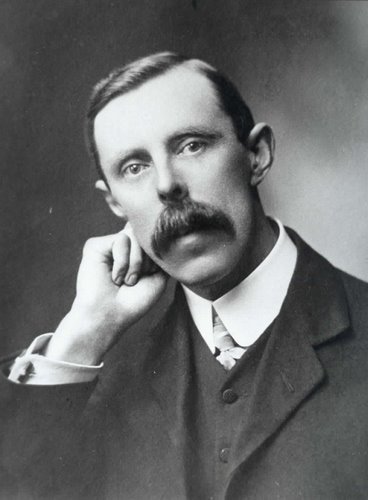
A photo F W Boreham took of himself in 1911

Monday, February 12, 2007

Boreham Entry in the ADB

Readers of this Boreham blog site might be interested to read the following entry in the Australian Dictionary of Biography, on F W Boreham. It was written by Dr. Ian McLaren, whose contribution was noted in yesterday’s posting.

BOREHAM, FRANK WILLIAM (1871-1959), preacher and writer, was born on 3 March 1871 at Tunbridge Wells, Kent, England, eldest child of Francis Boreham, solicitor's clerk, and his wife Fanny, née Usher. He was educated and was later a pupil-teacher at Grosvenor United School, Tunbridge Wells. In December 1884 he became junior clerk with a local brickworks where, in a locomotive accident, he lost his right foot, necessitating the life-long use of a stick. Late in 1887 he went to work as a clerk in London, becoming increasingly involved in church, debating and writing activities. Although his family was Anglican, he was baptized at Stockwell Old Baptist Church in 1890; he preached from pavement and pulpit and published Won to Glory in 1891. He was admitted to Spurgeon's College, London, in August 1892, serving as a student-minister at Theydon Bois, Essex, where he met Estella Maud Mary Cottee.

In 1894 Boreham was called to the Scottish community at Mosgiel near Dunedin in New Zealand, and was inducted on 17 March 1895. Stella, then 18, followed to marry him at Kaiapoi on 13 April 1896. Boreham became president of the Baptist Union of New Zealand in 1902, and published The Whisper of God and Other Sermons (London). He wrote editorials for the Otago Daily Times, contributed to theological journals and, as a keen temperance advocate, participated in liquor polls in 1905 and 1907.


In June 1906 Boreham was called to the Baptist Tabernacle, Hobart. He edited the Southern Baptist and later the weekly Australian Baptist and in 1910 became president of the Tasmanian Baptist Union. His George Augustus Selwyn was published in 1911. He wrote a biographical series for the Hobart Mercury, which in 40 years covered 2000 persons; in 1912-59 he contributed 2500 editorials to the Mercury and the Melbourne Age. Boreham's 80 publications, including religious works, homiletic essays and novels, sold over one million copies. Some were written around Mosgiel people, and one character, John Broadbanks, closely resembled the author. The Broadbanks Dispensary in Bengal, India, was established from proceeds of this series. Other writings were woven around everyday problems, with literary references to English writers and Australians such as Marcus Clarke, Henry Lawson and C. J. Dennis; most originated as sermons to responsive congregations. In 1940 he published his autobiography, My Pilgrimage.


In May 1916 Boreham had accepted a call to Armadale Baptist Church in Melbourne. He retired from that charge in 1928 to tour North America and Britain, where his writings were well known. On his return he preached at the Methodist Central Mission, Melbourne, and then at Sydney's Pitt Street Congregational Church. For many years he conducted Wednesday lunch-hour services at Scots Church, Melbourne. In 1936 he made another preaching tour abroad. McMaster University, Canada, had conferred on him a doctorate of divinity in 1928, and, for his 'services to religion and literature as a preacher and essayist', he was appointed O.B.E. in 1954.
Boreham never wore clerical garb. His physical activity was restricted by lameness and he broke his leg and hip several times in falls. He was a devotee of cricket. Friendly and unassuming, he had a gentle, sensitive face, a large drooping moustache, and a 'lingering Kentish flavour' to his voice. He died in Melbourne on 18 May 1959 and was buried in Kew cemetery, survived by his wife, son and three of their four daughters. His estate was sworn for probate at £22,379. He is commemorated by the F. W. Boreham Baptist Hospital in Canterbury.


Select Bibliography
T. H. Crago, The Story of F. W. Boreham (Lond, 1961); Age, 19 May 1959.

Author: Ian F. McLaren

Print Publication Details: Ian F. McLaren, 'Boreham, Frank William (1871 - 1959)', Australian Dictionary of Biography, Volume 7, Melbourne University Press, 1979, p. 349.
Source: Australian Dictionary of Biography, Online.

Image: F W Boreham.

Sunday, February 11, 2007

The F W Boreham Bibliography

Admirers of the life and writings of F W Boreham might be interested to learn of the bibliography that was published by Whitley College in 1997 entitled Frank William Boreham (1871-1959): A Select Bibliography.
This was written by Dr. Ian F McLaren whose interest in F W Boreham is best explained by appending below the introduction to his book. This bibliography seeks to describe the different books of F W Boreham, including detailed information on the various editions and annotations on special copies. It includes some select publications relating to Boreham and his contributions to newspapers and periodicals. It contains fascinating information about special F W Boreham collections and archives that hold Dr Boreham’s books and memorabilia.

The University of Melbourne’s information on the McLaren Collection indicates the following information:

The personal library of Mr Ian McLaren was acquired by the University in 1976. An enthusiastic bibliographer and former member of Parliament of Victoria, Mr McLaren assembled a large library which reflected his interests in the active world of politics. Initially numbering some 34,000 books, serials, newspapers, pamphlets, parliamentary papers and ephemera, the collection has grown to about 50,000 volumes through generous donations from Mr McLaren and purchases by the library.

The McLaren Collection is an exceptionally rich and comprehensive one, with a particular emphasis on Australian exploration, history, anthropology and literature. It also includes significant material on New Zealand, Papua New Guinea, South Pacific and Antarctica, and it is organized by Mr McLaren's own unique cataloging system of subject headings. Mr McLaren was awarded an honorary degree of Doctor of Laws by the University of Melbourne in 1996. He passed away in April 2000.

Here is Ian’s introduction and his tribute to F W Boreham:

INTRODUCTION

In the 1920s, as a schoolboy in my early teens, I lived diagonally across from the Armadale Baptist Church, and regularly attended Rev. F.W.Boreham's fortnightly services on books. So Dr.Boreham could be held responsible for my initial interest in reading and collecting, culminating in the publication of bibliographies of various Australian authors - including John Dunmore Lang, founder of the Australian Presbyterian Church - and of nine volumes of Australian exploration.

This present bibliography was begun long ago, as a "labour of love" rather than with any intention of publication. In 1996, Rev. Dr. Geoff Pound of Whitley College, Melbourne, discovered my collection of Boreham books, and the draft bibliography, in the McLaren Collection in the Baillieu Library, University of Melbourne, and approached me regarding the possibility of completion and publication of the bibliography.

The high regard and appreciation for the works of Dr. Boreham in the United Kingdom and North America is indicated by the wide range of libraries, particularly in U.S.A., holding copies of his works. The McLaren entry on Boreham in Australian Dictionary of Biography is reproduced with permission on page ix.

With my normal optimistic enthusiasm I believed that I could still cope with the time and effort required to complete the work, but only on condition that publication and distribution would be undertaken by Whitley College.

There was still much research needed to provide what I considered an accurate "comprehensive bibliography" to the standard established in my other published works, and, in my eighty-fifth year, I have found it impossible to achieve this to my own satisfaction. However, there is much valuable information in this select bibliography that will be of value and assistance to my successors in the bibliographical field, and to those to whom F.W. Boreham's work will always remain a landmark.

Consequently, this work is presented, as it now stands, in the hope that it may serve as an inspiration for the further research and application needed to compile a truly "comprehensive" bibliography of the works and related publications of Dr.F.W.Boreham.

Ian F. McLaren,O.B.E.,D.Litt.(Melb.) Hon.Bibliographer,
March, 1997 University of Melbourne

Geoff Pound

Image: Armadale Baptist Church, where Ian heard F W Boreham preach and give lectures on authors and their books.

Saturday, February 10, 2007

Boreham on Resurrection

Experiencing Resurrection
In an Easter editorial which F W Boreham submitted to the Argus as well as the Mercury and the Age, at various times in the 1930s and 1940s, he declared in typical fashion how, outside “the august setting” of the churches, “the fact of the resurrection was one of the dominating realities of life and experience”.[1]

Boreham quoted Oliver Lodge’s epigram, ‘That which exists persists’, then in down-to-earth language elaborated on life’s capacity to renew itself. He explained to his readers: “If a thing really lives, it must go on living. Life itself is incapable of dying; and, when it seems to die, there must, in the nature of things be something in the form of a return, a reaction, a revival, a resuscitation, a renaissance, a resurrection—call it what you will”.[2]

Jack-in-the-box Spirit
It was the truth of the renewing power of life that contributed to Boreham’s optimism about individuals and nations finding full expression, the prodigious regeneration in nature, the forward sense of progress throughout human history and the jack-in-the-box spirit that viewed the best arising from the worst.


While it may have appeared callous and unhelpful to write of the Depression of the 1930s and of the evils of the Second World War in terms of the “growing pains” which a nation must endure on its path to maturity, this idea arose from Boreham’s view that despite appearances of defeat, deprivation and death, the horrors of war were impotent in their fight to destroy life.[3]

Life’s Renewing Potential
Dr. Boreham spoke of life’s renewing potential many times, as in an end of the year editorial, when he wrote, “We only recognize the strength of the hold that life has upon us when there arises some question of its extinction”.[4] This insight helps explain Boreham’s concern about the increase in suicide, the victims of war and the despoliation of nature’s resources.

Ultimate Resurrection Assured
In various ways, Boreham personified life reaching toward humankind and craving mutual affection. These images included “life answering life”,[5] life aching for a response and existence being a matter of echoes.[6]

Viewing the endless implications of life’s renewing qualities, Boreham sketched some of his audacious convictions to his readers. According to Frank Boreham:

"If, in a statement, there is life—the life that people call truth—it may be contradicted, derided and shouted down; but its ultimate resurrection and victory are assured. If, in a movement, there is life—the life that people call justice—it may be whelmed in momentary defeat, but its final triumph is certain. And the beauty of it is that when life—in any phase or form—emerges from its temporary interment it appears more radiant than ever. We invariably attach peculiar value to the things we have lost—and recovered."[7]

Geoff Pound

Image: Beautiful life from 'dead' bulb.

[1] F W Boreham, Argus, 31 March 1934; Mercury, 10 April 1936; Age, 20 April 1946.
[2] Boreham, Argus, 31 March 1934; Mercury, 10 April 1936; Age, 20 April 1946.
[3] Boreham, Mercury, 9 March 1935; Mercury, 24 August 1946.
[4] Boreham, Mercury, 29 December 1945; Age, 27 December 1947.
[5] Boreham, Argus, 27 March 1937.
[6] Boreham, Mercury, 22 March 1958.
[7] Boreham, Mercury, 31 March 1934.

Thursday, January 25, 2007

Boreham Publishing Update

Check out the Boreham publishing update at this link:


Image: Cover of the new Boreham book, Lover of Life: F W Boreham's Tribute to His Mentor.

Boreham Book Update 25 January 2007

This book (see photo) is one of the reasons why the John Broadbanks Publishing was established early in 2006. The book is by F W Boreham and is entitled, George Augustus Selwyn.

The book has been advertised on ebay with a starting bid of US $274.00. It usually sells for at least US $500.00.

F W Boreham would not have been flattered about this and other Boreham books that are selling for such exorbitant prices. He would have been alarmed and disappointed that in these days people have to pay such high prices to read his work. He wrote so that ordinary people could read and benefit. He did not write for financial gain. Very few people know that the profits from his books went to establish and maintain the John Broadbanks Dispensary in Birisiri, Bangladesh, a health agency that continues today.

In order to make Boreham books accessible to as many people today at affordable prices, Michael Dalton and I established John Broadbanks Publishing. This is a voluntary ministry which is done in our spare time. Ten percent of any ‘profit’ that comes from the sales of these republished and repackaged books is going to Whitley College to support the training of Christian workers (a passion of Dr Boreham and a wish of the Boreham family). The rest of the monies will be ploughed back to make more Boreham books available.

We are extremely grateful for donations that have been sent to us, one of which came at just the time we had paid out a hefty amount to the printers of our first book, Lover of Life.

If you can help contribute to the other costs of publishing and ensuring that people don’t have to pay prices like US $500.00 to read books by F W Boreham, please follow this link, F W Boreham on Mentoring, for information on how to send money, as soon as possible. Thank you.

Geoff Pound

Image: A copy of F W Boreham’s George Augustus Selwyn (one of the few biographies that Boreham wrote).

Boreham on Life to the Full

Realizing Potential Not Automatic
Frank Boreham believed one might fully experience all the blessings of life. The values Boreham believed underlay such an aspiration included an appreciation of human worth, recognizing the uniqueness of individuals and the influence of personality. Advancing along the path of full expression involved a commitment to lifelong learning, becoming one’s own person and dovetailing one’s personality to other people. He asserted that the realization of one’s full potential did not happen automatically but that the imagination for such a goal could be fostered by such pursuits as adventure, literature, travel and the enjoyment of the arts.

Life to the Full?
In aspiring to fullness of life, F W Boreham was not oblivious to restrictive circumstances individuals might have to battle, such as ill health. Robert Louis Stevenson was an author who greatly influenced Boreham. The Baptist preacher judged that Stevenson had succeeded more than any other writer “in impressing his personality upon the imagination of his readers”, and that he was representative of a select literary circle “who by some subtle magic that can be felt but not explained, make everybody fond of them”.[1] The “invalid’s triumph”[2] was greater, in Boreham’s estimation because, despite the Scottish author’s frail condition and precarious existence, he waxed eloquently about the goodness of life and delighted in the season’s changes, the invigoration of Springtime and the way the “return of Spring gave him a new hold on existence”.[3]

Fullness Despite Dehumanizing Forces
Dr. Boreham was mindful of the restrictive dehumanizing forces in society that limited peoples’ enjoyment of life. In his editorials about children, the disabled, women and the racially oppressed he advocated educative, legislative and political policies to enable them to experience life fully.

National Fullness
Boreham believed that ‘All the blessings of life’ could take on national proportions when Australians celebrated their heroes and achievements, emerged with gratitude from their British roots, found their unique voice, especially in the arts and harnessed the country’s vast resources.

Fullness in All of Life
While it was in a church building that Boreham first heard the words that became the overriding theme of his editorials, he believed ardently that all the blessings of life were to be experienced in all of life’s domains. Boreham advocated nature as one of the major sources of life’s richness. He recommended what he had personally discovered, namely, that a regular exposure to nature’s bounty and beauty were among the many ways people could receive therapy, be stimulated to wonder, undertake learning and be nudged towards truth and an encounter with the spiritual.

Although Boreham stated that nature had a capacity to be replenished, he frequently identified the responsibilities of the public and politicians in such things as preserving and protecting birds and animals, conserving resources (soil, water, bush and forests) and enshrining natural principles into society’s laws and lifestyles.

Cry of Nature
The theme ‘All the blessings of life’ was for Boreham not only a personal expression of thanksgiving but also a statement of human justice and a cry on behalf of nature herself. In this way, Boreham’s unifying theme went beyond the human realm. As he related it to the environment, this overriding theme had ecological implications and assumed cosmic proportions.

Heirs of the Ages
F W Boreham believed that his readers were “the heirs of all the ages” and that history was a prime source of the blessings of life.[4] Books, monuments, architecture and memorabilia were recommended as significant avenues for readers to get in touch with the treasures of time.

Developing Passion for History’s Treasury
F W Boreham was disappointed that Australians were not passionate about “communing with antiquity”, but his hopefulness about a change in the public mind was expressed many times. Ensuring that historians connected the past to ordinary life in a colorful, human-centered style, and celebrating the anniversaries of the nation’s heroes and significant events were among the ways that history’s plenty could be harnessed for personal and national progress. In directing his reader’s gaze to the past, Boreham encouraged present, life-changing encounters which illustrated the truth that all the blessings of life were available, despite the dimensions of time and place.

Fullness in the Ordinary
Perhaps the limitlessness of this overriding theme was nowhere more emphasized than in Boreham’s editorials about the richness to be found in ordinary things. He wrote about the surprising wealth to be gleaned from the sphere of the small, the ordinary and the everyday highlighted the universality and the accessibility of ‘all the blessings of life’.

On the Fringe of Fullness
Boreham’s overriding theme was not a declaration that he had taken full possession of life’s bounty. Repeatedly he told his readers, “We are on the fringes of things”.[5] This expression was not a vain hope but an allusion to Boreham’s preferred theological method of encouraging his readers to move from things near at hand to the unexplored, from the familiar to what is presently foreign and from the creation to a knowledge of the Creator. The theme, ‘All the blessings of life’, was an exuberant expression of an inexhaustible goal.

Geoff Pound

Image: Australia Day 26 January. “F W Boreham's hopefulness about a change in the [Australian] public mind was expressed many times.” With Australia Day tomorrow there might be a demonstration of this change and Boreham’s hope fulfilled.

[1] F W Boreham, Mercury, 21 May 1932.
[2] Boreham, Mercury, 11 July 1936.
[3] Boreham, Mercury, 11 July 1936.
[4] Boreham, Mercury, 3 January 1948.
[5] Boreham, Age, 27 September 1947.

Wednesday, January 24, 2007

F W Boreham Trivia Question

What do the following have in common?:

Caroline Fry (writer)
Alec McCowen (actor)
Compton Bennett (film director)
David Gower (cricketer)
F W Boreham (preacher/writer)

For the answer scroll down the page:


Answer
They are all natives of Royal Tunbridge Wells. See a more expansive list of natives from this pretty town by clicking on Royal Tunbridge Wells.

Image: Elegant batsman, David Gower.

Boreham on Being Fully Alive

Living Dog or a Dead Lion
Always eager to present abstract truth in arresting and colourful images, F W Boreham introduced a Mercury editorial in 1948 with the maxim, “A living dog is better than a dead lion”.[1] Without revealing its biblical source, Boreham explained, “In its original setting the aphorism probably was intended to express our insatiable love of life. It is humanity’s master passion”.[2]

Lusting for Life
Dr. Boreham frequently made a distinction between being alive and entering into all the blessings of life. He conveyed this difference when describing J J Doke, who epitomized for him a person who was fully alive. Of his mentor, Boreham remarked that his “mind [that] was so saturated with history and biography”, his diplomacy in meetings, his practical piety and his passion for justice had developed through his personal contact with Mahatma Gandhi. These attributes led Boreham to state adoringly, “He loved life—life in every form and phase ... his lust for life was insatiable ... he represented in his own person the most engaging and most lovable type of masculine saintliness of which I have ever had personal experience”.[3]

Geoff Pound

Image: Is this a dead lion or is it alive but just asleep?

[1] F W Boreham, Mercury, 21 August 1948.
[2] This saying comes from the Hebrew Scriptures. The full text from Eccles. 9:4 reads, “But whoever is joined with all the living has hope, for a living dog is better than a dead lion”.
[3] F W Boreham, I forgot to say (London: The Epworth Press, 1939), 135-139.

Tuesday, January 23, 2007

Boreham's Dominant Theme

F W Boreham’s Unifying Theme
While he framed and illustrated it in various ways, ‘All the blessings of life’ was clearly the dominant subject of F W Boreham’s writing and preaching, the unconscious unifying ‘message’ in his many themes, and, judging by his autobiographical writings, the passion and mainspring of his life.

Consumed by a Thirst
Frank Boreham once said of Charles Dickens, “Nobody can read Dickens’ first great novel without feeling that, in delineating Mr Pickwick, he was thoroughly enjoying himself. His pen seems to romp across the pages … herein lies the charm and strength of Dickens … enamoured of life … real life … never hampered by a theory … consumed by a thirst”.[1] The theme, ‘All the blessings of life’, captures the enjoyment that Boreham seemed to experience in his writing and the same exuberant note that was characteristic of his editorials, essays and sermons.

Overflowing into Service
Exemplifying this overriding theme and expressing the way he believed the experience of the richness of life should overflow into service, Boreham said: “Like the gentle Elia, ‘I find this world a very pretty place to live in,’ and standing here, beside my golden milestone, I have tried to point out a few of the things that make it so lovable. If something I have said makes somebody somewhere more glad to be alive, I shall be inclined to forgive this truant pen of mine its inordinate garrulity”.[2]

Geoff Pound

Image: ‘this truant pen of mine…’

[1] F W Boreham, Mercury, 28 March 1936.
[2] F W Boreham, The golden milestone (London: The Epworth Press, 1915), 9. ‘Elia’ was the pseudonym of the English essayist, Charles Lamb (1775-1834).

Monday, January 22, 2007

Boreham and 'All the Blessings of Life!'

Writing late in his retirement, F W Boreham recounted a vivid memory when saying, “As a small boy, following in the Prayer Book the liturgy of the church, I was always impressed by one phrase in the General Thanksgiving—‘We bless thee for our creation, preservation and all the blessings of life’”. Boreham added the comment, “I loved that opening expression of gratitude and this particular clause gave me the opportunity of saying so. It is certainly good to be alive today”.[1]

Whether or not the church always nurtured Boreham’s lifelong gladness at being alive, this episode suggests that the church assisted him in naming this delight, in setting it within an ancient, religious tradition and in expressing it in a shared spirit of gratitude and prayer.

Geoff Pound

Image: The inside of St John's Anglican Church, Tunbridge Wells, where F W Boreham and his family worshipped in his early days.

[1] F W Boreham, Cliffs of opal (London: The Epworth Press, 1948), 172.

Sunday, January 21, 2007

Boreham on the Art of Worrying

I have often wished that somebody would write a book on The High Art of Worrying Well. I have never yet heard or read a sensible word on the subject of Worry. At the one extreme, I have known pietists and idealists who have declared, absurdly enough, that worry is wicked. And, at the opposite extreme, I have known men who worried themselves into premature graves. Between these two insanities there is a No-man's-land of common sense that lies unoccupied and unexplored.

Worry is a very good thing in its way. Those who condemn worry never stop to explain why, if it be wicked, we were sent into the world endowed with such an infinite capacity for doing it. Obviously, we were made to worry; but we were made to worry wisely. We were made to take life seriously and to feel the gravity of things. The man who never worries about his business will never have a business worth worrying about. But the trouble is that in this, as in so many other things, we go to ridiculous excess. Instead of worrying about one or two things—big things; things worthy of our worry; the things that we were sent into the world to worry about—we worry about everything! But worry is a fire that burns up the brain. In the most literal sense, therefore, it represents a burnt offering. The man who worries about too many things is laying his burnt offering on too many altars.

F W Boreham, A Tuft of Comet’s Hair (London: The Epworth Press, 1926), 195-196.

Saturday, January 20, 2007

Boreham's Call to Connect with Ordinary Life

Relate to Real Life
Recent posts on this blog site have examined a major theme of F W Boreham’s writings in which he maintained that the ordinary is a vital sphere through which people might encounter the rich dimension of life, variously described as the ‘spiritual’ or ‘sacred’. In many editorials, Boreham cited a person’s relationship with the prosaic and the everyday. He was not alone in sounding this theme as we have looked at Dickens’ novels, Turner’s canvas, Blake’s various media and Christ’s verbal pictures to illustrate the treasures that come in dealing in ordinary things. Overwhelmingly F W Boreham made a call to leaders, scholars and artists to relate their discipline to real or ordinary life.

Taking a Leaf from Dillard’s Books
In her Pulitzer Prize winning book Pilgrim at Tinker Creek, author Annie Dillard devoted an entire chapter to the subject of ‘seeing’. Explaining her convictions and literary intentions, she writes:

"Our life is a faint tracing on the surface of mystery, like the idle, curved tunnels of leaf miners on the face of a leaf. We must somehow take a wider view, look at the whole landscape, really see it, and describe what’s going on here. Then we can at least wail the right question into the swaddling band of darkness, or, if it comes to that, choir the proper praise …. The whole show has been on fire from the word go. I come down to the water to cool my eyes. But everywhere I look I see fire; that which isn’t flint is tinder, and the whole world sparks and flames."[1]

Dillard’s commitment to ‘really see’ life and describe it as it is, is reminiscent of Boreham’s dedication to a new way of looking. The popularity of both writers may well be attributable to making life their subject and wonder their style.

Reflection by Ordinary Believers
F W Boreham’s encouragement to cultivate a vision for the ordinary was made to his readers in the hope that theological reflection might be an activity of ordinary people. Boreham suggests how theology might be approached by ordinary people including seeing through one’s own spectacles, acknowledging personal and national blindness, uncluttering vision through simplification and looking not only at life but through life. Boreham’s emphasized the rich possibilities of discovering the hidden ‘romance’ in ordinary things and ordinary times and considering how readers individually and collectively might experience the sacred and the sacramental.

Exegeting Everyday Life
The importance which Boreham gave to this theme was revealed not only in his lectures on preaching, in which he highlighted ‘the art of seeing clearly’, but also in his large number of editorials, in which he praised writers and painters for their vision in studying the texture of everyday life. The significance of this theme has been advanced in the light of comments made by contemporary Australian writers such as David Tacey on the need for developing a sacral imagination.

Firing The Imagination
The role of imagination is noted by Boreham as a necessary step in perceiving the sacred. A theology of the ordinary is a rich and surprising field for theologians and all people interested in life. Such a theological pursuit is accessible, free from religious monopolies and defiant of traditional categories and language.

Gospel Imperatives
In pondering the theological dimensions of this theme, it is clear that the role of the gospel story was vital in leading F W Boreham to praise the theology of little people and small things. His choice of topics on this theme was influenced by Biblical values, popular demand, communication convictions and his whimsical humor. His vast employment of visual imagery, his use of the parabolic method and techniques from the court illustrate his belief that developing and expressing a vision for ordinary things is about style as well as subject.

Unsystematic Punches
F W Boreham’s essays and sermons represented an unsystematic theology of the ordinary. His writing about events like Easter illustrated Boreham’s determination to find the ordinary in matters mentally labeled ‘religion’ or ‘theology’. His essays encouraged readers not only to think and see theologically but also to experience their theology as they engaged in all the matter of life. Boreham’s work in taking readers on a picturesque journey, leading from the familiar to the unknown, was gentle, memorable and often contained revelatory surprises and a prophetic punch.

Geoff Pound

Image: “the whole world sparks and flames.”

[1] Annie Dillard, Pilgrim at Tinker Creek, 11.

Friday, January 19, 2007

Boreham: Prophet of the Prosaic

Prophetic Bite
F W Boreham’s depiction of Hobart cinemagoers being transfixed by the flickery scene, yet yawning at nature’s screening of the real thing, typifies how often with a story, sometimes with a cartoon drawn in words, his editorials had an everyday ring combined with a prophetic bite. This word picture is curiously like a drawing by Michael Leunig, the contemporary Australian cartoonist, that reveals a father and child watching the sunrise on a small television, while behind them, framed by a large window, the real thing is happening.[1]

Philosophy of Ridicule
F W Boreham’s editorials on ‘the value of comedy’ and ‘the philosophy of ridicule’ demonstrated his awareness of the power of caricature and revealed his motivation for employing this technique. Expressing the view that humor is not merely about entertainment, Boreham said, “The humorist is often the most effective reformer. He does not scold or preach; he simply exposes the silly side of the thing that he wishes to alter”.[2]

Geoff Pound

Image: Cartoon by Michael Leunig in which he proposes a new Aussie flag.

[1] Michael Leunig, The Penguin Leunig (Ringwood: Penguin Books, 1974), 26.
[2] F W Boreham, Mercury, 10 July 1926.

Thursday, January 18, 2007

Boreham on Easter

Easter in all of Life
Deserving special note are the Easter editorials of F W Boreham and the ordinariness with which he addressed this annual event. His editorial approach to this Christian festival was characteristic of the public theology tradition that has sought to avoid theology or religious events such as Easter falling captive to the church. In contrast to those described by Nicholas Lash, who “bind the mystery of God into the It-world, [who] set up a ‘God-district’ alongside the other districts in their life and, by so doing ... obscure the signs of God’s address and presence both in that district and elsewhere”,[1] Boreham wrote about Easter in its interrelatedness to all of life.

Easter in Nature
Approaching Easter in a down-to-earth manner, Dr. Boreham often commenced with the Easter principle in nature, in which the “crocus peeping bravely and promisingly through the snow” (in the northern hemisphere) and “the flaming splendor of the chrysanthemum” (in the southern hemisphere) both expressed the Easter message of “life’s unconquerability ... [and] forward-looking hopefulness”.[2] While recognizing that Easter was one of many “episodes and emotions too sublime and too sacred to be analyzed”,[3] Boreham adopted images from nature (“the living kernel enclosed within the dead husk”) and history (the resurrection of Old St Paul’s) to illustrate the infusion of hope into human life and to show that “humanity has a latent genius for resurrection”.[4]

Experiencing Easter
Boreham’s purpose in his editorials was not to analyse or prove the miracle of the first Easter but to encourage readers in their present ordinariness to experience Easter for themselves or, as Gerard Manley Hopkins expressed ‘easter’ as a verb, to “let him easter in us”.[5]

Supreme Festival
Boreham saw Easter as “the supreme festival of life”, explaining the thrill with which people greet Easter each year as “but another phase of the arresting phenomenon. It is life answering to life”.[6] Promoting the way Easter must be allowed to permeate the ordinariness of life every day of the year, Boreham said at Easter 1954: “Easter may represent the essence of religion; it is also the irradiation of reality. It touches actual life in every aspect and at every point. It assures us that, however prosaic our lot may be, we may, nevertheless, make life, death and the vast forever one grand, sweet song”.[7]

Geoff Pound

Image: “the living kernel enclosed within the dead husk.”


[1] Nicholas Lash, Easter in ordinary: Reflections on human experience and the knowledge of God, 286-287.
[2] F W Boreham, Mercury, 5 April 1958; Age, 20 April 1946.
[3] Boreham, Mercury, 27 March 1948.
[4] Boreham, Mercury, 11 April 1941.
[5] Gerard Manley Hopkins, ‘The wreck of the Deutschland’ Poems of Gerard Manley Hopkins ed. W H Gardner (Oxford: Oxford University Press, 1948), 67.
[6] Boreham, Mercury, 5 April 1947.
[7] Boreham, Mercury, 17 April 1954.

Wednesday, January 17, 2007

Boreham and the God of Small Things

Source of Values
F W Boreham’s themes represented an appreciation of small things, a vision of beauty in the unexpected and the discovery of good in what appeared to be the worst. In a late-in-life editorial in which Boreham appealed for a new kind of looking, he revealed the source of these values:

The New Testament represents the record of One who excelled in the sublime art of seeing the best shining through the worst. In a craven coward who had thrice denied Him, he saw a martyr who would dauntlessly die for his faith. In a woman of the street, he saw a saint of intimate sweetness and charm. In a ruthless and relentless persecutor, he saw a singularly winsome and persuasive evangelist. When he passed by, every berry bush stood beflagged with poems and every thoroughfare was brave with pageantry and masquerade.[1]

Countercultural Values
Dr. Boreham’s portrayal of a new kind of seeing involved a practical and holistic theology expressing counter-cultural values. His articles on the contribution of ordinary people, unsung heroes, the anonymous and the imperfect are expressions of grace and point to what contemporary author, Arundhati Roy, has described as ‘the God of small things’.[2]

Too Small for Public Interest?
F W Boreham was aware of the charge that a discussion of ordinary things could be viewed as too small, trivial and therefore beyond the scope of the public interest. While his titles often appeared to be quirky, Boreham believed that the domain of the ordinary and the everyday had a widespread appeal and a timeless quality. His discussions about work, leisure, play, simplicity and quietness suggested by nature’s rhythms, were clearly addressing matters of public concern.

F W Boreham

Image: “every thoroughfare was brave with pageantry and masquerade.”


[1] F W Boreham, Mercury, 25 February 1956.
[2] Arundhati Roy, The God of small things (London: Flamingo, 1997).

Tuesday, January 16, 2007

Boreham on Waiting for the Tide

Here is one of the stories that will appear in the forthcoming book, The Best Stories of F W Boreham.

The Melbourne Art Gallery possesses, among its treasures, a painting by Arthur Boyd entitled ‘Waiting for the Tide’. It represents a sheltered and tranquil cove in which a couple of boats are lying. The boat in the foreground is occupied by two men. It leans heavily over, showing that it is hard and fast upon the muddy bed of the little inlet.

Until the tide comes welling in, lifting and liberating it, its occupants are helpless. But their presence in the boat sufficiently indicates their determination to ply their oars and leave the bay the moment the waters rise.

Viewed superficially, the attitude of the two men seems to resemble the attitude of Mr. Micawber [in Charles Dicken’s David Copperfield]. In the daytime Mr. Micawber mingles with the throng upon the city streets, hoping for something to turn up among the faces that he finds there. In the evening he throws himself into his chair, adjusts his spectacles and seizes his newspaper, just to see if anything turns up among the advertisements. All life is a lottery to him.

But between Mr. Micawber on the one hand, and the two boatmen on the other, there is, in reality, no ground for comparison. Mr. Micawber represents the wretchedness of wishful thinking; the boatmen represent the satisfaction of a well-based hope.

The tide stands for the stately dependabilities by which we are encompassed and surrounded. The masterly mechanism of the universe—the rising and the setting of the sun, the phases of the moon, the persistence in their orbits of the stars, the revolution of the earth, the cycle of the seasons, the round of the year—all this, like the ebbing and flowing of the tide, is amazingly reliable. It is this element of constancy that, in our friends, means infinitely more than good looks, agreeable behavior or outstanding ability.

In common with all the best things, the tide is leisurely. Like its kinsman, Old Father Thames, ‘it never seems to hurry’. Like the men in Boyd's picture, we must wait its time. It soothes the brain and steadies the nerves and sweetens the soul to fasten one's eyes for awhile on these leisurely things. An oak tree takes just as long to grow in my garden as it took in the Garden of Eden. The tide ebbs and flows today exactly as it ebbed and flowed in the days of the Pharaohs.

Yet, although the tide does its work in a restful and leisurely way, it does it, and does it well. The world's best workers are those who never know the fret and fever of haste, yet who achieve their goals with meticulous certainty and exactitude. They always get there.

There is, according to Brutus, a tide in the affairs of men which, taken at the flood, leads on to fortune. As Shakespeare implies, and as Boyd's picture makes clear, the tide offers every person, sooner or later, the chance of escaping from the tiny cove of the here into the broad bosom of the everywhere; from the microscopic bay of Self to the infinite sea of Service. God suddenly confronts a person. The Savior, in infinite grace, presents Himself. Opportunity appears in some other form; and they are life's most enviable voyagers who, when the sublime moment actually arrives, are all alive and all alert, waiting, with oars in rowlocks, to greet the hour of destiny.

A person can no more hurry time along than these boatmen in the picture can hurry the tide. Life must be harmonized with, and harnessed to, the mighty forces operating around us. He alone is certain of happy days who, with open eyes and eager hands, stands ready to embrace the golden opportunities that every hour will offer.

F W Boreham, The Tide Comes In (London: The Epworth Press, 1958), 103-104.

Image: Waiting for the tide.

F W Boreham: One of the Greatest?


Readers of this Boreham blog site might like to check out a new article on F W Boreham which is the first in a series of articles on The Center for Baptist Studies web site.

The article is entitled F W Boreham: Australia's Greatest Baptist Preacher Ever.

Geoff Pound

Boreham on Boots and Shoes

Teaching Through Things
F W Boreham’s use of metaphors and parables is worthy of detailed study as it illustrated George Drummond’s statement, “Truth can be borne into the soul only through the medium of things”.[1] The movement from ‘things’ to ‘truth’ was evident in Boreham’s editorial entitled, ‘Boots and shoes’[2] which deserves a more detailed study.

Frank Boreham commenced this essay by establishing a connection with his readers as he highlighted both the prosaic nature and the essential importance of one’s footwear. He also noted that Thomas Carlyle, whose Sartor resartus exhaustively probed the inner meaning of garments and hats, had ignored Boreham’s theme. In rapid succession, Boreham told stories from history (footwear in the Napoleonic army), human nature (the perils of bare-footedness) and literature (Bunyan), each illustrating the significance of his subject. His climactic paragraph presented the biblical image of armory and, after establishing the stupidity of a soldier going into battle without wearing boots, Boreham encouraged his readers to put on the shoes of peace.

Boreham the Barrister
It has been noted that F W Boreham modeled his historical writing on Edward Gibbon’s example of arguing a case like a skilful lawyer. However, Boreham’s parabolic method also appeared to be shaped by what he had learned in the law courts. Offering a helpful link between philosophy and jurisprudence, Friedrich Waismann said, “An effective philosopher first makes you see all the weaknesses, disadvantages, shortcomings of a position; he brings to light inconsistencies in it or points out how unnatural some of the ideas underlying the whole theory are by pushing them to their farthest consequences .… On the other hand, he offers you a new way of looking at things, like a barrister, all the facts of his case, and you are in the position of the judge”.[3]

Commenting further on Waismann’s analogy, Nicholas Lash pictured a barrister resting his case, “only when he has reason to believe that he has adduced sufficient evidence, and patterned that evidence into a sufficiently compelling narrative, to persuade the jury to reach the same conclusion”.[4]

Readers in the Witness Box
Many of Boreham’s editorials adopted this legal reasoning, as he led readers through his picturesque case, calling people into the witness box and identifying evidence from everyday life, nature, history, literature and religion and compelling his readership, like Lash’s description, “not by terrorizing, or ... by manipulating the emotions ... not by steamrolling, but by eliciting responsible free acts of judgment, evaluation, and decision”.[5]

Geoff Pound

Image: Truth in Boots

[1] George Drummond, The ideal life and other unpublished addresses, 131.
[2] F W Boreham, Mercury, 10 July 1954.
[3] Friedrich Waismann, 'How I see philosophy', Contemporary British philosophy, (London: H D Lewis, 1956), 480-481.
[4] Nicholas Lash, Easter in ordinary: Reflections on human experience and the knowledge of God (London: SCM Press Ltd., 1988), 286-287.
[5] Lash, Easter in ordinary, 286-287.

Monday, January 15, 2007

Boreham on the Ordinary Becoming Sacramental


Ordinary Becoming Sacramental
The overflowing of the human soul into ordinary things was to F W Boreham, one of the ways an ordinary object became sacramental. This could be achieved at a personal level, as Boreham “invested his chairs with spiritual significance and voices”,[1] but many of his editorials were intended to cultivate a corporate sense of the sacramental.

Hallowed by Heroic Memories
Boreham recognized the power of shared experiences and memories in achieving this purpose, when writing, “Life becomes wonderfully sacramental when it is hallowed by such beautiful heroic memories”.[2] Examples of editorials written in this vein were those composed for national and international anniversaries. Boreham saw in Anzac Day[3] and Armistice Day[4] “a sacrament of memories”, in which the shared act of remembering touched life “with finer issues”.

Sanctity of the Road
Similarly, Boreham hailed Australia Day as an opportunity to rediscover deep significance. In an editorial commemorating nationhood, Boreham wrote of the sanctity that might be attributed to an ordinary Australian road.[5] Recognizing the ‘sanctifying’ role of memory, he wrote, “On every day of the year, but especially on Australia Day, we hear the voices of the pioneers calling to us from the very dust of the road”. This awareness dawns, said Boreham, when people realize that roads are “invested with a sacramental solemnity by the deaths of men like Burke and Wills, and Gray and Poole, and Baxter and Leichhardt, and a hundred others no less brave”. Pointing beyond the pioneers, Boreham openly declared the supreme source and influence upon matters prosaic, when he stated:

"But whence originated the sanctity of the road? It derives from the fountain-head of all real sanctities. In the beginning, when God created the heaven and the earth ... the word “scatter!” became the mandate and the manifesto of the road. The slogan of all civilisation, it imparted a divine significance to all our tracks and paths and thoroughfares. The call of the Road is mightier than the call of the Rooftree simply because the Voice of the Highway is essentially the call of the Highest."

Geoff Pound

Image: ‘The Call of the Road’

[1] F W Boreham, Mercury, 13 June 1942.
[2] Boreham, My pilgrimage, 133.
[3] Boreham, Mercury, 21 April 1956.
[4] Boreham, Mercury, 9 November 1946.
[5] Boreham, Mercury, 30 January 1954.

Saturday, January 13, 2007

Boreham on Finding Connections

Links to Deeper Meanings
F W Boreham did not have an anthropocentric conception in which the taking of the sacraments merely satisfied a spiritual craving as one of his important views was that the sacramental granted a connectedness to the wider world, including a rootedness within the cosmos and a participation in the sacred realm. For example, Boreham saw the sacrament of gardening not only giving this prosaic activity a ‘glory’ but forging connections in the way:

“It links us not only to the prentice efforts of our first ancestors, but to the
scientific sensations of the distant future. Under an easy assumption of hoary
antiquity and drab monotony, the garden guards the secrets that once read, will
become the marvels of the unborn years”.[1]

Two-Way Connections
Dr. Boreham saw the sacramental connecting in both ways. In elaborating on the responsibility of society’s artists and others who have experienced the sacred, David Tacey says:

This, perhaps, is the key feature of the visionary artist in any country at any
time: he or she ‘sees’ the sacred, when apparently the habitual consciousness of
the day does not. The creative artist is a seer …. The task of the artist is to
remind people that they do in fact have spiritual lives, that they do feel and
sense a level of being that is beckoning them to new awareness and
self-identity.[2]

Mutuality of Connections
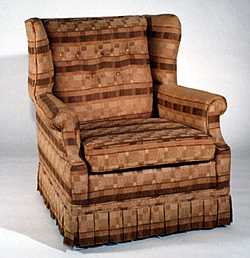
A further development in Boreham’s thinking about the mutuality of sacramental connections is found in his story about his armchair, which is reminiscent of the essay entitled, ‘The story of furniture’, by Boreham’s mentor, Richard Jeffries.[3] After admitting that he had spent hundreds of hours in his chair, Boreham argued, “An armchair is more than an armchair ... if we listen with sufficient care, the old armchair is talking to us”.[4]

Finding the Soul of Things
Reflecting on another occasion about his armchair being driven off for auction prior to him relocating, the anguished writer said, “He cannot persuade me that the old armchair is merely leather and oak. Why, the chair all but spoke to me as it passed. There is something extremely soulful about furniture”.[5] The hundreds of hours in which Boreham had spent sitting in the chair had developed its soul. Remarking on the emergence of the chair’s personality and the termination of their relationship, Boreham concluded quaintly:

This has been a one-sided study. It has concerned itself almost exclusively with
my view of the old armchair. But what does the old armchair think of me? The
armchair seems to me to be so much more than leather and oak. Do I seem to the
armchair to be ever so much more than flesh and blood? I catch myself thinking
about the soul of the armchair, ‘Does the armchair catch itself thinking about
the soul of me? And if not, why not?’ And now the secret is out. I said that it
was all a matter of overflow. The soul of the armchair is my own soul
overflowing into the chair.

Geoff Pound

Image: More than an old armchair.

[1] F W Boreham, Mercury, 3 July 1915.
[2] David Tacey, Re-enchantment: The new Australian spirituality, 113.
[3] Richard Jeffries, Beauty is immortal and other essays ed. Samuel J Looker (Sussex, England: Aldridge Bros., 1948), 74-78.
[4] F W Boreham, The home of the echoes (London: The Epworth Press, 1921), 138.
[5] F W Boreham, Australian Christian world, 31 January 1919.

Thursday, December 07, 2006

Boreham on Hide and Seek

Hidden Treasure
F W Boreham alluded to the hidden features of the sacramental in which its secret meaning was made known only to the initiated or to those who had the eyes to see. In editorials about ordinary objects hiding sacramental treasure, Boreham pleaded for discovering the sacramental in the inn,[1] revealed the “precepts of the porch”[2] and he wrote various articles about understanding “the secret of the street”[3] and seeing “the glory of the street”.[4]

Coming Ready or Not
A corollary to the concept of hiddenness was the belief that there was a power within ordinary objects that was working to make the hidden truths revealed. As already noted, Boreham wrote of ordinary things being “pregnant with romance”, a powerful image signifying the life and emerging quality of the sacramental.[5]

The nineteenth-century British preacher Henry Drummond (about whom Boreham wrote[6] and lectured[7]) voiced this same thought when saying, “If you are apathetic, if you will not look at the things which are seen, they will summon you”.[8]

Geoff Pound

Image: 'the precepts of the porch.'

[1] F W Boreham, Mercury, 14 December 1918.
[2] Boreham, Mercury, 2 October 1915.
[3] Boreham, Mercury, 26 April 1919.
[4] Boreham, Mercury, 5 January 1946.
[5] Boreham, Mercury, 22 December 1956.
[6] Boreham, Mercury, 17 February 1951.
[7] F W Boreham, Mushrooms on the moor (London: The Epworth Press, 1915), 21.
[8] Henry Drummond, The ideal life and other unpublished addresses (London: Hodder and Stoughton, 1897), 129.

Wednesday, December 06, 2006

Boreham on Sacraments and Sanctities

Sacraments Beyond the Church
While eccles-iastical views of the sacraments have variously defined and ordered certain rites performed by the church to produce grace in the recipient by the very performance of the sacramental act, F W Boreham’s understanding of sacraments was broader, less defined and related to a multitude of diverse experiences outside the jurisdiction and influence of the church.[1]

Related to his concept of ‘romance’ was his understanding of an ordinary object becoming a sacrament or receiving sanctity when it was rightly seen. While throughout his career Boreham wrote frequently of the sense of romance, the editorials in which he discussed matters sacramental were written mainly in the latter period of his life when he included distinct religious themes. One example of Boreham’s effort in using ‘thin’ religious language was when, in an early version, he wrote of the surprising value in the hiddenness of the garden using the secular title, ‘When spades are trumps’.[2] A later incarnation of this editorial revealed the sacramental features of a garden.[3]

Window to the Invisible
Sometimes in writing on “the art of looking through commonplaces”, Boreham adopted window imagery. He said that when William Blake looked, “the material realm was a window through which he saw the invisible”.[4] In this window image, Boreham was declaring that an object becomes sacramental when one looks through the material and sees the spiritual or when one views a visible object and an invisible quality dawns.

These concepts are illustrated in Boreham’s account of walking down a tree-lined street in his Melbourne suburb of Armadale. Overwhelmed by the vibrancy of life along his regular route, Boreham noted a towering gum and in his mind he saw thousands of kookaburras.

He passed an elm and this species brought to his mind an old lane in Kent in which he saw many squirrels. Boreham’s walk along Irving Street made him declare, “The loveliest things in all the world are the things that are not there. There is something strangely sacramental about those branches,” and such memories and the resulting reverence were reasons why he declared, “they should never be cut down”.[5]

These recollections highlight the role of imagination in appreciating the sacramental. Boreham’s flexibility in the way objects might be ascribed sacramental meaning are once again evident in his conclusion to another editorial entitled, ‘Spare that tree’, when he stated that branches and boughs may remind readers of another tree “on a green hill outside a city wall”.[6]

Emblems of Immortality
It appeared Frank Boreham believed that ordinary, visible things were sacramental when they represented a spiritual significance. This meant that an ordinary object like a mushroom was “the natural emblem of the ephemeral”,[7] or looking through the lens of scripture (“the grass withers”)[8] the blades of grass can become “emblems of immortality”.[9]

Pointing to a Higher Realm
A variant on this theme was Boreham’s understanding that an ordinary object becomes sacramental not only as it represents some value, but also when it actively points to a higher realm. In this way he identified sleep as a sacrament because it symbolised trust and belief in God.[10] He said, “Properly understood every sob is a sacrament. The sign of the Cross is indelibly stamped on every manifestation of mortal pain”.[11] Boreham saw chimneys serving an important role in “pointing to something loftier”[12] and the sacramental work of mountains fulfilling their divine destiny. He explained: “It is the glory of the mountains that they point to something infinitely loftier than themselves. The snow-white summits point like sacred spires from the high to the Highest, from the terrestrial to the celestial, from earth to heaven; and, having done that, the mission of the mountains has been triumphantly achieved”.[13]

Geoff Pound

Image: “thousands of kookaburras…”


[1] Richard McBrien, Catholicism 3rd ed. (North Blackburn, Vic.: CollinsDove, 1994), 1250. The sacraments defined by the Roman Catholic Church include Baptism, Confirmation, Eucharist, Penance, Marriage, Holy Orders and the Anointing of the Sick.
[2] F W Boreham, Mercury, 21 August 1937.
[3] Boreham, Mercury, 17 March 1945; Age, 29 March 1947.
[4] Boreham, Mercury, 26 November 1949.
[5] Boreham, The fiery crags, 138.
[6] Boreham, Mercury, 11 January 1958; Age, 26 October 1946.
[7] Boreham, Mercury, 1 March 1958; Age, 3 April 1954.
[8] Isa. 40: 7.
[9] Boreham, Mercury, 30 June 1956.
[10] Boreham, Mercury, 25 August 1945.
[11] Boreham, Mercury, 6 February 1954.
[12] Boreham, Mercury, 20 January 1951.
[13] Boreham, Mercury, 18 April 1953.

Tuesday, December 05, 2006

Boreham and the God of the Tea Cup


Highlighting the Natural
In contrast to the prevailing Australian religious culture that has often highlighted the miraculous, the sensational and the ‘out of this world’, F W Boreham pointed to ordinary things as a rich vein in which truth may be experienced. His encouragement of the ordinary as a valuable sphere of theological reflection was motivated by his personal delight in Dickens, Turner and others who specialized in portraying the ordinary and the public commendation that these artists were given. Boreham was also prompted by the public context of war and depression which limited the availability of money, possessions and travel. The enforced deprivation led Boreham to encourage his readers to discover richness in common objects and everyday experiences.

Reinforcing the view that at any period the ordinary is a largely untapped and unnoticed source of wealth, Myron Orleans, the editor of the Journal of mundane behavior wrote, “All around us are ordinary phenomena that can astound us if only we attend to them with the seriousness they do not typically receive”.[1]

Astounded by the Ordinary
This astonishment that often emerges out of theological reflection on ordinary things is illustrated in the vocational epiphany of Australian theologian Robert Banks. Recording how his intellectual pilgrimage was influenced by reading an essay by the Scottish author John Baillie on ‘A theology of sleep’, Banks remarked how “Baillie’s juxtaposition of ‘theology’ with something as mundane as ‘sleep’ came as a shock”.[2] Further reflection and study led Banks to discover the Bible’s invitation to finding God in the routine and to write a theology on ‘All the business of life’.

Readers of Boreham’s essays have commented on experiencing a similar shock at seeing the ordinariness of his subjects.[3] However, Boreham’s commitment to the study of ordinary things was not only a deliberate adoption of the communication model of Jesus but it enabled him to be viewed along with John Baillie,[4] Jacques Ellul,[5] Robert Banks[6] and a growing number of others as a ‘down-to-earth’ (Banks’ term) theologian intent on fostering a theology and spirituality of everyday life.

Theological Reflection for Everybody
Frank Boreham wrote about ordinary things because he hoped that all his readers, not only professional theologians, might engage in theological reflection. Not only did he express this hope but, as indicated in this chapter, he suggested some tools of theology that included training the vision, trusting one’s own judgement (‘seeing for yourself’), ‘looking through’ things and experiences and combining a contemplative and imaginative approach with rational analysis.

He urged his readers to begin with the ordinary, everyday and commonplace because he recognised that this was an inclusive sphere accessible to all people, not just the preserve of the church or an area mediated by religious specialists. As stated earlier in this chapter, Boreham also hoped that the domain of the ordinary would be a meeting ground for theologians, philosophers and people representing many other disciplines.[7]

Spirituality Grounded in Ordinary Sphere
Demonstrating the importance of this theme for contemporary Australians, David Tacey says, “Australian spirituality is, and will continue to be, grounded in the ordinary events and experiences of daily existence …. If we are looking for the God who produces otherworldly miracles and wonders, He will not necessarily be found in Australia”.[8] Finding the sacred to be revealed in the ordinary, by ordinary people, indicated for Tacey the “radically democratic God”.[9]

God in All Spheres
An extension of this thinking is that if God can be found in ordinary things, then there is no sphere in which God cannot be experienced. In his editorials, Dr Boreham intentionally blurred the usual dualistic distinctions between the natural and the spiritual, the holy and the profane. While Thomas Keneally’s definition of tea drinking as “the great secular sacrament”[10] exemplifies the way Boreham sought the sacramental in ordinary things outside the limits of the church, Boreham went further by exploding the ‘sacred’ and ‘secular’ categories to heighten their essential integration.

Knowable in Every Part of Life
A further implication of Boreham’s assertion that the sphere of the ordinary is a primary theatre of spiritual life is the truth that God is eternally present and knowable in every part of the world and universe. As author Elizabeth Dreyer says: “In the past, we may have seen the sacraments as “discrete discharges of grace” into a profane world. But today our theology invites us to see the world as permanently graced at its root, borne up by God’s self-communication whether or not we choose to accept it, whether or not our jaded sensibilities can perceive it”.[11]

Geoff Pound

Image: ‘The great secular sacrament’


[1] Myron Orleans, Journal of mundane behavior: Mission statement
http://www.mundanebehavior.org/mission.htm, 2000.
[2] Robert Banks, All the business of life (Sutherland, NSW: Albatross Books, 1987), 9-10.
[3] T H Crago, Australian Baptist, 13 March 1945. Crago said of Boreham, “He amazes his readers with what he sees in smoke and what he gets out of pockets”.
[4] John Baillie, Christian devotion (Oxford: Oxford University Press, 1962).
[5]Jacques Ellul, The presence of the kingdom (London: SCM, 1951).
[6] In addition to the book already cited, Banks has extended his thinking in Robert Banks, Faith goes to work: Reflections from the marketplace (Washington D C: The Alban Institute, 1993).
[7] Boreham, Mercury, 9 January 1954.
[8] David Tacey, Re-enchantment: The new Australian spirituality, 111.
[9] Tacey, Re-enchantment: The new Australian spirituality, 121.
[10] Tom Keneally, An angel in Australia (Sydney: Doubleday, 2002), 114.
[11] Elizabeth A Dreyer, Earth crammed with heaven (New York: Paulist Press, 1994), 173.

Sunday, December 03, 2006

Boreham on Spiritual Vision

Theological Principles
In the last few postings I have discussed one of F W Boreham’s major themes, ‘Vision for the Ordinary’. While some of the theological perspectives have been alluded to I want to examine in the next few articles some of the theology underpinning this theme.

Vision and the Visual
The importance of Boreham’s theme on vision is highlighted by Melbourne writer David Tacey, when writing about contemporary Australia, “It is little wonder our traditional religions have been declining, for they have lost the spiritual vision that is needed to track the sacred in the present and to bring the spirit into living focus”.[1]

Similarly, Frank Fletcher, drawing upon the Ghanaian experience, argued that the growth or decline in Christian faith around the world has been largely reflective of the extent to which the primal and sacral imagination has been encouraged or repressed.[2]

The Cultured Eye
Boreham stressed the importance of the visual in developing an imagination that encounters the spiritual realm. His encouragement to a new way of looking was similar to Rufus Jones’ call for a “cultured eye”, which requires reflection and rumination more than embarking on a cerebral exercise. The descriptions of Boreham’s observations of ordinary things hint at more than receiving a photographic imprint. Such experiences have a powerful effect on the observer and are expressed well in Dillard’s testimony that “it was less like seeing than like being for the first time seen”.[3]

Geoff Pound

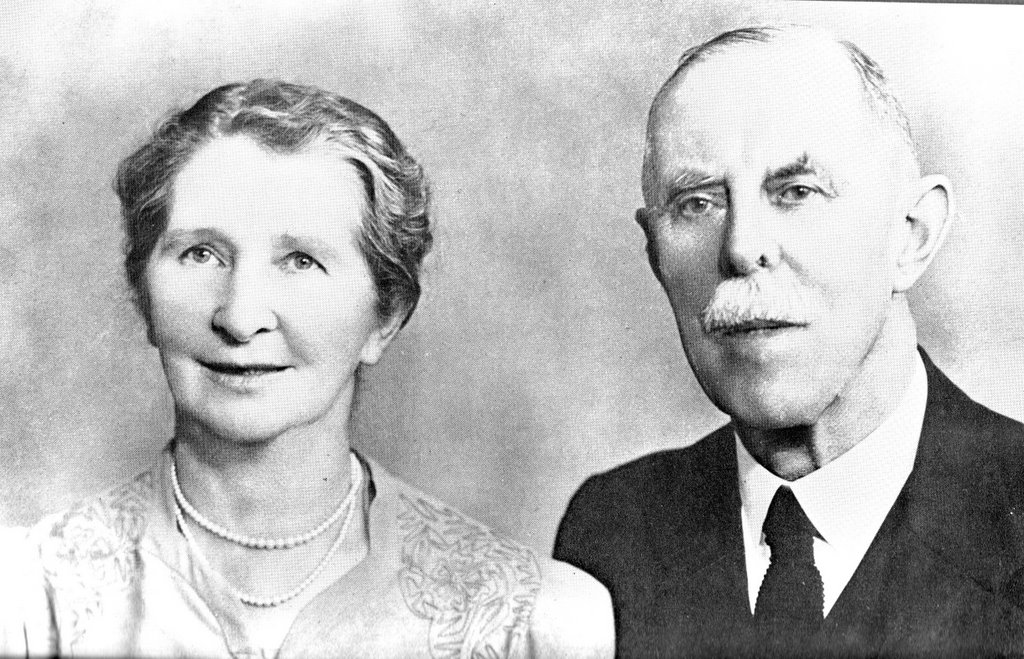
Image: ‘Receiving a photographic imprint.' A photographic imprint of Stella and Frank Boreham

[1] David Tacey, Re-enchantment: The new Australian spirituality (Sydney: HarperCollins, 2000), 241.
[2] Frank Fletcher, ‘Towards a contemporary Australian retrieval of sacral imagination and sacramentality’, Pacifica 13 (2000): 1.
[3] A Dillard, Pilgrim at Tinker creek, 35.