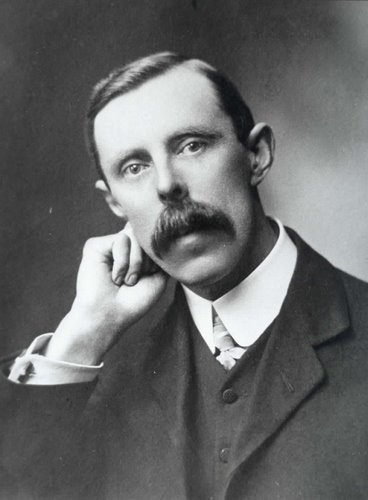
Frank William Boreham 1871-1959

Frank William Boreham 1871-1959
A photo F W Boreham took of himself in 1911

Thursday, June 07, 2007

Boreham on 'When I Survey'

I want you, if you kindly will, to peep over this gentleman's shoulder and take a swift glance into the room that he is just about to enter. You say that, before doing so, you would like to know something of the gentleman himself. I assure you that your objection is quite beside the point.

As a matter of fact, the well-groomed gentleman tapping softly at the door is the Right Hon. Arthur Onslow, Speaker of the House of Commons. Having heard that Dr. Isaac Watts is nearing his end, he feels somewhat ashamed of the circumstance that he has never made it his business to meet so good and so eminent a man. He has, therefore, made up his mind, before it is too late, to repair the omission.

And here he is! But see, the door is opening! And there, not in bed, but hunched up in his big study-chair, is a tiny, bony, pinch-faced wisp of humanity, almost hidden in the ample folds of a gaily-flowered dressing-gown, and looking for all the world like a little wizened Chinese mandarin! As his visitor enters, the shrivelled and dwarfish creature looks up and smiles, not unpleasantly, and, although his voice is a trifle squeaky, the general impression is a distinctly agreeable one. This, if you please, is the greatest hymn-writer of all time, the man whose songs are destined to be sung, always with enjoyment and often with ecstasy, by all the Churches as long as the language endures!

I

To his life-long chagrin, he was pitifully small. He loathed the sight of his diminutive figure whenever he glimpsed it in a mirror. Nothing stung him more than to hear somebody refer to him as little Dr. Watts. He simply squirmed. It was in self-defence that he sang:

Were I so tall to reach the pole,
Or grasp the ocean with my span,
I must be measured by my soul,
The mind's the standard of the man.

The torture of his physical insignificance frayed his nerves. It wove itself into his dreams. And, in times of serious illness, his delirium turned the horror topsy-turvy. He raved of his colossal proportions! He was too big to pass through any doorway! He could not squeeze himself into his pulpit! The chairs crumpled like matchwood under his weight! No cab or carriage would hold him! His fevered brain had converted the pygmy into a giant!

And, in some respects, a giant he was! `He stands absolutely alone,' says Thomas Wright. 'He has no peer. He is the greatest of the great.' Mr. Wright adds that if nothing from his pen has attained to the popularity of Toplady's Rock of Ages, or is quite so affecting as Cowper's God Moves in a Mysterious Way; if he lacks the mellifluence of Charles Wesley or the equipoise of John Newton: the fact remains that he has written a larger number of hymns of the first rank than any other hymnist.

He was literally a born poet. Even as a small boy there were times when he could not express himself other than in verse. His father—a stern and puritanical soul who had endured several terms of imprisonment for conscience' sake—looked askance on this propensity in his boy. But Isaac could not repress it. On one occasion the household was engaged in family worship. Isaac, sad to say, was on his knees with eyes wide open. Whilst the priest-like father lifted up his voice in fervent supplication, a mouse scampered across the room and ran up the bell-rope. Isaac burst into laughter. Prayers over, the horrified father indignantly demanded an explanation. Isaac told in his own way what had happened:

There was a mouse for want of stairs
Ran up the rope to say his prayers.

This was piling crime on crime. The father seized his rod and ordered Isaac to follow him out of the room. The boy, however, threw himself on his knees. `O father,' he cried,

‘O father, father, pity take
And I will no more verses make!’

His mother, more sympathetic, once offered a farthing to the boy who should write the best verses. Isaac entered for the prize, but attached to his manuscript the couplet:

I write not for a farthing; but to try
How I your farthing writers can outvie.

As he made his way through his teens, he became extremely serious. The salvation of his own soul became to him the thing above all others to be desired and sought. Among his papers there is a memorandum in which he tells us that he fell under considerable conviction of sin in his fifteenth year. Twelve months later he says: `I was taught to trust in Christ, I hope.' The two words, `I hope', introduce a palpable note of uncertainty. But there is no uncertainty about a later record. `An heir of glory has been born!' he joyously declares. And this transfiguring experience turned his gift for poesy into a new channel.

II

At the age of twenty-one, he accompanied his father one day to a Nonconformist chapel at Southampton. In discussing the service on the way home, Isaac remarked that he had carefully examined the hymn-book and had found it very disappointing. There was not, he sweepingly declared, a decent hymn in the collection. Without an exception, they were all lacking in dignity and beauty.
`Then, my boy,' replied the philosophical father, who had come to realize, by this time, that his son's poetic impulses were in capable of restraint, `the best thing that you can do is to write some better ones!'
On reaching home, Isaac sat down and called on his best powers to respond to his father's challenge. He wrote:

Behold the glories of the Lamb,
Amidst his Father's throne;
Prepare new honours for His name
And songs before unknown!

And thus commenced, on that very day, the fruitful career of `the father of our English hymnody'.

Many of the hymns that immediately followed were composed in the saddle in the course of long country rides, and those who are familiar with the swing and the cadence of his verses will find it easy to match the metre with the rhythm of the horse's feet.

In his monumental trilogy—Clayhanger, Hilda Lessways and These Twain—Arnold Bennett twice describes the public holiday on which the centenary of the Sunday School movement was celebrated in the Five Towns. Moved by curiosity, his hero and heroine, Edwin and Hilda, join the throng in the streets. They follow the proceedings—the procession, the speeches, the singing, and all the rest of it—with languid and almost cynical interest, until suddenly the assembled multitude joins in a hymn that changes the entire atmosphere:

When I survey the wondrous cross
On which the Prince of Glory died,
My richest gain I count but loss,
And pour contempt on all my pride.

Hilda, to whom religion had made no profound appeal, was overwhelmed: she could not tell why. To conceal her emotion, she turned her face.
'What's the matter?' asked Edwin.
Hilda was disgusted at his tactlessness in embarrassing her; but, for the sake of saying something, and easing the tension, she asked him who wrote the hymn. In spite of his pretensions to bookishness, Edwin did not know; and she despised him for his ignorance.
'Dr: Watts wrote it,' she flashed, `and it would be worth anything on earth to be able to sing those words—and mean them!'

A novelist of a very different type, Mrs. L. T. Meade, has devoted one of her books, Hepsy, Gipsy, to showing how the same hymn met the aching need and irradiated the young life of her principal character.
Hepry, Gipsy, is a story of two cavities. The first cavity is the hole in the druid oak from which Giant Lee's gold has been stolen. The second cavity is the empty heart of Hepsy, the gipsy girl, when she found her childish faith in ruins. The last chapter in the book is entitled Full and tells how both vacuums ceased to exist.

Hepsy chanced to discover that Giant Lee was going once more to the oak in the depths of the wood to grope for his lost treasure. Hepsy herself was mothering the baby boy that, in dying, Nancy Lee had presented to her husband. The Giant would have nothing to do with his child, and, but for Hepsy, it must have perished. Hepsy made up her mind that Lee should care for his boy, and she compassed her end by guile. She reached the druid oak before him and hid the baby where he had once hidden the gold. When he reached the spot, he climbed the tree, and, in doing so, thought he heard a strange sound in the heart of the oak. When he peered into the cavity, he was startled. For a very fair face, a face that was surrounded by an aureole of gold, a sweet, soft baby face that seemed the very image of poor Nancy's, peeped out of the ivy and looked straight at him. And, in the end, Giant Lee took his neglected baby to his heart; and his boy was a greater comfort to him than all his gold could have been.

And Hepsy? How was that empty heart of hers filled and satisfied? She one day heard a sweet voice singing:

When I survey the wondrous cross
On which the Prince of Glory died,
My richest gain I count but loss,
And pour contempt on all my pride.

Were the whole realm of nature mine,
That were an offering far too small:
Love so amazing, so divine,
Demands my soul, my life, my all.

`What's "love so amazing"?' Hepsy asked the singer.
And then, for the first time, Hepry heard the story of the Wondrous Cross. Poor Hepsy's empty heart drank it all in. She was thirsty for it. It was just what she wanted. It filled the aching void. The Cross was the substance of which her girlish dreams were the shadow.
Later on, Hepsy rescued the baby from a blazing tent; and, in doing so, was herself terribly burned.
`But what's the pain?' she murmured. `What's the pain? It's nothing when the heart's full—full of love so amazing, so divine! My heart is like a cup when you take it to the well and fill it to the brim!'

III

And, turning from fiction to fact, was not George Eliot fond of telling how her aunt, Mrs. Samuel Evans—‘the fiery little Methodist heroine of Adam Bede'—recited the hymn with rapturous fervour during her last sickness?

Nor can we forget Matthew Arnold. On a beautiful Sunday morning in the spring of 1888, Arnold, when visiting Liverpool in order to meet his daughter on her return from America, went to hear Dr. John Watson—better known as Ian Maclaren—at Sefton Park. Dr. Watson preached on `The Shadow of the Cross', using an illustration borrowed from the reports of the Riviera earthquake. In one village, he said, everything was overthrown but the huge wayside crucifix, and to it the people, feeling the very ground shuddering beneath their feet, rushed for shelter and protection. The service closed with Dr. Watts' When I Survey the Wondrous Cross. Matthew Arnold walked quietly back to the home of his brother-in-law, with whom he was staying; and, as he came down to lunch half an hour later, a servant heard him crooning the verses softly to himself. `Ah, yes,' he remarked to Mr. and Mrs. Cropper at table, after repeating Dr. Watson's earthquake story and telling of the deep impression left upon his mind by the service; 'Ah, yes; the Cross still stands, and, in the straits of the soul, makes its ancient appeal!' Glancing at his watch, he excused himself: hurried to catch a tram; collapsed of heart failure on the street; and was gone!

I am not surprised that the hymn appealed to a mind as coldly critical as Matthew Arnold's, for, like so many of the hymns of Isaac Watts, it is marked, not only by intense devotion, but by profound philosophy. Take the last verse for example:

Were the whole realm of nature mine,
That were an offering far too small:
Love so amazing, so divine,
Demands my soul, my life, my all.

It means, if it means anything, that a million universes are of smaller worth than a single human soul. The whole realm of nature is too paltry an offering: love so amazing, so divine, demands my soul! Arnold would appreciate a point like that.

Isaac Watts was a choice spirit. His people at Mark Lane—afterwards Bury Street—were devotedly attached to him, and although, during his later years, his health would only permit of fitful visits to his pulpit, they would not hear of any severance of the tie. Perhaps the finest testimony to the sweetness and charm of his disposition is found in the fact that, in 1714, he went to spend a week with Sir Thomas and Lady Abney; the visit extended until he died in I748; and Lady Abney said that he became more honoured and beloved of the household with every day that passed. I often think that his inner self is best reflected in that verse of his best-known hymn—When I Survey—which is usually omitted from our collections;

His dying crimson, like a robe,
Spreads o'er His body on the tree.
Then am I dead to all the globe
And all the globe is dead to me.

Blaming his petite stature for his rejection at the hands of the beautiful Elizabeth Singer—a highly-gifted young lady of comely form, rich auburn hair, and dark blue eyes that sparkled with animation—he remained a bachelor to the end of the chapter. He continued in secret to write amatory verses concerning his lost love who, some time later, married a minister thirteen years younger than herself. Dr. Watts retained her friendship to the last, and, when she died at the age of sixty-three, there was found in her desk a packet of manuscript with a letter addressed to him, assuring him of her sincere admiration and begging him to revise her work and, if he deemed it wise, publish it.

The good old man died in Lady Abney's beautiful home at the age of seventy-four. He was visited in his last illness by men like Philip Doddridge and by women like the Countess of Huntingdon. A monument marks his resting place in Bunhill Fields, where he lies in company with William Blake, John Bunyan, John Owen, Susanna Wesley, Daniel Defoe, and a multitude of other celebrities, with John Wesley himself and George Fox, the sturdy Quaker, nearby.

Another monument is to be found in Westminster Abbey. In Abney Park Cemetery, which marks the site of the stately home that showed him such extended hospitality, there is a statue by E. H. Bailey, R.A., erected by public subscription, whilst in the Watts' Memorial Park at Southampton there is another statue—a particularly fine one—by Mr. R. T. Lucas. At the Civic Centre in Southampton, too, a carillon rings out the tune of his O God, Our Help in Ages Past, every four hours. But his most fitting and most eloquent memorial is the stained-glass window at Freeby in Leicestershire which represents him as still surveying the Cross—that Wondrous Cross on which the Prince of Glory died.

F W Boreham, ‘When I Survey’ A Late Lark Singing (London: The Epworth Press, 1945), 29-36.

Words and Tunes of When I Survey

Image: Isaac Watts.

Wednesday, June 06, 2007

Boreham on 'Just As I Am!'

I have a couple of very attractive young ladies on my hands; let me introduce them!

But, first, I must revisit the dreamy old churchyard at Grasmere, in Westmorland, the churchyard in which I spent a very memorable hour or two some years ago. Among the yews and sycamores of that quiet God's acre, the Wordsworths all slumber side by side. It struck me as very beautiful, that little group of graves. A photograph of the six tombstones lies upon my desk at this moment, helping me to recapture the atmosphere in which the lovely place enfolded me.

Within a few feet of that long row of graves the crystal waters of the Rothay pursue their peaceful way. A low but massive stone wall divides the churchyard from the stream. In the delicious hush of that June morning, with no sound in my ears but the soothing murmur of the Rothay and the blithe notes of the birds, I sat for half an hour on that low wall, sometimes gazing afresh upon that magnetic group of graves; sometimes contemplating the square, romantic tower of old St. Oswald's Church close by—the church in which Wordsworth loved to worship—and sometimes letting my eye wander to Allan Bank (one of the poet's homes) on the hillside in the distance, to the straggling little village around me, and to the parsonage (another of Wordsworth's homes) just across the way.

The central stone bears the names of Wordsworth and his wife. Next on the right is the resting-place of Dora, the poet's `one and matchless daughter'. She was, from the day of her birth, her father's darling; and when the health of poor Dorothy, his sister, who, through the years, had `lent him eyes and lent him ears', suddenly went to pieces, Dora took her aunt's place at her father's side and became his constant companion.

Dora died three years before her father. And when, in 1850, Wordsworth's own last moment came, a sudden light illumined his rugged countenance. `Is that you, Dora?' he asked, as if recognizing some dear, familiar face in the world unseen; and, not long after, he was gone.

I am attracted to Dora Wordsworth's grave today by something on the epitaph that deeply impressed me when my eye first fell upon it, and that has grown upon me with the years. It always seems to me the most conspicuous object in this photograph that lies before me. For at least a third of Dora's tombstone is occupied with a carving of a lamb—a lamb with a cross behind it. Why is that lamb the most prominent feature in that churchyard scene? It is to answer that question that I reach for my pen to-day.

I

And, to answer that question, I must forsake the company of Dora Wordsworth, and must seek the society of my second young lady, a contemporary of Dora's, who lived at the opposite end of the country. Like Dora Wordsworth, Charlotte Elliott was very frail; but there was this difference between them; Dora Wordsworth died in 1847 at the age of forty-three, whilst Charlotte Elliott lived to be an old lady of eighty-two. Before she died in 1871, therefore, Charlotte Elliott must have heard the story of Dora Wordsworth's tombstone at Grasmere: she may even have visited it: I do not know. If she did, the carving of the lamb must have filled her soul with an emotion far deeper than that with which ordinary onlookers behold it.

Charlotte Elliott provides us with an interesting psychological study. To begin with, she was the granddaughter of Henry Venn of Huddersfield, the bosom friend of the seraphic Charles Simeon, whose gracious influence on the life of his period was so widespread and indelible. Her brother, with whose ministry at Brighton she herself was so intimately associated, was named Henry Venn Elliott after him. Then, too, Charlotte was born and brought up at Clapham, in London, the stronghold of Evangelical Anglicanism, aggressive Nonconformity, and devout Quakerism. Everybody knows the story of the Clapham set. Thackeray is inclined to poke fun at its puritanical strictness; but, in his Life of Macaulay—and Macaulay was a contemporary of Charlotte's at Clapham—Sir George Otto Trevelyan retorts that there can have been nothing wrong with a system that produced the Wilberforces, the Stephens, the Grants, and the Macaulays. At Grove House, the home of the Elliotts, religion dominated everything. The spirit of the great revival that gave birth to the Clapham movement swept through the house like a bracing wind from the upland moors and all the details of life and conduct were governed by a robust and simple faith.

The attitude of Charlotte herself to this welter of sanctity was an attitude neither of active sympathy nor of decided antipathy, but of languid apathy. She admired the piety and devotion of those about her, but she did not share it. She attended the church; took part in family worship; enjoyed all sacred music; and recognized the beauty of character exhibited by her relatives and friends. But, so far as she herself was concerned, she felt herself to be an outsider. Her unworthiness oppressed her. She regarded herself as distinctly of the world. The only virtue with which she could credit herself was a certain indefinable and unutterable wistfulness. Above everything else she longed to possess the calm, unquestioning faith, the radiant and confident assurance, that she saw in her relatives.

The crisis broke upon her in May, 1822. Charlotte was thirty-three. An illustrious and honoured guest came to Grove House in the person of Dr. Caesar Malan of Geneva. Dr. Malan was strangely attracted by the shy and pensive girl who always seemed to be hovering on the fringe of things. In a way she was part and parcel of the spirit of the home; and yet, when those things were discussed that meant everything to him and to his host and hostess, she shrank into herself and dissociated herself from the conversation. Like Cowper's wounded deer, she left the herd. Dr. Malan determined to speak to her. In those days, and especially in Anglican circles, religious conversation of an intimate and personal kind was looked upon as almost improper—an outrage on delicacy. Perhaps Dr. Malan chose an unfortunate moment for his approach; perhaps he introduced the theme a trifle too brusquely; at any rate, the overture was scarcely a success. Drawing Charlotte aside, he begged her to take him into her confidence. Was she a Christian? The question, thus bluntly put, offended her. She bridled, blushed and hurried from his presence, asking him, in future, to be good enough to mind his own business. Dr. Malan stammered his regret at having wounded her, promised to pray for her happiness, and let the matter pass.

The memory of the incident troubled him, however, and, though he little suspected it, it troubled Charlotte even more. She realized that the good man had been actuated only by an intense desire for her well-being. Putting herself in his place, she recognized that, in speaking to her, he had set himself a particularly difficult task; and she felt that she had repaid kindness with cruelty. A week or two later, when they chanced to find themselves alone together in the garden, she told him that she was sorry that she had been so rude.

`I have been thinking a great deal of what you said,' she added. `I feel that I should very much like to come to Christ; but I don't know how!'

`My dear young lady,' Dr. Malan replied, laying his hands on her shoulders and looking earnestly into her eyes, `you need worry no more about that! Come to Him just as you are!'

And in those four words just as you are—Charlotte Elliott saw daylight through her poignant problem. And those four words, which haunted her ever afterwards, proved the germ of the hymn that she was to give to the world twelve years later.
`Come to Him just as you are!' said Dr. Malan.
`Just as 1 am!' replied Charlotte in surprise.

Just as I am, without one plea
But that Thy blood was shed for me,
And that Thou bidd'st me come to Thee,
O Lamb of God, I come!

Just as I am, and waiting not
To rid my soul of one dark blot,
To Thee, whose blood can cleanse each spot,
O Lamb of God, I come!

That never-to-be-forgotten talk with Dr. Caesar Malan represented both the birth of her soul and the birth of her song.

II

A year or two after this irradiating experience at Clapham, Charlotte went to live with her brother, the Rev. Henry Venn Elliott, at Brighton. In addition to his strictly ministerial work, her brother was devoting himself to an attempt to establish at Brighton a high-class school at which the daughters of clergymen might obtain at nominal cost an excellent education under attractive and congenial conditions. His venture met with such success that, to this day, the school is, I understand, regarded as one of the best of its kind.

But its inauguration meant ceaseless activity, not only on the part of Mr. Elliott himself, but on the part of every member of his household. From early morning until late at night, they all worked assiduously to put St. Mary's Hall on its feet. But this whirlwind of consecrated energy again drove poor Charlotte back into herself. She had not the physical vitality to participate in it. She could not keep the pace. Whilst everybody around her was hard at work, she could only lie still and look enviously on. The spirit was willing, but the flesh was weak. Her compulsory idleness affected first her spirits, then her nerve, and, finally, her faith. Why was she alone excluded from this flutter of happy industry? Was it because she was so unworthy? Could God find no place for her in His great scheme of things? Had He rejected and discarded her? Was she a castaway?

The torture of this suspicion reached its climax on a certain evening in 1834. Charlotte was then forty-five. She was left alone in the pleasant boudoir set apart for her enjoyment in the lovely home at Westfield Lodge. Mr. and Mrs. Elliott, together with all the other members of the household, had gone to an important function in connection with the founding of the new school. The thoughts that had been such an agony to her during recent weeks swept back with redoubled force to attack her in her loneliness. She felt that these depressing suggestions must be met—and conquered! But how? She resolved to probe to the very root of the matter. It was not merely a question of participation or non-participation in the life of her brother's church or in the duties of his home. It went much deeper. It was a matter of the salvation of her very soul. The horror that had enfolded her from time to time was the horror of spiritual dereliction—the thought that God had spurned her. Was that true? Her mind swung back to that afternoon in the garden at Clapham.

`I feel that I should very much like to come to Christ; but I don't know how!' she had said to Dr. Caesar Malan.

'My dear young lady,' the good man had replied, `you need worry no more about that! Come to Him just as you are!'

`Just as I am!' she had repeated to herself. `Just as I am!' And those four words had seemed to open to her the gates of Paradise.

This memory of the Clapham garden in 1822 rushed back upon her troubled mind as she reclined in her lonely boudoir at Brighton in 1834. She would return to that starting-point of twelve years earlier. A wave of emotion engulfed her. An urge to express her thought in tuneful verse suddenly seized her. Reaching for her pen, she set down in black and white what she called `the formulae of her faith'. Her agonized soul took a fresh grip on the eternal certainties; and, out of the peace that overflowed her entire being, she wrote:

Just as I am, without one plea
But that Thy blood was shed for me,
And that Thou bidd'st me come to Thee,
O Lamb of God, I come!

Just as I am, Thy love unknown
Has broken every barrier down,
Now to be Thine, yea, Thine alone,
O Lamb of God, I come!

Just as I am, of that free love,
The breath, length, depth and height to prove,
Here, for a season, then above,
O Lamb of God, I come!

Thus, twelve years after they were uttered, she had set Dr. Malan's emancipating words to music—Just as I am! Just as I am! When Mrs. Elliott and a few friends returned to the home a little later, Charlotte handed them the hymn. They felt instinctively that it was a genuine inspiration and begged for copies of it. A few months afterwards it was printed, anonymously, as a leaflet; and a friend, coming into possession of a copy, thought of Charlotte and posted it on to her! `I am sure that this will please you,' she wrote, never dreaming that she was sending the song back to its source.

So Charlotte Elliott's Just as I am sprang into being. No hymn has survived the crucial test of translation as successfully as this one. It is sung today in practically every known language. Mr. Moody used to say that, at his immense evangelistic meetings, it moved the hearts of his huge audience as no other hymn could do. And Charlotte's brother, at the end of his life, said to those who watched beside his bed that, whilst he rejoiced in the success that had attended his own ministry, he felt that infinitely more good had been done, the wide world over, by the deathless verses that his sister had penned.

III

And this brings us back to that little group of graves in Grasmere Churchyard.

When Charlotte Elliott's hymn was first sent out into the world as an anonymous leaflet, somebody, as we have seen, sent a copy to Charlotte herself. And somebody else, knowing that Dora Wordsworth, the poet's daughter, was seriously ill, sent a copy to her. At first Dora felt too far gone to take the slightest interest in it. Later, however, somebody read it aloud, very slowly and very softly, beside her bed:

Just as I am, without one plea
But that Thy blood was shed for me,
And that Thou bidd'st me come to Thee,
O Lamb of God, I come!

The effect was startling. `Why,' the dying woman exclaimed, `that is the very thing for me!' And she begged that it might be read again and again and yet again. Sometimes she would ask for it as often as ten times a day. Occasionally, I like to think, her father, the laureate, read it to her.

`Now my hymn!' she would entreat, with a sad, tired smile; and, as the words were read, she would frame the syllables with her lips in a kind of ecstasy. All her thoughts were of the Lamb; all her faith was in the Lamb; all her hope rested on the Lamb! O Lamb of God, I come!

And so, when they laid her in that grassy spot in the beautiful lake country—the spot to which her father came three years later to lie down beside her—they carved the figure of the Lamb and the Cross boldly upon her tombstone, and, underneath, a text!

Him that cometh to Me I will in no wise cast out! That is the text on Dora Wordsworth's tomb.

Him that cometh to Me I will in no wise cast out! That is the text that Charlotte Elliott inscribed at the head of her original draft of the hymn.

And now that I have introduced my two young ladies, and now that they have blended their voices in so sublime a symphony, I may very well lay down my pen.

F W Boreham, ‘Just As I Am!’ A Late Lark Singing (London: The Epworth Press, 1945), 161-169.

Words of Just as I am and Tunes

Image: Charlotte Elliott

Tuesday, June 05, 2007

Boreham on 'Jesus, Lover of my Soul'

It is Monday morning. And, as I review the services of the past day, the memory that rushes most pleasantly upon my mind is the memory of the last hymn:

Jesus, Lover of my soul,
Let me to Thy bosom fly,
While the nearer waters roll,
While the tempest still is high:
Hide me, O my Saviour, hide,
Till the storm of life be past!
Safe into the haven guide,
O receive my soul at last!

As I stood in the pulpit during those closing moments of the day's worship, I was profoundly impressed by the fervour and intensity with which the people sang it. There was something about it. I asked myself what that something was. And to that problem I address myself this morning.

I

In pursuing this fascinating study, I propose, as the lawyers say in Court, to put in a number of exhibits.

My first exhibit is a photograph of a monument in Westminster Abbey. It is the only monument to a pair of brothers to be found there. The brothers thus memorialized are, of course, the brothers Wesley. At the top are the two names, with the dates of their births and deaths. In the centre is a plaque representing their two faces; with, beneath it, John's triumphant death-bed boast: `The best of all is, God is with us!' And, at the foot, is a bas-relief, depicting John preaching to a motley multitude in the open-air, with the inscription: `I look upon all the world as my parish.'

On Friday evening in an idle moment, I turned the dial of my wireless set, wondering what I should find on the air. I chanced upon a debate on the question of the limitation of families. Into the pros and cons of that delicate problem I shall not now enter. I am only reminded of it by the circumstance that John Wesley was the fifteenth child of his parents and Charles the eighteenth, whilst Susannah, their mother, was her father's twenty-fifth child. One shudders to think of what would have happened—or not happened—if the Wesleys of the seventeenth and eighteenth centuries had believed in the limitation of families.

For, in the eighteenth century, England, under the inspired leadership of these two brothers, was swept by a religious revival so overwhelming, so dynamic, so irresistible that it affected—vitally, fundamentally, and permanently—every phase of our national life. In days when ancient thrones were tottering and hoary institutions crumbling, it preserved for us, as Lecky has shown, our national integrity and respect. The country was born again. Apart from the direct spiritual fruitage of the revival, the by-products of that transfiguring cataclysm were literally legion. Social reforms were effected: slavery was abolished: industrial wrongs were righted: the plague—the spectre of the centuries—was banished by purer standards of living and saner systems of sanitation: whilst philanthropic and benevolent institutions sprang up like mushrooms on a misty morning. If Susannah Wesley, that twenty-fifth child, had never appeared; or if John and Charles, the two boys at the tail-end of her own enormous family, had never been born, the world would never have known what it had missed; but its loss would have been stupendous.

II

My second exhibit is a newspaper cutting. Unhappily, it is not dated; but the journal from which I snipped it went out of existence many years ago, and the extract itself is yellow with age. It says that Mr. Charles Wesley was one day sitting by an open window of his home, enjoying the fresh spring air and the fragrant breath of the garden below. All at once, the element of tragedy disturbed the tranquillity around him. His attention became focused upon the frantic flutterings of a sparrow that was attempting to elude the pursuit of a hawk. In its terror, the tiny creature darted hither and thither, always to be followed by its tormentor. Then, just as Mr. Wesley thought that the little bird's strength was exhausted, and that it must miserably succumb, it flew straight towards him and buried itself in the folds of his ample coat. Mr. Wesley, according to this newspaper-cutting, was himself in circumstances of grave anxiety at the moment, and fancied that he saw in the incident that had so deeply moved him a parable of his own deliverance. Reaching for a sheet of paper, he wrote:

Jesus, Lover of my soul,
Let me to Thy bosom fly!

And thus was born the hymn that my congregation sang so feelingly last night—the hymn that has been a comfort and inspiration to millions.

I notice that the modern experts on hymnology declare this dainty narrative to be of doubtful authenticity. I sometimes wonder on what their scepticism is based. I have reasons of my own for clinging to the story until it is absolutely torn from my grasp. And this brings me to my third and fourth exhibits.

During my college days, more than fifty years ago, it was my good fortune to preach on Sundays at a pretty little village in Epping Forest, a pretty little village from which, incidentally, I brought away a pretty little villager as a souvenir. But she was not the only souvenir. For here on my desk at this moment are a paperknife and a little casket, both of solid oak. In the construction of the casket there is no joint anywhere; it is a masterpiece of exquisite carving. It chanced that, in that village congregation of mine, there was a carpenter named Somner who was good enough to tell me that my poor 'prentice ministry had been a means of grace to him. On the night before I sailed for New Zealand he brought me these gifts.

'Some time ago,' Mr. Somner said, `I was employed on structural alterations to the house that was once occupied by Mr. Charles Wesley. The window-sill on which Mr. Wesley was leaning when the sparrow flew to his breast had to be removed, and, unhappily, was broken in the process. I managed to obtain a large splinter of it from which I have carved this paper-knife and casket. You will make me very happy if you will accept them and take them with you to New Zealand!' And, as a consequence, here they still are!

This, of course, proves nothing. But it serves to remind me that, fifty years ago, the story of the sparrow and the hawk was generally accepted; and, on the face of it, it would appear probable that those who lived fifty years nearer than we do to Mr. Wesley's time were as likely to know the facts as those who stand half a century farther away.

III

I confess frankly that I do not understand the Wesleys, and I think the more of them because of my failure in that respect. I should think less of Almighty God if I could understand Him.

I am completely mystified, for example, by their missionary adventure. As soon as they were ordained, they both sailed for America, John as a missionary to the Red Indians, and Charles, although nominally as secretary to General Oglethorpe, with the same high end in view. Yet they both assure us that they were utterly unregenerate at the time; they were not Christians; they had little or nothing to do with the Indians; they spent all their time at cross purposes with the authorities and the settlers; they were like square pegs in round holes; they simply did not fit. They realized that they were pitifully out of their element. Charles returned to England almost at once; John followed him eighteen months later.

This brings me to my fifth exhibit—a copy of John Wesley's Journal. `It is two years and four months', John says, on his arrival home, `since I left my native country to teach the Indians of Georgia the nature of Christianity; but what have I myself learned in the meantime? Why, what I least suspected, that I, who went to America to convert others, was never myself converted to God!' This is a terrible piece of self-condemnation; and John afterwards felt that it was too positive and too drastic; for, in revising his Journal, he adds the footnote: 'I am not sure of this.'

But whether we regard John as a converted or as an unconverted man at the time of his return from America, there can be no doubt about Charles. And this brings me to my sixth exhibit—the journal of Charles Wesley. At the time of John's return from America, Charles, who had been more than a year in England, was very ill. He was visited by Peter Bohler.
'Do you hope to be saved?' Bohler inquired.
'I do!' replied Charles, and Bohler asked him on what ground.
'On the ground that I have used my best endeavours to serve God,' poor Charles answered. Bohler shook his head, obviously dissatisfied. `I thought him', writes Charles, `very uncharitable, saying in my heart, "What, are not my endeavours a sufficient ground of hope? Would he rob me of my endeavours? I have nothing else to trust to!”’

This speaks for itself. Whether or not any work of grace had gone forward in the soul of John, it is clear that Charles, at any rate, is still in darkness. He was a very long, long way as yet from:

Thou, O Christ, art all I want,
More than all in Thee I find.

He had not begun to realize that desperate need which was to wring from his lips the heartbroken cry:

Jesus, Lover of my soul,
Let me to thy bosom fly!

But the day of his redemption was drawing near.

It was upon Charles that the light first broke. On WhitSunday, 1738, he was still desperately ill. He was staying with a Mr. Bray, whose sister, a simple and devout soul, was doing her best to nurse him. All at once it was borne in upon this good woman that she should speak plainly to her guest about the salvation of his soul. She shrank in horror from the suggestion. He was a clergyman: she was but a servant. What right had she to presume so far?

In an outbreak of emotion which almost rendered her voice inaudible, she told her brother of her perplexity. The two prayed together. Mr. Bray then told his sister that she had no option: she must follow the gleam. Trembling under a consciousness of her own unworthiness, she approached the minister's bedside: pointed him to the Saviour; and led him into the life everlasting.

That was on Sunday, May 21, John's deliverance soon followed. For it was on the Wednesday of that same week that John attended the memorable meeting at Aldersgate Street and passed through that transfiguring experience, the record of which has become one of the spiritual landmarks of our history. Charles, of course, was not present: he was still sick in bed. But, as soon as the meeting at Aldersgate Street broke up, John, with a number of kindred spirits, hurried to the bedroom of Charles and excitedly told the good news. Charles made it the occasion of the re-dedication of his own life; and the two brothers, with their friends, sang together the hymn which Charles had written a day or two earlier to celebrate his own conversion, and which I will make my seventh and last exhibit:

Where shall my wondering soul begin?
How shall I all to heaven aspire?
A slave redeemed from death and sin,
A brand plucked from eternal fire,
How shall I equal triumphs raise,
Or sing my great Deliverer's praise?

O how shall I the goodness tell,
Father, which Thou to me hast showed?
That I, a child of wrath and hell,
I should be called a child of God,
Should know, should feel my sins forgiven,
Blest with this antepast of heaven!

And so the work of grace was complete. The two brothers whose names appear on this monument at Westminster Abbey had clasped each other's hands in the brotherhood of the Kingdom of God.

IV

During the years that followed, without any organization or collaboration, these two brothers changed the face of England. They seldom met; they saw little of each other; yet the work of each dovetailed most perfectly with the work of the other. From early morning until late at night, John rode up and down the country, preaching three or four times a day the everlasting Gospel. And, as the consequent revival swept across the land, Charles caught its spirit and perpetuated it in song. He wrote more than six thousand hymns, including Jesus, Lover of My Soul, of which Henry Ward Beecher said that he would rather have written that hymn than enjoy the glory of all the kings that have ever reigned. John set the country weeping, Charles set it singing, and those tears of bitter repentance and those songs of plenteous redemption were the outward and visible evidence of the mightiest spiritual surge in the nation's experience.

Charles Wesley's place in history is typical. Every religious quickening in the history of the ages has immortalized itself in song. To take an illustration from the happenings of our own time, we have forgotten all that Mr. Moody said, but we still sing the hymns that Mr. Sankey taught us. The principle has always held. The spirit of Hebrew devotion lingers in the Book of Psalms; the faith of the early Christians lives in the Te Deum; the choicest life of the medieval monasteries is bequeathed to us in the hymns of men like Bernard of Clairvaux; the age of the Puritans is revived in the stately melody of Milton. And, in the same way, the movement that brought new life to the world in the eighteenth century stands crystallized in the throbbing verse of Charles Wesley. His ministry, as Dr. J. W. Bready says in his Before and After Wesley, his ministry went to the very heart and core of human life. `It pointed the relationship between Earth and Heaven, between Time and Eternity; it radiated an atmosphere of peace and progress; it fostered human fellowship and gladness; it symbolized the triumph of faith and the immortality of the soul. All this was expressed in music at once lyrical, dignified, soulful, and sweet. It gave the English-speaking world its richest heritage of sacred song.' The minstrelsy of Charles Wesley was, in a word, the epoch-making revival set to deathless music.

V

This explains the mystery that captivated my mind last night as I listened to the people singing:

Jesus, Lover of my soul,
Let me to Thy bosom fly,
While the nearer waters roll,
While the tempest still is high:
Hide me, O my Saviour, hide,
Till the storm of life be past!
Safe into the haven guide,
O receive my soul at last!

Consciously or unconsciously, the people, as they sang the hymn, were caught in the sweep of the tremendous movement that gave it birth, whilst each individual worshipper found it the perfect expression of his own deep need. On the wings of that inspired song tempest-tossed souls find the heavenly shelter that offers perfect peace.

F W Boreham, ‘Jesus, Lover of My Soul’, A Late Lark Singing (London: The Epworth Press, 1945), 99-107.

Words of the Hymn and Tune Aberystwyth

Words of the Hymn and Tune Hollingside

Image: The Wesley Memorial that FWB refers to:

“On 30 March 1876 the Dean of Westminster, Arthur Stanley, unveiled a white marble memorial, by J.Adams-Acton, to Methodists John and Charles Wesley on the wall of the south choir aisle. The profile portraits of the brothers appear in a roundel at the top and below is a relief of John preaching from his father’s tombstone in Epworth churchyard (Lincolnshire) to a large congregation. The top inscription reads:

JOHN WESLEY. M.A. BORN JUNE 17. 1703: DIED MARCH 2.1791
CHARLES WESLEY. M.A. BORN DECEMBER 18.1708: DIED MARCH 29.1788
Two quotations by John follow:
“THE BEST OF ALL IS, GOD IS WITH US”
“I LOOK UPON ALL THE WORLD AS MY PARISH”

and, at the base, Charles’ words:
“GOD BURIES HIS WORKMEN, BUT CARRIES ON HIS WORK”

Monday, June 04, 2007

Boreham on 'Abide With Me!'

You would scarcely think that this pretty blue bay, with its rocky coast and its graceful sweep of crescent beach, had witnessed anything worth talking about. Yet it was from these rugged cliffs that the men of Devon watched the great galleons of the Spanish Armada as they made their way into the Channel in 1588. It was in this very bay that William of Orange landed with his army exactly a century later and made himself King of England. It was in these quiet waters that the Bellerophon, with Napoleon as a prisoner on board, anchored for several days on her way to St. Helena in 1815. And it was on this secluded beach that one of the very greatest of our hymns was composed. Abide with me was written, on the night on which he closed his ministry, by Canon Henry Francis Lyte, who was for a quarter of a century Vicar of Brixham Parish Church—the church that you see up there on the hill.

Lyre was a cosmopolite. Of English parentage, he was born in Scotland and educated in Ireland. And in Ireland he commenced his ministry. The tiny village of Ednam, near Kelso, not far from the Tweed, holds the extraordinary distinction of having produced three poets of renown—James Thomson, who wrote Rule Britannia; Thomas Campbell, who wrote Ye Mariners of England; and Henry Francis Lyre, who wrote Abide with me.

As a boy, Henry dreamed of being a doctor, and actually became a medical student. But, whilst still in his 'teens, he passed through a profound religious experience which turned his mind in quite another direction. Of that transforming experience he has told us in his hymn, although, perhaps because of its personal character, the verse is never included in any of our collections:

Thou on my head in early youth didst smile,
And, though rebellious and perverse meanwhile,
Thou hast not left me, oft as I left Thee,
On to the close, 0 Lord, abide with me.

Following upon this experience, he devoted himself to study for the ministry, and, in1815—the year of Waterloo—he settled as curate at Wexford in Ireland. He was then twenty-two.

I

It was at Wexford that the hymn was really born, although it was not until many years later that it took definite shape. He did not stay long in that first curacy of his; but he made fast friends in the district; and in 1820 he revisited the scene of his first ministry as the guest of the Hore family. Hearing that an old acquaintance, William Augustus Le Hunte, was desperately ill, he hurried off to see him. The dying man had enjoyed a particularly vivid realization of his Lord's presence and grace; but was haunted, during his sickness, by the fear of losing it. He dreaded lest he should be left to tread the dark valley alone. Every now and again he would close his eyes, clasp his hands, and exclaim fervently: 'Oh, abide with me; abide with me; abide with me!' Mr. Le Hunte's fear of being forsaken at the last made an indelible impression on the sensitive mind of the young clergyman sitting by his bedside; and, although he said very little about it, his dying friend's pathetic entreaty echoed in his soul through all the years.

It was in 1823, at the age of thirty, that Mr. Lyte settled at Brixham in Devonshire, the fishing village with the colorful historic associations. He loved the sea; he loved the fisherfolk; and he quickly won the affection of all the people along the coast. Nothing pleased him more than to saunter along the beach, to perch on the side of one of the boats, and to chat with the men as they arranged their nets and tackle. He spent nearly a quarter of a century among them, and, the longer they knew him, the more highly they esteemed him.

He was, however, heavily handicapped. Although he contrived, by frequently wintering abroad, and by keeping in constant touch with his doctors, to live to the age of fifty-four, he was always pitifully frail. A victim of consumption, his lungs were in ruins and had to be incessantly coaxed or scourged into doing their duty.

Looking as if a puff of wind would blow him away, he seemed to be always coughing. Knowing that his day must be a brief one, he wondered in what way he could make it memorable and serviceable. This problem occupied his thought continually. And then he had a brain-wave: an idea suddenly flashed upon him. He fancied that he saw a way in which he could outwit the brevity of life and challenge the tyranny of the tomb.

II

He had always been passionately fond of expressing himself tunefully. The making of melodious verses fascinated him. Would it be possible, he wondered, to employ this gift of poesy in such a way that his influence would linger on for many years after his fragile body had been laid to rest? The more he thought about it, the more the idea gripped him. He set his daring aspiration to music. Why, he asks, should he shrink from an early death? If only, before dropping into his grave, he could produce something that should live for ages! If, he sings:

If I might leave behind
Some blessing for my fellows, some fair trust,
To guide, to cheer, to elevate my kind
When I am in the dust.

Might verse of mine inspire
One virtuous aim, one high resolve impart,
Light in one drooping soul a hallowed fire
Or bind one broken heart!

O Thou, whose touch can lend
Life to the dead. Thy quickening grace supply
And grant me, swanlike, my last breath to spend
In song that may not die!

The thought, which was at first but a nebulous and abstract dream, crystallized into a definite purpose, an inflexible resolve; and, every day of his life, he prayed that he might be permitted to realize his lofty ambition. And his prayer was magnificently answered.

III

He applied himself diligently to the writing of devotional verse. As he roamed about those Devonshire cliffs, or sauntered down those Devonshire lanes, or rested in solitude among the rocks and caves along the beach, he allowed his secret thoughts to express themselves in rhythmical and lilting lines. In due course he wrote a few hymns such as Pleasant are Thy Courts above; Praise, my soul, the King of Heaven; Jesus, I my cross have taken, and the like. But, while he was grateful to have produced such songs as these, he could nor satisfy himself that he had brought into being that deathless melody of which he had so often dreamed.

And, all the time, the sands in his hour-glass were running out. His brittle health was going from bad to worse. In the autumn of 1847, he had again arranged to leave for the Riviera before the English winter set in. The fourth of September, his last Sunday in Brixham, was Sacrament Sunday. To the consternation and alarm of his friends, he announced his intention of preaching the Communion sermon and of participating in the administration. They pleaded with him, in view of his extreme weakness, to abandon the project, but nothing would turn him from his purpose. He climbed the pulpit stairs, preached a sermon that was talked about long afterwards; administered the Sacraments; and then retired to his study for a time of rest and quiet.

Later in the evening he set out for a solitary stroll along the sands that he knew so well. In the course of that moonlit walk beside the waves, the text on which he had preached in the church took a new form in his fancy. He had read as the lesson the story of the walk to Emmaus; and he had preached from the words: Abide with us, for it is toward evening and the day is far spent.

Abide with us! His memory rushed back to the deathbed of his old friend in Ireland: ‘Abide with me: abide with me!’ Whilst still pondering this recollection of past years, he became aware that the moon had hidden herself behind dense clouds and that the light around him was fast failing. Somehow, it all wove itself in his mind into a set of verses:

Abide with me, fast falls the eventide;
The darkness deepens; Lord, with me abide;
When other helpers fail, and comforts flee,
Help of the helpless, O abide with me.

Swift to its close ebbs out life's little day;
Earth's joys grow dim, its glories pass away;
Change and decay in all around I see;
O Thou who changest not, abide with me.

Hastening back to his study, he wrote out the stanzas that had swept into his soul as he paced the sands: and handed the paper to a friend. He left England the following week, and died at Nice two months later. A beautiful marble cross marks his grave on that southern shore.

IV

Dame Clara Butt once made a list of the songs that, in the course of her career, she had found most appealing. She had not the slightest hesitation in putting Abide with me first of all. Nothing that she ever sang, she declared, so moved the hearts of her audiences.

In that amazing expedition over slippery glaciers and tossing icefloes of which he has cold in South, Sir Ernest Shackleton confronted perils that he and his companions regarded as absolutely insuperable. But, when death stared them most confidently in the face, they became vividly conscious of the divine presence and protection. The immanence of the Son of Man was as real to them amidst Antarctic snows as it was to the three Hebrew children in the burning fiery furnace. The story, as Shackleton tells it, is one of the most thrilling passages in our literature of travel. When the explorer unfolded it before his great London audiences, his hearers held their breaths: you could have heard a pin drop.

The memory of that unforgettable experience was strongly upon Shackleton when he prepared for his last—and fatal—voyage. It was not his custom to take anything with him with which he could possibly dispense; but he insisted on including among his treasures a gramophone record of Dame Clara Butt's rendering of Abide with me. He wanted to be assured in that melodious way that the invisible Companion of his former expedition would constantly attend him on this one. 'Just think,' commented a journalist at the time, `just think of those words and of that music—I need Thy presence every passing hour—ringing out across the icebound wastes of the Antarctic!' It was Shackleton's one thought and it grew upon him towards the close. As he lay dying, he asked for the record, and listened with strained and reverent attention to the voice of Clara Butt singing:

I need Thy Presence every passing hour;
What but Thy grace can foil the tempter’s power?
Who like Thyself my guide and stay can be?
Through cloud and sunshine, Lord, abide with me!

Hold Thou Thy Cross before my closing eyes;
Shine through the gloom, and point me to the skies;
Heaven's morning breaks, and earth's vain shadows flee;
In life, in death, O Lord, abide with me.

Now, whilst Sir Ernest Shackleton was undergoing his sensational experiences in South Georgia and on Elephant Island, Nurse Edith Cavell was awaiting execution in her cheerless prison cell at Brussels. Mr. Gahan, the British Consul, called to take a last farewell of her. He and she repeated, very softly and very slowly, the verses of Abide with me. When at length the moment of parting came, she clasped his hand and said with a lovely smile: `We shall meet again--heaven's morning breaks, and earth's vain shadows flee!' She then turned away, murmuring to herself under her breath—‘in life, in death, O Lord, abide with me!'

Tonight—and every night—at eight o'clock, the bells of Canon Lyte's old church at Brixham peal out the strains of Abide with me for the comfort and inspiration of the men of the fishing fleet as they put to sea. Tonight—and every night—the words find a responsive echo in the wistful hearts of all who hunger for the divine companionship. The hymn assures them that, so long as the world stands, no man need be lonely who will extend the hospitalities of his soul to One who loves to abide with all who court His company.

F W Boreham, ‘Abide With Me!’ A Late Lark Singing (London: The Epworth Press, 1945), 195-200.

Words and Tune: Eventide


Image: Henry Francis Lyte

Boreham on the Songs of Faith

This is the beginning of a short series of articles by F W Boreham on some songs of faith. The importance of this subject is best expressed in Dr Boreham’s own words:

“Nobody nowadays reads Luther's writings, but we all sing Luther's hymn. It was the most natural thing in the world that Charles Wesley and his songs should arise side by side with John Wesley and his sermons. Yet none but Methodist students read John Wesley's sermons nowadays—and even they do not read them from choice—but we all sing Charles Wesley's hymns. Moody's sermons are forgotten; but Sankey's hymns are all over the world. The sower does his work and leaves the field; but the sunshine plays with the growing crop till harvest-time. The song lingers; let that be the joy of the singer.”

F W Boreham, ‘A Nest of Singing Birds’ The Golden Milestone (London: Charles H Kelly, 1915), 78-89.

Image: “The sower does his work and leaves the field; but the sunshine plays with the growing crop till harvest-time.”

Sunday, June 03, 2007

Boreham and the Need for a New Story

In his Deakin Lecture at the beginning of the twenty-first century, Rodney Hall captured the yearnings of the Australian public when he said, “We need a new story …. In all aspects of living we seek the story of who we are, where we are and how we became like this, simply because we need to know. It applies to our nation too and to our collective future as international citizens.”[1]

John Carroll, in the same lecture series expressed a similar concern, “Where are the … stories of tragic suffering, of passion, of the metamorphosis out of fallen worldliness, of love, of the gaining of poise of spirit?”[2]

F W Boreham’s commendation in 1925 of the storytelling method has great relevance for people everywhere but especially contemporary Australia.[3] His use of story as a Trojan Horse for concealing and revealing ideas and concepts is instructive for theologians seeking to contribute to the story that Australians are seeking.

Remembering Boreham’s difficulty in ‘grasping the nettle’, further work needs to be undertaken to elucidate the benefits and limitations of stories to convey the prophetic word and to “reveal the fault lines hidden beneath the comfortable surface of the worlds we invent for ourselves.”[4] Stories demonstrate that beliefs are “living convictions which give shape to actual lives and actual communities”, not “propositions to be catalogued”[5] and they earth theology in the familiar realm of everyday experience.

David Tacey, who has identified the ordinariness of spirituality in Australia, claims that the most effective public communicators in various mediums have been “intensely visionary and spiritual, if not overtly religious.”[6]

Geoff Pound

Image: “F W Boreham’s use of story as a Trojan Horse for concealing and revealing ideas and concepts is instructive for theologians.”


[1] Rodney Hall, ‘Being shaped by the stories we choose from our history’, The Alfred Deakin lectures: Ideas for the future of a civil society (Sydney: ABC Books, 2001), 91, 102.
[2] John Carroll, ‘The blessed country: Australian dreaming 1901-2001’, The Alfred Deakin lectures: Ideas for the future of a civil society (Sydney: ABC Books, 2001), 116.
[3] F W Boreham, The ivory spires (London: The Epworth Press, 1925), 113.
[4] Kathleen Norris, The cloister walk (Oxford: Lion Publishing, 1996), 52.
[5] James W McClendon Jr., Biography as theology: How life stories can remake today's theology (Nashville: Abingdon, 1974), 37.
[6] David Tacey, Re-enchantment, 86.

Saturday, June 02, 2007

Boreham and the Art of Writing

Knowing that “true ease in writing comes from art, not chance,” F W Boreham observed good speakers and studied the style of those he selected as his literary models.[1] He was a wordsmith who delighted in the beauty of finding the right words and he recognized with reverence their mystical power and spirit. To capture the imagination Boreham penned words that were concrete, visual and vivid. Always seeking to “grip the hearts and sway the minds” his language was designed to arrest and persuade readers of the Saturday newspaper with a captivating title, lively prose, intriguing detail and a bombardment of images.[2]

His enjoyment of the task and enthusiasm for his subject was always evident even if it led him to lapse into ornate language and exaggerated claims. Boreham’s theological writing lacked an intellectual and analytical depth because of the constraints of editorial space and his views about sentiment and emotion.[3] In the heady world of theological scholarship, Boreham’s editorials deserve to be studied for their appeal to the emotions and the simplicity and freshness of language that is required, especially for presenting theology to a general readership.

Geoff Pound

Image: “F W Boreham observed good speakers and studied the style of those he selected as his literary models.” Joseph Parker of the City Temple, one of the speakers FWB heard often in his days in London.


[1] Alexander Pope, An essay on criticism, l. 362.
[2] F W Boreham, My pilgrimage,140.
[3] For examples, Boreham, Mercury, 4 May 1957; Mercury, 3 September 1957.

Friday, June 01, 2007

Boreham on 'The Whisper of God'

“Lo, these are the outskirts of His ways; and how small a whisper do we hear of Him! But the thunder of His power who can understand?” Job 26:14 (R.V.)

THESE words were written when the world was young. Yet they contain a scientific statement which the long file of centuries has not rendered obsolete: “Lo, these are but the outskirts of His ways.” They voice a sentiment which expresses one of the most intense problems which are throbbing in the minds of thoughtful men to-day: “How small a whisper do we hear of Him!” And they contain a shout of triumph in which the saints of all ages may participate: “The thunder of His power who can understand?” We have here:

A TREMENDOUS TRUTH.-“Lo, these are but the outskirts of His ways ! "

It obtains in the natural world.-I do not know how much you have seen of God's work. It may be that you have deeply and exhaustively explored it. You may have taken the telescope with Galileo, and Newton, and Kepler, and Herschel, and Ball, and scanned the heavens so thoroughly that the courses of the planets are your familiar paths, and the stars your most intimate friends. You may have descended into the earth with Logan, and Smith, and Dawson, and Carpenter, and Murchison, and Miller, until all the secrets of the rocks and the sands, the stones and the strata, have whispered themselves into your mind. With Ray, and Brown, and Bantam, and Lindley, and Hooker, you may have examined the ferns and the flowers, the mosses and the mammoth trees, until there is not a broken leaf or a crushed petal that does not unfold a revelation to your soul. The mysteries of all the arts ;in all the sciences may be mere commonplaces to you. But though you have all the -osophies and -ologies at your fingers' ends; though air, and earth, and sea, and sky have been unable to withhold any of their mysteries from you, yet of this I am certain—that you have but seen the shell and not the kernel, you have seen the part and not the whole. For, “Lo, these are but the outskirts of His ways.” And though, over and above this, you have followed the acts of God in the history of the ages; though you have sat side by side with Herodotus and Xenophon and Caesar, with Gibbon and Hume and Prescott, with Macaulay and Carlyle and Froude; though you have gone from event to event, from reign to reign and from battle to battle, saying to yourself: “This is the finger of God,” yet have you only seen the outskirts of His ways. You must still stand like the great philosopher and say: “I am but as a little child, picking up shells on the shores of Eternity”; or, like a great English writer, you must confess: “I have but kissed the hem of the garments of God!” I am not surprised that the words that were considered most appropriate to be carved over the archway leading into our splendid museum at Christchurch were the words of our text.

The best of man's work is to be seen on the surface. He, to use an expressive colloquialism, puts all his best goods in the window. The more deeply you probe and search into his manufactures, the more you see of their imperfections, and the less you see of their beauty. Take a microscope to them, and the loveliest work of art is a daub; the finest production of the sculptor is but a, rough-hewn block; the greatest masterpiece is full of flaws. Not so is it with the work of God. The superficial observer admires the stars that bespangle the heavens at night—the “forget-me-not of the angels”, as Longfellow called them; but the superficial observer cannot admire them with one hall the rapture with which the astronomer almost worships them. A little child can admire a lily; but only the botanist can fully appreciate it. A landscape painter may be delighted with a piece of mountain scenery; but the geologist sees in it a greater grandeur still. With the work of man familiarity breeds contempt, and distance lends enchantment to the view. With the work of God the very opposite is the case. He who gazes upon the external loveliness of Nature may say: “How beautiful!” but it may always be added: “These are but the outskirts of His ways.”

This is an excerpt from one of F W Boreham’s earliest published sermons, ‘The Whisper of God’, from the volume of the same name.

Image: “I am but as a little child, picking up shells on the shores of Eternity.”

Thursday, May 31, 2007

Boreham and the Art of Capturing Attention

In considering the relationship between poetry and religion, contemporary Australian poet Les Murray stated:

“Nothing’s said till it’s dreamed out in words
and nothing’s true that figures in words only.”[1]

F W Boreham’s editorials offer a fertile soil for poets, preachers and writers who seek to dream out theology in words in such a way that the truth will figure in the imaginations and lives of those who hear and read.

While grabbing and maintaining attention is an art for every communicator, presenting theology to the uninitiated, especially to Australian audiences that have been characterized by their reticence, embarrassment and skepticism towards religion, increases the challenge.[2]

In his editorials, Boreham exhibited a strong consciousness of his readers. Frequently, he revealed the condition of being ‘spellbound’ by an author and he tried to reproduce this magic in his own writings.[3] He possessed not only an itch to write but also a yearning that his words be read and experienced.

Geoff Pound

Image: Boreham “revealed the condition of being ‘spellbound’ by an author and he tried to reproduce this magic in his own writings.”


[1] Les Murray, ‘Poetry and religion’, New selected poems (Sydney: Duffy and Snellgrove, 1999), 95.
[2] Descriptions of Australian attitudes towards religion are to be found in Russel Ward, The Australian legend (Oxford: Oxford University Press, 1958), 16-17. Veronica Brady, A crucible of prophets: Australians and the question of God (Sydney: Theological Explorations, 1981), 1; David Tacey, Re-enchantment: The new Australian spirituality (Sydney: HarperCollins, 2000), 5, 22.
[3] For example, F W Boreham, My pilgrimage (London: The Epworth Press, 1940), 7, 25; Mercury, 19 July, 1924.

Wednesday, May 30, 2007

F W Boreham Communicating Theology to a Public Audience

F W Boreham enjoyed two significant public platforms in the daily newspapers that gave him an opportunity to communicate theology. However, the medium also shaped his theological content and style.

Immersed in the Culture
Boreham’s articles appeared alongside columns about politics, finance, industry, entertainment, sport, births, deaths and marriages. The symbolic placement of his editorials within secular newspapers, amidst the issues of life, expressed the concern of people like Dietrich Bonhoeffer who called not for “reserving some space for God [at] the boundaries ... but recognizing God ... in the middle of the human village.”[1] These were unattributed articles that made no reference to Boreham’s clerical title and were not marked ‘religion’ or ‘faith’. These factors of language and integration countered the common marginalization of theology.

Literary Style Adjusted to the Readership
Frank Boreham’s editorials differed in theological content and style from his essays and sermons which endorses the view that he was writing to attract a general public audience. While he was motivated to write editorials for a number of reasons, Boreham’s paramount concern was to convey theology, that is, to reflect on the person and presence of God and to encourage his readers to do the same.

Public Issues Shaping His Writing
The public context shaped Boreham’s ‘editorial theology’ by suggesting topics, although reference has been made to the factors that loosened his connection to the local context. Over the years, Boreham settled into a rhythm in which the context of time, season and annual festival prompted many of his subjects.

Reminiscent of the plaudit once paid to the contemporary Australian cartoonist, Michael Leunig, Boreham was “never ‘relevant’, ‘socially aware’ or narrowly political”.[2] At a significant period in the development of Australia as a nation, Boreham contributed to the public conversations about Empire, war, the Anzac legend, the role of women, the care and contribution of the disabled, the stewardship of natural resources, the quest for an Australian identity, the need for an Australian voice and the importance of the arts.

Boreham’s major themes focused on the public spheres of nationhood, nature, history and everyday life. Boreham looked to public affirmation rather than churchly authorities to give his editorials validation.

Expressing Theology Attractively
F W Boreham’s abhorrence of theological jargon and abstract language was linked to his desire to express theology attractively to a public audience. His generous use of visual imagery, characterization and stories were ways Boreham sought to win audience interest and assist their comprehension. His approach was to popularise theology by addressing down-to-earth subjects and everyday issues that he judged to be of interest to a general audience.

While the limitations of space placed major constraints on his ability to provide comprehensive theology, Boreham’s role as a ‘pointer’ allowed his readers to think and act theologically rather than to relegate this task to professional theologians.[3] This trust of his readers was indicative of the friendly stance and the reserved, suggestive tone that Boreham adopted towards his audience. The downside of Boreham’s irenic demeanor was that his theology lacked a pungency borne of courage, thus limiting the prophetic element.

In his editorials F W Boreham was a public theologian who addressed theological issues beyond the personal and outside the garden gate. His childhood puzzlement concerning the purpose of religion was transformed into a passionate commitment to discovering and helping other people to understand how religion connected with all aspects of life.

In his last decade, Boreham restated his conviction about the relationship of religion to life when he wrote, “Religion, to be piquant and satisfying must stand directly related to human life and human labor, human laughter and human tears.”[4] This insight clearly indicated that Boreham believed that the rightful place of religion and the focus of theology were neither bracketed at the margins, nor in pride of place at the centre but on the same level and inextricably connected with all aspects of life.

Geoff Pound

Image: “Religion, to be piquant and satisfying must stand directly related to human life and human labor, human laughter and human tears.”


[1] Dietrich Bonhoeffer, Letters and papers from prison, ed. Eberhard Bethge, Enlarged ed. (New York: MacMillan Publishing Company, 1972), 282.
[2]This compliment was paid to Leunig by Barry Humphries. Barry Humphries, introduction, The Penguin Leunig, by Michael Leunig (Ringwood: Penguin Books, 1974).
[3] Boreham’s editorials in 1912 were limited to 1,500 words, 1,000 words in 1930 and 500 by 1958.
[4] Boreham, Mercury, 5 June, 1954.

Tuesday, May 29, 2007

Boreham and the Issue of Literary Courage

The early years of F W Boreham’s public ministry revealed his bold outspokenness in addressing social issues and his condemnation of harmful and erroneous social practices.

Spurred on by mentors who modelled a ‘civic Christianity’ and increasing his knowledge through reading, his writing was developing a breadth of interest. Frank Boreham had a painful encounter with controversy through the pages of the Otago Daily Times newspaper which led him to make a vow never to become entangled in public controversy again. This self-imposed silence lacked courage, involved a sacrifice of truth and, as he later confessed, it diminished his editorial duty. This decision weakened his editorial responsibilities of protesting and provoking his readers. It limited Boreham’s range of subjects and severely curbed his engagement with readers on sensitive matters of ethical complexity and public debate.

There were very few readers who engaged with Boreham through the newspaper so it is difficult to determine who comprised his readership or to judge the response of readers to his editorials. The lack of letters to the editor concerning his articles appears to endorse the view that he adopted an encouraging style. He had a difference of opinion over style with the editor of the Age and Boreham’s stand indicated that he possessed the courage to maintain his new approach even at the risk of losing his editorial role.

Geoff Pound

Image: The courage to write.

Monday, May 28, 2007

Boreham’s Literary Style and Consistency

F W Boreham wrote editorials every week for 47 years and must win a prize for longevity. But would he receive an award for consistency?

Consistent Style?
The quality of consistency has sometimes been identified as an important criterion for assessing the contribution of a public theologian. An earlier posting addressed Boreham’s inconsistency in maintaining a lively connection with his context. Furthermore, from 1943 onward, without any explanation, Dr Boreham changed his style when adopting the habit of concluding most of his editorials with a religious moral. This shift was more dramatic as it was inverse to the general decline of religiosity and biblical knowledge in the Australian populace in general. While Boreham’s mood had been consistently bright and optimistic his failing health and his acquaintance with grief in the last decade of his career were factors that caused many of his editorials to take on a dismal tone.

Consistent Addressing of Public Issues?
While in the first year of the First World War Boreham vigorously discussed this public issue, the breakdown of his health early in 1916 contributed to an almost total silence on matters to do with the war (a practice of neglect that he also adopted during the Second World War). He justified this change by drawing attention to the example of Jane Austen and other writers who ignored international wars, promoted a ‘literature of escape’ and refused to become captive to a particular age.

In reflecting on this shift, some consideration must be made for the value of newspaper articles that might alleviate war news fatigue. Boreham’s turn-about and avoidance of discussion about the war represented an inconsistency in his editorial ideals and, some measure of failure in his theological responsibility.

In Conclusion
Throughout his career, F W Boreham maintained a remarkable evenness in the quality of his writing and the attractiveness of his expression. His gradual disconnection from his local context, the emergence of a moralistic style and the adoption of a more sombre tone represented inadequacies and inconsistencies in his editorial role.

Geoff Pound

Image: Today’s front page of the Hobart Mercury online.

Sunday, May 27, 2007

Boreham on Truth and Gilding the Lily

F W Boreham’s writing was popular with his audience because his words conveyed colorful images, his language aroused emotion and he used vivid elements that made his writing come alive. However, Boreham’s efforts to enthrall his readers and communicate to them a literary magic had a downside. C P Scott, the longtime editor of the Manchester Guardian, asserted that a newspaper must present “the unclouded face of truth” and that “comment is free, but facts are sacred.”[1] In writing his newspaper editorials, Boreham’s preoccupation with the fascinating and the distinctive sometimes led to a clouding of the truth, a lack of analytical depth which resulted in simplistic explanations. Boreham was aware of the bias and exaggeration of writers like Dickens and he forgave this because of their passion and enjoyment of their subject.

Varnishing the Truth
There were other ways that Frank Boreham unintentionally varnished the truth. The gusto with which he wrote exuded an optimistic air but it sometimes became monotonous and failed to recognize and value the other moods of human experience. This was surprising for a person who wrote with enjoyment about the variety of the seasons. There was little evidence that Boreham experienced or advocated what John Keats called ‘negative capability’, the state in which a person is “capable of being in uncertainties, mysteries, doubts, without any irritable reaching after fact and reason.”[2] Boreham’s unwillingness to write editorials in a minor key or to conclude with questions or ambiguities was one of his literary and theological weaknesses.

Diluting Theological Terminology
One of the significant features of Dr Boreham’s expression of theology for his public audience was his attention to appropriate language. Prior to 1943, when Boreham began to give many of his editorials a religious appendage, his articles had scant religious references and language of an overt theological nature. In the interests of maintaining contact with his readers in a secular medium, Boreham was intentional and skilful in liberally ‘diluting’ theological terms and hiding theological ideas in metaphor and story. For example, when discussing religious festivals like Christmas and Easter, he practiced the art of portraying their ordinary and most accessible features.

Pastel Sounds
In addition to thinning or disguising abstract theological language, Boreham guarded against the tendency to moralize and sermonize. Ever attentive to tone, his editorials were confident without being cocksure. While Boreham wrote several times of the ‘pastel shades’ of the autumn season, in 1949 he mixed his metaphors when commending the ‘pastel sounds’ that described the theological tone he favored. In his explication, he asked:

"Is it any wonder then that the Divine voice, whenever and whenever heard, is invariably marked by softness, calmness and restraint? The most convincing and compelling exhibitions of super human power come to men not in the earthquake nor in the fire, but in a still small voice. Isaiah has a quote about the servant who “Shall not scream.” The eloquence of heaven is always couched in pastel accents and in delicate and melodious undertones."[3]

Boreham’s theological writing was invariably ‘couched in pastel accents’ rather than in black and white. His editorials were restrained and open-ended rather than hard-hitting and dogmatic. While this predominant tone appeared to be appropriate for a public audience and in keeping with Boreham’s personality, his avoidance of controversy muted his prophetic voice when tough words needed to be declared decisively and with courage.

Boreham’s non-religious language and restrained style seemed appropriate for writing about theology and life in Australian newspapers until the addition of his overt religious conclusions from 1943 to 1959. Pitching his theology in open-ended, pastel tones heightened the longevity of Boreham’s editorial career but his writing would have improved with a broadening of the mood and a variation of the tone, especially the inclusion of a clearer, stronger, prophetic voice.

Geoff Pound

Image: Gilding the Lily.

[1] C P Scott, Manchester Guardian, 5 May 1921.
[2] Letter to George and Thomas Keats, 21 December 1817, Letters of John Keats 1814-1821 vol. 1 ed. Hyder Edward Rollins (Cambridge, Mass.: Harvard University Press, 1958), 195.
[3] F W Boreham, Mercury, 19 February 1949.

Saturday, May 26, 2007

Boreham and His Emotive Literary Style

This is a further article in a series that examines F W Boreham’s literary style that is most apparent in his newspaper editorials.

F W Boreham pitched his editorials at the emotional level of his readers. He highlighted the emotional transformation of his subjects that prompted a significant career, as when John Richard Green’s discovery of Edward Gibbon evoked “transports of excitement” and led him into a writing vocation.[1]

Boreham also described the impact of his subjects on the people of their time and context, as when he pictured the entry of the British politician William Cobbett into public life, by saying, “He plunged into the placidities of English life like a bull charging into a china shop.”[2] The quality of a character was often determined by the strength of the connection they forged with their contemporaries, as when the author Oliver Wendell Holmes “contrives to bind his reader to himself with hoops of steel”[3] or the philosopher Goethe was “destined to enchain half of Europe.”[4]

Frank Boreham wrote about the emotional effect in the original context, in the hope that his editorial might elicit a similar response within his own readers. The “magnetic”[5] or “electric”[6] personality of his subject and their ability to “wield magic,”[7] “mesmerise”[8] or “bewitch,”[9] are examples of the high-voltage vocabulary with which Boreham charged his editorials. He was also not averse to disclosing the impact of a subject on himself, as when he admitted, “Our nerves tingle in response to [Easter’s] stirring message.”[10]

Geoff Pound

Image: “He plunged into the placidities of English life like a bull charging into a china shop.”

[1] F W Boreham, Mercury, 6 March 1948.
[2] Boreham, Mercury, 17 June 1950.
[3] Boreham, Mercury, 29 August 1953.
[4] Boreham, Mercury, 27 August 1949.
[5] Boreham, Mercury, 7 July 1934.
[6] Boreham, Mercury, 17 June 1950.
[7] Boreham, Mercury, 21 May 1932.
[8] Boreham, Mercury, 30 April 1949.
[9] Boreham, Mercury, 6 March 1948.
[10] Boreham, Mercury, 5 April 1947.

Friday, May 25, 2007

Boreham and His Sensuous Literary Style

Continuing in a series on the hallmarks of F W Boreham’s literary style, as found especially in his newspaper editorials, is this posting.

F W Boreham attempted to engage his audience through their senses. His human-centred editorials gave ample scope for adopting vocabulary that was concrete, vivid and colorful. His descriptions of people usually resulted from contemplating their portraits in paintings and photographs. Boreham’s pen portraits were often expressed in a few telling words, such as his description of Mark Rutherford as “a ruddy, robust, almost sailor-like man.”[1]

On other occasions he was more elaborate and appeared to take imaginative license, such as in his description of John Keble:

"His fine eyes are full of playfulness, intelligence, and deep feeling. His unaffected simplicity, genuine humility, engaging innocence, and utter unworldliness are written unmistakably upon his countenance. And yet, though a twinkle haunts his eye and a smile seems to be playing perpetually about his lips, there is deep gravity in his expression and even an element of sadness. For he is still thinking about the agitated world he has left behind him."[2]

Dr Boreham’s personal descriptions usually began with obvious physical characteristics before moving to the finer aspects of a person’s countenance. His summation of the British politician and Quaker activist John Bright, whose “life was in keeping with his looks,” was an example of the way Boreham often searched for features that pointed to some underlying virtues.[3]

Frank Boreham was adept yet sometimes lavish in his descriptions of nature such as in the recollection of:

“… memories of gorgeous sunsets that transfigured sea and land, of moonlight nights when the fields sparkled with the frost and the river was like a stream of molten silver, of the russet tints of Autumn and the delicate sweetness of Spring.”[4]

Boreham often adopted the technique employed by many nineteenth-century writers in which descriptions hinted at the way nature was in sympathy with the mood of a character or a national event.

His practice of reading aloud and preaching heightened his appreciation of the aural quality of words.[5] The naturalness of Boreham’s language and the integration of his oral and written ministries were deserving of the tribute paid about the essays of Montaigne, that they were “so written as it is spoken, and such upon the paper as it is in the mouth.”[6]

Sometimes Boreham used short sentences and terse language to convey tension and drama. He was attentive to the cadence of writing and he worked to enhance the sense of beauty, harmony and unity that the sound of words produced. Occasionally it appeared that the commitment to euphony was at the expense of truth or clarity, as when he described the early years of the author Harriet Beecher Stowe as an “atmosphere in which the theology was inexorable, the drudgery illimitable, the finances infinitesimal, and the children innumerable.”[7]

Geoff Pound

Image: “russet tints of Autumn.”


[1] F W Boreham, Mercury, 13 March 1948.
[2] Boreham, Mercury, 11 September 1943.
[3] Boreham, Mercury, 26 March 1949.
[4] Boreham, Mercury, 15 March 1947.
[5] F W Boreham, The prodigal: Sidelights on an immortal story (London: The Epworth Press, 1941), 67.
[6] M de Montaigne, The essayes of Michael Lord of Montaigne, xxvi.
[7] Boreham, Mercury, 15 March 1952.

Thursday, May 24, 2007

Boreham on the Uses of Adversity

Gog and Magog are the two tall poplar trees that keep ceaseless vigil by my gate. But between them there is all the difference in the world; you cannot glance at the twins without seeing that Gog is incalculably the sturdier.

And in the trunk of Magog there is a huge cavity into which a child could creep, but Gog is as sound as a bell. It is odd that two trees of the same age, growing together under precisely identical conditions, should have turned out so differently. There must be a reason for it. Is there? There is!

The fact is, Gog gets all the wind. All the time, you can see that it is Gog that is doing the fighting. The fearful onslaught breaks first on him; and the force of the attack is broken by the time it reaches Magog. It may be that Gog is very fond of Magog, and, pitying his frailty, seeks to shelter him. But if so, it is a mistaken kindness. It is just because Gog has had to bear the brunt of so many attacks that he has sent down his roots so deeply and has become so magnificently strong. It is because Magog has always been protected and sheltered that he is so feeble, and cuts so sorry a figure beside his stouter brother.

It is not half a bad thing to be living in a world that has some fight in it. It is a good thing for a person to be buffeted and knocked about. I fancy that Gog and Magog could say some specially comforting things to parents.

A great meeting, attended by five thousand people, was recently held in London to deal with the White Slave question. The Rev. J. Ernest Rattenbury of the West London Mission, declared, ‘it is the girls who come from the sheltered homes who stand in the greatest peril’.

F W Boreham, Mushrooms on the Moor, pp 127-35.

Image: ‘Two Poplars on a Road through the Hills’, by Vincent van Gogh.