Frank William Boreham 1871-1959

Frank William Boreham 1871-1959
A photo F W Boreham took of himself in 1911

Saturday, March 04, 2006

The Man Who Saved Gandhi: Part 6

One lovely morning we were sitting together on the veranda, looking away across the golden plains to the purple and sunlit mountains, when I submitted to him a very pertinent question: “Can a man be quite sure,” I asked, “that, in the hour of perplexity, he will be rightly led? Can he feel secure against a false step?” I shall never forget his reply. He sprang from his deck chair and came earnestly towards me. “I am certain of it,” he exclaimed, “if he will but give God time! Remember that as long as you live,” he added, entreatingly. “Give God time!”

Ten years later‑Mr. Doke having left New Zealand in the interval‑my wife and I found ourselves in the throes of a terrible perplexity. I had received a call to Hobart in Tasmania. It took us completely by surprise: I knew nobody in Tasmania and nobody in Tasmania knew me. The thought of leaving Mosgiel nearly broke my heart: I loved every stick and stone about the place. But I was compelled to recognize that Hobart, being a city, offered opportunities of influence that Mosgiel could never boast.

The call came in 1906. In 1903 the Mosgiel Church had presented us with a delightful trip to the dear Homeland‑a heavy undertaking for so small a congregation. Could I, after accepting such munificence at their hands, think of leaving them? If my call to Hobart had been public property, I could have consulted my officers on the point. But not a soul knew of it, and we thought it best to keep the secret to ourselves until our decision had been taken.

For reasons of their own, the officials at Hobart had asked me to let them have my decision not later than a certain Saturday, three weeks distant, and I had promised to respect their wishes in that matter. As that day drew nearer, the issues narrowed themselves down to one. Did the acceptance of the English trip commit me to a prolonged ministry at Mosgiel?

When that Saturday dawned, we were as far from finality as ever. The post office closed at five o’clock in the afternoon and I was determined, come what might, to hand in my reply by then. In my confusion I recalled for my comfort that memorable conversation on the veranda ten years earlier. Give God time! But I had not much more time to give. That Saturday afternoon, to add to our distress, a visitor arrived. She stayed until half-past four. “Come on,” I then said to my wife, “put on your hat and we'll walk down to the post office. We must send the telegram by five o'clock, whatever happens.”

At five minutes to five we were standing together in the porch of the post office, desperately endeavouring to make up our minds. We were giving God time: would the guidance come? At three minutes to five, Gavin, the church secretary, rode up on a bicycle. He was obviously agitated.
“What do you think I heard in the city this morning?” he asked eagerly. I assured him that I could form no idea.
“Well,” he replied, his news positively sizzling on his tongue, “I heard that you have been called to Hobart!”
“It's true enough, Gavin,” I answered, “but how can we consider such an invitation after your goodness in giving us a trip to England?”
“A trip to England!” he almost shouted. “Man alive, didn't you earn your trip to England before you went? Why, you're very nearly due for another!”

I begged him to excuse me a moment. The clerk at the counter was preparing to close the office. I handed in my telegram and rejoined Gavin, who insisted on taking us home to tea. At his house I wrote out my resignation, asking him to call the officers together at ten o'clock next morning. And although the emotional strain under which I found myself choked my utterance and compelled me to leave to Gavin the task of explanation, I felt, beyond the shadow of doubt, that the promised guidance had not failed me and that Mr. Doke's assurance had been amply vindicated.

F W Boreham

Friday, March 03, 2006

The Man Who Saved Gandhi: Part 5

Nine times out of ten, before we rose from our chairs after these heart-to-heart talks, J.J.D. would strike a deeper note. How can a minister keep his soul in rapt communion with God? How can he inflame his personal devotion to his Saviour? How can he ensure the indwelling of the gracious Spirit? How can he prevent the evaporation of his early consecration, the fading of his youthful ideals? How can he keep his faith fresh, his passion burning, and his vision dear? When my companion turned to such topics, as he so often did, his eyes lit up, his soul shone in his face; he would lean forward in his chair in an ecstasy of fervour; he would talk like a man inspired.

For J.J.D. represented in his own person the most engaging and most lovable type of masculine saintliness of which I have ever had personal experience. He literally walked with God. He dwelt in the secret place of the Most High and abode under the shadow of the Almighty. God was never far away when he was near. To him the study of the Bible was a ceaseless revelry. During his earlier ministry he read it, from cover to cover, four times a year.

I recall a day on which the three of us‑the Mistress of the Manse, Mr. Doke and I‑had just finished afternoon tea on the lawn. We were still toying with our cups when a young fellow rode up on a bicycle. Taking me aside, he told me that Nellie Gillespie, a member of my young people's Bible class, was sinking fast: it was unlikely that she would last the night. As soon as the messenger had left, I explained the position to Mr. Doke, and begged him to excuse me. “Of course,” he replied, “but, first, come and sit here beside me.” He threw himself full length in the lounge chair, his body almost horizontal. “See,” he said, “I am Nellie Gillespie. I am just about to die. I have sent for you. What have you to say to me?”

Entering into the spirit of the thing, I leaned towards him and unfolded to him the deathless story that I shortly intended to pour into the cars of the real Nellie Gillespie. “Oh, my dear sir,” he moaned, “you're saying far too much. It's almost as bad as a theological lecture. Remember I'm utterly exhausted, months of languishing consumption ... I shall be gone in an hour or two. Make it very short and very simple.”

I began again, condensing into a few sentences all that I had said before. “Shorter still,” he demanded; “shorter and simpler! Remember, I'm dreadfully tired and weak. Shorter and simpler!”

I made a third venture, telling in just a word or two of the eternal Love and the eternal Cross. “Splendid!” he cried, springing suddenly to his feet and .clasping my hand. “Now away you go, as quickly as you can; and remember, whilst you are praying with Nellie Gillespie, I shall be praying for you! God bless you!” And the next day he assisted me at Nellie's funeral.

F W Boreham

The Man Who Saved Gandhi: Part 4

Nothing contributed more to the happiness and enrichment of our lives at Mosgiel than his visits to our manse. I was ten years his junior. Whilst never making me feel that he was presuming upon his seniority, he always impressed me as being intensely anxious that I should acquire, without the toil of patient and laborious search, the intellectual and spiritual wealth that he had gathered in the course of those extra years of pilgrimage. Seated on the broad and sunlit veranda of my Mosgiel manse, he would pour the golden treasure of his mind and heart into my hungry ear. All that he had learned about the choice of books, about systems of study, about the conduct of public worship, about the art of preaching, and about the best method of pastoral visitation, he endeavoured, in its entirety, to impart to me.

He was particularly anxious about my library and the use I made of its contents. In the absence of a college education, he owed everything to the books that he had privately purchased and devoured. “Read, my dear man,” he exclaimed, one day, springing to his feet in his excitement and pacing the veranda in his characteristic way, “Read; and read systematically; and keep on reading; never give up!”

“But give me a start,” I pleaded, “be definite; what shall I read first?” He walked the whole length of the veranda and back without replying. Then, approaching me with eyes that positively burned, he cried with tremendous emphasis: “Begin with Gibbon! Read Gibbon through and through! Don't drop it because the first volume seems dry! Keep right on, and you'll soon have no time for bed and no inclination to sleep even if you go there!”

I bought Gibbon's Decline and Fall of the Roman Empire the very next day. I would give a king's ransom‑always assuming that I possess such a thing‑to recapture the wild excitement of that magnificent adventure. It was my first serious incursion into the world of books. In my boyhood and youth I had read hundreds of books; books, for the most part, about pirates, Red Indians and grizzly bears, followed by a shelf or two of love stories and other romances of a sentimental kind. But what was this to the glory of Gibbon? I have the volumes still; and if, one of these days, I have either to sell them or starve, I tremble to think that I may by that time have fallen so low as to consent to their sacrifice. None of the tales of smuggler caves, or escapes in the jungle, or fights with sheiks and cannibals had ever fired my fancy as Gibbon did. Every chapter seemed to be a more gorgeous painting and a more spacious canvas than the one that preceded it. My imagination was so captivated by the swaying hordes of Goths and Huns, Vandals and Saracens that I started in my sleep as this imposing and variegated pageant of martial movement swept majestically through my dreams. My unfortunate and long-suffering little congregation was dumbfounded by the discovery that, whether the text were taken from Psalm or Gospel or Epistle, it could only be effectively expounded by copious references to the Avars, the Sabians, the Moguls and the Lombards, and could only he successfully illustrated by romantic stories about the hermits, the caliphs, the crusaders and the monks. Roman emperors stalked majestically through every prayer meeting address. Mosgiel was as astonished as ancient Gaul had been at finding itself suddenly invaded by the Roman legions! Poor little congregation! They did not suspect that their young minister had burst upon a new planet and that his brain was all in a whirl at the splendour of the discoveries that he was daily making!
For me, this intensive study of Gibbon, under Mr. Doke's supervision, led to a sequel that has coloured all my days. For, before I had finished the final volume, I found myself late one night in the office of Mr. (afterwards Sir) George Fenwick, the editor of the Otago Daily Times. I discovered that Mr. Fenwick was toying with the idea of inviting me to write leading articles on special subjects, for his paper. “Tomorrow's leader has yet to be written,” he remarked; “if you had to write it, what would you say?”

It chanced that, at that moment, all the young men in New Zealand were struggling to join the contingents that were being dispatched to South Africa. This historic development exactly synchronised with my excitement over Gibbon. “If I were writing to-morrow's leader,” I replied, with confidence, “I should establish a contrast between the patriotic eagerness of these young men to serve in South Africa and the shameful reluctance of young Romans to defend the Empire in the days of its decline and fall.” “That sounds promising,” Mr. Fenwick replied; suppose you sit down and write it!”

Next morning, in the big kitchen of the Mosgiel manse, a young minister and his wife gazed upon the leading article in that day's paper with a pride such as Lucifer can never have known. Thus Gibbon‑my first purchase under Mr. Doke's scheme‑paid for himself, as most of my books have done. For, from that hour, at Mr. Fenwick's invitation, I wrote leading articles for the Otago Daily Times on all kinds of historical scientific and literary themes. And, after leaving New Zealand I found ample scope for similar service on other daily papers. I have written more than two thousand leading articles in all.[1] Many of these have become the germs from which the essays published in my books have subsequently developed. When Mr. Fenwick received his knighthood, he assured me, in acknowledging my sincere felicitations, that he had often smiled over the recollection of our chat in his office on that bitter winter's night in the long, long ago.

F W Boreham

[1] Boreham wrote this book in 1948 so by the time his editorial writing finished (1959) he had written more than 3,000 editorials,GP.

Thursday, March 02, 2006

The Man Who Saved Gandhi: Part 3

At last, convinced that two years spent in the dry air of the African Karoo had patched up the holes in his lungs, he married a very charming girl at Graaf-Reinet and returned to England to succeed his father at his birthplace. After two years at Chuddigh and five at Bristol, he turned his face to the Antipodes. And so we met. At first glance we felt sorry for him. He was so small and so frail; he looked at times as if a puff of wind would blow him away. His asthma racked him pitilessly, day and night. Yet he never behaved as a sick man; never, if he could possibly help it, referred to his weakness. In all his movements he was brisk, vigorous, sprightly. He thought health; assumed health; radiated health. He emerged from his room every morning with the sunniest of smiles; whilst, long before breakfast was over, his clever witticisms and excellent stories would have everybody in the best of humour. His comments on the morning's paper represented a liberal education. His mind was so richly stored that every item in the news drew from him striking comparisons and dramatic contrasts gathered from the storied past.

The outlook from each window captivated him. As often as not, he would draw his sketch-book from his breast pocket and limn some pretty peep that particularly took his fancy. His home was luxuriously beautified by the multitude of his oil-paintings. When he slipped out into the garden, every flower, insect and bird awoke his enthusiasm. He loved life -life in every form and phase. In his later days he established a little zoo of his own and filled the house with the strangest pets. He would tell me in his letters of his lemurs, his meercats and his monkeys, and of the many-coloured birds in his aviary. And, as though real life failed to satisfy him, he invaded the realm of fiction. He wrote two novels ‑stories of the Karoo, ‑ that, for mystery and adventure, have been compared with the fancies of Rider Haggard. His lust of life was insatiable. I seldom saw him without his camera. He was eager to perpetuate every scene that confronted him, every experience that befell him.

[To be continued]

F W Boreham

Wednesday, March 01, 2006

The Man Who Saved Gandhi: Part 2


J.J.D., as we affectionately called him - although the natives of Central Africa knew him as Shikulu Dolcowas one of two brothers, the sons of the first minister of the Baptist Church at Chudleigh in Devonshire. Both boys early imbibed a sincere faith in Christ and a fervent enthusiasm for the evangelization of the world. The elder volunteered for the Congo, and, almost as soon as he arrived, laid down his life there. The tragic circumstance profoundly affected the mind of the surviving brother. He remembered how, when Thomas Knibb died at the very inception of his missionary venture in Jamaica, his brother William, who had cherished no overseas ambitions, immediately took the vacant place. But the cases were not parallel. With the Knibbs, it was the weaker brother who died, leaving the stronger to succeed him. But, with the Dokes, it was the more robust brother who perished, leaving the other unequal to the coveted task. Joseph would gladly have gone out to the scene of his brother's sacrifice, but, though possessed of the essential spirit and the requisite gifts, his health was far too frail. Notwithstanding his alert mind, his hunger for knowledge and his winsome personality, the doctors would not hear of his taking a college course. He abandoned with a sigh his African dream; but the fact that, years afterwards, he named all his children after heroes of the Congo mission field, indicate unmistakably the emotions that still held all his heart.

But although the colleges were closed against him, no power on earth could have kept him out of a pulpit. He was a born preacher. Looking back over a fairly long life, I affirm deliberately that, for the natural eloquence that can stir men's deepest emotions and sweep an audience off its feet, I have never known his equal. For some years he held his brittle body and his shining soul together by occupying a pulpit for a few months, saving every penny that he possibly could, and then spending the proceeds on an excursion or a cruise.

On all these gipsyings, he became the idol of his fellow-travellers. He was lounging one evening on the deck of a P. and O. liner in the Mediterranean when the captain, taking the empty chair beside him, asked him if he was on his way to the Holy Land. Mr. Doke, who had only saved enough money for the return trip to Port Said, explained that he was going straight back. Guessing the reason, the captain ridiculed the idea. “Nonsense!” he laughed, “you're going on! Now look at me! I'm the skipper of a liner, having nobody on earth on whom to spend my salary! You go on; see all that there is to be seen in Palestine; and you'll make me happy for the rest of my life!”

I remember, too, his telling me of a bitterly cold night that he was forced to spend on a lonely wayside station in India. “My only companion,” he said, “was a tall Bengali, rolled up in a rug on a wooden seat, fast asleep. I paced the platform to keep warm. At last I was compelled to lie down for a minute and must have dozed. For, when I awoke, I was snugly wrapped up in the rug and the Indian was walking up and down to keep warm!” In the fine biography of my old friend, written by Mr. W. E. Cursons, we catch glimpses of him in South Africa, in Ceylon, in America and in many odd corners of the planet; and, everywhere, he exercised his resistless magnetism on everyone he met.[1]

F W Boreham

[1]Joseph Doke the Missionary-Hearted, by W. E. Cursons, F.I.C.S., published Christian Literature Depot, Johannesburg

Tuesday, February 28, 2006

The Man Who Saved Gandhi: Part 1

As a small boy I took for granted that Paul's famous phrase about entertaining angels unawares was a piece of pure hyperbole, a poetical expression coined as an incentive to hospitality. Soon after our marriage in New Zealand, however, my wife and I discovered that this glittering gem of apostolic diction represents a nugget of stark and sober fact.

We were ridiculously young, she and I, when we built our first home at Mosgiel in New Zealand: she was still in her teens. New Zealand, too, was young: we were able to chat, every day of our lives, with men and women who had come out on the very first emigrant ships. Strangers in so strange a land, we struggled bravely to make ourselves at home. And, on the whole, we managed fairly well until Christmas came. But when Christmas came in the hot blaze of midsummer, the fields around us aglow with golden harvests, it was too much for us. We felt wretchedly lonely and horribly homesick. Well meaning people wished us a merry Christmas. As if anybody could be merry under such conditions!

In those far-off days, however, it was our ineffable delight to welcome to our manse one happy guest who invariably brought his Christmas with him. Whenever he entered our Mosgiel manse, every room echoed with the Glory to God in the Highest of the Bethlehem angels; and, whenever the front-door bell rang, we half suspected that, out in front of the house, we should see the Wise Men with their train of camels.

The man who set the angels singing in the Mosgiel manse was Joseph John Doke, Although one of the most dynamic and colourful personalities who ever spent a few years beneath these mistral stars, he was of so modest and unassuming a disposition that those within whose minds the mention of his name now awakens any responsive vibrations must be exceedingly few. And of those who were privileged to enjoy his companionship, scarcely anybody suspected that his whole life was an epic of romance and adventure.

It chanced that in 1894, two churches in New Zealand needed ministers. The city pulpit at Christchurch was vacant; and the little church at Mosgiel, that had never indulged in a minister before, resolved with great trepidation to venture on the momentous experiment. Both sent to England. Mr. Doke was appointed to Christchurch, and I, fresh from college, was allocated to Mosgiel. And so we met in Maori-Land; and, as the first of the many notable services that he rendered me, he officiated at my wedding.

(To Be Continued)

F W Boreham

Blog Site Update

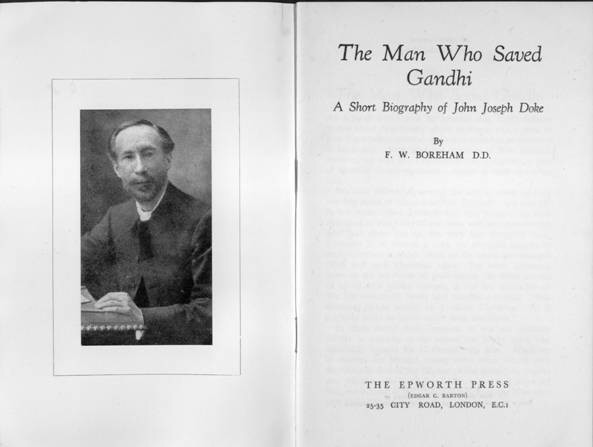
Since posting the article on Boreham and Mentoring which features Boreham's mentor, J J Doke, I have been asked where readers might get to read this hard-to-get little book.

Over the next few days I will be posting this book, The Man Who Saved Gandhi, in instalments.

I acknowledge that this book was originally published by Epworth Press. Permission to reprint this book has been granted by Whitley College, which holds copyright authority for all the books written by F W Boreham.

So to the first instalment of the book on J J Doke, one of the unsung heroes of the faith.

Geoff Pound

Monday, February 27, 2006

Boreham on Mentoring

Nothing New
Many people these days speak about mentoring as if it is a new phenomenon about which modern leaders are or should be engaged. It has been called by different names (supervision, curacy etc.) but the practice has been around forever.

Relationship Begins
It is instructive to note the many times in which F W Boreham pays tribute to his mentor, J J Doke and in such words to reflect on what this mentoring involved. This partnership it seemed was neither arranged by the seminary nor established by denominational leaders. The link was birthed in friendship. A year after Boreham commenced his ministry in New Zealand his young fiancée from Theydon Bois, arrived by ship in Christchurch. Boreham had asked the Rev J J Doke of the Spreydon church if he would conduct the wedding and along with the help of J J North, who served as best man, the knot was tied.

Pastoral Mentoring
J J Doke forged a strong friendship with both Stella and Frank and often made the long trek to Mosgiel to visit them on their home soil. On hearing the news of Doke’s untimely death in 1913 Boreham wrote, “He married me and helped me in more ways than I can tell. His friendship in our New Zealand days is one of my most cherished memories.”[1] Frank and Stella were to go through some difficult days of depression and ill health when Stella almost died so the pastoral care exercised by Doke through his visits and his letters was a lifeline.

Mentoring With Mutual Respect
After a month of formal ministry, this man who was fresh out of Spurgeon’s College felt totally inadequate and therefore receptive to any help that he could get. He wrote, “I was just beginning and was hungry for any crumb of wisdom that he, out of his rich experience, could impart.” It was this cry for help and his utmost respect for J J Doke that deepened the relationship. Boreham observed that Doke was “a born preacher”[2] and on another occasion, “I have never known his equal as a preacher.”[3] What amazed Boreham was that his mentor never received a College education, yet, “thanks to an indomitable will and tireless application, he was one of the most cultured and capable ministers I have ever known.”[4]

Different Style of Teaching
Doke was ten years older than Boreham but the younger man was never made to feel the lesser partner. In his essays and book about his mentor (The Man Who Saved Gandhi), F W Boreham attributed his ‘conversion’ to books to the encouragement of J J Doke. As he advised Boreham to read widely and commit himself to studying at least one serious book a week, J J Doke was responsible for prizing Boreham out of his narrowness and broadening him in all dimensions. He increased Boreham’s appreciation of nature (Doke was seldom seen without his camera) and he enlarged his world view. Doke was “an incorrigible traveler”[5] who undoubtedly passed on the travel bug to Boreham and reminded him of the way travel can make one a more interesting person. Like Doke, Boreham became a prolific letter writer and a regular contributor to newspapers.

The Broadening Role of the Mentor
It is remarkable to read the articles and correspondence that arose from Doke’s period in Africa, especially concerning the close friendship that developed between Gandhi and Doke.[6] As pastor of the Johannesburg Baptist Church the Rev Doke championed the rights of the Chinese and the Indians in their struggle for more humane conditions. The letters between Gandhi and Doke reveal that the Baptist pastor did much to negotiate on behalf of the Indians and he highlighted their cause prophetically in his weekly contributions to the Indian Observer and other papers.[7] This gives a glimpse into the way J J Doke was probably responsible for helping Boreham to understand the important social dimensions of the Christian faith and ministry, aspects that had been lacking through his early spiritual tutelage.

Geoff Pound

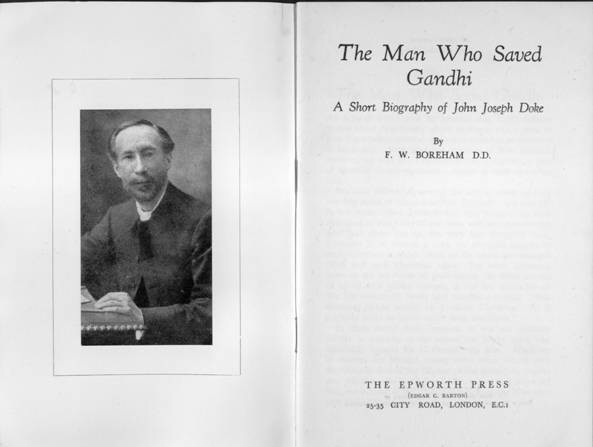
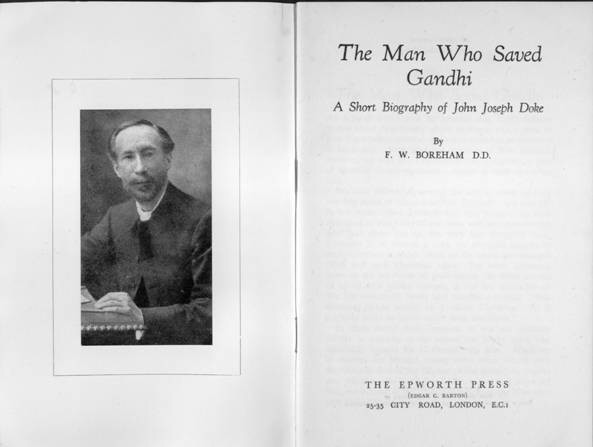
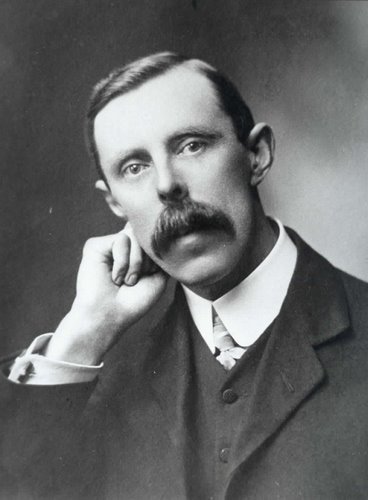
Image: Photo of J J Doke and front pages of F W Boreham's The Man Who Saved Gandhi.

[1] F W Boreham, The Golden Milestone, 50.
[2] F W Boreham, The Man Who Saved Gandhi, 5.
[3] F W Boreham, I Forgot To Say, 134.
[4] F W Boreham, The Ivory Spires, 28-29
[5] F W Boreham, The Passing of John Broadbanks, 200.
[6] Joseph John Doke Biography, http://www.unisa.ac.za/Default.asp?Cmd=ViewContent&ContentID=11685, viewed 20 February 2006. Gandhi and South Africa http://www.anc.org.za/ancdocs/history/people/gandhi/1-4.htm, viewed 20
February 2006.
[7] The C M Doke Collection of Letters from M K Gandhi (1907-1970)- Inventory http://www.unisa.ac.za/Default.asp?Cmd=ViewContent&ContentID=11322, viewed on 20 February 2006.

Sunday, February 26, 2006

Boreham On Letter Writing

Letters in War Zones
An article by Sabrina Tavernise from Baghdad reports on the heroism of the train drivers who carry the mail despite frequently being attacked, the postmen who bravely ride mopeds through gun battles to deliver letters in Dora and the sheer joy of receiving a hand-delivered letter. “It's something wonderful to get a letter,” said Ibrahim Ismail Zaiden, a postman in Dora. “The paper, the stamp, the envelope. It is not just a piece of paper. It is something sacred.”[1] The sacredness of letter writing and reading is also an important theme in the essays and editorials of F W Boreham.

Ministry of Letter Writing
In an age when emails are dashed off often just for pragmatic means of communication it is valuable to reflect on the ministry of letter writing. Frank Boreham had been the recipient of such a ministry. Aubrey Price, a Christian leader in London took Boreham under his wing and continued to write when the young pastor shifted to the southern hemisphere. About these Boreham wrote, “I treasure his letters still.”[2] Reference has already been made to the weekly letters Boreham received from his mother and the vigorous correspondence from his mentor, J J Doke. Influential people such as the New Zealand author Dr Rutherford Waddell and the British Baptist leader, Dr John Clifford wrote letters of encouragement to Frank Boreham early in his writing ministry.[3] In time Boreham exercised a similar ministry to young pastors and youth leaders and put much thought into it. Writing to newly ordained pastor, the Rev Payton, Boreham said: “I shall waft you a heartful of benedictions.”[4]

The Slow Process of Letters
Being a public figure it was inevitable that Boreham would receive some critical letters from his readers. In one essay he wrote about a person who saw the Hobart newspaper advertising Boreham’s Sunday sermon title and sent a letter of two words to the preacher saying, “PREACH CHRIST.”[5] F W Boreham said that his practice in this instance and in responding to other difficult letters was to follow Abraham Lincoln’s practice which was to write a letter, sign a response and then burn it![6] Frank told of one occasion when he got a letter from a crank who had pestered him for some time. Boreham wrote a stinging attack but delayed his reply. As he was going to post the letter he learned that the man had just died.”[7]

Reflective Reading
One of the benefits of a traditional letter (compared to email) is that it can easily be stored, preserved and carried for further reading. This seemed to be Boreham’s practice with special letters. He writes, “I was resting under the shadow of a notable old cypress on a seat to which I make it a practice to repair once a week or so [he is referring to his Thursday afternoon habit of visiting Melbourne’s Botanical Garden]. To this charming retreat I steal away from time to time to read, carefully at leisure, the letters of a certain kind…”[8] Boreham wrote of the enduring ministry of letters and cited the letters of the Bible and Johnson’s impassioned letter to his mother. Many times Boreham declared that the reading of a letter had been the source of inspiration for an essay or sermon.[9] The value he placed on many of the letters is evident when he writes, “Whenever I received a characteristic letter from a friend, a letter that seems saturated in his spirit and echoing with it the merriment of his laughter, I have found it impossible to destroy it.”[10] The letters of literature that have an enduring quality find their endorsement from Boreham when he said, “Many a man does his best work after he is dead.”[11]

The Artistry of Letter Writing
F W Boreham wrote creatively and quirkily about the purpose of envelopes and the role of stamps.[12] At a time when letter writing was losing its appeal, he regularly sought to raise the profile of this ministry. There are at least six editorials in which Boreham asks, Can we write letters?[13] In other articles he calls for “a revival of the high art of letter writing.”[14] In an essay he distils much of his thinking when he writes:
“There is something sacramental about letter writing… You seldom do any harm and often do a world of good by committing to paper the best that is in you…. Like
every well-written letter it is essentially a self-revelation.”[15]

The sacramental quality of letter writing and this exercise in self-expression is hinted at in Boreham’s question, “Who would dream of clicking off a love letter on a typewriter?”[16]

Geoff Pound

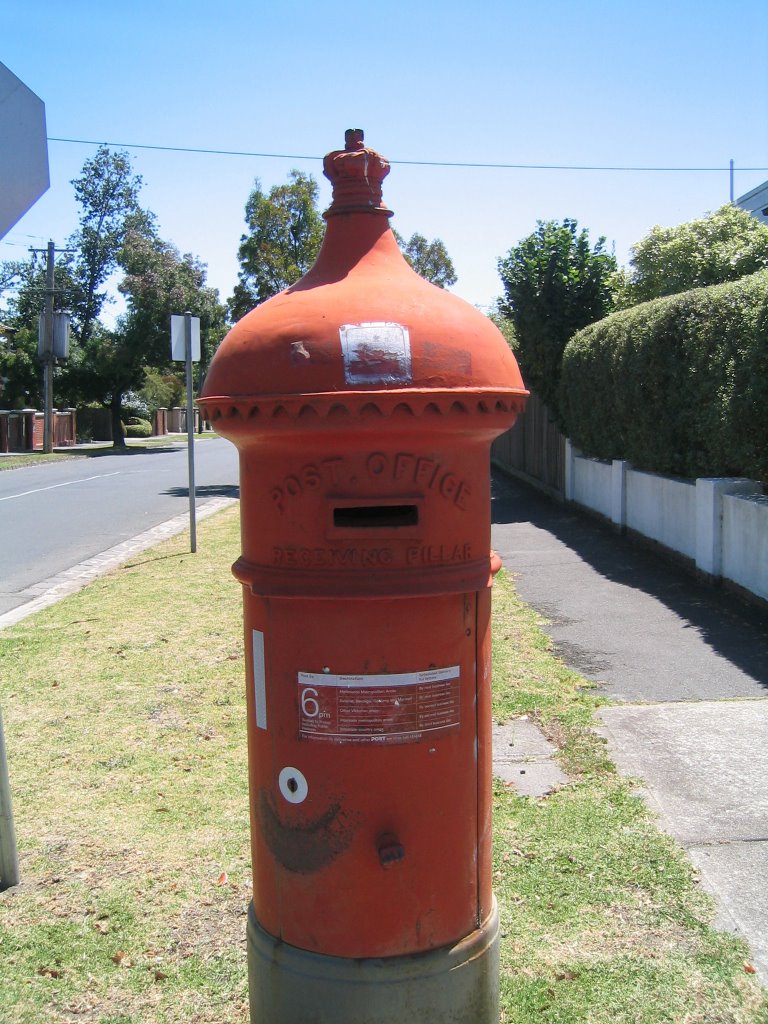
Image: The old Letter Box near the Boreham household in Kew, Melbourne. How many letters from FWB did this box receive?

[1] Sabrina Tavernise, ‘Neither War Nor Bombs Stay these Iraqi Couriers’, New York Times, 22 February 2006.
[2] F W Boreham, I Forgot To Say, 79.
[3] Letters from Rutherford Waddell and John Clifford are kept in the F W Boreham Collection, Whitley Colege, Melbourne.
[4] F W Boreham, Cliffs of Opal, 104.
[5] F W Boreham, Rubble of Roseleaves, 93.
[6] F W Boreham, The Fiery Crags, 221; F W Boreham, ‘The Science of Humbug’, Hobart Mercury, 30 March 1940.
[7] F W Boreham, The Crystal Pointers, 40.
[8] F W Boreham, The Three Half-Moons, 43.
[9] F W Boreham, The Silver Shadow, 241.
[10] F W Boreham, The Golden Milestone, 49.
[11] F W Boreham, ‘The Tales That Dead Men Tell’, Hobart Mercury, 10 October 1942.
[12] F W Boreham, ‘Peels and Pods’, Hobart Mercury, 4 September 1954.
[13] F W Boreham, ‘Can we write letters?’ Hobart Mercury, 3 February 1923.
[14] Boreham, Rubble of Roseleaves, 223.
[15] F W Boreham, When The Swans Fly High, 117-123.
[16] F W Boreham, ‘The Personal Touch’, Hobart Mercury, 25 July 1942.

Saturday, February 25, 2006

Boreham Pays Tribute To His Mother


Woman of Strong Opinions
Like many famous people Frank Boreham often paid tribute to his mother for the way she encouraged and inspired his gifts. Frank was the eldest child and felt that he had a special bond with his mother in that his advent signaled the commencement of mothering for Fanny Boreham.[1]

Frank’s mother had an influential shaping role on him and his nine brothers and sisters. He said, “Mother was a woman of strong opinions and prejudices. She knew her own mind and seldom gave a reason for any judgments that she formed. If any of us asked her why we were not allowed to go with other girls and boys to Sunday School she simply told us that she liked us all to go to church with father and herself on Sunday morning; that she liked us to spend Sunday evening with herself; and that she thought that this was quite enough.”[2]

Storyteller Supreme
Boreham wrote many times of the impact of storytelling on his own life and his mother’s ability to hold her children spellbound:

“And we loved to gaze upon the old church at night. It seemed strange to see the stained-glass windows showing their glories to the passer-by instead of to the worshippers within. Yet, pleasant as all this was, it was costly. For it meant forsaking the circle around the fire. There mother gathered her boys about her; read with us the collects and the lessons that were being used in church; and then held us spell-bound with a chapter or two of some delightful book. It is wonderful how many books we got through on those Sunday evenings. Then, before we said good night, we turned out the gas and just sat and talked by the light of the dying embers. Most of us were sprawling on the hearth-rug, sitting on hassocks, or kneeling around the fender. It always ended with a story. And, of all the stories that I have since heard and read, none ever moved me like those stories that in the flickering firelight, Mother told.[3]

Many times his mother gave the account of a gipsy woman who saw baby Frank in his pram and predicted that he would become a writer. He also acquired a special bond with Charles Dickens who had a memorable encounter with Fanny when she was a young girl.[4]

In Touch Through Letters
Frank Boreham left England at the age of twenty-four and spent most of the rest of his life in Australasia. Throughout his ministry he was always grateful for his rich upbringing and the blessing his parents gave to him in responding to a call that separated the Boreham family:

“Never a day comes to me under these clear Australian skies but I am touched to tears at the memory of the goodness‑the self-sacrificing goodness‑that my father and mother lavished upon me in the dear old English home.”[5]

In the days before effective phone calls and email F W Boreham was wonderfully sustained by regular letters from Tunbridge Wells:

“It is getting on for twenty years since I exchanged the Old World in the north for this new World beneath the Southern Cross. And never a single mail has reached Australia through all these years that did not bear a letter from my mother.”[6] Frank kept these letters throughout his life but most were destroyed upon FWB's death. A letter from Mrs Boreham has been found, preserved in one of Frank's books.[7]

Through an Arch of Roses
Frank and Stella Boreham made many trips back to England. Early in the 1930s on one of the visits home it was clear that Frank’s mother would not last long. It was a time for reminiscing, a memorable communion in the home and the final farewells. Boreham in an essay entitled, An Arch of Roses describes the last time he saw his mother as he and Stella left the family home to return to Australia:

“We saw [her] through an arch of roses, her tall and stately form at the bay-window...and a strange medley of smiles and tears playing across her brave and wrinkled face. Good-bye, dear Mother mine! I do not know how you will appear when I see you again; but I am certain that you will not look less sweet than you looked in that early summer morning when, in your pretty blue robe and your dainty lace cap, I saw you for the last time through a riot of red, red roses.”[8]

Upheld By Memories
Upon arriving back in Australia it was not long before the telegram arrived to say that, “Mother passed peacefully.” The news arrived at Christmas time. This news took the shine off the celebrations but unloosed waves of sustaining memories.[9]

Geoff Pound

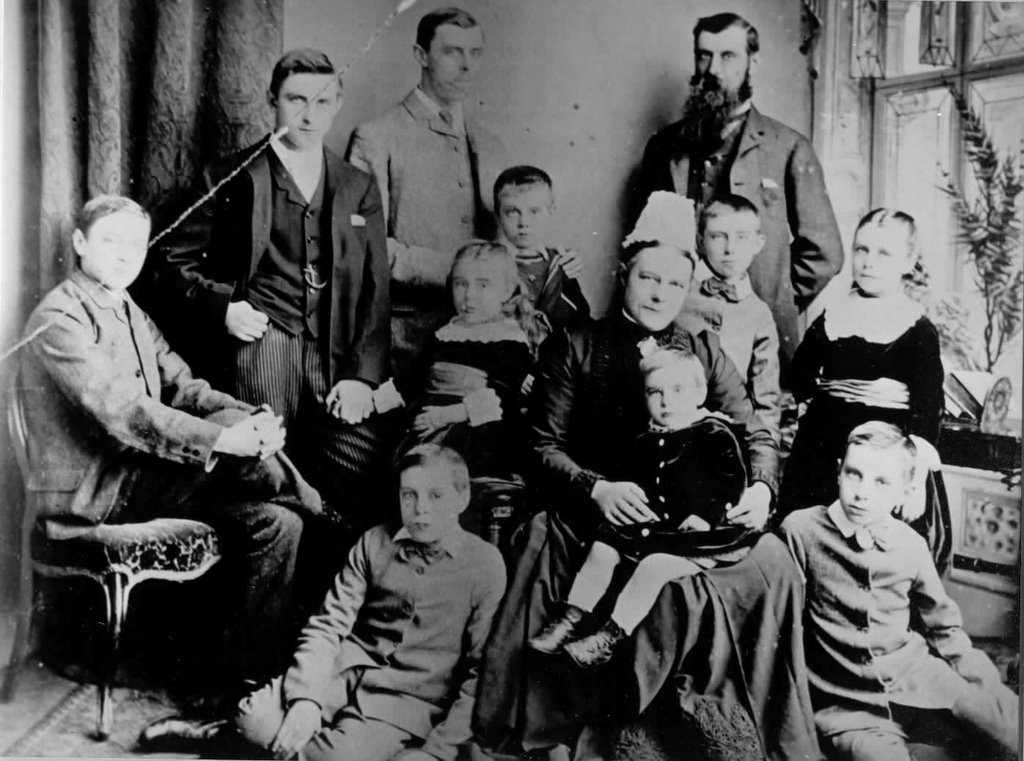
Image: One of the earliest photos of the Boreham family in Tunbridge Wells. Frank at the back next to his father. Fanny Boreham seated.

[1] F W Boreham, A Witch’s Brewing, 100
[2] F W Boreham, A Late Lark Singing, 23.
[3] F W Boreham, Arrows of Desire, 3.6
[4] Boreham, A Witch’s Brewing, 100.
[5] F W Boreham, The Other Side of the Hill, 107.
[6] F W Boreham, The Golden Milestone, 51.
[7] This is held in the F W Boreham Collection, Whitley College, Melbourne.
[8] Boreham, A Witch’s Brewing, 108-109.
[9] Boreham, A Witch’s Brewing, 100-109.

Tuesday, February 21, 2006

Boreham On His Conversion

F W Boreham felt it was important to often recall his own faith journey and the time when he sensed Christ put his hand on him. He commended this practice to young ministers as a way of re-warming their spiritual passion.

While Frank had been brought up in the church ‑ the St John’s Anglican Church in Tunbridge Wells and then the Immanuel (revivalist) church ‑ he marked his conversion experience to a phase in London. He later wrote several times about being dreadfully lonely when he moved to the big smoke at the age of sixteen.[1] In one of his earliest books (and now one of the most expensive to buy!), he describes his experience.[2]

In a sermon, The Ultimate Centre of Gravitation, he pictures the judge of all the earth … surrounded by the countless throng...reading the secrets of each heart as though He and the judge were there alone:

"The very magnitude of that drama of the ages shall only make each heart feel more fearfully lonely. I shall never forget the day when, at the age of sixteen, I left home and found my way up to the roar and din of London. I had never seen such crowds anywhere else, jostling and shoving for every inch of pavement. And yet I remember standing that day in the heart of the world's metropolis, under the very shadow of St. Paul's, and shivering in the thick of the crowd at my utter loneliness. Amid the hops and the clover and the orchards of my Kentish home one could often shout to his heart's content, and never a soul would hear him. Yet that was a delicious and tranquil loneliness that one loved and revelled in, but the loneliness of that awful surging crowd seemed an intolerable thing. That will be the loneliness of the Judgement day, the indescribable loneliness of standing in the midst of myriad millions, all in the regal presence of the King of kings, and each most dreadfully alone before him."

Geoff Pound

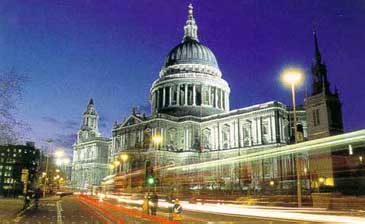
Image: St Paul’s Cathedral

[1] F W Boreham, Mountains in the Mist, 221; F W Boreham, A Reel of Rainbow, 20
[2] F W Boreham, The Whisper of God, 137.

Monday, February 20, 2006

Boreham On Acorns and Oaks

Aussie Soil
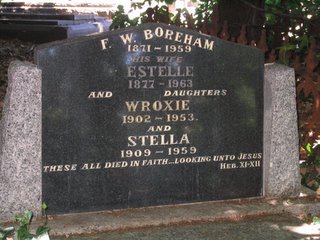
In his early years Boreham expressed his abhorrence at the thought of dying in Australia and being buried away from British soil. However his gradual love affair with this great brown continent led him to rescind his earlier statement. Perhaps in some way his prayers were granted when his body was finally laid to rest nearby, in the Kew cemetery - in Australian soil under an old English oak!

Under The Old Oak Tree
The old oak, though much taller than in the 1950's, still shelters the grave in a graceful manner. Frank and Stella used to picnic at this family grave from the time their daughter Wroxie died, in 1953. Frank loved the way that the possums left their marks all around. Today, if you visit, there's still ample evidence to suggest that possums persist in playing in the oak and dancing on Boreham's grave.

An abundance of acorns adorn this grave - seeds that are pregnant with life and potential. Frank Boreham understood that those who live effective lives are those who like oaks have taken years to develop into fruitfulness.

F.W. Boreham once remarked how he rarely returned home from a Sunday of worship services to report to his wife that someone had become a Christian in response to his preaching that day.

However, he was for ever amazed at the many times people said to him, "That sermon that you preached ten years ago was the means by which God turned my life around!"

Invisible Mystery
This is something of the mystery of the ministry? We say or do something that at the time seems small and ordinary yet through an invisible and often a lengthy process of maturing there emerges something that is profound and transforming. This conviction offers hope to all of us when we realize the significant part, often the hidden part that we play in the purposes of God. It’s like acorns becoming oak trees.

Geoff Pound

Image: The Boreham family grave in the Boroondara Cemetery, Kew, Melbourne.

Sunday, February 19, 2006

Boreham on Cricket

F W Boreham practiced his theme of 'making time for himself' through his passion for cricket. His wife is quoted in Who’s Who In Australia as saying that “if the house was on fire [her husband] would leave it to burn if there happened to be a cricket match in progress within twenty miles.”[1] His father was a cricket official who organized first class matches in Tunbridge Wells and the county of Kent and must have been responsible for introducing his son to the delights of the game.[2]
F W Boreham must be one of the few people who have shaken hands with W G Grace and dined with Sir Donald Bradman. I wrote to Sir Donald to ask him about this encounter but he gave a courteous reply saying he did not remember the man! Boreham played cricket on the green at Tunbridge Wells. He later was President of the Cricket Club in Hobart, Tasmania.

Boreham devoted so much time to the game because he loved it, he forgot everything apart from the runs and the cricket and he found it a great way to form friends outside the circles in which he normally moved.

Amid the busyness of his ministry in Tasmania Boreham wrote, “There is something wonderfully restful to the eye and strangely soothing to the mind about the very environs of a first class match.”[3] He also marveled at the game itself saying, “The glorious uncertainty of cricket is universally regarded as the greatest charm of the game.”[4] When, as an older man he found it hard to sleep, instead of counting sheep, he counted runs and with his brilliant memory he could replay entire cricket matches in his mind.[5]

There are many wonderful cricketing stories in his books (including an essay of The Middle Wicket),[6] but the cricketing story I like most is this one:

Watching the footy final at the MCG (he sat under the clock in the old Member’s Stand) Boreham and his cricketing friends were speculating at halftime about who would win the Test match in England that would decide the Ashes. Boreham did not say whether any money was put on it but they all wrote down what they thought Australia would make if the Aussies were batting first.

Boreham noted that one of his friends wrote down 250 runs and all the others wrote different scores up to 350. It was all so absurd because they had no idea about the state of the wicket or the outlook for the weather, but in an impish mood Boreham scribbled 475 and passed the paper on.

"475!" said his friend, who then said, "If Australia gets 475 on the board tonight you will be so excited that tomorrow when you enter the pulpit you will announce 475 instead of the proper hymn." Believe it or not, when stumps were drawn that night at the Kensington Oval Australia had made 475!

When on the next morning Boreham turned up to preach at the Paisley St Church at Footscray he was handed the order of service and on it was the opening hymn – ‘Glorious things of thee are spoken!’ No. 475!

Boreham does not try and explain this coincidence but he gets a sermon out of it and says: "If in the ordinary things of life we confront things that are incredible, we should not be surprised that in matters of the faith we sometimes find ourselves out of our depth."[7]

Geoff Pound

Image: Boreham (top left) with his cricket team in Hobart.

Sources:
[1] F W Boreham, The Drums of Dawn, 168.
[2] F W Boreham, Faces in the Fire, 26.
[3] F W Boreham, Luggage of Life, 89.
[4] F W Boreham, The Passing of John Broadbanks, 22.
[5] F W Boreham, Wisps of Wildfire, 241.
[6] F W Boreham, Nests of Spears, 160.
[7] F W Boreham, I Forgot to Say, 90.

Saturday, February 18, 2006

Boreham on Sleep

Do You Sleep Well?
How many sermons have you heard on the subject of sleep? John Baillie wrote a great chapter on A Theology of Sleep. Victor Hugo had some wonderful lines and prayers on the same topic. As an indication of the way F W Boreham was keen to discover the connection between faith and all of life it is instructive to see how many times he addresses the subject of sleep.

‘Do You Sleep Well?’ Boreham said, “Is a most important question.” The spectacle of a person sleeping in the face of distress and calamity is very impressive. Boreham contends that one of the main reasons why missionaries go to peoples of other cultures is to teach them to sleep! This is one of the tasks of the church today as it has been throughout the centuries. “She [the church] has excelled in the production of heroic and magnificent sleepers. That is why I insist that every candidate for her membership should be searchingly questioned as to her ability to sleep.”

Sleep for Boreham was not only a sign of faith but an essential experience of renewal. He wrote:
“I believe in Sleepy Hollow. They may laugh at its repose who laughed at the
great souls who slumbered there; but I am convinced that, if I can learn its
restful secret, there will enter into my life a great and wonderful
enrichment.”

Practicing the Boreham Nap
Frank Boreham practiced what he preached. Every day after lunch Frank and Stella (his wife) would go to bed. It was not just ‘forty winks’; it was a decent sleep for about an hour.

Once when I was conducting a Boreham Bus Tour in Melbourne I spoke about this insight and one of Boreham's nieces, who had often visited the Boreham household when she was young, added the following observation: “And they took all their clothes off too!" If couples in ministry want to keep their relationship fresh, and live a long life, what better start than by implementing the Boreham Nap!

Sleep On It
A recent scientific study in Amsterdam has concluded that “when it comes to making tough decisions- don’t sweat it, sleep on it.” The report is giving weight to the role of sleep and letting the unconscious mind churn through the options of a decision.

F W Boreham commended the inspirational and visionary benefits that came to him in his sleep:

“We invariably find ourselves richer on rising than we were on retiring.
Personally, I have spent most of my life scribbling. I have always found it a
mistake to attempt to complete a manuscript in one day. I like to do part of it
- enough to get the theme well on to my mind - and then go to bed with the work
half-done. I do not consciously review the matter during the night: yet I
invariably wake up with a batch of ideas that were not there the previous day.”

“I have always kept a notebook beside my bed in which to record, as soon as I opened my eyes, the treasure with which my plunge into oblivion had enriched me. How often a word or a phrase or a quotation eludes us overnight; but in the morning it seems to be standing in the gateway of consciousness awaiting us.”

Geoff Pound

Sources:
F W Boreham, The Golden Milestone, 14-21.
F W Boreham, Ships of Pearl, 16.
‘Sleep on it ‑decision-makers told.’ BBC News, 17 February 2006.

Image: Frank and Stella Boreham's first home in Mosgiel, NZ

Friday, February 17, 2006

Boreham on the Crucial Element in Effective Communication


Boreham Encounters a Closed Door
Soon after his conversion to Jesus Christ F W Boreham sensed a conviction to use all his time in Christian work. After many interviews with Hudson Taylor about going to China, the old man invited him to tea and with great tact and gentleness pointed out the opportunities of doing effective missionary work at Home, for his injury would, according to Hudson Taylor, hamper him in a foreign country.

Ministry Starts at Home
Not daunted, Boreham took up preaching at the age of seventeen on the street corner in Clapham. His first sermon was on the text, "Today, if you hear God's voice, do not harden your hearts."

Maiden Sermon
Years later, having heard hundreds of sermons he said "This manuscript [his first sermon] ...is easily the crudest of them all. From a theological and homiletical point of view, it has not one redeeming feature."[1] He went on however, to identify the dominant characteristic of that maiden sermon, that it throbbed with passion and this was due to the intensity and fervour of those men into whose company he had been thrown.

Crucial Element in Effective Communication
Fifty years and many sermons later he found himself even in his best moments praying that that essential quality of passion and conviction might endure with him to the end.[2] When asked what had been the keynote of his ministry he had no hesitation in saying it was the evangelistic note.


Geoff Pound

Image: Clapham Street

[1] F.W. Boreham, My Pilgrimage p80
[2] Ibid, p81

Tuesday, February 14, 2006

Boreham on Breaking Down Suspicion


Living Amid Prejudice
It is easy to develop unfair perceptions and unrealistic suspicions of people of other denominations, faiths and attitudes. This is a story of the way F W Boreham developed an appreciation for Roman Catholics at a time when there was great antipathy between Protestants and Catholics. He lived in NZ and Australia in a period when many of his ministerial colleagues gave lectures and wrote tracts about those people who were different and were to be avoided and opposed!

Broken Limb
When he finished school, Frank Boreham worked as a clerk in a Brick Company near Tunbridge Wells and here his absent mindedness [see earlier posting-Boreham on Cultivating Absent-Mindedness, 7 February 2006] cost him dearly. It was his job to record the carriages of bricks before the trains pulled away. One Saturday, Frank stood in front of a lever and as the engine drew across the points, the rails flung the lever forward and hurled Frank under the wheels of the train. The wonder was not that he was so badly smashed but that he was lifted out alive. He lost his right leg from his knee down and he had all sorts of complications as he lay in hospital for the next five months.

Broken Heart
Throughout his life Boreham walked with a limp. He broke that leg three times and it gave him enormous pain. But something happened in that hospital that changed him for life. Boreham fell in love with a nurse. What complicated things was that she was a full blooded Catholic and he was a young convinced Protestant. What made it even more difficult was that he was only 14 and she was over 40!! But he said, "To my dying day I shall never forget the face that in hours of anguish and delirium seemed to me like the face of an angel. We both cried when we said goodbye to each other and whenever I been tempted to a too vigorous criticism of Roman Catholicism I have been confronted by the imperishable memory of Sister Kathleen. She would have thought it heaven to lay down her life for her Church- or her patients.

Ecumenical Spirit
It is interesting to see as an outcome of this experience that one of the hallmarks of Boreham's ministry was his ecumenical spirit. He preached in many denominations in Melbourne and in his retirement, Scots Church was the place Dr. Boreham served as lunch hour preacher for 18 years until the age of 84! He often wrote of his debt to Catholics- friends, the saints and hymn writers.

Lesson in the Limp
Like Jacob, every step he took would have reminded F W Boreham of the day he lost his leg and the love and lessons he learned from Sister Kathleen about breaking down prejudice.

Geoff Pound

Sources:
F W Boreham, The Silver Shadow, 234
F W Boreham, Nest of Spears, 146f

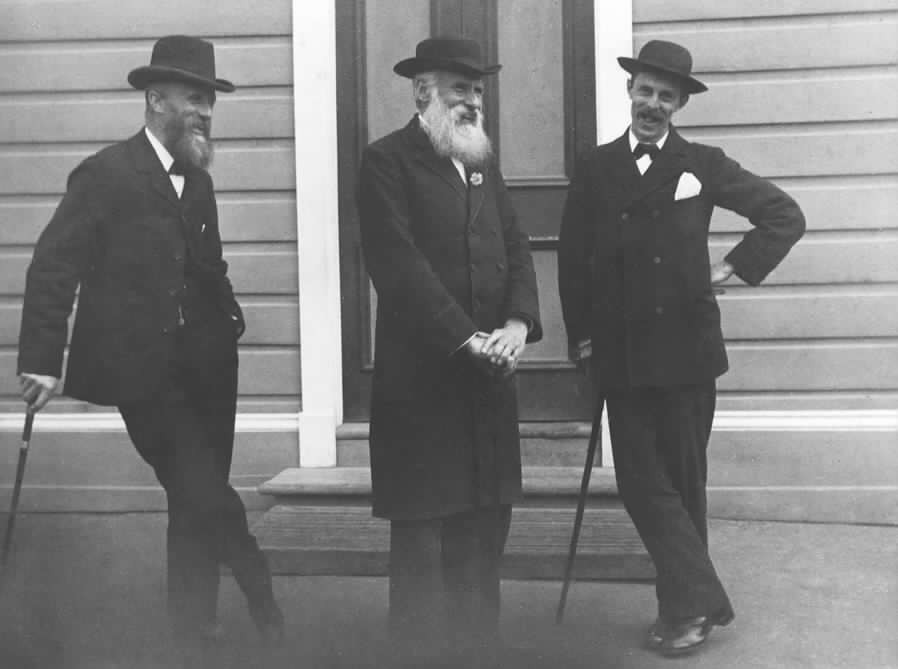
Photo: F W Boreham with colleagues in Mosgiel, NZ. FWB is the one on the right.

Boreham on Finding Time for Yourself


Reference has earlier been made [12 February 2006] in this blog site to the way Dr Boreham overcommitted himself in his first years of ministry. Giving the ordination charge to a young minister F W Boreham emphasized what became a recurring theme in his very productive ministry:

Find time for yourself. Feel it no shame at proper periods to be doing nothing.
Make seasons for leisure and for recreation. Climb the hills; scour the valleys;
row on the river; stroll along the beach. Cultivate the friendship of the fields
and the ferns and the flowers. Laugh with the young folk and romp with little
children. Be at your ease. Let the mind swing into an easy balance, a natural
poise, an attitude of perfect repose. The restless soul, eternally doing
something, never accomplishes anything. It is the person who can sometimes be at
rest who produces the finest work in the long run. Find time for yourself!

Geoff Pound

Source: F W Boreham, Drums of Dawn, 62

Photo by F W Boreham of his wife and two girls. Location probably Taieri Mouth, near Dunedin, NZ, a favourite place for Boreham and his family to have time for themselves.

Sunday, February 12, 2006

Boreham on Finding Focus

Early in his ministry Boreham was preaching a couple of times a week, accepting invitations to speak in the nearby city and throughout NZ. He was a weekly contributor to two papers and he was appointed to various committees. His life was hectic!

After one very busy week when he was reflecting on how good life was, Stella [his wife] said, "I have been so lonely. And when I have seen other men coming home of an evening and playing with their little ones, my heart has ached for ours. And then when you said that the week you have spent with us was one of the happiest you had ever had, it was more than I could bear."

When Frank listened to this confession, he realised that a river can be widened until it is so shallow and incapable of navigation. He saw that a ministry is better narrow and deep. So he resolved that night to only do the work to which his people had called him and to take on other things only when convinced it would be wrong not to do so. Refusing invitations and coming off committees meant that he, his family and his church were so much better.

Geoff Pound

Photo: Stella and Frank Boreham

Boreham's Influence on Billy Graham


Billy Graham’s Visit to Australia
When Billy Graham visited Australia in 1959 he said the one person he wanted to meet was Dr F W Boreham, because of the influence the old man’s books had had upon his ministry. There is still some footage in the F W Boreham Heritage Centre at Whitley College showing the handsome American evangelist striding down the driveway at Fellows Street in Melbourne and meeting Mr and Mrs Boreham. An account of this encounter in relayed in the foreword to Boreham’s last book and is told by Sir Irving Benson who escorted the Grahams. Ruth Graham has a full collection of the Boreham books. Dr Graham asked F W Boreham to sit with him on the platform at the Melbourne Cricket ground but Boreham declined because of his failing health (he died two months later). They talked about communication styles and Billy knelt on the floor while the Doctor prayed for profitable meetings in Australia.

Long After I Have Lost All Trace
In his essay, "The House That Jack Built," F.W.Boreham wrote about the links in the chain that are influential yet whose connections are seldom seen. To illustrate their importance and to encourage readers to be faithful links, Boreham related the story of how Richard Baxter helped a person to conversion who in turn did the same until finally the baton of faith was passed to Queen Victoria. This truth made an impression on Dr. Billy Graham for during his evangelistic crusade in Sydney in 1959 he asked his host, Dr. Gordon Powell if he knew the story that Boreham had told about Baxter and the chain of faith. Powell remembered the story but not the reference so at the evangelist's request he wrote to F.W. Boreham. Gordon Powell received the following letter with the passage concerned torn from the book. It is dated 5 May 1959 and it reveals something of Boreham's ill health. The old man died on 18 May and it would seem that this is the last letter that F.W. Boreham wrote.

This letter is reprinted with permission of Gordon Powell. It is headed with the familiar address embossed at the top of the page:

WROXTON LODGE
57 FELLOWS ST
KEW E4 VIC.

My dear old friend,

Your request comes at a most unfortunate
moment. I am really ill and have had the doctor with me during the night.
Moreover, Mrs. Boreham & Stella have both survived major operations of
recent weeks. It has been a terrible time.

Under these conditions,
my memory has gone to pieces. But I fancy that the par you want is Drums of Dawn
p259. I enclose it.

I do hope that this is the reference you
seek.

Blessings on you and Billy Graham,
As
ever
FWB


Rev. Sir Irving Benson once recalled how Billy Graham exemplified this truth in regard to his own role. Addressing in 1959 a gathering of nearly a thousand ministers in the Town Hall in St. Kilda, Melbourne, where Benson said there was 'some frostiness and perhaps a little bristling opposition' Graham began by saying, "I am always learning, changing and growing." There had been a welter of publicity focussing on the famous evangelist so in an effort to shift the emphasis where he believed it belonged he told of an episode from his boyhood days growing up on the farm in North Carolina:


"I [will] never forget the harvest dinners, with fried chicken and piles of
water melons. The chief guests were the eight harvesters. They had the first
helping. I used to think that my father, who had worked hard all spring and
summer, seemed the forgotten man at the feast. The harvesters only came to
handle the harvest he had worked hard to produce."

Applying the story and winning the hearts of his hearers, the evangelist said:

"I never claim to have led anybody to God- there have been many prayers and you have been working, preaching, serving faithfully for years-perhaps with little recognition or encouragement. I am only the harvester come to help you gather in the fruit of your own labor."[1]

Benson's newspaper article reporting this address lies folded in the book that Billy Graham autographed and gave to F.W.Boreham. [This book is in the Boreham Collection at Whitley College]. The old man would have loved that variation on the tidal theme because it pricks the bubble of those who claim undue credit, it encourages those who faithfully labour away from the spotlight and it is a fitting reminder to recognise with gratitude the unseen hand of God behind all effective and enduring ministry.

Long after I Myself am Dead and Forgotten
More than 100 years after Boreham wrote his first book, it is interesting to reflect on the fact that his books of sermons are still being read and reprinted. It is also instructive to note that 40 years after Boreham's death people still fondly recall his sermons and cherish his memory. Beneath the surface of the tide of influence are also the people whose lives have been touched for good in ways still to be discovered.

Geoff Pound

[1] Irving Benson, Billy Graham-the Harvester, xxxx 69

Boreham's Influence on Gordon Moyes


The Rev. Dr. Gordon Moyes (and now parliamentarian) has served as Superintendent of Australia's largest church, the Wesley Mission in Sydney. In this capacity he has spoken to more people with the gospel message through national weekly television and radio than any other Australian preacher. Gordon is another person who has been touched by the Boreham influence:

"For as long as I can remember, Dr. F.W.Boreham was part of my life. I was first introduced to his books as a primary school student.... As a teenage preacher I used his books to gain ideas for sermons which- unbelievably today-were aimed at teenage audiences!"

"...I have read scores of his books. Over the years I have collected his works and have had some books which very serious collectors desperately wanted....Each week, in a very busy life, I take time to sit and read something for no other reason than the sake of my own soul- I read one of C.H.Spurgeon's sermons, I read a chapter in one of Dr. Martin Lloyd Jones, or a chapter from F.W.Boreham....All of these great preachers of the past are far too wordy for today and too dated even to use some quotes in contemporary communication. But they are still right for my soul. I must take their concerns and insights and translate them into contemporary speech."

"There are many thousands of people who now receive my written sermons each week throughout Australia and overseas and I know many preachers have used my material that I have originally published. I rejoice in that. After all, Dr. Boreham helped me on my journey. I praise God for his life and influence."[1]

[1] Letter from Gordon Moyes to Geoff Pound 7th May 1996