 David Doran, an exiting student at Sydney’s Moore College and from 2009 the Assistant Minister at St James Anglican Church in Minto, has written an essay on F W Boreham.
I appreciate David’s willingness to allow his essay to be published on this Boreham site, thus enabling many others to benefit from his research. My apologies for not being able to reproduce the same formatting, especially with the endnotes. GRP.
An account of the life and ministry of Frank W. Boreham.
In 1936 at the General Assembly of the Church of Scotland Professor Daniel Lamont introduced Frank W. Boreham as ‘the man whose name is on all our lips, whose books are on all our shelves, and whose illustrations are in all our sermons.’1 Reflecting on their publication of 50 of Boreham’s books, the head publisher of Epworth Press said, ‘It was the discovery of F W Boreham [which was] the Book Room’s greatest catch, from John Wesley’s day to down to my own.’2 These and other tributes give a sense of the mass appeal and respect Frank W. Boreham’s preaching and writing won in the early twentieth century. John Henry Jowett wrote to his protégés, ‘I would advise you to read all the books of F.W. Boreham.’3 In one brief history of the Baptist denomination in Australia, Boreham is described as the best known graduate of Spurgeon’s Training College ever to serve in our country.4 In 1959, in what would be the year Boreham died, Billy Graham paid him a personal visit to thank him for the way his books had enriched his evangelistic ministry.5 All this is most impressive, but perhaps even more so for Sydney Anglicans is the report in Boreham’s biography that Bishop Howard Mowll visited Boreham and ensured a photographer came along with him!
Who was this man and what characterised this life-long ministry that won such massive appeal and affection? The major part of this essay is dedicated to answering these questions, firstly through a biographical sketch outlining the major movements and achievements of his life. Following that, through a study of a sample of his writings, a portrait is built of Boreham according to the passions that characterise his ministry. Reflecting on this story and portrait, I will then dedicate a section arguing the cultural movement of Romanticism, especially imbibed through F.B. Meyer and J.J. Doke, was the most significant influence shaping Boreham’s passions and style. Finally, through the grid of Bebbington’s quadrilateral of Evangelicalism we will describe the nature of Boreham’s evangelicalism, proposing that Boreham was dominated by conversionism and activism, who, due to a deliberate avoidance of theological controversy was understandably misinterpreted as happy with any branch of Christianity, including Liberalism or Roman Catholicism.
A Biographical Sketch of the Life and Ministry of F.W. Boreham
Frank W. Boreham was born in 1871 and grew up in the English rural village of Tunbridge Wells. His parents were devoted members of the Anglican church there but it was not until Frank moved to London at the age of 18 that faith dominated his life. He could not recall a specific moment of conversion rather that, ‘at that critical juncture, Christ laid His mighty hand upon me and claimed me as His own.’6 On arrival in London, he attended a Non-conformist church named Immanuel and through friends became involved in the London City Mission, where it is clear he became captivated by the work of evangelism and mission. It was through participating in evangelistic events they ran that Frank ‘glimpsed the unutterable preciousness of a single human soul.’7 With an enormous spiritual zeal he avidly attended F.B. Meyer’s Saturday Bible Classes, and ventured around London to hear preachers like C.H. Spurgeon, Joseph Parker and Archibald Brown. He began attending meetings of China Inland Mission but was advised by Hudson Taylor that his permanently injured leg would make missionary work in China untenable. He continued however to give himself to city evangelism and preached his first sermon on the street within months of his arrival in London. Although he did have an immersion baptism in 1890 it was more his friendship with James Douglas that brought him into Baptist circles. It was Douglas who encouraged Frank to apply for admission into Spurgeon’s Training College.8 Clearly he did not exclusively affiliate with Baptists though, because at that same time he accepted a request to preach at the Park Crescent Congregational Church and he continued this for five months.
In his early years in London his keenness and ability to write were also evident. In 1891 he got a 1,000 word essay about poverty in London published in the Clapham Observer, and later that year had a booklet published about some reflections on Genesis 24, which included an introduction written by F.B. Meyer.9 In August 1892 he began studying at Spurgeon’s College and at the end of two years there, Boreham answered a call from Thomas Spurgeon (Charles’ son) to become pastor of the rural Baptist congregation at Mosgiel in New Zealand. In the course of his farewell address to the church where he had been student minister, he expressed his hope ‘that in the course of my ministry I shall hold three pastorates, and then be free to travel in many lands preaching the everlasting Gospel among all the denominations.’10 He went on to do exactly that.
From 1895 to 1906 he was the pastor at Mosgiel, a time Boreham always reflected on fondly. He described it as the church where he was ‘learning at their hands to be a minister of the everlasting gospel.’11 In 1896, after proposing via letter to his would-be bride who lived in England, he married Stella and with her they would go on to have five children. In New Zealand his writing career began to flourish as he soon wrote a sermon a week in the local newspaper, and later fortuitously scored a place writing editorials for the Otago Daily Times.12 His activities at Mosgiel were voluminous, as shown for example in his heavy involvement in Temperance campaigns,13 and his quick rise to become president of the New Zealand Baptist Union.14 During his time in Mosgiel he struck up a close friendship with older minister J.J. Doke, the man who became his treasured mentor in these early years of ministry.
With a great degree of sadness at leaving Mosgiel but an excitement to take on a city pastorate, Boreham began his ministry at the Hobart Baptist Tabernacle in 1906. Here he thrived even more than at Mosgiel, having grown confidence as a preacher15 and a drive to plunge himself into all manner of causes.16 The church thrived under his leadership, with church membership going from 180 to 320 during his ten years there.17 During his time at Hobart he started his ‘Texts that changed the world’ series, which entailed biographical sermons on Christian heroes focusing on the verse of Scripture that compelled their conversion. Boreham would later call this sermon series his all-time favourite: ‘It was certainly the longest and the most evangelistic and the most effective.’18 Such sermons would later form the content of the books A Bunch of Everlastings, A Casket of Cameos and A Faggot of Torches.
In 1912 Boreham’s first big selling book was published, The Luggage of Life. This book was a series of short essays, each one having a spiritual lesson illuminated through a range of illustrations. It was typical of the kind of book that Boreham would
go on to write again and again and sell by the thousands. At the end of his time at Hobart, because of his books, Boreham could be described as a household name among Australian churchgoers.19
The workload at Hobart could not be sustained forever, and after a particularly draining year of 1915 with the extra stresses that war brought, in 1916 Boreham accepted a call to be pastor of the Baptist church at the populous and attractive Melbourne suburb of Armadale. Boreham felt that Armadale exactly suited him.20 It was a large church that was well resourced enabling him to concentrate on writing and preaching. His ministry at Armadale was again warmly received and resulted in good growth for the church.21 In one year the church added 52 new members to their roll.22
At this stage Boreham had established a substantial overseas readership and so in 1928 he was able to travel the United States and Canada on a preaching and lecturing tour. In the same year the McMaster Baptist University of Toronto awarded him an honorary doctorate in Divinity, in recognition of his work as a preacher and author. The time was right for Boreham to fulfil his final dream of itinerant ministry, and so he retired from pastoral ministry after 12 years service at Armadale. Boreham remained in Melbourne, active as ever, guest preaching at churches that were not only Baptist but Presbyterian, Methodist, Congregational, Salvation Army and Anglican as well. This included six month relief stints at the Melbourne Methodist Central Mission and at the Pitt Street Congregational Church in Sydney. At the age of 65, with Boreham still possessing an insatiable desire to preach, he accepted the offer of the pulpit at Scots Presbyterian Church Melbourne, for the Wednesday lunch-hour service conducted for businessmen. Furthermore he began contributing to The Age newspaper’s Literary Supplement essays. He would continue to have articles in The Age for twenty years and preached at Scots Church for the next 18 years. In 1954 he received an Order of the British Empire ‘In Recognition of his distinguished services to religion and literature as preacher and essayist.’23
When Frank W. Boreham passed away at the age of 88, he left behind an astonishing literary output of 49 books and around 3,000 newspaper editorials.24 His pastoral work and preaching had formed the basis of this work, and his times at Mosgiel, Hobart and Armadale had demonstrated his immense gifts as a church leader. Through his writing and later touring he attracted devotees in Australia and beyond, and we turn now to examine the passions that Boreham possessed that found resonance around the world.
The Passions of F.W. Boreham
The following portrait of Frank W. Boreham is deliberately framed in terms of his ‘passions’, for he was a man who was strongly imbued with a sense of passion and believed strongly in the need for deep fervour and emotion for effective ministry. The primary documents shaping this portrait are a sample of his books, ranging from The Luggage of Life (1912) to The Last Milestone (1961), including his autobiography, My Pilgrimage (1940).
Evangelism and Mission
Boreham’s biographer quotes Frank saying these words on the 50th anniversary of his ordination, but we also find them verbatim in his autobiography in the chapter entitled ‘Evangelism’:
“From the day of ordination to this day, the one passionate desire of my heart has been to lead my hearers to Christ.” 25
This was no doubt driven by his conviction of the gospel of Christ, but it was also driven by the sheer thrill of being involved in the someone’s conversion. Noting the trademark Boreham flourish, it is hard not to catch some of the zeal described in these words taken from The Luggage of Life:
“No Christian knows what Christianity really means until he has experienced such days as that day of Lydia’s and such nights as that night with the jailer. Religion catches fire and becomes sensational. The moment when two weary workers kneel with their first convert has all eternity crammed and crowded into it.” 26
For Boreham, once someone has played a part in one conversion, ‘he will be restless and ill at ease until the vessels are filled to the brim.’27 These words explain in a large part why Boreham was primarily an evangelist even though he involved himself in many other ventures. For example, according to Crago Boreham was heavily involved in the Temperance movement, but these rate only a very brief mention in his autobiography. The pinnacle moments of Boreham’s ministry in his mind were the time God used him to bring people into the kingdom.
In accord with this passion for evangelism was Boreham’s deep commitment to seeing the gospel win converts from every nations: ‘foreign missions have been the dearest passion of my heart.’28 No doubt part of the reason he travelled to New Zealand was this missionary impetus (which had been thwarted in regard to China), and of the many committees he took part in Mission ones were high on his agenda.29 Boreham was one who had been caught up in the grand quest of the Church to make disciples of all nations:
“[…]when the Church comes to understand the love with which God loved the world, she will be restless and ill at ease until all the great empires have been captured, until every coral island has been won.”30
Preaching and Writing
Ever since he moved to London Frank W. Boreham was eager to write and in London his passion for preaching was ignited. He was a man who had a firm conviction in the power of words, particularly to convert people to Christ. In his introduction to A Faggot of Torches, he says ‘words are very powerful, just as God spoke creation into being,’31 the event of someone being converted through the word was when ‘the ancient drama of Creation is repeated on a really imposing and majestic scale.’32 Thus he gave himself studiously to the labours of preaching and writing.
It is hard to split the preaching and writing of Boreham because all his writings grew out of his pulpit ministry.33 This means we can gain accurate insight as to the content of his sermons from his books, especially those based on his ‘Texts that Changed the World’ Series. His aim in both endeavours was to present Christ, but not through sustained theological argument. Crago said Boreham was ‘convinced that it is the preacher’s mission to make impressions and to create visions rather than to state reasons.’34 Boreham puts it this way: ‘Happy the preacher, however unlettered, who knowing little else, knows how to direct such wistful and hungry eyes to the only possible fountain of satisfaction.’35 Boreham believed sermons explaining theology would not arrest hearers but theology rather formed the invisible skeletal shape to the
sermon.36 An example of this is in one sermon where he raises the question of what faith is, but rather than offer any kind of theological definition, he merely paints an illustration to make his point.37 We shall explore the effects of this aversion for explicit theology on an account of Boreham’s evangelicalism later in the essay.
Being a firm believer in the power of artful rhetoric, Boreham invested a lot of time and energy in developing his oratory skills as a preacher.38 Part of his motivation for doing so was the maintenance of respect for the gospel in the public sphere: ‘I felt strongly that since a preacher is a public speaker, no speaker in any other department of public life should put him to shame.’39 Clearly his hard work paid off in this area, as Boreham developed a reputation as a masterful orator, as witnessed by the words of this non-Christian observer of him at a public function during the Hobart days:
“A while back, Alfred Deakin, Australia’s leading artist in words, told us peroration was dead. Mr Boreham doesn’t think so. On Tuesday night he winged his flight from State to State, from continent to continent, from world to world, and from sun to sun.
And the audience approved the oratorical flight.”40
Undoubtedly his honed oratory skills were a key ingredient in the effectiveness of his preaching. His oratory abilities were matched by his ability to craft language of high passion and gripping fervour. He was particularly adept at using repetition to impress one point through numerous descriptions, or build a momentum to a stirring climax. To exemplify the former, take these words opening his sermon about the text that changed John Bunyan’s life:
“By its radiance he extricates himself from every gloomy valley and from every darksome path. Its joyous companionship beguiles all his long and solitary tramps. It dispels for him the loneliness of his dreary cell. When no other visitor is permitted to approach the gaol, John Bunyan’s text comes rushing to his memory as though on angel’s wings.” 41
To exemplify the latter, read these words about George Whitefield’s conversion:
“I cannot explain the creation of the universe; but for all that, here is the universe! I cannot explain the mystery of birth; but what does it matter? Here is the child! I cannot explain the truth that, darting like a flash of lightning into the soul of that Oxford student, transforms his whole life; but, explained or unexplained, here is George Whitefield!”42 (emphasis his)
Boreham’s sermons obviously were designed to move the heart but they were also characterised by a dominance in content of illustration and metaphor. One writer quotes (without reference) Boreham as saying, ‘The world is full of sacramental things,’43 and it is easy to recognise the pervasiveness of this belief in Boreham’s books. These words from the essay ‘The Prudentialities of Life’ sum up Boreham’s approach:
“The microscopic is often as eloquent and as revealing as the majestic. Divinity often trembles in a dewdrop. A trifling incident may reflect a tremendous principle.44 So his books follow a similar pattern where small essays present one dominant metaphor that is teased out and developed to make a forceful spiritual point. For example, in the essay ‘The Candle and The Bird’ he explores how the rejection of the gospel is more like the frightening away of a bird than the extinguishing of a candle.45 In another piece he writes how the cry of a child seeking to see his father’s face is just like our desire to know our Heavenly Father’s face upon us.46 Or, we could sample this method of Boreham’s in the ‘Poppies in the Corn’. Poppies are splendid to the eye amidst the duller surrounds of corn but each conceals a cross. In the same way we can speak of the Cross:
“Yes, it is impossible to think of the red, red poppy without thinking of the black, black Cross. That is why the day of the Cross is the ruddiest and most radiant poppy in the whole field of human history. It is the blood mark which shall glorify and sanctify every ear of common corn as long as the world shall stand.”47
Myriad upon myriad of these word pictures, often based on normally very innocuous things, occupy Boreham’s writings as he mined what he saw as a highly sacramental world for spiritual truth. This is why Crago concludes his book by describing Boreham’s legacy as ‘the lovely lines, the sweetening influence, and the signposts pointing to the Saviour.’ 48
His Churches
While it may be easy to simply focus on the skill and success of Frank W. Boreham the preacher and writer, any account of his ministry would be deficient if it did not acknowledge his dedication as a pastor. Another great love that shaped his life was the churches he shepherded, as the dedication prefacing his book A Bunch of Everlastings (1920) shows: ‘At the feet of those three elect ladies. The churches at Mosgiel, Hobart and Armidale I desire, with the deepest affection and respect, to lay
this Bunch of Everlastings.’
Boreham was someone who tirelessly worked at following up his pulpit ministry with personal care. Records of his practise week by week indicate he sought to follow the example of Richard Baxter, whom he obviously admired:
“During the week he (Baxter) exhausted all his energy and time - though never free from pain- in trying to save the souls of his people one by one. He gathered them in groups; he formed them into classes; he dealt with them family by family; he appealed -earnestly, pleadingly, yearningly- to each individual alone.”49
So Boreham says when he was in good health he would spend four afternoons a week engaged in visitation.50 During the war he laboured to keep up with soldiers he knew by writing to them individually.51 Even with his lunchtime ministry at Scots, after preaching he would make himself available for one on one pastoral talks with people.52 His practise always demonstrated a deep commitment to the welfare of each and every member of his congregation.
It appears, as for his preaching, his pastoral ministry was very well received. He clearly developed a personal touch that communicated genuine love. Crago records this public tribute offered by one Judge C.H. Book near the end of Boreham’s life: ‘But above all, I rejoice that I have spoken with him face to face, and then he makes you feel that it is you who have his interest and love.’53 Part of this ability no doubt came to him naturally, but it is also clear Boreham worked at his pastoral ministry. Such can be gleaned from the story of J.J. Doke engaging in a role play with his protégé just prior to a visit Boreham had to pay to a dying person.54 Thus his close friend C. Irving Benson wrote this about him: ‘As a brother minister he was an apostle of encouragement and as a pastor he had a rare skill in the art of comforting.55
Books, Nature and History
Another tribute C. Irving Benson paid to Frank Boreham sums up the final passion that defines him, Boreham’s passion for life itself!
“What a relish he had for living and how vastly he enjoyed being alive! He was interesting because he was interested in everybody and everything.”56
This zest for life and God’s world repeatedly comes out in his writings, where his wealth of knowledge of literature, nature and history are all mustered to drive home his points. A classic example of this is found in his essay entitled ‘Our Desert Islands’ in The Luggage of Life, where there are mentions of Robinson Crusoe, Enoch Arden, Patmos, Napolean, the nature of islands, Defoe, Tennyson, Andromeda and Perseus, all on the first page! 57 He believed, in God’s world, ‘Truth is always and everywhere friendly to Truth,’58 so he avidly pursued knowledge and simply delight from any source he could. At the beginning of his time in Mosgiel, he pledged to buy a book a week and read the same, and this he did for 20 years.59 A lot of what he read was history (not theology), and the book that really inspired his passion for reading and history was Gibbon’s Decline and Fall of the Roman Empire.60 His love for nature must have fuelled his love of photography that Crago reports.61 These pursuits are key indicators of Boreham’s Romanticism, and all his work is infused with a fascination and love for all that nature, history and art could teach him.
Explaining Frank W. Boreham
Having provided a biographical sketch of Frank W. Boreham and an exploration of the passions that shaped his ministry, I now turn to argue what best explains this prolific man. It is clear Boreham was not a man moulded by denominational convictions. We do not get very far trying to explain Boreham as a Baptist. He was heavily involved in Baptist Unions in New Zealand and Australia but these seem more about combining resources for gospel proclamation rather than a preservation of
denominational distinctiveness,62 and so it makes sense that an evangelist like Boreham would be committed to them. Boreham never explicitly identifies himself with any branch of Baptist faith, he never speaks much of Charles Spurgeon or his training College, but what is always dominant is his keenness to work with other denominations and emphasise the commonality he shared.63 What most explains the person and ministry of Frank W. Boreham, apart from his gospel faith, is the cultural movement of Romanticism.
The Influence of Romanticism
David Bebbington names Romanticism as one of the key cultural movements affecting British and American evangelicalism of the nineteenth century.64 This movement ‘stressed […]the place of feeling and intuition in human perception, the importance of nature and history for human experience.’65 Its impacts were immediately to make ‘preaching more elaborate, rhetorical, and charged with metaphor.’66 Over the longer term it inclined people toward doctrinal liberalism and a focus on ethics.67 We will discuss whether the label ‘liberal’ sits fairly with Boreham in the final section of this essay, but our analysis of his preaching for starters seems to match nicely the style of preaching borne out of Romanticism.
Given Bebbington’s description of Romanticism, it is already clear how Boreham aligns with the Romantic movement. We have outlined his passion for history and nature. Our analysis of his preaching matches the characteristic Romantic preaching style. What has not been demonstrated already is the premium Boreham placed on ‘feeling and intuition’. But this is ever-present in Boreham’s writings. For example, look at these words that come in the context of a classic Romantic polemic against the emptiness of philosophical debate. The first quote comes from an exposition by Boreham on the Beatitude, ‘Blessed are they that mourn’:
“Blessed are they that mourn!- the Saviour says; and I think I begin to understand Him. Blessed are those who feel! - he seems to say.”68 (emphasis his)
He goes on to say the feeling is especially about deep sorrow for sin, but the emphasis on feeling is very strong. The second quote just as strongly evidences Boreham’s Romanticism as he explains the key way gospel transforms:
“And it is by the things we feel that life is dominated and controlled[…] It was not that men’s minds were illuminated by a new light; it was that their hearts suddenly glowed with a new passion. The priceless evangel of the New Testament is not a system of philosophy, but a divine love letter.”69 (emphasis his)
Boreham exhibited the ways of a Romantic and it appears he learnt and imbibed these from the two most important intellectual and spiritual influences on his life: F.B. Meyer and J.J. Doke.
According to Ian Randall, who has conducted extensive study on F.B. Meyer, Meyer could be described as ‘a thoroughgoing Romantic. For him, Wordsworth and all his followers were students in the school of Jesus Christ.’70 From the records of Boreham’s formative years in London, it appears F.B. Meyer had a huge impact on him. It was then that he devotedly attended Meyer’s Saturday afternoon Bible classes and where Meyer ‘captured [his] whole heart.’71 Indeed, he and his classmates regarded Meyer as ‘the father of us all.’72 Crago reports that Boreham’s love of Meyer began with him voraciously reading his books.73 The fact that Meyer was willing to pen an introduction to Boreham’s first book shows that, at least at that stage for both of them, Meyer and his pupil were very much like-minded. Indeed, Randall’s account of F.B. Meyer bears out striking resemblances to Boreham and it appears we would go a long way (not completely) towards understanding Frank W. Boreham by studying F.B. Meyer.74 Thus undoubtedly Boreham’s Romanticism is largely attributable to the F.B. Meyer’s strong influence in his life.
The next most important influence on Frank W. Boreham must be J.J. Doke, the man who has simply been called Boreham’s ‘mentor’.75 Boreham relishes the memory of the times Doke would ‘pour the golden treasure of his mind and heart into my hungry ear.’76 This was also at another formative time in Boreham’s life when he was carrying out his first pastorate at Mosgiel. In terms of Boreham and Romanticism, Boreham credits Doke as beginning his insatiable reading and guiding him as to what to read.77
For instance, Doke began Boreham’s obsession with history by urging his pupil to read Gibbon. In addition, as a personal model Doke was a passionate Romantic- a man of liberal education, who painted, who was a photographer and who even started his own zoo!78 Boreham’s passion for life and zest for God’s world mimic in a lot of ways that of his mentor, so it is clear Doke also would be a reliable window into the workings of Frank W. Boreham.
To summarise this section, the style and loves of Frank W. Boreham demonstrate the heavy influence Romanticism had on his life, and that is best explained by two people who taught him a great deal about life and ministry: F.B. Meyer and J.J. Doke.
The Evangelicalism of Frank W. Boreham
One only has to note Frank W. Boreham’s inclusion in The Australian Dictionary of Evangelical Biography,79 to see Boreham has historically been regarded as evangelical. However, it is hard to be precise about how Boreham fitted into the evangelical landscape and there are suggestions he drifted toward liberalism in his later years. Two quotes present the puzzle of Boreham’s evangelicalism well. The first, taken from Crago’s biography, is a report of how the Presbyterian Standard assessed Boreham when he visited America:
While all were charmed with his style and entertained by his peculiar technique in the pulpit, his hearers gladly detected the evangelistic note and the earnest purpose of the speaker. Montreat accords him the seal of orthodoxy and rejoices in his common loyalty and devotion to the common Lord.80 Boreham had an idiosyncratic way about him, but these conservative Evangelicals were happy to welcome him. The next quote, which raises questions (I think misguidingly) even about the label ‘evangelical’ and Boreham, comes from his close personal friend, C. Irving Benson: 81
“I do not remember his name being associated with any controversy. With Fundamentalist, with High Church and Evangelical, with Roman Catholic and Protestant, he had no discernible quarrel. With true catholicity of spirit he moved among them with the easy grace of a man who picked flowers from all their gardens.”82 (emphasis added)
This intended tribute to Boreham suggests Boreham tied himself to no theological brand but moved with whatever attracted him. What was the nature of Frank W. Boreham’s evangelicalism? Indeed, is it historically true to label Boreham an ‘evangelical’?
To answer these questions we will apply David Bebbington’s inductive definition of evangelicalism,83 assessing how each part of the fourfold grid sits with Boreham. We will achieve this with insights gleaned from the foregoing analysis, and with particular attention to The Tide Comes In (1961). This was the last book of devotional essays Boreham compiled and notably the one which he writes contains pieces ‘of which he was particularly fond.’84
According to Bebbington, the mark of evangelicalism called conversionism is ‘the belief that lives need to be changed’, and another one called activism is ‘the expression of the gospel in effort.’85 Given Boreham’s passion for evangelism and mission and the sheer volume of gospel enterprise and preaching he conducted to the very end of his life, its fair to say conversionism and activism dominated his life. As to his conviction that a man needs to be converted to enter fellowship with God there
could be no clearer statement of it than this one offered in the essay ‘So It’s Your
Birthday!’:
‘[…] life presents man with two supreme and indispensable imperatives. Its says: Ye must be born! And it says: Ye must be born again.’86 (emphasis his)
Furthermore it is clear his passion for activism directed toward evangelism still burns
bright as essays like ‘The Wafted Fragrance’,87 ‘The Angler’88 and ‘Wagon Wheels’89 are basically pieces calling on Christians to evangelise. Judging by the first two marks of Bebbington’s definition, Boreham is vibrantly evangelical.
It is when we turn to Bebbington’s two other marks of evangelicalism: crucicentrism (‘a stress on the sacrifice of Christ on the cross’90); and biblicism (‘a particular regard for the Bible’91) that people may find ground to question Boreham’s evangelicalism. We could recall Boreham’s glorying in the Cross as the centre of ‘human history’ in his essay ‘The Poppies in The Corn’ to show his commitment to preaching it in his early years. And, in The Tide Comes In he continues to speak of the Cross in the highest terms: it is the ‘supreme revelation’ of God;92 the place where our sins are taken away;93 and a rejection of the redemption it secures is ‘the sin of sins.’94 However, one quote, which appears in another of Boreham’s books as well,95 could be construed as a movement in his thinking away from crucicentrism. The words, in an essay simply entitled ‘God’, denote a self-reflective re-evaluation of thought and are quite intriguing:
“If I had my ministry over again, I would talk more about God; I would indeed. Not about works or His ways, His power or His bounty. But about His very, very self - His omnipotence; His unutterable goodness, His ineffable holiness, His splendour, His glory, His beauty, His love. For if I could make men very sure of God, they would soon hurry to that divine Saviour who is able to save to the uttermost those who come unto God by Him.”96
One could understandably take these words and claim Boreham had drifted from teaching the Cross at the centre of his gospel, away from the works of God’s Son. Whether this was fair may come down to an analysis of Boreham’s preaching in his latter days, of which we do not have direct access. But given the aforementioned strong and theologically orthodox statements about the Cross in his last book, we would be hard pressed to seriously question Boreham’s crucicentrism.
Whilst it is probably true, as some commentators say, Boreham was ‘a man of one Book,’97 his writings make his biblicism nebulous. There is only one essay I found that explicitly contends for the supreme authority of Bible (explicitly opposing Roman Catholicism) - in his first major book, The Luggage of Life. There is always an everpresent belief in the power of and love of the Bible, but the problem is his Romanticism drowns out the elevation of the Bible as being the authoritative revelation we have today. That is, his method of mustering as much from nature, literature and history as the Scriptures has the effect of placing the Bible as one source of truth along with many others. In The Tide Comes In in one essay he describes the Bible as like a telescope, because it is ‘a revelation’ which we need to see through to know God.98 This is uncontroversial in itself, but the problem is in the next paragraph Boreham speaks of the Church in the same way, as an agent of revelation. A sensible conclusion from this essay is that the Bible is a revelation but not the revelation for us now of God. Crago speaks of this tendency positively, but it does undermine Boreham’s biblicism: ‘He welcomed truth wherever he found it, and exultingly proclaimed it in the name of the Author of all truth.’99 It may be unintentional and unrepresentative of his convictions but the reader is left understanding Boreham’s regard for Scripture to be a little less than that of the supreme authority traditionally reserved for it by evangelicals.
Thus to summarise the findings from our analysis according to Bebbington’s criteria we see Boreham very strong on conversionism and activism, demonstrably crucicentric but veering from the norm in biblicism. Perhaps Boreham’s evangelicalism could be described as a forerunner to the evangelicals of the mid-twentieth century, who Bebbington says were characterised by the high order of activism.100 Another perspective may be to say that Boreham was more concerned with being ‘evangelistic’ than ‘evangelical’, the very thing that was urged by a leading Australian Baptist, C.J. Tinsley, to his fellow Australian Baptists in 1912.101 Whatever the case, if Bebbington was accurate, Boreham deserves to be known unreservedly in history as evangelical, even if not in the mainstream.
The question remains what it is to be made of Irving Benson’s remarks about Boreham having ‘no discernible quarrel’ with any branch of Christianity. There are three things which can be cited to argue that while one may think Boreham had no difference with anyone, in reality he did, but he refused to show it, in the interests of peace-keeping. Firstly, from all reports Boreham was a very gentle man. This is evident by noting how much he was affected and made unhappy by a rift with a friend during his time at Mosgiel, at the end of which he learns what he calls the ‘futility’ of controversy.102 One can imagine the peace-loving Boreham reacting to the anti- Catholic sentiment so prevalent amongst Protestants in the early twentieth century by personally showing love to Catholics, which may be misinterpreted as having ‘no quarrel’ with them. Secondly, Boreham made a deliberate decision to avoid controversy or quarrel in his writing and preaching. In The Tide Comes In, he wholeheartedly upholds the contention of Francis of Assisi that the godly man ‘has no need to resort to words in order to rebuke the iniquities that disfigure the Church and world around him.’103 Thus, even if Boreham had a quarrel with someone - he would never mention it! Finally, as already alluded to, his language and method presented his theology quote ambiguously at times. We could cite as examples of this his comments about preaching more about God (even though in other places the Cross is central), or his statement in his last essay in The Tide Comes In that ‘Harmony and light are, therefore, the two biggest things in the universe.’104 Such language tends to leave the theology accompanying it ‘in the eye of the beholder’, and one can imagine Catholics or Liberals happily adopting these words as at least a concession to them. This is why Crago can say Boreham’s books ‘were read with equal avidity by theological liberals and conservatives.’105 If Boreham had any issue with them he never explicitly argued it, and his language at terms courted an inclusiveness that perhaps he never intended. There is definitely enough evidence positively of traditional Protestant evangelicalism on the part of Boreham in his writings to suggest Boreham would have staunchly opposed Roman Catholicism and Liberalism, it is simply that he avoided that fight. In support of this is the absence of record of any preaching in Catholic churches, he always worked with Protestant ones. From my estimate, James Townsend, who made an extensive study of Boreham’s theology, makes an accurate summation of the man. On soteriology, Townsend says Boreham ‘tended to swim with the Evangelical mainstream.’106 However, Townsend emphasises more that ‘Boreham’s bent is more often to build bridges where they can built’107 and according to Boreham, ‘Rightness never need be accompanied by rudeness.’108 Though it is hard to detect at times, Boreham at heart was a theologically orthodox Protestant evangelical, who chose to work through a love that never criticised to win over those he disagreed with.
Concluding Reflections on Frank W. Boreham
What have I gained from a study of Frank W. Boreham? His significance is not really found in enlightening a case study of Baptists in Australia. He does give us concrete insight into how Romanticism influenced an evangelical, but really Frank W. Boreham was simply an outstanding Christian individual, and as such it is the person himself that is the lesson. If I am to be critical, I have learned that to avoid theological controversy risks losing theological distinctiveness, which may result in a loss of the gospel itself. This cannot be said to be true of Frank W. Boreham’s life and churches, but the long-term trajectory of his Romanticism and decision to avoid theological argument gives his devotees that option. Trumping that wariness though is a sheer admiration of and inspiration from a man who loved the Lord Jesus, and laboured incredibly to see him glorified. Most strikingly in Frank W. Boreham we meet a Christian who sought to truly connect to people in order to connect them to Christ, and the sales of his books and the growth of his churches show that he did connect with people, and he did win converts to Christ. So while his style is quite foreign to preaching I am accustom to, I can learn from Boreham the value of illustration and the
colour wide reading can bring to the pulpit. His deliberate commitment to and connection through the written word raises the question of whether ministers these days too often neglect the pen for the sake of the pulpit - Boreham always looked to hone both arts for the sake of the gospel. Overall what stands out about Frank W. Boreham is that he was one uniquely gifted, but one who dedicated these gifts to tireless evangelism and shepherding the flock given to him, and in this regard he is a model I have been privileged to study.
Endnotes
1 Frank W. Boreham, My Pilgrimage (London: Epworth Press, 1940), 251
2 Geoff Pound, ‘F. W. Boreham: The Public Theologian’ Baptist World Alliance: 3. Online:
http://www.bwa-baptist-heritage.org/sl-borhm.htm Cited June 18, 2008
3 James Townsend, ‘F.W. Boreham: Essayist Extraordinaire’ JGES 14:26 (2001): 2. Online:
http://www.faithalone.org/journal/2001i/townsend.html Cited June 18, 2008
4 Ken Manley, Baptists in Australia: An Historical Introduction (Hawthorn: Baptist Union of Australia 1999), 2
5 Pound, ‘Public Theologian’, 4
6 Boreham, My Pilgrimage, 60
7 Boreham, My Pilgrimage, 74
8 Boreham, My Pilgrimage, 87-89
9 T. Howard Crago, The Story of F.W. Boreham (London: Marshall, Morgan and Scott, 1961),
39-43.
10 Crago, Story of FWB, 57
11 Boreham, My Pilgrimage, 122
12 Boreham, My Pilgrimage, 147-148
13 Crago, The Story of FWB, 106-108
14 Crago, The Story of FWB, 98
15 Boreham, My Pilgrimage, 183
16 ‘at Hobart.[…] I felt it my duty, as the representative of a central church, to take part in every helpful movement in the city. I was on every committee and was invited to speak at all kinds of public gatherings.’: Boreham, My Pilgrimage, 216
17 Crago, Story of FWB, 160
18 Boreham, My Pilgrimage, 196-197
19 Crago, Story of FWB, 167
20 Boreham, My Pilgrimage, 216
21 F.J. Wilkin, Baptists in Victoria Our First Century 1838-1938 (Baptist Union of Victoria:
Melbourne, 1939) 144
22 Crago, Story of FWB, 171
23 Crago, Story of FWB, 248
24 Pound, ‘Public Theologian’, 1, 3
25 Crago, Story of FWB, 237; Boreham, My Pilgrimage, 207.
26 Frank W. Boreham, The Luggage of Life (London: Epworth Press,1912): 31
27 Frank W. Boreham, Mountains in the Mist (London: Epworth Press,1914), 96
28 Boreham, My Pilgrimage, 231
29 Boreham, My Pilgrimage, 231
30 Boreham, Mountains in the Mist, 20
31 Frank W. Boreham, A Faggot of Torches (London: Epworth Press, 1926), 8
32 Boreham, Faggot of Torches, 8
33 Crago, Story of FWB, 248
34 Crago, Story of FWB, 171
35 Frank W. Boreham, A Bunch of Everlastings (London: Epworth Press, 1920), 136
36 Crago,The Story of FWB, 180
37 Boreham, Bunch of Everlastings, 27
38 Boreham, My Pilgrimage, 94,140; Crago, Story of FWB, 133
39 Boreham, My Pilgrimage, 141
40 Crago, Story of FWB, 121
41 Boreham, Bunch of Everlastings, 56-58
42 Frank W. Boreham, A Casket of Cameos (London: Epworth Press, 1924), 50-51: In passing notice his intentional avoidance of an attempt to explain the theology of regeneration.
43 Townsend, 2
44 Boreham, Luggage of Life, 46
45 Frank W. Boreham, Boulevards of Paradise (London: Epworth Press, 1944), 103-113
46 Frank Cumbers, Daily Readings from F.W. Boreham, (London: Hodder and Stoughton,
1976), 25
47 Boreham, Mountains in the Mist, 285
48 Crago, Story of FWB, 256
49 From the sermon on ‘Richard Baxter’s Text’: Boreham, Faggot of Torches, 164
50 Boreham, My Pilgrimage, 185
51 Crago, Story of FWB, 170
52 Crago, Story of FWB, 241
53 Crago, Story of FWB, 244
54 Frank W. Boreham, Lover of Life F.W. Boreham’s Tribute to His Mentor (Eureka: John Broadbanks Publishing, 2007), 14-15
55 C. Irving Benson, ‘Dr Frank W. Boreham – The Man and the Writer’, in The Last Milestone
(ed. C.Irving Benson, The Epworth Press: London,1961), 8
56 Irving Benson, 7
57 Boreham, Luggage of Life, 10
58 Boreham, Luggage of Life, 80
59 Boreham, My Pilgrimage, 143
60 Boreham, My Pilgrimage, 142-143
61 Crago, Story of FWB, 130, 150
62 In New Zealand, Leonard says of a ‘prelude’ to a Baptist Union: ‘[…] was founded “to advance the cause of the Lord Jesus Christ by promoting the formation of Christian Churches, by the sustenance of Evangelists, by the assistance of Pastors, by giving counsel if requested[…]”.Bill J. Leonard, Baptist Ways A History (Valley Forge: Judson Press, 2003): 299
63 Boreham, My Pilgrimage, 250
64 David W. Bebbington, ‘Evangelicalism in Modern Britain and America: A Comparison’ in Amazing Grace Evangelicalism in Australia, Britain, Canada and the United States (ed. George A. Rawlyk and Mark A. Noll, Baker Books: Grand Rapids, 1993) 189-191
65 Bebbington, ‘Comparison’,189
66 Bebbington, ‘Comparison’,191
67 Bebbington, ‘Comparison’, 191
68 Frank W. Boreham, The Heavenly Octave A Study of the Beatitudes (London; Epworth Press,1935) 33
69 Boreham in The Gospel of Uncle Tom’s Cabin 29 in Cumbers, 23.
70 Ian Randall, ‘A Christian Cosmopolitan: F.B. Meyer in Britain and America’ in Amazing Grace Evangelicalism in Australia, Britain, Canada and the United States (ed. George A. Rawlyk and Mark A. Noll, Baker Books: Grand Rapids, 1993), 164
71 Boreham, My Pilgrimage, 65
72 Boreham, My Pilgrimage, 65
73 Crago, Story of FWB, 32
74 For instance, Meyer’s avoidance of theological controversy (Randall, 180-181); and focus on evangelism with involvement in things such as Temperance campaign (Randall, 172). I wouldn’t say Boreham shows as big a devotion to the holiness / Keswick movement as Randall says Meyer did but every now and then we see glimpses of a similar spirituality in Boreham: he uses language of ‘higher spiritual plane’ (My Pilgrimage, 70) and in another places teaches purity in the heart is no impossible ideal (Heavenly Octave, 113)
75 Geoff Pound, ‘Foreword’ in Lover of Life, vii-x
76 Boreham, My Pilgrimage, 130
77 Boreham, My Pilgrimage, 141
78 Boreham, My Pilgrimage, 129
79 Susan E. Emilsen, ‘Frank William Boreham’, ADEB, 44-45
80 Crago, The Story of FWB, 211
81 Benson prayed the memorial prayer at Boreham’s funeral; Crago, Story of FWB, 255
82 Irving Benson, ‘Frank W. Boreham’, 8
83 David W. Bebbington Evangelicalism in Modern Britain: A History from the 1730’s to the 1980’s (London: Routledge,1989): 2-3 Ironically, I am using Bebbington’s definition of evangelicalism which was gained inductively in a deductive way - does Boreham meet this given, predetermined standard? It is simply a tool to use to see if Boreham fitted in with the evangelicalism of his day.
84 Frank W. Boreham, The Tide Comes In, 7
85 Bebbington, Evangelicalism in Modern Britain, 3
86 Boreham, The Tide Comes In, 16
87 Boreham, The Tide Comes In, 34-36
88 Boreham, The Tide Comes In, 49-51
89 Boreham, The Tide Comes In, 57-58
90 Bebbington, Evangelicalism in Modern Britain, 3
91 Bebbington, Evangelicalism in Modern Britain, 3
92 Boreham. The Tide Comes In, 33
93 Boreham, The Tide Comes In, 108
94 Boreham, The Tide Comes In, 112
95 The words verbatim appear on the lips of Boreham’s fictional, admired character ‘John Broadbanks’, who shares this reflection approvingly with Frank: Frank W. Boreham, I Forgot to Say A Gust of Afterthought (London: Epworth Press, 1939), 186 96 Boreham, The Tide Comes In, 60
97 Frank Cumbers, ‘Foreword’ in Daily Readings from F.W. Boreham, 8; Crago, Story of FWB, 13
98 Boreham, The Tide Comes In, 65
99 Crago, The Story of FWB, 180
100 Bebbington, Evangelicalism in Modern Britain,4; It would make an interesting study to compare Boreham’s evangelicalism with the man who paid him a personal visit, Billy Graham. Iain Murray in Evangelicalism Divided: A Record of Crucial Change in the Years 1950 to 2000 (Cambridge, Banner of Truth, 2000): 24-50 argues Billy Graham’s emphasis on evangelism to the extent of sharing a platform with Roman Catholics weakened evangelicalism - perhaps the same dynamic operated over the course of Boreham’s life?
101 Leonard, Baptist Ways, 297
102 Boreham, My Pilgrimage, 168
103 Boreham, The Tide Comes In, 22
104 Boreham, The Tide Comes In, 117
105 Crago, Story of FWB, 180
106 Townsend, 11
107 Townsend, 9
108 Townsend, 10
BIBLIOGRAPHY: PRIMARY SOURCES CITED
Boreham, Frank W. A Bunch of Everlastings. London: Epworth Press, 1920.
________________ A Casket of Cameos. London: Epworth Press, 1924.
________________ A Faggot of Torches. London: Epworth Press, 1926.
________________Boulevards of Paradise. London: Epworth Press, 1944.
________________ I Forgot to Say A Gust of Afterthought. London: Epworth Press,
1939.
________________Lover of Life F.W. Boreham’s Tribute to His Mentor. Eureka, CA:
John Broadbanks Publishing, 2007.
________________ Mountains in the Mist. London: Epworth Press, 1914.
________________My Pilgrimmage. London: Epworth Press, 1940.
________________ The Heavenly Octave A Study of the Beatitudes. London: Epworth
Press, 1935.
________________ The Luggage of Life. London: Epworth Press, 1912.
________________The Tide Comes In. London: Epworth Press, 1958.
BIBLIOGRAPHY: SECONDARY SOURCES CITED
Bebbington, David W. ‘Evangelicalism in Modern Britain and America: A Comparison.’ Pages 183-212 in Amazing Grace Evangelicalism in Australia, Britain, Canada and the United States. Edited by George A. Rawlyk and Mark A. Noll. Grand Rapids, USA: Baker Books, 1993.
_______________ Evangelicalism in Modern Britain: A History from the 1730’s to the 1980’s. London: Routledge, 1989.
Cumbers, Frank. Daily Readings from F.W. Boreham. London: Hodder and Stoughton, 1976
Crago, T. Howard. The Story of F.W. Boreham. London: Marshall, Morgan and Scott, 1961
Emilsen, Susan E. ‘Frank William Boreham.’ Pages 44-45 in The Australian Dictionary of Evangelical Biography. Edited by Brian Dickey. Sydney; Evangelical History Association, 1994.
Irving Benson, C. ‘Dr Frank W. Boreham – The Man and the Writer.’ Pages 7-20 in The Last Milestone. Edited by. C.Irving Benson. The Epworth Press: London, 1961.
Leonard, Bill J. Baptist Ways A History. Valley Forge, USA: Judson Press, 2003.
Manley, Ken. Baptists in Australia: An Historical Introduction. Hawthorn: Baptist Union of Australia, 1999.
Murray, Iain. Evangelicalism Divided: A Record of Crucial Change in the Years 1950 to 2000. Cambridge, UK: Banner of Truth, 2000.
Pound, Geoff. ‘F. W. Boreham: The Public Theologian’ Baptist World Alliance -Heritage and Identity Commission General Council Meeting July 2004: Cited June 18, 2008. Online: http://www.bwa-baptist-heritage.org/sl-borhm.htm
Randall, Ian. ‘A Christian Cosmopolitan: F.B. Meyer in Britain and America.’ Pages 157-182 in Amazing Grace Evangelicalism in Australia, Britain, Canada and the United States. Edited by George A. Rawlyk and Mark A. Noll. Grand Rapids, USA: Baker Books, 1993.
Townsend, James. ‘F.W. Boreham: Essayist Extraordinaire’ Journal of the Grace Evangelical Society 14:26 (2001). Cited June 18, 2008. Online: http://www.faithalone.org/journal/2001i/townsend.html
Wilkin, F.J. Baptists in Victoria Our First Century 1838-1938. Baptist Union of Victoria: Melbourne, 1939.
BIBLIOGRAPHY: PRIMARY SOURCES NOT CITED
Boreham, Frank W. The Last Milestone. .Edited by C. Irving Benson. London: Epworth Press, 1961.
_______________ Bread Upon the Waters. London: Epworth Press, 1949.
Cranston, Jeffrey S. ‘So This is Boreham’ Cited May 9, 2008. Online: http://jmm.aaa.net.au/articles/4636.htm.
Jensen, Philip, ‘A new vision of Evangelical History’ Briefing 178 (1996): 3-10
McBeth, H. Leon. The Baptist Heritage. Nashville, USA: Broadman Press, 1987.
Piggin, Stuart. ‘An Old New Vision of Evangelical History’ Briefing 181 (1996): 6-9
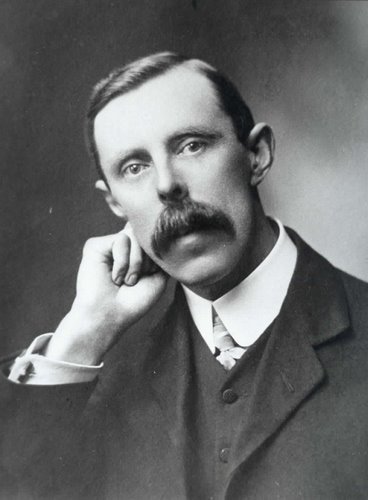
Image: Stella and Frank Boreham, Hobart, Australia.
 Barbara Frame wrote an article on Boreham book collections for Nga Purongo: New Zealand Libraries-The Journal for Library & Information Management, Vol 49, No. 12, March 2005.


