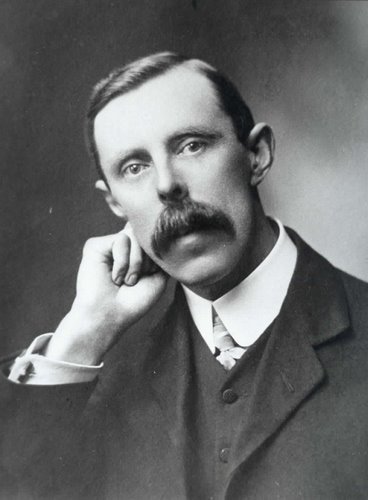
Frank William Boreham 1871-1959

Frank William Boreham 1871-1959
A photo F W Boreham took of himself in 1911
Showing posts with label Everyday Life. Show all posts

Tuesday, May 08, 2007

F W Boreham on a Theology of Human Living

One of F W Boreham’s major themes could be described as a theology of human living.

Boreham wrote human-centered editorials, not just because of the “insatiable passion for personalities”, which would make his writing popular but because he wanted to offer theological reflections on human living.[1] He shared Montaigne’s conviction that “our great and glorious masterpiece is to live appropriately.”[2] Through many editorials, Boreham focused on the wide range of ordinary human experience, including worry, hardship and pleasure,[3] the broad spectrum of human responsibilities, including Henry Drummond’s triad of love, work and worship[4] and thoughts on the distinctiveness of the “human instinct” and the “human element.”[5]

While most of Boreham’s editorials struck a positive note, in the latter part of his life he occasionally discussed issues such as human suffering,[6] the “problems and perplexities of human life”[7] and the difficulties people faced during special periods like wars and the Great Depression.[8] His human-centered editorials often gave the impression that Boreham’s theology had only personal or private dimensions. Many of the personalities he discussed, however, were representative figures who served as symbols activities and values in different parts of the public domain.

Geoff Pound

Image: F W Boreham wrote articles on theology connecting with daily work.

[1] F W Boreham, Mercury, 8 September 1956.
[2] Montaigne, Michel de, The essayes of Michael Lord of Montaigne. Translated by John Florio (London: George Routledge & Sons, Ltd., 1891), 570.
[3] Boreham, Mercury, 9 February 1957.
[4] Boreham, Mercury, 22 January 1949.
[5] Boreham, Mercury, 9 February 1957.
[6] Boreham, Mercury, 16 November 1954.
[7] Boreham, Mercury, 23 July 1955.
[8] Boreham, Mercury, 18 October 1941.

Friday, April 27, 2007

Boreham Points to Daily Life

While F W Boreham pointed his readers to some special spheres where he had found great delight, “the deuteronomy of daily life”[1] was the area he believed was most accessible and offered “a virgin field of novelty and freshness.”[2]

Others, like author Elizabeth Dreyer, who have drawn attention to studying the spiritual in the ordinariness of life, have highlighted the way this focus “reminds us that the reach of God has no bounds.” Furthermore, she says, this spirituality which is “located within the human situation” is attractive because it is unspecialized and devoid of any ‘churchy’ connotation.[3]

Australian poet Les Murray suggested further reasons for exegeting the everyday, when he said, “Human order has at heart an equanimity …. Christ spoke to people most often on this level … all holiness speaks from it.”[4]

Geoff Pound

Image: “the deuteronomy of daily life” was the area he believed was most accessible and offered “a virgin field of novelty and freshness.” Drinking coffee in the Sudan.

[1] James McAuley, ‘Chorale’, in Les A Murray, Anthology of Australian religious poetry (North Blackburn: CollinsDovePublishers, 1986), 164.
[2] F W Boreham, My pilgrimage, 7.
[3] Elizabeth A Dreyer, Earth crammed with heaven: A spirituality of everyday life (New York: Paulist Press, 1994), 81, 106.
[4] Les A Murray, ‘Equanimity’, Collected poems 1961-2002 (Sydney: Duffy & Snellgrove, 2002), 179.

Saturday, April 21, 2007

F W Boreham on Communication that Connects

As F W Boreham matured and developed in his writing and preaching, his ability to forge connections between faith and all expressions of life became increasingly evident.

Dr Boreham was convinced that people needed a theology by which they might understand and cope with life. Preferring the word ‘philosophy’ over the term ‘theology’, he told his readers, “No man is fully equipped for the struggles of life unless he possesses a philosophy with which to face it.”[1]

Symbolic of his understanding that theology must connect with all areas of life, Boreham wrote editorials on such everyday topics as the philosophy of loss,[2] friendship,[3] change,[4] time,[5] play[6] and art.[7]

To drive home his contention that there must be no crack or cranny of life in which theology was irrelevant Boreham wrote on unusual subjects such as the philosophy of posture,[8] cosmetics,[9] cold steel,[10] ridicule[11] and window-dressing.[12]

Indicative of Boreham’s belief that theology must relate to all avenues of life he wrote articles on the ethics of criticism,[13] failure,[14] appetite,[15] feminine charm,[16] cutlery[17] and photography.[18] However, Boreham did not appear to have any master plan that mapped out the subjects that he would tackle and the topics with which he would seek to make theological connections.

F W Boreham’s everyday, pedestrian subjects conveyed his strong belief that useful theology is not remotely abstract but practical and down-to-earth, not exclusively spiritual but immersed in the humdrum, not reserved for privileged people or special occasions but accessible to everybody and at all times.

Geoff Pound

Image: Have you ever spoken about the deeper truths about cutlery?

[1] F W Boreham, Mercury, 7 July 1956.
[2] Boreham, Mercury, 28 August 1943; Age, 8 September 1945.
[3] Boreham, Mercury, 10 August 1957.
[4] Boreham, Mercury, 1 March 1941.
[5] Boreham, Mercury, 1 March 1941.
[6] Boreham, Mercury, 7 December 1946.
[7] Boreham, Mercury, 13 February 1926.
[8] Boreham, Mercury, 8 June 1940.
[9] Boreham, Mercury, 10 March 1956.
[10] Boreham, Mercury, 29 April 1939; Age, 29 November 1947.
[11] Boreham, Mercury, 27 June 1953.
[12] Boreham, Mercury, 7 November 1923.
[13] Boreham, Mercury, 4 August 1956.
[14] Boreham, Mercury, 26 May 1934; Age, 13 April 1946.
[15] Boreham, Mercury, 17 March 1956.
[16] Boreham, Mercury, 24 November 1931.
[17] Boreham, Mercury, 3 October 1953.
[18] Boreham, Mercury, 16 September 1950.