Frank William Boreham 1871-1959

Frank William Boreham 1871-1959
A photo F W Boreham took of himself in 1911

Tuesday, May 09, 2006

Boreham on Second Fiddles

On my web site This Day With F W Boreham, I have posted the editorial, ‘Boreham on Second Fiddles’. This was the editorial he had appointed for 14 May in his unfinished book in which he intended to have one article for every day of the year.

You can find it at the web address below.

I am in this posting presenting a published essay entitled ‘Second Fiddles’. This was a common theme (as FWB indicates in this piece) but both postings represent the different genre of editorial and essay. The editorial which appeared in the newspaper, the Hobart Mercury, had tight word restrictions. The essay was more extensive. The editorial was written for the general public. The essay, he knew, was written for a loyal readership who had a higher theological literacy, hence, there are more references to the bible, church history and the local congregation.

Enjoy both the editorial and this Boreham essay, entitled ‘Second Fiddles’:


ONCE in a blue moon it falls to the lot of a public man to read his own obituary notice. Mr. Charles Brookfield closes his Random Reminiscences by telling of an interesting experience of the kind. He was laid up at the Isle of Wight with a sharp attack of pleurisy; one afternoon it was rumoured that the malady had proved fatal; and the evening papers rushed out the usual sketches of his character and career. Mr. Brookfield had the satisfaction of lying in bed, propped up by snowy pillows, and reading these lachrymose lamentations and candid criticisms. The latter proved by far the more entertaining. But the climax of the sick man’s enjoyment was reached when, in the columns of a leading journal, he was told that, ‘though never a great actor, he was invaluable in small parts.’ Mr. Brookfield used to say that he regarded that phrase as one of the finest compliments ever paid him.

Some of the world’s best work is done by those who, by no means great actors, are nevertheless invaluable in small parts. They are essentially second fiddles. They have not the perspicacity to see exactly what needs doing, but, once it is pointed out to them, they will exhaust all their energies in the prosecution of the task. They are eager to help, anxious to serve, grateful to be commanded. They are conscious of their own limitations. They know that they can never hope to lead; but, when they find a leader who knows how to win their hearts, they will show their delight by following him through thick and through thin. ‘Dundas is no orator,’ Pitt once said; ‘he is not even a speaker; but he will go out with you in any weather!’ He was a second fiddle. So was Jamie Greenleaf, my old Mosgiel deacon. Jamie was no great actor, but in small parts he was invaluable. I never in my life heard him make a suggestion. He had no more initiative than the chair on which he sat. When a debate was in progress, he sat bewildered and confused. His ready sympathy led him to see the best on both sides; and I have even caught him voting both for the resolution and the amendment. In such an atmosphere he was like a fish out of water. But tell him that, at its last meeting, the Church had decided on such and such a policy, and that somebody would be needed to distribute handbills, or run a message, or visit a distant member, or drive the minister to an outlying township, and Jamie instantly volunteered his services. Sunday might bring with it a snowstorm or a tornado, you would always find Jamie at the church door distributing hymn-books. Was there to be a coffee supper or a social evening? You would always find Jamie preparing the tables and stoking the fire. At the Sunday School picnic it was always Jamie who pitched the tent, hung the swings, and kept things merry. If any special service was approaching—a wedding, a funeral, a mission, or an anniversary—Jamie always gave a ‘cry roon’ at the Manse the night before to see if there were any odd jobs that he could attend to. If you suggested that he should make a speech, he looked terrified; he could not initiate a policy to save his life; yet I doubt if any one in the Mosgiel Church was held in greater affection than was he. In every club, school, society, and congregation you will find men of this fine type. They are essentially second fiddles. Never great actors, they are simply invaluable in small parts.

The cynic will say with a sneer that a second fiddle is a second fiddle because it cannot be a first. It might just as truly—perhaps more truly—be said that a first fiddle is a first fiddle because it cannot be a second. The most striking illustration of this phenomenon occurs in the political history of the nineteenth century. During the memorable period to which I refer, Gladstone was the first fiddle of the Liberals and Disraeli was the first fiddle of the Conservatives. But, at the beginning, the two men were members of the same party. And, as you read Lord Morley’s stately chapters, or any other history of the mental evolution of the two men, you are unable to resist the conviction that they were driven into hostile camps by their utter lack of affinity. Each got on the other’s nerves; each felt an unconquerable animosity for the other. Had they continued in the same party, one would have had to be first fiddle and the other second. It was out of the question. Neither could be second fiddle to the other; the idea was preposterous, inconceivable, absurd. And so, beneath the commanding influence of their gigantic personalities, parties were remodelled; the one went to the one side of the House, and the other to the other; and they remained protagonists to the end of the chapter. They stand for all time as a classical exemplification of the fact that, whilst some men are second fiddles because they can’t be first, others are first fiddles because they can’t be second.

Some men, on the other hand, are shaped by destiny to be second fiddles. It is as second fiddles that they shine. They are second, not because they cannot force their way to a leading place, but because they recognize that they can do their best work in a subordinate role. It has been said that Nelson could never have won the battle of Trafalgar but for the assistance and support that he received from Cuthbert Collingwood. On the day that determined the destinies of Europe, Nelson himself was lost in admiration of the heroic part played by his second-in-command. Collingwood, on the Royal Sovereign, led the lee line of ships towards the enemy's fleet, and, first under fire, opened the historic engagement. ‘See,’ cried Nelson, pointing to his colleague's vessel as she steered straight for the enemy's line, ‘see how that noble fellow Collingwood carries his ship into action!’ Let us grant for the sake of argument that, without Collingwood, Nelson could not have destroyed Napoleon's fleet that day. But nobody will deny that, if Nelson had not been there, Collingwood would never have destroyed it. The day was decided by the dazzling genius of ‘the greatest sailor since the world began.’ As soon as the French and Spanish admirals saw the formation of the British lines, they knew that, notwithstanding the superior size, strength, and numbers of their own ships, the battle could end only in one way. They were defeated before a shot was fired. Grant, therefore, as everybody will grant, that Collingwood could not have won the battle without Nelson; and grant, for the sake of argument that Nelson could not have won the battle without Collingwood, and you have only proved that some men are essentially first fiddles, and others, just as essentially, second fiddles. Collingwood was equipped with every qualification for becoming a second fiddle. As a second fiddle he was literally invaluable; as a first fiddle he would have whelmed a continent in appalling disaster.

Or if, preferring to see the same principle at work in less warlike surroundings, the student cares to shift the scene, he will find an identically similar illustration in the cases of Martin Luther and Philip Melancthon. Luther could never have brought the reformation into being but for the work and influence of Philip Melancthon; and, most certainly, Melancthon could never have done it without Luther. Luther was a first fiddle; who can imagine him second? Melancthon was a second fiddle; he had neither the desire nor the ability to be a first.

Everything depends upon the correct arrangement of the first and second fiddles. When, as in the case of Bright and Cobden, the men fit into their right positions at the start, the cause they represent is given an incalculable advantage. When, as in the case of Burke and Wills, the Australian explorers, the second fiddle is given first place and the first second, the situation can only end tragically. Wills was a born leader; it was the one qualification that Burke lacked. Macaulay has shown that, when Sir James Mackintosh was first fiddle and Charles Fox second, the Whig cause lost ground every day; but when they changed places it swept the country. There are men who make excellent lieutenants but poor captains; they are admirable assistants but execrable leaders. They are sent into the world to be second fiddles.

We ministers are specially sensitive at this point. We are generally regarded as first fiddles. Our position involves us in a prominence that is out of all proportion to the value of our service. Every day of our lives we become increasingly conscious that the real glory belongs to the second fiddles. The secretaries, the treasurers, the office-bearers of our churches—the men who, year in and year out, cheerfully devote their time, their energy, their wealth, and their ability to the service of the sanctuary—the men who, in many cases, bore the burden of responsibility before we ministers appeared, and will continue to bear it after we have vanished—how could the Church exist without these? They are the pride and the comfort of every minister and of every congregation.

And what of the men who are quaintly termed ‘the local preachers’? Consult the records of any congregation in Australia or New Zealand, and, before you have turned many pages, you will find yourself reading the annals of a time when a few devout souls met in a barn or a kitchen and received gratefully the ministrations of earnest laymen whose hearts had been divinely touched and whose lips had been divinely opened. In the early history of every church there were the gravest difficulties to be encountered and the fiercest prejudices to be overcome. In the nature of things, there were no ministers on the scene, and the positions were bravely and cheerfully taken by busy men—farmers, smiths, clerks, shopkeepers—who, although deeply conscious of their scanty equipment and meagre qualifications, were of faith so fine and sense so sound that no discouragement ever damped their ardour and no opposition ever daunted their determination. When the Churches look proudly round at their prosperity, and joyously recount the mercies that have crowned past years, they do but advertise their base ingratitude if they omit an eloquent allusion to the priceless spirits of these valiant men.

I am very fond of Richard Jefferies. My old friend, J J Doke, who laid down his life pioneering in Rhodesia, once advised me to sell the clothes from my back, if need be, in order to possess myself of Field and Hedgerow and the other treasures that our great naturalist has left us. My only sorrow, as I have read these classics of the countryside, has been that Jefferies hated churches and ministers. He turned his back on a church whenever he caught sight of it, and loved to look out upon the sea because there, he said, he could be sure that the horizon would be disfigured by no steeple. Yet even Jefferies found it impossible to withhold his admiration from the local preacher. In his Wild Life in a Southern County, he describes the varied phenomena of a Sussex hamlet. And how can he honestly portray the moving panorama of village life without making some reference to the cottage meeting? He pictures the quaint little room—its old-fashioned furniture and odd assortment of books. There is a Bible among them. Hardly a cottager, Jefferies says, is without his Bible. And no man can interpret that cottage Bible like the local preacher. ‘The good man has been labouring in the hayfield from dawn till dusk; but at night he faces without any sign of weariness the devout folk who gather to hear him. He opens the Bible, and, though he can but slowly wade through the book, letter by letter, word by word, he has caught the manner of the ancient writer and expresses himself in an archaic style not without its effect. There is no mistaking the thorough earnestness of this cottage preacher; he believes what he says; no persuasion, rhetoric, or force could move him one jot. Men of this kind won Cromwell's victories; but to-day they are mainly conspicuous for upright and irreproachable moral character, mingled with some surly independence; such men are not paid, trained, or organized; they labour from good will in the cause.’ Thus Richard Jefferies, scorning the Churches, doffs his cap to the local preacher. I range myself, bare-headed, beside him, and am grateful to have found another point of kinship with a teacher to whom I owe so much.

I once preached a long series of sermons on Second Fiddles. I could not help it. Paul makes so much of them. At the end of his very greatest letter he devotes a whole chapter to Second Fiddles. ‘I commend unto you Phebe our sister,’ he says; and then he goes on to a long list of people who, none of them great actors, were all of them invaluable in small parts. Take Phebe herself. In days when travelling was particularly hazardous, when means of locomotion and postal services were unknown, she, a woman, carried Paul’s letter all the way from Corinth to Rome. Only a first fiddle could have written the Epistle to the Romans; but how would that epistle have benefited the people to whom it was addressed unless a second fiddle had risked her life to deliver it? ‘Paul had a multitude of noble qualities,’ says William Brock, ‘and he had one quality which great men do not always exhibit; he never forgot a kindness, and never forsook a friend.’ And everybody knows why. It was because Paul had sat at the feet and caught the spirit of One who takes good care that no cup of cold water given in His name misses its reward. To Him the players of small parts—the Second Fiddles—are precious beyond price.

F W Boreham

Image: First and second fiddle.

Boreham's editorial on The Second Fiddle can be found at:
http://thisdaywithfwboreham.blogspot.com/2006/05/14-may-boreham-on-second-fiddles.html

Monday, May 08, 2006

Boreham on John Broadbanks

If you have read several of the books by F W Boreham you will not be the first person to have asked the question, “Who was John Broadbanks?” Helen, a frequent reader of this web log, has recently asked the question and specifically enquired as to whether I had asked the question of Dr Boreham’s son, Frank Boreham Jnr. Here is my response.

From his books these are some of the details we can glean. The Rev John Broadbanks was a neighboring minister at Silverstream when Boreham was pastor at Mosgiel,New Zealand. Both of small towns are real places (there is a photo of Silverstream in Boreham’s booklet, ‘The Empty Pitchers’) and are about 10 kilometers apart, from memory). Boreham doesn’t say but it would seem Broadbanks was a Presbyterian minister.

Boreham and Broadbanks were close friends and on their day off (Monday) they alternated their weekly meetings at each other’s manse. They went on shooting expeditions, holidayed together, visited churches in outlying areas, swapped sermon ideas and shared the deep things on their hearts.

Broadbanks appears to have been older than Boreham. He was married to Lilian and their daughter, nicknamed Goldilocks, is mentioned in one of Boreham’s essays. Boreham once wrote: “The best debater that I ever knew was John Broadbanks.” In another essay he wrote that John Broadbanks had “a superb gift of mimicry and was a fine actor.”

John Broadbanks suffered a breakdown in health (so did FWB) and came to the resolution that he would be faithful to the basics of ministry and not take on every invitation (again, Boreham’s personal resolve).

John’s death had a profound effect on Boreham, leading him to write, “With the passing of John Broadbanks I myself must pass.” This book, ‘The Passing of John Broadbanks’ was published at the time of Boreham’s retirement in 1928 and was to be his last book. A couple of years later a new book appeared (he suffered from an ‘incontinent pen’) and he went on to write another twenty books!

F W Boreham used the profits from his books and preaching to establish and fund the ‘John Broadbanks Dispensary’, in Birisiri, East Pakistan (now Bangladesh). Calling it by this name was a way of diverting attention away from himself.

What did F W Boreham say about John Broadbanks? T Howard Crago, his biographer, asked him this question and his answer was quite unclear!

When I quizzed Dr Boreham’s son, this is what Frank Boreham Jnr. said:
“I have given a lot of thought to the person of John Broadbanks and I talked to Howard Crago about it. There is a general consensus that when my father wanted to introduce a character e.g. his wife and did not want to refer to my mother she would be John Broadbanks. Sometimes he would be John Broadbanks. He talked about it. My father refers to Silverstream, the place where John Broadbanks lived, because when you go there the manse is right on Silverstream. So when he wanted to talk about himself he talked about John Broadbanks.”

I agree with this conclusion and find some support for this literary technique among some of Boreham’s literary models. Here is what I wrote a few years ago on this subject:

One of Boreham’s famous fictional characters was the enigmatic, John Broadbanks,[1] In Boreham’s development of John Broadbanks it is possible to see traces of the Dickensian “tendency toward multiple projection”[2] and the way Dickens developed “sides of himself in all the major figures in his moral and social spectrum, male and female, young and old.[3]

Boreham concealed his thinking behind the guise of ‘John Broadbanks’ and particularly in his editorials he displayed a [Mark] Rutherford-like restraint in refraining from references to himself. A [rare] example of authorial disclosure is found in an editorial about Catherine Booth which Boreham implies that he had attended her funeral.[4]

It may have been Boreham’s immersion in the Scottish province of Otago that led to his acquaintance with a variety of Scottish writers who left their mark on his writing style. Among these was James Matthew Barrie whom Boreham described, with his characteristic use of superlatives, as “the most distinctive, most outstanding and most lovable figure of his time”.[5] Perhaps it was Barrie’s popularity in immortalising obscure Kirriemuir and projecting himself in the “impish McConnachie” that led Boreham to write his essays about country town Mosgiel and project another side of his personality into the character of John Broadbanks.[6]

Like Boreham, temperamentally “shy and sensitive”, Barrie’s great gift was “the ability to invent and tell a good story”.[7] Boreham alluded to the virtues of restraint and anonymity which were most evident in his editorials when he said of Barrie, “There is a sense in which he never speaks of himself: there is a sense in which he puts himself into every word that he utters. Therein lies his charm”.[8]

For literary license and Boreham's personality makeup it would seem that John Broadbanks was a fictional character who is made to take on different personalities at different times, be a spokesperson for wisdom and an exemplar of good living. Still, John Broadbanks remains a mystery.

While the identity of John Broadbanks is enigmatic this should not prevent us from benefiting from his contribution. Jeff Cranston expressed it well in a recent posting on this site:

“There is much wisdom and insight to be gained for every minister as the reader meets Pastor John Broadbanks of Silverstream, surely one of the choicest ministers who ever lived. He and Boreham were inseparably linked in life; you will delight in learning about John. His knowledge, expertise, and sagacity will be a boon for every minister struggling with the daily challenges presented by both the ministry and people.”

Geoff Pound

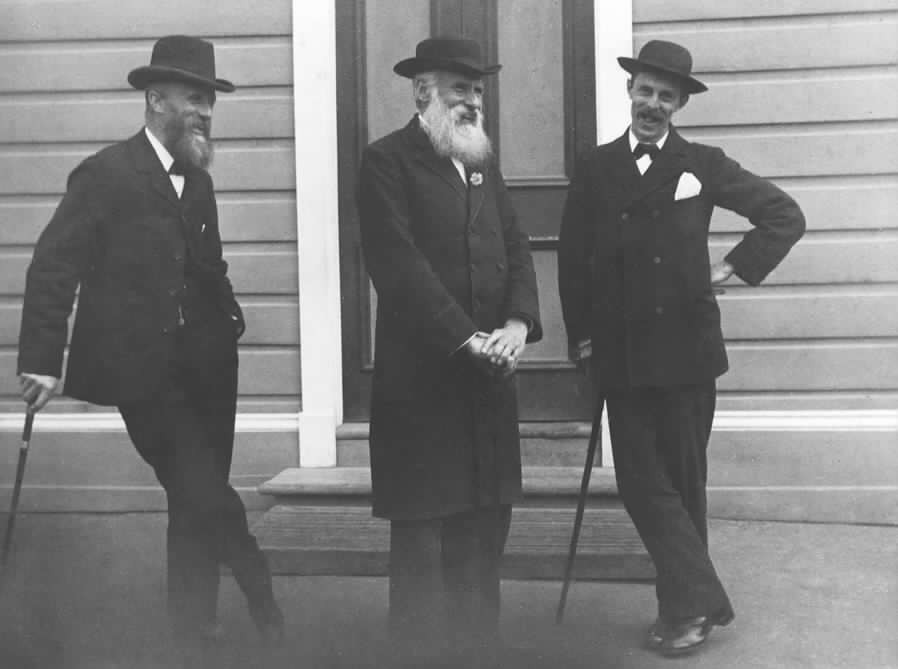
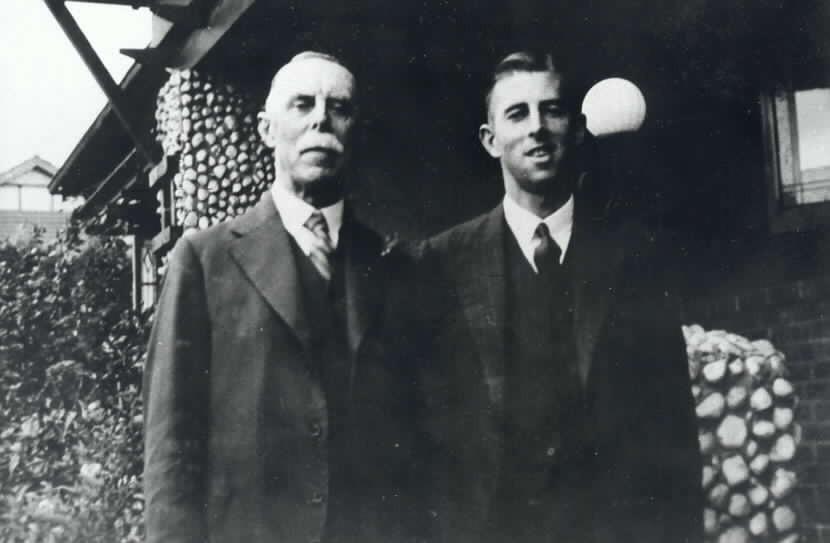
Image: Boreham is on the right but is John Broadbanks one of the other two?

[1] For examples of the way Boreham developed the Broadbanks figure see Boreham, Ships of pearl, 163, 223. An analysis of the Broadbanks phenomenon is found in Crago, The story of F W Boreham, 98, 74, 225.
[2] A Welsh, From copyright to Copperfield: The identity of Dickens (Cambridge; Harvard University Press, 1987), 28, 45.
[3] M Golden, Dickens imagining himself: Six novel encounters with a changing world (Lanham: University Press of America, 1992), 4.
[4] Boreham, Mercury, 4 October 1947.
[5] Boreham, Mercury, 9 May 1942.
[6] Boreham, Mercury, 9 May 1942.
[7] James A Roy, James Matthew Barrie: An appreciation (London: Jarrolds Publishers, 1937), 48.
[8] Boreham, Mercury, 9 May 1942.

Sunday, May 07, 2006

Boreham on Seeing the World in a Grain of Sand

This is the third of three postings by David Enticott who has been studying the early influences on the developing preaching style of F W Boreham:

The second and more pervasive impact of nature on his preaching was that it taught him to be curious. Boreham valued the instinct of curiosity highly.[1] It was to become an invaluable tool both for the preparation and content of many sermons. He was able to gain spiritual merit or value from a simple phrase or word. His sermons sought to probe the hidden depths of spiritual matters.

Therefore, more than providing illustrations, the natural world gave Boreham a curious spirit. It was detailed and contained surprises that could be unravelled. For Boreham the scriptures held a similar kind of detail. He was able to take, and sometimes even twist, a single phrase or sentence from a text into several different places and meanings. He had a photographer’s eye for minutia, for hidden shapes and colours. Of course sometimes this would not exactly accord with what the text itself was saying. For example on the 10th of December 1893 he preached a sermon at Theydon Bois[2], which was based on a simple sentence of scripture: “Beware! Lest thou forget the Lord” (Deut. 6:12). From these six words he constructed five points: “to forget God: is to miss the chief object of life, is Satan’s most subtle temptation, is to abandon hope, is to forget all that’s worth remembering, is impossible.”[3] One sentence had been not only expounded, but expanded as well, to cover a variety of topics. It had unfolded and opened up, like many things in nature.

It was only in his later years that Boreham allowed this sense of curiosity to spread from himself to his congregation. Perhaps part of the reason for his initial reluctance to feed the theme of creation into his sermons, was that Boreham believed at this stage of his ministry that nature was restricted in terms of revealing God. He said that it was “the shell and not the kernel, …the part and not the whole.”[4] It could not meet the deepest needs of a person’s soul.[5] Boreham’s earliest sermons allowed little room for the imagination. They were more often direct appeals for holy living or conversion. It was only in his later years that his messages were seasoned with truths from God’s creation when he came to view the natural world as being a place of revelation.

With time Boreham learnt to flavour his sermons with metaphors that granted room for different interpretations. [6] Nature assumed a leading role. He let the natural world speak for itself and for God. In his copy of his book Mushrooms on the Moor, Boreham wrote in his own handwriting a poem from William Blake’s Songs of Innocence that argues for the sufficiency of nature as God’s spokesperson:


“To see a world in a grain of sand
And heaven in a wild flower,
Hold
infinity in the palm of your hand
And eternity in an hour.”[7]

David Enticott

Image: Grains of Sand

[1] Boreham commented that “the world owes more than it can ever acknowledge to the instinct of curiosity, and so do I.” In: F.W.Boreham, The Home of the Echoes (London: The Epworth Press, 1921), 25.
[2] F.W.Boreham, “Beware! Lest thou forget the Lord.” Sermon, Theydon Bois, United Kingdom, 10 December, Preacher’s handwritten sermon manuscript.
[3] ibid.
[4] F.W.Boreham, The Baptist Pulpit XXIV. The Whisper of God (London: Arthur H.Stockwell, 1902), 10
[5] F.W.Boreham, The Golden Milestone and Other Bric A Brac (London: Charles H.Kelly, 1915), 121-5. Here he wrote that while “nature is very, very beautiful”, “there are things for which my soul is aching, but which neither bush nor beach can give me.” “I need a Saviour.”
[6] One of Boreham’s models for preaching, F.B.Meyer wrote in the introduction to F.W.Boreham’s first book that “nature is full of analogies to deep spiritual truth, though it needs the purged eye to behold them.” In: F.W.Boreham, Won to Glory: A Review of the 24th Chapter of Genesis (London: Marshall Brothers, 1891), introduction.
[7] This handwritten note is contained on the inside cover of Boreham’s own copy of his book Mushrooms on the Moor. In: F.W.Boreham, Mushrooms on the Moor (London: Charles H.Kelly, 1915). Copy held in the F.W.Boreham Collection in the Whitley Library, Royal Parade, Parkville.

Saturday, May 06, 2006

Boreham on Nature: Nature on Boreham

This is the second of three postings by David Enticott from his Masters Qualifying essay on the early influences on the preaching of F W Boreham.

The impact of nature on F W Boreham’s preaching, from 1891 to 1895, was borne out in two ways. Firstly there were some illustrations in his sermons that referred specifically to the creation, such as “snow on cottages.”[1] This was a pervasive image of newness in Christ that covered everything- all sins and mistakes. Another strong picture from the environment contained in these early sermon manuscripts, was called “arctic rivers.”[2] Here Boreham included a quotation to elaborate on what he meant. The quote stated: “Some Christians like the rivers which flow into the Arctic Ocean are frozen over at the mouths.”[3] Again this scene from nature may have been an effective illustration, as it could have been easy for a listener to picture what a frozen river might look like. To visualise an Arctic landscape filled with snow and icebergs.

Despite these references, it was only in his sermons after 1895 that Boreham allowed nature to have free reign.[4] As an example of this, on the 4th of February 1894 he delivered a message at Theydon Bois which was entitled “A word fitly spoken.”[5] The text for the day was Proverbs 25:11 and the headings chosen related both to the passage and the audience. It was a literal reading of the verse. By the time he reached Hobart and gave the same sermon in 1910, the title and headings had changed dramatically. The new theme was freed from a literal interpretation and modified to “Lips like Lilies.” [6] The headings read: “Some like thistles, some like poppies, some like violets, some like daisies.”[7] He thought that a person’s use of language could be thorny, misused, loving or divine. Nature was his means of explaining the point and as such it had been given its full voice. Here were the flowers and colours of the common at Tunbridge Wells coming to life. This use of the real world also allowed for the possibility of different interpretations, as a metaphor can be understood and pictured in different ways.

These relatively sparse references to the creation in his early sermons were nearly always used to illumine a theological or practical issue. When he spoke at Theydon Bois on the theme of Christians being released from condemnation,[8] Boreham used a scene from the natural world to make his point. Here there was a graphic backdrop of waves, wind and thunder, that only Christ could abate.[9] Such references to nature were still rare by the time Boreham left England in 1895. In his final four sermons at Theydon Bois in late 1894 he only used one illustration from creation.[10]

David Enticott

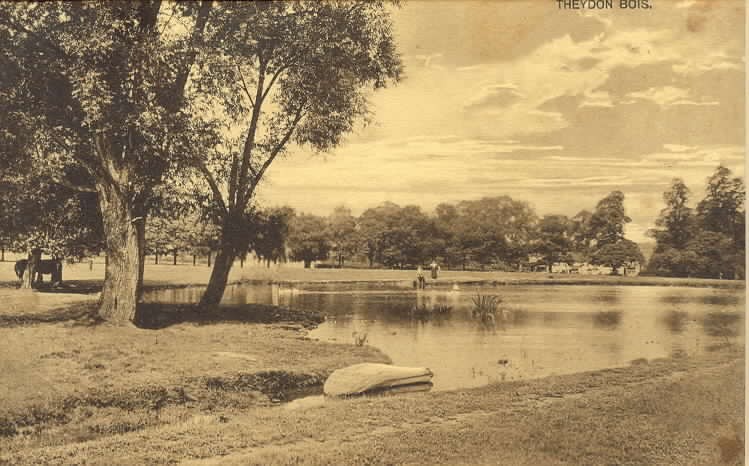
Image: From a Postcard of Theydon Bois in the F W Boreham Collection, Whitley College.

[1] F.W.Boreham. 1892. “Walk in the newness of life.” Sermon, Clapham, United Kingdom, 12 June, Preacher’s handwritten sermon manuscript. As with all of Boreham’s manuscripts, this illustration was denoted by a squiggly line underneath the key phrase of the story.
[2] F.W.Boreham. 1894. “A word fitly spoken.” Sermon, Theydon Bois, United Kingdom, 4 February, Preacher’s handwritten sermon manuscript.
[3] ibid.
[4] A notable exception, where Boreham did use nature as a guiding force, was a sermon entitled “Roots, Shoots and Fruits” from Theydon Bois in March 1894. Here he preached on a text taken from Matthew 7:20: “wherefore by their fruits ye shall know them” and said that Christians should be known not by their roots, or shoots but instead by their fruits. In this message he teased out some of these links with the natural world by holding that “it is well to be reminded that we are not saved by profession, sap brings shoots: not shoots sap.” In: F.W. Boreham. 1894. “Roots, Shoots, Fruits.” Sermon, Theydon Bois, United Kingdom, 25 March, Preacher’s handwritten sermon manuscript.
[5] ibid.
[6] F.W. Boreham. 1910. “Lips like Lilies.” Sermon, Hobart Baptist Church, Australia, 25 May, Preacher’s handwritten sermon manuscript.
[7] ibid.
[8] F.W. Boreham. 1894. “No condemnation.” Sermon, Theydon Bois, United Kingdom, 20 May, Preacher’s handwritten sermon manuscript.
[9] In this sermon Boreham said that Christians were accused but not condemned. To show what it was like to be accused he drew a mental picture for his hearers. This started with a lifeboat that was tossed about by the waves and the wind. There were clouds overhead and the sound of thunder all about. Christ was the one to bring relief in the midst of this dramatic scene. The clouds, waves and thunder may have provided his message with a convincing natural backdrop to the point he was trying to make- that Christ was able to rescue a disciple from danger, from condemnation. In: ibid.
[10] This was contained in a sermon on the second coming of Christ entitled: “Behold! I come quickly” taken from Revelation 22:12. The reference was to the impact Christ’s second coming would have on the “heavens- earth- sea.” F.W.Boreham.1894. “Behold! I come quickly.” Sermon, Theydon Bois, United Kingdom, 17 June, Preacher’s handwritten sermon manuscript.

Friday, May 05, 2006

Boreham on Tunbridge Wells

Over the past twelve months the Rev David Enticott, from the Mordialloc Baptist Church in Victoria, has been spending some time researching F.W. Boreham’s sermons. His specific task was to examine the influences prevalent in Boreham’s earliest sermons from 1891 to 1895. These messages were delivered at a variety of churches through the United Kingdom, in areas such as: Clapham (in London), Theydon Bois (on the outskirts of London and Boreham’s first placement as a pastor) and Tunbridge Wells (his childhood home.)

A number of these original sermon manuscripts are contained in the archives of the Baptist Union of Victoria. David is now undertaking a master’s thesis, with a view to examining both the influences and changes evident in Boreham’s preaching throughout his ministry career.

The following articles are excerpts from David’s Masters Qualifying essay, which I have had the privilege of supervising.

I have (with David’s permission) carved his offering into three postings. Thank you David for this contribution:

Frank William Boreham was born to Francis and Fanny Boreham on the 3rd of March 1871. He was raised in the village of Tunbridge Wells, Kent, which is located an hour’s train ride south of London. Today Tunbridge Wells remains a picturesque village, surrounded by lush English countryside. A large common, or public garden, still dominates the western side of the town, as it did in F.W. Boreham’s time.

The captivating beauty of F.W. Boreham’s surroundings in the Kent of his childhood was to have an influence upon his preaching. He encountered nature in a variety of ways. The experience of walking to church had just as profound an effect on him as did each service itself. It was a place to encounter God. His father Francis was a keen walker, and on many occasions he would find a new way to walk to the Sunday worship service. Each moment in nature was an experience to be savoured for the young F.W. Boreham.[1] It was sacramental, a place resonant with God and grandeur. The family also went out for walks on Saturdays. Francis[2] would season these hikes by means of using his “racy conversation about nature.”[3] The key was to observe one’s surroundings. F.W. Boreham was taught to cherish the natural world.

Later, when Boreham returned to Tunbridge Wells on a trip from New Zealand, he described its surrounds as follows:

“Its sylvan valleys, bespangled with primroses and bluebells and violets,
its fragrant hedgerows aglow with the hawthorn and the honeysuckle; its
exquisite parks carpeted with an infinite variety of ferns and flowers; its
verdant and undulating common…its magnificent forests; its romantic walks; its
arching avenues; its giant rocks and dainty mosses…”[4]

These are the notes of someone who as a child was an observer, who paid attention to his environment. However, although nature was an influence on his preaching, it did take time to develop.

(To be continued)

[1] He wrote that: “We always set out.. in a perfect fever of curiosity and every step of the way was made brimful of interest.” In: F.W.Boreham, The Other Side of the Hill (London: The Epworth Press, 1917), 113.
[2] His Father worked in a local legal firm and the family grew up in relative comfort. Their home at 134 Upper Grosvener Road had eight rooms and two stories. Crago, The Story of F.W.Boreham, op.cit., 19.
[3] ibid., 21.
[4] FW Boreham, Loose Leaves: From The Journal of my Voyage Round the World (Mosgiel: “Taieri Advocate” Office, 1902), 44.

David Enticott

Image: Tunbridge Wells Common. Photo taken by David Enticott.

Thursday, May 04, 2006

Boreham on A First Mate

In my last article I posted the tribute I gave at the funeral of F W Boreham’s son, Frank Boreham.

In this article I present excerpts from the tribute I gave at the funeral of Betty, Frank junior’s wife (who died in 2003).

Betty was a woman given to hospitality, an interested listener, a person of prayer, intelligent and self-effacing. She was an avid reader and, with Frank in their latter years, a great traveler. Betty would write up their travels in her journal while Frank recorded scenes on his video camera.

These are portions of what I said at the Kew Baptist Church (the church FWB went to on his retirement and the church where Frank and Betty worshipped and served for most of their lives):

“They (Betty and Frank) were generous with what they had been given. Together they donated cabinets and memorabilia to the Armadale Church and Whitley College to further the work of Frank’s father.

They contributed to the establishment of the F W Boreham Training Centre at the ABMS in Auburn [Melbourne]. They had a world wide interest and God only knows the missionaries and Christian workers that they supported.

Betty’s generosity, her care, her hospitality, her positive attitude and her commitment to learning are all qualities that sprang from her deep faith in God.

While there are many that remember the literary contribution of her father in law, whom she admired greatly, there are very few who realize the work of Betty Boreham behind his manuscripts.

The proofs of one of the fifty-five Boreham books would arrive from the Epworth Publishing Company and in the few days that the ship was at Port Melbourne before returning to England, F W Boreham had to complete the proof reading. Who did he call? This author relied so many times on the services of Betty who with her eagle eye was sharp and thorough.

He so much appreciated this work she did. For me this typified the contribution that Betty made in life. Not centre of stage, her work was largely unsung yet her contribution behind the scenes was absolutely essential.

Dr Boreham entitled one of his essays to The First Mate as distinct from the skippers and the captains who usually win the accolades. In this essay in which he writes about the people who helped writers and politicians he concludes with these words:

“One of these days the worth of the world's workers will be justly and accurately assessed. It will be a day of the most startling and sensational surprises; and not least among its astonishments will be the disclosure of the immensity of the debt that the world owes to its first mates.”

On that day the full disclosure of Betty’s service will be revealed and we shall understand more fully the immensity of the gift that Betty has been to us and we shall be truly thankful!”

Geoff Pound

Image: The Kew Baptist Church in Highbury Grove, Melbourne. I am disappointed that I do not have a photo of Betty.

Tuesday, May 02, 2006

Boreham and Son

In his auto-biography, F W Boreham quotes Mark Twain when saying, that people should be careful in the choice of their parents! With this in mind I write a commendation of Frank Boreham junior, in the choice of his parents, F W and Stella Boreham.

The following is the eulogy that I gave at the funeral of Frank Boreham junior in 2001.

I wonder what things surface in your mind as you ponder today, the life of Frank Boreham? Hasn’t it warmed our hearts to recall the pleasure Frank gained through sport, film and collecting, his record in commerce, his contribution to business, his faithful commitment to the church and his devotion to his family?

I find it hard to think of Frank without thinking of Betty [his wife], because didn’t they do so much together? They enjoyed their own space and they cultivated their own interests but they extended hospitality together, they initiated social gatherings together, they coordinated holidays with friends together, they traveled with this wide eyed interest in the world together and they delighted in telling their stories together on their return.

They often invited me to their home at the Templestowe Orchards and over these times I came to know Frank as a fascinating storyteller, a person with a keen wit and a thoughtful friend.

Frank and Betty inspired me because even in their seventies they were galavanting around the world and they had this unquenchable thirst to drink in beauty, to appreciate wonder and to keep on being people who were forever learning and always growing. I found this most impressive!

For Frank and Betty their friendship with God was something that flowed naturally out of who they were. I loved the way that at lunch Frank would invariably give the same grace. A prayer that his father had often always prayed. I wonder if you know it?

Back of the loaf is the snowy flour,
And back of the flour is the mill,
And back of the mill is the wheat and the shower,
And the sun, and the Father’s will.
For mill and flour,
And sun and shower,
We give You thanks, O Lord. Amen.

This personal faith that Frank and Betty possessed was fleshed out in so many ways, not the least in their gift of time and friendship and resources. They demonstrated a breadth of concern. They gave generously to Whitley, the Baptist College, the Australian Baptist Missionary Society and other groups that trained people for Christian ministry in this land and overseas.

Having the Boreham name was to Frank a privilege and a responsibility although it wasn’t until later in life that he came to realize how famous his father had become through authoring more than 50 books, writing weekly editorials for the Otago Daily Times, the Hobart Mercury and The Melbourne Age for more than 50 years and as a much loved pastor and international speaker.

Because his father had this insatiable itch to write, there’s a lot that we know about Frank’s childhood. In fact on the day of his birth F W Boreham started a journal for young Frank that he kept going for his son for 16 years!

On the first day he tells with a great flourish of Frank’s birth in Hobart. Later he writes about the name they gave him. After several months he writes about changing his name to Francis Randolph after FW’s close friend in Christchurch.

There’s the record of holidays in the Dandenongs and playing cricket in Munro Street, Armadale, outside the family home.

While generally reserved about inserting personal and family details in his books there are several instances when Dr Boreham breaks his own rules and writes about looking up at the sky with Frank to view the shape and movement of the clouds.

On another occasion he writes about being with his young son sitting out under the inky sky and watching the stars with wonder. What a great friendship they enjoyed.

In Dr Boreham’s journal that records the last and difficult decade of his life, amid the entries that report the visit to the Boreham home of such famous people as Rita Snowden, Leslie Weatherhead and Billy Graham there are so many notes that read:

“Frank and Betty visited” or “Frank drove me to the doctor” or “Frank helped me with my tax return” and “Frank and Betty had us around for a meal” or “Frank came to get the possum out of our roof!” This last episode goes on for several weeks!

There are so many glimpses of Frank’s practical and unstinting devotion to his frail parents, a commitment that we’ve seen mirrored in Frank’s decision to take Betty to a warmer climate [Cairns, Queensland] to enjoy a better quality of life.

Earlier this morning we laid Frank to rest in the Boroondara soil and we have no need to fear. Many times, I have walked through that cemetery with Frank in search of the family grave and very calmly Frank would point to his own plot and he had a quiet peace about the inevitable. Frank Boreham was not afraid to die!

In fact he often expressed with amusement that in the 1950’s after his sister was buried there his parents would regularly take a picnic and enjoy it in the cemetery! Picnicking in the cemetery! It may sound rather macabre but the people who know that death is not a dead end can even turn a cemetery into a place of celebration!

There are very few people who have a newspaper editorial written about their birth and still fewer whose advent is written up in a book.

Listen to F W Boreham as in his autobiography he sets the scene:

“We had to wait nearly twenty years for a boy. I myself had long abandoned all thought of such a possibility; my wife, on the contrary, never for a moment wavered in her confidence that he would arrive in due course. All through the years she was constantly telling me of the things she would do ‘when our boy comes.’ He arrived just before the outbreak of war in 1914.”
F W Boreham, My Pilgrimage, p191.

Sense the exuberance with which Frank’s father records the actual event:
It’s a boy!’ The thing seemed incredible. Nobody knew what to make of it. We had
spent nearly twenty years on the cultivation of a choice little garden of girls.
But a boy! Who could have dreamed of such an astounding and sensational
development?


I was away at a committee meeting when this bolt fell from the blue. The
doctor’s car gave me the first hint of the excitement awaiting me. A feminine
form was waiting at the gate.


It’s a boy!’ she exclaimed, in breathless amazement.


It’s a boy!’ I was informed by a second emissary when half way up the path.
And, at the top of the steps, stood the nurse in consultation with the doctor,
who was just taking his departure.

It’s a boy!’ they exclaimed simultaneously, on catching sight of me. It is
with unusual confidence, therefore, that I approach my first theme in this new
volume.”
The Fiery Crags, p1.


Friends, if we can understand this earthly father’s longing for a son and if we can appreciate the sheer exuberance that was there at his birth then is it not too hard to believe the Bible when it speaks of heaven as a home and these words of Jesus?

“In my Father’s house are many rooms…And if I go and prepare a place for you I will come again and will take you to myself, so that where I am, there you may be also.”

The longing, the expectation and the love that welcomed Frank Boreham into the world is wonderful but it’s a pale shadow of the longing, the expectation and the sheer delight that has welcomed him at his death.

This is the good news that we celebrate for Frank today. This is the Gospel truth for all who believe—Heaven awaits us! There’s a right royal welcome prepared for us! Thanks be to God!

Geoff Pound

Image: Three generations. F W Boreham with son, Frank and his son Howard (outside FW's home in Kew, Melbourne).

Monday, May 01, 2006

Boreham's Grace

I found it useful listening to members of F W Boreham’s family in picking up scores of snippets about the old man’s life. At my first of many meals with Frank and Betty Boreham (FWB’s son and daughter-in-law) I discovered the prayer that F W Boreham used before meals.

Frank, his son, knew it by heart and invariably prayed this when we dined together at their home. It is sometimes called ‘The Miller’s Prayer’. I wonder if you know it?

Back of the loaf is the snowy flour,
And back of the flour is the mill,
And back of the mill is the wheat and the shower,
And the sun, and the
Father’s will.
For mill and flour,
And sun and shower,
We give You
thanks, O Lord. Amen.


This prayer was written by Maltie Davenport Babcock, who was an author ('Thoughts for Everyday Living', 1901) and a song writer (he wrote ‘This is my father’s world’).

F W Boreham refers to Babcock's grace in an essay and says that he first heard it at a New Zealand farmhouse in his Mosgiel days (F W Boreham, 'I Forgot To Say', 175).

You can find it (or at least the first verse) on many web sites that list Graces. If you want to learn to sing it the music can be found at the following Internet address:
http://gsong.ms11.net/Graces/words/bkbreadb.html

It is a grace of thanksgiving. It is a prayer that opens our eyes to all that is behind the supermarket shelves… the flour, the mill, the wheat, the rain, the sun. This verse gets us right back to the basics, even to recognizing the hand of our Creator and Provider.

Geoff Pound

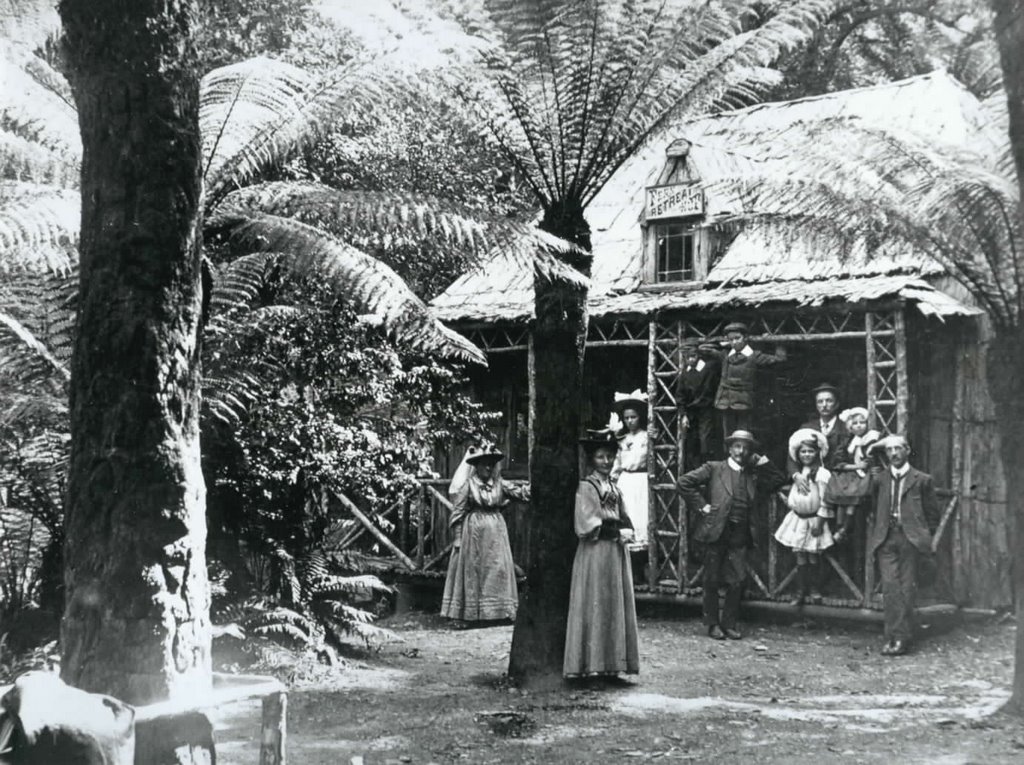
Image: F W Boreham (front left), with his wife (holding down her hat in the wind), their first daughter and a couple of friends around a well. Location? Somewhere near Mosgiel, New Zealand. Date? About 1896.

Sunday, April 30, 2006

Boreham the Editorialist

Editorial Record
On 3 September 1949 readers of the leading daily paper in Hobart, Tasmania, were informed of a remarkable achievement that, “for about 37 years the scholarly editorials of Dr F W Boreham—the one published on this page today is the 2000th—have been a widely read feature of the Mercury each Saturday”.[1] The article highlighted the fact that the long series of editorials by Boreham had commenced “as a stop-gap arrangement” when the then editor died and had continued following the appointment of a new editor. When F W Boreham left Hobart in 1916 for Melbourne, he undertook to send editorials until his successor was appointed. However, the anniversary article reported, that “in the absence of such an appointment the matter has rested on that basis for 33 years”.

From 1934 until 1943, Boreham added to his responsibilities when he wrote two editorials (usually Easter and Christmas) each year for the Melbourne Argus.[2] In 1936, he commenced submitting fortnightly essays to the Literary Supplement of the Age. His writing responsibilities were extended further when in 1945, at the age of seventy-four, Boreham accepted the invitation to write weekly lead editorials for the Age. These essays and editorials to Melbourne’s major daily did not represent entirely new work for Boreham was an unashamed recycler of words and stories.[3] Boreham furnished the Mercury and the Age with weekly editorials until two weeks before his death on 18 May 1959. On the way to the Royal Melbourne Hospital Boreham handed his son a bundle of editorials which supplied the papers with weekly editorials for several months following his hospitalization and death.[4]

I was inspired by F W Boreham’s role and record as a writer for newspapers. That is why I wrote a dissertation focusing on this important part of his ministry. In my thesis I examined the almost 3,000 editorials that Boreham wrote for the Mercury and the Age between 1912 and 1959. The thesis explored the content of the editorials, identified the major themes and tried to elucidate his motivation for writing. These were some of the questions that tantalized me:

Motivation?
Why did Boreham write? What constrained his writing vocation that commenced earlier than his preaching career and continued for several years after his retirement from the pulpit? Several times in jest, Boreham spoke of his “incontinent pen”.[5] Could he not help himself? Was he motivated by a sense of self-aggrandizement and a lust to see himself in print? Did he see himself as educator or entertainer? Did he regard writing as an essential part of his vocation and the outworking of his ordination to the Christian ministry? Was Boreham following a brief established and regulated by the editors of the newspapers or did he enjoy an unshackled literary freedom?

Relationship to Other Genre?
In writing about Boreham’s published essays, Dr Ian McLaren has concluded that “most originated as sermons to responsive congregations”.[6] Similarly, what evidence is there to reveal the starting point and stimulus for Boreham’s editorial writing? Did the regular discipline of sermon writing fuel the weekly editorials or vice-versa?

When in 1954 Boreham received the Order of the British Empire, the citation that accompanied the award read, “In recognition of his distinguished services to religion and literature as preacher and essayist”.[7] This honour suggests a tantalising connection between Boreham’s primary contributions. I have tried to illumine the relationship between the sermons and essays published in Boreham’s books and his newspaper editorials. I looked for clues concerning the methods Boreham adopted in composing material that was used in these different formats.

Style?
As Boreham wrote in the various capacities of journalist, preacher, politician, lecturer, editor, biographer, autobiographer, diarist, poet[8], hymnist[9] and letter writer in addition to essayist, it is good to attempt to distil the essential Boreham literary style and, in particular, the style he adopted in the writing of newspaper editorials.

Recognising Alexander Pope’s expectation, “How the wit brightens. How the style refines”, it is important to mark the development of Boreham’s written style.[10] Boreham often wrote as a literary critic, so what clues can we find as to what he perceived to be an excellent writing style? Who are the writers that Boreham judged to be worthy of emulation and how did they shape his literary style?

Connection with Faith?
The heart of the dissertation focuses on the interplay of faith and life in Boreham’s newspaper editorials. Recognizing that he was a Baptist preacher at the same time as an editorialist, it is intriguing to explore the extent to which Boreham’s articles offer a faith or religious perspective to the readers of the newspaper in a similar way that he did in his sermons and books. Did Boreham consider it appropriate to use his columns to preach and persuade his readers to turn to God and accept spiritual truths?

Who Was His Audience?
A distinctive aspect of Boreham’s editorial writing was the audience that he was seeking to address. His published books and his submissions to Christian magazines and papers could be seen as preaching to the converted. In contrast, however, Boreham’s contributions to the Mercury and the Age were geared to a general readership. In these editorials he had in mind the thousands of people in Tasmania and Victoria who would pick up or have delivered the paper on a Saturday morning.[11] Boreham was greatly aware of the privilege and importance of his role as leader writer and in 1949, concerning his association with the Mercury, he said he was, “Unconscionably proud of the fact that, in 37 years, no article has ever been returned to him and, as far as he knows, no article has ever been altered”.[12]

In the current climate, when there are repeated calls for theology to be worked out and heard afresh in the public sphere, Boreham’s weekly editorials for the readers of two leading Australian newspapers over forty-seven years, make them worthy of attention.

Geoff Pound

Image: A page from the Hobart Mercury.

[1] F W Boreham, Mercury, 3 September 1949. The newspaper editorials are not attributed but for the purposes of this study Boreham is cited as the author of the text.
[2] The Argus was launched in 1846 (eight years before the Age commenced) and it folded in 1957. At the time when Boreham wrote occasional articles for the Argus, it was one of three morning dailies in Melbourne. Boreham wrote a total of fifteen editorials for the Argus.
[3] For further information see L L Newnham, 'Recycling by Dr F W Boreham', Our yesterdays 5 (1997): 70-79.
[4] Frank R Boreham, interview by author, Templestowe, Vic., 26 July 1996. Also C Irving Benson, ‘Dr Frank W Boreham- The man and the writer’, in F W Boreham, The last milestone (London: The Epworth Press, 1961), 10.
[5] F W Boreham, The passing of John Broadbanks (London: The Epworth Press, 1936), 7.
[6] ADB, s.v. “F W Boreham.”
[7] This medal and citation is on display at the F W Boreham Mission Training Centre, Australian Baptist Missionary Society Headquarters, Auburn, Vic.
[8] Poems written for friends and family members appear in Boreham’s personal papers, F W Boreham Collection, Whitley College Library. A patriotic poem written at the British victory in Mafeking appears in T Howard Crago, The story of F W Boreham (London: Marshall, Morgan & Scott, 1961), 86-87.
[9] Crago recalls that Boreham often wrote hymns for services at Mosgiel and Hobart in Crago, The story of F W Boreham, 190. The only published hymn that Boreham wrote is the baptismal hymn, Eternal Father, whose great love, No. 288 in The Baptist hymn book, H Martin, et al, ed., (London: Psalms and Hymns Trust, 1962), 359.
[10] Alexander Pope, An essay on criticism, l. 51.
[11] Most of Boreham’s editorials were written to be printed on a Saturday morning, apart from contributions he was asked to write for special editions geared to ‘red letter’ days such as Anzac Day, Easter or Christmas.
[12] Boreham, Mercury, 3 September 1949.

Saturday, April 29, 2006

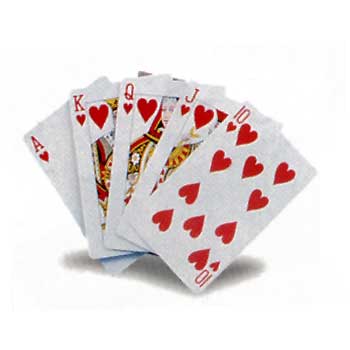
Boreham on the Deck of Cards

Helen, a regular reader of this site has alerted me to an interesting Boreham angle.

In Dr Boreham’s book, ‘The Drums of Dawn’, there is an essay entitled ‘Second Husband’ about a man named Curley. This man, Boreham said, used playing cards as his bible and his calendar.

Helen goes on to write about an old time ‘singing cowboy’, named Tex Ritter, who made a record about an American GI, during WWII, using a deck of cards in chapel for a bible and calendar. The title of the record was ‘Deck of Cards’.

A quick Google search of the Internet has revealed numerous sites (see one below) explaining how one can use playing cards to speak about the Christian message. It also gives information on the singing cowboy’.

One story on this site says that a young soldier was in his bunkhouse all alone one Sunday morning over in Afghanistan. It was quiet that day, the guns and the mortars, and land mines for some reason hadn't made a noise. The young soldier knew it was Sunday, the holiest day of the week. As he was sitting there, he got out an old deck of cards and laid them out across his bunk.

Just then an army sergeant came in and said, "Why aren't you with the rest of the platoon?" The soldier replied, "I thought I would stay behind and spend some time with the Lord." The sergeant said, "Looks like you're going to play cards." The soldier said, "No sir, you see, since we are not allowed to have Bibles or other spiritual books in this country, I've decided to talk to the Lord by studying this deck of cards." The sergeant asked in disbelief, "How will you do that?"

"You see the Ace, sergeant, it reminds that there is only one God.
The Two represents the two parts of the Bible, Old and New Testaments.
The Three represents the Father, the Son, and the Holy Ghost.
The Four stands for the Four Apostles: Matthew, Mark, Luke and John.
The Five is for the five virgins that were ten but only five of them were glorified.
The Six is for the six days it took God to create the Heavens and Earth.
The Seven is for the day God rested after working the six days.
The Eight is for the family of Noah and his wife, their three sons and their wives, in which God saved the eight people from the flood that destroyed the earth for the first time.
The Nine is for the lepers that Jesus cleansed of leprosy. He cleansed ten but nine never thanked Him.
The Ten represents the Ten Commandments that God handed down to Moses on tablets made of stone.
The Jack is a reminder of Satan. One of God's first angels, but he got kicked out of heaven for his sly and wicked ways and is now the joker of eternal hell.
The Queen stands for the Virgin Mary.
The King stands for Jesus, for he is the King of all kings.

When I count the dots on all the cards, I come up with 365 total, one for every day of the year. There are a total of 52 cards in a deck, each is a week, 52 weeks in a year.
The four suits represents the four seasons: Spring, Summer, Fall and Winter.
Each suit has thirteen cards, there are exactly thirteen weeks in a quarter.

So when I want to talk to God and thank Him, I just pull out this old deck of cards and they remind me of all that I have to be thankful for."

The sergeant just stood there and after a minute, with tears in his eyes and pain in his heart, he said, "Soldier, can I borrow that deck of cards?"

There are many variations on how these cards can be used. We may not find the entire card commentary to our theological taste. But it is an interesting way of using familiar symbols and charging them with a deeper meaning.

When I worked for several years in a Prison one of my guests who came inside to assist me with a worship service used the cards in a similar way. I was amazed at the impact his illustrated talk had on that captive audience.

Geoff Pound

Thanks to Helen for the inspiration for this posting.

Site: http://www.snopes.com/glurge/cards.htm

Image: Playing Cards

Tuesday, April 25, 2006

So This Is Boreham: Part Ten

This brings to mind a story Boreham shared. A minister was leaving his church for another charge, when a church member approached him at a farewell reception and said, "Sir, I am sorry to see you go. I never had but one objection to you; your preaching was always too horizontal!" Boreham ties in this parishioner's brutal honesty with the words of Henry Jowett: "We must preach more upon the great texts of the Scriptures; we must preach on those tremendous passages whose vastnesses almost terrify us as we approach them!"

If you are looking for unexcelled conversion testimonies, his Great Texts series is a necessity. Some of the best devotional thoughts penned anywhere can be found in The Tide Comes In. Boreham delves into the Beatitudes in The Heavenly Octave and sheds light upon Luke 15 in The Prodigal. Mrs. Ruth Graham Bell was influenced by The Prodigal and includes a wonderful Boreham story of Dostoyevsky's death-bed scene in her book, Prodigals and Those Who Love Them.

Finally, in one of his rarest and earliest writings, Whisper of God, Boreham reminds the preacher that he must have a vision of Deity before he steps into the pulpit. Preaching must flow from the wellspring that has as its source a personal relationship with Almighty God. Says Boreham, "A man who has no personal experience of the presence and power of God cannot possibly impress others with the august and intense reality of things eternal."

He reminds us of how this truth permeated the thoughts of our preaching forefathers. Boreham shares the words from the journal of an old Puritan divine: "'Resolved that, when I address a large meeting, I shall remember that God is there, and that will make it small. Resolved that, when I address a small meeting, I shall remember that God is there, and that will make it great.'

It is said that, when Chrysostom was composing his sermons, he was wont to fancy that the communion rails around the pulpit were crowded with listening angels. It was splendid inspiration. But the truth is greater still. Dr. Gordon dreamed that, when he preached, the Christ sat in the pew. It is verily so. The preacher needs a vision of Deity as will fill his whole horizon with the grandeur of the Divine, and assure him, in the hours of loneliness and listlessness, of the stupendous fact that God is his witness and Co-worker."

Where do you begin? Just like the rest of us who love Boreham's writings--on your hands and knees scouring second-hand book shops. Be warned! His books are not easy finds, but when one is discovered, the recipient is awash with a sense of instant gratification and accomplishment of a job well done. Those of us in the ministry need that from time to time! Then the reward: relax in a comfortable chair, pour a cup of coffee, (Boreham would prefer that you imbibe with a cup of tea), and settle back. Happy hunting!

Rev. Jeffrey S. Cranston is Senior Pastor of LowCountry Community Church, Hilton Head Island/Bluffton, South Carolina, USA.

Thanks
This is the final instalment of So, This is Boreham. Many thanks Jeff for your permission to publish it here on The Official F W Boreham Blog Site (GP).

Sources
Benson, Irving C. "Dr. Frank W. Boreham--The Man and the Writer." In The Last Milestone, F.W. Boreham, London: The Epworth Press, 1961.
Boreham, Frank W., Jr. Personal correspondence with the author, 01 February 1997.
Boreham, F.W. Cliffs of Opal. Wheels Within Wheels. London: The Epworth Press, 1940.
________. Cliffs of Opal. So This is Moody!. London: The Epworth Press, 1940.
________. Faces In the Fire. The Baby Among the Bombshells. London: The Epworth Press, 1941.
________. My Pilgrimage. London: The Epworth Press, 1940.
________. A Temple of Topaz. London: The Epworth Press, 1928.
________. Whisper of God. The Seer. London: Arthur H. Stockwell, 1902.
Crago, Rev. T. Howard. "Tribute to Dr. F.W. Boreham." The Australian Baptist, May 27, 1959.
The Australian Baptist. "Death of Dr. F.W. Boreham", May 27, 1959.
The Victorian Baptist Witness. "New Mission Centre is Dedicated". July 1995, p. 3.
...next page ________. Scholarships and New Courses. December 1996, p. 14.
Wiersbe, Warren. Walking With the Giants. Chicago: Moody Press.

Image: F W Boreham with his son, Frank, circa 1958 (GP). Frank, Jnr died about three years ago and he with his wife Betty, was very helpful to all those who were seeking to learn about their famous father.

Monday, April 24, 2006

So This Is Boreham: Part Nine

In his essay entitled, “Wheels Within Wheels”, from his book, Cliffs of Opal, Boreham writes to a young man, the son of a ministerial colleague. The young minister had just been ordained and the reader senses a veteran Paul addressing a greenhorn Timothy. Boreham tells our young friend that preaching has "three distinct values." Preaching, he says, should have an entertainment value. This is not to be confused with what comes through our television cable boxes that some call entertainment. Preaching should be of entertainment value in the regard that the preacher should, "at every art of his command...capture and hold the attention of his hearers.

It is not enough that [the preacher] should say what it is his duty to say in the first words that happen to come. He must arrange his matter so attractively, and present it so effectively, that the most listless and languid will be compelled to follow him. There is no earthly reason why actors, [lawyers] or statesmen should state their cases more attractively, more convincingly, or, if you like, more entertainingly, than the preacher.

The art of preaching...is the art of compelling the congregation to listen to your message; and you can only be sure that they will listen if you make it worth their while to listen. The Master preachers - Jesus, Paul, Wesley, Whitefield, Spurgeon, Moody and the rest - knew that they had something to say that was well worth saying."

With a rather unique analogy, Boreham continues, "You will never attract or arrest your hearers by an elaborate display of theology. The prominence of theology in a sermon suggests a slipshod preparation. Theology is what ladies call a foundational garment: it imparts shapeliness and affords support to the drapery of your utterance without itself becoming visible. It is very noticeable that Jesus Himself seldom or never became theological." Preaching should have an entertainment value and therefore, force the listener to pay attention.

Boreham also believed that preaching should have an educational value. It "fill[s] the hearts of people, with thoughts and emotions that were startlingly and sensationally new to them."

"And, as an inevitable climax, [preaching] has evangelistic value." In everything the preacher does - from prayer to preparation to delivery - "it [leads] his hearers to the feet of God."

Jeff Cranston

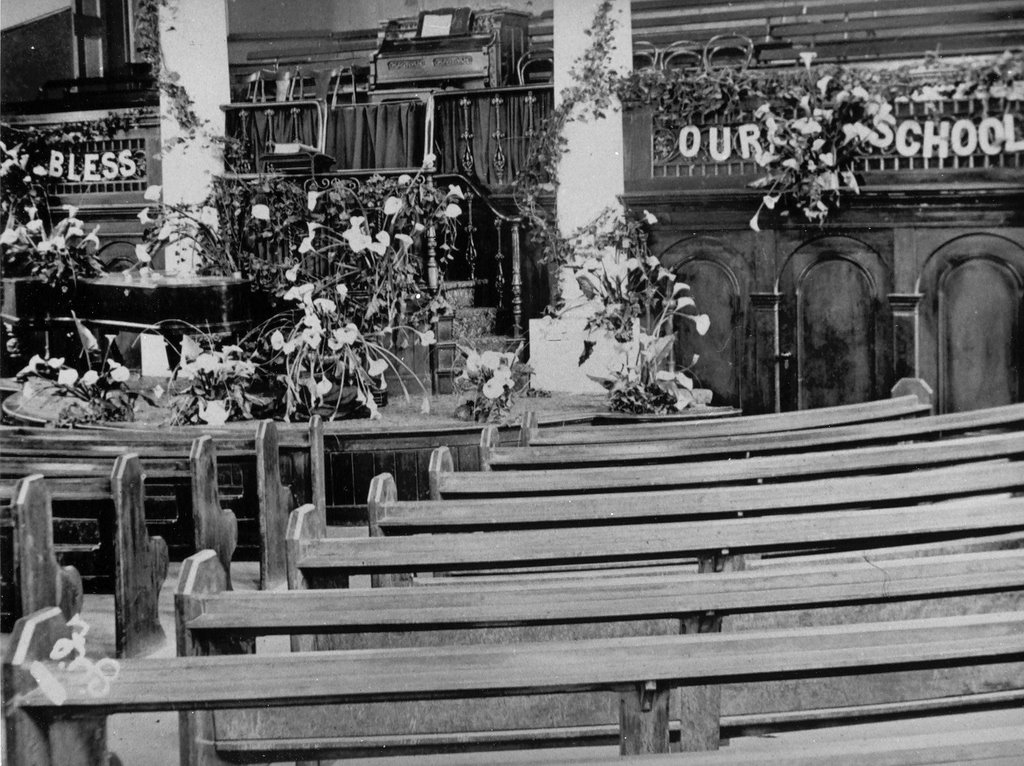
Image: Another photo that FWB took, this one of the inside of the Hobart Baptist Tabernacle on the day of the Sunday School Anniversary. This is a good reminder of Boreham's ability to speak attractively, educationally and evangelistically (GP).

Sunday, April 23, 2006

So This Is Boreham: Part Eight

Boreham preached in numerous pulpits, to a variety of crowds, over the course of six decades. Nuggets for the preacher are buried just below surface level throughout his writings.

One fine day, while on a bush walk in New Zealand with a very eminent preacher, young Boreham was asking advice from the seasoned preacher regarding the art and calling of preaching. His walking partner turned to him, looked him squarely in the eye, and remarked,

"Keep up your surprise power, my dear fellow; the pulpit must never, never lose its power of startling people!"

Let's have Boreham mine the ore and extract the gold: "Is it enough for a preacher to preach the truth? In a place where I was quite unknown, I turned into a church one day and enjoyed the rare luxury of hearing another man preach. But, much as I appreciated the experience, I found, when I came out, that the preacher had started a rather curious line of thought. He was a very gracious man; it was a genuine pleasure to have seen and heard him. And yet there seemed to be a something lacking. The sermon was absolutely without surprise. Every sentence was splendidly true, and yet not a single sentence startled me. There was no sting in it. I seem to have heard it all over and over and over again; I could even see what was coming."

"Surely it is the preacher's duty to give the truth such a setting, and present it in such a way that the oldest truths will appear newer than the latest sensations. He must arouse me from my torpor; he must compel me to open my eyes and pull myself together; he must make me sit up and think. 'Keep your surprise power, my dear fellow,' said my companion that evening in the bush, speaking out of his long and rich experience. 'The pulpit,' he said, 'must never, never lose its power of startling people!' The preacher, that is to say, must keep up his stock of explosives. The Bishop of London declared the other day that the Church is suffering from too much 'dearly beloved brethren.' She would be better judiciously to mix it with a few bombshells."

Jeff Cranston

Image: Boreham, the church planter. Laying the foundation for the Moonah Baptist Church in Hobart, I think from memory, 1908. FWB is in the front (GP).

Saturday, April 22, 2006

So This Is Boreham: Part Seven

Perhaps one of the greatest gifts Boreham shares with preachers is his ability of story-telling. For those of us who stand in the pulpit on a weekly basis, we know the necessity of being able to communicate interesting stories.

Boreham excelled at this. Reading his works and catching the spirit of the man will benefit every preacher.

Boreham's use of the language excels most of what is available to the general reader today.

You will gain a deeper appreciation for the turn and twist of a phrase, the use of a properly presented adjective, and the spiritual truths that spring from the paragraphs near the close of a chapter.

Heed Dr. Warren Wiersbe's advice: "If at first Boreham does not excite you, give him time. He grows on you. He has a way of touching the nerve centers of life and getting to that level of reality that too often we miss. Some may consider him sentimental; others may feel he is a relic from a vanished era. They are welcome to their opinions. But before you pass judgment, read him for yourself and read enough to give him a fair trial."

Jeff Cranston

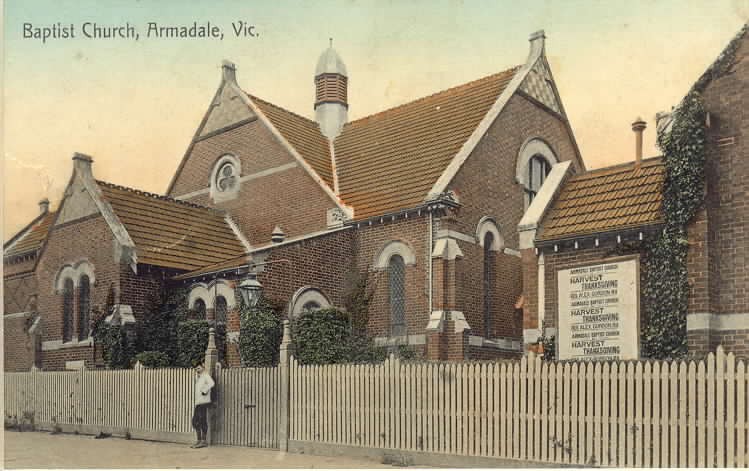
Image: A photo of the Armadale Church, in Melbourne (taken in the Boreham era 1916-1928).

Friday, April 21, 2006

So This Is Boreham: Part Six

Into the life of every pastor come M.G.R. (More Grace Required) parish-ioners. Boreham presents the minister with a stellar example of how to deal with his critics. His close friend, C. Irving Benson, tells us how one day Boreham handed over a very strongly worded letter commanding him to preach the gospel.

Benson said, "[The writer] was apparently misled by one of his intriguing titles. All who heard Frank Boreham knew full well that, however far away on the circumference he began, he always came to the very heart of the gospel. The letter hurt him and I advised he consign it to the waste-paper basket and forget it. 'I have already answered it,' he said. 'I wrote and told her that I appreciated her concern for the preaching of Christ's Gospel and asked her to pray for me that I may be a faithful minister of the Word.'" Every minister needs some of that spirit.

Although he lived a busy life, Boreham was always in control of his schedule and nothing stood in the way of him spending each and every morning in writing and study. His preaching and his writing were closely linked but his books are not necessarily collections of sermons.

Once he was asked which he liked better: to write or to preach? He answered without hesitation that preaching and pastoring held the upper hand. He went on to add, "Of course, it is like asking a man which of his two children he loves best! I glory in my pulpit--the greatest moments of my life have been spent there--but I am scarcely less fond of my pen. I do not like to choose between them. I want to be a preacher and a scribbler to the end of the chapter."

There is much wisdom and insight to be gained for every minister as the reader meets Pastor John Broadbanks of Silverstream, surely one of the choicest ministers who ever lived. He and Boreham were inseparably linked in life; you will delight in learning about John. His knowledge, expertise, and sagacity will be a boon for every minister struggling with the daily challenges presented by both the ministry and people.

Jeff Cranston

Image: This photo was taken by Boreham. It is of a bush scene near Hobart with family (Stella is in the front and the children are theirs) and friends.

Thursday, April 20, 2006

So This Is Boreham: Part Five

His most well-known sermon series came about in a unique way. He tells it best. If you're able, secure a copy of A Temple of Topaz and you shall find printed there, in the foreword, these words:
"One Sunday evening...I was standing in my pulpit in Hobart, Tasmania. The occasion was special and the church was crowded. I was commencing that night my Winter Series of Addresses. The addresses, as the printed syllabus showed, were to be delivered at fortnightly intervals. During the hymn before the announcements, I was deliberating on the precise phraseology in which I should refer to the course on which I was embarking. It suddenly flashed upon me that, by emphasizing the address that was to be delivered a fortnight hence, I was virtually inviting the more casual members of the congregation to absent themselves on the following Sunday. Could I not say a word that would make the intervening Sundays attractive? It happened that, during the week, I had been reading the Life of Luther, and had been impressed by the way in which the Reformation sprang from a single text."

"Whilst I was still engrossed in this brown study, the hymn came to an end and the people resumed their seats. I announced my fortnightly addresses according to the printed syllabus; and then astonished myself by intimating that, on the following Sunday evening, I should commence an alternating series of fortnightly addresses entitled Texts That Made History. 'Next Sunday evening,' I added with extraordinary temerity, 'I shall deal with Martin Luther's Text!'

"At the close of the service, one of my most trusted officers came to me in great delight.’That's a noble idea,' he exclaimed enthusiastically; 'it will be the best series that you have ever preached!' It has certainly been the longest, and the most evangelistic, and the most effective. And it has been the series in which I myself have found the most delight."

This series is composed of 125 messages Boreham delivered on fortnightly Sunday evenings. As a result of these compelling messages, scores of people placed their trust in the Saviour. Kregel Publishing in Grand Rapids, Michigan, has recently reprinted these addresses. Included are the salvation accounts, with the Scripture texts God used, of such notable figures as Abraham Lincoln, Catherine Booth, John Wesley, Robinson Crusoe, Blaise Pascal, John Milton, David Brainerd, William Penn, and Everybody's Text (Jn. 3:16). These delightful histories are readily available and should be in every minister's library.

Jeff Cranston

Image: The Hobart Baptist Tabernacle. Photo taken in the Boreham era by FWB. It is a huge auditorium and was regularly packed out in Boreham's ministry (GP).

So This Is Boreham: Part Four

After twelve fruitful years, the Borehams left Mosgiel and moved to Hobart, Tasmania, to accept the leading Baptist pulpit there.

During his years at Hobart, his writing found an even greater readership. More articles and books flowed from his pen.

His final pastorate was in Armadale, a prosperous suburb of Melbourne, Australia. He settled in nicely there and it was in Armadale where he spent his remaining pastoral years. As his writing became increasingly well known, invitations to speak began to come his way. He ministered all over the world addressing denominational councils and Bible conferences. He maintained his Baptistic convictions but in his heart his outlook was ecumenical. In his autobiography, My Pilgrimage, he writes, "During these years I have preached an almost exactly equal number of times in the pulpits of the various denominations and have felt equally at home in each. Indeed I like to think of myself as a kind of shuttle, moving to and fro, between the Churches and, perhaps binding them a little closer together." He added that he felt his sermons were equally accepted in all the churches. Moving between various denominational traditions fulfilled a lifelong dream of his. He stated at his commissioning service prior to sailing for New Zealand and embarking on his ministerial career, "...it is my hope that in the course of my ministry, that I shall hold three pastorates, and then be free to travel in many lands preaching the everlasting gospel among all denominations."

While speaking at the Church of Scotland's General Assembly in 1936, the moderator, Dr. Daniel Lamont, welcomed him as "the man whose name is on all our lips, whose books are on all our shelves, and whose illustrations are in all our sermons." His heart's desire had come to fruition.

Jeff Cranston

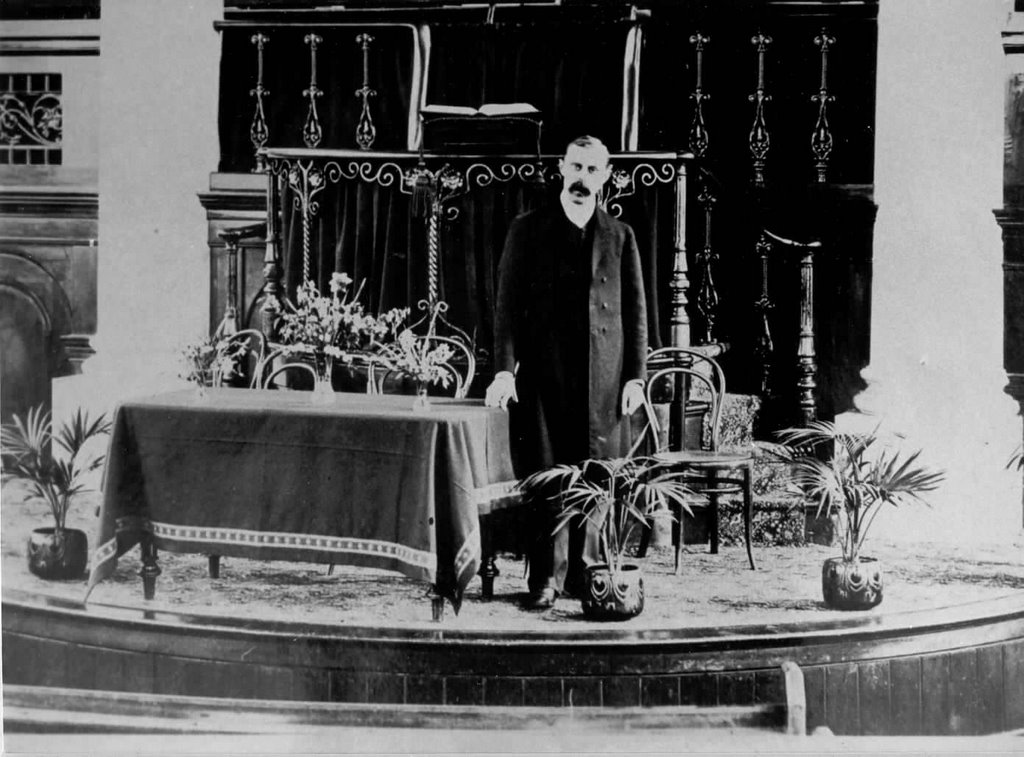
Image: F W Boreham on the platform of the Hobart Tabernacle. Note his traditional preaching coat (GP).

Tuesday, April 18, 2006

So This Is Boreham: Part Three

Believing God was indeed calling him to ministry of some sort, Boreham enrolled at Spurgeon's College. He was among the last students personally accepted by C. H. Spurgeon himself. In 1894, Thomas Spurgeon, who had been ministering in New Zealand but was returning to London to assume some of his father's responsibilities, issued a call for men to immigrate to New Zealand. There was a need for pastors in this newly opened Dominion, especially for someone to minister in the South Island, who would assume the pastorate of the Mosgiel Baptist Church. After conferring with his parents, Frank declared that he would go.

He set sail in January 1895, not even 24 years old and with a full year of school yet to complete. While en route, he cabled back to the little country village, Theydon Bois, where he had served a student pastorate. He asked for the hand of a young lady to whom he had become rather attached. Her father gave his approval and Frank's teen-age fiancé arrived in New Zealand later that year. They were married by their close friend, Rev. J. J. Doke, who later was instrumental in saving the life of Mahatmas Ghandi while both were in South Africa.

Mosgiel was settled primarily by Scots who had left the Old Country not many years prior. Within a matter of months they had built a manse for their new minister and his wife. It stands there still today. Oh, the stories that poured out of the lives of those to whom he ministered! Read his essays and learn of Tammas the church treasurer. Boreham writes, "The man who got Church money out of Tammas was regarded in the light of a genius." You will get to know Gavin and Wullie, Saddle Hill, and the engaging love story of Seth and Emily. Boreham himself played match-maker--partnering with a pressed nasturtium!

It was in Mosgiel that Boreham's pen started to make its presence known. He began to write on the many ordinary things in life that he observed, peculiarly different from others. He wrote as few others have. His command of language is impressive but the truths behind the words are what really capture the reader. Most of his writings are of the "devotional essay" style; they are engrossing and moving. He often enjoyed telling of the old gypsy crone who told his nanny, while she was taking him for a stroll one day, "Put a pen in his hand and he'll never want for a living." From childhood, he began his "scribbling," sending in submissions to children's magazines. In his later years he would be a household name among the Christian community of the British Commonwealth and North America.

Jeff Cranston

Image: Photo taken in 1898 of some of the members of the church at Mosgiel. F W Boreham is standing on the left holding his first-born baby. His wife Stella is in the back row, second from the right (with her eyes on her husband and child!). Unfortunately the Mosgiel Baptist church declined in vitality and about two to three years ago, wound up as a church. (GP)

Monday, April 17, 2006

So This Is Boreham: Part Two

One day in Tunbridge Wells, it was announced that the American evangelist, D.L. Moody, would be preaching that Sunday afternoon at the Village Green. Young Frank and his siblings were escorted to the village center by their aunt, she with strong evangelical leanings, and no doubt hoping for the salvation of her nieces and nephews. Upon arrival, they discovered the Green packed with people. There was no hope of getting close enough to the portly preacher to hear him. As they were resigning themselves to this fact, there was a sudden commotion behind them. The wind had shifted and a makeshift platform was being erected. Frank had a front row spot from which to listen to Mr. Moody!

Frank learned a great deal about preaching that day. It is a lesson every preacher must learn and of which he should be constantly reminded. Boreham writes, "...the astonishment of that afternoon lay in the circumstance that I could understand every word! I had somehow assumed that preachers of eminence must be very abstruse, recondite, and difficult to follow. I had hoped that, by intense concentration, I might occasionally catch the drift of the speaker's argument. But Mr. Moody took a text in which there was no word containing more than one syllable: The Son of Man is come to seek and save that which was lost. He used the simplest and most homely speech: he told stories that interested and affected me: he became sometimes impassioned and sometimes pathetic: he held my attention spellbound until the last syllable had died away. I could scarcely believe my ears. It was all so different - so delightfully different - from what I had expected the utterance of a world-renowned preacher to be." Moody was not the only great man of God used to mold Boreham's life.

Taking leave of home and moving to London for work at age 16, Frank was first employed in a clerical capacity. He later found a better paying job with a railway company. While working there, he suffered a serious accident that almost cost him his life and affected him through his remaining years. Living in a boarding house introduced him to many temptations only a metropolis like London could offer. Frank decided he needed to join a church and seek further spiritual training and teaching. The great Bible teacher, Dr. F.B. Meyer, pastored a church in London and offered a Saturday afternoon Bible class for young men. As Frank sat under Dr. Meyer's expository teaching week after week, he sensed God's call to the ministry. In order that he might test this tugging at his heart, he joined a group of young men from C. H. Spurgeon's Preacher's College and assisted them in evangelistic street meetings. Soon he found himself standing on a London street corner preaching the gospel.

Jeff Cranston

Image: D L Moody

So This Is Boreham: Part One

"For all of his life, he was a person apart. His Saviour was all important to him." So runs the descriptive phrase of a son about his father. The son is Frank Boreham, Jr. and his father is the man I wish for you to meet.

Frank William Boreham was a prolific author, penning more than 45 books, the composer of numerous booklets and approximately 2,000 newspaper articles. He served as pastor to three Baptist congregations in Mosgiel, New Zealand, Hobart, Tasmania and Armadale, Australia. His name is still spoken of with reverence in these locales today. As a minister, there is much to learn from him. As a writer, he leaves few equals in his wake. He was a consummate story-teller and every preacher can garner useful illustrations and acquire the knowledge on how to tell a good story simply be sitting at his feet and observing. He is a favorite of Mrs. Ruth Bell Graham, Warren Wiersbe, and Ravi Zacharias, along with countless others through the years.

F. W. Boreham was born in Tunbridge Wells, Kent, England on March 3, 1871. He says of that day, "Salvoes of artillery and peals of bells echoed across Europe on the morning of my birth." He was speaking, of course, not about his advent, but about the culmination of the Franco-Prussian War "that self-same day." It was the days of Victorian England and a wonderful setting in which a boy could grow up. "Wroxton Lodge," as his childhood home was called, held within its walls Frank and his nine brothers and sisters. He often recalled one of his favorite childhood memories: those Sunday nights when his mother would gather her brood around the fireplace and read a chapter or two from a classical book and then tell a personal story. Their perennial favorite was of their mother when she was a young girl visiting Canterbury Cathedral. She was to tour the grand old cathedral with her cousin, but her cousin failed to materialize. His mother was turning away, "disgusted and dejected," when a kindly gentleman, "with a short, pointed beard, brown hair going gray, a very fine forehead and wonderfully lustrous eyes," approached and offered to personally guide her through the Cathedral. She received a delightful tour and was later embarrassed to find out, upon receiving her escort's card as they departed, that her tour guide had been none other than Charles Dickens! Years later, Boreham related that perhaps the greatest developments in his heart and mind took place at that fireside, "...and, of all the stories that I have ever heard or read, none ever moved me like those stories that, in the flickering firelight, mother told!"

Jeff Cranston

Image: Boreham as a boy.

Time for an F W Boreham Overview

Many readers of this blogsite have a long term interest in the life and writings of F W Boreham. I have received, however, one or two letters from readers who have little acquaintance with Boreham’s life. I thought it would be good to offer an overview of the life and ministry of Dr Boreham. To present this I have sought and gained permission from Dr Jeff Cranston, to republish a fine article he wrote for Preaching Magazine in Winter 1998.

Jeff Cranston is the Senior Pastor of the Low Country Community Church in South Carolina where he has served since June, 1999. Prior ministry experience includes serving with Ravi Zacharias International Ministries; he also ministered for seventeen years as a senior pastor and youth pastor with the Christian and Missionary Alliance and Southern Baptist Convention. You can find out more about Jeff’s church at:
http://www.lowcountrycc.org/

In addition to serving as Senior Pastor, Jeff also serves as an Associate Trainer with EQUIP, (http://www.iequip.org/), training Christian leaders in Manchester, England, bi-annually.

I have carved this article So This is Boreham, into ten parts so sit back over these next two weeks and enjoy all the work Jeff has put into its research and presentation. Grateful thanks to you Jeff.

Geoff Pound

Image: Jeff Cranston