Frank William Boreham 1871-1959

Frank William Boreham 1871-1959
A photo F W Boreham took of himself in 1911

Thursday, February 15, 2007

Warren Wiersbe's Rap on F W Boreham

In his Foreword to ‘A Frank Boreham Treasury’ ( sermons from Texts that Made History), compiled by Peter F.Gunther, Warren Wiersbe gives this glowing tribute to F W Boreham:

Surprise in the Pulpit
On Sunday evening, May 21, 1911, the pastor of the Baptist Tabernacle in Hobart, Tasmania, announced a series of sermons that was as much a surprise to him as to the congregation. He had already announced a biweekly series on "The Specters of the Mind" and wanted to encourage the people to attend on the alternate Sundays as well. He found himself announcing a series on "Texts That Made History," with "Martin Luther's Text" as the very first message. (The previous week he had read a new biography of Luther, so the great Reformer was on his mind.) Before the series ended, he preached one hundred and twenty-five sermons. It turned out to be his most popular sermon series.

Famous and Original
The preacher was Dr. Frank W. Boreham, and the series was published in five volumes from 1920 to 1928: A Bunch of Everlastings, A Handful of Stars, A Casket of Cameos, A Faggot of Torches, and A Temple of Topaz . It is perhaps one of the most famous series of sermons in the history of preaching and certainly one of the most original.

F W Boreham: This is Your Life
Frank W. Boreham was born on March 3, 1871, in Tunbridge Wells, England. He became an avid reader at an early age and was encouraged by his father to read the best biographies, a practice Boreham continued all his life. His schooling finished, he worked at various business offices in London, was converted and united with a local Baptist church, began to preach, and then felt a definite call to the ministry.

He was probably the last student that Charles Haddon Spurgeon personally interviewed for entrance into his Pastors' College. After graduation Boreham accepted a call to a church in New Zealand. He began his ministry at the Mosgiel Baptist Church, Dunedin, in March 1895, and quickly won the hearts of the people. He also began to write essays for newspapers as an extension of his ministry and soon became a popular "local writer." Many of these delightful essays were eventually included in the more than forty books that Boreham was to publish during his lifetime, books that I heartily recommend to you. I agree with Dr. John Henry Jowett, who said, "I would advise you to read all the books of F. W. Boreham!"

Borrowing Boreham
Boreham pastored Baptist churches in Hobart, Tasmania, and Melbourne, Australia; and then left the pastoral ministry to devote himself to itinerant preaching and writing. He traveled widely and preached to large and appreciative congregations. He was once introduced as "the man whose name is on all our lips, whose books are on all our shelves, and whose illustrations are in all our sermons." One pastor confessed that he would be ashamed to meet Boreham personally, having "borrowed" so much of his material for his own sermons.

Unhurried yet Purposeful
One of his closest friends wrote of Boreham, "Nobody saw him in a hurry, and nobody saw him idle." He was punctually at his desk each morning at 8:30 and at lunch each afternoon at 1:00. For one hour after lunch he went to bed and slept soundly; then he set out for his afternoon of visitation. He set aside each Thursday afternoon and evening for "an outing" with his wife, and in the midst of pastoral duties he managed to read at least one book a week and publish at least a book a year. His forty-sixth book, The Tide Comes In, was published in 1958. On May 18, 1959, F. W. Boreham was called Home. He was buried at the Kew Cemetery in Melbourne.

Sermon Taster
Some of Boreham's books have been reprinted from time to time, but many of them have become collectors' items. I rejoice that my good friend Peter Gunther has compiled this selection of F. W. Boreham's writings so that a new generation of readers may get acquainted with this remarkable man. Boreham's critics (and every successful preacher has them) called his sermons "homiletical confectionery" because he didn't follow the usual analytical treatment of a text. But Boreham was successful because he avoided theological jargon and rigid homiletical outlines. He got straight to the heart of a passage of Scripture and then imaginatively applied the truth to the hearts of his listeners.

Addicted to Boreham
If you are already addicted to Boreham, this volume will surely warm your heart. If you are not yet acquainted with this remarkable preacher—and Boreham always considered himself a preacher first and a writer second—then you are in for great treat. I'm sure that this collection will whet your appetite appreciative inure, and that you will join the growing host of appreciative readers who are constantly searching out new Boreham titles to add to their library. Happy reading -- and happy hunting!
WARREN W. WIERSBE
Associate Teacher
"Back to the Bible Broadcast" Lincoln, Nebraska

Source: Peter F Gunther, A Frank Boreham Treasury Chicago: Moody Press, 1984, vii-ix.

Image: The Boreham home in Munro Street, Armadale.

Wednesday, February 14, 2007

Boreham Valentine Story Part II

This is a continuation of Frank Boreham’s story on the way his romance with Stella Cottee flowered:

The Knot Tied
Early in the morning of Monday, April 13, 1896, we were married, my bride being eighteen and I five-and-twenty. I was, of course, unconscionably proud of her. I have never ceased to admire her courage in leaving her village home in England at such an age in order to sail, quite unattended, to earth's remotest bound and to live a life every tiniest detail of which was entirely unfamiliar to her.

Relationship of Permanence?
When I left London on that bleak January afternoon, I intended to maintain a decorous and friendly correspondence with my sweetheart, making no faintest reference to my fondest hopes until I had firmly entrenched myself in my New Zealand pastorate. By that time, I argued, I should be in a position to judge as to whether it was the kind of land and the kind of life to which to invite her. This plausible project satisfied me less and less each day.

During the six long weeks at sea, the haunting theme monopolized my mind sleeping and waking. In the process, the most delicate problems presented themselves. I realized that, since she was absolutely uncommitted, and perhaps sublimely unaware of the tumult that she had awakened in my breast, it would be the easiest thing in the world for her to become involved in some other entanglement. Indeed, thinking of her as I naturally thought of her, such a tragedy appeared almost inevitable. Who, seeing her, could be insensible of her attractions? Then, surveying the matter from her standpoint, I was forced to recognize that, by deferring all action until after my arrival in New Zealand, I was laying myself open to the suspicion that I desired to exploit the femininity of that far field before deciding on the importation of a bride.

Permission Requested
Impressed by the cogency of this shipboard reasoning, I therefore resolved upon an immediate overture. When, a few days before reaching my destination, the Tainui called at Hobart in Tasmania—destined to be our future home—I posted a private and confidential letter to her father, apprising him of my sentiments and intentions and leaving it to his own discretion as to whether or not he unfolded my secret to the young lady herself.

Popping the Question
Having posted that fateful letter and again put out to sea, my tortured mind swung to its normal poise and I was able to concentrate on the preparation of my opening sermons in New Zealand. Those sermons—the manuscripts of which I still possess—were preached on March 17, 1895—St. Patrick's Day. In view of the warmth of the welcome that had been accorded me, and the enthusiasm that had marked those opening services, I felt that any delay in the development of my love affair would be absurd. I therefore wrote the very next day begging my lady-love to join me and entreating her to wire her reply. On the third of May that cable reached me and I was the happiest man in either hemisphere.

Romance and the Church
How, I wondered, could I break this glorious news to my people? But old Wullie, my senior deacon, took the matter entirely out of my hands. It chanced that, at about this time, the church found itself in financial difficulties. I do not mean that they had insufficient money: I mean that they had too much. The one paralysing dread of these cautious Scots folk had been lest they should lure a young minister from the distant Homeland and then find themselves unable to support him. This terrifying apprehension, and this alone, had constrained them, through several years, to postpone the realization of old Wullie's darling dream—the calling of a minister.

Flush with Funds
And now that the minister was actually in residence, the fear became still more acute, with the result that the members contributed with frenzied munificence. The money poured in: the exchequer literally overflowed: and poor Tammas, the treasurer, was at his wit's end.
`If the church gets to know that we have all this money,' he exclaimed, aghast, to his fellow-officers in the privacy of the vestry, `the collections will drop off to nothing!' It was generally agreed that, in some way or other, the money must be spent, and each man undertook to think out some means of disposing of it.

But murder will out! At the church meeting held a day or two later, a private member, little dreaming that he was precipitating a crisis of the first magnitude, asked for a financial statement. Tammas rose ponderously, the picture of abject misery. Anguish was stamped upon his face. He could scarcely have looked more forlorn or woebegone had he stood convicted of misappropriating the church funds. He confessed, with the countenance of a culprit, that he had fifty pounds in hand! The position was appalling.

Blushing Boreham
But, at that crucial moment, Wullie, as his custom was, sprang into the breach and saved the situation. He rose deliberately, a sly twinkle in his eye, and quietly asked:
`Would the meenister tell us if he has a lassie?'

I was covered with confusion: the cablegram was in my pocket: and I hid my face to conceal my blushes. I confess that, for a few seconds, I lost control of that meeting. But, happily, my very confusion saved me the necessity of a reply. My secret was out. Wullie was on his feet again.

`Then, Mr. Chairman,' he said, with the gravity of a statesman, `I move that we buy a block of land with that fifty pounds and proceed to build the meenister a manse!'
The motion was carried with enthusiasm. The treasurer looked like a man who had been saved from the very brink of destruction.

Building a Home
The house was built and was for many years my home. It had but one discomfort, and that was the sorrowful reflection that poor Wullie never lived to see either the manse or its mistress. One Saturday afternoon, shortly after his adroit move at the meeting, without a sickness or a struggle, he suddenly passed from us. It seemed incredible. The entire township was in tears. I have seldom seen grief so universal and sincere.

Financée on High Seas
By this time I was absorbed in a whirl of rainbow-tinted plans. On November 14, I received a cablegram telling me that my bride-elect would sail by the Ruapehu in February. And on March 25 she landed at Wellington, the New Zealand capital. Wellington is nearly five hundred miles from Mosgiel; but I was determined to meet her. As to whether or not I did actually meet her has always been a moot point between us. Here are the facts.

Taking a Cold Shower
The Ruapehu was due on March 24. In those days ships had no means of advising ports of their approach. The only way of meeting a vessel was by haunting the wharves till she appeared. At dawn on March 24, I took up my vigil on the pier. It rained—a steady, misty drizzle—all through the day. I was chilled to the bone and soaked to the skin. When, late at night, I was assured that the boat would not venture in until daylight, I returned to the home of the Rev. C. and Mrs. Dallaston—my host and hostess—for a few hours' sleep. At daylight I was again on the rain-swept pier. In the early afternoon, visibility having become poorer than ever, the harbour officials advised me to go home. `No captain in his senses would bring his ship through the heads in this weather!' they said. And, as I was again saturated, I acted accordingly.

On reaching the house, Mrs. Dallaston, good motherly soul, insisted on my changing my clothes. Having no other garments with me, she considerately produced a suit of Mr. Dallaston's. Now my good host was of a distinctly petite build, whilst I was of clumsier proportions. Recognizing the wisdom of Mrs. Dallaston's kindly counsel, however, I contrived with a struggle to encase myself in the diminutive attire placed at my disposal. My own wet clothes were put to dry.

Late for a Date
This transformation had scarcely been completed when, looking from the window, I descried the tops of two tall masts moving above the roofs of the city buildings. I cried to my good hostess to bring me my dripping suit, and, making no attempt to wrestle with the skin-tight clothes I was wearing, I pulled the wet garments over the dry ones and dashed frantically from the house. A city-bound tram was just passing the door, and, catching the driver's eye, I boarded it. At the very first curve, that hideous tram left the rails and shot across the pavement. How I eventually reached the wharf I cannot now remember. I only know that, by the time I hurried breathlessly on to the pier, the Ruapehu had already berthed, and the fond embraces of which I had dreamed a thousand dreams had to be punctuated by laborious explanations and humiliating apologies.

Cooling Off Period
All's well that ends well, however. The laws of New Zealand required that, my lady-love being under age and having no relatives in the Dominion capable of giving legal assent, a delay of three weeks must intervene between her arrival and her wedding. But even three weeks come to an end at last; and, as soon as their tardy course was fully run, we were married. That early morning ceremony, at which exactly half a dozen people, including ourselves, were present, was conducted by the Rev. J. J. Doke.

F W Boreham, My Pilgrimage (London: The Epworth Press, 1940), 123-128.

Image: The Ruapehu on which Stella arrived in NZ.

A Boreham Foreword

From time to time I get questions and requests for information relating to the life and writings of F W Boreham. One of the most recent was a request for a book containing the Forewords to F W Boreham’s books. What an interesting request! Who would be bothered reading those?

I picked up the nearest book to me, which happened to be My Pilgrimage, also published as A Pathway of Roses. Here is its foreword. I am sure you will agree that it possesses a wealth of insight and encouragement in just a few words:

Virgin Field
Let nobody imagine, for the thousandth part of a second, that my Autobiography is born of an inflated conception of my own importance. On the contrary, it is born of a delicious consciousness of my own insignificance. The lives of important people are seldom exciting: everybody knows the story before the biographer sets out to tell it. But the lives of the Nobodies and the Nonentities offer a virgin field of novelty and freshness.

The Drama of Reality
Let one of our most brilliant writers, having completed his latest manuscript, put on his hat and step out into the street in quest of the material for his next literary venture. With as much politeness as he can muster, let him intercept the first person whom he happens to meet; and let him break to that astonished individual the sensational intelligence that he is about to write the stranger's biography. It does not matter in the least who that stranger is. It may be a millionaire or it may be an organ-grinder; or, for that matter, it may be the millionaire's mastiff or the organ-grinder's monkey. Such a book, sensibly written, would prove of entrancing interest. The twists and turns of its colorful pageantry, the cunning intricacies of its droll comedy and poignant tragedy, would hold the reader spellbound from the first page to the last. There is no drama like the drama of reality; no lure like the lure of life; no business half as intriguing as other people's business. The man whose biography is not worth writing has never yet been born.

And, after all, every life, however commonplace, has its purple patches, its stupendous thrills, its surges of wild romance, its golden dreams, its excruciating heart­break, its crimson bloodstains and its stream of tears. The gorgeous epic of universal history is reflected, as in an exquisite cameo, in the secret soul of every crossing sweeper.

Grateful and Reverent Witness
I therefore venture. If I achieve nothing else, I shall at least have borne grateful and reverent witness to the goodness and mercy that have followed me all the days of my life, and to the sweetness and splendour of those companionships that have made a pilgrim track glow like a pathway of roses.
KEW,
VICTORIA,
AUSTRALIA.
Easter, 1940.
F. W. BOREHAM.

Source: F W Boreham, My Pilgrimage London: The Epworth Press, 1940, 7-8.

Image: Pathway of Roses

Boreham in Braille

Hearing the Text
In reviewing the different books of F W Boreham, it is interesting to note the existence of a Sound Recordings Edition for the blind.

The date of publication is 1959 (the year of Boreham’s death) and it appears to have been commissioned by the Christian Blind Mission International in Kew, the suburb where the Borehams retired.

The collection consists of five sound cassettes which are readings of A Bunch of Everlastings, in his popular series, Texts that Made History.

These cassettes can be found at the Christian Blind Mission and they are also available at the National Union Catalogue of Library Materials for People with Disabilities and the Mitchell Library, the State Library of New South Wales, Australia.

The Boreham Touch
FWB’s autobiography, My Pilgrimage, which went into six editions, came out in 1944 in a Braille edition. This was published by the Melbourne Braille Writer’s Association of Victoria, Australia and it consists of four volumes of interline Braille.

Copies of this special edition can be viewed at the National Library of Australia in Canberra and the National Union Catalogue of Library Materials for People with Disabilities.

Geoff Pound

Source: Ian McLaren, Frank William Boreham: A Select Bibliography (Parkville: Whitley College-The University of Melbourne, 1997), 33 -75.

Image: Braille Alphabet.

Frank and Stella Boreham's Valentine Story

In his autobiography, My Pilgrimage, Frank Boreham tells his Valentine story:

In my time the [seminary] students were boarded out in groups of six or eight. The system may not be ideal, yet it has its advantages. It developed personal intimacy, loyal comradeship and, in many cases, laid the foundations of lifelong friendships.

Moreover, it developed in each man the delicate art of harmonizing his own tastes and temperament with those of the men whose room and whose table he daily shared. And it excited a healthy rivalry between the different houses. If a man excelled in classes, in debate, in university examinations or in public life, the glory of his achievement shed a lustre on the house to which he belonged.

For some reason that I have never quite fathomed, the student-pastorates attached to the College were divided among the different houses, and, within the house, were passed on from one student to another in order of seniority. Our house at Durand Gardens, Stockwell, was responsible for two of these student-pastorates-Forest Row in Sussex and Theydon Bois in Essex. Long before I had set foot in either of those charming English villages I seemed to know them thoroughly. And I knew the people who lived in them -at least by name.

For, on Monday evenings, having returned from our various preaching appointments, we pulled ourselves together for another week's work. And, in the process, we naturally compared notes as to our week-end experiences. And as, in the discharge of his duties as student-pastor, one of the men had, of necessity, been to Forest Row and another to Theydon Bois, we all became familiar with the outstanding phenomena of those two places.

The student-pastorate of Forest Row never came my way. I often spent a Sunday there, mainly because it was near to Tunbridge Wells; and, during the College vacations, when I returned to my own home, it was easy for me to slip over to Forest Row to conduct the Sunday services. It was here that I stayed with Old Bessie, the minister's widow, of whom I have written in This is the Day! and other stories.

But the student-pastorate at Theydon Bois, upon which I entered after completing my first year of College life, always interested me. In the course of that Monday evening gossip concerning our week-end adventures, we discussed everything under the sun: the scenery that had charmed us, the homes that had entertained us, the congregations to which we had ministered, and—so human were we!—the young ladies whose acquaintance we had made.

I noticed, from the first, that the conversation invariably took this romantic turn as soon as Theydon Bois came into the picture. I gathered that the student pastor was usually lodged in a home that was adorned by a most attractive garden of girls. All the men in the house, with the exception of myself, had taken the Theydon Bois engagement at some time or other and were therefore in a position to discuss appreciatively the members of this delightful family. I alone was out in the cold, and I confess that their encomiums piqued my curiosity.

At long last, however, my turn came. The student pastor was asked by the authorities to preach elsewhere, and the Theydon Bois appointment automatically devolved upon me as being next in order of seniority. I went: I liked the picturesque little village nestling in the heart of the forest: I liked the chapel perched on the edge of the green: I liked the kindness and cordiality of the people: and, quite frankly, I liked the girls. The only fly in the ointment was that one of the girls was missing. 'What a pity,' some member of the household would remark every now and again, `what a pity that Stella is not here!' Stella, I gathered, both from her sisters and from my fellow-students, possessed attractions peculiarly her own.

A few weeks later, on August 2, 1893, I went to Theydon Bois, not as a mere stop-gap, but to assume the student-pastorate. Stella was there; but, as I was on that occasion entertained at another home, I only met her at the church. The following week, however, I was the guest of her parents. Stella was at the home on my arrival on the Saturday evening. I learned that, after tea, she was walking over to Epping to do some shopping. I saw no sign of any escort: and so, unwilling that she should undertake so lengthy a trudge in solitude, I gallantly craved permission to accompany her. And thus my troubles began. We met with no misadventure on the outward journey. But, walking home through the forest in the moonlight, a vexatious wind sprang up. She chanced to be wearing a very becoming broad-brimmed hat that, buffeted by these untimely gusts, refused to keep its place. It blew from her head again and again. At last I suggested that she should allow me to tie it on with my handkerchief. She demurely submitted, and, as she stood there with the silver moon shining full upon her face, I thought the new arrangement of her millinery even more bewitching than the old. I was thankful that she could not read the daring thought that swept into my mind as, tying the 'kerchief beneath her chin, I looked into her upturned eyes: she would have adjudged her new minister totally unworthy of the nice things that her sisters had said about him. Anyhow, the delicious temptation was successfully resisted and the rapturous moment passed. We saved the hat; but, as we eventually discovered, we lost our hearts. And, since we have neither of us regretted that heavy loss, it seems to follow that the hat must have been a particularly valuable one.

When, on the Monday evening, the conclave of students met in the big general study at the College house to talk over our Sabbatic experiences, I was careful, when my turn came, to raise quite a number of thorny theological questions arising out of my own sermons and out of those of the other men. I was prepared to dilate at great length on the unseasonable weather, on the choice of hymn-tunes, on railway connexions and on autumn tints. On one theme, and on theme only, had I no syllable to say.

In 1894 Mr. Thomas Spurgeon was called from New Zealand to succeed his father in the Tabernacle pastorate. In common with all the other students, I marked this development with deep interest and attended the various services held in connexion with the new minister's induction. I little dreamed, however, that the return of Mr. Thomas Spurgeon from the Antipodes would have the effect of banishing me to the ends of the earth.

On Wednesday, November 14, of that year, however, a strange thing happened. After the morning classes, the entire College assembled, in accordance with the customary routine, for the sermon and its criticism. At the close of this session we sprang to our feet as usual whilst the professors retired, and then gathered up our books and papers preparatory to returning to our various houses. It chanced that my next neighbour on the desk-room benches was F. W. Jarry, who has since won universal admiration by his magnificent lifework in India. Even then his whole heart was set on missionary enterprise and he made no secret of his enthusiasm. On this particular day, instead of rushing out of the hall on the heels of the tutors, Jarry quietly turned and faced me.
`Where,' he inquired, `are you going to settle when you leave?'
Since I had expected to remain in College for at least another year—possibly two—the question took my breath away. As a rule, a man only hears of a possible pastorate a few weeks before he is invited to it. I had scarcely given the matter a thought.
`Suppose,' Jarry persisted, `suppose that the whole wide world were open to you, and you were free to settle in any part of it, where would you go?'
`I would go to New Zealand!' I replied on the instant. I was astonished at my own temerity, for the matter had never exercised my mind. But, regarding the conversation as a purely casual and irresponsible affair, I blurted out my reply with that assumption of confidence that is characteristic of young people generally and of students in particular.
`New Zealand!' echoed Jarry, as startled as I was. `And why New Zealand of all places?'
`Well,' I answered, `I should love to be a missionary in China or Africa; but there's no chance of that. The China Inland Mission has already turned me down, and no other Society would look at me. That door is closed. Seeing, then, that missionary work is not for me, I should like to go where ministers are few and far between, where men are urgently needed, where one would have ample scope and could lay foundations of his own instead of building on foundations laid by others. I imagine that New Zealand would provide just such a field!'
`It probably would,' Jarry replied thoughtfully. `We must pray about it!' And away we went.
The next day, on reaching College, I received a message to the effect that, at the close of the sermon-class, Professor Marchant wished to see me in his room.

`Before leaving New Zealand,' the Professor began, `Mr. Thomas Spurgeon was commissioned by the church at Mosgiel—a church that has never yet had a minister—to send out a suitable man. He has invited the tutors to introduce him to the student whom we should select for the appointment and our unanimous choice has fallen upon you. Will you go? If you are prepared to consider it, Mr. Spurgeon would like to see you as soon as possible.'
I sought out Jarry. `You knew all about this when you asked that question yesterday!' I exclaimed, accusingly.
`My dear fellow!' he replied, `I give you my word of honour that I never heard of it until this moment, and I assure you that I never breathed to a soul the confidence you gave me. It certainly looks as if you are being guided!'

I wrote to my father and mother that afternoon. My mother replied by return of post. `If you go to New Zealand,' she said, `I shall never see you again. I am afraid we could never consent to it!' After posting that letter, however, she remembered her vow at Prebendary Webb-Peploe's meeting eight years earlier. She therefore sat down and wrote a second letter.

`I am sorry I wrote as I did,' she said. `We have talked it over and now feel differently. If you decide to go to New Zealand, it will be a terrible wrench. But it may be God's will for you, and, if so, we shall have nothing to say but a fervent God bless you!'

During the next few days everything seemed to be pointing me to New Zealand. Until that critical fourteenth of November, I had scarcely given New Zealand a thought. Of its history, geography and climatic conditions I knew next to nothing. But now! New Zealand shouted at me from all the hoardings; it figured prominently in all the newspapers: it was the theme of every conversation; I met New Zealand everywhere. Everybody seemed to have brothers there or cousins there, or friends who had just been there or relatives who were just going there. The world appeared to be divided into two hemispheres—New Zealand and The Rest—and, of the two, the former seemed to be by far the more important.

As against all this, however, there was one factor that occasioned me a hurricane of concern. I had fallen in love, although, so far as I knew, I had betrayed my secret to nobody, least of all to the young lady herself. How, until I had brought this vital matter to a satisfactory issue, could I dream of leaving England?

The situation was extremely complicated. On the one hand, she was only just seventeen; she was only fifteen on the night of our fateful struggle with the ill-behaved hat. And, on the other hand, I knew nothing at all of the conditions that would await me on the other side of the world. New Zealand was in its infancy; within living memory it had been a wilderness of virgin bush. Would it be fair to say a single word that would commit a girl of such tender years to a life in such a land? I decided that such a course would be unpardonable.

Yet every hour made my duty more crystal clear. I therefore informed Mr. Spurgeon and the tutors that I was willing to go. On December 3, 1894, at Mr. Spurgeon's request, I delivered a farewell address at the Metropolitan Tabernacle, and, on January 24, 1895, I sailed on the Tainui from the Royal Albert Docks. On my way to the ship, Mr. Spurgeon gave me a Birthday Book which I still treasure. I handed it round for signatures and among those who autographed it was my college-companion, Jarry, whose unexpected question had first pointed the finger of destiny. Unlike the others, he added a text to his signature—the text in which Paul claims that he has preached the gospel in places in which he was building on no other man's foundation.

And so I left the dear Homeland. My father and mother came to see me off. So did my brothers and sisters, my college companions and many of the people to whom I had ministered at Theydon Bois. And of course, with her father, my Stella was there. Did she understand? Did she guess? To this day I am not sure. The only hint that I allowed myself to give her—perhaps a broad one—was in the actual moment of leave-taking. With the other young ladies who had come to the ship, I probably shook hands. But, in her case, I deliberately and of malice aforethought yielded to the alluring temptation to which I so nearly succumbed on the night on which I wrestled with her hat.

(To Be Continued)

Source: F W Boreham, My Pilgrimage (London: The Epworth Press, 1940), 104-112.

Image: Stella Cottee
We Are Meant to take a 'Boreham Nap'

Mention has been made earlier of the practice of Frank and Stella to undress and get into bed for an hour’s sleep every afternoon. Was this merely a pastor’s luxury, another quaint habit that the Borehams adopted or was there a deeper purpose?

A recent article in the Gulf News says:

“In these times of power lunches, a post-lunch nap would be considered a sacrilege. But, not so, says Dr Gregg D. Jacobs, an American consultant. “Many people feel a mid-afternoon slump in mood and alertness, especially after a poor night sleep. Many believe that this slump is caused by eating a heavy lunch. However, in reality, this occurs because we were meant to have a mid-afternoon nap.”

“Based on varied evidence, including the universal tendency of toddlers and the elderly to nap in the afternoon, sleep researchers have concluded that nature intended that we take a nap in the middle of the day. This biological tendency to fall asleep in mid-afternoon coincides with a slight drop in body temperature and occurs regardless of whether we eat lunch or not.”

“Research on napping suggests that an afternoon nap as short as 10 minutes can enhance alertness, mood, and mental performance, especially after a night of poor sleep.”

So F W Boreham was a man before his time. The Boreham nap with Stella was no luxury! Frank Boreham was no slouch when it came to productivity.

Change your lifestyle.
Institute the Boreham Nap.
Ease into it by reading a chapter of one of Boreham’s books.
You’ll discover, like Frank and Stella, that the 'Boreham Nap' will recharge your batteries.

Source: Shiva Kumar, ‘Is there a Lesson Here?’ Gulf News, Friday Magazine, January 26-February 1, 2007, 19.

Image: A wise baby taking a Boreham Nap.

Tuesday, February 13, 2007

One Thing F W Boreham Forgot To Say

One of the things F W Boreham ‘forgot to say’ (in his book of the same name), was a word about the importance of prayer.

He reflects:

“When as little more than a boy, I left my home at Tunbridge Wells and went to London, I fell under the influence of the Rev C Aubrey Price, of Clapham Park, an evangelical clergyman who exercised considerable authority in those days. I treasure some of his letters still...”

Concerning his attempts at prayer, Frank Boreham asked this wise pastor, “How can I prevent my mind from wandering off to business, to pleasure, to the novel I was reading and to a thousand things beside?”

“Take my advice,” the wise pastor replied sympathetically, “always pray aloud.”

Frank Boreham said he found this practice to be so helpful throughout the course of his life. He said, “If I sit in a chair and ponder a theme in silence, my mind wanders repeatedly: if I discuss that theme aloud, my mind never wanders at all.”

Michael Dalton and I, who have been working on the F W Boreham publishing projects, have been exercised recently on the need for us to be praying purposefully and enlisting your support for this important work.

Will you join us, like Boreham encouraged, to draw up a chair and pray aloud now for:


  • Wisdom in the selection of publishing projects

  • Joy in the tedious work of scanning the text

  • Alertness for those undertaking the meticulous job of proof reading

  • Creativity for the woman who design the covers

  • Flair for those who lay out the text

  • Efficiency for the printers as they print our first book on Thursday 22 February

  • Promptness and safety in the shipping of the books

  • Fruitfulness in the distribution, especially by the Ravi Zacharias International Ministry

  • Blessings to old time readers and the discovery of the richness of these books by a new generation of readers.

  • Provision of finance to pay the bills and seed the new publication.


And don’t forget to join in the lines of the prayer that Dr. Boreham enjoyed so much:


“We bless you for our creation, our preservation and all the blessings of life.”


Geoff Pound

Source: F W Boreham, I Forgot to Say, 79.


Image: Albrecht Durer's Praying Hands


Health Benefits of 'The Boreham Nap'

F W Boreham is well known for perfecting and commending the ‘Boreham nap’ and today’s newspapers around the world are reporting the immense value of such a practice.

His biographer seemed to attribute Frank Boreham’s youthfulness to this holy habit:

“At fifty he hardly looked his age. No trace of grey shone from the dark but thinning hair or drooping moustache, although the facial lines were perceptibly deepening. More than ever now he was proving the value of the habit formed in Mosgiel, twenty years back, of deliberately undressing after lunch and going to bed for an hour before facing the afternoon’s engagements. Only imperative demands ever interfered with this almost life-long habit.”

World newspapers from the NZ Herald to the LA Times is offering scientific support to the practice that F W Boreham knew was good for him and all people:


Regular naps are good for your heart, researchers said today.

A six-year study of nearly 24,000 Greek adults found those who regularly took midday naps lowered their risk of dying from heart disease by more than a third.

Those who made it a practice of napping at least three times a week for a minimum of 30 minutes had a 37 per cent lower risk of dying from heart disease compared to non-nappers.

The relationship was even stronger among employed men as compared to unemployed men, with nappers apparently relieving some of the work-related stress that was bad for their hearts, researchers at the University of Athens Medical School said.

The same conclusion could not be made for working women because of a limited number of subjects.


"We interpret our findings as indicating that among healthy adults, siesta, possibly on account of stress-releasing consequences, may reduce coronary mortality," lead author Androniki Naska wrote in the Archives of Internal Medicine.


Occasional nappers were also less likely to die from heart problems than those who did not nap, but researchers said the benefit was not significant.


Out of 792 men and women who died during the follow-up period, 133 died from heart disease. Roughly half the subjects took naps.


Unlike previous studies that have produced mixed findings on the heart benefits of napping, this study controlled for the effect from smoking, diet and exercise. None of the subjects, who ranged in age from 20 to 86, were ill when the study began.


"This is an important finding because the siesta habit is common in many parts of the world, including the Mediterranean region and Central America," Naska wrote.


Sources: T H Crago, The Story of F W Boreham, (London: Marshall, Morgan & Scott, 1961), 183.

'Napping is Good for Your Heart', NZ Herald, Reuters
http://www.nzherald.co.nz/section/2/story.cfm?c_id=2&objectid=10423770&ref=emailfriend

Boreham on Radio

On the Wings of Radio
During his retirement (1930) F W Boreham conducted a short-term ministry at Sydney’s Pitt Street Congregational Church. Howard Crago (Boreham’s biographer) says:

It was from the Pitt Street pulpit that the Doctor's voice was first carried out on the wings of radio. This new medium he revelled in exploiting to the full. In the course of each broadcast he would send "loving greetings to all listening at Kew"-where the family would always be gathered around the radio when their father was on the air. Most touching of all the letters of appreciation which flowed in from listeners was the one from Mosgiel, where members of his old congregation met after their own service-New Zealand time being two hours ahead of Sydney's-to listen to his.

Radio Series
In the year 1934 F W Boreham began a series of fortnightly biographical sketches in the Christian World, under the general title of My Study Chair: A Glance Round My Shelves. This series, alternating with the fortnightly essays, was to continue for the next ten years. Most of them had already appeared as leaders in the Mercury. But each of these literary portraits was carefully re-touched before its second exhibition in other columns. Later, scores of the same articles were to appear, again slightly refashioned, as a fortnightly series in the Melbourne Age Literary Supplement. A selection of them was made this year when the Australian Broadcasting Commission invited their author to broadcast from their Victorian studios a series of literary talks, and he chose Literary Ladies.

Shut the Door!
At the age of eighty F.W.B. acceded to the Australian Broadcasting Commission's request to record six short talks for transmission in its nightly Meditation session: the first of numerous series over the next few years. This whole series, which he entitled My Easy Chair, were recorded in the A.B.C. studios at one sitting.

F.W.B. afterwards chuckled many a time over an incident which occurred on this occasion. The studio control-room technician had signalled that all was ready when, "Shut that door!" shouted the speaker's voice from the monitor. Almost before the next sentence could be uttered, the operator burst into the studio. He was sorry, he said, but Dr. Boreham's command to someone to shut the door had been inadvertently recorded, so he must begin again. The broadcaster then had to explain to the embarrassed operator that the realistically declaimed "Shut that door!" was the opening sentence of his talk on Shutting the Door!

Source: T Howard Crago, The Story of F W Boreham London: Marshall, Morgan and Scott, 1961), 216, 220, 246.

Image: ABC Logo.

Monday, February 12, 2007

New Boreham Book Update


Further information about the distribution of Lover of Life by F W Boreham may be found at the F W Boreham on Mentoring site.


Geoff Pound

Image: Book Front Cover.

Making an F W Boreham Pilgrimage


Tossing Around a Thought
While in Oz and NZ recently I had an idea or dream. In 2009, (just over two years from now), it will be the 50th anniversary of the death of F. W. Boreham. The idea is to stage an F W Boreham Gathering and Pilgrimage, to reflect with gratitude on his life and consider the significance of his ministry.

Melbourne, Australia, would be an ideal place to hold this conference as this city was the base for the longest chapter (31 years) in his life.

What Could We Do?


  • We could listen to addresses and visit some of the places that were pivotal in the life and ministry of F W Boreham.

  • We could spend time at Whitley College, hearing preaching in the chapel from the F W Boreham Pulpit and singing the song that he wrote. It would be fitting to spend time in the library, gazing at photos, leafing through Boreham's own copies of his books and reading his carefully marked scrapbooks.

  • We could do a bus tour (more extensive than the previous tours) of Melbourne city, looking at the Art Gallery which he visited each week, the Melbourne library (where he did all his research for those sermons in the series Texts that Made History, the Botannical Gardens where Frank and Stella retreated every Thursday afternoon and the F. W. Boreham Mission Training Centre, where there is an extensive cabinet of Boreham memorabilia.

  • We could go past the two houses in Armadale where FWB lived and possibly have a tour through the Boreham home ('Wroxton Lodge') in Kew where they lived from 1928. This was the place where Dr Billy Graham visited and we could watch film footage of Billy's visit.

  • We could visit the Armadale Church where FWB was pastor and where his funeral was held. There is another room of Boreham memorabilia here and you could have your photo taken in Boreham's preaching chair.

  • Wouldn't it be great to visit Scot's Church in the inner city (where there is more memorabilia) and worship in this beautiful church, where FWB had such a significant ministry of lunch hour services from 1935 to 1955?

  • We would go to the Kew Church where FWB and his family were members from 1928 and then go to the grave where Frank and Stella are buried (in Australian soil under the English oak).

Anyone Interested (God willing)?


This could be a 3-4 day conference in Melbourne, Australia, possibly in mid June (?) 2009.

It would be a challenge organizing this Boreham pilgrimage from my home in the Middle East, but not an impossibility.

At this stage, without making any commitment to proceed, I thought that I would toss out the idea, 'fly a kite' and judge whether we go further by the interest that I get.

If you are interested in exploring this possibility (this doesn't commit you), please register your interest and desire to receive updates by emailing me at:<geoffpound@yahoo.com.au> and saying 'I am interested. Keep me posted'.

Geoff Pound

Image: The beautiful (and recently renovated) Reading Room of the State Library of Victoria, where FWB did all the research for his most important preaching series, Texts that Made History.

Boreham Entry in the ADB

Readers of this Boreham blog site might be interested to read the following entry in the Australian Dictionary of Biography, on F W Boreham. It was written by Dr. Ian McLaren, whose contribution was noted in yesterday’s posting.

BOREHAM, FRANK WILLIAM (1871-1959), preacher and writer, was born on 3 March 1871 at Tunbridge Wells, Kent, England, eldest child of Francis Boreham, solicitor's clerk, and his wife Fanny, née Usher. He was educated and was later a pupil-teacher at Grosvenor United School, Tunbridge Wells. In December 1884 he became junior clerk with a local brickworks where, in a locomotive accident, he lost his right foot, necessitating the life-long use of a stick. Late in 1887 he went to work as a clerk in London, becoming increasingly involved in church, debating and writing activities. Although his family was Anglican, he was baptized at Stockwell Old Baptist Church in 1890; he preached from pavement and pulpit and published Won to Glory in 1891. He was admitted to Spurgeon's College, London, in August 1892, serving as a student-minister at Theydon Bois, Essex, where he met Estella Maud Mary Cottee.

In 1894 Boreham was called to the Scottish community at Mosgiel near Dunedin in New Zealand, and was inducted on 17 March 1895. Stella, then 18, followed to marry him at Kaiapoi on 13 April 1896. Boreham became president of the Baptist Union of New Zealand in 1902, and published The Whisper of God and Other Sermons (London). He wrote editorials for the Otago Daily Times, contributed to theological journals and, as a keen temperance advocate, participated in liquor polls in 1905 and 1907.


In June 1906 Boreham was called to the Baptist Tabernacle, Hobart. He edited the Southern Baptist and later the weekly Australian Baptist and in 1910 became president of the Tasmanian Baptist Union. His George Augustus Selwyn was published in 1911. He wrote a biographical series for the Hobart Mercury, which in 40 years covered 2000 persons; in 1912-59 he contributed 2500 editorials to the Mercury and the Melbourne Age. Boreham's 80 publications, including religious works, homiletic essays and novels, sold over one million copies. Some were written around Mosgiel people, and one character, John Broadbanks, closely resembled the author. The Broadbanks Dispensary in Bengal, India, was established from proceeds of this series. Other writings were woven around everyday problems, with literary references to English writers and Australians such as Marcus Clarke, Henry Lawson and C. J. Dennis; most originated as sermons to responsive congregations. In 1940 he published his autobiography, My Pilgrimage.


In May 1916 Boreham had accepted a call to Armadale Baptist Church in Melbourne. He retired from that charge in 1928 to tour North America and Britain, where his writings were well known. On his return he preached at the Methodist Central Mission, Melbourne, and then at Sydney's Pitt Street Congregational Church. For many years he conducted Wednesday lunch-hour services at Scots Church, Melbourne. In 1936 he made another preaching tour abroad. McMaster University, Canada, had conferred on him a doctorate of divinity in 1928, and, for his 'services to religion and literature as a preacher and essayist', he was appointed O.B.E. in 1954.
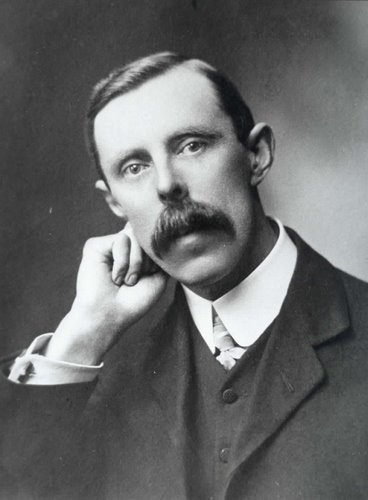
Boreham never wore clerical garb. His physical activity was restricted by lameness and he broke his leg and hip several times in falls. He was a devotee of cricket. Friendly and unassuming, he had a gentle, sensitive face, a large drooping moustache, and a 'lingering Kentish flavour' to his voice. He died in Melbourne on 18 May 1959 and was buried in Kew cemetery, survived by his wife, son and three of their four daughters. His estate was sworn for probate at £22,379. He is commemorated by the F. W. Boreham Baptist Hospital in Canterbury.


Select Bibliography
T. H. Crago, The Story of F. W. Boreham (Lond, 1961); Age, 19 May 1959.

Author: Ian F. McLaren

Print Publication Details: Ian F. McLaren, 'Boreham, Frank William (1871 - 1959)', Australian Dictionary of Biography, Volume 7, Melbourne University Press, 1979, p. 349.
Source: Australian Dictionary of Biography, Online.

Image: F W Boreham.

Sunday, February 11, 2007

The F W Boreham Bibliography

Admirers of the life and writings of F W Boreham might be interested to learn of the bibliography that was published by Whitley College in 1997 entitled Frank William Boreham (1871-1959): A Select Bibliography.
This was written by Dr. Ian F McLaren whose interest in F W Boreham is best explained by appending below the introduction to his book. This bibliography seeks to describe the different books of F W Boreham, including detailed information on the various editions and annotations on special copies. It includes some select publications relating to Boreham and his contributions to newspapers and periodicals. It contains fascinating information about special F W Boreham collections and archives that hold Dr Boreham’s books and memorabilia.

The University of Melbourne’s information on the McLaren Collection indicates the following information:

The personal library of Mr Ian McLaren was acquired by the University in 1976. An enthusiastic bibliographer and former member of Parliament of Victoria, Mr McLaren assembled a large library which reflected his interests in the active world of politics. Initially numbering some 34,000 books, serials, newspapers, pamphlets, parliamentary papers and ephemera, the collection has grown to about 50,000 volumes through generous donations from Mr McLaren and purchases by the library.

The McLaren Collection is an exceptionally rich and comprehensive one, with a particular emphasis on Australian exploration, history, anthropology and literature. It also includes significant material on New Zealand, Papua New Guinea, South Pacific and Antarctica, and it is organized by Mr McLaren's own unique cataloging system of subject headings. Mr McLaren was awarded an honorary degree of Doctor of Laws by the University of Melbourne in 1996. He passed away in April 2000.

Here is Ian’s introduction and his tribute to F W Boreham:

INTRODUCTION

In the 1920s, as a schoolboy in my early teens, I lived diagonally across from the Armadale Baptist Church, and regularly attended Rev. F.W.Boreham's fortnightly services on books. So Dr.Boreham could be held responsible for my initial interest in reading and collecting, culminating in the publication of bibliographies of various Australian authors - including John Dunmore Lang, founder of the Australian Presbyterian Church - and of nine volumes of Australian exploration.

This present bibliography was begun long ago, as a "labour of love" rather than with any intention of publication. In 1996, Rev. Dr. Geoff Pound of Whitley College, Melbourne, discovered my collection of Boreham books, and the draft bibliography, in the McLaren Collection in the Baillieu Library, University of Melbourne, and approached me regarding the possibility of completion and publication of the bibliography.

The high regard and appreciation for the works of Dr. Boreham in the United Kingdom and North America is indicated by the wide range of libraries, particularly in U.S.A., holding copies of his works. The McLaren entry on Boreham in Australian Dictionary of Biography is reproduced with permission on page ix.

With my normal optimistic enthusiasm I believed that I could still cope with the time and effort required to complete the work, but only on condition that publication and distribution would be undertaken by Whitley College.

There was still much research needed to provide what I considered an accurate "comprehensive bibliography" to the standard established in my other published works, and, in my eighty-fifth year, I have found it impossible to achieve this to my own satisfaction. However, there is much valuable information in this select bibliography that will be of value and assistance to my successors in the bibliographical field, and to those to whom F.W. Boreham's work will always remain a landmark.

Consequently, this work is presented, as it now stands, in the hope that it may serve as an inspiration for the further research and application needed to compile a truly "comprehensive" bibliography of the works and related publications of Dr.F.W.Boreham.

Ian F. McLaren,O.B.E.,D.Litt.(Melb.) Hon.Bibliographer,
March, 1997 University of Melbourne

Geoff Pound

Image: Armadale Baptist Church, where Ian heard F W Boreham preach and give lectures on authors and their books.

Saturday, February 10, 2007

Boreham on Resurrection

Experiencing Resurrection
In an Easter editorial which F W Boreham submitted to the Argus as well as the Mercury and the Age, at various times in the 1930s and 1940s, he declared in typical fashion how, outside “the august setting” of the churches, “the fact of the resurrection was one of the dominating realities of life and experience”.[1]

Boreham quoted Oliver Lodge’s epigram, ‘That which exists persists’, then in down-to-earth language elaborated on life’s capacity to renew itself. He explained to his readers: “If a thing really lives, it must go on living. Life itself is incapable of dying; and, when it seems to die, there must, in the nature of things be something in the form of a return, a reaction, a revival, a resuscitation, a renaissance, a resurrection—call it what you will”.[2]

Jack-in-the-box Spirit
It was the truth of the renewing power of life that contributed to Boreham’s optimism about individuals and nations finding full expression, the prodigious regeneration in nature, the forward sense of progress throughout human history and the jack-in-the-box spirit that viewed the best arising from the worst.


While it may have appeared callous and unhelpful to write of the Depression of the 1930s and of the evils of the Second World War in terms of the “growing pains” which a nation must endure on its path to maturity, this idea arose from Boreham’s view that despite appearances of defeat, deprivation and death, the horrors of war were impotent in their fight to destroy life.[3]

Life’s Renewing Potential
Dr. Boreham spoke of life’s renewing potential many times, as in an end of the year editorial, when he wrote, “We only recognize the strength of the hold that life has upon us when there arises some question of its extinction”.[4] This insight helps explain Boreham’s concern about the increase in suicide, the victims of war and the despoliation of nature’s resources.

Ultimate Resurrection Assured
In various ways, Boreham personified life reaching toward humankind and craving mutual affection. These images included “life answering life”,[5] life aching for a response and existence being a matter of echoes.[6]

Viewing the endless implications of life’s renewing qualities, Boreham sketched some of his audacious convictions to his readers. According to Frank Boreham:

"If, in a statement, there is life—the life that people call truth—it may be contradicted, derided and shouted down; but its ultimate resurrection and victory are assured. If, in a movement, there is life—the life that people call justice—it may be whelmed in momentary defeat, but its final triumph is certain. And the beauty of it is that when life—in any phase or form—emerges from its temporary interment it appears more radiant than ever. We invariably attach peculiar value to the things we have lost—and recovered."[7]

Geoff Pound

Image: Beautiful life from 'dead' bulb.

[1] F W Boreham, Argus, 31 March 1934; Mercury, 10 April 1936; Age, 20 April 1946.
[2] Boreham, Argus, 31 March 1934; Mercury, 10 April 1936; Age, 20 April 1946.
[3] Boreham, Mercury, 9 March 1935; Mercury, 24 August 1946.
[4] Boreham, Mercury, 29 December 1945; Age, 27 December 1947.
[5] Boreham, Argus, 27 March 1937.
[6] Boreham, Mercury, 22 March 1958.
[7] Boreham, Mercury, 31 March 1934.

Thursday, January 25, 2007

Boreham Publishing Update

Check out the Boreham publishing update at this link:


Image: Cover of the new Boreham book, Lover of Life: F W Boreham's Tribute to His Mentor.

Boreham Book Update 25 January 2007

This book (see photo) is one of the reasons why the John Broadbanks Publishing was established early in 2006. The book is by F W Boreham and is entitled, George Augustus Selwyn.

The book has been advertised on ebay with a starting bid of US $274.00. It usually sells for at least US $500.00.

F W Boreham would not have been flattered about this and other Boreham books that are selling for such exorbitant prices. He would have been alarmed and disappointed that in these days people have to pay such high prices to read his work. He wrote so that ordinary people could read and benefit. He did not write for financial gain. Very few people know that the profits from his books went to establish and maintain the John Broadbanks Dispensary in Birisiri, Bangladesh, a health agency that continues today.

In order to make Boreham books accessible to as many people today at affordable prices, Michael Dalton and I established John Broadbanks Publishing. This is a voluntary ministry which is done in our spare time. Ten percent of any ‘profit’ that comes from the sales of these republished and repackaged books is going to Whitley College to support the training of Christian workers (a passion of Dr Boreham and a wish of the Boreham family). The rest of the monies will be ploughed back to make more Boreham books available.

We are extremely grateful for donations that have been sent to us, one of which came at just the time we had paid out a hefty amount to the printers of our first book, Lover of Life.

If you can help contribute to the other costs of publishing and ensuring that people don’t have to pay prices like US $500.00 to read books by F W Boreham, please follow this link, F W Boreham on Mentoring, for information on how to send money, as soon as possible. Thank you.

Geoff Pound

Image: A copy of F W Boreham’s George Augustus Selwyn (one of the few biographies that Boreham wrote).

Boreham on Life to the Full

Realizing Potential Not Automatic
Frank Boreham believed one might fully experience all the blessings of life. The values Boreham believed underlay such an aspiration included an appreciation of human worth, recognizing the uniqueness of individuals and the influence of personality. Advancing along the path of full expression involved a commitment to lifelong learning, becoming one’s own person and dovetailing one’s personality to other people. He asserted that the realization of one’s full potential did not happen automatically but that the imagination for such a goal could be fostered by such pursuits as adventure, literature, travel and the enjoyment of the arts.

Life to the Full?
In aspiring to fullness of life, F W Boreham was not oblivious to restrictive circumstances individuals might have to battle, such as ill health. Robert Louis Stevenson was an author who greatly influenced Boreham. The Baptist preacher judged that Stevenson had succeeded more than any other writer “in impressing his personality upon the imagination of his readers”, and that he was representative of a select literary circle “who by some subtle magic that can be felt but not explained, make everybody fond of them”.[1] The “invalid’s triumph”[2] was greater, in Boreham’s estimation because, despite the Scottish author’s frail condition and precarious existence, he waxed eloquently about the goodness of life and delighted in the season’s changes, the invigoration of Springtime and the way the “return of Spring gave him a new hold on existence”.[3]

Fullness Despite Dehumanizing Forces
Dr. Boreham was mindful of the restrictive dehumanizing forces in society that limited peoples’ enjoyment of life. In his editorials about children, the disabled, women and the racially oppressed he advocated educative, legislative and political policies to enable them to experience life fully.

National Fullness
Boreham believed that ‘All the blessings of life’ could take on national proportions when Australians celebrated their heroes and achievements, emerged with gratitude from their British roots, found their unique voice, especially in the arts and harnessed the country’s vast resources.

Fullness in All of Life
While it was in a church building that Boreham first heard the words that became the overriding theme of his editorials, he believed ardently that all the blessings of life were to be experienced in all of life’s domains. Boreham advocated nature as one of the major sources of life’s richness. He recommended what he had personally discovered, namely, that a regular exposure to nature’s bounty and beauty were among the many ways people could receive therapy, be stimulated to wonder, undertake learning and be nudged towards truth and an encounter with the spiritual.

Although Boreham stated that nature had a capacity to be replenished, he frequently identified the responsibilities of the public and politicians in such things as preserving and protecting birds and animals, conserving resources (soil, water, bush and forests) and enshrining natural principles into society’s laws and lifestyles.

Cry of Nature
The theme ‘All the blessings of life’ was for Boreham not only a personal expression of thanksgiving but also a statement of human justice and a cry on behalf of nature herself. In this way, Boreham’s unifying theme went beyond the human realm. As he related it to the environment, this overriding theme had ecological implications and assumed cosmic proportions.

Heirs of the Ages
F W Boreham believed that his readers were “the heirs of all the ages” and that history was a prime source of the blessings of life.[4] Books, monuments, architecture and memorabilia were recommended as significant avenues for readers to get in touch with the treasures of time.

Developing Passion for History’s Treasury
F W Boreham was disappointed that Australians were not passionate about “communing with antiquity”, but his hopefulness about a change in the public mind was expressed many times. Ensuring that historians connected the past to ordinary life in a colorful, human-centered style, and celebrating the anniversaries of the nation’s heroes and significant events were among the ways that history’s plenty could be harnessed for personal and national progress. In directing his reader’s gaze to the past, Boreham encouraged present, life-changing encounters which illustrated the truth that all the blessings of life were available, despite the dimensions of time and place.

Fullness in the Ordinary
Perhaps the limitlessness of this overriding theme was nowhere more emphasized than in Boreham’s editorials about the richness to be found in ordinary things. He wrote about the surprising wealth to be gleaned from the sphere of the small, the ordinary and the everyday highlighted the universality and the accessibility of ‘all the blessings of life’.

On the Fringe of Fullness
Boreham’s overriding theme was not a declaration that he had taken full possession of life’s bounty. Repeatedly he told his readers, “We are on the fringes of things”.[5] This expression was not a vain hope but an allusion to Boreham’s preferred theological method of encouraging his readers to move from things near at hand to the unexplored, from the familiar to what is presently foreign and from the creation to a knowledge of the Creator. The theme, ‘All the blessings of life’, was an exuberant expression of an inexhaustible goal.

Geoff Pound

Image: Australia Day 26 January. “F W Boreham's hopefulness about a change in the [Australian] public mind was expressed many times.” With Australia Day tomorrow there might be a demonstration of this change and Boreham’s hope fulfilled.

[1] F W Boreham, Mercury, 21 May 1932.
[2] Boreham, Mercury, 11 July 1936.
[3] Boreham, Mercury, 11 July 1936.
[4] Boreham, Mercury, 3 January 1948.
[5] Boreham, Age, 27 September 1947.

Wednesday, January 24, 2007

F W Boreham Trivia Question

What do the following have in common?:

Caroline Fry (writer)
Alec McCowen (actor)
Compton Bennett (film director)
David Gower (cricketer)
F W Boreham (preacher/writer)

For the answer scroll down the page:


Answer
They are all natives of Royal Tunbridge Wells. See a more expansive list of natives from this pretty town by clicking on Royal Tunbridge Wells.

Image: Elegant batsman, David Gower.

Boreham on Being Fully Alive

Living Dog or a Dead Lion
Always eager to present abstract truth in arresting and colourful images, F W Boreham introduced a Mercury editorial in 1948 with the maxim, “A living dog is better than a dead lion”.[1] Without revealing its biblical source, Boreham explained, “In its original setting the aphorism probably was intended to express our insatiable love of life. It is humanity’s master passion”.[2]

Lusting for Life
Dr. Boreham frequently made a distinction between being alive and entering into all the blessings of life. He conveyed this difference when describing J J Doke, who epitomized for him a person who was fully alive. Of his mentor, Boreham remarked that his “mind [that] was so saturated with history and biography”, his diplomacy in meetings, his practical piety and his passion for justice had developed through his personal contact with Mahatma Gandhi. These attributes led Boreham to state adoringly, “He loved life—life in every form and phase ... his lust for life was insatiable ... he represented in his own person the most engaging and most lovable type of masculine saintliness of which I have ever had personal experience”.[3]

Geoff Pound

Image: Is this a dead lion or is it alive but just asleep?

[1] F W Boreham, Mercury, 21 August 1948.
[2] This saying comes from the Hebrew Scriptures. The full text from Eccles. 9:4 reads, “But whoever is joined with all the living has hope, for a living dog is better than a dead lion”.
[3] F W Boreham, I forgot to say (London: The Epworth Press, 1939), 135-139.

Tuesday, January 23, 2007

Boreham's Dominant Theme

F W Boreham’s Unifying Theme
While he framed and illustrated it in various ways, ‘All the blessings of life’ was clearly the dominant subject of F W Boreham’s writing and preaching, the unconscious unifying ‘message’ in his many themes, and, judging by his autobiographical writings, the passion and mainspring of his life.

Consumed by a Thirst
Frank Boreham once said of Charles Dickens, “Nobody can read Dickens’ first great novel without feeling that, in delineating Mr Pickwick, he was thoroughly enjoying himself. His pen seems to romp across the pages … herein lies the charm and strength of Dickens … enamoured of life … real life … never hampered by a theory … consumed by a thirst”.[1] The theme, ‘All the blessings of life’, captures the enjoyment that Boreham seemed to experience in his writing and the same exuberant note that was characteristic of his editorials, essays and sermons.

Overflowing into Service
Exemplifying this overriding theme and expressing the way he believed the experience of the richness of life should overflow into service, Boreham said: “Like the gentle Elia, ‘I find this world a very pretty place to live in,’ and standing here, beside my golden milestone, I have tried to point out a few of the things that make it so lovable. If something I have said makes somebody somewhere more glad to be alive, I shall be inclined to forgive this truant pen of mine its inordinate garrulity”.[2]

Geoff Pound

Image: ‘this truant pen of mine…’

[1] F W Boreham, Mercury, 28 March 1936.
[2] F W Boreham, The golden milestone (London: The Epworth Press, 1915), 9. ‘Elia’ was the pseudonym of the English essayist, Charles Lamb (1775-1834).

Monday, January 22, 2007

Boreham and 'All the Blessings of Life!'

Writing late in his retirement, F W Boreham recounted a vivid memory when saying, “As a small boy, following in the Prayer Book the liturgy of the church, I was always impressed by one phrase in the General Thanksgiving—‘We bless thee for our creation, preservation and all the blessings of life’”. Boreham added the comment, “I loved that opening expression of gratitude and this particular clause gave me the opportunity of saying so. It is certainly good to be alive today”.[1]

Whether or not the church always nurtured Boreham’s lifelong gladness at being alive, this episode suggests that the church assisted him in naming this delight, in setting it within an ancient, religious tradition and in expressing it in a shared spirit of gratitude and prayer.

Geoff Pound

Image: The inside of St John's Anglican Church, Tunbridge Wells, where F W Boreham and his family worshipped in his early days.

[1] F W Boreham, Cliffs of opal (London: The Epworth Press, 1948), 172.

Sunday, January 21, 2007

Boreham on the Art of Worrying

I have often wished that somebody would write a book on The High Art of Worrying Well. I have never yet heard or read a sensible word on the subject of Worry. At the one extreme, I have known pietists and idealists who have declared, absurdly enough, that worry is wicked. And, at the opposite extreme, I have known men who worried themselves into premature graves. Between these two insanities there is a No-man's-land of common sense that lies unoccupied and unexplored.

Worry is a very good thing in its way. Those who condemn worry never stop to explain why, if it be wicked, we were sent into the world endowed with such an infinite capacity for doing it. Obviously, we were made to worry; but we were made to worry wisely. We were made to take life seriously and to feel the gravity of things. The man who never worries about his business will never have a business worth worrying about. But the trouble is that in this, as in so many other things, we go to ridiculous excess. Instead of worrying about one or two things—big things; things worthy of our worry; the things that we were sent into the world to worry about—we worry about everything! But worry is a fire that burns up the brain. In the most literal sense, therefore, it represents a burnt offering. The man who worries about too many things is laying his burnt offering on too many altars.

F W Boreham, A Tuft of Comet’s Hair (London: The Epworth Press, 1926), 195-196.

Saturday, January 20, 2007

Boreham's Call to Connect with Ordinary Life

Relate to Real Life
Recent posts on this blog site have examined a major theme of F W Boreham’s writings in which he maintained that the ordinary is a vital sphere through which people might encounter the rich dimension of life, variously described as the ‘spiritual’ or ‘sacred’. In many editorials, Boreham cited a person’s relationship with the prosaic and the everyday. He was not alone in sounding this theme as we have looked at Dickens’ novels, Turner’s canvas, Blake’s various media and Christ’s verbal pictures to illustrate the treasures that come in dealing in ordinary things. Overwhelmingly F W Boreham made a call to leaders, scholars and artists to relate their discipline to real or ordinary life.

Taking a Leaf from Dillard’s Books
In her Pulitzer Prize winning book Pilgrim at Tinker Creek, author Annie Dillard devoted an entire chapter to the subject of ‘seeing’. Explaining her convictions and literary intentions, she writes:

"Our life is a faint tracing on the surface of mystery, like the idle, curved tunnels of leaf miners on the face of a leaf. We must somehow take a wider view, look at the whole landscape, really see it, and describe what’s going on here. Then we can at least wail the right question into the swaddling band of darkness, or, if it comes to that, choir the proper praise …. The whole show has been on fire from the word go. I come down to the water to cool my eyes. But everywhere I look I see fire; that which isn’t flint is tinder, and the whole world sparks and flames."[1]

Dillard’s commitment to ‘really see’ life and describe it as it is, is reminiscent of Boreham’s dedication to a new way of looking. The popularity of both writers may well be attributable to making life their subject and wonder their style.

Reflection by Ordinary Believers
F W Boreham’s encouragement to cultivate a vision for the ordinary was made to his readers in the hope that theological reflection might be an activity of ordinary people. Boreham suggests how theology might be approached by ordinary people including seeing through one’s own spectacles, acknowledging personal and national blindness, uncluttering vision through simplification and looking not only at life but through life. Boreham’s emphasized the rich possibilities of discovering the hidden ‘romance’ in ordinary things and ordinary times and considering how readers individually and collectively might experience the sacred and the sacramental.

Exegeting Everyday Life
The importance which Boreham gave to this theme was revealed not only in his lectures on preaching, in which he highlighted ‘the art of seeing clearly’, but also in his large number of editorials, in which he praised writers and painters for their vision in studying the texture of everyday life. The significance of this theme has been advanced in the light of comments made by contemporary Australian writers such as David Tacey on the need for developing a sacral imagination.

Firing The Imagination
The role of imagination is noted by Boreham as a necessary step in perceiving the sacred. A theology of the ordinary is a rich and surprising field for theologians and all people interested in life. Such a theological pursuit is accessible, free from religious monopolies and defiant of traditional categories and language.

Gospel Imperatives
In pondering the theological dimensions of this theme, it is clear that the role of the gospel story was vital in leading F W Boreham to praise the theology of little people and small things. His choice of topics on this theme was influenced by Biblical values, popular demand, communication convictions and his whimsical humor. His vast employment of visual imagery, his use of the parabolic method and techniques from the court illustrate his belief that developing and expressing a vision for ordinary things is about style as well as subject.

Unsystematic Punches
F W Boreham’s essays and sermons represented an unsystematic theology of the ordinary. His writing about events like Easter illustrated Boreham’s determination to find the ordinary in matters mentally labeled ‘religion’ or ‘theology’. His essays encouraged readers not only to think and see theologically but also to experience their theology as they engaged in all the matter of life. Boreham’s work in taking readers on a picturesque journey, leading from the familiar to the unknown, was gentle, memorable and often contained revelatory surprises and a prophetic punch.

Geoff Pound

Image: “the whole world sparks and flames.”

[1] Annie Dillard, Pilgrim at Tinker Creek, 11.

Friday, January 19, 2007

Boreham: Prophet of the Prosaic

Prophetic Bite
F W Boreham’s depiction of Hobart cinemagoers being transfixed by the flickery scene, yet yawning at nature’s screening of the real thing, typifies how often with a story, sometimes with a cartoon drawn in words, his editorials had an everyday ring combined with a prophetic bite. This word picture is curiously like a drawing by Michael Leunig, the contemporary Australian cartoonist, that reveals a father and child watching the sunrise on a small television, while behind them, framed by a large window, the real thing is happening.[1]

Philosophy of Ridicule
F W Boreham’s editorials on ‘the value of comedy’ and ‘the philosophy of ridicule’ demonstrated his awareness of the power of caricature and revealed his motivation for employing this technique. Expressing the view that humor is not merely about entertainment, Boreham said, “The humorist is often the most effective reformer. He does not scold or preach; he simply exposes the silly side of the thing that he wishes to alter”.[2]

Geoff Pound

Image: Cartoon by Michael Leunig in which he proposes a new Aussie flag.

[1] Michael Leunig, The Penguin Leunig (Ringwood: Penguin Books, 1974), 26.
[2] F W Boreham, Mercury, 10 July 1926.