Frank William Boreham 1871-1959

Frank William Boreham 1871-1959
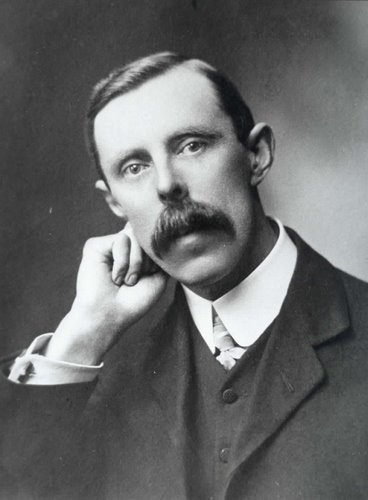
A photo F W Boreham took of himself in 1911

Thursday, February 22, 2007

Boreham on The News

In this era when newspapers are declining because readers are finding their news on the Internet, I wonder how F W Boreham would have viewed the trend of reading the news online.

Boreham had an aversion to his personal use of technology. His biographer reports that in 1906 he did have a try on a new item of technology:

“Christmas brought a welcome break after the past few months' exertions, and also one of the most remarkable innovations that ever invaded the Boreham study. It was a strange black device on the table, known as a portable typewriter. Induced largely by the facility with which the machine could produce carbon copies, he had laid aside a strong prejudice against writing with anything but his trusty pen and bought himself this "Buck" as a Christmas present, and after a little practice was soon turning out neatly typed manuscripts and letters.”

Two pages later, however, Howard Crago reports:

“Meanwhile, that typewriter had been causing him considerable concern. He had struggled with it for weeks. Although the thing turned out readable copies, preoccupation with the keyboard stultified the flow of thought that used to drive his pen with such effortless ease. So the "Buck" went among the household effects that were offered for sale. And never again would such a machine cast its shadow upon the desk of F. W. Boreham. From now on every line he wrote would flow from his faithful pen.”

F W Boreham wrote for many newspapers and magazines, many of which like the Argus, have gone under.

Wherever people got their news from, F W Boreham was aware of people’s hunger:

“No feature of modern life is more arresting than the hunger for news….The great event of the day is the arrival of the newspaper.”

“The individual wants the world, and his appetite for the world expresses itself in his insatiable thirst for news. The Australian bushman sits outside his lonely humpy and hungers for Europe, Asia, America, Africa, and all the scattered islands of the rolling seas. He wants the equator and he wants the poles. He must have the Atlantic and he cannot do without the Pacific. He must feel the throb of every revolution and upheaval. He must know of every invention and discovery. He must be kept abreast of sport and politics. He must peep into every Court and every Cabinet. He must follow the movements of all earth's travelers and explorers. He must be kept in touch with the fluctuations of commerce and industry. He must peruse the lists of births, marriages, and deaths. He hates to feel that any scrap of gossip has eluded him.”

“Our hunger for news is one of the sublimest things about us. It is one of humanity's master-passions.

Sources: T H Crago, The Story of F W Boreham, (London: Marshall, Morgan & Scott, 1961), 111, 113.
F W Boreham, ‘The Hunger for the News’, Hobart Mercury, 14 June, 1941; Melbourne Age, 15 October, 1949.

Image: Not the exact brand but a 1908 portable typewriter.

Boreham on the Value of Mess

Cleanliness Next to Godliness?
We have all been exasperated by the people who tell us with wearisome reiteration that cleanliness is next to godliness. They seem to think that their favorite aphorism was inscribed upon the Decalogue or included among the pearl-like phrases of the Sermon on the Mount. They must learn that the proposition boasts no such sublime authority. It may or may not have figured among the millions of sagacious observations that Confucius is supposed to have made, or that he intended to make, or that he would have made if it had been his good fortune to think of them. However that may be, the Bible is not responsible.

Admiration of Grime
Cleanliness, we are told, is next to godliness. It sometimes is. And sometimes, on the contrary, it is as far from godliness as Pole is from Pole. Those who fancy that the familiar quotation is to be found in the pages of Holy Writ should reflect that, so far from chanting a psalm in praise of cleanliness, the inspired writers have a good deal to say in admiration of the grimy hands of the tired toiler, the stains and smudges on the person and apparel of a healthy child, and the flurry of dust necessarily created by the busy housewife. One of the old prophets picturesquely describes the horrors of famine as a time of cleanness of teeth, whilst another formulates the striking epigram: Where no oxen are, the crib is clean.

No Ox, Crib Clean
The ox is the dynamo of an oriental farm. With his oxen the husbandman ploughs his fields, leads in his harvest, and transports his produce to market. If, through some tragic loss or devastating pestilence, the farmer is left without oxen, the cattle sheds may be a model of cleanliness—the harness and the gear all in their proper places, and the floor impeccably speckles—but look at the farm! Everything is going to rack and ruin. With no oxen, the crib is clean; but it is the cleanness of a dire and terrible catastrophe.

Deathly Orderliness
A home in which everything is in apple-pie order is not of necessity a matter for congratulation. The rooms are silent; there are no signs of childish romp and revelry. In the nursery, the toys are all in their proper places; everything is orderly and shipshape; all is spick and span. But the father and mother are heartbroken; their child is dead.

Confusing Office
When at the height of his renown, Sir Henry Hawkins, the most successful criminal advocate of all time, contrasted the bewildering confusion of his office in 1859 with the flawless tidiness of his official apartment in 1839. In 1839, when he was just starting, he took a tiny room in Elm Court. It was on the fifth floor. The papers were faultlessly arranged in the pigeonholes; a virgin sheet of white blotting paper adorned the brand-new desk; the pen nibs fairly glistened. In those days Hawkins spent most of his time in surveying the forest of chimney pots from the window and in listening at the top of the stairs in the frantic hope that one wonderful day, somebody would actually climb to the fifth floor. In his spacious rooms in 1859 there are piles of papers everywhere; messengers rush in and out; the waiting room is thronged with clients and witnesses; attorneys flit to and fro; clerks fly hither and thither; everything seems in a whirl and a flurry. But, with all its neatness, 1839 spelt worry and anxiety, whilst, with all its disorder, 1859 spelt prosperity and popularity. The upstairs office to which no client ever comes can readily be kept tidy.

Being Thankful for Mess
Let every minister be thankful that his study needs tidying; let every barrister be thankful for the confusion in his office; let every carpenter be thankful for the shavings on the floor; let every mother be thankful for the tumult in the nursery; let every farmer be thankful that the crib needs cleaning out. It all goes to show that there is something doing.

And, lifting the principle to a higher plane, let every man be thankful when his conscience cries out against him; the evil day is the day on which his conscience resolves to speak no more.

Coughing in the Cemetery
We have all heard of the old grave-digger whose terrible cough elicited the sympathy of a visitor to the cemetery. Straightening himself up, the sexton pointed with a sweeping gesture to the tombs around. `There's plenty here,' he tellingly observed, `who'd be glad of my cough!'

Catalyst for a Clean
But, although the cough is a sign of life, it must be cured or it will drag the old man down to a grave of his own. The litter in the office is suggestive of a prosperous business; but it is, at the same time, a clamant call for some tidying hand. The soiled stall is a wholesome spectacle; but it cries aloud to the farmer for water and broom. The torments of an aroused conscience are symptoms of spiritual vitality for which a wise man will give thanks on bonded knees; but they are useless and worse than useless unless they drive him, in his desperation, to the fountain open for all sin and for all uncleanness.

F W Boreham, ‘A Limited Virtue’, The Last Milestone (London: The Epworth Press, 1961), 62-64.

Image: “Be thankful for the tumult in the nursery.”

Boreham on Being Real

Desire to Taste Life’s Delicacies
The insatiable appetite to taste life’s delicacies was interpreted by F W Boreham as one of the drives behind the human capacity to realize its full expression. Moreover, it explained his passion for history which he regarded as “the reflection of real life”. He did not consider the lust for life as a selfish desire that resulted in a hoarding of life’s treasure. On the contrary, Boreham testified that the pursuit of life triggered a further desire to share life’s wealth, saying, “Life has been so sweet to me that I like to mark the relish with which others tell their enjoyment of it”.[1]

Intoxicated by Life’s Joys
This need to share and experience the joy of readers’ response may explain the motivation and the endurance that Boreham exhibited in his marathon literary career. Although rejoicing in the generosity of life that ensured there was always an abundant supply for all, it is surprising to find Boreham, the ardent teetotaler and prohibition campaigner, writing about the “intoxicating”[2] joy of life and declaring “the richest wine in the chalice of life still waits their thirsty lips”.[3]

Keep in Touch With Reality
One of the dominant notes in F W Boreham’s editorials was stimulated by the deeper theme of the magnetism of life. Announcing that “Drama can only hold the hearts so long as it keeps in touch with reality,”[4] Boreham then turned from the stage and sounded this call and warning to all the professions:

“If it be true, as it undoubtedly is, that the actor tends to become artificial, it is no less true that the poet tends to become fanciful, the philosopher hypothetical, the scientist chimerical, the schoolmaster theoretical, the artist technical, and the clergyman cloistral”.


Religion Must Deal With Realities
Reserving his harshest warning for the religious sphere, Boreham said, “The Church cannot afford to lose herself ... in a golden haze of nebulous speculation. Religion is of use to a real world only so far as it deals with realities”.

Concluding his editorial with an affirmation about life’s magnetism, Boreham said, “‘We were made by Thee and for Thee,’” cried Augustine, “‘and our hearts can only find rest when they find their rest in Thee’”.[5]

Geoff Pound

Image: “Drama can only hold the hearts so long as it keeps in touch with reality.”

[1] F W Boreham, The other side of the hill, 173.
[2] F W Boreham, Mercury, 21 May 1932.
[3] F W Boreham, Mushrooms on the moor (London: The Epworth Press, 1915), 105.
[4] F W Boreham, Mercury, 24 September 1955.
[5] F W Boreham, Mercury, 24 September 1955.

Wednesday, February 21, 2007

What F W Boreham and Mark Twain Had in Common

An interesting episode occurred in the life of F W Boreham soon after World War II had finished and Melbourne was still buzzing with people dancing, singing, and shouting in the streets.

Those celebrations in the streets were at their height as F.W.B. mounted the pulpit steps of Scots Church for the weekly midday service, to face the church packed with grateful worshippers. It was a memorable service as the vast congregation, led by the preacher they so highly esteemed, gave humble thanks to God.

That evening, only a few hours later, among the radio bulletins reporting the progress of the surrender negotiations, came the words:

'We regret to announce the death today of the Reverend Doctor Boreham, of Melbourne. Dr. Boreham was widely known for his long ministry at the Scots Church. A memorial service in his honor will be held at Scots tomorrow.'

F.W.B.'s vast company of friends could scarcely credit the news which came with such dramatic suddenness. And many of them had sent their condolences to Mrs. Boreham before learning that, as with Mark Twain, the report of her husband's death was greatly exaggerated.

A corrected announcement that evening explained that the obituary referred, not to Dr. Boreham, but to Dr. Borland, a former minister of Scots Church.

Source: T H Crago, The Story of F W Boreham (London: Marshall, Morgan & Scott, 1961), 234-235.

Image: Mark Twain

Boreham on Life's Magnetism

Lust for Life
One of the ingredients in F W Boreham’s philosophy about ‘All the blessings of life’ involved the magnetism between human life and all living things. Boreham often wrote of this mutual attraction, saying, “It is only man’s quenchless lust of life that enables him to live.”[1] He discerned this persistence in the human capacity to “cling with amazing tenacity” to life, “to endure when all things band together for his destruction” and “to endure any torture to retain [life]”.[2]

Attraction to Life
Dr. Boreham recognized the human attraction towards life, in the “infatuation that we see so much beauty in the dawning of a new day and find so wealthy a romance in the unfolding of the Spring,”[3] the fascination with books[4] and delight in humor.[5]

Underlying Passion
Casting his mind about for other pursuits that captivated his attention, Boreham said, “The same hunger underlies my passion for biography and even my fondness for the Bible .… It appeals to my love of life”.[6]

New Forms of Life Startle
Recognizing humanity’s attraction towards all expressions of life, Boreham dilated, “We love the city because it swarms with life; we love the bush because new forms of life startle us everywhere; we love the play, the film, the novel and the art gallery because, by means of them, we are able to explore new twists and turns of the life we love.” Continuing on the same tack, Boreham explained the thrill with which people greet Easter, saying, “In celebrating Easter we are unconsciously giving three cheers for life itself”.[7]

Geoff Pound

Image: “We love the city because it swarms with life.” Taken on a recent visit to Kolkata: city of joy and life.

[1]F W Boreham, Mercury, 11 July 1936.
[2] Boreham, Mercury, 5 April 1947.
[3] Boreham, Mercury, 21 August 1948.
[4] Boreham, Mercury, 31 July 1920.
[5] F W Boreham, The other side of the hill (London: The Epworth Press, 1917), 173.
[6] Boreham, The other side of the hill, 173.
[7] Boreham, Mercury, 5 April 1947.

Boreham Plagiarized

In Detective Novel
“Among the popular detective novels published in 1942 was Angus MacVicar's Strangers from the Sea -a story of a Scottish minister who, whilst under suspicion of the murder of one of his elders, "laid down the exercise book in which he had been scribbling notes for a sermon-notes based on his reading of the latest book by Dr. F. W. Boreham -and prepared to light his pipe", for ‘the minister, like many another in Scotland, relied for his illustrations almost exclusively upon the books of Dr. F. W. Boreham, the great Australian preacher and writer.’”

Looking Boreham in the Eye
“Nor was it only by fictitious characters that F.W.B. was plagiarized. An American chaplain in World War I, on meeting an Australian chaplain who mentioned that he was a friend of F. W. Boreham's, exclaimed, ‘My, I'd hate to meet that man! I've plagiarized so many of his sermons, I couldn't bear to look him in the eye!’”

Boreham Broadcast Thief
“Perhaps one of the most flagrant instances of plagiarism had occurred in I932, in London, when a service was being broadcast over the B.B.C. from a well-known London church. Down in Tunbridge Wells, Francis Boreham, now too infirm to go to St. John's at night, sat listening to the radio with daughter Jeanie. As the sermon on The Building of the Bridge proceeded, Francis Boreham exclaimed, "I'm sure I've heard that before!" and stepping over to the bookcase, took down son Frank's book Mountains in the Mist, and opening it at page 108 followed the rest of the sermon word for word. He waited for the acknowledgement of its source, and when it did not come, the old gentleman was furious. Indignantly turning to his desk, he penned a straight letter to the preacher about the matter. Not only did the preacher reply to Mr. Boreham in apologetic terms, but also wrote to F.W.B. himself, explaining what he had done and justifying his action on the grounds that, if a sermon were worth printing in a book, surely it ought to be broadcast for all to hear!”

“Not only in the pulpit was he so plagiarized, but also by numerous authors-including some well-known essayists, who would lift whole paragraphs, and even his chapter headings, without acknowledgement. F.W.B. bore none of them any ill-will, but only strengthened his own invariable practice of giving credit for everything he borrowed from others.”

Copyright was passed to me by the Boreham family in the 1990s and I passed it on to Whitley College. Permission to reprint significant portions of Boreham material can be sought from Whitley College Principal, Dr. Frank Rees at frees@whitley.unimelb.edu.au

Source: T H Crago, The Story of F W Boreham (London: Marshall, Morgan & Scott, 1961), 1961.

Image: Quotation marks

Tuesday, February 20, 2007

Boreham on the 'Comrades of the Night'

A recent note from Boreham enthusiast, Les Nixon, who oversees Australia’s Outback Patrol, prompted the posting of this essay by F W Boreham in which he shares some truths he discovered on a trip to the outback.

Tea at the End of the World
We had come to the End of the World; at least, that is what they called it. In point of fact, it was an Australian sheep station, away in the Never-Never country. The nearest neighbors were twenty miles away. All through that golden autumn afternoon our car had been making its way as rapidly as the condition of the road would permit, between the barbed-wire fences that seemed to stretch from one end of the continent to the other. We had been assured, when we left the run at Seldom Seen, that, with luck, we could reach the End of the World by dusk. Perhaps the luck was lacking; at any rate, we were getting nervous about things. The mists were settling down upon the hills; the nip of evening was laying hold of our ears and finger-tips; yet still there was no sign of a settlement. We were gloomily speculating on our chances of getting back to Seldom Seen before mid-night when, all at once, we detected a suspicion of smoke curling up from behind a distant ridge. A moment later we distinctly heard the barking of dogs. Involuntarily we increased the speed of the car, and then, as we swept round the bend of the grassy road, the homestead broke suddenly upon us. We reached the End of the World in time for tea; and tea at the End of the World is a noble meal.

Whole Galaxy of Heaven
After tea we sat around the great log-fire. At the End of the World they build fires such as civilization never dreams of. We talked and laughed together for awhile; and then the experiences of the day began to tell upon me. The fierce glow of the huge fire and the genial atmosphere of the cosy room, following upon the long drive in the strong bracing air of the hills, proved too much for me, and I felt as drowsy as a tired child. Before retiring, however, I stepped out on to the verandah to have a look at the night. There is something very captivating about a lonely Australian scene by starlight. And this particular night seemed to have called out the whole galaxy of heaven. Every star was in its place. I stepped off the verandah in order to get a better view of the skies. Sauntering down towards the great white gate I discovered that I was not alone. The little governess whom they all called Grace was standing with her elbow resting on the top bar of the gate, and her chin resting on her hand. I hesitated to disturb her, but she turned on my approach, and we were soon engaged in conversation. And either the conversation or the night air made me forget my sleepiness. For she said a very interesting thing:

Cure for Homesickness
`I always come out here on a night like this,' she said. `It does me good, and cures my homesickness. My home is in Melbourne, and I have always been used to the city. But they wanted a governess at the End of the World. They pay well; I needed the money; and so it suited me to come. But, oh, it's so different from Melbourne in the daytime, and home seems an eternity away. But at night this gate seems just like the gate at home. Everything strange is wrapped up in the darkness, so that I shall not see it. And the stars come out, the very same stars that I used to watch from our dear old front garden. It is lovely to see them. They seem so companionable, and when I stand here and look at them I forget that I am at the End of the World. I sometimes think I could never stay here but for them!'

Odd Coincidence
I left her musing by the gate and went to my room. And then a strange thing happened, one of those odd coincidences that stamp truth as stranger far than fiction. At the last post-town through which we had passed I received a letter from a young fellow away at the war. He came out from England to these new lands five years ago; but, when the war broke out, he heard the call of the flag and marched away with the rest. I glanced over his letter in the car coming along, but in the quietude of my room I was able to read it more carefully. And, to my astonishment, I came upon this:

'It sometimes happens, 'he writes from Flanders, 'it sometimes happens that we really wonder if we are living on the same planet as that which we formerly inhabited. There is absolutely nothing here to connect us with the quiet life we once lived. But at night-time it is different. One by one the stars come out, and we trace the same constellations that we used to watch as we strolled up the old lane or trudged along the great high-road; and when we see them taking their old places in the skies above us, the link with the old land and the old life seems to have been suddenly restored.'

I rather wish I could introduce these two—our little governess at the End of the World and our young officer in Flanders. You never know what night come of it. They evidently have a good deal in common.

Excellent Medicine
But let neither of them suppose that they were the first to think along this line. It is thousands of years since it was first discovered that the stars make an excellent medicine for homesick hearts. Many an empire has risen and declined since one of the ancient prophets was commanded to direct the attention of an exiled and dejected people to the stars that circled peacefully above their heads.

Lift your eyes on high,' he exclaimed, 'and behold who hath created these things, that brings out their host by number; He calls them all by names by the greatness of His might, for that He is strong in power; not one, fails.' And when, lifting their downcast faces, the captives observed that the stars that looked down upon the land of their banishment were the same as those with which they had become familiar in the country from which they had been cruelly snatched, they instinctively felt that there were ties to the old land that no conqueror could break, and possibilities of restoration of which no tyrant could deprive them.

Eyes to the Skies
From time immemorial disconsolate men and women have turned their eyes to the skies at night and have felt precisely as our lonely little governess felt by the gate the other evening. The stars have always seemed to be speaking some consoling and heartening message to suffering nations and to distracted individuals. How they soothed the mental the mental anguish of Mark Rutherford! ‘The provision of infinity in Nature,' he says, 'is an immense help to me. No person can look up to the stars at night and reflect upon what lies behind them without feeling that the tyranny of the senses is loosened. The beyond and the beyond, turn it over as we may, is a constant visible warning not to make our minds the measure of the universe. This understanding of ours whose function it seems to be to imprison us, is manifestly limited.’ And, in his Autobiography, the stars appear to have been his comforters.

There is Room
On one occasion he is oppressed by his conviction—the most distressing and unmanning of all the convictions that sometimes seizes us—the conviction that there is nothing in him. He walks beneath the stars, and feels that, in a universe of such inconceivable immensity, there is room for every creature born, and, therefore, a place for him. `I sought refuge in the idea of God, the God of a starry night with its incomprehensible distances; and I was at peace, content to be the meanest worm of all the millions that crawl upon the earth.' Again, he is aflame with anger. He strolls beneath the stars, and, reflecting on the great idea of God, and on all that it implies, his animosities are softened and his heat against his brother is cooled.'

Stars Spoken Again
On a third occasion he is worried almost to death, and utterly disheartened. `But just before I reached home the clouds rolled off with the south-west wind into detached, fleecy masses, separated by liquid blue gulfs, in which were sowed the stars. The effect upon me was what that sight, thank God, always has been—a sense of the infinite, extinguishing all mean cares.' The stars had spoken, and his hurt was healed.

Linking the Ages
But standing beside the great white gate at the End of the World, our sad little governess did not see everything. When you turn your eyes starward you are apt to miss something. And both she and our young officer in Flanders missed the best part of the celestial vision. For the stars not only link the lonely station on which poor Grace now lives with the great city she has left behind; they not only link those trenches in Flanders with the tranquil English meadows; but they link up all the ages. Had our young officer who felt that the stars reunited him to his native village and his childhood's home given the matter a second thought, he would have seen that, along a similar line of reasoning, those same stars immediately related him to all the moving drama of the Empire's story. The stars that shine on the British regiments this evening are the selfsame stars that looked down upon the campaigns of Marlborough and Wellington. The stars that must seem to our people in the North Sea to be sharing with them their long and tedious vigil are the self-same stars that gazed upon the destruction of the Spanish Armada and upon Nelson's famous victory ill Trafalgar Bay. The stars link the reality of an age with the romance of all the ages; they unite the prose of the present with the poetry of the past. As Mr. Edward Shillito recently pointed out, the heavens upon whose wealth of wonder the average Londoner gazes with stolid indifference are:

The heavens, beneath which Alfred stood, when he
Built ramparts by the tide against his foes;
The skies men loved when in eternity
The dream-like Abbey rose;

The heavens whose glory has not known increase
Since Raleigh swaggered home by lantern-light,
And Shakespeare, looking upwards, knew the peace,
The cool deep peace of night.

Under those heavens brave Wesley rose betimes
To preach ere daybreak to the tender soul;
And in the heart of Keats the starry rhymes
Roll, and for ever roll.

Selfsame Stars
I fancy that this was the idea in the prophet's mind. It was not merely that the stars that looked down on Israel's captivity were the same that they had seen from the streets of Jerusalem; it was that the stars that they saw were the selfsame stars upon which Abraham gazed when lie received thee promise of the future glory of his race. 'Like the stars of the sky for multitude,' he repeated to himself as his eye scanned the radiant arch above him. And it was something for the stricken people in the day of their adversity to rest their eyes upon the selfsame spectacle that the father of their race had dwelt upon with such deep and mystic rapture.

When Napoleon's army, under Desaix, came within sight of the Pyramids, the men stood still in breathless admiration, and then, quite spontaneously, they rent the stillness of the desert with a shout of wonder and delight, Here was posterity cheering antiquity; the modern cheering the ancient; the world's newest today cheering the world's oldest yesterday. The fine deed was inspired by precisely the same emotions as those with which the captive Hebrews feasted their eyes upon the stars that had greeted the eyes of Abraham. It is good at times to catch sight of the things that abide, the things that filled the first person on this planet with wonder, and that will seem just as magnificent to the man who hears the crack of doom.

Life’s Immutabilities
Which things, besides being helpful and stimulating in themselves, are an allegory, a figure of things still greater. Life needs its fixed quantities, its immutabilities, its things that shine unchangingly. Was it for this reason that, in the Apocalypse, ministers are likened to the stars? `Coming home through the wood last night,' writes Dr. Andrew Bonar in his journal, 'I was refreshed and comforted in looking at the stars. Ministers, like those stars, are set to give light through the night. We shine on, whether travelers will make use of our light or not.' The Christian ministry passes on from age to age the things that abide. If a broken heart is comforted in a church today, it is because the minister gave a message that healed a stricken soul, long centuries ago. If into the broken and contrite spirit of some lowly penitent there flows tonight the rapture of sin forgiven, it is because the minister told an old, old story that has been the light of all the ages. .’I, Jesus, am the Bright and Morning Star,’ said the Risen Saviour, in the sentences with which the Bible closes; and tired eyes will rest steadily on Him until tie stunning tides and shifting scenes of time and sense have ceased for ever to confuse them.

F W Boreham, ‘Comrades of the Night’, The Silver Shadow (London: The Epworth Press, 1918), 77-86.

Image: ‘Comrades of the Night.’
Boreham and The Pull of Things

The people of Lochlee were very fond of Davie McPhail. The little lad was stone blind; yet, despite his heavy affliction, he showed as keen and as blithe a spirit as any on that Scottish country-side. The villagers said that there was a far-away look in his sightless eyes, as though, seeing nothing that they saw, he nevertheless peered into things that they were not permitted to behold.

When, in the summer of1871, Dr. Thomas Guthrie and Dr. John Ker were spending their holiday among the Grampians, they fell in love with Davie. They came upon him several times, and, each time, he furnished them with some fresh cause for wonder. They were tramping one afternoon across a rugged and romantic mountain-side. For hours they reveled in the varied panorama of crag and torrent, wood and waterfall, and saw no sign of life except the herds of red deer browsing down in the glen. All at once they were astonished at seeing, in the distance, a boy's kite. Their surprise was intensified when, on drawing near, they found Davie crouching among the fern on the hillside, holding the string. Clasping the twine firmly, he moved his hands to and fro, sometimes pressing them to his breast and sometimes holding them out at arm's length. His face shone as with secret ecstasy. 'Why, Davie lad,' exclaimed Dr. Ker, 'what's the good of your having a kite? You can't even see it!'
'No, sir,' replied Davie,' but I like to feel it pull!'

The incident has often struck me as being profoundly significant. We are affected more than we know by forces that we cannot see, but of which we feel the pull. It is by the pull of things that our destinies are shaped.

F W Boreham, ‘The Pull of Things,’ The Three Half-Moons (London: The Epworth Press, 1929), 216-217.

Image: Kite

Boreham Unforgettable

Writer Appreciated
At an age when so many prominent men drop into the background and are soon forgotten, it was no small satisfaction to know, at seventy-eight, that one's work was still not only being done, but appreciated.

Radio Tribute
In fact, a further appreciation was to come a few weeks later, which would move F.W.B. even more deeply than the tribute of the Mercury. An old friend, judge C. H. Book, of the Victorian County Court, had been invited, by radio station 3KZ in Melbourne, to deliver a 250-word contribution to a program of Christmas-night broadcast talks on The Most Unforgettable Character I Have Met. The judge now wrote saying that he proposed, if the subject himself approved, to speak about Dr. Boreham. To which, F.W.B. characteristically replied:

“I cannot adequately express my bewildered appreciation of the great honor that you so kindly propose for me. But, truth to tell, you completely took my breath away. Now, however, that I have to some extent regained my balance, let me say that, even if the 3KZ studio is burned down during the week, or a stroke of light­ning puts the station off the air on Christmas Day, I shall cherish to my last hour the thought that, for some reason entirely beyond my comprehension, you had accorded me so lofty a place in your esteem. I can only add that I know of no man living from whom so great a compliment would have meant so much to me....”

Christmas Around the Radio
On Christmas night, at Wroxton Lodge, the Boreham family was around the radio at 7.30 p.m. In his talk, Judge Book said

“It is not an easy task to select the most unforgettable character I have ever met. There are so many people to whom I could say, "I shall never forget you!" For example, there is my dear mother. I could never forget her; and there are others dearly loved: but to speak of any of them would be too personal and intimate for the present occasion.

So I have chosen one whom no one who has been privileged to meet him could possibly forget; someone I have known for many years and to whom I am much indebted.

He is the Rev. Dr. F. W. Boreham, preacher, poet and saint. Eloquent, friendly, a man with a gift of humour, humble with the divine humility of his Master, he is a great man in the best sense of the word.

I have read his essays, listened many times to his sermons, de­livered in that well-loved voice and in a manner all his own; and by these I have been uplifted, strengthened and inspired. But above all, I rejoice that I have often spoken with him face to face, and then he makes you feel that it is you who have his interest and his love.

It is a person's character which makes him unforgettable, be­cause it is character alone which is eternal.

And so, with a loving and a grateful heart, I salute Dr. Boreham, and I say to him, "You are a character I shall never forget!"

The next day, F.W.B, wrote:

“What can I possibly say? You have certainly set me something to live up to! Surrounded by Mrs. Boreham, the family, and one or two guests, I listened with incredulous emotion to all that you so kindly said. With heart overflowing, I then bade the company a silent farewell and slipped away to bed. I felt that I wanted to be, for awhile at least, alone.”

“In the nature of things, a day must soon come in which you will be aware that graceful and generous tributes are being paid to my memory. When that hour strikes, I trust that it will be a secret satisfaction to you that you spoke your beautiful piece whilst my hungry but astonished ears drank in every precious syllable ...”

No Turning Head
Such tributes of appreciation as he had been receiving might have turned the head of a smaller man. But although Dr. Boreham would not have been human had he not enjoyed every one of them, he still maintained that "divine humility" and that same unspoiled friendliness which "makes you feel that it is you who have his interest and his love".

Source: T H Crago, The Story of F W Boreham, (London” Marshall, Morgan and Scott, 1961), 243-245.

Image: 'around the radio.'

Monday, February 19, 2007

Boreham and His Change of Mind

What do basket ball player Michael Jordan, tennis champ Martina Hingis, swimmer Jenny Thompson, cyclist Lance Armstrong and F W Boreham all have in common?

Scroll down when you’re ready for the answer.


Answer: They all made comebacks after announcing their retirement.


F W Boreham Retirement Announced
After writing thirty-six books, readers of the popular Boreham books, received The Passing of John Broadbanks and were horrified to read this foreword:


BY WAY OF INTRODUCTION

WITH the passing of John Broadbanks, I myself must pass.

It is just about a quarter of a century since, with my heart in my mouth, I daringly submitted the first of these manuscripts to a publisher. Since then, one by one, thirty volumes have trickled from my incontinent pen.

In writing thirty volumes a man has, or has not, delivered his message. If he has, why linger? If not, it is time that he recognized his failure and abandoned the futile adventure.

Were I to devote another thirty volumes to the task, I could not adequately express to my publishers, my critics and my readers my deep sense of obligation.

This Australian study of mine has sometimes oppressed me by its severe aloofness. And yet, as the years have come and gone, I have sensed the constant flow towards me of tides of generous friendliness emanating from away beyond the far horizon.

To that great host of kindred spirits with which I can never hope to mingle I wave my hand to-day in affectionate farewell.


FRANK W. BOREHAM.
Kew, Victoria, Australia.
Easter 1936.


Coming Out of Retirement
In 1939 Boreham readers had been successful in their protest for they were able to purchase another Boreham book, appropriately entitled, I Forgot to Say and subtitled, A Gust of Afterthought.

I Forgot to Say
He explained himself in the foreword of this book in these words:

BY WAY OF INTRODUCTION

WITH characteristic courtesy, my publishers urge me, in defiance of my leave-taking of three years since, to send them yet another volume. In a way, I am glad to comply. On retiring for the night, few of us plunge into instant oblivion. When the soft lamp beside the bed has been switched off and the great world is hushed into stillness, the mind obstinately insists upon a final flutter. The events of the busy day march past in grand review, and one is haunted by the things that he should have said, but didn't.

Since issuing the book that I believed to be my last, I have been the victim of some such insomnious experience. Reaching for my discarded pen, therefore, I have dotted down one or two wayward fancies that, in my earlier scribblings, I forgot to say.

F. W. BOREHAM.
KEW,
VICTORIA,
AUSTRALIA.
Easter, 1939.

Some, like boxer Mohammed Ali, regretted making the return but F W Boreham and his readers hailed the new period as being gloriously productive.

Readers were glad he changed his mind for F W Boreham went on to write another fifteen books including his autobiography, My Pilgrimage, which Leslie Weatherhead described as “the most inspiring ministerial autobiography I have ever read.”

Geoff Pound

Image: Comeback champion, Martina Hingis.

Sources:
F W Boreham, The Passing of John Broadbanks (London: The Epworth Press, 1936), 7.
F W Boreham, I Forgot to Say (London: The Epworth Press, 1936), 7.
T H Crago, The Story of F. W. Boreham, (London: Marshall, Morgan & Scott, 1961), 229-230.

Sunday, February 18, 2007

Boreham on the Paralysis of Silence

In an article published by the Hobart Mercury on 19 February 1924 F W Boreham wrote about the plight of deafness. In ‘The Paralysis of Silence’ he speaks not only about living in a silent world but of the stigma that adds to the suffering.

He tells the story of Mr. E Abraham who conceived the idea that something might be done in Australia to render self-supporting and independent, those who were severely deaf and dumb.

In 1909 the Adult Deaf & Dumb Society (now the Adult Deaf Society of Victoria), purchased a 75 acre property which included the Lake, now called the Blackburn Lake.

[This was the bushland area, where in the 1890s, the artist Frederick McCubbin set up his easel and painted some of his best known works, e.g. "Down on his Luck" and "The Bush Burial"]

They cleared the land and cultivated a flower farm. The property became known as "Lake Park", and was a place for the "aged, infirm and feeble minded deaf mutes" to live and work, by growing flowers & vegetables, that were sold at the Victoria Market.

F W Boreham writes about the development of this dream as an ‘object lesson to the world.’ He says: “Australia has to her credit some very notable triumphs…. No country has done more to abolish the disability and the suffering due to being deaf and dumb.”

Sources: F W Boreham, ‘The Paralysis of Silence’, Hobart Mercury, 19 February, 1924.

‘Blackburn Lake Sanctuary’


Image: Black and white postcard of Blackburn Lake entitled 'Lake, Deaf Mutes' Farm, Blackburn.'
http://www.picturevictoria.vic.gov.au/site/whitehorse_manningham/Blackburn/7238.html

Saturday, February 17, 2007

Boreham on the Romance of a Dictionary

Typical of F W Boreham’s interest in encouraging people to reflect and discover meaning in everyday things is this article on ‘A Romance of a Dictionary’:

A HUNDRED years ago Noah Webster, the compiler of the famous dictionary, passed away. Descended on his father's side from John Webster, a pioneer governor of Connecticut, and on his mother's side from William Bradford, one of the leaders of the Pilgrim Fathers, Noah Webster was a man of original and outstanding gifts. In the 85 years of his remark able career he was alternately farmer, lawyer, academician, politician and historian, but all through the years his mind was dominated by an insatiable curiosity as to the etymology and significance of words, and every odd moment was devoted to notes and memoranda embodying his latest discoveries. He found it a fascinating and inexhaustible study.

Word Factory
For, after all, the world is an enormous word-factory and its output is prodigious. Every year, almost every week, brings a new crop of words. The vast majority of these words perish almost as soon as they are born. They are coined to fit a certain occasion and, being essentially ephemeral in their purpose and character, are quickly forgotten.

Armory of the Mind
Others, however, appeal to a deeper instinct. They meet an obvious need, describe a certain quality that no dictionary word described so well, captivate the popular imagination, and, as a consequence, they live.

A good dictionary is, as Coleridge said, the armory of the human mind and contains both the trophies of its past, and the weapons of its future, conquests.

Fossilized Poetry
In his classic, On the Study of Words, Archbishop Trench has seven masterly chapters in which he shows that words are fossil poetry and petrified history and embalmed romance, and that all the ages have left the record of their tears and laughter, virtues and vices, passion and pain, in the words they have created.

Astounding Treasure
Did not Ruskin urge his readers to delve in the dictionary like prospectors searching for gold? Just as, on the diggings, the richest nugget may ravish the eyes of the miner when he is turning over the most common clay, so Ruskin held, the most astounding treasure may be found concealed in the heart of the most ordinary words.

Polished Gems
`When I feel inclined to read poetry,' says Oliver Wendell Holmes, `I reach down my dictionary. The poetry of words is quite as beautiful as that of sentences. The author may arrange the gems effectively, but their shape and luster have been given by the attrition of age. Bring me the finest simile from the whole range of imaginative writing, and I will show you a single word which conveys a more profound, a more accurate, and a more elegant analogy.' It will be seen, then, that, properly understood and appreciated, words are jewel cases, treasure chests, strong-rooms; the repositories in which the archives of the ages arc preserved.

Like Mushrooms on a Misty Morning
Language is obviously an evolution. There was a time when even the Encyclopedia Britannica declared that our first parents received it by immediate inspiration. In view of our present knowledge of the coinage and creation of words, however, most people will feel that this can only have been true, at the most, to a very limited extent. With every momentous event in human history new words spring up like mushrooms on a misty morning.

Sound Words
Most of these new words, as Sir Edward Cook once pointed out, are frankly onomatopoeic. They are, that is to say, mere imitations of sounds frequently heard. The deaf and dumb man imitates, by means of gestures, the things that he sees. The man who is not so afflicted imitates, on the same principle, the things that he hears. And these oral imitations crystallize into permanent augmentations of the vocabulary. Philologists assure us that we should be astonished if we were to discover the number of our common words that were originally imitations of sounds heard.

A child's first ventures in articulation are, as Prof. Drummond has pointed out, frankly imitative. He calls the cow a moo-moo, the dog a bow-wow, the duck a quack-quack, the rooster a cock-a-doodle-doo, the clock a tick-tick, the train a puff puff; and so on. Nor does he drop the habit when he emerges from the nursery. In maturer years he still speaks of the hum of the bee, the click of the gate, the whir of machinery, the chirp of the grasshopper, the twitter of the sparrows, the hiss of the snake, the boom of the cannon, the roar of thunder, the tramp of armies, and the rest. He is building up a vocabulary on that onomatopoeic principle to which Sir Edward Cook ascribes so many of the words in the dictionary.

Common Words
Oddly enough most of our words come to us, not from the halls of learning, but from playgrounds and village greens. In her Rustic Speech and Folklore, Mrs. E. M. Wright maintains that it is an egregious mistake to suppose that country people, even when quite unlettered, possess limited vocabularies. She instances one district in which the local dialect contains more than a thousand words for giving a man a thrashing, a thousand words by which one man could tell another that he was a fool, 120 names for the smallest pig of a litter, and hundreds of names for a slut. `And as for dying and getting drunk,' she adds, `there is no number to be put upon the names for them.'

Words, Words, Words!
In view of this facility, possessed by the most ordinary men, it is clear that the task of Noah Webster, a century ago, represented an undertaking of no small magnitude. `Words, words, words!' moaned Hamlet in his dialogue with Polonius, and he said it as though words were things to be regarded with contumely and disdain. But if he, and those who think as he did, were to probe the matter as deeply as Noah Webster had to do, they would discover that, to an imaginative and adventurous mind, the manufacture of words offers a wealthy field for the play of curiosity and research.

Source: F W Boreham, ‘Romance of a Dictionary,’ The Last Milestone (London: The Epworth Press, 1961), 75-77.


Image: Dictionary

Friday, February 16, 2007

F W Boreham on The Queen

It’s the Princess Calling!
On the evening of November 19, 1947, a telephone rang at Westminster Abbey. A voice asked for Canon Elliott; was he on the premises? He was; but who wanted him? `This is Buckingham Palace; and I am ringing on behalf of Princess Elizabeth; she would like to speak to Canon Elliott.'

It turned out that the Princess, who was to be married on the following day, had, with her mother and sister, visited the Abbey to listen to the rehearsal of the music. Chatting it over afterwards, the three royal ladies agreed that the setting of Crimond to the twenty-third Psalm was very different from the setting to which they were accustomed. The bride-elect determined to ring the Abbey.

Canon Fire
`When we are in Scotland,' she explained to the canon on the phone, `Mother and Margaret and I often sing the twenty-third Psalm, sometimes when driving home across the moors; but the setting of Crimond, as it was rendered in the Abbey this afternoon, doesn't seem quite the same as that with which we are familiar. We wondered if it could possibly be altered.'

Royals Singing On the Phone
There was consternation among the officials at the Abbey. The ladies at the Palace sang the Psalm over the phone, the canon, the organist, and the precentor listening, as if for their lives.

Psalms at the Palace Piano
At length the gentlemen at the Abbey begged that they might be permitted to come to the Palace and practise the amended setting of Crimond with the ladies at the piano. And, next day, to the delight of the bride, destined so soon to become a Queen, the Abbey resounded to the music that she had so often enjoyed among the heather.

F W Boreham in his book on this part of the Scriptures that has meant so much to so many remarks, “It is wonderful how people of all kinds and classes capitulate to the charm of the twenty-third Psalm.”

F W Boreham, In Pastures Green (London: The Epworth Press, 1954), 8.

Image: Finding her voice.

Boreham on Noises and Sounds

What Noises Should be Muted?
It is quite conceivable that, as the movement for a quieter world develops, some differences of opinion may emerge as to the particular noises that should be suppressed. To some people the music of a band—particularly a jazz band--is intolerable; and Macaulay, who could never distinguish between one tune and another, could be quoted in their support. Things do not appeal similarly to all tastes and temperaments; one man's food is another man's poison; one man's Paradise is another man's Purgatory.

Incessant Guggles
A well-known statesman used to complain that his nightly drive home from the House of Commons was rendered hideous by the incessant guggle, guggle, guggle of the nightingales! In any outcry against noise there is usually a reference to the crowing of cocks. One is reminded of the agonies endured by Carlyle. Again and again he complains bitterly that `the cocks and hens are as large as ostriches, and scream and crow with the power of a steam whistle.' Yet, by an odd coincidence, whilst the distracted historian was suffering such torture with ill-disguised impatience, his distinguished contemporary, Thoreau, was descanting on the same theme in a very different temper.

Cock Crowing Newer Testament
To Thoreau the crowing of the cock was the bugle-blast of the universe. He called upon all men everywhere to applaud it. 'There is,' he averred, something in a cock-crow that is a Newer Testament—the Gospel according to the Moment. It is an expression of the health and soundness of Nature, a brag for all the world—healthiness as of a spring burst forth. The merit of this bird's strain is its freedom from all plaintiveness. The singer can easily move us to tears or to laughter; but where is he who can excite in us a pure morning joy?'

Sounds of Owners and Neighbors
Over such transports, Carlyle would only groan in uttermost mystification and disgust. Similar varieties of outlook are not uncommon; and, even when the barking of dogs comes in for consideration, we sometimes discern a marked difference between the view of the proud owner of the faithful beast on the one hand and that of his next-door neighbor on the other!

Spirituality of Sound?
There may be a moral and even a spiritual issue at stake. Did the statesman always regard the song of the nightingale as a guggle, guggle, guggle? Was there never a time at which Carlyle discerned something stimulating in the crowing of the cock?

Unmoved Heart and Stolid Eye
In one of her best poems, Mrs. Ella Wheeler Wilcox tells of a young fellow who would go into raptures over a dazzling sunset or a lovely song. But the years went by. Queen Folly held her sway. She fed his flesh and drugged his mind: he trailed his glory in the mire. In the days that followed, neither sunsets nor songs had any charm for him.

The clouds made day a gorgeous bed;
He saw the splendor of the sky
With unmoved heart and stolid eye!
He only knew the West was red!

Then suddenly, a fresh young voice
Rose, bird-like, from some hidden place;
He did not even turn his face,
It struck him simply as a noise!

Dulled to Higher Things
He saw the sunset that once filled him with ecstasy; but he saw it 'with unmoved heart and stolid eye'! He heard the song that once sounded to him like the voice of angels, and 'it struck him simply as a noise’! And, in closing her poem, Mrs. Wilcox exclaims—

O worst of punishments, that brings
A blunting of all finer sense,
A loss of feelings keen, intense,
And dulls us to the higher things.

Sounds and Sensations
This may, in some cases and in some phases of experience, account for our changed attitude towards sounds and sensations. Not always, of course; but sometimes—often enough, at any rate, to make a little heart-searching worthwhile.

F W Boreham, ‘My Scallop-Shell of Quiet’, The Passing of John Broadbanks (London: The Epworth Press, 1936), 14-16.

Image: "the bugle-blast of the universe."

Can You Help Publish This F W Boreham Book?

Can you help publish this Boreham Book?

The publishing of F W Boreham’s book, From England to Mosgiel, will cost approximately $2,000. It was first published by Boreham’s local paper, the Courier.

Very few copies of this short book were printed. Chances are you have never seen it, let alone read it.

If you (and others) would contribute sufficient finance so we can get this book republished, not only will your name/s and generosity be acknowledged in the introduction to this Boreham book but you will have a chance to read it, certainly for the first time. Most importantly, you will be setting loose a Boreham book that is currently ‘imprisoned’ in an F W Boreham display cabinet in Australia to give joy to hundreds of other people who enjoy the writings of F W Boreham.

If you can assist with a gift to republish From England to Mosgiel, click on this web site, F W Boreham on Mentoring, for instructions on contacting Michael Dalton and sending your money in the easiest way possible.

I have just finished scanning the first chapter which I am posting below to whet your appetite for publication, one of the earliest from the pen of F W Boreham. It begins with a letter to the editor, which FWB’s copy says, was added by someone else.
----------------------------------------------------------------------------------
A TUNBRIDGE WELL’S MAN’S VOYAGE TO NEW ZEALAND

To the Editor

Dear Sir—I am writing you in the hope that a few notes by the way, made during my voyage to New Zealand, may be of interest to readers of the Courier.

The following deals with the first half of the voyage, and takes me as far as Cape Town, and I shall hope to complete my story on reaching my destination.

[FWB writes in the margin of his own copy about the above: ‘added to my M.S.S by Editor or Somebody]
---------------------------------------------------------------------------------
It was on the afternoon of Saturday, the 26th of January, that we stood on the deck of the Tainui, about 36 miles off Plymouth, and caught the last glimpse of old England. And the rugged Cornish coast looked very beautiful as it gradually faded from our view. The hilly cliffs towered up in sullen majesty, the thin layer of snow which had fallen the day before still lay in the valleys beneath them, whilst the sun glinting and glistening on them both threw into view at the same time distances of landscape which had otherwise been entirely hidden from us. Standing out in bold relief against the jagged coastline stood Eddystone lighthouse, like a giant stepped down from his home on the hill. And as all this became fainter and more distant, a snowstorm blew up from the west, and tearing along the coast eastward, added to the beauty of the scene. We watched the mass of whiteness as it swept on o’er hill and dale, till in a few moments all had vanished—and England was to us a thing of maps and memory. We frankly confess that our hearts were more sad than glad as the “white walls of old England” disappeared; and the biting wind and driving snow were hardly calculated to inspire a more joyful state of mind. So we went below, had tea, and retired early—partly to dispel the sorrows of “farewell,” and partly to fortify ourselves against the terrors generally reported to await us on the morrow “In the Bay of Biscay O!”

But the Bay of Biscay was on its best behaviour. It was choppy enough to give us an idea of what it could do if it chose; it was sufficiently calm to permit of our sitting on deck, without indulging in morbid speculations as to which particular wave would wash us overboard. We entered it on Saturday evening, and left it very early on Monday morning, finding on rising that the foaming billows had given place to ripples that plashed pleasantly against the sides of the vessel, and seemed in perfect harmony with the soft warm Southern breezes which had displaced the chilling blasts of 36 hours before. Then for three days we scudded on across the waters, the seagulls that had followed us persistently from Plymouth, and a couple of porpoises that sported in the foam, being the only exceptions to the rule of “water, water, everywhere.”

Glad indeed were we, on rising on Thursday morning, to find that we were safely anchored off Teneriffe. And whether it was the reaction from the sense of monotony that had prevailed for the last day or two, or whether it was the beauty of the morning and the softness of the balmy atmosphere, I cannot say, but certain am I that as we stepped on deck that day the air seemed full of romance.

Source: F W Boreham, From England to Mosgiel, Tunbridge Wells: Courier, 1895, 1.

Image: The Eddystone Lighthouse

Trading Boreham: Further F W Boreham Trivia

Who was the Boreham enthusiast who sold his F W Boreham book collection to buy himself a new Subaru?

Click on the link below to discover the answer.


For the answer and the good web site click on:

http://priscillasfriends.org/interviews.html

Image: A Subaru

Boreham and His Protest Against Noise

Writing about Walter Raleigh’s wonderful phrase, F W Boreham says:

My scallop-shell of quiet! The phrase makes an irresistible appeal in view of the movement that I see afoot around me. Humanity is in revolt. It is arming itself against noise. The circumstance is intensely significant. The mere recognition of the fact that noise has become a species of tyranny is itself a healthy sign. For several generations humanity has been so excited over its success in mechanizing everything that it has had no time to notice the inordinate din that it was incidentally creating.

Noise Creeping Up
Yet there it is! 'Noise,' the Engineer observes, 'has crept upon us unawares with the advent of mechanical engineering. We are only vaguely conscious how great it is; only vaguely conscious that it is bad for us; or long ago we should have taken steps to stop it.'

Noise Injurious to our Health
Our doctors are telling us every day that diseases of the nervous system are alarmingly on the increase and that the distracting clamor amidst which our lives are spent has a good deal to do with it. It is of no avail to assure these excellent physicians that we are growing accustomed to the everlasting racket. Motor-cycles go snorting past our windows without our even glancing up. We sleep soundly at night with trams rumbling, horns tooting and railway engines screaming furiously around us. The doctors shake their heads: they are not satisfied. Young people warned by their elders concerning the folly of bolting their food in chunks, laugh at the idea of indigestion. But Nature will not be laughed at; she stands no nonsense; years afterwards the inevitable penalty is paid. And, in the same way, our medical authorities assure us that, in sleeping amidst a babel of noise, we are not enjoying the immunity upon which we plume ourselves. The perfect restfulness of sleep is being unconsciously ruined; there are mental starts and sensations of which we know nothing; the nerves are being imperceptibly frayed and worn down; the whole thing is as bad as bad can be.

Hopeful Signs
The most hopeful sign on the horizon is the declaration by the engineers that mechanization and noise do not of necessity go together. Noise, they say, is bad workmanship. `It is the outward token,' as one expert puts it, `of wasted energy. It can be caused only by vibration. That vibration can be set up by hammering, by shaking or by friction; and these are the three cardinal sins of mechanical engineering.' The hydraulic crane, the rubber tyre, the silencer and all such contrivances, indicate that the tide has turned. The world's best workers are finding their ideal away back on a Syrian hill.

“There was neither hammer nor axe nor any tool of iron heard in the temple while it was in building.”

“Like some tall palm the noiseless fabric sprang.”

The noiseless fabric! There stands the supreme triumph of engineering! And it is altogether to the good that the twentieth century, turning its face wistfully towards that ancient model, is bending every effort to eliminate the crash and the scream and the roar to which we have been martyrs for so long.

Source: F W Boreham, The Passing of John Broadbanks (London: The Epworth Press, 1936), 12-14.

Image: A book on noise in the classroom.

Prof Skinner on F W Boreham

Professor Craig Skinner, was an Australian who taught at the Golden Gate Baptist Theological Seminary for many years. He wrote this preface to the ‘Frank Boreham Treasury’ in which he gives good advice to those learning how to preach:

Golden Preacher
When I introduce my fellow-Australian F. W. Boreham as one of the stars students should study in the History of Preaching course here at Golden Gate Baptist Theological Seminary, they tolerate him mostly as an idiosyncratic excess of their professor's own South Pacific genesis. His move to favoritism among many other giants is very swift, however, for most of them.

Belongs to the World
Australian Baptists are naturally proud of the only preacher among them who has gained such international eminence and literary excellence. But he belongs not to Australians alone, nor to New Zealanders, nor to the British, all of whom may lay some claim to a share in his fame. He belongs to the whole world and to the whole evangelical church. Wherever thinking, feeling, and believing Christians live—there Boreham's words remain relevant. His insight, perspicacity, and erudition remain unequaled. His incisive application of the lessons of history and literature as applied to spiritual living and his dynamic relation of these to biblical truths still outshine most others.”

You and I live in a generation where Boreham is largely forgotten. This fine selection of his writings will do much now to fill such a gap.”

Boreham and Billy Graham
When Billy Graham visited England, the man he wanted above all to meet was the saintly Dr. W. E. Sangster. In Melbourne, Australia, his choice was the encouraging Dr. F. W. Boreham. After recounting memories of D. L. Moody for Mr. Graham, Boreham had both of his visitors kneel while "with face uplifted to heaven and his hands on our heads he poured out his great heart in a consecrating prayer which will follow us through the years like the sound of a great Amen."*

Skinner’s Commendation
In this volume many will relate to Frank Boreham so as to hear words and discover thoughts that will become just such an abiding benediction.

If you are a preacher you will discover sermon ideas sprouting like spring wheat from every page. If you are a reader you will savor thoughts expressed in words of such finesse that their quality stands almost unique. If you are Christ's your heart will quicken, your mind will stretch, and your tongue will move to praise Him. That says a lot for the book. It says more about the writer. It says most about the reality of his thoughts and themes.

CRAIG P. SKINNER
Professor of Preaching
Golden Gate Baptist Theological Seminary Mill Valley, California

Source: Peter F Gunther, A Frank Boreham Treasury (Chicago: Moody Press, 1984), xi-xii.
*F. W. Boreham, The Last Milestone, Introduction (London: Epworth, 1961), 20.

Image: Craig Skinner often did a one man show (now with DVD, on the life of Boreham's seminary principal, C H Spurgeon. I do not know whether or not the photo is of CS dressed up as CHS (it would be a pretty good resemblance) or whether it is one of CHS. Craig died last August at the age of 75 in Atlanta.

Thursday, February 15, 2007

F W Boreham's Scallop Shell of Quietness

My wife and I walked the beach this morning and watched the sun coming up over the Arabian Sea. It was magnific-ent. We had the beach all to our-selves. The air was pure. The view was majestic. Our ears rejoiced in the sound of the waves lapping and the sea birds waking. We breathed in the pure sea air. It was a total experience.

We were the first to see the shells that the waves had hurled onto the beach. As we picked up some shells that had such exquisite patterns, my mind turned to that favorite prayer of F W Boreham’s from which he drew the title of his autobiography:

Give me my scallop-shell of quiet,
My staff of faith to walk upon,
My scrip of joy, immortal diet,
My bottle of salvation,
My gown of glory, hope's true gage,
And thus I'll take my pilgrimage.

The words are those of Sir Walter Raleigh, written on the night before his execution.

F W Boreham comments on this prayer:

"The staff, the scrip, the bottle, the gown—these are the commonplaces of pilgrimage: alike in prose and in poetry we have met them repeatedly. But the scallop-shell of quiet! It strikes a distinctive note. It represents the final up-flaring of the spiritual genius of Sir Walter Raleigh."

Source: F W Boreham, The Passing of John Broadbanks (London: The Epworth Press, 1936), 11-12.

Image: Sun rising this morning over the Arabian Sea.

Boreham on Adoniram Judson

This sermon was first published in F W Boreham's A Temple of Topaz. It is also included in Peter Gunther's Treasury and will appear in the forthcoming book, The Best Essays and Sermons of F W Boreham.

It is one of 125 sermons in F W Boreham's Texts that Made History series, that Warren Wiersbe has called 'one of the most famous and original series in the history of preaching.'


ADONIRAM JUDSON'S TEXT

I
He is a thorough-paced sceptic, this dashing young fellow with the slight and fragile frame, the round and rosy face, the laughing brown eyes, and the rich shock of chestnut hair. There is something defiant about his unbelief. He is the son of a Congregational minister in Massachusetts, who cherishes a fond and secret hope of seeing his brilliant boy following in his own footsteps. But the son knows better than the sire. At school and at college he has swept everything before him. His teachers have stood astonished at the ease and splendour of his triumphs. In every classical contest, Adoniram Judson was first and his rivals nowhere. His phenomenal success has awakened within him a proud and all-absorbing self-consciousness. The conquests that his dazzling intellectual endowments must win for him in the golden future fire his fancy with excited dreams. 'Day and night,' as one of his biographers puts it,' he feeds his ambition with visions of eminence and glory such as no mortal has yet won. Now he is a second Homer, thrilling a nation with heroic lays; now a mighty statesman, guiding, with steady hand, the destinies of his country; but, whatever the dream of the moment, its nucleus is ever his own transcendent greatness.' A minister! He a Congregational minister! He smiles disdainfully at his father's lack of imagination.

This was in 1803 and in1803 the hectic and amazing vogue of Tom Paine was at its very height. In every seat of learning it was considered the correct thing to pooh-pooh Christianity. It is said that, at Yale, every student was an avowed infidel. The graduates even adopted the names of the great French and English atheists, and asked to be addressed by those names in preference to their own. The imperious mind of Judson was swiftly infected by the prevailing epidemic. At Providence College, in the class above his own, was a young fellow named E_____, a youth of rare genius, of sparkling wit, of high culture, and of charming personality. This senior student was powerfully attracted to Judson, and Judson was flattered and fascinated by his friendship. E_____ was, however, one of the leaders of the new philosophy; and, in accepting his companionship and confidence, Judson committed himself irretrievably to an attitude of audacious and aggressive unbelief. In those days his father's dreams of ordination seemed to rest upon a singularly flimsy foundation.

II
But, as is so often the case, it was the unexpected that happened. Wherever Adoniram Judson went, in the course of his historic and adventurous career, he carried with him, as Dr. Angus says, that evidence of the truth of Christianity which is at once the most portable and the most conclusive—the vivid memory of a startling and sensational conversion.

Our sceptical young student makes up his mind to set out on horseback on a tour of the northern States. He rests one night at a certain wayside inn. The landlord explains apologetically that the only room that he can offer is one that adjoins an apartment in which a young man is lying very ill—dying perhaps. Judson assures the innkeeper that it does not matter; death, he declares, is nothing to him; and, except that he will feel a natural sympathy for the unfortunate sufferer, the circumstance will in no way disturb him.

The partition between the two rooms is, however, terribly thin. In the stillness of the night, Judson lies awake, listening to the groans of the dying man—groans of anguish; groans, he sometimes fancies, of despair. The heartrending sounds powerfully affect him. But he pulls himself together. What would his college companions say if they knew of his weakness? And, above all, what would the clear-minded, highly-intellectual, sparklingly-witty E_____ say? How, after feeling as he had felt, could he look into the face of E_____ again? But it is of no use. The awful sounds in the next room continue, and although he hides his head beneath the blankets, he hears everything—and shudders! At length, however, all is still. He rises at dawn; seeks the innkeeper; and inquires about his neighbour.

`He's dead!' is the blunt reply.
`Dead!' replies Judson. 'And who was he?’
`Oh,' explains the innkeeper languidly, 'he was a student from Providence College; a very fine fellow; his name was E_____!’

Judson is completely stunned. He feels that he cannot continue his tour. He turns his horse's head towards his old home; opens his stricken heart to his father and mother; and begs them to help him to a faith that will stand the test of life and of death, of time and of eternity. Full of the thoughts that his parents suggest to him, he retires to the calm seclusion of Andover, and there, with nothing to distract his attention from the stupendous themes that are pressing upon his mind, he makes a solemn dedication of himself to God. He feels, beyond the shadow of a doubt, that he has become a new creature in Christ Jesus. Returning home, he gladdens everybody by announcing his momentous decision; and, in the year that marks his coming-of-age, he becomes a member of his father's Church.

During these memorable days of crisis and of consecration one overwhelming thought has taken possession of his mind. The love of Christ! The love that, in the days of his overweening pride and selfish ambition, had not cast him off; the love that had neither been estranged by his waywardness nor alienated by his blatant and audacious unbelief; the love that had followed him everywhere; the love that would not let him go! Here, on my desk, are three separate accounts of his conversion. In summing up the situation, each writer refers to this factor in the case.

`The love of Christ displaced selfish ambition as the ruling motive of his life,' says the First.
'He became a man of one idea—the love of Christ—and he desired to spend his whole life in demonstrating it' says the Second.
'Having been forgiven much, he loved much,' says the Third.
To comprehend the breadth and length and depth and height and to know the love of Christ which passeth knowledge—this became, at the dawn of his manhood, his one supreme and passionate aspiration. It is the climax of all that has gone before; it is the key of all that follows.

III
The depth and height of the love of Christ—he knew something of the depths from which it could rescue, and of the heights to which it could raise.

But the breadth and length of the love of Christ—here was a new conception! The breadth and length! It seemed to embrace the whole wide world! And yet the world knew nothing of it! The idea took such a hold upon his mind that he could think of nothing else. He was haunted by the visions of nations dying in the dark. He started in his sleep at the thought of India, of Africa, and of China. The situation so appalled him that he became incapable of study. Then, one-never-to-be-forgotten day, as he was taking a solitary walk in the woods, it seemed to him that the Saviour Himself drew near and said: 'Go ye into all the world and preach the gospel to every creature.' His course was clear! Come wind, come weather, he must go!

But how? There was no Mission Board or Missionary Society to which he could apply. He talked it over with his fellow students until half a dozen of them were as eager as himself for such service. They petitioned the heads of the denomination, who, in their perplexity, laid the matter before the Churches. To the surprise of everybody, money poured in, and the newly-formed committee was able to equip the mission-party, advancing each man a whole year's salary. Before leaving his native land, Judson had married. He and his bride sailed from Salem on February 18, 1812; they were welcomed at Calcutta by William Carey four months later; and, after a brief stay, set out for Burma. They reached Rangoon in July 1813. Their first home was a rude hut built on a swamp outside the city wall. Wild beasts prowled around it. Near by, to the left, was the pit into which the offal of the city was poured. Near by, to the right, was the place where the bodies of the dead were burned. The young couple was sickened and disgusted by every sight and smell. On the day of their arrival, poor Mrs. Judson was too ill to walk or ride; she had to be carried to her unalluring home. Yet there was no repining. Both husband and wife smiled at the primitive conditions under which their first home was established; and, with brave hearts, they solemnly engaged to spend their entire lives among their barbarous and inhospitable neighbours.

IV
And they kept their word, although the price they had to pay was terrible beyond words. On one occasion we see Mr. Judson, starved to a skeleton, being driven in chains across the burning desert, until, his back bleeding beneath the lash and his feet blistered by the hot sand, he sinks, utterly exhausted, to the ground and prays for the merciful relief of a speedy death. On another occasion he is imprisoned for nearly two years in a foul and noisome den, his confinement being embittered by every device that a barbarous and malignant brutality could invent. He must have sunk under the fierce ordeal had not Mrs. Judson, often under cover of darkness, crept to the door of his horrid cell and ministered to him. For three weeks, it is true, she absented herself from the prison; but, when she returned, she bore a little child in her arms to explain her delinquency. Shortly afterwards the mission-house was stripped of every comfort; Mrs. Judson is left without even a chair or seat of any kind. To add to her troubles, Mary, her elder child, develops small-pox. Under the terrific strain, the poor mother finds herself unable to nurse her baby, and its pitiful cries intensify her anguish. In sheer desperation, she bribes the jailers to release her husband for an hour or two. And, whilst she applies herself to the little patient who is tossing in the delirium of the dreaded scourge, he carries the baby into the village, begging the nursing-mothers there to pity and to nourish it.

The crisis passed; but passed to be followed by others. It was announced that Mr. Judson's imprisonment was to be terminated by his execution. The exact date and hour were proclaimed; and husband and wife braced themselves for the tragic separation. In the interval, however, he was smuggled away, and the distracted wife had no inkling as to what had become of him. And one of the most pitiful and pathetic pages in the annals of Christian missions is the page that describes the subsequent return of Mr. Hudson to his stricken home. He was scarred, maimed, and emaciated by long suffering; she was so worn and haggard that he could scarcely recognize her. Her glossy black curls had all been shaved from her finely-shaped head. She was dressed in rags—the only garments left her—and everything about her told of extreme wretchedness and privation.

And, before he had been fourteen years in Burma, he had buried his wife and all his children there. Yet, through it all, he never for a moment doubted the reality and richness of the love of Christ.

`The love of Christ!' he says again and again in his letters, 'the breadth and length and depth and height of the love of Christ! If I had not felt certain that every additional trial was ordered by infinite love and mercy, I could not have survived my accumulated sufferings.'

V
But there were joys as well as sorrows. That was a great and golden day on which, after six long years of diligent labour, he welcomed his first convert. He never forgot the emotions with which, that day, he and Mrs. Judson took the Communion with a son of the soil who had entered into a deep and transforming realization of the wonder of the love of Christ.

On that day he set before himself two lofty aims. He prayed that he might live to translate the entire Bible into the native language, and to preside over a native Church of at least one hundred members. He more than realized both ambitions. He not only translated the whole Bible into the Burman tongue, but wrote, in addition, many valuable pamphlets in the native language. And, before he had been twenty years in Burma, he had baptized his hundredth convert. After more than thirty years he revisited his native land.

'Behold,' exclaimed the chairman of the great meeting that welcomed him at Richmond, Virginia, 'behold what a change God bath wrought in Burma! The entire Bible has been skilfully translated, carefully revised, accurately printed, and eagerly read. In a land so recently enveloped in darkness and superstition, many vigorous Churches have been planted. Native preachers have been raised up to proclaim, in their own tongue, and among their own people, the unsearchable riches of Christ. The Karens, a simple-hearted and singular people, are turning by hundreds and thousands to the Lord. Among them the gospel has met with a success rarely equalled since the days of the apostles. On Burma the morning light is breaking!'

And, in achieving these notable triumphs, Mr. Judson adhered constantly to his old theme. `Think much on the love of Christ!' he used to say to all his converts and inquirers, 'think much on the love of Christ!' He seemed convinced, as Dr. Wayland says, that the whole world could be converted if only each separate individual could be persuaded that there was a place for him in the divine love.

VI
'Think much on the love of Christ!' It was the keynote of all his days. He returned to his beloved Burma; but he was never quite the same again. His health was shattered and his strength was spent. It was clear that his time was short. But in one respect, at least, he was unchanged. He talked with even greater fervour, frequency, and fondness of the deathless love of his Lord. 'And,' adds his biographer, 'if he found anything clouding his consciousness and enjoyment of the love of Christ, he would go away into the jungle and live there by himself until the sweetness of his faith had been restored to him.'

He died at sea. In the course of that last voyage, undertaken in search of health, he harped continually on the one familiar string. Mr. Thomas Ranney, who accompanied him, says that he kept repeating one text: 'As I have loved you, so ought ye to love one another.' 'As I have loved you,' he would exclaim; `as I have loved you!' and then he would cry ecstatically: 'Oh, the love of Christ! The love of Christ!’

Later, when confined to his berth, he would talk of nothing else. 'Oh, the love of Christ! The love of Christ!' he would murmur, his eye kindling with enthusiasm and the tears chasing each other down his cheeks. 'The love of Christ—its breadth and length and depth and height—we cannot comprehend it now—but what a study for eternity!' And, even after he had lost the power of speech, his lips still framed in silence the familiar syllables: `The love of Christ! The love of Christ! '

A few days before he passed, he spoke, with evident pleasure, of being buried at sea. It gave, he said, a sense of freedom and expansion; it contrasted agreeably with the dark and narrow grave to which he had committed so many whom he loved. The vast blue ocean, into which his body was lowered a day or two later, seemed to his dying fancy a symbol of his Saviour's unfathomable and boundless love—the love that passeth knowledge—the love that knows neither measure nor end, neither sounding nor shore.

F W Boreham, ‘Adoniram Judson’s Text’, A Temple of Topaz (London: The Epworth Press, 1928), 130-141.


Image: Adoniram Judson.