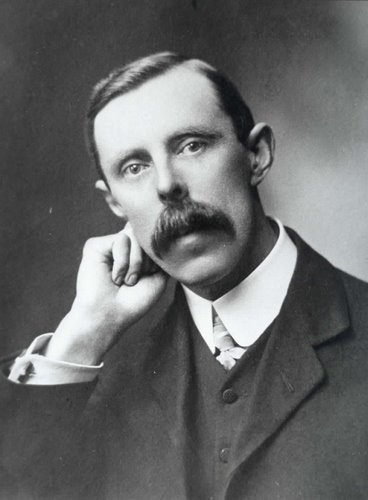
Frank William Boreham 1871-1959

Frank William Boreham 1871-1959
A photo F W Boreham took of himself in 1911

Saturday, May 12, 2007

Boreham on Human Endeavor

F W Boreham’s editorials sometimes appeared humanistic, with their reflections on the possibilities and achievements of the human spirit in the quest for endeavor, exploration and the enjoyment of “the occult magic of human imagination.”[1] The attainment of such ideals often seemed to be for Boreham a matter of ongoing learning, reading and other forms of self-improvement.

It was only in his later editorials that he explicitly stated the Christian vision of “life in all its fullness” and the offer of divine power that enabled good character to emerge and fine ethics to be expressed.[2]

Geoff Pound

Image: “Reflections on the possibilities and achievements of the human spirit in the quest for … exploration.”

[1] F W Boreham, Mercury, 19 April 1938.
[2] Jn 10:10.

Friday, May 11, 2007

F W Boreham Covered

When Michael Dalton first proposed the idea of including in a new Boreham book a story about the creation of the book’s cover I thought, “That’s interesting.”

Then later when he suggested that it would be good to have a book about the covers of Boreham books I thought, “Where does he get these ideas from?”

As I have read Mike’s ‘Cover Story’ (9 May 2007) I have come to realize that his emphasis is absolutely Borehamesque. F W Boreham was entranced by the covers of things.

Excelling in Envelopes
Take for instance Boreham’s fixation with envelopes. It is natural to tear open the envelope and dispose of it as we study the letter but F W Boreham wrote of the ‘eloquence of envelopes.’[1] He exclaimed, “Nature is an expert in envelopes.” He went on to extol the architecture of an orange. He then asked, “Is there anything on earth more delicate and ingenious than the wrappings of a maize-cob? The husks and rinds and pods and shells that we toss upon the rubbish-heap are masterpieces of design and execution.”

In a variation of this theme, entitled ‘Peels and Pods’, Boreham wrote, “Nature takes great pride in wrapping up her goods.”[2] Do you see why Boreham believed that covers were so important?

Index to the Invisible
F W Boreham, in ‘Peels and Pods’ then considers the role of covers in the realm of literature. He wrote:

“Nobody better understood the philosophy of envelopes than Charles Dickens. Indeed, his critics have as good as said that he never gives you the orange; he politely offers you the peel. Instead of the kernel he hands you the husk; in place of the letter he gives you the envelope. He presents us, not with the barrister, but with his wig; not with the beadle, but with his cocked hat; not with the bishop but with his apron; and so on. The fault, if it be a fault, arises from the subtle way in which orange and peel, kernel and nut, letter and envelope, become part and parcel of each other.” Boreham concluded his discussion on his hero by saying, “If it be conceded that Dickens was a little too fond of the outward wrappings of his characters, it must be confessed that he knew how to make good use of them.”

For F W Boreham, husks and pods or in story telling, the outward trappings are not rubbish to be thrown away or ignored. Dr. Boreham believed that the covers and the peels are “an index to the invisible.” When in communication one attempts to ‘explain the inexplicable’ or ‘unscrew the inscrutable’ the best in the art simply tell the truth in symbols, signs and stories.

Hear Frank Boreham in his own words: “It is an old story, ‘Bring Forth the Best Robe and Put It on Him!’ A sublime evangel is epitomized here. The poets and prophets and seers of the ages have found it impossible to express within the limits of human speech the felicities and raptures of which they have dreamed. They have sung therefore of robes and diadems and crowns—mere outward symbols—and have left it at that, assured that the wise would understand.”

Brown Paper and String
When F W Boreham wrote his popular Christmas editorials he concentrated not only on the gifts but upon the gift wrapping. He believed the Christmas covers had relevance to the Christmas gift. In his 1956 Christmas editorial he wrote:

“Like many others things that are pregnant with romance, brown paper and string look commonplace enough; yet, in reality, they embody all the wistfulness, the tenderness, and the sacredness of Christmas-tide. The emotions that, in the hearts alike of givers and receivers, will attend the opening of the parcels, represent the condensed essence of that peace on earth and goodwill among men of which the angels caroled; whilst the rustlings of all those tons of paper, properly heard and accurately interpreted, is itself an essential fragment of the ecclesiastical melodies. Indeed, the brown paper and string with which we are so familiar at this season may justly claim to be regarded as an emblem of the exalted event that Christmas celebrates. For Bethlehem represents the presentation to the world of deity enfolded in humanity.

‘Wrapped in flesh the Godhead see,
Hail the incarnate Deity.’

Lifted to this high level, the symbolism of the brown paper and string becomes positively sublime.”[3]

Telling a Book by its Cover
The husks and envelopes, parcels and string can be wonderfully expressive of deep truth. If nature takes such great pride in its covers so should we. Our countenance and demeanor can form the attractive cover that draws people to listen to the tantalizing story.

Geoff Pound

Image: ‘The eloquence of envelopes.’

[1] F W Boreham, ‘Experts in Envelopes’, Hobart Mercury, 15 January, 1921.
[2] F W Boreham, ‘Peels and Pods’, Hobart Mercury, 4 September, 1954.

[3] F W Boreham, ‘Burdens of Christmas’, Hobart Mercury, 22 December, 1956.

Wednesday, May 09, 2007

F W Boreham on Character and Conduct

F W Boreham’s theology of human living dealt extensively with matters of character and conduct. These issues could be viewed as personal matters, yet Boreham’s views about the characteristics of the British and the influence of the Empire revealed that he was interested in public and social transformation.

The virtues he lauded were not always ‘Christian’ traits as they often appeared to encapsulate the Homeric figure or the ideal English gentleman with the Victorian qualities of bravery, charm, chivalry, diligence, fidelity and valor.

While his storytelling method was a useful vehicle for expressing human character, Boreham’s editorial readers in Hobart and Melbourne might have found his editorials more valuable if he had focused more often on the distinctive character of Australian people and “their own constellation of virtues.”[1]

Geoff Pound

Image: “The virtues he lauded were … bravery…”

[1] John Carroll, ‘The blessed country: Australian dreaming 1901-2001’, The Alfred Deakin lectures: Ideas for the future of a civil society (Sydney: ABC Books, 2001), 103.

New Boreham Book Covered


Michael Dalton has posted on his blog site this beautiful cover for the forthcoming new Boreham book, All the Blessings of Life: The Best Stories of F W Boreham.


He has also written a story about the creation of this cover.


Do mark this blog site as a favourite so you can be kept informed about the arrival date of this new Boreham book.


The link to this site is here: F W Boreham Publishing News.


Geoff Pound


Image: The new cover of All the Blessings of Life.


Tuesday, May 08, 2007

Boreham and a Theology of Time and Place

A major theme in F W Boreham's newspaper articles was his theology of time and place.

Boreham’s reading of history cultivated his long view of human existence. His allusive style provided his readers with other perspectives and encouraged them to see how their era contrasted with a former age.

Dr Boreham, through his historical editorials, sought to be an interpreter of the times as he wrote about destiny, unchanging principles, elemental powers and providence. Hoping his love of history would be contagious, Boreham hinted at history as a medium of divine revelation. His human-centered approach encouraged readers to engage with the figures of history who, though dead, might become through books and monuments a “potent force” through which “our finest impulses are quickened and our highest aspirations inflamed.”[1]

Boreham also sought to connect history to the present day and his editorials that addressed seasons, religious festivals and civic commemorations took seriously the context of time and had important public dimensions.

Geoff Pound

Image: “Boreham also sought to connect history to … civic commemorations.” View of ANZAC Cove at Gallipoli. One of the most important commemorations in the Australia and NZ calendars is ANZAC Day on the 25 April of each year.

[1] F W Boreham, Mercury, 8 April 1933.

F W Boreham on a Theology of Human Living

One of F W Boreham’s major themes could be described as a theology of human living.

Boreham wrote human-centered editorials, not just because of the “insatiable passion for personalities”, which would make his writing popular but because he wanted to offer theological reflections on human living.[1] He shared Montaigne’s conviction that “our great and glorious masterpiece is to live appropriately.”[2] Through many editorials, Boreham focused on the wide range of ordinary human experience, including worry, hardship and pleasure,[3] the broad spectrum of human responsibilities, including Henry Drummond’s triad of love, work and worship[4] and thoughts on the distinctiveness of the “human instinct” and the “human element.”[5]

While most of Boreham’s editorials struck a positive note, in the latter part of his life he occasionally discussed issues such as human suffering,[6] the “problems and perplexities of human life”[7] and the difficulties people faced during special periods like wars and the Great Depression.[8] His human-centered editorials often gave the impression that Boreham’s theology had only personal or private dimensions. Many of the personalities he discussed, however, were representative figures who served as symbols activities and values in different parts of the public domain.

Geoff Pound

Image: F W Boreham wrote articles on theology connecting with daily work.

[1] F W Boreham, Mercury, 8 September 1956.
[2] Montaigne, Michel de, The essayes of Michael Lord of Montaigne. Translated by John Florio (London: George Routledge & Sons, Ltd., 1891), 570.
[3] Boreham, Mercury, 9 February 1957.
[4] Boreham, Mercury, 22 January 1949.
[5] Boreham, Mercury, 9 February 1957.
[6] Boreham, Mercury, 16 November 1954.
[7] Boreham, Mercury, 23 July 1955.
[8] Boreham, Mercury, 18 October 1941.

Monday, May 07, 2007

Boreham on the Value of Storytelling

For most of F W Boreham’s writing career, he discovered, along with other exponents of the art, how the storytelling style frees a writer and speaker from “the tendency to be didactic.”[1]

Many times Boreham said, “Our best reformers often fail us because they rely too exclusively on the negative approach … they attack this; they condemn that; they denounce the other. They forget that the best way of showing that a stick is crooked is by laying a straight one beside it.”[2] This principle underlay Boreham’s stories about people who embodied the values and virtues he was seeking to commend. “The contemplation of a great heroic sacrifice,” Boreham wrote, “must produce in the beholder a profound ethical effect.”[3]

Instead of scolding or spelling out instructions, Boreham respected the intelligence of his readers and trusted them to draw their own implications. His metaphors of ‘holding up a mirror’, ‘pointing’ and ‘poking … the fire’,[4] suggested that his editorials were not intended to be ready-made for they required the contemplation of the reader to complete the circuit of communication.

Geoff Pound

Image: Story telling is about ‘poking … the fire.’

[1] Alan David Gold, Minyan (Sydney: Flamingo, 1999), 105.
[2] F W Boreham, Mercury, 4 August 1956.
[3] Boreham, Mercury, 25 April 1925.
[4] F W Boreham, A reel of rainbow (London: The Epworth Press, 1920), 118.

Saturday, May 05, 2007

Why F W Boreham Favored Storytelling

F W Boreham favored the story because it usefully disguises overt religious language, as nature camouflages its seeds. In stories about people doing ordinary, everyday things, Boreham wrapped theological ideas in flesh and blood to engage his readers’ imagination and aid their comprehension. In the telling of human stories, theological ideas descended from remote, other-worldly planes to a down-to-earth level, thus enhancing the potential to evoke liveable experiences in the lives of Boreham’s readers.

As storytelling theologian Frederick Buechner said, “The Truth that Christianity claims to be true is ultimately to be found … not in the Bible, or the Church, or Theology—the best they can do is point to the Truth—but in our own stories.”[1]

Geoff Pound

Image: “stories usefully disguise overt religious language, as nature camouflages its seeds.”

[1] Frederick Buechner, Whistling in the dark: A doubter’s dictionary (New York: HarperSanFrancisco, 1993), 115.

Wednesday, May 02, 2007

Boreham on Writing Theology for the Public Sphere

F W Boreham’s three primary theological methods of urging connections, seeing something more and sharing stories were shaped by his knowledge that he was writing editorials in a secular medium to an Australian audience. He judged his readers to be wary about religion and resistant to theological discussion that issued from the church and focused on spiritual and other-worldly topics.

His method of connecting theology to familiar personal and public activities was a helpful way of deepening the reader’s understanding of theology’s purpose and developing a fully integrated life.

Boreham’s discussion about ‘seeing more’ represented the teaching of a theological method so that readers could see for themselves. He urged his readers to see more in the public spheres of nature, history, literature, art and ordinary life because they provided sources of divine revelation and pointers to an understanding of God.

His use of stories to attract readers, spark their imagination and (perhaps despite their own resistance) engage in their own theological reflection was a skilful ploy aimed at making theology truly public and revealed his commitment to convey a theology that was ‘liveable’ and ‘doable’.

Geoff Pound

Image: “Writing editorials in a secular medium to an Australian audience.” Prime Minister, John Howard and some Aussie mates.

Monday, April 30, 2007

Boreham on Conveying Truth through Stories

A further theological method, which was also shaped by F W Boreham’s awareness that he was communicating in a public context could be described as theology sharing stories.

Boreham had an aversion to the writing of history, theology or philosophy as a set of propositions. The focus of his disdain was well expressed by the poet John Keats, who said, “Do not all charms fly at the mere touch of cold philosophy? …. Philosophy will clip an Angel’s wings.”[1]

Dr Boreham preferred the medium of storytelling because it conveyed what ‘cold philosophy’ was judged not to supply, namely, charm, warmth and the means to make it soar in the minds of readers.

Geoff Pound

Image: “Boreham preferred the medium of storytelling because it conveyed … charm, warmth and the means to make it soar in the minds of readers.”

[1] Keats, Lamia 2.1.229.

Friday, April 27, 2007

Boreham on Looking Slowly and Praying

F W Boreham often wrote about the importance of ‘seeing’ and his call to be ‘looking through’ ordinary things in order to experience the sacred. While Boreham did not use the term ‘prayer’ to describe this action, writer Alan Ecclestone, in his primer on prayer, teaches people to start by looking further at those commonly experienced “sudden annunciations which occur day by day and are not specifically religious in content at all.” Ecclestone continues:

"Praying at this point means deliberately prolonging, extending, savoring the expression of gratitude so that it doesn’t drop away unused and unexplored. To pray is to make the most of our moments of perception. You pause on the thing that has happened, you turn it over and over like a person examining a gift, you set it in the context of the past and future, you mentally draw out its possibilities, you give the moment time to reveal what is embedded in it."[1]

F W Boreham would have endorsed Ecclestone’s view that a useful starting point was to look slowly and deeply at the ordinary everyday things, but Boreham went on to call people to look reflectively at nature, history, art and literature until they experienced an “ampler vision of life.”[2]

Japanese theologian Kosuke Koyama defined the art of theology in simple terms when he said, “Theology … requires the mind to see something more in the ordinary things.”[3] Boreham adopted this approach in conveying theology to his unchurched readers. His role as a ‘pointer’ and his teaching on the art of ‘seeing more’ was an indication of the way he encouraged and trusted his readers to share in the task of theology.

Geoff Pound

Image: “look slowly and deeply at the ordinary everyday things.” A flower upon which to feast your eyes.

[1] Alan Ecclestone, ‘On Praying’, Spirituality for today, ed. Eric James (London: SCM Press, 1968), 31.
[2] F W Boreham, Mercury, 14 August 1943.
[3] Kosuke Koyama, 50 meditations (Maryknoll, New York: Orbis Books, 1975), 16.

Further Review of Lover of Life

The reviews on F W Boreham’s, Lover of Life, are coming in thick and fast.

I love the one that was sent to Michael Dalton today.

Entitled, JJD, the review can be found at F W Boreham Publishing News, 27 April 2007.

Geoff Pound

Image: Key characters in Lover of Life.

Boreham Points to Daily Life

While F W Boreham pointed his readers to some special spheres where he had found great delight, “the deuteronomy of daily life”[1] was the area he believed was most accessible and offered “a virgin field of novelty and freshness.”[2]

Others, like author Elizabeth Dreyer, who have drawn attention to studying the spiritual in the ordinariness of life, have highlighted the way this focus “reminds us that the reach of God has no bounds.” Furthermore, she says, this spirituality which is “located within the human situation” is attractive because it is unspecialized and devoid of any ‘churchy’ connotation.[3]

Australian poet Les Murray suggested further reasons for exegeting the everyday, when he said, “Human order has at heart an equanimity …. Christ spoke to people most often on this level … all holiness speaks from it.”[4]

Geoff Pound

Image: “the deuteronomy of daily life” was the area he believed was most accessible and offered “a virgin field of novelty and freshness.” Drinking coffee in the Sudan.

[1] James McAuley, ‘Chorale’, in Les A Murray, Anthology of Australian religious poetry (North Blackburn: CollinsDovePublishers, 1986), 164.
[2] F W Boreham, My pilgrimage, 7.
[3] Elizabeth A Dreyer, Earth crammed with heaven: A spirituality of everyday life (New York: Paulist Press, 1994), 81, 106.
[4] Les A Murray, ‘Equanimity’, Collected poems 1961-2002 (Sydney: Duffy & Snellgrove, 2002), 179.

Thursday, April 26, 2007

Rowland Croucher: Review of F W Boreham’s Book on Mentoring

Rowland Croucher has read and reviewed F W Boreham’s book, Lover of Life.

To read his review and his suggestion as to what you might do with this book click on this link—Victoria Concordia Crescit, 26 April 2007.

Thanks Rowland.

By the way, if you haven’t seen the 'Ten New Blogs' that Rowland has just created, check the same blog and his entry at the 22 April 2007.

Geoff Pound

Image: Rowland Croucher

New Book: The Best Stories of F W Boreham

Mike Dalton and I are excited because Laura Zugzda has just sent us the new cover design (pictured) for our forthcoming book, “All the Blessings of Life: The Best Stories of F W Boreham."

We thought you’d like to have a look at this superb cover and click on the photo to get a closer look.

And what’s behind the cover? There are about 250 of the best stories by F W Boreham in this new book and Mike Dalton has helpfully added some indexes for quick and ready finding of that story that you’re after.

I’ve said in the foreword:

“This volume is a compilation of the best stories of F W Boreham. Such a rating is subjective and the compiler of this book could do another marathon Boreham book and come up with a different selection. If you do not find your favorite Boreham story in this book it may be because it has been saved for the forthcoming Best Essays of F W Boreham.”

“While many readers of this new volume will be devoted ‘Borehamaniacs’ or ‘Borehamphiles’, others may be sampling Boreham for the first time. For such readers the biographical essay by Irving Benson has been included as it provides an introduction and the setting for understanding the life and work of this storyteller.”

And if you’re not familiar with that title and its origins, that’s another story. Here is that story from this forthcoming book, in Dr Boreham’s own words:

"It is great to be alive—at any age. As a small boy, following in the Prayer Book the liturgy of the Church, I was always impressed by one phrase in the General Thanksgiving: We bless Thee for our creation, preservation and all the blessings of this life. "

"In those days I only dimly discerned the meaning of the phrases that followed—inestimable love, redemption, the means of grace, the hope of glory, and so on. All this, to me, was enfolded in a golden haze. But I loved that opening expression of gratitude. I felt that it belonged to me. I was glad to be alive, and this particular clause gave me the opportunity of saying so. It is certainly good to be alive today."

F W Boreham, Cliffs of Opal, (London: The Epworth Press, 1948), 172.

Do keep an eye on Michael’s blog site F W Boreham Publishing News to learn more about when this book will roll of the printing press and be available for purchase.

Geoff Pound

Image: Front Cover of All the Blessings of Life.

Eureka!: Discovering F W Boreham in California.


Eureka! They’re discovering F W Boreham in California.

If you’d like to read an article about the John Broadbanks partnership between Michael Dalton and Geoff Pound, here is the link to the Times Standard newspaper.

Mike has also posted this at his newly established F W Boreham Publishing News web site with the article entitled: Author Published Again by Long-Distance Teamwork.

Geoff Pound

Image: The Times-Standard Masthead.

Wednesday, April 25, 2007

Boreham Pointing to Art

F W Boreham’s many references to artists and paintings indicated that art was a significant sphere to which he pointed and encouraged his readers to gaze.[1] His convictions that “art has a special ministry”[2] and “we owe more to pictures than we suspect,”[3] hint at the spiritual dimension of art.

The capacity of art to serve as a subtle ‘pointer’ to God is helpfully discussed by author Richard Harries, when he said:

"True art always has a spiritual dimension. Yet, if religion tries to turn it into propaganda the spiritual would slip away. Works of art inescapably witness, by their truth and beauty to their fount and origin in God himself. Yet religion, always in danger of being corrupted and corrupting does not have this at its beck and call …. It cannot use it for its own ends. It can, however, recognize and praise both the artist and the artist’s God, and, where appropriate seek to express its own deepest truth in works of truth and beauty, regardless of whether the artist has a professed religious faith or not."[4]

Geoff Pound

Image: “Art has a special ministry.” The iconic triptych, ‘The Pioneer’, by the Australian artist, Frederick McCubbin.

[1] References to many of the painters and paintings cited in Boreham’s editorials are listed in an earlier posting, entitled F W Boreham on Art.
[2] F W Boreham, The other side of the hill, 31.
[3] F W Boreham, Rubble and roseleaves (London: The Epworth Press, 1923), 227.
[4] Richard Harries, Art and the beauty of God (London: Mowbray, 1993), 113-114, 139.

Tuesday, April 24, 2007

Boreham Pointing to History and Literature

In thinking about the communicator’s role as a ‘pointer’, the “shining web of history”[1] represented for F W Boreham a source by which people might be enriched from its “priceless hoard.”[2] The historic ‘vaults’ to which he directed his readers included books, shrines, monuments and anniversaries.

Boreham also pointed people towards books because he recognized literature to be “a mirror to the face of life.”[3] When reading, Boreham said, a character in a book “delights us and rebukes us”, thus saving the author from needless moralizing or sermonizing.[4]

Geoff Pound

Image: Boreham recognized literature to be “a mirror to the face of life.” Bernado Strozzi’s painting, ‘Old woman at the mirror’.

[1] F W Boreham, Mercury, 23 November 1946.
[2] Boreham, Mercury, 20 November 1926.
[3] Boreham, Mercury, 14 August 1948.
[4] Boreham, Mercury, 23 July 1949.

Monday, April 23, 2007

Boreham Pointing to Nature

In adopting the communication metaphor of ‘the pointer’, it is interesting to ask, “To what did his editorials point?”

In his newspaper editorials the Bible was certainly not the first place to which he directed his readers. Furthermore, his editorials had scant ecclesiological references and he did not seek to draw his reader’s attention to the church as the primary place where they might discover truth. Rather, Boreham pointed his readers to various public spheres in the hope that they would come to a deeper understanding of God. One of the spheres was the realm of nature.

In his nature editorials, in which he wrote of the “maxims of the mud”,[1] the “stones articulate”,[2] the “rhetoric of the rocks”,[3] rocks as “the manuscripts of God”[4] and the universe as “the archives of the ages”,[5] Boreham was following the biblical tradition of pointing his readers to “look at the birds of the air” and “consider the lilies of the field.”[6]

Geoff Pound

Image: ‘the rhetoric of the rocks.’ Rock faces from the Hajar mountains, Fujairah, United Arab Emirates.

[1] F W Boreham, The other side of the hill,152.
[2] Boreham, Mercury, 5 July 1952.
[3] Boreham, Mercury, 25 May 1957.
[4] F W Boreham, When the swans fly high (London: The Epworth Press, 1931), 63.
[5] Boreham, Mercury, 26 October 1957; Age, 5 September 1953.
[6] Matt. 6: 26, 28.

Sunday, April 22, 2007

Boreham on Pointing Toward Something More

A major theological idea that undergirded Frank Boreham’s communication was Boreham’s view that theology was seeing something more in ‘ordinary’ things.

He revealed an important insight into his role of encouraging his readers to see beyond the surface of things and experiences when he noted, “The papers that I have written possess no value or importance of their own; but they point to things that no man can afford to miss: that is their only glory.” Boreham went on to link the origin of the ‘pointer’ image to his experience on an ocean voyage, when someone exclaimed, “There are the pointers of the Southern Cross.”[1]

Although, many years later, Archbishop Donald Coggan used the image of a ‘pointer’ as a metaphor for preaching, Boreham drew his analogy from the nocturnal vistas with which his readers would have been familiar—the southern skies.[2]

Geoff Pound

Image: Pointers to the Southern Cross.

[1] F W Boreham, The crystal pointers, 8.
[2] Donald Coggan, Preaching: The sacrament of the word (New York: Crossroad, 1988), 109-110.

Saturday, April 21, 2007

F W Boreham: Theology Connecting with Human Need

F W Boreham wrote newspaper editorials in which he called for compassion and just laws for those disadvantaged by age, gender, disability and race. These articles reflected Boreham’s conviction that theology must connect with acts of freedom and justice. He said that a theology that was disconnected from human need was dead and, writing about the less fortunate in life, he contended, “The religion that has nothing to say to the hindmost is no religion for a world like this.”[1]

Not only did Boreham write articles that discussed the link between different activities of life and religion, but he also suggested connections between one part of life and another. His call to break out from one’s specialty and develop an all-roundedness stemmed from his belief about ‘life’s oneness.’ For instance, he drove this point home in a 1954 editorial when he declared:

"And life is one .… Each realm impinges upon the others, and everything in each stands related to everything in the universe. The philosopher must have eyes and ears for all things everywhere. He must study the ways of grubs but he must study also the ways of God. Eternity is not too vast nor microscopic atoms too small for his attention. Physical life is not too sordid for his research nor spiritual life too sublime. And if some things can only be perceived through a veil, indistinctly, that veil, like the tantalizing gossamer, must serve to pique the philosopher’s curiosity and lure him to his ultimate triumphs."[2]

In a world that is overly-compartmentalized and disconnected, Boreham called for his readers to recognize the integration that exists in life by valuing both the ‘spiritual’ and the ‘physical’, ‘grubs’ as well as ‘God,’ the ‘vast’ and the ‘small’, that which is perceived to be ‘sordid’ as well as that which is ‘sublime’.

Geoff Pound

Image: “He must study the ways of grubs but he must study also the ways of God.”

[1] F W Boreham, Mercury, 17 January 1948.
[2] Boreham, Mercury, 9 January 1954.

F W Boreham on Communication that Connects

As F W Boreham matured and developed in his writing and preaching, his ability to forge connections between faith and all expressions of life became increasingly evident.

Dr Boreham was convinced that people needed a theology by which they might understand and cope with life. Preferring the word ‘philosophy’ over the term ‘theology’, he told his readers, “No man is fully equipped for the struggles of life unless he possesses a philosophy with which to face it.”[1]

Symbolic of his understanding that theology must connect with all areas of life, Boreham wrote editorials on such everyday topics as the philosophy of loss,[2] friendship,[3] change,[4] time,[5] play[6] and art.[7]

To drive home his contention that there must be no crack or cranny of life in which theology was irrelevant Boreham wrote on unusual subjects such as the philosophy of posture,[8] cosmetics,[9] cold steel,[10] ridicule[11] and window-dressing.[12]

Indicative of Boreham’s belief that theology must relate to all avenues of life he wrote articles on the ethics of criticism,[13] failure,[14] appetite,[15] feminine charm,[16] cutlery[17] and photography.[18] However, Boreham did not appear to have any master plan that mapped out the subjects that he would tackle and the topics with which he would seek to make theological connections.

F W Boreham’s everyday, pedestrian subjects conveyed his strong belief that useful theology is not remotely abstract but practical and down-to-earth, not exclusively spiritual but immersed in the humdrum, not reserved for privileged people or special occasions but accessible to everybody and at all times.

Geoff Pound

Image: Have you ever spoken about the deeper truths about cutlery?

[1] F W Boreham, Mercury, 7 July 1956.
[2] Boreham, Mercury, 28 August 1943; Age, 8 September 1945.
[3] Boreham, Mercury, 10 August 1957.
[4] Boreham, Mercury, 1 March 1941.
[5] Boreham, Mercury, 1 March 1941.
[6] Boreham, Mercury, 7 December 1946.
[7] Boreham, Mercury, 13 February 1926.
[8] Boreham, Mercury, 8 June 1940.
[9] Boreham, Mercury, 10 March 1956.
[10] Boreham, Mercury, 29 April 1939; Age, 29 November 1947.
[11] Boreham, Mercury, 27 June 1953.
[12] Boreham, Mercury, 7 November 1923.
[13] Boreham, Mercury, 4 August 1956.
[14] Boreham, Mercury, 26 May 1934; Age, 13 April 1946.
[15] Boreham, Mercury, 17 March 1956.
[16] Boreham, Mercury, 24 November 1931.
[17] Boreham, Mercury, 3 October 1953.
[18] Boreham, Mercury, 16 September 1950.

Friday, April 20, 2007

F W Boreham Shares His Greatest Secret

What was the secret to F W Boreham’s effectiveness as a communicator in print and in pulpit?

Writing and Speaking that Connects
The notion of ‘connection’ was at the heart of what Boreham was seeking to accomplish through his editorials, essays and sermons and this idea had childhood origins. He revealed that it was when his parents resolved their domestic dispute by drawing on their common faith that he learned about life’s interrelatedness.

What’s the Point of the Church?
He admitted that earlier he had appreciated the church. “Yet one thing puzzled me; I could see no utility in it at all. I used to wonder what end was served by it. It seemed so hopelessly remote from real life and from the pleasures and pursuits of the week”. After witnessing his parents’ pain and the way they eventually made reconciliation, Boreham exclaimed:

"It was here that I made my discovery. Here was the long-lost secret! Here was the connexion between religion on the one hand and real life on the other. I saw for the first time that there was a strong and subtle link between the services of the old grey church and the daily struggle in which my father and mother were so valiantly engaged. The discovery of that day took to itself all the elements of a great sensation. My eyes were opened; the whole world seemed changed. And among the big things of my little life the revelation of that memorable day stands out in bold and heroic relief."
[1]

This ‘big … revelation’ about ‘the connexion between religion … and real life’ provides a key to understanding Boreham’s theological approach in his editorial writings. In telling the stories of heroes, some triumph from history or a wonder from nature’s showcase, Boreham was seeking to facilitate in his reader a discovery of the way that the story from life connected with God.

Geoff Pound

Image: “there was a strong and subtle link between the services of the old grey church and the daily struggle.” This is the old grey [?] church—St. John’s Tunbridge Wells or did he have in mind the Immanuel Church that the Boreham family joined, that no longer exists?

[1] F W Boreham, My pilgrimage, 47-50.

Wednesday, April 18, 2007

The F W Boreham Approach: Urging Connections

In seeking to characterize F W Boreham’s style of writing and interweaving thoughts about God, the Boreham approach could be described as a theology urging connections.

The Cistercian writer Thomas Merton suggested the possibilities of the pen making divine-human connections when he said, “To write is to think and to live, even to pray.”[1]

On a similar tack, the Czech novelist Franz Kafka identified “writing as a form of prayer,”[2] a phrase interpreted by Melbourne journalist Deborah Forster to mean, “Writing … is a letter to infinity, a way of connecting to the world.”[3]

When Frank Boreham said, “I share it with all the world and all the ages,” he was not only expressing his jubilation at the opportunities of sharing his discoveries with his readers but hinting at the various connections that can be made through the act of writing.[4]

Geoff Pound

Image: “the various connections that can be made through the act of writing.”

[1] Thomas Merton, The intimate Merton: His life from his journals, eds. Patrick Hart and Jonathan Montaldo (New York: Lion Publishing, 1999), 9.
[2] Frederick R Karl, Franz Kafka, representative man (New York: Fromm International Publishing Corporation, 1991), 644.
[3] Deborah Forster, ‘Hearing the prayer’, Age, 29 September 2001.
[4] F W Boreham, The golden milestone, 37.

F W Boreham and the Angel and the Iron Gate

Mary Whitbeck (see ‘F W Boreham: An Appreciation’), wrote to me this week and dropped a comment about how much she enjoyed Frank Boreham’s essay, ‘The Angel and the Iron Gate’.

I looked this essay up again and read it for my enrichment. I thought I would post it here for others to read this encouraging post-Easter reflection. Thanks for the commendation Mary:

THE ANGEL AND THE IRON GATE
by
F W Boreham.

IT is of no use arguing against an iron gate. There it stands-chained and padlocked, barred and bolted—right across your path, and you can neither coax nor cow it into yielding. So was it with Peter on the night of his miraculous escape from prison. 'Herod,' we are told, 'killed James with the sword, and, because he saw that it pleased the Jews, he proceeded to take Peter also.’ There he lay, ‘sleeping between two soldiers, bound with chains, whilst the keepers before the door kept the prison.' He expected that his next visitor would be the headsman; and whilst he waited for the executioner, there came an angel! This sort of thing happens fairly often. They are sitting round the fire, and the lady in the arm-chair is talking of her sailor-son.
`Ah!' she says, 'I haven't heard of him for over a year now, and I begin to think that I shall never hear again.'
There is a sharp ring at the bell. She starts.
`Something tells me,' she continues, ' that this is a message to say that the ship is lost, and that I shall never see my boy again.'
Even whilst she speaks the door is opened, and her last syllable is scarcely uttered before she is folded in the sailor's arms.

The principle holds true to the very end. It is a sick-room, and the pale wan face of the patient looks very weary.
`Oh, how I dread death!' she says; `I cannot bear to think that I must die.'
An hour later the door of the unseen opens to her, and there stands on the threshold, not Death, but Life Everlasting!
Peter very, very often waits for the executioner, and welcomes an angel.

I

During the next few moments Peter scarcely knew whether he was in the body or out of the body. Was he alive or was he dead? Was he waking or was he dreaming? `He wist not that it was true which was done by the angel, but thought he saw a vision.' He walked like a man with his head in the clouds. Doors were opening; chains were falling; he seemed to be living in a land of enchantment, a world of magic. But the iron gate put an end to all illusion. `They came to the iron gate,' and, as I said a moment ago, an iron gate is a very difficult thing to argue with. The iron gate represents the return to reality. After our most radiant spiritual experiences we come abruptly to the humdrum and the commonplace. It was Mary's Sunday evening out. Mary, you must know, is a housemaid in a big boarding establishment, and her life is by no means an easy one. But Mary is also a member of the Church. On Sunday she was in her favourite seat. Perhaps it was that she was specially hungry for some uplifting word, or perhaps it was that the message was peculiarly suitable to her condition; but, be that as it may, the service that night seemed to carry poor Mary to the very gate of heaven. The Communion Service that followed completed her ecstasy, and Mary seemed scarcely to touch the pavement with her feet as she hurried home. She fell asleep crooning to herself the hymn with which the service closed

O Love, that will not let me go,
I rest my weary soul in Thee;
I give Thee back the life I owe,
That in Thine ocean depths its flow
May richer, fuller be.

She knew nothing more until, in the chilly dark of the morning, the alarm clock screamed at her to jump up, clean the cold front steps, dust the great silent rooms, and light the copper-fire. `And she came to the iron gate.' There come points in life at which poetry merges into the severest prose; romance yields to reality; the miracle of the open prison is succeeded by the menace of the iron gate.

II

As long as Peter had an iron gate before him, he had an angel beside him. It was not until the iron gate had been safely negotiated that 'forthwith the angel departed from him.' Mary made a mistake when she fancied that she had left all the glory behind her. The angel is with us more often than we think. A devout Jew, in bidding you farewell, will always use a plural pronoun. And if you ask for whom, besides yourself, his blessing is intended, he will reply that it is for you and for the angel over your shoulder. We are too fond of fancying that the angel is only with us when the chains are miraculously falling from off our feet, and when the doors are miraculously opening before our faces. We are too slow to believe that the angel is still by our side when we emerge into the night and come to the iron gate. It is a very ancient heathen superstition. `There came a man of God, and spake unto the king of Israel, and said, Thus with the Lord, because the Syrians have said, "The Lord is God of the hills, but He is not God of the valleys," therefore will I deliver all this great multitude into thine hand, and ye shall know that I am the Lord.' We are always assuming that He is the God of the mountaintops, and that He leaves us to thread the darksome valleys alone; and our assumption is a cruel and unjust one. As long as Peter had an iron gate before him, he had an angel beside him.

III

The converse, however, is equally true. As long as Peter had an angel beside him, he had an iron gate ahead of him. Angels do not walk by our sides for fun. 'Are they not all ministering spirits, sent forth to minister for them who shall be heirs of salvation?' If there is an angel by my side, depend upon it, there is work that only an angel can do in front of me. Mary’s radiant experience that Sunday evening was directly and intimately related with the brazen yell of the alarm clock on Monday morning. It was not intended as a mere temporary elevation of the spirit, but as an assurance of a gracious presence—a presence that should never be withdrawn as long as a need existed. It is part of the infinite pathos of life that we misinterpret our visions. Jacob beheld his staircase leading from earth to heaven, with angels ascending and descending upon it. And straightway, as he prepared to leave, he began to say good-bye to the angels! 'Surely,' he exclaimed, 'the Lord is in this place! How dreadful is this place! This is none other but the house of God, and this is the gate of heaven! And he called the name of that place Bethel!' And thus he missed the whole meaning of the beatific vision. The vision was to warn him of the perils that awaited him, and to assure him that 'behold, I am with thee in all places whither thou goest.'
`All places!' said the Vision.
"This place! this place! THIS PLACE!' said Jacob.
And so he journeyed on towards his iron gate, pitifully ignorant of the meaning of the golden dream. Life's ecstasies are warnings, premonitions, danger-signals. Even in the experience of the Holiest, the open heavens and the voice from the excellent glory immediately preceded the grim struggle with the tempter in the wilderness. Paul had his vision; he saw the Man of Macedonia; and he followed the gleam—to bonds, stripes, and imprisonment. Bunyan knew what he was doing when he placed the Palace Beautiful, with all its sweet hospitalities and delightful ministries, immediately before that dark Valley of Humiliation in which Christian struggled with Apollyon. When we hear angels' voices speaking, when we find our fetters falling, when we see our jail doors opening, be very sure that outside, outside, there is a dark night and an iron gate!

IV

But there is always this about it. Although the radiant vision is a premonition of the coming struggle, it is also an augury concerning that struggle. Opening doors are an earnest of opening gates. It is inconceivable that I shall be miraculously delivered from my dungeon, with its guards and its chains, and then be baulked by an iron gate out there in the blackness of the night. It is inconceivable that here, at the Communion Service, God should draw so near to the spirit of this young housemaid, and then leave her to face alone the drudgery of Monday morning. If Mary is half as wise as I take her to be, she will answer the scream of the clock with a song. She went to bed singing; why not get up singing? She crooned to herself on retiring the hymn that had followed her from the Communion Table. Let her sing in the morning quite another tune:

His love, in time past, forbids me to think
He'll leave me at last in trouble to sink;
Each sweet Ebenezer I have in review
Confirms His good pleasure to help me quite through.

The voice of the angel, the falling of fetters, and the opening of doors are all designed to brace us for the dark night and the iron gate.

V

`The iron gate opened to them.' Of course it did. Who could suppose that the prison doors had been opened by angel's hands, only that the prisoner might be caught like a rat in a trap outside? `The iron gate opened to them of its own accord.' It did look like it. During my twelve years at Mosgiel, I often went through the great woollen factory. The machines were marvelous—simply marvellous. As you watched the needles slip in and out, or stood beside the loom and saw the pattern grow, it really looked as though the things were bewitched. They seemed to be doing it all 'of their own accord.' But one day the manager said, 'Would you care to see the power-house?' And he took me away from the busy looms to another building altogether, and there I saw the huge engines that drove everything. Neither looms nor needles really work 'of their own accord.' Nor do iron gates. A few minutes after the gates had opened, and the angel had vanished, Peter `came to the house of Mary, the mother of Mark, where many were gathered together praying.' And then Peter understood by what power the iron gates had opened, just as I understood, when I saw the engine-room, how the great looms worked.

The prayer-meeting may not be artistic. For the matter of that I saw very little in the power room of the factory that appealed to the sense of the aesthetic within me; but when angels visit prisons, and iron gates swing open of their own accord, there must be a driving-force at work somewhere. And Peter only discovered it when he suddenly broke in upon a midnight prayer-meeting.

F W Boreham, ‘The Angel and the Iron Gate’ Faces in the Fire (London: Charles H Kelly, 1916), 89-97.

Image: An Iron Gate. You will have to imagine the angel!
Tuesday, April 17, 2007

Boreham Book Distributors

Check out the notice on the New Books by F W Boreham site to read the current list of distributors.

Geoff Pound

Image: Lover of Life covers.

Monday, April 16, 2007

F W Boreham: An Appreciation

In response to the posting on my favorite Boreham lines, Mary Whitbeck wrote to me and said:

“I read the FWB Blog regularly & appreciate so much all you post on the subject and the pictures too.”

“Perhaps my introduction to Boreham books goes back to before your birth—judging by your pictures you have posted—how about late 1942 when I listened to my Canadian Grandma read "a chapter of Boreham" at her dining room table to the family? My collection started by their kindness to me—now up to 40 plus Mr. Crago's books. My friend Dr. Warren Wiersbe was a real help in reaching that.”

“Thank you so much for the BLOG and all you are doing to make the books/material available. I could say a lot about favorite chapters--concepts. Here's a chapter I think just super—‘The Angel and the Iron Gate’, in Faces in the Fire.”

Another FWB lover,

Mary Whitbeck

You might like to read more of Mary’s fascinating story in:
A Rainbow Every Day Part One
A Rainbow Every Day Part Two

I wonder if any readers of this Boreham blog site go back earlier than Mary in terms of their acquaintance with F W Boreham and his books? If so, I’d love to hear your reflections or even if your acquaintance is not so long.

Geoff Pound

Image: Boreham Books

Geoff Pound and the Finale of the Boreham Interview

This posting concludes the interview I had recently with an American journalist:

What do you do for a living?
My wife is supporting me while I kick start a new career as a freelance writer, teacher, conference speaker and a consultant. For some things I get paid but more often than not I try to work as a volunteer in countries where the resources are not great.

Lyn and I decided that when our children were off our hands that we would like to lend our support to people who are not well off financially. In this last year I have worked in India, Indonesia and I have recently returned from time in a Karen refugee camp on the Thai-Burmese border. I find these opportunities to be very rewarding and I learn much from my experiences with people who are poor and oppressed.

On the side I write a few blogs including:
Experiencing the Emirates
Stories for Speakers and Writers and
Reviewing Books and Movies

Where are you located and what is your job title?
My wife teaches English to Emirati men at a tertiary College so we are living in Fujairah, United Arab Emirates.

Lyn’s employer calls people like me a ‘trailing spouse’! I love this tag and the imagery and this term might provide the title for one of my forthcoming books—‘Tales of a Trailing Spouse’.

I generally refer to myself as a freelance writer and a consultant. To refer to myself as a ‘volunteer’ is something many in this neck of the woods cannot get their minds around. To work for nothing and not have an office that I go to, a business card, an important title or a salary are things that bamboozle most people but I am feeling stretched and I love the work that I do.

Geoff Pound

Image: Picture of Lyn (my wife), our granddaughter (Lily) and myself.

Geoff Pound Speaks about Publishing Boreham Books

This is a further posting of recent interview questions and my answers:

How and when did you get involved in this publishing process?
Many of F W Boreham’s books have gone out of print. I became a focus for some Boreham activities and I often received requests for Boreham books. Those books that were available often were selling for exorbitant prices. Two of his books regularly sell on eBay for $500 each. I know of two complete collections that were sold in the USA for $20,000. I was concerned that Boreham books had become collector’s items by people who probably did not even read them but whose trading pushed the prices way beyond the reach of the ordinary person.

How did you meet up with Michael Dalton?
Michael Dalton
wrote to me about his passion for the books by F W Boreham. Over the years we have written to each other many times and he sells Boreham books along with many other titles.

In the last two years we began discussing how our dream for Boreham books to be accessible to readers at realistic prices might become a reality and this hope led to the establishment of the John Broadbanks Publishing Company (named after a fictional character in Boreham’s books).

You guys have never met in person, and Michael said there are some funny stories about how people can't believe you haven't met.
We have been separated by hundreds of miles but our enthusiasm for Boreham books and our publishing project has welded us together as a fantastic unit.

Can you tell me about some of those times?
Nothing specific but people marvel at all we have achieved when we have never seen each other nor spoken on the phone. This says something about our commitment to this shared vision and the wonders of email communication.

What is your role in the publishing process?
My role has mainly been in selecting material and writing forewords and introductions. Michael is a good writer but he excels at the publishing end of the process and negotiating with printers and artists. We have complementary gifts and we make decisions together. It has been great that as the publishing project has become known, especially through regular postings on The Official F W Boreham Blogsite, other people have offered to do proof reading, cover designs, oversee the distribution of books in America and Australia/New Zealand and give finance to fund the publishing costs.

What are some of the struggles or triumphs you have had during the process?
For Michael and me this project is a sideline to our other work. We would love to be full time on the writing and publishing projects.

What do you hope to accomplish by publishing these books?
We simply want to get as many of the F W Boreham books back in print. The new book Lover of Life is the first one. We are not only republishing out of print books but repackaging some of the Boreham material. Next to come off the printing press is a new book that contains The Best Stories of F W Boreham. Following that is a book on The Best Essays and Sermons of F W Boreham.

Long-term goals - mass publishing and distribution to bookstores?
The republishing and repackaging of Boreham books will be an important step along the way but interest in the life and writing of F W Boreham is building, especially in Australia where he lived for so long and in the USA.

I get enquiries about Boreham books and Boreham matters every week from people all over the world. I am discovering that some readers of the Boreham Blog site are from China and I am waiting for someone from the Chinese speaking world to put their hands up and work with us on translating and publishing Boreham books into Mandarin or Cantonese.

Geoff Pound

Image: Geoff Pound in Florence, Italy

Sunday, April 15, 2007

Geoff Pound and His Favorite Boreham Quotes

In a recent interview with a journalist I was asked this question:

What are some of your favorite Boreham lines or messages?
He was eternally curious and interested about anything and everything which are important qualities for writers and speakers.

F W Boreham throughout his life called for people to take “adventures of the mind” in order to “keep the mind fresh and vigorous and healthy” and said, “Like a dog on a country road, the mind must poke into as many holes as it can.”

As a preacher and writer he was very conscious about style. In this regard he encouraged people not to mimic other people but to be yourself. Be the communicator you are intended to be. He once wrote:

“Let no preacher preach in a certain way simply because he fancies that it is in that particular way that preachers are expected to preach.... Let each painter, each preacher, each person whose duty it is to write a newspaper article or pray, realize that his view of God and of Man and of the Universe is essentially an individualistic view. He sees as nobody else sees. He must therefore paint or preach or pray or write as nobody else does. He must be himself: must see with his own eyes and utter that vision in the terms of his own personality. He must, as Rudyard Kipling would have said, paint the thing as he sees it for the God of things as they are. And, expressing his naked and transparent soul by means of his palette, his pulpit or his pen, he will find sooner or later—sooner rather than later—that truth, like wisdom, is justified of all her children.”

F W Boreham’s fifty-five books were mostly published by Epworth Press and the manager of this publishing company, in commenting on the thousands of Boreham books that they printed said that Boreham was ‘their best catch since John Wesley’.

At a large international conference of ministers in Edinburgh in 1936 F W Boreham was the keynote speaker. He was introduced in these words: “His name is on all our lips, his books are on all our shelves and his illustrations are in all our sermons.”

Geoff Pound

Image: “Like a dog on a country road, the mind must poke into as many holes as it can.”

Saturday, April 14, 2007

Geoff Pound: How I Became Interested in Books by F W Boreham

I was interviewed recently by an American newspaper. I thought in this and one or two subsequent articles I would post the questions of the journalist and my answers for a wider readership.

How did you first learn about Boreham's writings?
I started off as a Baptist pastor, working in a church in Dunedin, New Zealand. As a new communicator I did not have much of a problem coming up with content but I struggled to find clear and relevant stories with which to illustrate my talks. I used to go to the local public and seminary libraries and that is where I came across some books by F W Boreham. They were essays or sermons, which had a deeper meaning. As I got hooked into these books I discovered he had been pastor of a nearby church in Mosgiel, just outside of Dunedin. He had served as a pastor there from 1894-1906. I was intrigued with the way he wrote about life in his community.

I found as a pastor that I could use or adapt his illustrations for my own communication and I found this particularly helpful in my work as chaplain of the local prison. Sure they represented a captive audience but they didn’t want to be locked away. I discovered in those years that the telling of stories was an excellent way of attracting and holding the attention of prison inmates and also a crucial key in communicating with children.

F W Boreham was a captivating storyteller and this is the reason why his books are so relevant and still so popular. He despised abstract language and technical jargon, especially theological terminology which he thought confused people and was often used by theologians to parade their knowledge. Much better he thought to wrap a truth in an attractive story as nature wraps its seeds and kernels in beautifully presented fruit.

F W Boreham was a pastor who he had ‘an itch to write’ and he often spoke about his ‘incontinent pen’! Everywhere he went to serve as a pastor he developed a friendship with the editor of the major daily newspaper and was soon asked to write regular editorials. He wrote for the Otago Daily Times when he was in New Zealand (1894-1906), the Hobart Mercury, when he was in Hobart (1906-1916) and The Age (1916-1959), when he was in Melbourne.

I was inspired at the way Frank Boreham wrote 3,000 editorials (at least one per week) for two major dailies between 1912 and 1959. These editorials were unattributed and they appeared on the editorial page with other editorials not in a separate column marked ‘Religion’. This symbolized the way he exploded the usual compartments and sought to reflect in fascinating ways on the spirituality of everyday life. The thing that challenged me was the way as a Christian he addressed issues beyond the garden gate and he was interested in things outside the bounds of the church. He was interested in nature, culture, scientific inventions, the emergence of Australia as a nation but he was also interested in the ordinary everyday things like letter writing and the liquid spirituality that is involved in drinking a cup of tea.

After pastoring in two churches in NZ I went to Melbourne to be a consultant with the Baptist churches of the state of Victoria, Australia. In my travels I met up with the son of F W Boreham and developed a close friendship with him and his wife. It was great to get deeper insights into his father’s life especially regarding such highlights as what F W Boreham was like as a father and grandfather and about the time when Dr Billy Graham visited Boreham’s home in Melbourne to thank the old man for the influence of his writings on the young evangelist’s ministry. Frank Boreham Jnr. shared with me photographs and memorabilia, including some old film footage of Billy Graham striding down the path to greet Dr. and Mrs. Boreham.

I later taught in the Baptist seminary in Melbourne (1994-2005) and became its President. Ferreting around in the seminary archives one day I stumbled across two big boxes of books. I discovered they were a collection of books written by F W Boreham with his signature in them and some hand-written notes. These had been given to the seminary after Dr Boreham died in 1959 but nothing had been done with them. Looking later I discovered the plan of a book Boreham had been working on at the time of his death—the structure of the book involved one newspaper editorial for every day of the year. Often an anniversary suggested a topic for his newspaper article for that day of publication and Boreham had gone through his editorial scrapbooks assigning articles to 75 percent of the 365 slots. Unfortunately he died before this book was finished.

Over the next few years I finished this book, conducted F W Boreham Bus Tours around the major sites in Melbourne and wrote a doctoral dissertation on F W Boreham, focusing on his newspaper articles, to discover what he said over the long span of years and exploring how his faith interplayed with his writing on the issues of the day.

Geoff Pound

Image: Geoff Pound takes off his masks—in Venice.