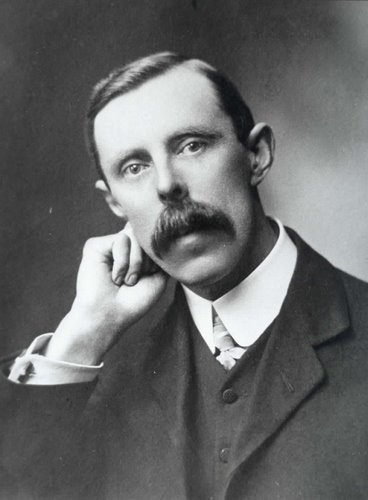
Frank William Boreham 1871-1959

Frank William Boreham 1871-1959
A photo F W Boreham took of himself in 1911

Thursday, May 24, 2007

Boreham Literary Style: Unobtrusive yet Present

This posting is a continuation of several articles which seek to identify and describe the Boreham literary style.

When F W Boreham said of J M Barrie’s writing that “there is a sense in which he never speaks of himself: there is a sense in which he puts himself into every word that he utters,”[1] he offered a clue into his own relationship with his readers. Boreham was content with the anonymity of the unattributed editorial and he prized the authorial restraint that refrained from including personal references. His commitment to self-effacement was intended to enhance the readability that comes, according to Orwell, when “good prose is like a windowpane.”[2]

Frank Boreham rejected Anton Chekhov’s advice to writers to be “as objective as a chemist” and to “abandon the subjective line,” because it was his aim to allow his personality and his enthusiasm for the subject to ooze through his words.[3] His subjectivity was most noticeable in his language of commendation, when he referred to a character’s “exemplary courage,”[4] “scrupulous exactitude”[5] or “resistless charm.”[6] Boreham cultivated a friendly position of parity with his readers rather than an omniscient, patronizing and intrusive stance.

Geoff Pound

Image: Frank Boreham Collage.

[1] F W Boreham, Mercury, 9 May 1942.
[2] George Orwell, ‘Why I write’, 7.
[3] Letter to M V Kiselev, 14 January 1887, Anton Chekhov: Letters on the short story, ed. L S Friedland (London: Geoffrey Bles, 1924), 275.
[4] Boreham, Mercury, 11 September 1943.
[5] Boreham, Mercury, 30 April 1949.
[6] Boreham, Mercury, 17 March 1951.

Wednesday, May 23, 2007

Hallmarks of the Boreham Literary Style

What would you say were the hallmarks of F W Boreham’s writing? How would you describe his signature style?

In the next few postings I will seek to describe Boreham’s characteristic style and show how effective this style was for his newspaper editorials as he expressed theology in appropriate ways for a public audience.

Invitational Style
Frank Boreham’s journalistic training and his experience as a preacher sharpened his consciousness of his editorial readership. The brief period of open-air preaching on Clapham Common and his early practice of observing successful politicians and barristers developed a writing style that aimed to grab and hold the reader’s attention.

This invitational style was also evident in Boreham’s predictable editorial structure. He tantalized the reader with a surprising title, presented a startling introduction to keep people reading, continued the article in a narrative style with stories to build drama and intrigue and concluded with a call for the reader’s response.

Dr Boreham developed his subjects and described his characters in lifelike ways to hold his reader’s interest and build a rapport. His diction had a “tang of originality” and was simple, clear and intended to be universally intelligible.[1] Depending on the word limit, Boreham added illustrations and commendations from different spheres of life to strengthen his argument and persuade his readers to make their verdict.

The desire to capture the reader’s attention and stir the reader to respond sometimes led to Boreham making global claims such as, “No man did more …”,[2] or, “No name shines with a richer luster …”,[3] and, “No other book …”[4]

Related to this was his frequent use of superlatives, as in “the most charming…”[5] or “the most idyllic …”[6] and “the most striking ...”[7] While each editorial was a unit in itself, Boreham’s long-term readers may have tired of his use of hyperbole and questioned his judgment. His overstatements were often borne of exuberance for his subject but they also created doubts about his critical capacities.

In an editorial in which he mentioned that Charles Dickens was “the victim of a constant tendency to gross exaggeration”, Boreham said of his literary mentor, “He immensely enjoyed everybody in his books; and, as an inevitable consequence, everybody else has enjoyed everybody in those books ever since.”[8]

Geoff Pound

Image: “His early practice of observing successful politicians.” PM Gladstone was one politician F W Boreham observed in his London days.


[1] Harold Bloom, The western canon: The books and schools of the ages (London: Papermac, 1995), 6.
[2] F W Boreham, Mercury, 30 June 1951.
[3] Boreham, Mercury, 24 November 1951.
[4] Boreham, Mercury, 17 March 1951.
[5] Boreham, Mercury, 13 March 1948.
[6] Boreham, Mercury, 13 March 1948.
[7] Boreham, Mercury, 11 September 1943.
[8] Boreham, Mercury, 17 March 1951.

Tuesday, May 22, 2007

Boreham and His Theological Approach

While he was usually logical, F W Boreham did not depend upon highly reasoned argumentation and the constraints of editorial space certainly limited this practice. Like theologian Ronald Thiemann, Boreham was less concerned that theology provide overarching theories and detailed answers and more intent on reflecting on the ‘intersections’ and ‘joints’ where public issues and Christian convictions meet.[1]

While conceding the imposition of word space, Frank Boreham’s suggestive style meant that his theology was strong on casting a vision but weak on critical analysis and teasing out life implications. In addition, his optimistic spirit often led him to ignore complexities and gloss over the ambiguities at the delicate points where theological reflection and life issues meet.

Geoff Pound

Image: The modern masthead from the Hobart Mercury.

[1] Ronald Thiemann, Constructing a public theology: The church in a pluralistic culture (Louisville: Westminster/ John Knox Press, 1991), 21-22, 24.

Monday, May 21, 2007

Boreham on Shutting the Door

“Years ago,” a friend told me once, “I used to take all my troubles to bed with me. I would lie there in the darkness with closed eyes, fretting and worrying all the time. I tossed and turned from one side of the bed to the other, as wide awake as at broad noon. As life went on, the habit grew upon me until it threatened to undermine my health. Then, one night, things reached a crisis. I could not sleep, so I rose from my bed and sat at the open window. The garden below and the fields were flooded in silvery moonlight. Not a breath of wind was stirring; the intense stillness was positively uncanny. The perfect tranquility mocked the surging tumult of my brain. How quiet the room seemed! And I had entered it—for what? My behavior seemed absurd in the extreme. Nature had wrapped around me her infinite calm; and here I was allowing all the worries of the world to fever my brain and break upon my rest! Why had I locked the office door so carefully if I wished all the ledgers and day books and order-forms to follow me home? Why had I closed the bedroom door so carefully if I wished all the cares of life to follow me in? I knelt down there at the window sill, with the delicious air of the still night caressing my face, and I then and there asked God to forgive me. And since then, when I've shut a door, I've shut a door!'

F. W.Boreham, The Silver Shadow, pp110-11.

Image: “when I've shut a door, I've shut a door!”

Boreham and His Theology of Nature

F W Boreham’s theology of nature gave his theology a significant breadth. While he made statements about the human yearning for nature and the contributions that nature makes to the human condition, there was evidence that Boreham was concerned for ecology, regardless of the benefits for human society.

His call for the protection of animal and plant species and the conservation of natural resources sometimes had utilitarian and nationalistic elements, but his protests over exploitation and his pleas for just policies and the wise stewardship of earth’s resources arose from sincere theological convictions. These editorials were often prompted by events and conversations in Boreham’s local context and represented an important contribution to contemporary issues of public concern.

Dr. Boreham’s call to commune with nature sprang from his contention that nature pointed to the divine creator as “the heavens are telling the glory of God.”[1] This communion involved for Boreham a sacramental understanding of nature in which, in the words of Elizabeth Barrett Browning:

"Earth’s crammed with heaven,
And every common bush afire with God:
But only he who sees, takes off his shoes…"[2]

The editorials in which Boreham wrote of experiencing God through nature or ‘touching God’ through the soil, may seem to reflect paganism or pantheism but Tony Kelly’s definition of ‘panentheism’ as, “all things existing in God, as their source, ground and goal”, helpfully describes Boreham’s understanding.[3]

His nature articles provided him with the opportunity to write of the relationships between nature, God, religion, truth and science in ways that stressed their unity, harmony and a “cosmology of wholeness.”[4]

Geoff Pound

Image: “But only he who sees, takes off his shoes…[5]


[1] Ps. 19:1.
[2] Elizabeth Barrett Browning, Aurora Leigh 7. 1. 821-826.
[3] Tony Kelly, An expanding theology: Faith in a world of connections (Newtown, NSW: E J Dwyer, 1993), 41.
[4] Kelly, An expanding theology, 40.
[5] Elizabeth Barrett Browning, Aurora Leigh 7. 1. 821-826.

Sunday, May 20, 2007

F W Boreham and William Shakespeare

F W Boreham writes about his first attempts to memorise some lines from Shakespeare and the way the speech stayed with him:

“The first Shakespearian recitation that I ever learned was Cardinal Wolsey's address to Cromwell, his secretary. It seemed to me then, and seems to me still, the most pathetic and impressive passage in our literature. Because of the interest I displayed in the passage, my parents took me on pilgrimage and showed me the oak-tree beneath which, after his fall, the great cardinal sat and brooded on his terrible misfortunes....”

F W Boreham, A Witch’s Brewing, 31.

I am unclear about the location of the oak tree where Boreham went on pilgrimage (in the palace? The Globe?) but I think this is the speech that Frank Boreham refers to:

The Famous History of the Life of King Henry VIII, Act III, Scene 2.

WOLSEY: Cromwell, I did not think to shed a tear
In all my miseries; but thou hast forc'd me,
Out of thy honest truth, to play the woman.
Let's dry our eyes; and thus far hear me, Cromwell,
And when I am forgotten, as I shall be,
And sleep in dull cold marble, where no mention
Of me more must be heard of, say I taught thee—
Say Wolsey, that once trod the ways of glory,
And sounded all the depths and shoals of honour,
Found thee a way, out of his wreck, to rise in—
A sure and safe one, though thy master miss'd it.
Mark but my fall and that that ruin'd me.
Cromwell, I charge thee, fling away ambition:
By that sin fell the angels. How can man then,
The image of his Maker, hope to win by it?
Love thyself last; cherish those hearts that hate thee;
Corruption wins not more than honesty.
Still in thy right hand carry gentle peace
To silence envious tongues. Be just, and fear not;
Let all the ends thou aim'st at be thy country's,
Thy God's, and truth's; then, if thou fall'st, O Cromwell,
Thou fall'st a blessed martyr!
Serve the King, and—prithee lead me in.
There take an inventory of all I have
To the last penny; 'tis the King's. My robe,
And my integrity to heaven, is all
I dare now call mine own. O Cromwell, Cromwell!
Had I but serv'd my God with half the zeal
I serv'd my King, he would not in mine age
Have left me naked to mine enemies.

Geoff Pound

Image: Picture of Cardinal Wolsey from a book whose title is drawn from the last line of his speech.

Saturday, May 19, 2007

Boreham on Leaving a Useful Bequest

“Isaac dug again the wells of Abraham his father, for the Philistines had stopped them, and he called their names after the names by which his father had called them.”
Genesis 26: 18

Isaac is not one of the Homeric figures of Bible history; indeed, there are only two things to be said about him. He was the son of his father; and he was the father of his son! He was the son of his father, and, as his father's son, he performed one of the most charming acts of filial devotion ever recorded. That is very beautiful. Isaac made up his mind that, though Abraham might be buried, Abraham should never die. Isaac was content to be Nobody in order that his father might be Everybody. He made his father's immortality the supreme aim of his own existence. He unstopped the wells that Abraham had dug.

Centuries afterwards Jesus rested on one of these wells, and uttered words of everlasting life to the woman of Samaria. Centuries later still, these self-same wells refreshed the exhausted troops of General Allenby [during the First World War].

Isaac made it possible for his father, Abraham, to lift a cup of cold water to the parched lips of spent wayfarers through countless generations. One of these wells is known as Jacob's well to this very day.

The world can only make real progress so far as each generation hands on to its successor, not only the intricacies and complexities that it has itself invented, but also the simplicities that have refreshed the hearts of people from time immemorial.

It is splendid for our generation to be able to bequeath to posterity the cinema, the radiogram, television, nuclear research. But with these we must hand on our English Bible, our family altar, our peaceful Sunday, or posterity may look upon our sensational bequest as a very doubtful gain. For these are the fountains that never fail.

F W Boreham, The Tide Comes In, pp 54-56.

Image: Jacob’s Well.

Boreham and His Sense of Place

Did F W Boreham feel himself an Englishman (he lived there until he was 24), a Kiwi (after his 10 years in the Shaky Isles) or an Aussie (by far the country where he lived for the greatest period of his life)?

The longevity of Boreham’s work as an editorialist gave an opportunity to track the changes in his theology of place. His earlier statements about belonging and his changing identity reflected his own struggles (and those of many of his readers) as an Englishman becoming at home in Australia.

His newspaper articles and later his autobiography reveal that the Australian soil and wattle tree (national symbol) had gradually won over his love and his children were growing up and marrying Australians.

His editorials on Australia Day and on Anzac themes, when he discussed the unique Australian values and the features that were typically Australian, best represented Boreham’s attempt to sketch a theology of place.

His frequent calls for the development of a unique Australian voice in literature and the arts were a vital element in naming what it meant to be Australian.

Geoff Pound

Image: Wattle flower.

Boreham on the Promise of Divine Guidance

“I will guide you with my eye.” Psalm 32:8

Many have come to adore the priceless boon of the divine guidance. When the time comes to move, He leads the way! If the time has come for striking camp and moving on, He always finds some perfectly simple and perfectly natural means of indicating His will.

He may not always give the Sign of the Fleece as He did to Gideon, or the Sign of the Flowers as He did to Aaron when He made the dry rod blossom; or the Sign of the Food as He did to Peter in his approach to the house of Cornelius; but by some sign, suited to the seeker and his special circumstances, God will find a means of directing those who earnestly desire His guidance. Some pillar of cloud will precede them in the daytime; some pillar of fire will blaze on their horizon in the night. To those who are willing to follow the gleam, there will always come a kindly light to lead.

‘I will guide you!’ He says. He even tells me how. ‘I will guide thee with mine eye!’

I have seen a noble dog sit at his master's feet, intently gazing into his master's eyes, for the faintest intimation of his will. The words obviously mean that I am to live very near to Him—in perfect accord with Him—my eyes riveted upon His.

And to those who enter into that rapt and sacred intimacy—such an intimacy as the disciples tasted in the Upper Room—the path that it is their wisdom and their happiness to tread will always be made unmistakably clear. ‘Arise, let us go hence!’

F W Boreham, Cliffs of Opal, pp 157-58.

Image: “I have seen a noble dog sit at his master's feet, intently gazing into his master's eyes, for the faintest intimation of his will.”

Friday, May 18, 2007

Boreham on People who are Pure Gold

I had promised to lecture at an anniversary gathering of a church in one of the poorer suburbs. At the church door I was greeted by a singularly unattractive piece of humanity. He was a tall, gaunt, elderly man, somewhat bent at the boulders, bearded and wrinkled. In spite of the balmy evening, he was muffled up in a great-coat, obviously worn, not or comfort, but to conceal the clothes that it covered. He affected neither a collar nor a tie.

Sitting alone in the vestry, it occurred to me that there must be more about this man than met the eye. I strolled around to the front door. ‘I have never been here before,’ I said, ‘and as I shall be expected presently to refer to the work that you are doing here, I should like to be shown over the premises.’ I could see that I had touched him in a tender spot. I could see that he was very fond and very proud of the place. I soon discovered, too, the cause of his embarrassment when we first met. ‘You must excuse me, sir,’ he said, turning up the collar of his great-coat, ‘but, you see, I have to go on duty at eleven o'clock. I work at night in the tramway tunnels under the streets, seeing that things are ready for the morning. There's no time to go home and change. I was half a mind not to come; but there are only two or three of us to keep the place going; the others are late getting home to their tea, and can't be here as soon as I can. ‘I didn't like to think that you might come and find no one here to meet you.’ I told him that it was very noble of him to come under such conditions. ‘Oh, don't say that, sir! You see, I was led to the Saviour here, over forty years ago. I wouldn't like to tell you what sort of a man I was in those days. But, I tell you, it made all the difference. And when I think of what the church has been to me these forty years, I feel I can't keep away when there's something to be done!'

Half an hour later I was listening to the secretary's report. It contained an appreciative reference to my friend at the door. ‘This church owes,’ the secretary said, ‘a debt it can never repay, to Mr. Walter Price.’ Just as the meeting was closing a piercing scream rang through the building, and a young fellow in an epileptic fit was carried out. ‘It was young Price,’ the chairman explained as soon as the meeting was closed. ‘He is terribly afflicted. It's a great trouble to his father. The poor old man has a heavy cross to carry.’ And I had blamed him for seeming gloomy and taciturn! As I passed to the vestry I saw the poor young fellow. ‘I was talking to your father just now,’ I said ‘and feel very thankful to have met him.’ ‘If you've been talking to my father, sir, you've been talking to the best man living. My father's all gold, sir, that's what he is, all gold!’ Gold! Gold! All gold!

F W Boreham, The Home of the Echoes, pp 32-34.

Image: All gold.

Thursday, May 17, 2007

New Review of Lover of Life by F W Boreham

It is good to see people enjoying the book, Lover of Life, and finding that it is resulting in some life changes and stimulating some questions.

You can read the review entitled, ‘Keep Reading’ at this link: Spirit of Adoption.

Geoff Pound

F W Boreham: An Appreciation by Leslie Church

In 1937 Epworth Press published a book entitled Day by Day with F W Boreham. It begins with the following appreciation to Boreham, by Leslie Church, a writer and the compiler of the daily Boreham excerpts.

F. W. Boreham: An Appreciation

To read the essays of Frank Boreham is to know him intimately, for he has bravely and generously worn his heart on his sleeve. Like all writers of strong personality he has transfigured common, homely speech, and given us back our simple, familiar words impressed with his own rich experience. In his books you may trace his intellectual, artistic and spiritual development, though he writes without any trace of egotism.

He was born at Tunbridge Wells and spent his childhood there. Before his tiny hands had learnt to write, he gave some hint of what his great work was to be. An old gipsy stopped his nurse and, looking gravely at the little child, said, `Mercy! Go home and tell his mother to put a pen in his hand, and he'll never want for a living'. The prophecy was to be fulfilled, though not by his own deliberate choice.

For some years he went to the Grosvenor United School at Tunbridge Wells, and when he was sixteen he came up to London. A course at the Metropolitan College prepared him for life in a city office. The gipsy woman was surely wrong. He had chosen commerce!

But London is a lonely place. The ‘awful, surging crowd’ near St. Paul's was like a great unfriendly sea tossing a solitary leaf. The sights and sounds of London alternately attracted and repelled him. He was conscious of a dreadful fascination and fear. A great loneliness brought him perilously near a sense of desolation. He was approaching a spiritual crisis, and the hunger in his heart for ‘Someone outside him-self’ was his warning. ‘I can only believe at that critical juncture,’ he says, ‘Christ had laid His mighty hand upon me and made me His own.’

In a little hall at White Square, Clapham, he met Mr. A. L. Leighton of the London City Mission. The purpose of the simple services he attended was, to him, an amazing revelation of life's possibilities. A door was opened; he looked out upon a new world. He saw the crowd no longer as an angry, pitiless sea but rather as a company of weary, anxious folk who needed Christ. Soon he learned to lead them to Him. The ledger and the day-book were no longer the boundaries of his life. It had seemed that he chose commerce; it was now obvious that God had chosen him.

In 1890 he spent his holidays helping in a mission to hop-pickers in Kent. The motley crowd in the hop-fields looked forbidding enough. He saw them as men and women needing a Saviour. At night they crowded into the tent, and raised their raucous voices in song. The hymns they chose showed the need they vaguely felt. The boy, released from the bondage of the office, felt the challenge of this strange crowd. Out of their need his first sermon was born.

He was seventeen years old when he preached for the first time. It was a strange utterance. The text was ‘To-day if you will hear His voice harden not your hearts’. As he recalled it, after many years, Dr. Boreham said, ‘It had no exordium, no exegesis, no divisions, no anything.... It began with the application!’ Yet the man who has become a famous preacher to three continents looks back, wistfully, to that first sermon. It thrilled with passion, and it was the expression of an intense yearning for the little congregation to which it was delivered.

For some time he had been writing spasmodically, and there was a half-suppressed desire to become an author. On the other hand there was a call to preach, and he could not refuse. It seemed as though the old gipsy woman had only been guessing! From an office stool he went to a theological college to train for the ministry.

When his course at Spurgeon's College was ended, he was sent in I894 to Mosgiel, a little Scottish settlement in New Zealand. It was the great formative period in his life. The people were shrewd but kindly. He was their first minister; they were his first charge. They taught him many things, and learnt more surely from him, the ways of God. ‘I spent twelve happy years among those simple but sturdy folks,’ he says, ‘learning at their hands to be a minister of the everlasting Gospel.’

Many writers have said that Mosgiel made Boreham, but it would be equally true to say that Boreham made Mosgiel. He rescued the people of those lonely farms from oblivion, and made them messengers to the whole world. Their strangely varied experiences challenged him almost every day with some new problem. At one moment he was comforting a felon on the gallows—at the next he was conveying the proposal of a bashful lover to his beloved! Into the intimacy of this long apprenticeship he has admitted us in his books—not that we might see what a fine fellow he is, but that we may share, with him, the treasure God gave him in those loving, needy hearts. If Frank Borcham was fortunate in his first pastorate, the people of Mosgiel were thrice-blessed in his coming. He had eyes that saw, cars that heard, and a heart that loved them into newness of life.

When he first arrived they came to meet him—a crowd of ‘stern old grizzled stalwarts’ looking with penetrating eyes at the boy who stepped shyly down to greet them. They were no keener in discernment than he—‘I soon discovered that behind countenances that were like granite cliffs there lay a vast wealth of human tenderness. They pitied my loneliness, for had not each of them crossed the same wide seas in the days of long ago? And deep down in their hearts I think that each man felt I had come to bury him, and the thought brought a new softness into all their breasts.’

After twelve years at Mosgiel he went to Hobart, Tasmania, where he began his second ministry, which was to last ten years. It was while he was at Hobart that he began to write his books. In 1916 he went to his third pastorate at Armadale, Melbourne. He was no longer a local figure; the pulpits of the world were open to him. There was a sanity about his outlook which appealed to the man in the street. There was a sympathy in his approach which won for him an increasing audience everywhere he went. ‘People want helping,’ he said, ‘and you don't help them by scolding them.’

In all his ministry he has been strengthened by the understanding comradeship of his wife. In the early days of his first charge, Miss Stella Cottee, the daughter of John Cottee of Theydon Bois, came out to New Zealand to fulfil her promise to marry him. The gracious lady who became mistress of the little manse, set amongst the quiet farms and homesteads of Mosgiel, has endeared herself to her husband's vast circle of hearers and readers. She has been the guide to the philosopher, and the mother of his five children. All his service has been enriched by her radiant personality. ‘I want to scatter benedictions as thickly as autumn leaves,’ he said to a Sydney audience, and she has helped him towards his heart's desire.

For forty-three years in New Zealand, Tasmania and Australia he has preached the gospel, and almost every English-speaking land has heard his spoken word. Even so, it has been the ministry of his pen which has exerted the largest and most permanent influence. He was astonished to discover, when in Hobart, that he had not finally to abandon the writing of books because he had entered the Christian ministry. Indeed, in the exercise of that ministry—in preparation and intellectual discipline as well as in countless human contacts—he was being prepared for the new task. In twenty-five years he has written over thirty books, and maintained a consistent style and a freshness of outlook which is remarkable.

It is as an essayist that he is so widely known. Many people have described themselves by that term without considering its proper definition—‘An essay’, according to A. C. Benson, ‘is a thing which someone does himself; and the point of the essay is not the subject ... but the charm of personality.’ Whether one accepts Mr. Benson's view or not, it is certain that in Dr. Boreham's writing one is conscious of that charm. His reveries are personal—‘Says I to myself, says I’. At the same time one is conscious that this ‘thinking aloud’ is not accidental or aimless. He shares his experiences and emotions with his readers, and they are thrilled because their own experience has ready points of contact.

He is a spectator of life but he is never an unconcerned spectator. For Boreham, life is more than a pageant; it is a school and sometimes a battlefield.

He sees into the soul of things. For him there is always the element of romance in homespun.

The simple dignity of friendliness is in every approach. He is never pompous or overbearing.

His criticism is honest but kindly. The new humour with its biting cynicism does not appeal to him. There is often a smile upon his face as he watches life go by, but there is nothing ill-natured or arrogant in his description. He is never ‘the Superior Person’.

His work tells you that he is in love with life. It is all worth while and he is determined to help you to see it is lovable. That is why he finds many a diamond, glinting in the sun, as he walks a long, monotonous road. Such men are never bored, nor do they bore their readers.

He is a pilgrim, not a tramp—a homely philosopher with a passion for souls. In his search for truth he has ransacked the world of books, yet, as someone has wisely said, he remains a man of one Book. In so far as he is an anthologist he is original and purposeful. That is why he so often reveals in his use of quotation deeper truths than the writers themselves realized. All books arc commentaries on the central message of the Book.

If you meet him you will see a pair of kindly eyes—the eyes of an interpreter and critic—but you will find, in a moment, that he has been looking for the best in you, not the worst. That is why he discovers a great secret—that man may be taught to love beauty and truth and goodness, by being brought to look upon them. In this method Dr. Boreham is not to be classed with many modern essayists, who appear to take a morbid delight in cavalcades of ugliness. There are those who will argue that such parades are justifiable, yet more men are stirred to a crusade against ugliness, falsehood and evil by seeing the reality of their opposites. That was certainly the way of the Master, who showed men what they might be at their best, and left them suddenly conscious of the tremendous contrast.

The essayist who is content with reverie as an end in itself may reveal nothing more than himself, when the last page is written. In all Dr. Boreham's books there is one increasing purpose, so that at the end we are standing by his side before the Risen Lord.

During his ministry at Mosgiel he formed a lasting friendship with his neighbour, John Broadbanks, the minister of Silverstream. In his last book, he described the passing of John and reminds us of David Copperfield's wistful recollection of Agnes: ‘So may thy face be by me when I close my life indeed: so may I, when realities are melting from me like the shadows which I now dismiss, still find thee near me, pointing upward!’

That is how one feels as one reads the last page. It is a great achievement to have written thirty books which have all pointed upward. This kindly philosopher has trudged many a mile with countless readers, but he has helped every one to be a better pilgrim, and with him they have learned to climb.

Source: Leslie F Church, Day by Day with F W Boreham (London: The Epworth Press, 1937) 9-17.

Image: Modern day Mosgiel.
Wednesday, May 16, 2007

Frank Boreham’s Prescription for Stress

Immensity is magnificent medicine ... We lose life's shallow worries in the vision of unplumbed depths.

In Florence Barclay's Rosary the heroine, in the crisis of her life, determined to consult her physician: and, after having realized the fearful strain to which her nerves had been subjected, he exclaimed: ‘Here is a prescription for you! See a few big things!’ He urged her to go out west, and see the stupendous Falls of Niagara, to go out east and see the Great Pyramid. ‘Go for the big things,’ he said; ‘you will like to remember, when you are bothering about pouring water in and out of tea-cups. "Niagara is flowing still!"'

John Bunyan says, ‘Upon a day the good providence of God called me to Bedford, to work at my calling, and in one of the streets of that town I came where there were three or four poor women sitting at a door, in the sun, talking about the things of God. I heard, but understood not, for they were far above, out of my reach. Their talk was about a new birth, the work of God in their hearts; they talked how God had visited their souls with His love in the Lord Jesus, and with what words and promises they had been refreshed, and comforted, and supported' ... ‘The things of God—far above—out of my reach.’

The soul of the poor tinker was tired of the microscopic and hungry for the majestic. He craved ‘a tonic of big things,’ and the talk of the four poor women sitting in the sun was like a banquet to his famished spirit.

There are times when we get so tired of the plain; we love to get among the mountains. The soul makes its own pilgrimage among great, rugged, snow-clad ranges. She loves the peaks that pierce the sky; she enjoys ‘the tonic of big things’.

Frank Boreham, The Luggage of Life, pp 178-81.

Image: ‘See the stupendous Falls of Niagara.’

F W Boreham: 'Please Shut the Gate!'

This excerpt was written by F W Boreham and it comes from his book, The Silver Shadow.

“Forgetting those things which are behind, I press toward the mark for the prize of the high calling of God in Christ Jesus.”- Philippians 3: 13-14

It was at Criccieth; and Mr. Lloyd George was playing golf. It happened that, after a round, he and a friend had to cross some fields in which cattle were grazing. ‘I was so eager to catch every word that fell from his lips,’ explains his companion, ‘that I failed to close one of the gates through which we passed.’ But Lloyd George noticed it, paused, went back and carefully shut and latched the gate. They resumed their walk.

‘Do you remember old Dr. ____________ ?’ he asked, mentioning a local worthy not long deceased. ‘When he was on his deathbed a clergyman went to him and asked him if there was anything he would like to say or any message he wanted to deliver. "No," answered the doctor, "except that through life I think I have always closed the gates behind me!"'

There is, I fancy, a good deal in that. I had in my congregation at Mosgiel a little old man of singular serenity of countenance and sweetness of disposition. Nothing seemed to ruffle his faith or disturb the perfect tranquility of his spirit. One evening, in the early Autumn, he came down to the manse to bring me a basket of freshly gathered fruit. We sat for a while chatting. It was an hour for confidence, and he opened his heart to me. I asked him how he accounted for the calm which seemed a perpetual rebuke to our fretfulness and worry. He would not at first admit that he possessed any features that distinguished him from the rest of us. But I pressed my point, and at length he said, ‘Well. I'll tell you this. I've always made it a rule that when I've shut the door, I've shut the door!'

Source: F W Boreham, The Silver Shadow, pp 109-10.

Image: Bamboo Gate

Monday, May 14, 2007

F W Boreham on Nationhood

F W Boreham wrote a theology of nationhood which was an extension of his concern for the public arena. In reaching beyond the personal and individualistic Boreham issued calls for the stewardship of resources, the care of the environment and the fostering of a national spirit.

His editorials on the monarchy and the British Empire were intended to help Boreham’s readers to acknowledge their heritage and sense an international connectedness. Unfortunately, these statements were often laden with blind patriotism and imperialistic fervor and were devoid of any significant critique.

Geoff Pound

Image: Many nationalities.

Sunday, May 13, 2007

Boreham on Being Explicitly Christian

The editorials where F W Boreham most clearly dealt with Christian character and ethics were found in his statements about human uniqueness, his celebration of ‘nonentities’ and his concern for the disadvantaged.

Boreham’s editorials on subjects of education, justice and inclusivity featured educationalists and workers for freedom and human rights. These editorials illustrated the way that his theology of human living had public dimensions that went beyond the level of individual citizenship.

Geoff Pound

Image: “His concern for the disadvantaged.”

Saturday, May 12, 2007

Boreham on Human Endeavor

F W Boreham’s editorials sometimes appeared humanistic, with their reflections on the possibilities and achievements of the human spirit in the quest for endeavor, exploration and the enjoyment of “the occult magic of human imagination.”[1] The attainment of such ideals often seemed to be for Boreham a matter of ongoing learning, reading and other forms of self-improvement.

It was only in his later editorials that he explicitly stated the Christian vision of “life in all its fullness” and the offer of divine power that enabled good character to emerge and fine ethics to be expressed.[2]

Geoff Pound

Image: “Reflections on the possibilities and achievements of the human spirit in the quest for … exploration.”

[1] F W Boreham, Mercury, 19 April 1938.
[2] Jn 10:10.

Friday, May 11, 2007

F W Boreham Covered

When Michael Dalton first proposed the idea of including in a new Boreham book a story about the creation of the book’s cover I thought, “That’s interesting.”

Then later when he suggested that it would be good to have a book about the covers of Boreham books I thought, “Where does he get these ideas from?”

As I have read Mike’s ‘Cover Story’ (9 May 2007) I have come to realize that his emphasis is absolutely Borehamesque. F W Boreham was entranced by the covers of things.

Excelling in Envelopes
Take for instance Boreham’s fixation with envelopes. It is natural to tear open the envelope and dispose of it as we study the letter but F W Boreham wrote of the ‘eloquence of envelopes.’[1] He exclaimed, “Nature is an expert in envelopes.” He went on to extol the architecture of an orange. He then asked, “Is there anything on earth more delicate and ingenious than the wrappings of a maize-cob? The husks and rinds and pods and shells that we toss upon the rubbish-heap are masterpieces of design and execution.”

In a variation of this theme, entitled ‘Peels and Pods’, Boreham wrote, “Nature takes great pride in wrapping up her goods.”[2] Do you see why Boreham believed that covers were so important?

Index to the Invisible
F W Boreham, in ‘Peels and Pods’ then considers the role of covers in the realm of literature. He wrote:

“Nobody better understood the philosophy of envelopes than Charles Dickens. Indeed, his critics have as good as said that he never gives you the orange; he politely offers you the peel. Instead of the kernel he hands you the husk; in place of the letter he gives you the envelope. He presents us, not with the barrister, but with his wig; not with the beadle, but with his cocked hat; not with the bishop but with his apron; and so on. The fault, if it be a fault, arises from the subtle way in which orange and peel, kernel and nut, letter and envelope, become part and parcel of each other.” Boreham concluded his discussion on his hero by saying, “If it be conceded that Dickens was a little too fond of the outward wrappings of his characters, it must be confessed that he knew how to make good use of them.”

For F W Boreham, husks and pods or in story telling, the outward trappings are not rubbish to be thrown away or ignored. Dr. Boreham believed that the covers and the peels are “an index to the invisible.” When in communication one attempts to ‘explain the inexplicable’ or ‘unscrew the inscrutable’ the best in the art simply tell the truth in symbols, signs and stories.

Hear Frank Boreham in his own words: “It is an old story, ‘Bring Forth the Best Robe and Put It on Him!’ A sublime evangel is epitomized here. The poets and prophets and seers of the ages have found it impossible to express within the limits of human speech the felicities and raptures of which they have dreamed. They have sung therefore of robes and diadems and crowns—mere outward symbols—and have left it at that, assured that the wise would understand.”

Brown Paper and String
When F W Boreham wrote his popular Christmas editorials he concentrated not only on the gifts but upon the gift wrapping. He believed the Christmas covers had relevance to the Christmas gift. In his 1956 Christmas editorial he wrote:

“Like many others things that are pregnant with romance, brown paper and string look commonplace enough; yet, in reality, they embody all the wistfulness, the tenderness, and the sacredness of Christmas-tide. The emotions that, in the hearts alike of givers and receivers, will attend the opening of the parcels, represent the condensed essence of that peace on earth and goodwill among men of which the angels caroled; whilst the rustlings of all those tons of paper, properly heard and accurately interpreted, is itself an essential fragment of the ecclesiastical melodies. Indeed, the brown paper and string with which we are so familiar at this season may justly claim to be regarded as an emblem of the exalted event that Christmas celebrates. For Bethlehem represents the presentation to the world of deity enfolded in humanity.

‘Wrapped in flesh the Godhead see,
Hail the incarnate Deity.’

Lifted to this high level, the symbolism of the brown paper and string becomes positively sublime.”[3]

Telling a Book by its Cover
The husks and envelopes, parcels and string can be wonderfully expressive of deep truth. If nature takes such great pride in its covers so should we. Our countenance and demeanor can form the attractive cover that draws people to listen to the tantalizing story.

Geoff Pound

Image: ‘The eloquence of envelopes.’

[1] F W Boreham, ‘Experts in Envelopes’, Hobart Mercury, 15 January, 1921.
[2] F W Boreham, ‘Peels and Pods’, Hobart Mercury, 4 September, 1954.

[3] F W Boreham, ‘Burdens of Christmas’, Hobart Mercury, 22 December, 1956.

Wednesday, May 09, 2007

F W Boreham on Character and Conduct

F W Boreham’s theology of human living dealt extensively with matters of character and conduct. These issues could be viewed as personal matters, yet Boreham’s views about the characteristics of the British and the influence of the Empire revealed that he was interested in public and social transformation.

The virtues he lauded were not always ‘Christian’ traits as they often appeared to encapsulate the Homeric figure or the ideal English gentleman with the Victorian qualities of bravery, charm, chivalry, diligence, fidelity and valor.

While his storytelling method was a useful vehicle for expressing human character, Boreham’s editorial readers in Hobart and Melbourne might have found his editorials more valuable if he had focused more often on the distinctive character of Australian people and “their own constellation of virtues.”[1]

Geoff Pound

Image: “The virtues he lauded were … bravery…”

[1] John Carroll, ‘The blessed country: Australian dreaming 1901-2001’, The Alfred Deakin lectures: Ideas for the future of a civil society (Sydney: ABC Books, 2001), 103.

New Boreham Book Covered


Michael Dalton has posted on his blog site this beautiful cover for the forthcoming new Boreham book, All the Blessings of Life: The Best Stories of F W Boreham.


He has also written a story about the creation of this cover.


Do mark this blog site as a favourite so you can be kept informed about the arrival date of this new Boreham book.


The link to this site is here: F W Boreham Publishing News.


Geoff Pound


Image: The new cover of All the Blessings of Life.


Tuesday, May 08, 2007

Boreham and a Theology of Time and Place

A major theme in F W Boreham's newspaper articles was his theology of time and place.

Boreham’s reading of history cultivated his long view of human existence. His allusive style provided his readers with other perspectives and encouraged them to see how their era contrasted with a former age.

Dr Boreham, through his historical editorials, sought to be an interpreter of the times as he wrote about destiny, unchanging principles, elemental powers and providence. Hoping his love of history would be contagious, Boreham hinted at history as a medium of divine revelation. His human-centered approach encouraged readers to engage with the figures of history who, though dead, might become through books and monuments a “potent force” through which “our finest impulses are quickened and our highest aspirations inflamed.”[1]

Boreham also sought to connect history to the present day and his editorials that addressed seasons, religious festivals and civic commemorations took seriously the context of time and had important public dimensions.

Geoff Pound

Image: “Boreham also sought to connect history to … civic commemorations.” View of ANZAC Cove at Gallipoli. One of the most important commemorations in the Australia and NZ calendars is ANZAC Day on the 25 April of each year.

[1] F W Boreham, Mercury, 8 April 1933.

F W Boreham on a Theology of Human Living

One of F W Boreham’s major themes could be described as a theology of human living.

Boreham wrote human-centered editorials, not just because of the “insatiable passion for personalities”, which would make his writing popular but because he wanted to offer theological reflections on human living.[1] He shared Montaigne’s conviction that “our great and glorious masterpiece is to live appropriately.”[2] Through many editorials, Boreham focused on the wide range of ordinary human experience, including worry, hardship and pleasure,[3] the broad spectrum of human responsibilities, including Henry Drummond’s triad of love, work and worship[4] and thoughts on the distinctiveness of the “human instinct” and the “human element.”[5]

While most of Boreham’s editorials struck a positive note, in the latter part of his life he occasionally discussed issues such as human suffering,[6] the “problems and perplexities of human life”[7] and the difficulties people faced during special periods like wars and the Great Depression.[8] His human-centered editorials often gave the impression that Boreham’s theology had only personal or private dimensions. Many of the personalities he discussed, however, were representative figures who served as symbols activities and values in different parts of the public domain.

Geoff Pound

Image: F W Boreham wrote articles on theology connecting with daily work.

[1] F W Boreham, Mercury, 8 September 1956.
[2] Montaigne, Michel de, The essayes of Michael Lord of Montaigne. Translated by John Florio (London: George Routledge & Sons, Ltd., 1891), 570.
[3] Boreham, Mercury, 9 February 1957.
[4] Boreham, Mercury, 22 January 1949.
[5] Boreham, Mercury, 9 February 1957.
[6] Boreham, Mercury, 16 November 1954.
[7] Boreham, Mercury, 23 July 1955.
[8] Boreham, Mercury, 18 October 1941.

Monday, May 07, 2007

Boreham on the Value of Storytelling

For most of F W Boreham’s writing career, he discovered, along with other exponents of the art, how the storytelling style frees a writer and speaker from “the tendency to be didactic.”[1]

Many times Boreham said, “Our best reformers often fail us because they rely too exclusively on the negative approach … they attack this; they condemn that; they denounce the other. They forget that the best way of showing that a stick is crooked is by laying a straight one beside it.”[2] This principle underlay Boreham’s stories about people who embodied the values and virtues he was seeking to commend. “The contemplation of a great heroic sacrifice,” Boreham wrote, “must produce in the beholder a profound ethical effect.”[3]

Instead of scolding or spelling out instructions, Boreham respected the intelligence of his readers and trusted them to draw their own implications. His metaphors of ‘holding up a mirror’, ‘pointing’ and ‘poking … the fire’,[4] suggested that his editorials were not intended to be ready-made for they required the contemplation of the reader to complete the circuit of communication.

Geoff Pound

Image: Story telling is about ‘poking … the fire.’

[1] Alan David Gold, Minyan (Sydney: Flamingo, 1999), 105.
[2] F W Boreham, Mercury, 4 August 1956.
[3] Boreham, Mercury, 25 April 1925.
[4] F W Boreham, A reel of rainbow (London: The Epworth Press, 1920), 118.

Saturday, May 05, 2007

Why F W Boreham Favored Storytelling

F W Boreham favored the story because it usefully disguises overt religious language, as nature camouflages its seeds. In stories about people doing ordinary, everyday things, Boreham wrapped theological ideas in flesh and blood to engage his readers’ imagination and aid their comprehension. In the telling of human stories, theological ideas descended from remote, other-worldly planes to a down-to-earth level, thus enhancing the potential to evoke liveable experiences in the lives of Boreham’s readers.

As storytelling theologian Frederick Buechner said, “The Truth that Christianity claims to be true is ultimately to be found … not in the Bible, or the Church, or Theology—the best they can do is point to the Truth—but in our own stories.”[1]

Geoff Pound

Image: “stories usefully disguise overt religious language, as nature camouflages its seeds.”

[1] Frederick Buechner, Whistling in the dark: A doubter’s dictionary (New York: HarperSanFrancisco, 1993), 115.

Wednesday, May 02, 2007

Boreham on Writing Theology for the Public Sphere

F W Boreham’s three primary theological methods of urging connections, seeing something more and sharing stories were shaped by his knowledge that he was writing editorials in a secular medium to an Australian audience. He judged his readers to be wary about religion and resistant to theological discussion that issued from the church and focused on spiritual and other-worldly topics.

His method of connecting theology to familiar personal and public activities was a helpful way of deepening the reader’s understanding of theology’s purpose and developing a fully integrated life.

Boreham’s discussion about ‘seeing more’ represented the teaching of a theological method so that readers could see for themselves. He urged his readers to see more in the public spheres of nature, history, literature, art and ordinary life because they provided sources of divine revelation and pointers to an understanding of God.

His use of stories to attract readers, spark their imagination and (perhaps despite their own resistance) engage in their own theological reflection was a skilful ploy aimed at making theology truly public and revealed his commitment to convey a theology that was ‘liveable’ and ‘doable’.

Geoff Pound

Image: “Writing editorials in a secular medium to an Australian audience.” Prime Minister, John Howard and some Aussie mates.

Monday, April 30, 2007

Boreham on Conveying Truth through Stories

A further theological method, which was also shaped by F W Boreham’s awareness that he was communicating in a public context could be described as theology sharing stories.

Boreham had an aversion to the writing of history, theology or philosophy as a set of propositions. The focus of his disdain was well expressed by the poet John Keats, who said, “Do not all charms fly at the mere touch of cold philosophy? …. Philosophy will clip an Angel’s wings.”[1]

Dr Boreham preferred the medium of storytelling because it conveyed what ‘cold philosophy’ was judged not to supply, namely, charm, warmth and the means to make it soar in the minds of readers.

Geoff Pound

Image: “Boreham preferred the medium of storytelling because it conveyed … charm, warmth and the means to make it soar in the minds of readers.”

[1] Keats, Lamia 2.1.229.

Friday, April 27, 2007

Boreham on Looking Slowly and Praying

F W Boreham often wrote about the importance of ‘seeing’ and his call to be ‘looking through’ ordinary things in order to experience the sacred. While Boreham did not use the term ‘prayer’ to describe this action, writer Alan Ecclestone, in his primer on prayer, teaches people to start by looking further at those commonly experienced “sudden annunciations which occur day by day and are not specifically religious in content at all.” Ecclestone continues:

"Praying at this point means deliberately prolonging, extending, savoring the expression of gratitude so that it doesn’t drop away unused and unexplored. To pray is to make the most of our moments of perception. You pause on the thing that has happened, you turn it over and over like a person examining a gift, you set it in the context of the past and future, you mentally draw out its possibilities, you give the moment time to reveal what is embedded in it."[1]

F W Boreham would have endorsed Ecclestone’s view that a useful starting point was to look slowly and deeply at the ordinary everyday things, but Boreham went on to call people to look reflectively at nature, history, art and literature until they experienced an “ampler vision of life.”[2]

Japanese theologian Kosuke Koyama defined the art of theology in simple terms when he said, “Theology … requires the mind to see something more in the ordinary things.”[3] Boreham adopted this approach in conveying theology to his unchurched readers. His role as a ‘pointer’ and his teaching on the art of ‘seeing more’ was an indication of the way he encouraged and trusted his readers to share in the task of theology.

Geoff Pound

Image: “look slowly and deeply at the ordinary everyday things.” A flower upon which to feast your eyes.

[1] Alan Ecclestone, ‘On Praying’, Spirituality for today, ed. Eric James (London: SCM Press, 1968), 31.
[2] F W Boreham, Mercury, 14 August 1943.
[3] Kosuke Koyama, 50 meditations (Maryknoll, New York: Orbis Books, 1975), 16.

Further Review of Lover of Life

The reviews on F W Boreham’s, Lover of Life, are coming in thick and fast.

I love the one that was sent to Michael Dalton today.

Entitled, JJD, the review can be found at F W Boreham Publishing News, 27 April 2007.

Geoff Pound

Image: Key characters in Lover of Life.

Boreham Points to Daily Life

While F W Boreham pointed his readers to some special spheres where he had found great delight, “the deuteronomy of daily life”[1] was the area he believed was most accessible and offered “a virgin field of novelty and freshness.”[2]

Others, like author Elizabeth Dreyer, who have drawn attention to studying the spiritual in the ordinariness of life, have highlighted the way this focus “reminds us that the reach of God has no bounds.” Furthermore, she says, this spirituality which is “located within the human situation” is attractive because it is unspecialized and devoid of any ‘churchy’ connotation.[3]

Australian poet Les Murray suggested further reasons for exegeting the everyday, when he said, “Human order has at heart an equanimity …. Christ spoke to people most often on this level … all holiness speaks from it.”[4]

Geoff Pound

Image: “the deuteronomy of daily life” was the area he believed was most accessible and offered “a virgin field of novelty and freshness.” Drinking coffee in the Sudan.

[1] James McAuley, ‘Chorale’, in Les A Murray, Anthology of Australian religious poetry (North Blackburn: CollinsDovePublishers, 1986), 164.
[2] F W Boreham, My pilgrimage, 7.
[3] Elizabeth A Dreyer, Earth crammed with heaven: A spirituality of everyday life (New York: Paulist Press, 1994), 81, 106.
[4] Les A Murray, ‘Equanimity’, Collected poems 1961-2002 (Sydney: Duffy & Snellgrove, 2002), 179.

Thursday, April 26, 2007

Rowland Croucher: Review of F W Boreham’s Book on Mentoring

Rowland Croucher has read and reviewed F W Boreham’s book, Lover of Life.

To read his review and his suggestion as to what you might do with this book click on this link—Victoria Concordia Crescit, 26 April 2007.

Thanks Rowland.

By the way, if you haven’t seen the 'Ten New Blogs' that Rowland has just created, check the same blog and his entry at the 22 April 2007.

Geoff Pound

Image: Rowland Croucher

New Book: The Best Stories of F W Boreham

Mike Dalton and I are excited because Laura Zugzda has just sent us the new cover design (pictured) for our forthcoming book, “All the Blessings of Life: The Best Stories of F W Boreham."

We thought you’d like to have a look at this superb cover and click on the photo to get a closer look.

And what’s behind the cover? There are about 250 of the best stories by F W Boreham in this new book and Mike Dalton has helpfully added some indexes for quick and ready finding of that story that you’re after.

I’ve said in the foreword:

“This volume is a compilation of the best stories of F W Boreham. Such a rating is subjective and the compiler of this book could do another marathon Boreham book and come up with a different selection. If you do not find your favorite Boreham story in this book it may be because it has been saved for the forthcoming Best Essays of F W Boreham.”

“While many readers of this new volume will be devoted ‘Borehamaniacs’ or ‘Borehamphiles’, others may be sampling Boreham for the first time. For such readers the biographical essay by Irving Benson has been included as it provides an introduction and the setting for understanding the life and work of this storyteller.”

And if you’re not familiar with that title and its origins, that’s another story. Here is that story from this forthcoming book, in Dr Boreham’s own words:

"It is great to be alive—at any age. As a small boy, following in the Prayer Book the liturgy of the Church, I was always impressed by one phrase in the General Thanksgiving: We bless Thee for our creation, preservation and all the blessings of this life. "

"In those days I only dimly discerned the meaning of the phrases that followed—inestimable love, redemption, the means of grace, the hope of glory, and so on. All this, to me, was enfolded in a golden haze. But I loved that opening expression of gratitude. I felt that it belonged to me. I was glad to be alive, and this particular clause gave me the opportunity of saying so. It is certainly good to be alive today."

F W Boreham, Cliffs of Opal, (London: The Epworth Press, 1948), 172.

Do keep an eye on Michael’s blog site F W Boreham Publishing News to learn more about when this book will roll of the printing press and be available for purchase.

Geoff Pound

Image: Front Cover of All the Blessings of Life.

Eureka!: Discovering F W Boreham in California.


Eureka! They’re discovering F W Boreham in California.

If you’d like to read an article about the John Broadbanks partnership between Michael Dalton and Geoff Pound, here is the link to the Times Standard newspaper.

Mike has also posted this at his newly established F W Boreham Publishing News web site with the article entitled: Author Published Again by Long-Distance Teamwork.

Geoff Pound

Image: The Times-Standard Masthead.

Wednesday, April 25, 2007

Boreham Pointing to Art

F W Boreham’s many references to artists and paintings indicated that art was a significant sphere to which he pointed and encouraged his readers to gaze.[1] His convictions that “art has a special ministry”[2] and “we owe more to pictures than we suspect,”[3] hint at the spiritual dimension of art.

The capacity of art to serve as a subtle ‘pointer’ to God is helpfully discussed by author Richard Harries, when he said:

"True art always has a spiritual dimension. Yet, if religion tries to turn it into propaganda the spiritual would slip away. Works of art inescapably witness, by their truth and beauty to their fount and origin in God himself. Yet religion, always in danger of being corrupted and corrupting does not have this at its beck and call …. It cannot use it for its own ends. It can, however, recognize and praise both the artist and the artist’s God, and, where appropriate seek to express its own deepest truth in works of truth and beauty, regardless of whether the artist has a professed religious faith or not."[4]

Geoff Pound

Image: “Art has a special ministry.” The iconic triptych, ‘The Pioneer’, by the Australian artist, Frederick McCubbin.

[1] References to many of the painters and paintings cited in Boreham’s editorials are listed in an earlier posting, entitled F W Boreham on Art.
[2] F W Boreham, The other side of the hill, 31.
[3] F W Boreham, Rubble and roseleaves (London: The Epworth Press, 1923), 227.
[4] Richard Harries, Art and the beauty of God (London: Mowbray, 1993), 113-114, 139.

Tuesday, April 24, 2007

Boreham Pointing to History and Literature

In thinking about the communicator’s role as a ‘pointer’, the “shining web of history”[1] represented for F W Boreham a source by which people might be enriched from its “priceless hoard.”[2] The historic ‘vaults’ to which he directed his readers included books, shrines, monuments and anniversaries.

Boreham also pointed people towards books because he recognized literature to be “a mirror to the face of life.”[3] When reading, Boreham said, a character in a book “delights us and rebukes us”, thus saving the author from needless moralizing or sermonizing.[4]

Geoff Pound

Image: Boreham recognized literature to be “a mirror to the face of life.” Bernado Strozzi’s painting, ‘Old woman at the mirror’.

[1] F W Boreham, Mercury, 23 November 1946.
[2] Boreham, Mercury, 20 November 1926.
[3] Boreham, Mercury, 14 August 1948.
[4] Boreham, Mercury, 23 July 1949.

Monday, April 23, 2007

Boreham Pointing to Nature

In adopting the communication metaphor of ‘the pointer’, it is interesting to ask, “To what did his editorials point?”

In his newspaper editorials the Bible was certainly not the first place to which he directed his readers. Furthermore, his editorials had scant ecclesiological references and he did not seek to draw his reader’s attention to the church as the primary place where they might discover truth. Rather, Boreham pointed his readers to various public spheres in the hope that they would come to a deeper understanding of God. One of the spheres was the realm of nature.

In his nature editorials, in which he wrote of the “maxims of the mud”,[1] the “stones articulate”,[2] the “rhetoric of the rocks”,[3] rocks as “the manuscripts of God”[4] and the universe as “the archives of the ages”,[5] Boreham was following the biblical tradition of pointing his readers to “look at the birds of the air” and “consider the lilies of the field.”[6]

Geoff Pound

Image: ‘the rhetoric of the rocks.’ Rock faces from the Hajar mountains, Fujairah, United Arab Emirates.

[1] F W Boreham, The other side of the hill,152.
[2] Boreham, Mercury, 5 July 1952.
[3] Boreham, Mercury, 25 May 1957.
[4] F W Boreham, When the swans fly high (London: The Epworth Press, 1931), 63.
[5] Boreham, Mercury, 26 October 1957; Age, 5 September 1953.
[6] Matt. 6: 26, 28.