
Frank William Boreham 1871-1959

Frank William Boreham 1871-1959
A photo F W Boreham took of himself in 1911

Saturday, June 03, 2006

Boreham Speaking and Writing During WWI

The Rev David Enticott is a pastor and staff member of Whitley College in Melbourne. He is writing a thesis on the preaching of F W Boreham, having already written a long essay on the influences which shaped Boreham's preaching from 1891-1894 (the English period). David recently gave a lecture on F W Boreham in a lecture series at Whitley College entitled, Faith in the Public Sphere. Here is an excerpt from his lecture in which David focuses on Boreham's preaching and writing from Hobart during the First World War:

At the start of 1914 Boreham’s sermons were predominantly about timeless values. They were optimistic and filled with notes of “attractiveness, expectancy and triumph.” He preached one in January 1914 called; The Deep and the Shallows that was then turned into an article for the Australian Baptist.

In this sermon manuscript he drew from his love of nature and spoke of the rapture of the sea-side. He painted a picture for his listeners of picnickers by the sea and said that they were “ENTIRELY DETACHED FROM THE ACCIDENTS OF ANY PARTICULAR AGE. THE WORLD COULD CHANGE AS IT WILL AND THEY WOULD NOT KNOW IT.”[1]

In August 1914 the world did change. The seas of conflict swept the globe. And just as he did in his newspaper editorials for the Hobart Mercury, Boreham sought to ask the question of: where is God in the midst of war?

He engaged in deep theological reflection. On the 2nd of August 1914 he preached on the topic of the Comforter Divine. On the back of his sermon manuscript was the note: “preached on occasion of great crisis. Germany declared war on Russia.” He spoke to this uncertainty and offered a vision of a God of hope, strength and love.

For the remainder of 1914, his sermons took on more of a focus around the themes of: duty and obligation. While Howard Crago might have commented that Boreham’s sermons “were not flamboyant or jingoistic” the evidence suggests otherwise. Instead they were filled with fervour for the battle ahead.

A message preached on the 13th of September was something of a call to arms, that was given the title: The Second Mile. He used the example of Christ to show that Jesus not only fulfilled his duties by going the first mile, but he went on doing good by going the second.

One sermon took up President Woodrow Wilson’s favourite text and another spoke of the King’s faith. The latter spoke of: the importance of enlisting, wearing the uniform and then adorning the uniform with medals and meritorious service. Howard Crago writes that during this time “recruiting was in full swing and some of the Tabernacle’s best young men were appearing in khaki.”

While we may not share his conclusions, these messages were: up to date, engaging, fresh, relevant and sharp. They were a mixture of the newspaper and the Bible. They were sharp, just like his editorials at the time. Then in 1915 the flavour of his sermons started to shift.

As families felt the full toll and cost of the war, he uttered words of comfort and consolation. Two months prior to the Gallipoli landing he brought a reflection upon Micah 7:8 that says: “When I sit in darkness, the Lord shall be a light unto me.”

He spoke of the problem of pain and started with an evocative story from the front line. It was told by Canon D.J.Stather-Hunt who was the Vicar of the Holy Trinity Church in Boreham’s birth-place- Tunbridge Wells. The story was of a soldier who had been shot across the eyes, with sight then being lost permanently in one eye.

The Chaplain upon seeing the soldier was moved with compassion, delved into his satchel and drew something from it. The contents were a small bag of lavender with a note that Stather Hunt read to the wounded soldier: It was Micah’s passage- when I sit in darkness, the Lord shall be a light unto me. The chaplain said to the soldier: “that sweet smell will remind you of home.”[2]

Boreham was unsure about whether to include this narrative and even added a question within his manuscript asking: “Is it morbid?” He believed though that it was evidence of an incarnational God able to turn terror to triumph. People needed such stories of comfort from the front-lines of battle.

But then as the war progressed Boreham became increasingly silent, just as he did in his editorials. Perhaps war fatigue had set in both for him and for his congregation. His sermons lost their spark, their sense of vital engagement.

As he looked out on regiments marching through the streets, broke bad news to families and comforted the bereaved, Boreham’s enthusiasm for the war and for engaging with the issues of his time, died down.

In Winter 1915, he preached a series called: The Happy Warrior- His Struggles, Reverses and Triumphs. The series ran from April to September and considered themes such as: “The Enemy- seen through the eyes of a savage”, “Buckling on the Sword”, “Decoy and Ambush” and the “Fight of the Foe.” However, this war was spiritual not physical. It took place upon an eternal battlefield rather than those in France and Africa.

By the end of the year Boreham’s messages returned to the timeless themes of spiritual satisfaction and stories from Samuel Wesley, Livingstone, C.H.Spurgeon and Dickens. He had moved from the public sphere to the eternal.

Something had been lost. In his autobiography he looked back on the First World War (ironically in 1941) and commented:

“My health was going from bad to worse. The trouble began with the outbreak of war. People said that I took things too seriously….I formed the conviction that at such a time a minister should remain among his own people…When hearts were breaking, and the comfort of the gospel was most sorely needed, I felt it my duty to be on the spot…such concentration..wore me down.”(My Pilgrimage, p.201)

Boreham’s story is a reminder that to engage in public issues theologically is to bear a certain cost. Boreham, early in the war, said in one of his sermons: “we must go so far, whether we will or no. You can never say, ‘thus far and no further.”[3]

Sadly Boreham himself found the cost of the war and of visiting families with the horrific news that their sons had just died on a foreign battlefield, too great.

His public theology could go so far and no further. It struggled under the weight of the war. A recent example of a similar cost is presented by the Melbourne Age cartoonist Michael Leunig, who in the midst of drawing many images against the Iraq War, found himself entered (against his wishes) in an Anti-Semitic Cartoon Competition. In the days following the furore Leunig found his peaceful farm invaded by television helicopters and crews.

In a sense he took up his cross, for daring to speak out against government policies. Yet he has continued to draw bravely and courageously! He has counted the cost, and kept going. This is not always easy, but it is an essential ingredient for a public theologian to have a thick skin!!!

[1] F.W.Boreham. 1914. “The Deep and the Shallows,” Sermon Manuscript, 11th of January, Hobart Tabernacle.
[2] F.W.Boreham. 1915. “The Luminous Dark”, Sermon Manuscript, 28th of Februuary, Hobart Tabernacle.
[3] F.W.Boreham. 1914. “The Second Mile”, Sermon Manuscript, 13th of September, Hobart Tabernacle.

Source: David Enticott. Many thanks David for allowing us to publish this part of your lecture on the Boreham Blog.

Image: David Enticott

Friday, June 02, 2006

Where Did F W Boreham Get His Ideas?

Ideas?
Where did F W Boreham get his ideas for the subjects of his articles? The following answer relates to his editorials but as his newspaper contributions and sermon proclamations had connections this answer has implications for all his work.

Was Boreham told by the newspaper managers what subjects he should and should not address? How much was his editorial subject shaped by events and issues in the news?

Editorial freedom
An investigation of Boreham’s private papers has failed to discover whether there were specific directions and guidelines given to him by the owners and editor of the Mercury and the Age about his editorial writing. The editorial constraints on writing a Saturday leader appeared minimal, for Boreham exclaimed that he had “ample scope” for developing articles on “all kinds of historical, scientific and literary themes” and he researched topics for editorials that could also be worked into his sermons and books of essays.[1] Keeping a long list of themes upon which some day he thought he might write,[2] and revelling in his authorial freedom, Boreham stated: “An essayist is a privileged scribe: he is under no obligation to explain his choice of a theme .... his work is apropos de rien: it has no connexions or relationships. He may open his lips whenever he likes on any subject that takes his fancy. Nobody, therefore, has any right to ask my reason for selecting my present subject. And certainly nobody will guess it”.[3]

While it is unclear whether the above statement referred to his Saturday editorials as well as to his published essays, Boreham was largely unrestricted as an editorialist and he prided himself on never having an editorial rejected or altered by an editor.[4]

Observer of days
Throughout his writing career Frank Boreham regularly returned to address the familiar subjects from his developing editorial ‘lectionary’. Most years he wrote articles for the following days, events and seasons (as recognised in the southern hemisphere):
New Year
The holiday season (summer holidays in December-January)
Australia Day (Waitangi Day, when writing in New Zealand)
Return to work (January-February)
Easter
Anzac Day (from 1916 onwards)
Autumn
Mothers’ Day (May)
Empire Day (celebrated on 24 May since 1905 until 1953 when it was replaced by Queen Elizabeth’s birthday and observed on 11 June)
Empire Youth Day (May)
Mid-winter’s Day
Wattle Day (observed on 1 September from 1910 and on 1 August from 1916 although observance has weakened since WWII)
August
Spring (September)
Show Day (In Tasmania the Agricultural show day is celebrated in October.)
Armistice or Remembrance Day (November)
Bible Sunday (first Sunday in Advent)
End of school year (December)
Christmas
End of Year

The regularity of these articles gave structure, predictability and a rhythm to Boreham’s writing. He believed with Montaigne in the universal “passion for linking” so to dispel any sense of living in a vacuum, Boreham highlighted connections with the past and helped readers to feel related to others around the country or the world who were also recognising the special day.[5] Boreham saw Edinburgh Professor George Saintsbury’s assertion that “the Englishman is but a sparing and infrequent observer of days” as even more apt for Australians and believed with him that “every commemoration of the past, every linking of the common, dying things that are, with the immortal and stable things that have been, is an infinite gain for the health and the life, the pleasure and the profit of the soul”.[6]

Eye for anniversaries
Boreham consulted almanacs and developed a perpetual almanac to plan editorials that commemorated the anniversaries of heroes from the spheres of literature, science, exploration, politics and religion.[7] These biographical editorials, the regular articles about Anzac and Armistice days and the reverence with which Boreham wrote, exemplified the way he sought to instil patriotic pride within his readers.

Saying it again
From preachers Joseph Parker and F B Meyer and from essayist Thomas Macaulay, Boreham learned “the high art of repeating [him]self”.[8] Remembering “the slippage” between writer and readers, Boreham took comfort in the Gospel record that ‘Jesus said a third time’ and he unashamedly preached the same sermons and submitted the same editorials many times.[9] While in his first five years, everything he wrote was new, after this milestone he began to enjoy the freedom that came through using revamped material.

Geoff Pound

[1] F W Boreham, The man who saved Gandhi (London: The Epworth Press, 1948), 12.
[2] F W Boreham, A reel of rainbow (London: The Epworth Press, 1920), 19.
[3] F W Boreham, A witch’s brewing (London: The Epworth Press, 1932), 14-15.
[4] Boreham, Mercury, 3 September 1949.
[5] Boreham, Mercury, 17 April 1920.
[6] Boreham, Mercury, 26 October 1918.
[7] Crago, The story of F W Boreham, 160.
[8] Boreham, My pilgrimage, 98.
[9] F W Boreham, The uttermost star (London: The Epworth Press, 1919), 202.

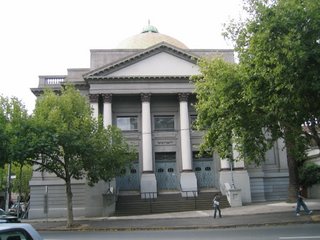
Image: Photo of the main Jewish synagogue in Toorak, Melbourne. This is in the neighbouring suburb to Armadale where FWB was pastor. Boreham developed a friendship with the Rabbi who came to Boreham's farewell from the local church and retirement celebration in 1928. FWB was broad in his interests and ecumenical in his relationships.

Thursday, June 01, 2006

Boreham and Editorial Expectations

What Would You Say?
“The leading article for to-morrow’s paper has yet to be written. If you had to write it, what would you say?”[1] This question posed by Otago Daily Times editor, George Fenwick, must have focussed Boreham’s mind every time he sat down to write a lead editorial. Of the things that helped to answer that question, the editorial expectations which will be explored in this section were important factors.

Word Limit
One editorial expectation that influenced Boreham’s subject and style was word limit. The 1,500 word limit that Boreham was given when he started as a lead writer for the Mercury gave scope for developing a theme. By 1930, when his word limit was reduced to 1,000 words, there is evidence of him eliminating illustrative paragraphs to meet the new constraint. In February 1958, when editorials in the Mercury were reduced to 500 words, Boreham’s biographical style was hampered because of the difficulty of introducing and telling a life story within the limitations of space.

Guest editorials
It is difficult to distinguish between the editorial expectations of the newspaper and the personal expectations of Boreham, however, throughout his career there were discernible phases. When Boreham commenced writing for the Otago Daily Times in 1900, he contributed as a guest editorialist. These articles, either requested or submitted, were written at an irregular frequency (about two per month) and consisted mainly of eulogies, anniversaries and articles concerning the visit of prominent people to the city. Occasionally Boreham expressed opinions on current national issues such as compulsory military training,[2] militarism,[3] poverty[4] and education.[5] Already there is evidence of articles devoted to Boreham’s passion for the British Empire.[6] Boreham’s contribution to Melbourne’s Argus of an Easter and a Christmas article most years from 1934 to 1943 represented a later phase as a guest editorialist.[7]

Weekday editorials
The sudden death of the editor of the Mercury in August 1912 was the event that launched Frank Boreham’s editorial career with the leading Tasmanian newspaper. Slipping into the breach, Boreham wrote daily editorials and sometimes two each day from 23 August 1912 until 9 November 1912. In this three-month period Boreham wrote the most topical editorials of his entire career. It was chiefly the news of the day that prompted the ideas for these articles. During this time he discussed many international events including the construction of the Panama Canal,[8] the Titanic disaster,[9] the suicide of a Japanese politician,[10] the upheaval in China[11] and politics in India.[12] He viewed his role as informing readers about world events and interpreting global trends. His attempt to bring the lesser known issues into focus was evident for when writing about the ‘derelict empire of Persia’, Boreham said, “It is never safe to assume that the matters that loom most largely in our columns of cablegrams are of necessity the most important factors on the international horizon”.[13] In addition to his ‘stock in trade’ biographical editorials,[14] during this period Boreham wrote editorials that dealt with national issues such as the economy,[15] “the problem of the [mentally] unfit”,[16] employment[17] and immigration.[18]

Saturday editorials
When a new editor was appointed to the Mercury, the proprietor, Mr C E Davies requested continuing contributions from Boreham, to which he responded by agreeing to write a leader for the Saturday issue. These Saturday articles, which represent the vast majority of Boreham’s editorials, had a different character from the weekday editorials. Discussing this ‘Saturday spirit’ in an article entitled, ‘The end of the week’, Boreham agreed with Norman Lindsay that Saturday was “Australia’s great day”. He continued, “It is certainly the day on which Australia most freely expresses herself” with “paper shops infected by the Saturday spirit”. For Boreham Saturday was “Saturday all the world over”, his inference being that the weekend enabled a consideration of the valuable link that this day gave to Tasmanians with people around the world. “Memories of childhood”, he added, “foster the Saturday spirit”.[19] The Saturday editorial gave a freedom to depart from the weekday, temporal issues that dominated the paper and to address issues that were more reflective, unchanging and universal in nature.

Geoff Pound

Image: This is the cover of the Bibliography that Melbourne University bibliographer, Ian McLaren wrote in which he describes the books of F W Boreham and where the different editions can be found. A technical book, available from Whitley College, but it has some interesting insights within it. Ian got to know FWB when Boreham was pastor at Armadale and staged lectures on books.

[1] F W Boreham, My pilgrimage (London: The Epworth Press, 1940), 150.
[2] F W Boreham, Otago Daily Times, 18 March 1901.
[3] Boreham, Otago Daily Times, 28 March 1901.
[4] Boreham, Otago Daily Times, 15 June 1901.
[5] Boreham, Otago Daily Times, 11 December 1901.
[6] Boreham, Otago Daily Times, 15 June 1900; 7 September 1901; 29 October 1901.
[7] Boreham contributed fifteen editorials to the Argus, seven of which were Easter editorials, seven were Christmas editorials and one took the theme of diary writing.
[8] F W Boreham, Mercury, 28 August 1912.
[9] Boreham, Mercury, 14 September 1912.
[10] Boreham, Mercury, 20 September 1912.
[11] Boreham, Mercury, 7 October 1912.
[12] Boreham, Mercury, 14 October 1912.
[13] Boreham, Mercury, 7 November 1912.
[14] Boreham, Mercury, 7 September 1912; 9 September 1912.
[15] Boreham, Mercury, 23 August 1912.
[16] Boreham, Mercury, 18 September 1912.
[17] Boreham, Mercury, 28 September 1912.
[18] Boreham, Mercury, 10 October 1912.
[19] Boreham, Mercury, 16 September 1933.

Wednesday, May 31, 2006

Boreham in the Editorialist Tradition

Crucial Platform
While the influence of the press as an educative instrument was waning in the first two decades of the twentieth century when Boreham’s editorial career was flourishing, the press continued to exercise a dominant role in providing information, educating and influencing thought in society.

The Australian press had long been considered an agent of social improvement and community cohesion through its promotion of family values, its pro-Imperial stance, its advocacy of the British way of life and its loyalty to the royal family. The power of the press to influence political opinion could be seen in the unashamed stance of most Australian dailies in cultivating support for wars, promoting allegiance to England, urging support for conscription and challenging the value of strikes and riots. Commenting on the first two decades of the Australian commonwealth, communication academics Graeme Osborne and Glen Lewis said, “The press was the dominant media of the day. The major papers and magazines took the leading role in communicating political news and forming public opinion”.[1] As to whether the press accurately reflected society, Osborne and Lewis stated that the press “was often anti-Catholic and opposed Irish Home Rule. It excluded women and ignored Aboriginals. Most papers were anti-Asian”.[2]

The editorials appeared to be the major source of ideas and opinions in the twelve to sixteen pages of the paper when Boreham wrote between 1912-1920, a period when the Mercury experienced no competition from any other daily. Australian academic Imne Salvsinszky’s assertion that “the familiar essay ... had few outlets in Australia in the first half of the nineteenth century” highlights the importance of the editorial.[3]

Even by 1930, Sydney Morning Herald writer Henry M Green observed that “in essays, Australian literature is even weaker than in drama”,[4] and believed this was due to a “lack of leisure and lack of a market”.[5] This observation underscores the continuing importance of the editorial in society. In spite of the advance of books and magazines in Australia, a survey undertaken in 1950 indicated that readers of the Mercury were spending an average of forty-five minutes each day (compared with an Australian average of thirty-five minutes) and that the editorial columns were being regularly read by fifty-eight percent of the readers.[6]

Always Throwing Light on Things
It is important to view Boreham’s editorial contributions in the context of the tradition in which he wrote. The earlier phases of his writing career with the Otago Daily Times (1899-1906) and the Mercury (1912-1918) fitted the description once given to editorial writer, Dr Rutherford Waddell: “Always to be throwing light on things, to stimulate thought and aspiration, and conduct them along desirable channels, to interpret to the younger and less informed the world of men, of books, and of things, and in doing this to give them the surest and most wholesome interpretations”.[7] In the first, impromptu, editorial that Boreham wrote for the Otago Daily Times, he offered a Gibbonese analysis of the Roman Empire to assess the current health of the British Empire. He laced his argument with quotations from Lord Tennyson and Robert Louis Stevenson and then pressed home his conclusion with an analogy drawn from nature.[8] This maiden editorial not only bore the Boreham editorial signature but it distinguished his writing from the paper’s regular editorials chiefly by the way it provided a historical and literary lens through which readers could interpret the present and find encouragement for the future.

Christians and the Press
In sketching the sphere of Christian influence in Australia between 1836 and 1901, Ian Breward observed the significant “number of Christians, lay and clerical, [who] owned and edited local and urban newspapers” including the Syme brothers in Melbourne, “who had been educated for the Congregational ministry [but] found a wider platform through the Age”.[9] Breward further observes that, “religion’s importance was underlined by extensive reporting in both metropolitan and local papers”.[10]

The educated voice of a local religious leader was highly valued during Boreham’s career and editorial staff of Australasian dailies hired church representatives with literary skills to express a religious or moral voice. The occasional editorial took on a public chaplaincy role especially at times of national emergency or international crisis. These sometimes took the form of a eulogy with statements of comfort, such as in the editorial, ‘Mr Gladstone is dead’,[11] a message of hope such as the editorial that launched the Mercury in 1915, ‘A New Year—and The World at War!’[12] or an expression of civic celebration as stated on the occasion of Queen Elizabeth’s arrival in Hobart, ‘Great Day Dawns’.[13] The regular religion editor usually expressed a viewpoint on Christian festivals—Easter and Christmas—and other red-letter days, such as New Year, Australia Day, Empire Day (later Queen’s Birthday) and End of Year. The Saturday editorial in the Mercury and the Age developed a different style from the rest of the week, and was usually designed to uplift, provoke or inspire. This thesis will seek to ascertain whether there were any specific expectations, directions or constraints that were imposed on Boreham by the managers and editors of the papers to which he contributed.

Standing in the Editorial Tradition
While Boreham undertook the religious editorial role in the Mercury between 1912-1959 and the Age from 1936-1959, others provided this function at different times and in various papers. Contemporaneous with Boreham was the Presbyterian minister, the Rev Thomas Jollie Smith (1858-1927), who was a leader-writer for the Argus and the Australasian from 1907 to 1927. He studied as an undergraduate at the University of Melbourne and did his theological education at Ormond College where he later trained ministers for the church. After ordination, he had a distinguished pastoral ministry in South Australia before undertaking a “brilliant” academic career.[14] Like Boreham he was “a voracious and retentive reader” which, combined with his ability as a “pithy and substantial preacher”,[15] equipped him to be “an erudite critic and plain-speaking leader-writer”.[16] Professor Rentoul asserted that Jollie’s editorial writing “did much to ensure a more serious hearing for the Christian message than in earlier decades”.[17]

The Rev Edward Sidney Kiek (1883-1959) wrote for the Adelaide Advertiser at a later period than Thomas Jollie. Kiek trained ministers in his Congregational tradition and was an active, liberal church leader who, according to Breward, “revitalized the South Australian theological world in the 1920s”.[18] Assessing the significance of his Saturday leaders in the Advertiser from 1937 to 1959, Walter Phillips writes: “It was a magnificent feat to sustain that effort weekly to the end of his life ... the variety of topics he dealt with is most impressive. He reflected on many aspects of life and thought in the modern world, bringing to bear on them his wide knowledge of literature and history. Through them he conveyed a common sense morality and spirituality”.[19]

Following Boreham at the Age was the Rev Dr Alan Watson, a prominent church leader whose editorials reveal a thinker who “loved literature and … loved words” and was able to relate to the ordinary person.[20] Watson continued the Saturday editorial tradition on 25 July 1959 and wrote for the next seventeen years until 24 January 1976. From March 1996 the Age gave this editorial the heading, ‘A Saturday Reflection’.

From 1976, the role was assumed by Boreham’s biographer, the Rev T Howard Crago. Later, when Crago could not continue at a weekly frequency, the editorial, on alternate Saturdays, bore the initials of THC and the new writer JD—Jim Darling. When this arrangement concluded, the Age employed the Rev Robert Brown (the third Baptist in succession) and ‘the motor bike preacher’, John Smith, who wrote on alternate Saturdays. During this time the editorial became known as the ‘Faith’ column and in 1998 authorship was widened to incorporate people from traditions other than Christian and people without a faith in God. The anonymous religious lead editorial no longer exists in the newspapers in which Boreham wrote and has been replaced by religious or faith opinion columns written by named authors.

F W Boreham discovered an important platform in the leading papers of the state and countries where he lived. He contributed to these newspapers for an extremely long period and saw this as an important part of his ministry.

Geoff Pound

Image: A recent edition of the Melbourne Age, to which FWB contributed for decades.

[1] Osborne and Lewis, Communication traditions in Australia, 63.
[2] Osborne and Lewis, Communication traditions in Australia, 64.
[3] Imne Salvsinszky, The Oxford book of Australian essays (Melbourne: Oxford University Press, 1997), 1.
[4] Cited in Salvsinszky, The Oxford book of Australian essays, 1.
[5] Salvsinszky, The Oxford book of Australian essays, 2.
[6] Mayer, The press in Australia, 228-233. In contrast, the section of the Mercury that drew the greatest number of regular readers was the Letters to the Editor (eighty-one percent and the least attention, the Radio Programmes (forty-one percent).
[7] Mr Wilson, Otago Daily Times, 28 April 1900.
[8] Otago Daily Times, 15 June 1900; Mercury, 15 August 1914.
[9] Breward, Australia: ‘The most godless place under heaven’, 30.
[10] Breward, Australia: ‘The most godless place under heaven’, 31.
[11] Otago Daily Times, 20 May 1898.
[12] Mercury, 1 January 1915.
[13] Mercury, 20 February 1954.
[14] Ian Breward, ‘Thomas Jollie Smith’, ADB, vol. 2, 1891-1939, ed. Geoffrey Serle (Melbourne: Melbourne University Press, 1988), 663.
[15] Breward, ADB, 664.
[16] Breward, ADB, 664.
[17] Breward, ADB, 664.
[18] Ian Breward, ‘Edward Sidney Kiek’, ADB, vol. 9, 1891-1939, eds. Bede Nairn and Geoffrey Serle (Melbourne: Melbourne University Press, 1983), 587-588.
[19] Walter Phillips, Edward Sidney Kiek: His life and thought (Adelaide, SA: Uniting Church Historical Society, 1981), 17.
[20] Duncan Watson and Nigel Watson, eds. Alan Watson's Saturday reflections: A selection from his writing for 'The Age' over seventeen years (Melbourne: Mullaya, 1976), xiii.

Tuesday, May 30, 2006

Boreham and Disability


In My Pilgrimage F W Boreham writes at length about one of his daughters, Estelle or Stella.[1]

Gift of a Disabled Child
We saw from the first that as long as she lived, Stella would always have to be coddled and cosseted, the object of constant solicitude, to be watched night and day, treated with unceasing tenderness and guarded from every wind that blows. To make matters worse, our frail little babe sustained, during the first year of her life, a terrible fall, a fall that led to a severe attack of meningitis followed by a long and trying illness. Did any element of rebellion ever enter our wayward hearts? Were there bitter moments in which we wondered why this happened to our treasure- and to us? Did we sometimes compare her with bonnier girls? Do not press me too closely! I can only plead that if we sinned, we have most fervently repented. For the little girl who came to us in Hobart has proved a perennial benediction: every phase of our home life has been sweetened and sanctified by the beautiful ministry of her gentle life.

The Most Shattering Moment in F W Boreham’s Life
If I were asked as to the most nerve-shattering moment that I have ever known, my mind would go back to a certain Sunday morning at Hobart. The service over, I noticed, on emerging from the church, that Stella- then about five- was standing at the manse gate opposite. Catching sight of me, she forgot all about the traffic on the busy street between us, and dashed toward me. As soon as she left the pavement on her side of the road, I saw that nothing could save her. She stepped right into the path of an oncoming car which, striking her on the full, hurled her, a huddled little heap, into the middle of the roadway. With a horror that I cannot attempt to describe, I hurried across to gather her up, only to find that, miraculous as it must seem, she was quite unhurt.

Sweetest Companion
Shy and reserved in the presence of strangers, she has always been to us- and to those who know her- the sweetest and most entertaining of companions: no member of our little circle could bear the thought of life without her.”

Addressing Disabilities
It is interesting to note that with a daughter who had an intellectual disability and he himself having a physical disability (having lost a leg in a tram accident,) F W Boreham regularly wrote in his newspaper editorials about coping with disabilities. Sometimes he would write about blindness and deafness. Sometimes the message was a call to local or national government to provide more services for the disabled while at other times it was an encouragement to see disability in a different light. In 1955 he wrote:

“A handicap is a call for a superb and superlative endeavour. It is at this point that life rises to real grandeur. In his most famous painting, Paul Delaroche, the French artist, represents the heroes of the ages grouped around a central tribunal. But the striking thing about the picture is the fact that all the figures in the foreground are men, who, like Homer, Epictetus, Milton, and a score of others, were horribly afflicted. They had mastered the philosophy of that noble saying of Lord Bacon which every handicapped man should learn by heart: "Whosoever hath anything fixed in his person that doth induce contempt hath thereby a perpetual spur in himself to rescue and deliver himself from scorn.”[2]

Geoff Pound

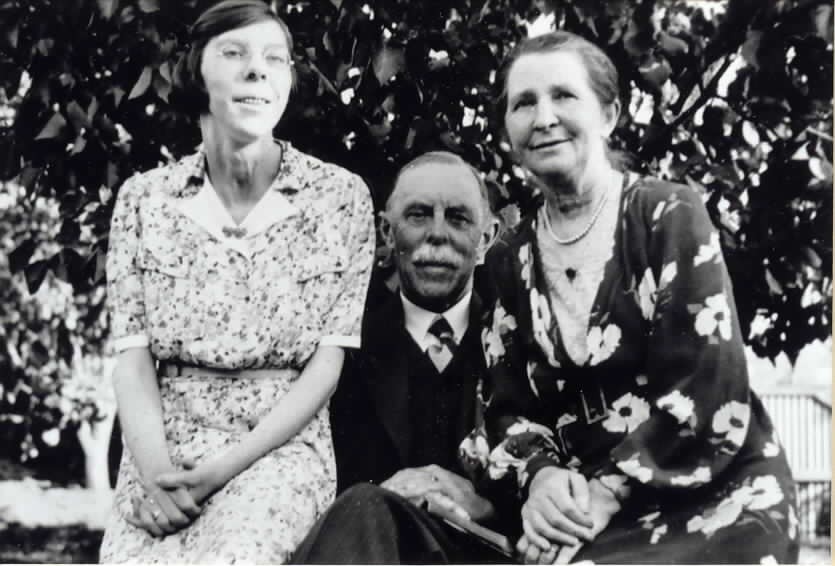
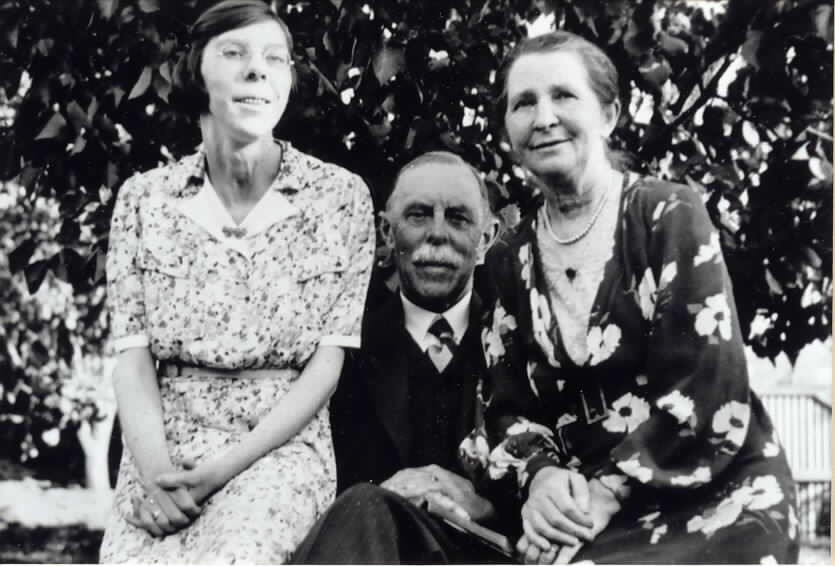
Image: Photo of Frank and Stella Boreham’s daughter, also known as Stella, along with her father and mother.

[1]F W Boreham, My Pilgrimage (London: The Epworth Press, 1940), 190-1.
[2] F W Boreham, ‘The Base and the Apex’, Hobart Mercury, 17 September, 1955.

Monday, May 29, 2006

F W Boreham's Family


Some readers have asked for more information about F W Boreham’s family. While there are several photos that we have (many of which have been posted on this blog site) there are not a lot of references to his children in his writings.

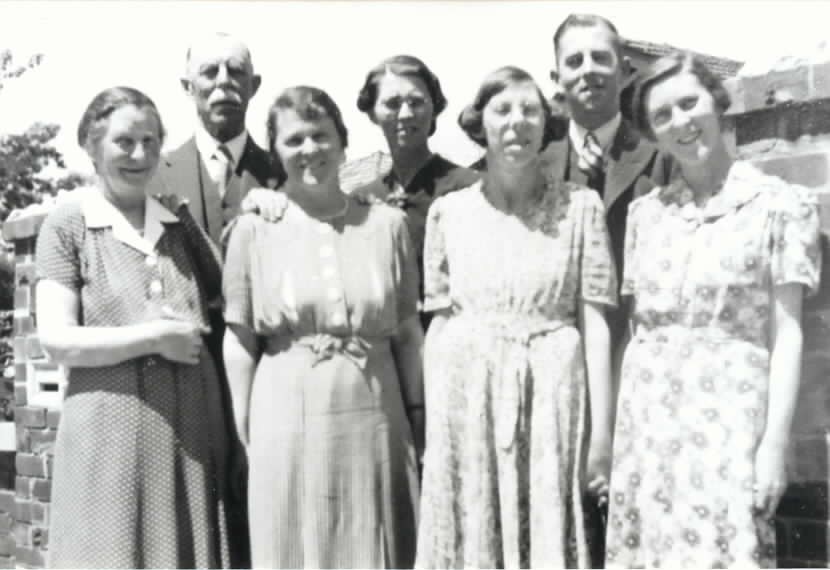
This is one of the few photos we have of F W Boreham’s entire family. This photo was probably taken in the late 1940s. Here are the names and dates (according to T Howard Crago’s biography).

From left to right:
Stella (FWB’s wife)

F W Boreham

Ivy Tireni Boreham who was born on 27 September 1897 was the eldest daughter who married Rev Norman McDonald, a Presbyterian minister who served around Victoria, Australia.

Stella Wroxton Boreham who was known as Wroxie did not marry and with FWB and Stella not being drivers, Wroxie was the one who did most of the driving. Wroxie was born on 13 May 1902 and died on 8 November 1953.

Estalle Boreham was born in 1909 and died in 1959 about one month after the passing of FWB.

Frank Boreham who was born in 1913, married Betty and worked for the Gas & Fuel in Melbourne.

Joan Boreham was born in July 1916, married Harvey Lincolne and lived for most of her life in Hobart.

Reference has been made in an earlier posting to Frank Boreham Jnr and the essay F W Boreham wrote at the time of his birth, entitled, ‘It’s a boy!’.

There are two more references to Frank Jnr, both of which speak of father and son walking at night and looking up with wonder (and lots of questions) at the stars.[1]

I am unsure how Wroxie got her name but ‘Wroxton Lodge’ was the name of the Boreham house in Tunbridge Wells and it was the name (shown on a plaque) of the homes where FWB and Stella lived in Mosgiel, Hobart, Armadale and Kew. The death of Wroxie was a real heart break to the family. After she died in 1953 FWB and Stella had regular picnics in the cemetery around her grave. There is an oblique reference to Wroxie’s passing in the opening pages of In Pasture’s Green where F W Boreham says:

“These studies in 23 Psalm are born of a profound personal experience. I fondly hope that it will pour into the hearts of its readers something of the comfort and grace that the Shepherd Psalm has, in my eighty-third year, ministered to me.”

More will be said about young Stella in the next posting.

Geoff Pound

Image: A Boreham Family Photo

[1] F W Boreham, The Nest of Spears (London: Epworth, 1927), 240; F W Boreham, When the Swans Fly High (London: Epworth, 1931), 87.

Sunday, May 28, 2006

F W Boreham's Literary Style

I am Debtor
Over the last 15 postings we have examined the novelists and historians who shaped the writing of F W Boreham. To all these people and others Boreham was indebted.

Editorials in Scrapbooks
F W Boreham’s 3,000 editorials were printed in the Otago Daily Times, the Hobart Mercury, the Melbourne Age and there were a few in The Argus. Thankfully he or a relative cut these out and pasted them into large scrapbooks which are kept at the F W Boreham Collection at Whitley College in Melbourne. From his scribblings in the margin and blue crayon (signifying that he used that editorial in the Age) one gets to see how Boreham recycled his articles.

Detective Work
Unfortunately the scrapbooks do not contain Boreham’s editorials from the Otago Daily Times and there is a scrapbook missing from 1914-1917 (from memory). When I read Boreham’s editorials in old copies of the Otago Daily Times and the Mercury on microfiche at the Victorian State Library over these periods I had to guess which of the unattributed editorials each day belonged to Boreham. Fortunately by that time I had read hundreds of his editorials and had become proficient at detecting his work. This posting seeks to identify his style and describe Boreham’s literary signature?

Literary Style Arises out of the Person
In writing about literary style, Boreham drew attention to the diverse approaches of some of his models: “You can’t understand their styles unless you understand them. For their styles are simply themselves .… If you were to put a sentence of Carlyle into Gibbon or Macaulay ... each of these sentences would seem as much out of place as a cuckoo in a robin’s nest. Their style is peculiarly and exclusively their own.[1]

Who was the literary Boreham and how did his personality find expression in his unique writing style? In what ways did his writing bear the marks of those he selected as ‘worthy models’ of the literary art?

Lover of Words
Boreham was a lover of words who possessed a passion to write. His reserved temperament and shyness with people, which he shared with many of his role models, may have found compensation in his extroverted pen. He would have agreed with the current editor of the Age, Michael Gawenda, who wrote, “There is a magic about printed words on paper that cannot be replicated by any other form of communication. There is something about printed words on paper that goes to the heart of what defines us as human beings, that speaks to our deepest needs”.[2]

Those whom Boreham anointed as his models were wordsmiths who approached their craft with reverence. The training in shorthand and journalism that he shared with many of his mentors made Boreham attentive to tone, to the sound of words and how they would be received by his readers. With Walter Landor, he wondered at the intrinsic beauty of words and believed that the artistic selection of words was “what melody is to the composer, what colour is to the painter”.[3]

Lover of Stories
Moreover, Boreham was a lover of stories who adopted storytelling as his major literary form. While Charles Dickens introduced him to the enchantment and entertainment of stories, Gibbon, Macaulay and Scott extended his appreciation of the use of a narrative style for presenting personalities, motives and movement. Boreham’s writing possessed a predictable structure but it relied heavily for its colour and appeal on dramatic movement, concrete images, eye-catching detail and a preoccupation with people—particularly little, unassuming people. A revealing gift that Boreham shared with Dickens, Gibbon and Macaulay was an unusually retentive and imaginative memory that aided the study of a scene and the ability to portray it in words with artistic flair.

Lover of History
Further, Boreham’s love of history was meteoric yet enduring. He liked to set the present situation within an historical context, to encourage a respect for the past and to draw lessons from the past for future living. His reading of the story of England instilled within him a pride in the nation’s achievements and heightened his sense of optimism and progress about the British Empire. From Macaulay, Gibbon and Scott he learned to write history in a narrative style, enshrining principles within his many biographical editorials. His person-centred view of history was sanctioned by Thomas Carlyle who championed the importance of recalling great heroes. Boreham’s belief that history needed to be told in an interesting and graphic fashion often led to a lack of analytical depth and a “dangerous simplicity”.[4] Being attentive to how his readers were enjoying his work, Boreham’s propensity to daydream enabled him to climb into characters and explore contexts but, as with Gibbon and Macaulay, his self-projection led to a loss of historical objectivity.

Lover of Style
In addition, Boreham’s writing displayed a love of style. While attentive to the diverse approach of different authors, he was adamant that writers must find their unique style. Boreham was also conscious of the need for a speaker or writer to change with the times when he wrote in 1916, “The pompous phrase, the superb figure, the classical quotation and the irridescent glow of the elaborate peroration are among the things that have had their day and ceased to be”.[5] He recognised style as a “reduction of one’s personality to paper” and an expression of one’s God-given creativity which may be developed through study and practice.[6] He admired the forthrightness of Macaulay and Carlyle and derived from them a confidence. However, Boreham’s written expression was a reserved, dignified style that he described as portrayal in “pastel shades” rather than black and white.[7] This was his customary style by personality and conviction. While Boreham’s early literary efforts appeared wordy and cumbersome, from Gibbon he came to value clarity. Boreham’s commitment to authorial restraint contributed to the “crystalline” style.[8] From models such as John Bunyan and Mark Rutherford, Boreham prized the qualities of simplicity and a naturalness of expression. Boreham revelled in the energy that pervaded the writings of Robert Louis Stevenson and he, in turn, strove to achieve a style where aptly chosen words might throb, exude joy, elicit insight and transport readers on a journey of discovery.

Geoff Pound

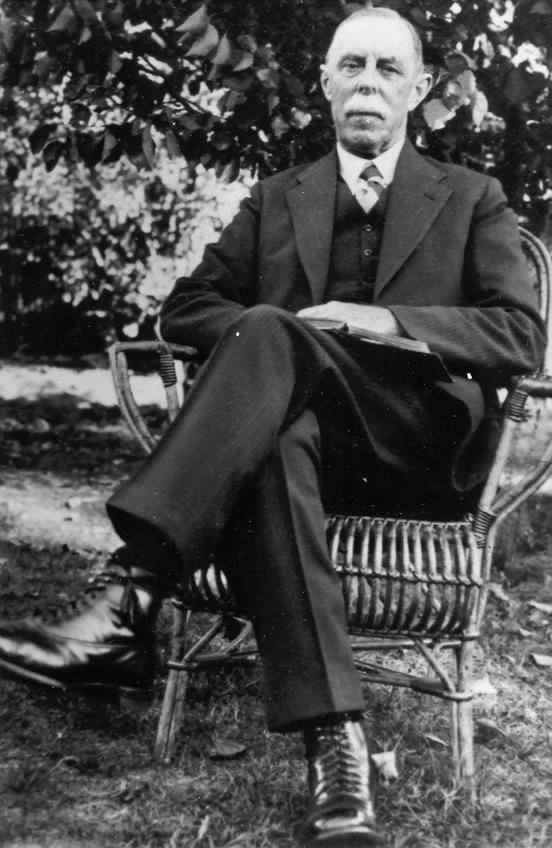
Image: F W Boreham seated in his cane chair at Fellows Street in Kew, Melbourne. Circa, 1956-59.


[1] Boreham, When the swans fly high, 130-131.
[2] Michael Gawenda, Age, 1 November 1999.
[3] Boreham, Mercury, 20 October 1934.
[4] Porter, Edward Gibbon: Making history, 7.
[5] Boreham, Mercury, 24 June 1916.
[6] Boreham, Mercury, 12 March 1938.
[7] Boreham, Age, 27 April 1946.
[8] Boreham, Mercury, 16 March 1957.

Saturday, May 27, 2006

Boreham and His Literary Models Part 15: Thomas Carlyle

This is another article on the writers that shaped the literary style of F W Boreham. This posting looks at Thomas Carlyle (1795-1881)[1]:
Passionate Historian
A further literary influence upon Boreham was Thomas Carlyle. This Scottish writer reinforced Boreham’s passion for history, not as a succession of events but “as a process shaping the contemporary world, and sometimes as a process in which it is thought that the individual forces at work, whether personal, national, or purely abstract, can be examined and interpreted”.[2]

Importance of Heroes
Boreham’s numerous references to Carlyle indicated how his writing was inspired by Carlyle’s lifelong devotion to the study of history,[3] his encouragement to wonder[4] and his passion for hero-worship.[5]

Prophetic Voice
Boreham recognised Carlyle as “one of the mightiest moral forces of our time” and he admired the prophetic way in which Carlyle denounced all that was hollow and unreal.[6] Boreham described Carlyle as a “literary calamity” whose writing was “volcanic” and who gave to anyone reading him for the first time “the feeling that he is crossing a ploughed field in silk slippers”.[7] While Boreham did not attempt to imitate Carlyle’s style, he embraced many of his ideas and was challenged by Carlyle to consider how he might introduce a moral and prophetic dimension into his writing.

Geoff Pound

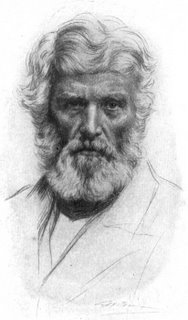
Image: Thomas Carlyle


[1] Thomas Carlyle was a celebrated essayist, historian and philosopher from Scotland. More information on Carlyle may be found in the Bloomsbury guide to English literature, 387-388.
[2] Roger Sharrock, ‘Carlyle and the sense of history’, Essays and studies collected for the English Association, 19 (1966): 74.
[3] F W Boreham, Faces in the fire (London: The Epworth Press, 1916), 42.
[4] Boreham, Mercury, 17 October 1942; Age, 22 January 1949.
[5] Boreham, When the swans fly high, 145.
[6] Boreham, Mercury, 2 March 1935.
[7] Boreham, Mercury, 2 March 1935.

Friday, May 26, 2006

Boreham and His Literary Models Part 14: Robert Louis Stevenson

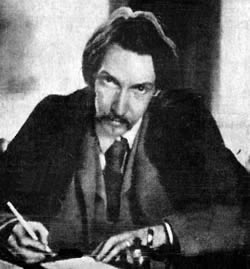
We are considering a range of the authors who left their mark on the development of F W Boreham’s literary style. In this article we look at the influence of Robert Louis Stevenson (1850-1894)[1]:

Nurtured on Bible and Adventure Stories
The essayist and novelist Robert Louis Stevenson hailed from Edinburgh but some of his best writing emerged when he was based in the Pacific islands. Perhaps the affinity that Boreham felt with Stevenson may be explained by the way they both had had their childhood imaginations fired by a rich diet of Bible and adventure stories,[2] and by their experiences of a strong bond with their homeland despite having lived many years away from it.[3] Those who knew them commented on their astonishing memories, not only of things, but of thoughts and emotions.[4]

Lover of Life
Boreham sought to emulate what T M MacCallum described as Stevenson’s “optimistic sunniness”,[5] a quality made all the more striking when one considers the long periods of sickness that Stevenson endured. Boreham owed one of his major themes to what Stevenson called “the essential livableness of life”[6] and remarked that despite life’s vicissitudes Stevenson “loved life; loved it passionately and devotedly, loved it from first to last”.[7]

Oozing Personality
While many who met Stevenson remarked on his “personal magnetism”,[8] Boreham was greatly influenced by the way that Stevenson’s writing oozed personality, a quality that led one critic to say, “No Victorian writer is so powerfully present in his work”.[9] It was this “subtle magic that can be felt but not explained”[10] that led Boreham to imitate Stevenson’s disciplined approach to writing and to class him within a select circle of writers in English who made their readers very fond of them.[11]

Geoff Pound

Image: R L Stevenson

[1] Robert Louis Balfour Stevenson was born in Scotland but spent much of his time abroad. He is remembered as a novelist, especially for his historical romances and adventure stories (Treasure Island), an essayist and a poet. More information on Robert Louis Stevenson can be found in the Bloomsbury guide to English literature, ed. Marion Wynne-Davies (London: Bloomsbury Publishing, 1989), 931-932.
[2] Charles J Guthrie, ‘“Cummy, I was just telling myself a story”’, in Robert Louis Stevenson: Interviews and recollections, ed. R C Terry (Hampshire: MacMillan, 1996), 11.
[3] R C Terry, ‘Introduction’, in Robert Louis Stevenson: Interviews and recollections, xiv.
[4] H B Baildon, ‘Quick and bright but somewhat desultory scholar’, in Robert Louis Stevenson: Interviews and recollections, 23.
[5] T M MacCallum, ‘Always eager for excitement’, in Robert Louis Stevenson: Interviews and recollections, 144.
[6] Boreham, Mercury, 2 November 1946.
[7] Boreham, Mercury, 21 May 1932.
[8] MacCallum, ‘Always eager for excitement’, 144.
[9] Terry, ‘Introduction’, xxi.
[10] Boreham, Mercury, 21 May 1932.
[11] R C Terry et al., ‘Patriarchal relations’, in Robert Louis Stevenson: interviews and recollections, 183.

Thursday, May 25, 2006

Boreham and His Literary Models Part 13: Walter Scott

This posting is part of a series on F W Boreham and the authors who influenced his literary style. This article is about the influence of the author, Walter Scott (1771-1832):[1]

Poet and Historical Novelist
From the numerous editorials that Boreham wrote on Sir Walter Scott, his many references to Lockhart’s Life of Scott, which Boreham regarded as one of the “two greatest biographies in the language”[2] and his homage at Scott’s tomb one gets a sense of the respect that Boreham had for ‘the Waverley wizard’.[3]

Attracted to stories and storytelling from an early age,[4] Scott’s storytelling ability was enhanced by an “understanding of character and motive”[5] and “a strong feeling for the dignity of all human beings”.[6] He was a poet and the inventor of the true historical novel.

Captured Readers’ Attention
Always attentive to the effect writers had on their readers, Boreham believed that Scott’s hold on the people of Scotland was because he “captured the imagination more than all except perhaps Dickens”.[7] Thomas Carlyle wrote of him, “No fresher painting of Nature can be found than Scott’s.”[8] The popularity of Scott, according to Boreham was attributable to Scott’s “reverence for reality”.[9]

Enamoured by Scott’s passion for antiquity, and the way (unlike Gibbon) Scott’s “history embraces the common man as well as kings and statesmen”,[10] Boreham believed that people’s fascination translated into a revival of the Scottish spirit as Scott was convinced “that the torpid and lethargic Present needed to be brought in contact with a splendid and stately Past”.[11]

Geoff Pound

Image: Walter Scott

[1] Sir Walter Scott was a Scottish writer best remembered for his poems (‘The lady of the lake’) and historical novels which included Waverley and The heart of Midlothian. More information on Walter Scott can be found in the Bloomsbury guide to English literature, 884-885.
[2] F W Boreham, Bunch of everlastings (London: The Epworth Press, 1920), 70.
[3] Boreham, When the swans fly high, 157.
[4] N T Phillipson, ‘Scott as story-teller: An essay in psychobiography’, Scott bicentenary essays: Selected papers read at the Sir Walter Scott bicentenary conference ed. Alan Bell, (Edinburgh: Scottish Academic Press, 1973), 95.
[5] Beattie, ‘Scott’, Scott bicentenary essays, 14.
[6] Johnson, ‘Scott and the corners of time’, Scott bicentenary essays, 24.
[7] Boreham, Mercury, 11 April 1925.
[8] Thomas Carlyle, ‘Sir Walter Scott’, Thomas Carlyle’s collected works vol. V. (London: Chapman & Hall, 1869), 271.
[9] Boreham, Mercury, 11 April 1925.
[10] Johnson, ‘Scott and the corners of time’, 35.
[11] Boreham, Age, 16 December 1950.

Wednesday, May 24, 2006

Boreham and His Literary Models Part 12: J M Barrie

This posting is part of a series on F W Boreham and the authors who influenced his literary style. This article is about the influence of the author, J M Barrie (1860-1937).[1]

It may have been Boreham’s immersion in the Scottish province of Otago that led to his acquaintance with a variety of Scottish writers who left their mark on his writing style. Among these was James Matthew Barrie whom Boreham described, with his characteristic use of superlatives, as “the most distinctive, most outstanding and most lovable figure of his time”.[2]

Perhaps it was Barrie’s popularity in immortalising obscure Kirriemuir and projecting himself in the “impish McConnachie” that led Boreham to write his essays about country town Mosgiel and project another side of his personality into the character of John Broadbanks.[3]

Like Boreham, temperamentally “shy and sensitive”, Barrie’s great gift was “the ability to invent and tell a good story”.[4] Boreham alluded to the virtues of restraint and anonymity which were most evident in his editorials when he said of Barrie, “There is a sense in which he never speaks of himself: there is a sense in which he puts himself into every word that he utters. Therein lies his charm”.[5]

Geoff Pound

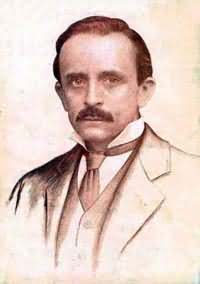
Image: J M Barrie

[1] Sir James Matthew Barrie was a Scots dramatist, now famous for his creation of Peter Pan (1904) and his play, The admirable Creighton (1902). More information on J M Barrie can be found in the Bloomsbury guide to English literature, 340-341.
[2] Boreham, Mercury, 9 May 1942.
[3] Boreham, Mercury, 9 May 1942.
[4] James A Roy, James Matthew Barrie: An appreciation (London: Jarrolds Publishers, 1937), 48.
[5] Boreham, Mercury, 9 May 1942.

Tuesday, May 23, 2006

Boreham and His Literary Models Part 11: John Bunyan

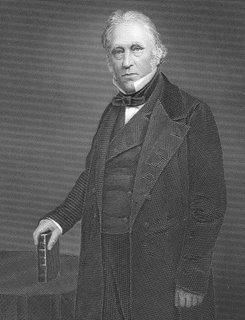
This posting is part of a series on F W Boreham and the authors who influenced his literary style. This article is about the influence of the author, John Bunyan (1628-1688)[1]:
Desert Literature?
Was it the stories of his mother, the urging of Mark Rutherford, who “read Bunyan assiduously throughout his life”[2] or Macaulay’s commendation to all literary aspirants of The pilgrim’s progress “as the supreme and incomparable pattern”[3] of English style that led Boreham to say, “If I was shipwrecked on a desert island, the one book, in addition to the Bible, will certainly be John Bunyan, although I could not be sure whether it would be The pilgrim’s progress or Grace abounding?”[4]

A Spiritual Master
Boreham claimed Bunyan as being “among his spiritual masters”[5] and testified to Bunyan’s influence on his writing when he said, “In the writings of those who have modelled themselves on his perfect style, he lives a thousand lives, quite anonymously, but with tremendous effect.”[6]

Effortless Simplicity
What impressed Boreham was Bunyan’s simple style that appeared to arise effortlessly from the person himself: “The charm of Bunyan is that he is always himself .… There is nowhere anything grandiloquent, efflorescent or highfalutin, about a word that he says. He never tried to write; he just wrote. The simplicity of his soul found perfect and natural articulation in the crystalline clarity of his own native speech”.[7]

Geoff Pound

Image: John Bunyan

[1] Further information on the Bedfordshire author can be found in, DNB eds. Leslie Stephen & Sidney Lee, vol. 3 (London: Oxford University Press, 1937), 275-284.
[2] Beresford, ‘Mark Rutherford and hero-worship’, 270.
[3] Boreham, Mercury, 31 August 1946.
[4] Boreham, When the swans fly high, 156.
[5] Boreham, A witch’s brewing, 155.
[6] Boreham, Mercury, 31 August 1946.
[7] Boreham, Mercury, 31 August 1946.

Monday, May 22, 2006

Boreham and His Literary Models Part 10: Thomas Macaulay

This posting is part of a series on F W Boreham and the authors who influenced his literary style. This article is the second of two instalments on the historian, Thomas Macaulay (1800-1859):

Daydreaming Historian
Macaulay’s childhood tendency to daydream enabled him to imagine himself in historical places (ancient Greece) or amid events (the French Revolution) and led him to compose conversations with great people of the time. This imaginative gift, which he retained throughout his life, contributed to his “strongly developed sense of the concrete in pictorial form and the capacity to animate into forward motion in time, motives, characters and situations”.[1] Macaulay wrote in his journal about his “strange habit” of daydreaming to which he imputed a great part of his literary success.[2] While this added colour and drama to his writing, John Clive believed that it was “here the historian’s fantasy life ... tended to let him down” leading to “inaccuracies” and “unfair bias”.[3]

Allusive Style
In the opening sentence of one of his editorials on the life of Lord Macaulay, Boreham exhibited many of the traits of his subject when writing, “A boy of wide-open eyes, excitable temperament, and swift, impulsive movement, Macaulay was five when Nelson laid down his life amidst the glories of Trafalgar, and fifteen when Wellington finally overthrew Napoleon at Waterloo”.[4] Boreham’s introduction resembles Macaulay’s abundantly allusive style in which there is a frequent comparison or contrast with a literary figure or historic scene. This opening paragraph referred to the glories of England (which is a dominant theme with both these writers) and displayed dramatic detail and visual images rapidly joined to give a sense of vigour and movement. Boreham continued in this editorial in the strong narrative style that was the hallmark of Macaulay’s writing and asked, “Is it any wonder that the pages that passed under his pen became infected by the fever of his inexhaustible virility? There is a throb in every sentence.” Boreham concluded in Macaulay manner, pressing home his points like an orator and building to a resounding peroration:

"There was the rational Macaulay, who was generally wrong, and there was the romantic Macaulay, who was invariably right. Happily the rational Macaulay emerged so seldom that, for all practical purposes, he is a negligible quantity. That pale-blooded, flinty-hearted Macaulay was buried, once and for all, in Westminster Abbey, and has never since been seen; but the real Macaulay, the red-blooded Macaulay, the romantic Macaulay—the Macaulay who, with flashing eyes, waved his hands, brandished his umbrella, smashed the decanters and bit his quill to pieces—will live for centuries; and, living, he will be honoured for the virility with which he visualised a past in which he gloried, and interpreted it for the inspiration of a future that ever seemed to be calling him to give of his best."[5]

Faggot of Thunderbolts
Some critics said that Macaulay was “always cocksure” and his “characters were all drawn in black and white”[6] but Boreham graphically described him as “a faggot of thunderbolts”.[7] While Boreham would never have fitted this description, his confident literary style indicated the measure of his response to Macaulay’s “protest against timidity” and his contention that “the historian’s supreme business in life is to exhibit lions” not to present “lions in curlpapers”.[8]

In Summary
Thomas Macaulay fuelled Boreham’s interest in history that Edward Gibbon had ignited and the force of his writing led to Boreham developing many of Macaulay’s conservative and Brito-centric views about life. Like many of his generation, Boreham’s editorial subjects suggested that he was a diligent student in Macaulay’s school of citizenship. Boreham praised Macaulay as “our severest judge of style” and he developed a writing mode reminiscent of his master’s with its drama, pulse, colour and clarity.[9]

Geoff Pound

Image: Thomas Macaulay

[1] Clive, ‘Macaulay’s historical imagination’, 23.
[2] Trevelyan, The life and letters of Lord Macaulay, 666.
[3] Clive, ‘Macaulay’s historical imagination’, 27.
[4] Boreham, Mercury, 24 October 1942.
[5] Boreham, Mercury, 24 October 1942.
[6] A J P Taylor, Englishmen and others (London: Hamish Hamilton, 1956), 20.
[7] Boreham, Mercury, 24 October 1942.
[8] Boreham, Mercury, 24 April 1920.
[9] Boreham, Mercury, 31 August 1946.

Sunday, May 21, 2006

Boreham and His Literary Models Part 9: Thomas Macaulay

This posting is part of a series on F W Boreham and the authors who influenced his literary style. This article is the first of two instalments on the historian, Thomas Macaulay (1800-1859)[1]:

Strength of Opinions
In an essay entitled, ‘The influence of Macaulay’, Boreham affirmed that Thomas Babbington Macaulay, the English journalist turned historian, essayist and politician “has more than any other man influenced the writing of the English tongue”.[2] Boreham himself was profoundly influenced by Lord Macaulay and, after reading and marking carefully The history of England and The life and letters of Lord Macaulay in March and April 1902, he wrote on the last page of his copy, “Read with immense profit, Apl 1902”.[3]

Boreham recognised Macaulay’s works as “a manual for the uneducated”[4] and people like him who had commenced a discipline of self-education.[5] While Boreham affirmed Macaulay for advocating “the importance of forming one’s own opinions and not seeing through the eyes of others”,[6] Macaulay’s strength of convictions appeared to have shaped Boreham’s views enormously, especially concerning the importance of a nation taking pride in its achievements,[7] the virtue of patriotism,[8] the value of history,[9] the progress of society[10] and the things that make for citizenship.[11]

How History Should Be Written
Macaulay’s History extended Boreham’s knowledge of his homeland (albeit from a conservative, old-fashioned perspective) and confirmed his convictions about how history should be written.[12] Boreham’s underlining of a reference to a compliment paid to Macaulay (which he ‘really prized’) for “having written a history which working men can understand”[13] suggests a stimulus for Boreham in adopting Macaulay’s patient practice of reworking and polishing to produce a clear, simple writing style.[14] While it has been noted that Boreham admired Gibbon and Rutherford for the clarity of their expression, Thomas Macaulay, who also valued this quality, lamented that so few shared this conviction: “How little the all important art of ‘making meaning pellucid’ is studied now! Hardly any popular writer except myself thinks so.”[15]

Imaginative History
Macaulay’s aim to write a history that was instructive, entertaining and universally intelligible led him to “get as fast as he could over what was dull, and to dwell as long as he could on what could be made picturesque and dramatic”.[16] While these traits were admirable, the historian John Clive said they “may also have acted as impediments to the genuine historical imagination which is more concerned with the unvarnished truth than with enlivening it”.[17]

First Hand Observation
Boreham was impressed by William Thackeray’s tribute that Macaulay “reads twenty books to write a sentence; he travels a hundred miles to make a line of description”.[18] The aspiring author was also inspired by Macaulay to take scrupulous care in checking out references[19] and visiting whenever possible the historical sites that related to his subjects.[20] Macaulay’s habit of travelling to the scene of his subject developed his eye for detail and involved collecting a large store of images—“images which his photographic memory retained, so to speak, as negative film to be developed into positives when he came to write”.[21]

Geoff Pound

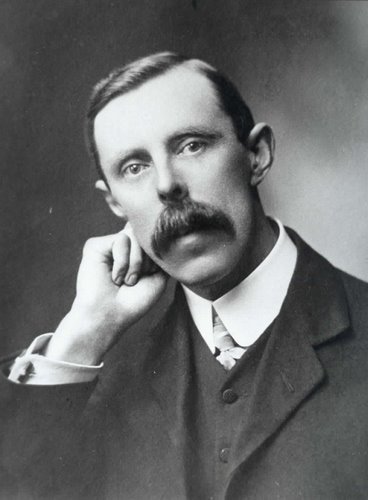
Image: Thomas Macaulay

[1] Thomas Macaulay was an English historian, essayist, politician and poet. He contributed to the Edinburgh Review and wrote biographical essays on John Bunyan and the history of England. More information on Lord Macaulay can be found in the Bloomsbury guide to English literature, 689.
[2] Boreham, Mercury, 25 September 1920.
[3] Inscribed by Boreham in G O Trevelyan, The life and letters of Lord Macaulay, pop. ed. (London: Longmans, Green, and Co., 1899), 688. This book is in F W Boreham Collection, Whitley College.
[4] Boreham, Mercury, 25 September 1920.
[5] Boreham, Mercury, 25 September 1920.
[6] Boreham, Mercury, 11 January 1930.
[7] Boreham, Mercury, 26 October 1918.
[8] Boreham, Mercury, 3 November 1934.
[9] Boreham, Mercury, 19 August 1933.
[10] Boreham, Mercury, 9 March 1935.
[11] Boreham, Mercury, 4 November 1944.
[12] G S Fraser, ‘Macaulay’s style as an essayist’, Review of English literature 1 (4 October 1960): 9.
[13] Trevelyan, The life and letters of Lord Macaulay, 509.
[14] Trevelyan, The life and letters of Lord Macaulay, 502.
[15] Trevelyan, The life and letters of Lord Macaulay, 502.
[16] Macaulay’s journal entry on 3 March 1853 is cited in John Clive, ‘Macaulay’s historical imagination’, Review of English literature 1 (October 1960): 22.
[17] Clive, ‘Macaulay’s historical imagination’, 27.
[18] See Boreham’s underlining in his copy of Trevelyan, The life and letters of Lord Macaulay, 495. Also Boreham’s further reference to this quote in his copy of T B Macaulay, History of England, vol. 1. (London: Longmans, Green, and Co., 1899), title page, in F W Boreham Collection, Whitley College.
[19] Boreham wrote of the rich research facilities of the Melbourne Public Library [now the State Library of Victoria] which assisted his scholarship, in Boreham, My pilgrimage, 197.
[20] Boreham wrote extensively about visiting sacred sites and the way it forged a link with the personality who had died, in Boreham, When the swans fly high, 157.
[21] Clive, ‘Macaulay’s historical imagination’, 22.