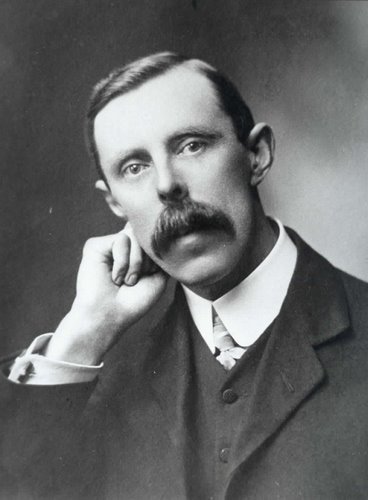
Frank William Boreham 1871-1959

Frank William Boreham 1871-1959
A photo F W Boreham took of himself in 1911

Saturday, December 02, 2006

Boreham on Beauty in the Unexpected

Romance of Monotony
In the tradition of Joseph Turner and William Blake, F W Boreham wrote many editorials on the ordinary experience of discovering beauty and truth in the unexpected. As Turner in his painting ‘Rain, steam and speed’ portrayed beauty in a train rushing through rain, Boreham perceived fascination in prosaic sources, which included “the romance of monotony”,[1] “the romance of the bank”[2] and “the evolution of pockets”.[3] Such themes were mined for truth but the unexpected and unlikely topics were also designed to arrest attention and add to Boreham’s ‘surprise power’. Other titles which caught the interest of readers and reviewers included the editorials ‘Wet paint’,[4] ‘Second wind’,[5] ‘The fly in the ointment’,[6] ‘If’,[7] ‘Black sheep’[8] and ‘Keep off the grass’.[9] Additional stylistic devices included the use of graphic statements as in his definition of tea as “liquid prophecy”[10] or his description of an acorn as “a pocket edition of a forest”.[11]

Appreciator of Small Things
At times, Dr. Boreham’s treatment of ordinary things seemed unexpected because the subjects were quaint or even trivial. In the tradition of the early French essayist Michel de Montaigne,[12] who wrote about ‘Sleeping’, ‘Thumbs’ and ‘Smells and Odours’, Boreham addressed seemingly unimportant subjects such as ‘Left-handedness’,[13] ‘Hats’,[14] ‘The man in the moon’,[15] ‘Smoke’,[16] ‘Scarecrows’,[17] ‘Babies’,[18] ‘Boots and shoes’[19] and ‘Sugar and spice’.[20] This feature of Boreham’s editorial writing saturated his life and wider work. His contemporary, J J North, identified this characteristic when describing Boreham: “From the beginning of his career he has been a tremendous appreciator of small things. He was never guilty of despising them. He came from London to Mosgiel. Mosgiel was, if we may be forgiven the pun, saved from the moss by a solitary woollen mill. Otherwise it belonged to the cow and the plough and to the pleasant murmur of the bees”.[21]

In an assessment of the early part of his career, North described the Boreham trademark of presenting surprising and peculiar topics: “It was something to hear a man fresh from London town who would preach on the inner meaning of test matches and hitting your middle wicket, who, as the Boer war came on, could give a series on David’s valiant men who slew bears in pits on snowy days”.[22]

Trivial but Treasures
Frank Boreham was aware that others sometimes found his subjects preposterous yet upon reviewing his life he found justification for his style when declaring: “The things that most readily rush to mind are things that, at first blush, seem ridiculously trivial ... and yet the fact that the mind insists on treasuring such trifles, letting slip many incidents of greater apparent importance, may indicate that memory has a more just standard of values than we sometimes fancy”.[23]

Geoff Pound

Image: Hitting your middle wicket.

[1] F W Boreham, Mercury, 24 November 1917.
[2] Boreham, Mercury, 30 September 1922.
[3] Boreham, Mercury, 20 August 1921.
[4] Boreham, Mercury, 2 April 1938.
[5] Boreham, Mercury, 31 May 1936.
[6] Boreham, Mercury, 5 December 1931.
[7] Boreham, Mercury, 2 June 1923.
[8] Boreham, Mercury, 2 August 1924.
[9] Boreham, Mercury, 28 April 1945.
[10] Boreham, Mercury, 31 October 1936.
[11] F W Boreham, The crystal pointers (London: The Epworth Press, 1925), 217.
[12] Michel de Montaigne, The essayes of Michael Lord of Montaigne, trans. John Florio (London: George Routledge & Sons, Ltd., 1891), 134-135, 352, 156-157.
[13] F W Boreham, The silver shadow (London: The Epworth Press, 1919), 255.
[14] Boreham, Mercury, 31 October 1931.
[15] Boreham, Mercury, 31 July 1954.
[16] Boreham, Mercury, 4 November 1939.
[17] Boreham, Mercury, 29 May 1920.
[18] Boreham, Mercury, 30 April 1955.
[19] Boreham, Mercury, 10 July 1954.
[20] Boreham, Mercury, 13 March 1954.
[21] J J North, Australian Baptist, 16 February 1926.
[22] J J North, New Zealand Baptist, April 1943.
[23] F W Boreham, My pilgrimage (London: The Epworth Press, 1940), 11-12.

Friday, December 01, 2006

Boreham on the Romance of the Everyday

Profundity in Postage Stamps
In December 1926, F W Boreham commenced an editorial with the question, “What can be more common-place than a postage stamp?”[1] This was typical of the style of many Boreham editorials in which he wrote about an object or issue that was common-place and, building on the familiar, urged readers to consider something more profound. Such articles included the titles, ‘The art of holiday making’,[2] ‘Going back to school’,[3] ‘Harvest time’,[4] ‘Fireside fellowship’,[5] ‘Drinking tea’,[6] ‘The weather’,[7] ‘Letter writing’[8] and ‘What’s in a name?’[9]

So Wealthy a Romance
In writing about the ordinary and the everyday, an enduring theme of F W Boreham was the notion of ‘romance’. He wrote that in everyday objects and even in the “life of the ordinary man there is a nugget of romance”.[10] In this statement, Boreham was inferring that romance was an element that gave special value to something or someone that might otherwise have been overlooked. Continuing with this imagery, he wrote variously of “discovering so wealthy a romance in the unfolding of Spring”,[11] the capacity of a crisis to “impart ... romance”[12] and a writer who “went on investing reality with romance”.[13]

Pregnant but Concealed
Boreham wrote that the romance of the everyday was a quality that was usually not immediately apparent. This idea was consistent with the notions in which the truth enclosed within nature’s “peels and pods”, Dickens’ “philosophy of envelopes” and Carlyle’s “concept of clothing”, provided variations on the idea of keeping the romance temporarily concealed.[14] Boreham inferred that there was a human responsibility to mine for truths in order to procure ‘a nugget of romance’. In another editorial, Boreham alluded to brown paper and string being “pregnant with romance”,[15] thus hinting at the way romance, while hidden within the ordinary, had a life within that was moving towards visibility.

Irresistible Fascination
Boreham believed people had an “irresistible fascination for all tales of romance”[16] and a longing to see “fresh phases of ... romance”,[17] yet he recognised that this sense had to be “awakened” and continually discovered.[18] While Boreham wrote about some things in which romance was widely anticipated, as in “the romance of the throne”[19] or the “romance of places unexplored”,[20] he sought to cultivate a pursuit of romance in objects where it was least expected. In this regard, Boreham wrote editorials on such unlikely topics as “the romance of a recluse”,[21] “the romance of a dictionary”[22] and “the romance of obscurity”.[23]

Halo of Surprise
The editorials that addressed the romance of everyday things exemplified ways that Boreham encouraged a way of looking through an object. In writing about the everyday experience of work, he admitted his inability to express his vision adequately when speaking of the “indefinable atmosphere of romance”.[24] It seemed for Boreham that the awareness of romance evoked an experience of wonder and mystery and was triggered by something that was seen. This thought arose from his frequent use of visual images in which he wrote of “an atmosphere of romance”, “a gleam of romance”[25] or casting “a halo of romance”.[26] Contemporary author, Annie Dillard, noted the emotional factor in such an experience when “although it comes to those who wait for it, it is always, even to the most practised and adept, a gift and a total surprise”.[27]

Illuminated by Radiance
In the foreword to one of his books, Boreham described how, walking along one day and noticing the beautiful effect of the glance of the sun on some rugged rocks, he arrived at the title of his latest book, The fiery crags. In explaining the purpose of the essays, he said, “I have simply attempted to communicate to these pages a few impressions gathered in restful moments when life’s commonplaces were illumined by the radiance that sometimes streams upon this world from worlds above”.[28] In this revealing title and commentary that conveyed another visual image illustrating romance in the everyday, Boreham alluded to further significant convictions.

While it has been noted that the discovery of romance must be worked at like a miner or pursued intentionally like an explorer, Boreham’s experience of momentarily seeing the fiery crags highlighted the elusive nature of romance which cannot be manufactured but may flash in the eyes of those with the patience to see. His mood for welcoming such an elusive experience was reflective rather than rational, contemplative more than cerebral. In this foreword to his book of religious essays, Boreham hinted at the spirituality of the experience and its divine source.

Geoff Pound

Image: Parable of the Postage Stamp

[1] F W Boreham, Mercury, 11 December 1926.
[2] Boreham, Mercury, 9 January 1915.
[3] Boreham, Mercury, 15 January 1916.
[4] Boreham, Mercury, 18 December 1928.
[5] Boreham, Mercury, 22 June 1957.
[6] Boreham, Mercury, 6 December 1930.
[7] Boreham, Mercury, 6 March 1926.
[8] Boreham, Mercury, 24 September 1927.
[9] Boreham, Mercury, 1 September 1917.
[10] Boreham, Mercury, 9 December 1933.
[11] Boreham, Mercury, 29 December 1945.
[12] Boreham, Age, 26 February 1949.
[13] Boreham, Mercury, 20 August 1927.
[14] Boreham, Age, 4 September 1954.
[15] Boreham, Mercury, 22 December 1956.
[16] Boreham, Mercury, 29 December 1945.
[17] Boreham, Mercury, 4 March 1944.
[18] Boreham, Mercury, 26 May 1956.
[19] Boreham, Mercury, 18 April 1925.
[20] Boreham, Mercury, 4 February 1939.
[21] Boreham, Mercury, 12 July 1952.
[22] Boreham, Mercury, 15 May 1932.
[23] Boreham, Mercury, 9 December 1933.
[24] Boreham, Age, 26 February 1949.
[25] Boreham, Age, 29 March 1941.
[26] Boreham, Age, 3 January 1953.
[27] Annie Dillard, Pilgrim at Tinker Creek (New York: Perennial Classics, 1985), 35.
[28] F W Boreham, The fiery crags, 7-8.

Thursday, November 30, 2006

Boreham on Telescopic Sight

New Kind of Looking
In what appeared to be a contra-dictory idea to the call to look at the ordinary or real life, F W Boreham advanced his thoughts on a new kind of looking. He illustrated this approach by picturing the way one uses a telescope—by looking through it rather than at it.

He said: “There are two ways of seeing every thing .… You may see it sacerdotally—seeing, that is to say, the thing itself, but seeing nothing through it or beyond it. Or you may see it sacramentally—scarcely seeing the thing itself, but seeing a world of wonder as you look through it. You never see a thing by looking at it; you only see a thing by looking through it”.[1]

Looking Through
Boreham then applied the telescopic manner of looking to other spheres. Rather than looking at nature, Boreham suggested that viewers miss the best that nature offers if they do not see through nature. Turning the readers’ attention to the Biblical revelation, Boreham said that “unless a man has looked through its phraseology, and caught the vision that it was designed to reveal, he has, in spite of everything, read the wondrous passages in vain”.[2]

Pointing to a Greater Vista
Boreham also related the principle of the telescope to the church in stating that it fulfils its mission, not by attracting attention to itself, but by pointing towards a greater vista. He concluded by affirming, “Life’s richest revelations come, not by looking at things, but by looking through them”.[3]

Geoff Pound

Image: ‘looking through a telescope.’


[1] F W Boreham, The tide comes in (London: The Epworth Press, 1958), 63.
[2] Boreham, The tide comes in, 65.
[3] Boreham, The tide comes in, 65.

Wednesday, November 29, 2006

Boreham on Uncluttering the Vision

Simplify!
In F W Boreham’s articles on William Blake he revealed that simplicity was an important strand in Boreham’s own thinking as it relates to seeing the value of ordinary things. He appeared to be echoing Henry D Thoreau’s chorus, “Simplify, simplify”,[1] and his frequent announcement of this theme was one of the indications of Boreham’s drift towards Quakerism.[2] He wrote of the despotic nature of possessions in which “the luxuries of one day become the indispensabilities of the next”, resulting in a blunting of one’s vision toward the greatest luxuries, which he contended were the least expensive.[3]

Leave Luxuries Behind
In conquering the “tyranny of disguise”, Boreham invited his readers to experience “the luxury of renouncing luxuries”, asking, “Is it not intensely significant that when we wholeheartedly abandon ourselves to the real pleasures of life, we leave our so-called luxuries behind us?” [4]These thoughts reveal the motivation for his abandonment of clutter indicated in such things as his determination not to drive a car, use a typewriter, install a telephone or watch television.

Benefits in the Turmoil
In Boreham’s judgement, one of the positive benefits of the international wars and the Depression was the way they brought an enforced renunciation of pleasure and a simplification of life. Writing about this revision of values, Boreham said: “In days like these, in which many of the ordinary commodities of life are rationed, and in which we are asked, for the sake of the starving millions of Europe, to curb our appetites and to impose upon ourselves a voluntary austerity, we learn with astonishment how many things we can do without”.[5]

Time for Overhaul
In a variety of editorials on this physical and mental overhaul, Boreham observed that the days of rationing and deprivation had resulted in people discovering “the inestimable value of a few simple and basic delights that are ordinarily overlooked”,[6] and the recognition that:

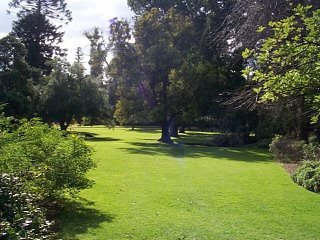
“Whatever losses we sustain, nothing can deprive us of the brightness of the daylight, the fragrance of gardens, the grace of velvety lawns, the glow of sunset, the love of good women, the laughter of little children, the loyalty of friendship, the companionship of books, the strains of stirring music, the beauty of noble paintings—the things that have represented the satisfactions of humanity since our little race began”.[7]

Geoff Pound

Image: ‘the grace of velvety lawns’.

[1] Henry D Thoreau, Walden, ed. J Lyndon Shanley (Princeton: Princeton University Press, 1971), 91.
[2] Rufus M Jones, The faith and practice of the Quakers (London: Methuen & Co Ltd, 1927), 90.
[3] F W Boreham, Mercury, 2 March 1957.
[4] Boreham, Mercury, 2 March 1957.
[5] Boreham, Mercury, 28 February 1917; Mercury, 7 September 1929; Mercury, 15 November 1941.
[6] Boreham, Mercury, 23 October 1943; Age, 6 April 1946.
[7] Boreham, Mercury, 17 May 1952.

Tuesday, November 28, 2006

Boreham on Looking at the Ordinary

Become an Explorer
F W Boreham offered a corrective to blindness or fragmented vision when saying, “To see life steadily and to see it whole, a man must become an explorer, determined to discover and to chart these spacious continents of human experience that have heretofore eluded him”.[1] He understood that the setting of one’s focus on the spacious continent of ordinary or ‘real’ life was the starting point for the sharpening of human vision.

Boreham called representatives of all spheres to a new consideration of ordinary things. In 1913, he detected that politicians and educationalists were grappling with the detachment of learning from life and he added his voice to the call for a return to “establishing some vital relationship between the teaching of the schools and the throbbing actualities of real life”.[2]

Literary Litmus Test
In the field of literature, Boreham declared, “The books we like best are the books that portray life as we ourselves have seen it”.[3] Judging that others shared this same delight, especially in autobiography and biography,[4] he pleaded that “we badly need a few biographies with bad endings”.[5] Boreham supported John Galsworthy’s litmus test for truthful character depiction in the question, “Do men and women in real life talk and dress and behave like this?” [6]Boreham added: “Literature, so far as his work was concerned, should be a mirror to the face of life. His men and women should be the sort of men and women whom one meets in banks and shops and restaurants and picture-shows and railway trains—ordinary but interesting, commonplace but lovable”.[7]

Philosophy of Life
Boreham’s pleaded for connecting historical study to life and this call was extended to other disciplines including the subject of philosophy. In 1954, in an editorial in which Boreham traced ‘The evolution of thought’, he wrote approvingly that philosophy showed signs of turning away from “nebulous theories, abstract propositions, mystifying hypotheses, and occult disquisitions” towards a better and more intelligible condition. In so doing, he observed: “Philosophy’s most monumental discovery, as Maeterlinck[8] pointed out, was the discovery that its primary and particular concern is with life itself. There is nothing in the archives of the past from which philosophy may not learn, nothing in the life of the present that philosophy can afford to ignore; and nothing in the sensational developments of the boundless future into which philosophy, with infinite profit both to itself and humanity, cannot pour its priceless hoard”.[9]

Life is the Theatre
Boreham’s claim, that ordinary life was the raw material upon which all academic research must draw, was restated in reference to philosophy: “Life is the stuff from which the philosopher must weave his magic web. Life is the subject of his investigation; life is the field of his activity; life is the theatre of his service”.[10]

Charm of Reality
Boreham saw himself as voicing the desires of ordinary people for ordinary things when saying, “The vital principle in window-dressing is the principle that the articles displayed in the window shall adequately and enticingly represent the goods in stock”.[11] Throughout his career Boreham perceived a gradual adjustment of the public vision and expressed his delight in claiming that “the outstanding discovery of the twentieth century is the discovery of the charm of reality”.[12]

Geoff Pound

Image: Window Dressing

[1] F W Boreham, Mercury, 11 December 1954.
[2] Boreham, Mercury, 25 October 1913.
[3] Boreham, Mercury, 12 September 1931.
[4] Boreham, Mercury, 18 February 1933.
[5] F W Boreham, Wisps of wildfire (London: The Epworth Press, 1924), 183.
[6] Boreham, Wisps of wildfire, 183.
[7] Boreham, Mercury, 14 August 1948.
[8] Maurice Maeterlinck (1862-1949) was a Belgian playwright, poet, storywriter and essayist who lived most of his life in France and won the Nobel Prize for literature in 1911. More information about Maeterlinck can be found in Something about the author Vol. 66 ed Donna Olendorf (Detroit: Gale Research Inc., 1991), 154-160.
[9] Boreham, Mercury, 9 January 1954.
[10] Boreham, Mercury, 9 January 1954.
[11] Boreham, Mercury, 2 January 1932.
[12] Boreham, Mercury, 12 September 1931; Age, 14 September 1946.

Monday, November 27, 2006

Boreham on Blindness

Acknowledging Blindness
In an article entitled ‘The blind spot’, F W Boreham lamented that “the things we see are as nothing compared with the things that we miss”.[1] In writing about the prevalent blindness to reality in ordinary things, Boreham chastised certain individuals who, in “luxuriating among the cowslips” failed to appreciate the beauty under their noses.[2] He also criticised those who declined “to recognise that the mud of life is jingling with jewels”.[3] In alerting readers to the human condition, Boreham was quick to admit his own blindness for, in 1928, the year when he first had occasion to wear glasses, he wrote, “I am sadly aware of a dimness of sight that no oculist can relieve”.[4]

Aversion to Artificiality
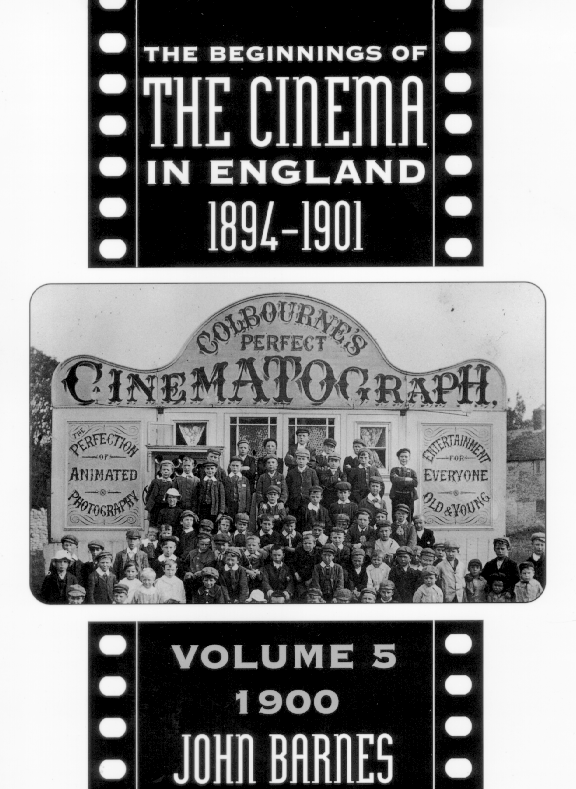
Boreham perceived that a symptom of the prevailing blindness in society was the growing popularity of artificial things. His aversion to the artificial (also a theme of Richard Jeffries)[5] was focused on shows about which he said, “very few things look their best when on exhibition”.[6] However, it was the artificiality of life portrayed by the cinema that received Boreham’s harshest criticism. Describing an evening at the cinema, sometime prior to 1915, he observed that the audience was full of admiration for the film’s lifelikeness but in Boreham’s assessment it was “a very stilted, flickery kind of affair”. Reflecting later, Boreham said, “The next day I saw the real thing .… It is a mad world truly! We go into ecstasies over the scene in the cinema; the scene as God paints it only makes us yawn”.[7]

Peril of Familiarity
An aspect of human vision that Boreham believed could be corrected was the blindness that came through familiarity. While he said of his holiday location at Wedge Bay, “The local inhabitants have never awakened to the charms of the beauty-spots around them”, he also confessed, “I saw more of London and formed a more just appreciation of its grandeurs during a brief visit to the Homeland from New Zealand than during all the years of my residence in the world’s metropolis”.[8] Boreham’s editorials on this theme aimed at recovering what the art critic, John Ruskin, described as the “innocence of the eye”.[9] In his writings, Boreham sought to take his readers back to a place or an occurrence with which they were familiar and describe it with a reality and in a way that enabled them to feel that they were seeing it for the first time.

Geoff Pound

Image: ‘A flickery kind of affair…’

[1] Boreham, Mercury, 7 February 1928.
[2] F W Boreham, The other side of the hill (London: The Epworth Press, 1917), 130.
[3] Boreham, Mercury, 6 July 1947.
[4] F W Boreham, The fiery crags (London: The Epworth Press, 1928), 251.
[5] Richard Jeffries, Field and hedgerow (London: Longmans, Green, & Co., 1892), 148.
[6] F W Boreham, Mountains in the mist (London: The Epworth Press, 1914), 141.
[7] F W Boreham, The golden milestone (London: The Epworth Press, 1915), 94.
[8] Boreham, The golden milestone, 109.
[9] John Ruskin, The genius of John Ruskin: Selections from his writings, ed. John D Rosenberg (George Allen & Unwin Ltd, 1963), 12.

Sunday, November 26, 2006

Boreham and a New Way of Looking

New Way of Looking
We have been looking at F W Boreham’s call for the sphere of ordinary life to become a primary focus for his reader’s study and we have considered this theme in reference to selected representatives who inspired him: Dickens, Turner, Blake and Jesus.

Attention is now directed to insights and illustrations from Boreham’s editorials that develop this theme and reflect on how his readers might develop their vision for the ordinary. What were the simple, common, everyday things and events that Boreham addressed? How did he advocate that they be seen and studied and why?

See For Yourself
In one of his many editorials on the theme of seeing, F W Boreham claimed in 1930 that “millions of people have gone through life seeing a blur” and he concluded by saying “the art of life lies in every man seeing clearly for himself”.[1] Boreham’s convictions about ‘seeing’ are reminiscent of the French theologian and scientist Pierre Teilhard de Chardin who, in 1938, writing at great length on the importance of ‘seeing’, concluded:

“We might say that the whole of life lies in that verb. That, doubtless, is why the history of the living world can be summarized as the elaboration of ever more perfect eyes within a cosmos in which there is always more to be seen .… If to see is really to become more, if vision is really fuller being, then we should look closely at man in order to increase our capacity to live”.[2]

While both writers elaborated on this theme in different ways and in dissimilar literary styles, they were united in their passion to convince their readers of developing one’s vision. F W Boreham claimed that the realisation of one’s full expression would come by ceasing to see through other peoples’ spectacles and looking through one’s own eyes.

Geoff Pound

Image: Eyes to See

[1] F W Boreham, Mercury, 11 January 1930.
[2] Pierre Teilhard de Chardin, The phenomenon of man (London: Collins, 1938-40), 31-32.

Saturday, November 25, 2006

Boreham Inspired by Jesus the Storyteller

Down to Earth Storyteller
While writers and artists such as Charles Dickens, Joseph Turner and William Blake were influential in encouraging F W Boreham in his vision for ordinary and everyday things, a major impetus for this sprang from Jesus, the teacher from Nazareth.

Cultivator of Vision
In his Bevan Lectures to preachers at Adelaide’s Parkin College in 1931, Boreham revealed his belief that in any sphere in which people excel, the cultivation of vision was one of three essential arts. Taking the ministry of Jesus as his supreme model and showing the inextricable link between subject and style, the lecturer said:

"He saw things as nobody else saw them. Take, for example, His view of the mob, the crowd, the rabble. Nobody else ever noticed in the pushing, jostling, struggling multitude anything particularly charming. But He did. He looked upon the Eastern crowd; it ravished His eyes: and straightway He likened it to a flock of shepherdless sheep and to a field of golden corn. To the average man, the mob is the most prosaic of all prosaic things. But, in His vision, it became a pastoral idyll: the mob became white sheep on a green and graceful hillside. It became an agricultural idyll: the mob became a field of standing corn, flecked with crimson poppies, over which the clouds were scudding. And, since, in fields and flocks, an Eastern told His wealth, the mob became transformed into a commercial idyll. In the rabble He saw fields and flocks—His fields and His flocks—and it was to Him a stately vision of His own abiding affluence."[1]

In this excerpt from Boreham’s first lecture, ‘The preacher’s vision’, the stimulus of his theme and the source of his passion for the prosaic are evident. It suggests that Boreham saw through the biblical lens and, letting his imagination soar, added colourful details such as golden corn, crimson poppies and scudding clouds to enable his hearers to picture the truth.

Teller of Parables
This statement illustrated Boreham’s use of the parabolic method in which he took an everyday scene and reflected upon it until he arrived at a significant truth. Rather than squeezing one image until exhausting truth, Boreham demonstrated in this lecture his propensity to gather several images, view their various facets like a jeweller and then paint with words the detail of what he saw in order to build a compelling case for the value of an ordinary crowd.

Geoff Pound

Image: "Scudding clouds" in the Middle Eastern sky, Fujairah, UAE.


[1] Australian Christian world, 26 June 1931.

Friday, November 24, 2006

Blake's Influence on F W Boreham

Vision for the Ordinary
We have contended that one of the secrets to F W Boreham’s success as a writer and speaker was that he spoke about ordinary things and made them glow.

This is the fourth article in a series which looks at exponents of the ordinary who used various media to get across their message. This posting looks at the influence of William Blake on F W Boreham.

Glorying in the Commonplace
F W Boreham honoured William Blake “as one of the purest poets, one of the most eminent painters and one of the most cunning engravers of all time ... [who] deserves to be esteemed as the peak and pinnacle of the rennaissance in our literature”.[1] Like Dickens and Turner, the endearing gift according to Boreham, was the way Blake so quickly “saw the glory of common things”,[2] and his ability in which, even when looking at the drabness and squalor of London, he “saw the best shining through the worst”.[3] Boreham, with the perspective of history, hailed Blake as a seer, a prophet and a philosopher.[4] According to Boreham, Blake displayed “the most perfect blend of simplicity with sublimity” which was found in literary records. Of Blake, he said: “To him every common object was transfused with radiant splendour; every crust of bread was sacramental; every cup of cold water that he lifted to his lips was, to him, the Holy Grail. He hardly wrote a line that a little child could fail to understand; yet his crystal clear conceptions are shot through with a gorgeous imagery that for beauty has been unsurpassed”.[5]

Simplicity Without Clutter
Boreham attributed Blake’s simple style to the simplicity of his life when saying, “He was a simple soul. He mingled with simple folk, cultivated simple ways, developed simple tastes, and expressed himself in a simple phraseology”.[6] Boreham deduced that Blake’s simplicity led to a depth of vision and he inferred that the embracing of an uncluttered lifestyle was conducive to the cultivation of pure vision.

Writing amidst the depression of the 1930s, Boreham asked, “Is it too much to hope that it is because our own generation is turning with renewed relish to life’s simpler and sweeter delights that it is discovering a new charm in the minstrelsy of this clear, pure singer of two hundred years ago?”[7]

Life Responding to Life
It has been noted that Boreham attributed the immediate, positive response towards Charles Dickens and Joseph Turner to the fact that their artistry reflected ordinary life and that they gloried in the common things. Accordingly, one would anticipate that Boreham would be swift to find further vindication for artists of the ordinary in the response to the output of William Blake. However, the poet was not lauded in his day, nor was his greatness recognised. Boreham lamented the poor response by Blake’s generation but did not perceive his inconsistency when recording that Blake’s artistry did not illustrate the principle of life responding to life. While Blake’s contemporaries viewed him as an enigma, Boreham commented in 1931, “It is pleasant to notice the growing disposition of our own generation to atone for the neglect and disdain of his unappreciative contemporaries”.[8]

Geoff Pound

Image: I took this photo last week of Blake’s gravestone in the Bunhill Fields cemetery in central London. The photograph is dark because the sky was dark when I took it at 3.30pm!!

[1] F W Boreham, Mercury, 26 November 1949.
[2] Boreham, Mercury, 17 October 1931.
[3] Boreham, Mercury, 28 November 1942.
[4] Boreham, Mercury, 17 October 1931.
[5] Boreham, Mercury, 26 November 1949.
[6] Boreham, Mercury, 28 November 1942.
[7] Boreham, Mercury, 17 October 1931.
[8] Boreham, Mercury, 17 October 1931.

Thursday, November 23, 2006

How Turner inspired F W Boreham

Vision for the Ordinary
We look today at Joseph Turner who, through his art, inspired F W Boreham to write about ordinary, everyday scenes and experiences.

Painting Things as they are
In an editorial entitled, ‘Things as they are’, Boreham stated that the landscape painter, Joseph Turner (1775-1851), “did for art what Dickens did for literature. He threw a lustre about the mediocre and the ordinary”.[1] Not only did Turner insist on painting things as they appeared but he exhibited a fascination in looking for beauty in the most unexpected places.

Always attentive to human response, Boreham said, “As if by magic, many eyes were opened. People recognised that there is a wealth of comeliness lurking in sordid and mundane objects that had hitherto appeared to them so utterly prosaic and almost disgustingly commonplace”.[2] Boreham contended that when people respond to art that has a “fidelity to reality”,[3] as in Turner’s paintings, it leads them to a new way of looking at their world. Writing of this service of art to people, Boreham continued: “By means of such paintings art provides windows through which any man may gaze into infinity. Art renders us her most valuable service when she teaches us to see marble where, until then, we had only seen mud .… From that moment the world becomes transfigured. Having discovered loveliness in one commonplace setting, we look for it in every setting”.[4]

Hungry Eyes
In his editorials about Turner, Boreham referred to the domino effect in which the viewing of beautiful paintings sets one looking for loveliness in the world that, in turn, makes “the eye become hungry with expectancy”.[5] Boreham wrote that a further consequence of this process was the cultivation of an eye for beauty.

Richard Jeffries hinted at the potential to train the eye when saying, “If a man carries a sense of beauty in his eye, he will find beauty in things as they really are”.[6] Urging this development of vision in his readers, Boreham said, “The eye becomes a realm of fascination. And, since we are living in a world in which we see pretty much what we have eyes to see, we henceforth find scintillations of beauty breaking from every crack and cranny”.[7]

Furthermore, Boreham believed a person could only claim to have an eye for beauty in ordinary things, when: “In donning his hat and coat on a day of fog and slush and drizzle, he beholds, in the outlook framed by his own doorway, a picture that, portrayed upon canvas, would constitute itself a masterpiece …. The man who cannot find Fairyland beside his own doorstep will never find the fairies anywhere”.[8]

Geoff Pound

Image: Joseph Turner's Frosty Morning set in Yorkshire.

[1] F W Boreham, Mercury, 12 September 1931; Age, 14 September 1946.
[2] Boreham, Mercury, 12 September 1931; Age, 14 September 1946.
[3] Boreham, Mercury, 12 September 1931; Age, 14 September 1946.
[4] Boreham, Mercury, 13 February 1932.
[5] Boreham, Mercury, 12 September 1931; Age, 14 September 1946.
[6] Boreham, Mercury, 13 February 1932.
[7] Boreham, Mercury, 13 February 1932.
[8] Boreham, Mercury, 12 September 1931; Age, 14 September 1946.

Wednesday, November 22, 2006

Boreham and His Debt to Dickens

Boreham and Dickens
In an earlier posting we have discussed the similarities between Charles Dickens and F W Boreham—those things which may have urged Boreham to lean on Dickens for inspiration. To recapitulate, they were both reporters, they both learned shorthand to help their journalistic writings, they both had stints at editing newspapers, their popularity grew through their stories that were first printed in newspapers and later were compiled into many books, they both liked to visit the scenes they were describing and they had retentive (photographic?) memories.

There is one other significant area for comparison and this focuses on the theme of this series of postings—their vision for ordinary people and things and their ability to capture the colour and the detail of everyday life in words and pictures. This is one of the big secrets behind their popularity and success as communicators in their age.

Artist in Real Life
We have already seen how the English novelist Charles Dickens shaped Boreham’s literary style but let us focus specifically now on how Boreham understood Dickens’ views and descriptions of the ordinary. The reason why Boreham praised Dickens as “an artist in real life” was because of the novelist’s commitment to study and know ordinary life. In Boreham’s words, “he saw humanity in every garb and from every conceivable angle. The panorama fascinated his hungry mind”.[2] Characteristic of the Dickensian style was the telling of stories about common things and common people. Quoting Compton-Rickett’s tribute to Dickens, Boreham wrote, “He is great because, though dealing continually with little worries, little hardships, and little pleasures, he made the dullest of lives in the drabbest of streets as enchanting as a fairy tale”.[3]

Love is Notoriously Blind
A compelling stylistic feature for Boreham was Dickens’ “unswerving fidelity to truth” yet, through “the melting pot of his vigorous mentality”, Boreham recognised that Dickens expressed his own rendition rather than presenting an accurate reflection of what he saw. However, in Boreham’s reckoning, these two features could coexist without contradiction, for when noting Chaucer’s transparent honesty, yet conceding validity in the public criticism of Chaucer’s depiction of an idealised England, he said: “Love is notoriously blind. When a lover describes his lady, everybody knows that, though he may be the soul of veracity, he is not telling the whole truth. He has no eyes for the faults and foibles that seem so conspicuous in the sight of others. So was it with Chaucer, and, on the whole, we like him all the better for it”.[4]

Ringing with Reality
Despite questions as to Dickens' faithfulness in articulating his vision, it was his descriptions of ordinary people, everyday moods, typical scenes in recognisable places such as the kitchen, the club or the street that delighted his readers. Writing about everyday human experience led Boreham to say of Dickens that “his pages carry conviction; they ring with reality”.[5] The familiarity of his creations produced an affinity rather than contempt.

In contrast to Shakespeare and Milton, whose devotees took time to appreciate their worth, Boreham said that Dickens experienced an immediate response of appreciation that vindicated his passion for writing about the commonplace. Boreham explained Dickens’ secret as “life answers to life, as, in another connotation, love answers to love”.[6]

Geoff Pound

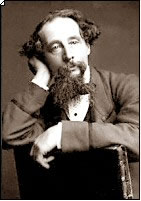
Image: Charles Dickens

[2] F W Boreham, Mercury, 9 June 1951.
[3] Boreham, Mercury, 12 June 1920.
[4] Boreham, Mercury, 2 September 1933.
[5] Boreham, Mercury, 12 June 1920.
[6] Boreham, Mercury, 9 June 1951.

Tuesday, November 21, 2006

Boreham's Vision of the Ordinary

Secret to His Success
What made F W Boreham such a popular writer with book sales passing the one million mark?

We have examined in previous articles Boreham's easy, simple, clear, literary style and his attention, as a wordsmith, to finding the right word for the right place.

But one of his big secrets was the way he wrote about ordinary, everyday things about which every reader had experience and from this rich sphere he extracted valuable truths that made those same readers say: "Yeah! That is so right! Why didn't I think of that?"

The Significant Arena for Reflection
Melbourne churchman Irving Benson once referred to Boreham's essays entitled ‘Strawberries and cream’ and ‘Dominoes’ as representative of the many ordinary things that F W Boreham used to commence an editorial and gather a host of associated ideas.[1] Benson then quoted Emma Herman’s description of Boreham’s process and presentation as being “reminiscent of the great Dutch manner of painting, which, by the magic play of light and shade, can make a peasant’s kitchen romantic as a fairy palace”.[2]

It has been noted in previous blog postings that F W Boreham reveled in nature and delved into history to find many of his writing themes. In these next few postings we shall explore the way Dr Boreham found the ordinary, the commonplace and the everyday to provide a wealth of truth and inspiration. As Benson and Herman hinted, this theme in Boreham’s writings was as much about style as it was about subject.

Exponents of the Ordinary
F W Boreham discovered from several important authors and teachers the importance of writing about ordinary, everyday objects and experiences.

He lauded Daniel Defoe for championing the prosaic,[3] Samuel Richardson, whose extraordinary success with Pamela and Clarissa “proved that love is human rather than aristocratic”,[4] Walter Scott and his “reverence for reality”,[5] John Constable who “insisted on painting people and things as they actually did look”[6] and Geoffrey Chaucer whose secret lay in his ability “to transfer to his broad canvas nothing but what he actually saw”.[7]

In the next few postings I want to give a more extensive examination of the thoughts of F W Boreham as they related to three people who looked at the ordinariness of life and expressed its reality in their respective medium: Charles Dickens the novelist, Joseph Turner the painter and William Blake the poet.

P.S.
What sort of a speech or sermon would you be able to construct from the game of dominoes, draughts, chess or some other popular game? It is not enough to talk about some popular game- one must also do the deeper reflection and application.

If you want to know what F W Boreham made of the game of dominoes you can read about it if you have the book: F W Boreham, ‘Dominoes’, The Silver Shadow (London: The Epworth Press, 1918), 11-21. Place a comment at the bottom of this article if you'd like me to post it. It is one of the essays that might qualify for inclusion in the forthcoming book, The Best Essays of F W Boreham.

By the way Michael and I still need financial help to get this and other books by F W Boreham published. Give a gift this Thanksgiving. Check The Best Stories of F W Boreham web site to discover how you might do this.

Geoff Pound

(To be continued.)

Image: Dominoes

[1] C I Benson, ‘Dr Frank W Boreham—The man and the writer’, The last milestone (London: The Epworth Press, 1961), 9-10.
[2] Benson, ‘Dr Frank W Boreham—The man and the writer’, 12.
[3] F W Boreham, Mercury, 23 February 1924.
[4] Boreham, Mercury, 3 July 1948.
[5] Boreham, Mercury, 11 April 1925.
[6] F W Boreham, I forgot to say (London: The Epworth Press, 1939), 126.
[7] Boreham, Mercury, 2 September 1933.

Saturday, November 11, 2006

Boreham on the British Empire

Lover of Empire
From F W Boreham’s first editorial for the Otago Daily Times, the subject of the British Empire was a constant theme throughout his editorial writings. Still expressing his fascination for the Empire in 1944, Boreham said, “Its history is, far and away, the most stately romance that has ever been written. There is nothing in legend or fable to compare with it”.[1]

Boreham’s annual editorial on Empire Day (celebrated in Australia on 24 May from 1905 to the late 1950s) gave him the chance to tell the story of Empire, to arouse readers’ appreciation and to stir aspirations about the Empire’s future. One can sense his deep feelings for the subject in the following words:

“We speak of the Empire, and, as those two glowing syllables fall from our lips, we discover that they throb with a magic peculiarly their own. They spread before the mind a broad canvas of vivid and variegated hues. These are words in our vocabulary that mean very much more than any dictionary would suggest. Such words represent fossilised poetry, petrified history, embalmed romances. All the ages have left the record of their tears and their laughter, their virtues and their vices, their passion and their pain in the words that they have coined. Among these archives of articulation no word is more rich in encrusted tradition and glittering association than the word that falls so musically and so majestically upon our ears on May 24.”[2]

British Uniqueness
Beyond sentiment, Boreham often expressed the uniqueness of the British Empire in its ability to “evoke deep-seated affection of heterogeneous citizens”.[3] It epitomized for him democracy at work as Great Britain brought together a united commonwealth of free and equal nations. Since the time that Empire Day had been established in Australia there was a minority who opposed the concept, including the editor of the Bulletin, who called it ‘Vampire Day’ and “the feast day of St Jingo”.[4] The vast majority of Australians who supported the commitment to the Empire recognised the strong ties of blood, language, history, culture and the practical link in trade.

Writing about the first Empire Day celebrations in 1905, Gavin Souter discerned that Australians had a dual perception, believing that “to praise the whole was automatically to praise the part” and not result in any diminution of the young nation.[5] Being part of the Empire also “conferred on Australians a role and significance in the world which they could not otherwise hope to attain”.[6] When some in 1914 were casting doubts on the viability and worth of the Empire, Boreham exclaimed, “To say that the British Empire has had its day is nonsense”.[7] Gibbon had taught him that what fostered the growing affection for the motherland was that in contrast to other empires that had “looted” new territories “like vampires”,[8] the British Empire had operated by the opposite principle. According to Boreham, Great Britain “has given of her best to her dependencies, and has, in the process, bound them to herself with hoops of steel”.[9] Boreham’s Empire was “not bound by red tape”[10] but by “deep affection” forged through “moral ties”.[11]

Contribution of Empire
Boreham recognized that the greatest contribution of the Empire was in its inculcation of values that had the potential to transform colonial cultures and penetrate even the remote parts of the commonwealth.[12] These values he identified as Britian’s integrity, justice, the championship of freedom, honesty in dealing with national rulers[13] and chivalry or gentlemanly spirit.[14] This attitude fostered an “attachment of people of the same stock, thinking the same thoughts, cherishing the same ideals”,[15] an approach that was vindicated, Boreham believed, in the affectionate way in which colonies regarded Great Britain. At its worst, this belief in British cultural superiority bolstered the country’s White Australia policy (1901) and with it discrimination towards Asians and aborigines.[16]

Empire During War
Imperial sympathy became most apparent during the struggle of international wars. During the Second World War, Boreham predicted the future role of the British Empire when he stated, “The guardianship of the world’s peace, must, after the war, become the supreme responsibility of the British people”.[17] Writing from Australia in 1949, Boreham said, “Never since English history began has so much affection and so much sympathy been felt for England on this side of the world”.[18]

Empire Excelling
Noting that explorers such as Captain Cook had been motivated by a love of empire, Boreham wrote that British and Australian conquests in exploration[19] and sport[20] were major peacetime methods of fostering the imperial spirit. To this end, Boreham expressed the hope in 1921, 1937 and 1947 that Mount Everest would be first climbed by a “British conqueror”[21] and writing about the link between citizenship and sport he stated, “Nothing is more to be desired than that the British peoples may continue to lead the world in the quality and the purity of their sport”.[22]

Resilience of British Throne
Boreham considered the British monarchy to be the heart and embodiment of the British Empire. His recognition in 1935 that the number of thrones that had been overturned within the lifetime of the current generation led him to conclude that “monarchy, as an abstract principle, is passing through difficult and trying days”.[23] The unique thing that explained the resilience of the British throne and the affection throughout the empire was, in Boreham’s estimation, the “personal excellence” of the monarch and the royal family. Boreham’s understanding of history led him to recall that when Queen Victoria commenced her reign there were calls for the throne to become vacant and obituaries were published announcing the death of the British monarchy. However, her influence raised the prestige of royalty and “the attractive life of Queen Victoria elevated the social conditions of the entire British people”.[24] Assessing Victoria’s personal influence Boreham continued, “She saved not only the Throne but the Empire itself”. In 1935, Boreham wrote that “King Edward and King George have splendidly maintained the shining tradition established by that noble lady” and that the interest of people in the Royal family augured well for the “happy state of things for many a long day to come”.[25] While Boreham’s descriptions of the royal visits were full of superlatives, more recent writers have detected little sign of the diminution of ‘royal worship’. Reading the accounts of the royal visits of 1920 and 1934-35, historian Michael Davie says they are written in “the tone … of breathless admiration and shameless sentimentality”.[26]

Cashing the Check
Boreham drew a distinction between the possession of the Empire and the creation of an imperial spirit, saying that such an inheritance needed to be cashed like a cheque.[27] He, therefore, encouraged the observation of Empire Day, Empire Youth Sunday, royal birthdays, anniversaries and royal visits as key occasions for expressing appreciation and arousing aspirations for the Empire and the monarchy. Boreham wrote about the importance of flags,[28] statues[29] and music[30] in awakening memories and stirring a reverential allegiance toward the monarchy.

Sway of the Crown
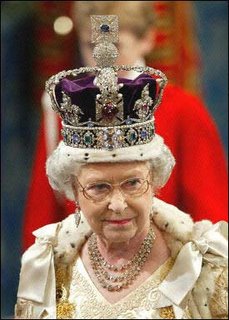
In writing about the changing role of the British monarchy, Boreham observed a gradual development of its influence and rule throughout the centuries. Despite the monarch’s decreasing involvement in the political processes of Britain and the Empire, in 1935 Boreham rejected Emerson’s simile about being “as impotent as a British monarch” saying “nothing was further from the truth”.[31] On the occasion of the visit of Queen Elizabeth II and Prince Philip to Tasmania in 1954, Boreham declared “that the sway of the Crown is today immensely more potent and more impressive than in the days when our sovereign assumed despotic and dictatorial prerogatives”.[32] Throughout his lifetime Boreham perceived an increase in affection between Australians and the royal family and regularly stated that “the Crown is never more popular than today”.[33]

Aussie Shifts
The shift in Australian’s relationship to the British Empire was apparent at the New South Wales Conference of the Labor Party in 1931 when the Education Committee recommended that Empire Day no longer be observed in the schools of NSW, the weekly ceremony of flag saluting be discontinued and the Imperialist bias be removed from school textbooks.[34] Although the acquisition of new territories in the first part of the twentieth century was slower than in the second half of the nineteenth century, Boreham did not concede that the British Empire was in decline.

Declining Empire
When after the Second World War there was a redefinition of the status of Britain’s dominions, a disintegration of a common foreign policy within the Commonwealth and independence declared by India, Ceylon and Burma, Boreham did not interpret these events as an erosion of British influence. In the 1950s, the rush towards independence by the many remaining British colonies in Africa, Asia, the Caribbean and the Mediterranean coincided with the conclusion of Boreham’s editorial career. He neither discussed these issues nor reported on a waning of the imperial spirit. One would suspect that Boreham found it hard to accept that the British Empire was in decline.

Geoff Pound

Image: 'Sway of the crown...'

[1] Boreham, Mercury, 2 September 1944.
[2] Boreham, Mercury, 20 May 1944; Age, 24 May 1947.
[3] Boreham, Mercury, 24 May 1952.
[4] A G Stephens, ‘Empire Day’, Bulletin, 18 May 1905.
[5] Gavin Souter, Lion and kangaroo: The initiation of Australia, rev. ed. (Melbourne: The Text Publishing Company, 2000), 129.
[6] Souter, Lion and kangaroo, 3.
[7] Boreham, Mercury, 17 February 1914.
[8] Boreham, Mercury, 21 May 1921.
[9] Boreham, Mercury, 20 May 1944; Age, 24 May 1947.
[10] Boreham, Mercury, 20 May 1916.
[11] Boreham, Mercury, 19 September 1914.
[12] Boreham, Mercury, 20 February 1954.
[13] Boreham, Mercury, 19 September 1914.
[14] Boreham, Mercury, 30 June 1928.
[15] Boreham, Mercury, 19 May 1928.
[16] Notions of citizenship were formed on the view of Australians as being British subjects. Asians and aborigines were excluded from voting by the 1901 constitution and excluded from the 1903 Naturalisation Act.
[17] Boreham, Mercury, 20 May 1944.
[18] Boreham, Mercury, 23 April 1949.
[19] Boreham, Mercury, 12 March 1921.
[20] Boreham, Mercury, 4 November 1919.
[21] Boreham, Mercury, 12 March 1921; Mercury, 5 November 1938; Age, 1 November 1947.
[22] Boreham, Mercury, 4 November 1919.
[23] Boreham, Mercury, 11 May 1935.
[24] Boreham, Mercury, 19 June 1937.
[25] Boreham, Mercury, 11 May 1935.
[26] Michael Davie, Anglo-Australian attitudes (London: Secker & Warburg, 2000), 92-93.
[27] Boreham, Mercury, 20 May 1916.
[28] Boreham, Mercury, 21 May 1921.
[29] Boreham, Mercury, 14 May 1921.
[30] Boreham, Mercury, 7 December 1940; Age, 17 May 1947.
[31] Boreham, Mercury, 4 May 1935.
[32] Boreham, Mercury, 20 February 1954.
[33] Boreham, Mercury, 2 June 1928; Mercury, 11 May 1935.
[34] Clark, A history of Australia vol. vi, 373; Sydney Morning Herald, 4, 6, 7 April 1931.
Friday, November 10, 2006

Boreham Remembering Special Days

Observer of Days
F W Boreham was attentive to special anniver-saries and was an avid 'observer of days'. Any ordinary event he liked to attach to some anniversary of significance. In this vein, he commences his autobiography:

"Salvoes of artillery and peals of beals echoed across Europe on the morning of my birth.... I discovered afterwards... that my advent synchronized exactly with the dramatic termination of the Franco-Prussian War. On Friday March 3, 1871, an hour before my arrival, the Prussian troops that had held Paris in a cruel strangle-hold commenced the evacuation of the capital."

Each year in his editorial columns he always included fresh ideas on regular anniversaries. One of these he addressed each year was Christmas.

Everybody’s Day
While Dr Boreham often compared the festivities of Christmas in England with the celebrations in Australia,[1] he also emphasized the universality of this anniversary when describing Christmas as “everybody’s day”.[2]

He was conscious of the breadth of religious affiliation among his readers and he highlighted the inclusive nature of Christmas with its independence of geography,[3] its cosmopolitan attraction in drawing together “men and women of all kinds, classes and conditions”[4] and its childlike simplicity and profundity as the baby “expresses the unexpressable and utters the unutterable”.[5]

Queen of Feasts
On this anniversary, described by Boreham as “the queen of feasts [and] festival of festivals”,[6] Christmas provided the occasion “for the forgetting of old feuds and grudges, [and] for the exercise of benevolence, sympathy, consideration and goodwill”.[7] Boreham named Christmas the “changeless festival”[8] whose reminder became especially important to him during years of war when readers could experience both the incongruity and comfort of “pealing bells and bursting shells”.[9]

Geoff Pound

Image: A symbol of Remembrance Day, 11 November.

[1] F W Boreham, Mercury, 17 December 1927.
[2] Boreham, Age, 21 December 1946; Argus, 24 December 1935.
[3] Boreham, Mercury, 24 December 1941.
[4] Boreham, Mercury, 22 December 1945.
[5] Boreham, Mercury, 23 December 1950.
[6] Boreham, Mercury, 23 December 1944.
[7] Boreham, Mercury, 23 December 1950.
[8] Boreham, Mercury, 24 December 1938.
[9] Boreham, Mercury, 25 December 1939.