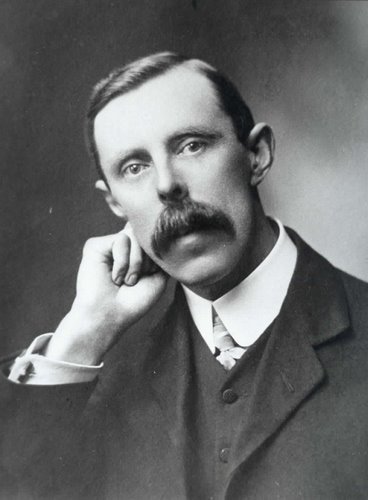
Frank William Boreham 1871-1959

Frank William Boreham 1871-1959
A photo F W Boreham took of himself in 1911

Thursday, May 21, 2009

Boreham on The Squirrel's Dream

At the Melbourne Art Gallery this afternoon my attention was captivated and monopolized by a noble painting by the late John Pettie, R.A. It is entitled Challenged, and once adorned the walls of the Royal Academy in London. A gay young aristocrat has been called from his sumptuous couch in the early morning by a challenge to a duel. There he stands, attired in his blue dressing gown, holding the momentous document in his hand. His old serving-man, who has delivered the missive to his master, is vanishing through the distant door; a sword reposes suggestively upon a chair. But the whole artistry of the picture is concentrated in the face. It is the face of a thoughtless, shallow, self-indulgent young man-about-town suddenly startled to gravity and something like nobleness. By means of that face, the artist has skilfully portrayed the fact that life becomes smitten with sudden grandeur the moment it is challenged by stupendous issues. Life and death confront this young lord, and he becomes a new man as he realizes their stately significance.

No man amounts to much until all his faculties have been challenged. There must come a moment when a trumpet-blast, a pistol-shot, a bugle-call stirs all his pulses. And, this being so, life takes good care that, sooner or later, we shall each find ourselves dared by some tremendous situation. Therein lies the secret of that thirst for adventure which is the hall-mark of humanity.

I was listening last night to Dr. Adrian Carter, the principal of Clarendon House. Dear old Dr. Carter-'Magna Charta' as the boys irreverently call him! I would not miss the old gentleman's Speech Day oration for a king's ransom. His very appearance is a sight for sore eyes. He looks for all the world like a reincarnation of Mr. Pickwick. Everything about him—his chubby face, his prominent glasses, his expansive waistcoat, and even his trick of keeping his left hand, when speaking in public, under his coat—tails and flicking those coat-tails to emphasize his crucial points—intensifies the similarity to Mr. Pickwick. In his Speech Day deliverances, Dr. Carter lays down the law in such a way that every sentence seems a crystallization of the ultimate wisdom. On the theme with which he is dealing, there appears to be nothing more to be said. And yet, on the way home, you often catch yourself wondering.

This year, in his Speech Day address, the little old gentleman deplored the decay, in the rising generation, of the spirit of adventure. The world has been knocked into shape, he said, by people who scorned comfort and courted hardship. Anybody, he declared, flicking his coat-tails with special energy, anybody can follow the line of least resistance; anybody can settle down to the first job that comes; anybody can hug the coast. `I trust,' he impressively observed in conclusion, `I trust that the boys of Clarendon House will seek life's distant and more difficult tasks and thus maintain the most splendid traditions of the glorious past! 'He resumed his seat, I need scarcely say, amidst a storm of tumultuous applause.

This is excellent—as far as it goes; the only trouble is that it does not carry us very far. For, to begin with, it is evident that it is some little time since the doctor himself was a boy. He has forgotten one or two things pertaining to his boyhood. For, in point of fact, no boy needs to have revived within him the spirit of adventure. It pulses in his blood all the time. No boy could have presented to the world a less adventurous appearance than did I. I do not recall one solitary occasion on which I became involved in censure through any daring escapade such as those of which the writers of school-boy stories love to tell. To my parents and teachers my life must have appeared utterly placid, utterly tranquil, utterly commonplace. Yet, looking back, I can see that, all unsuspected, the spirit of adventure was throbbing within me. The worst crime ever laid to my charge was the crime of being absent-minded. The headmaster stigmatized me as 'an incorrigible wool-gatherer.' I distinctly remember a certain Examination Day. We had been told overnight that the Inspector was coming. We were to arrive at school next morning in our best Sunday clothes, with clean collar, brightly polished boots and finger-nails destitute of any funereal suggestion.

All went well until the Inspector tested our class in matters of geography. He asked some question about Western Canada which sent my mind hurtling off on eventful journeys of its own. All at once, the boy sitting next me, giving me a dig with his elbow that almost fractured my ribs, whispered 'Java.' I then realized to my dismay that the Inspector was looking straight at me. Taking my school-fellow's violent but well-intentioned hint, I shot up my hand and said `Java!'

`Exactly,' the great man replied with a patronizing smile,' and now perhaps you will repeat the question that I asked you!'

I was floored, for the question had completely eluded me. His previous inquiry concerning Western Canada had despatched my mind on a personally-conducted tour to the Rocky Mountains, and I was in the midst of a titanic struggle with a grizzly bear at the very moment at which he asked his further question relating to Java. Reviewing my boyhood, I can see that this sort of thing happened frequently. My unimaginative teachers obstinately insisted on asking their most ridiculous questions concerning Latin conjugations and recurring decimals at exciting moments when I was engaged in snatching a beautiful girl from the horns of an angry bull, or pursuing, single-handed, a powerful tribe of Iroquois Indians, or delivering a charming princess from a blazing palace or winning the Victoria Cross under circumstances of unprecedented gallantry.

The doctor was anxious, he said, to awaken in his boys the spirit of adventure. Has it never occurred to him, I wonder, that, in itself, the spirit of adventure is a pitifully poor thing? Two of the best books ever written—books that all the boys at Clarendon House will read before they are many days older—were written to show that, in itself, the spirit of adventure is worthless and even dangerous. It only becomes sublime when consecrated by a noble aim.

In the early pages of Hereward the Wake, Kingsley describes his hero as he first becomes conscious of his insatiable craving for adventure. Longing for a hectic and perilous career, he looks this way and that way in search of some opportunity of performing desperate and doughty deeds. He wearies of the humdrum of home. Out in the wide, wide world, beyond the borders of the too-familiar Bruneswald, he fancies that every hill and valley is swarming with dragons, giants, dwarfs, ogres, satyrs and similar weird and fantastic creatures. Where shall he go? To Brittany where, in the depths of the forest, beautiful fairies may be seen bathing in the fountains, and possibly be won and wedded by a sufficiently bold and dexterous knight? To Ireland, and marry some beautiful princess with gray eyes and raven locks and saffron smock and enormous bracelets made from the gold of her own native hills? No, he will go to the Orkneys and join Bruce and Ranald and the Vikings of the northern seas! Or he will go up the Baltic and fight the Letts upon the water and slay the bisons on the land! Or he will go South; see the magicians of Cordova and Seville; beard the Mussulman outside his mosque and perhaps bring home an Emir's daughter! Or he will go to the East, join the Varanger Guard, and, after being thrown to the lion for carrying off a fair Greek lady, will tear out the monster's tongue with his own hands and show the Orient what an Englishman is made of! At this stage, it will be observed, Hereward is seeking adventure for its own sake. The purpose of the exploit may be admirable or execrable: it does not matter. It may leave him a hero or a cut-throat: he does not care.

Happily, Hereward discovered, comparatively early in his career, that a deed can only derive its lustre from its motive and its aim. No deed, however audacious, is worth while unless it relieves the oppressed, raises the fallen, and makes the world a better place for everybody. This discovery represents the spiritual development of Kingsley's massive hero; and it is to trace this subtle evolution in Hereward's character that Kingsley wrote the book.

Pretty much the same may be said of Don Quixote. Cervantes saw to his sorrow that chivalry was running wild. The stories told by the men who were returning from the wars were inflaming the imagination of the youth of Castile to a positively dangerous degree. Hot-headed young enthusiasts were swept off their feet by an insatiable desire to cover themselves with glory. They would fight something or somebody, whether that something or somebody needed to be fought or not. Cervantes wrote his book to show that it is better to stay at home breaking stones by the roadside than to rush forth and hazard one's life in tilting at windmills.

It is not enough, therefore, to urge boys to develop the spirit of adventure. The spirit of adventure, undirected and unconsecrated, made Hereward the Wake a ruffian, made Don Quixote a clown; and has made many a boy a criminal. Dr. Carter must go one step further.

He must show that, provision having been made in the eternal scheme of things for the gratification of every legitimate appetite, provision has been made to gratify the thirst for adventure. In a quaint, fantastic and vivacious little play entitled The Squirrel's Cage, Tyrone Guthrie has demonstrated that each of us is like a squirrel shut up in a twirling prison. The very globe on which we live revolves continually. The year follows the same law: spring, summer, autumn, winter: the cycle goes round and round and round. A babe is born, a child develops, a youth matures, a man marries, a babe is born; and so the circle is again completed. Within this revolving cage it is natural that everything should tend towards monotony. All things go round and round and round!

Now, if I had been writing Tyrone Guthrie's play, I should have pointed out that, just beside the whirling cage, there is a small box-like compartment in which the squirrel sleeps. The little creature's antics in the open may be wonderfully spectacular; but, to me, his dreams in the sleeping compartment are much more enticing. Curled up there, he dreams—dreams every night the same dream—a dream of felicities that might have been. It is a dream of the vast woods, the swaying tree-tops, the arching boughs that look like bridges specially constructed to make easy a squirrel's progress from one end of the forest to the other. It is a dream of rich clusters of tawny filberts, of the greensward littered with beechnuts, of oak trees twinkling with innumerable acorns, and of a wondrous abundance of sweet forest seeds. It is a dream of a cosy little nest, lined with fur and fibre and leaves and moss, high up in the fork of the fir tree; it is a dream of the sweetest, shyest, daintiest little squirrel that ever hid coyly behind the bole of an elm tree; and of four tiny wee squirrels, scarcely to be recognized as squirrels, nosing and jostling each other in the secrecy of the quiet nest. But when he gets to this part of his dream the sleeper wakes up with a quiver and a start, stretches himself, passes out into the revolving cage, and, partly in sheer desperation, partly to throw off the memory of his dream, and partly to make himself believe that he is racing madly about the forest, he twirls his treadmill like a thing bewitched. Lookers-on laugh when they see him doing it: but he himself is not laughing. He has come back to the monotony of his treadmill after his dream of a wonderful and romantic escape.

The whole point of Tyrone Guthrie's play is that, at least once in every squirrel's life, the cage door is left open. And everything depends upon his behaviour in that critical hour. Will he dare to pass out into the world to enjoy the actual realization of his dreams. Will his adventurous visions crystallize at last into actual experience? Or will he tremble in the presence of the unknown, and, terrified, creep back into his cage once more? That hour is the hour of his challenge; the greatest epoch in his life. Such a challenge comes, at some time and in some form, to each of us. We are presented with a sensational opportunity of escape. As a rule, when that sublime opportunity comes, we shrink from the unknown, hug the familiar cage, and allow the door to shut us in again. Tyrone Guthrie's hero, Henry Wilson, had the chance, in early youth, of going out to Africa. It appealed to all the adventurous instincts that tingled through his frame. But, on second thoughts, he felt that the exploit was extremely risky; his father pointed out the assured comforts that would accrue from his succeeding to the business; and so Henry, letting the cage-door close, went off to town every morning by the 9.23 and returned by the 6.13. Round and round and round!

The Church's evangel presents people with the most sublime of all those challenges. In his Everlasting Man, Mr. Chesterton says that life is a great game of Noughts and Crosses. The Nought—the circle—represents the basic monotony of life. Like the squirrel's cage, it goes round and round and round. Oriental religions, Mr. Chesterton points out, became infected by the dreariness of this fundamental monotony. The most typical and most eloquent symbol on an Eastern temple is a serpent with its tail in its mouth—a complete circle—a round that ends where it begins—a grind, a routine, a treadmill.

But beside the Nought, Mr. Chesterton says, stands the Cross. And, to play the game rightly, you must put the Cross inside the Nought. The four extremities of the Cross will pierce the Nought at four separate points, and, by the Cross, the monotony of life will be shattered into fragments and shattered for ever.

It is a perfect parable, needing neither elaboration nor application. But, having begun with a famous painting, I will close with another. Just two hundred years ago, Stenburg at Dusseldorf painted his Gipsy Girl. As his model posed upon the dais, her black eyes wandered round the studio. They were arrested by an altar-piece painted for Father Hugo of the Church of St. Jerome—a representation of the thorn-crowned face of Jesus. When the gipsy stepped down from her platform, she begged the artist to explain the picture to her. He tried, but found it difficult; for the thought of Christ stirred no profound emotion within him. When he had finished, the girl remarked simply: 'You must love Him very much, Signor, when He has done all that for you!'

The artless words pierced the painter's soul. They filled him with shame, for, in point of fact, he did not love Christ at all. But he soon did. And, when he did, he painted another picture—a picture of the Christ he now adored. Underneath the thorn-crowned face on the new canvas he inscribed the words:

All this I did for thee;
What hast thou done for Me?

He then presented it to the public gallery at Dusseldorf. And one day Count Zinzendorf was among the visitors who stood before it. Young, rich, gay and impressionable, the picture powerfully appealed to him, whilst the question beneath it rang through his soul like a challenge. It was a challenge, and he accepted it. He went out to serve his Saviour. He became the founder of Moravian Missions. Within a few months missionaries were sent to the Esquimaux and to the people of the West Indies. In a year or two, evangelists of the Cross were despatched to all parts of the world. The Moravian Brethren became, in 1738, the means of the conversion of John Wesley, and thus the amazing revival of the eighteenth century was initiated. The Cross had shattered the indolent monotony of Zinzendorf's life. He became a new man; the Church became a new Church; the world became a new world! The soul-stirring challenge had been accepted: the great escape had been made: and, as long as the world endures, people will rejoice in the sensational developments that followed.

F W Boreham, ‘The Squirrel’s Dream’, A Witch’s Brewing (London: The Epworth Press, 1932), 89-99.

Dr Geoff Pound

Wednesday, May 20, 2009

Boreham on The Supremacies of Life

Life has a wonderful way of tapering majestically to its climax. It narrows itself up towards its supremacies, like a mountain rising to its snow-capped summit in the skies. Our supreme interests assert themselves invincibly at the last. Our master passions are 'in at the death.' Let us glance at a pair of extraordinarily parallel illustrations.

Paul is awaiting his last appearance before Nero. The old apostle is caught and caged at last. He is writing his very last letter. He expects, if spared, to spend the winter in a Roman dungeon. 'Do your very best,' he says to Timothy, ‘to come to me before winter.' 'And,' he adds, 'the cloak that I left at Troas with Carpus, when thou comest, bring with thee, and the books, but especially the parchments’!

Under circumstances almost exactly similar Paul's great translator, William Tyndale, was lying in his damp cell at Vilvorde awaiting the fatal stroke which set his spirit free a few weeks later. And, as in Paul's case, winter was coming on. 'Bring me,' he writes, `a warmer cap, something to patch my leggings, a woollen shirt, and, above all, my Hebrew Bible'!

Especially the parchments!
Above all, my Hebrew Bible!

The emphasis is upon the especially and upon the above all. Paul knows how isolated he will feel in his horrid cellar, and he twice begs his young comrade to hurry to his side. He knows how cold he will be, and he pleads for his cloak. He knows how lonely will be his incarceration, and he says, 'Bring the books'! Yet he feels that, after all, these do not represent the supremacies of life. It is not on these that he is prepared to make his final stand. 'But especially the parchments'! Much as he yearns for the clasp of Timothy's hand, he is prepared, if needs be, to face the stern future alone. Much as he longs for his warm tunic to shelter his aged limbs, he is prepared, if needs be, to sit and shiver the long winter through. Gladly as he would revel in his favourite authors, he is prepared, if needs be, to sit counting the links in his chain and the stones in the wall. But the parchments! These are life's supreme, essential, indispensable requisites. These represent life's irreducible minimum. 'Especially the parchments'! `Above all, my Hebrew Bible'! These are the supremacies of life.

The hero of romance erects a pyramid upon its apex. He sets out in life with one or two friends. He soon multiplies the number. He counts them, as the years pass, by the score and by the hundred. And he dies at last in the possession of friendships which can be numbered by the thousand. It is a false note. The thing is untrue to experience. `The first true gentleman that ever breathed' found His path thronged with friends at the outset. But, as time wore on, they wore off. 'Many of His disciples went back, and walked no more with Him.' Twelve remained, such as they were; but even that remnant must be sifted, and of the twelve a selection had to be made. And into the chamber of death, and up to the Mount of Transfiguration, and into the Garden of Gethsemane 'Jesus taketh with Him Peter and James and John.' The pyramid is narrowing up towards its apex. And when He passes from Gethsemane to Golgotha John alone stands by the cross, and even he had wavered. `And Jesus said unto John, Son, behold thy mother.' It had tapered sharply to the unit at last. `Especially John.'

Sir William Robertson Nicoll has a story of an old Scotsman who lay a-dying. His little room was crowded with friends. Presently a number of them rose and quietly left. There remained his old wife, Jean, and the trusted companions of a long pilgrimage. As his frame became more feeble and his eye more dim one after another reverently rose, lifted the worn old latch silently, and left the room. At last the old man pressed the withered hand in which his own was clasped, and whispered faintly: 'They will a' gang: you will stay!' And at last he and she were the sole occupants of the little chamber. `Especially Jean.' Which things are an allegory. The pyramid narrows to its apex. Life contracts towards its supremacies. 'Especially the parchments'! 'I have hosts of friends,' wrote Lord Macaulay in one of his beautiful letters to his sister, 'but not more than half a dozen the news of whose death would spoil my breakfast.' And of that half-dozen he would probably at a later stage have made a selection. Friendship has its supremacies.

The same is, of course, true of our libraries. Like the apostle, we are all fond of books; but our book-shelves dwindle in intensity as they grow in extensity. As life goes on we accumulate more and more volumes, but we set more and more store on a few selected classics of the soul. The number of those favourites diminishes as the hair bleaches. We have a score; a dozen; and at length three. And if the hair gets very white, we find the three too many by two. 'Especially the parchments'!

Sir H. M. Stanley set out upon his great African exploration with quite a formidable library. One cannot march eighteen hours a day under an equatorial sun, and he gave a prudent thought to the long encampments, and armed himself with books. But books are often heavy—in a literal as well as in a literary sense. And one by one his native servants deserted him (the pyramid towering towards its apex). And, as a consequence, Stanley was compelled to leave one treasured set of volumes at this African village, and another at that, until at last he had but two books left—Shakespeare and the Bible. And we have no doubt that, had Africa been a still broader continent than it actually is, even Shakespeare would have been abandoned to gratify the curiosity of some astonished Hottentots or pigmies.

It all comes back to that pathetic entry in Lockhart's diary at Abbotsford: 'He [Sir Walter Scott] then desired to be wheeled through his rooms in the bath-chair. We moved him leisurely for an hour or more up and down the hall and the great library. "I have seen much," he kept saying, "but nothing like my ain hoose—give me one turn more!"

Next morning he desired to be drawn into the library and placed by the central window, that he might look down upon the Tweed. Here he expressed a wish that I should read to him. I asked, from what book. He said, "Need you ask? There is but one!" I chose the fourteenth chapter of St. John's Gospel.' He listened with mild devotion, and, when Lockhart had finished reading of the Father's house and the many mansions, he said, 'That is a great comfort!' The juxtaposition of phrases is arresting: `In the great library'—'there is but one book!' The pyramid stood squarely upon its solid foundation, but it towered grandly and tapered finely towards its narrow but majestic summit.

'Come,' says Paul the Aged, `for I am lonely; bring the cloak, for I am old and cold; bring the books, for my mind is hungry; but, oh, if all these fail, send the parchments!' Especially the parchments! Life's supremacies must always conquer and claim their own at the last.

F W Boreham, ‘The Supremacies of Life’, The Luggage of Life (London: Charles H Kelly, 1913), 40-45.

Dr Geoff Pound

Image: “Like a mountain rising to its snow-capped summit in the skies.”

Tuesday, May 19, 2009

Boreham on The Tireless Trudge

Whilst the fire crackled cheerily between them two friends of mine discussed a knotty point. The question under debate was, briefly, this: Which is the most trying part of a long journey? One argued for the initial steps on setting out. The weary road, he said, stretches out interminably before you. Every stick and stone seems to be shouting at you to turn back and to take your ease. His friend, on the other side of the hearth, thought quite differently. He contended stoutly for the final stage of the pilgrimage. He vividly pictured the exhausted pedestrian at the end of his journey, scarcely able to drag one blistered and bleeding foot in front of the other. It is certainly rather a fine point; but, after all, it was really not worth discussing, for nothing is more absolutely clear than that they were both wrong. Which, of course, is the usual fate of controversialists.

Now the worst part of a journey is neither at its beginning nor at its close. There is a certain indescribable exhilaration arising from the making of the effort which imparts elasticity to the muscles and courage to the mind, at starting. The road seems to dare and challenge the pilgrim, and he swings off along the taunting trail with a keen relish and a buoyant stride. And, at the other end, the twinkling lights of the city that he seeks help him to forget that he is footsore and choked with the dust of the road. His blood tingles with the triumph of his achievement and the delight of nearing his goal. But there is another stage concerning which neither of my friends had a word to say. What of the intermediate stage? What of the long and lonely tramp? What of the hours through which no applauding voices from behind can encourage and no familiar fingers from before can beckon? This, surely, is the worst part of the way! There is no intellectual stimulant so intoxicating as the formation of a noble purpose, the conception of a sudden resolve, the making of a great decision. And, in the luxurious revelry of that stimulus the prodigal finds it easy to rise from the degradations of the far country and to fling himself with a will along the great Phoenician road. And at the other end! Surely the most overpowering of all human instincts and emotions is that which holds captive every nerve at the dear sight of home! No; neither the first nor the last steps of that familiar journey were very hard to take. But between the one and the other! What questionings and forebodings! What haltings and backward glances! What doubts and fears! Yes, there can be no doubt about it, both my friends were wrong.

It is the intermediate stage that tests the mettle of the person. It is the long, fatiguing trudge out of sight of both starting-point and destination that puts the heaviest strain on heart and brain. That is precisely what Isaiah meant in the best known and most quoted of all his prophecies. He promises that, on the return from Babylon to Jerusalem, `they that wait upon the Lord shall renew their strength; they shall mount up with wings as eagles; they shall run, and not be weary; and they shall walk, and not faint.' Israel is to be released at last from her long captivity. Imagine the departure from Babylon—its fond anticipations, its rapturous ecstasies, its delirious transports! Those first steps of the journey were not trying; they were more like flying. The delighted people walked with winged feet. And the last steps—with Jerusalem actually in sight, the pilgrims actually climbing the mountains that surrounded the holy and beautiful city-what rush of noble and tender emotions would expel and banish all thought of weariness! But Isaiah is thinking of the long, long tramp between-the drag across the desert, and the march all void of music. It is with this terrible test in mind that he utters his heartening promise: 'They shall walk and not faint.' They would fly, as on wings of eagles, out of Babylon at the beginning; they would run, forgetful of fatigue, into Jerusalem at the end; but they should walk and not faint. That is life's crowning comfort. The very climax of divine grace is the grace that nerves us for the least romantic stage of the journey. Farewells and welcomes, departures and arrivals, have adjusting compensations peculiar to themselves; but it is the glory of the gospel that it has something to say to the lonely traveller on the dusty track. Religion draws nearer when romance deserts. Grace holds on when the gilt wears off.

Two cases come to mind. I know a man whose whole delight was in his boy—a little fellow of six or so. Then, suddenly, like lamps blown out by a sudden gust, the lad's eyes failed him, and he was blind. The father was the recipient of scores of touchingly sympathetic letters. All sorts of people called. Kindly references were made in press and pulpit. The man had no idea until that moment that he had so many friends. All the world seethed to bepaying homage to his sorrow. That was the beginning. After many years the boy had been taught to interpret the world again by means of his remaining senses. There was nothing he could not do. He earned his own living, and his sightlessness seemed no real hindrance to him. That was the end. But the father told me that the strain of it all came between these two. There came a time when the postman brought no cheering letters. Friends uttered no heartening words. The world had transferred his boy's blindness into the realm of the normal and the commonplace. Nobody noticed. But in the home the little fellow staggered about, and his parents' hearts ached for him. What was to become of him? It was during those intervening years lying between the first crushing blow and the final relief that the real strain came. That was by far the worst stretch of the road.

I knew a woman. Without a moment's warning she was plunged into widowhood, and left to battle for her five little children and herself. There was an extraordinary outburst of affectionate sympathy on the part of all who knew her. Then came the funeral. After that the world went on its way again as though nothing had happened. That was the beginning. After the years, the battle had been well fought and well run. The children had been clothed, educated, and placed in positions of usefulness and honour. That was the end. But my widowed friend told me that she did not forget when the world forgot. Every morning her grief woke up with her. And every night it followed her to her rest. Every day, as she struggled for her little ones, the haunting question tortured her: What would become of them if sickness or death seized upon her? That was the killing time. That intermediate stretch was the worst part of the desolate way.

As it is with individuals, so it is with great causes. A crusade is launched amidst vituperation, derision, and execration. And there is enough fight in most of us to lend a certain enjoyment to the very bitterness of antagonism. And at last the self-same movement is crowned with triumph. But the real inwardness of the struggle lies midway. William Wilberforce used to say that he was less dismayed by the storm that broke upon him when first he pleaded the cause of the slave than by the `long lull' that followed when the country accepted his principles, but did nothing to hasten their realization. In America the same thing happened. The war against slavery was undertaken with a light heart. Young men sprang to the front in thousands with the refrain of 'John Brown's body' on their lips. But the real struggle was not then, nor towards the close, when victory and emancipation were in sight. But who can forget the long agony of disaster that intervened between those two? It was when the nation was trudging tearfully along that blood-marked track that the real suffering took place. The same experience repeats itself in the history of every great reform. Some one has said that every movement has its bow-wow stage, its pooh-pooh stage, and its hear-hear stage. Of those three phases the central one is infinitely the most difficult to negotiate. Between the howl of execration that greets the suggestion of a reform and the shout of applause that announces its final triumph there is a long and tiresome stretch of steep and stony road that is very hard to tread. They are God's heroes who set a stout heart to that stiff brae, and walk and not faint.

In his Autobiography Mark Rutherford tells of his fierce struggle with the drink fiend. On one never-to-be-forgotten night he resolutely put the glass from him and went to bed having drunk nothing but water! 'But,' he continues, 'the struggle was not felt just then. It came later, when the first enthusiasm of a new purpose had faded away.' And, in his Deliverance he applies the same principle in a more general way. He is telling of the stress of his life as a whole. 'Neither the first nor the last,' he says 'has been the difficult step with me,' but rather what lies between. The first is usually helped by the excitement and promise of new beginnings, and the last by the prospect of triumph. But the intermediate path is unassisted by enthusiasm, and it is here we are so likely to faint.'

I cannot close more fittingly than by setting those two striking sentences over against each other: `It is here we are so likely to faint,' says Mark Rutherford, speaking of the long and tiresome intermediate phase. 'They shall walk and not faint,' says the prophet in reference to precisely the same circumstances and conditions. Wherefore let all those who are feeling the toilsome drudgery of the long and unromantic trail pay good heed to such comfortable words.

F W Boreham, ‘The Tireless Trudge’, The Luggage of Life (London: Charles H Kelly, 1913), 70-77.

Dr Geoff Pound

Image: “It is the intermediate stage that tests the mettle of the person.”

Tuesday, April 28, 2009

Boreham Books For Sale

A person in New Zealand is selling the following Boreham books. Let me know if you want the email address to chase them up.

Dr Geoff Pound

First Editions.
A Temple of Topaz
Mushrooms on the Moor (Signed)
The Last Milestone
The Silver Shadow (3) One first, one signed, one second ed.}
The Nest of Spears (Also 2nd ed.)
A Casket of Cameos( 2 1st eds)
The Blue Flame (2)
Rubble and Roseleaves
The Three Half Moons (2)
A Reel of Rainbow
Faces in the Fire
The Crystal Pointers ( 1 1st ed and 2 others)
Boulevards of Paradise

Signed copies. (Not 1st Eds.)
The Fiery Crags (3 one signed)
Mushrooms on the Moor
The Luggage of Life (2 copies Facsimile signed)
Gospel of Uncle Tom’s Cabin
Cliffs of Opal (Possible 1st ed.)
Mountains in the Mist (2 copies one signed)
The Gospel of Crusoe
The Other side of the Hill
The Silver Shadow


Other Titles.
The Golden Milestone
The Passing of John Broadbanks
Wisps of Wildfire
A Late Lark singing
A Bunch of Everlastings (2 copies)
Faces in the Fire
The Prodigal
Arrows of Desire (2 copies one a p/back)
Dreams at Sunset
In Pastures Green
Empty Pitchers –Published Essay with photos
My Pilgrimage. Autobiography


.

Monday, March 30, 2009

Rare F W Boreham Library for Sale

Les Nixon’s personal collection of eighty-five of his F. W. Boreham volumes is now available for a donation, for Missions.

The books are rare collectors’ items perhaps suitable for a theological or a personal library. They will be sold as a unit and not broken up.

Nixon’s previous Boreham library was placed in a Bible College Library in 1997, for a gift of $4500.

Inspect this collection (he lives in Australia) or see a photo of the books, and make an offer.

They consist of forty-five hard-cover volumes, and 38 pocket-editions, in good condition, with author’s greetings and autograph. Some are around 60-years old; several a hundred, worth a thousand each in the US market. Valuable for research.

Contains numerous exquisite Christian essays, said to be ‘on most Pastor’s shelves and in everybody’s sermons, and many elegant speeches’. Epworth Press London - from 1891 to 1861.

A complete list of the books with details are available.

Do let me know if you are interested and I can send the list or put you in contact with Les.

Dr Geoff Pound

Wednesday, March 25, 2009

Boreham Book for sale

A reader from England has Boreham's most popular autobiography for sale.

Dr Lesley Weatherhead of London's City Temple wrote to F w Boreham saying that he thought My Pilgrimage was one of the most helpful books to give to an aspiring pastor.


She writes: "I have a copy of FW Boreham 1954 6th Impression My Pilgrimage. This is a signed copy "most gratefully yours, FW Boreham" underneath his photo.In the top right hand corner on the facing page is, in different hand written"To all in memory of Jessie Down/Dunn Auntie Jessie Died Jan 20th 1964."


The sale price is US$30 plus P & P.


Do let me know if you would like to buy this book and I can link you with the present owner.


Geoff Pound

Sunday, February 08, 2009

Home of the Echoes Web Site

I came across a web site of a couple by the name of Steve & Jennifer Cuttino who now live in the Czech Republic.

Their web site is entitled, ‘Home of Echoes’, which Boreham fans will know is the title of a book by F.W. Boreham.

In explaining the name of their site the Cuttinos say:
“It means that Life is meant to respond to Life, and when that happens it creates an echo that goes on for eternity…Life is designed to respond with Life, and Jesus said, that whoever believes on me will have everlasting life, which means a life having an echoing effect to all around it. We want to have an ECHOING EFFECT in the Czech Republic.”

A great name and a lofty aspiration.

Their site is at this link:

Home of the Echoes

Dr Geoff Pound

Image: Steve & Jennifer Cuttino

Tuesday, January 13, 2009

Boreham on Waiting for the Tide

WAITING FOR THE TIDE

Sauntering through the Melbourne Art Gallery—a favourite haunt of mine—on Friday afternoon, I was captivated by a picture that I had never seen before. I need scarcely say, therefore, that it was not hanging on the wall. The people who visit the galleries are always worth watching. On Friday my wayward eyes were arrested by a young couple—she in brown and he in navy-blue—sitting in earnest conversation in front of one of the paintings. Whether they were a honeymoon couple or merely sweethearts, I cannot say: her left hand was provokingly gloved: but it does not matter, the question is of moment to nobody but themselves. She was leaning forward—face in hands, and elbows on knees—absorbed in the study of a picture. He was eyeing it less intently, yet with genuine interest, moved thereto partly by the skill of the artist and partly by the infection of her enthusiasm.

The picture was Mr. Arthur Boyd's Waiting for the Tide. It represents a sheltered and tranquil cove in which a couple of boats are lying. The boat in the foreground is occupied by two men. They are doing nothing, for there is nothing to be done. The boat leans heavily over, showing that it is hard and fast upon the muddy bed of the little inlet. Until the tide comes swelling in, lifting and liberating it, its occupants are helpless. But their presence in the boat sufficiently indicates their determination to ply their oars and leave the bay the moment that the waters rise. Till then they are waiting—idly waiting—eagerly waiting—watchfully waiting—waiting, just waiting for the tide!

`It reminds one,' I heard the young fellow in navy-blue remark, as I slowly passed behind them, `it reminds one of Mr. Micawber waiting for something to turn up!'

I did not catch her reply: I should dearly like to have done so. I hope that, being the wise little woman that she looked, she gently reproved his lack of penetration and discernment. The observation was as shallow as the water in the picture. For between the men sitting in their stranded boat, waiting for the flowing of the tide, and Mr. Micawber pusillanimously waiting for something propitious to happen, there is all the difference in the world. Having had a good look at the picture, let us submit Mr. Micawber to a similar scrutiny.

It is in the eleventh chapter of David Copperfield that we are introduced to Mr. Micawber. He is, as ever, on the brink of ruin; and, as ever, he alternates with lightning rapidity, between the heights of ecstasy and the depths of despair. 'It was nothing unusual for him to begin a conversation by sobbing violently and to finish it by bursting into song. I have known him,' says David Copperfield, `I have known him come home to supper with a flood of tears and a declaration that nothing was now left but a gaol; and go to bed making a calculation of the expense of fitting the house with bow-windows, in case anything turned up. This,' David adds, 'was his favourite expression.'

Three pages further on, Mr. Micawber is contemplating his release from prison under the Insolvent Debtors' Act. 'And then,' he exclaims, `I shall, please Heaven, begin to live in an entirely new manner if—if—if, in short, if anything turns up!'

I turn three more pages and find Mr. Micawber, out of the bitterness of his own experience, pouring sage counsel into the ears of David. `My dear young friend,' he says, `I am older than you; a man of some experience in life, and—and of some experience in difficulties, generally speaking. At present, and until something turns up (which I am, I may say, hourly expecting) I have nothing to bestow but advice.'

And so on. In the daytime Mr. Micawber mingles with the throng upon the city streets, hoping for something to turn up among the faces that he meets there. In the evening he throws himself into his chair, adjusts his spectacles, and settles down to the newspaper, 'just to see whether anything turns up among the advertisements.'

There, then, is Mr. Micawber! Anything more unlike the boatmen in Mr. Boyd's painting it would be very difficult to imagine. Something may or may not turn up to gratify the baseless optimism of Mr. Micawber: as a rule nothing of the kind eventuates, and Mr. Micawber is left lamenting. But the tide! The tide is bound to turn! And not only so but it is bound to turn at a certain time. My morning paper tells me that it will be high water today at 8.57 a.m. and 7.51 p.m. Mr. Micawber's newspaper—the paper in which he expected something to turn up among the advertisements—never once mentioned the hour at which that nebulous and mysterious happening would take place! The men in the picture, on the contrary, know the exact moment at which the waters may be expected to come surging in; and they have everything in readiness.

That, in their case, is the beauty of it! And that, in Mr. Micawber's case, is the wretchedness and the pathos of it. Yes, the pathos of it! I think of W. J. Wills, the young astronomer and explorer, the most gallant figure among all our Australian pathfinders. The Burke and Wills expedition—the expedition in which, although only twenty-six, he was second in command—was the first to cross the continent. Leaving Melbourne on August 20, 1860, they reached the northern coast early in the following year. But disaster overwhelmed them on the return journey. Their supply of provisions gave out, and they were left to perish miserably in the hot and barren desert. Gray was the first to die. Burke, feeling that his end was near, attempted to stagger to Cooper's Creek, knowing that there his body would be discovered and taken to Melbourne for burial. Unwilling to see his leader go to a solitary death, King—the junior member of the party—decided to accompany him. Leaving Wills alone, the two set out into the wilderness. They had not gone far when Burke fell upon the sands, and King hurried back to Wills. But, during the absence of his comrades, Wills, too, had passed away. And there, lying near the body, was his journal, kept as was Burke's, to the very last:
'Here I am,' says the final entry, `here I am, waiting, like Mr. Micawber, for something to turn up!'

There lay the pathos of it! Waiting, like Mr. Micawber! In that brave young heart of his, Wills knew that, as in Mr. Micawber's case, nothing was likely to turn up; but he made up his mind to keep smiling to the last. Waiting like Mr. Micawber! There is an infinity of difference between that and Waiting for the Tide!
The something for which Mr. Micawber and our gallant young explorer are waiting—is a spectral contingency, a remote possibility, a shadowy chance, a forlorn hope. The tide—for which these boatmen are waiting—is the natural representative of those stable and reliable forces that dominate life at every turn. The tide stands for the stately dependabilities by which we are encompassed and surrounded. The masterly mechanism of the universe—the rising and the setting of the sun; the persistence in their orbits of the stars; the paths of the planets; the phases of the moon; the revolution of the earth; the cycle of the seasons; the round of the year—all this, like the ebbing and the flowing of the tide, is wonderfully reliable. The astronomers tell us that a comet that was last seen shortly after midnight on March 3, 1603, will again make its appearance at 9.30 p.m. on September 17, 1962; and we know for certain that, on September 17, 1962, the dazzling phenomenon will again adorn the evening sky. The astronomers tell us that, in a few years' time, there will be a total eclipse of the moon, visible in such-and-such a latitude and at such-and-such an hour ; and we know that, to the very minute, the earth will be darkened and the silver moon obscured.

Obviously, there is about all this nothing that savours of Mr. Micawber. We are not the children of chance. Life is controlled by a superb combination of certainties. They may, with the most implicit confidence, be waited for; and they will always prove themselves to be worth the waiting. The thoughtless observation of the young fellow in the navy-blue suit was hopelessly wide of the mark. I sincerely hope that his fair companion, with characteristic charm and sweetness and delicacy, demonstrated to him his egregarious blunder and tactfully set him right. The tide represents our best friends –the friends in whom we can always trust: the friends who never fail—and since she is likely to be the truest, dearest, most constant friend that be will ever know, there is a sense in which the tide represents her! And it would be painful to think of hurt as leaving the Art Gallery without a clear perception of the essential difference between her fond fidelity and the phantom-like fickleness of the will-o'-the-wisp after which Mr. Micawber was perpetually dancing.

I find it singularly pleasant today to think of those young people—she in brown and he in navy-blue—sitting in front of Mr. Boyd's picture. I hope they remained there long after I myself left the gallery—long enough, at least, to become impressed by the subtle significance that lurks in the lovely canvas. If they did, they will make time, through all the happy years to come, for just such quiet and restful hours as they were enjoying together today. For the tide—the tide for which the men in the picture were waiting—is the emblem of all the leisurely things in life. The tide cannot be hurried; there is nothing for it but to do as the men in the picture are doing; you must wait for it.

We have accelerated the pace of almost everything. The wheels of life revolve a hundred times as swiftly as they used to do. We dash through the years at a break-neck pace. And we have every reason to be proud of our achievements. But one cannot check a flush of pleasure at the thought that there are a few things—and those are the best things—that still jog along at the same old pace. An oak takes just as long to grow in my garden as it took in the Garden of Eden. The tide ebbs and flows today exactly as it ebbed and flowed in the days of the Pharaohs. It soothes the brain and steadies the nerves and sweetens the soul to fasten one's eyes for awhile on these leisurely and unhurriable things. They breathe a benediction of peace on all beholders.

If these young people—she in brown and he in navy-blue—are as wise as I suppose them, they will take the hint. In the years ahead of them they will be tempted to smile disdainfully upon the days when they loitered in Art Galleries and wasted time in doing nothing. To be forewarned is to forearmed; and therefore I forewarn them. Let them, as they sit in front of Mr. Boyd's, eloquent picture, pay good heed to the lesson that the tide is trying to teach them. The men in the boat may be in a perfect agony of impatience; it makes no difference; they must wait. The tide takes its time; it waits for no man: it compels all men to wait for it.

If these young people learn the lesson of the tide, I shall meet them again in the Gallery. It may be in ten years' time; it may be in twenty: I cannot tell. But, however pressing the claims of business and society may become, they will always contrive to set aside a few delicious hours in which they can sit at their ease, and sit together, luxuriating in the beauty of the world. If the hour appointed proves wet or cold or windy, they will come to the Gallery and enjoy the beauties of Art. If, on the other hand, the chosen day proves sunny, they will stroll in the fields, or ramble in the woods, or sit in the park and enjoy the beauties of Nature. The tide declines to be infected by tile fever of the folk who wait for it; let the girl in brown and her lover in navy-blue take that hint.

Let no man misinterpret! The doctrine of the tide is not a doctrine of Indolence: it is a doctrine of Activity. In point of fact, the tide is never still. Although it does its work in a restful and leisurely way, it does it. And it does it well. It is ever so; the world's best work is done by those who never know the fret and fever of haste. In their impatience the boatmen may feel that the tide is slow; but they know that it is sure. And they know that, before so very long, the tide will bring them their priceless opportunity.

For the tide—the tide for which they are waiting—does not intend these men to spend their lives waiting with folded hands in the seclusion of a narrow bay. The tide, for which they have waited so impatiently, comes at last! And then, if they have the will for it, and the strength for it, they can leave the tiny inlet in which they have been enclosed, and court a more adventurous experience on the broad waters beyond the bay. And then, as they do business in deep waters, they will feel that the tide, which seemed so long in coming, was worth the ordeal of waiting, after all!

I wonder if those young people—she in brown and he in navy-blue—heard the picture whispering that secret to their hearts! The tide—so faithful and so sure—offers every man, sooner or later, the chance of escaping from the tiny cove of the Here to the broad bosom of the Everywhere, from the little bay of Self, to the infinite sea of Service; and they are life's most enviable voyagers who, when the sublime opportunity presents itself, are all alive and all alert, waiting, with oars in rollocks, to make the most of it. It is the hour of destiny. The kingdom of heaven pours its wealth into the heart of the man, who is ready when that hour strikes. He was waiting: but only waiting for the tide!

F W Boreham, ‘Waiting for the Tide’, The Nest of Spears (London: The Epworth Press, 1927), 48-57.

Dr Geoff Pound

Image: Waiting for the Tide.

Wednesday, December 31, 2008

New Year Message from F W Boreham

F W Boreham wrote this essay on the last night of the year:

'PLEASE SHUT THIS GATE!'

It was at Criccieth; and Mr. Lloyd George was playing golf. It happened that, after a round, he and a friend had to cross some fields in which cattle were grazing. ‘I was so eager to catch every word that fell from Mr. Lloyd George's lips,' explains his companion, `that I failed to close one of the gates through which we passed.' But Mr. Lloyd George noticed it, paused, went back and carefully shut and latched the gate. They resumed their walk. 'Do you remember old Dr._____ of _____?' asked Mr. Lloyd George, mentioning a local worthy not long deceased. 'When he was on his death-bed a clergyman went to him and asked him if there was anything he would like to say or any message he wanted to deliver. "No," answered the doctor, "except that through life I think I have always closed the gates behind me!"'

There is, I fancy, a good deal in that. I had in my congregation at Mosgiel a little old man of singular serenity of countenance and sweetness of disposition. Nothing seemed to ruffle his faith or disturb the perfect tranquillity of his spirit. One evening, in the early autumn, he came down to the manse to bring me a basket of freshly gathered fruit. We sat for a while on the verandah chatting. It was an hour for confidences, and he opened his heart to me. I asked him how he accounted for the calm that seemed a perpetual rebuke to our fretfulness and worry. He would not at first admit that he possessed any features that distinguished him from the rest of us. But I pressed my point, and at length he became more communicative.
`Well, I'll tell you this,' he observed, 'I've always made it a rule that, when I've shut the door, I've shut the door I'

I sat pondering in silence this cryptic utterance. My friend saw that I was somewhat mystified, and hastened to the rescue.
`Years ago,' he explained, `I used to take all my troubles to bed with me. I would lie there in the darkness with closed eyes, fretting and worrying all the time. I tossed and turned from one side of the bed to the other, as wide awake as at broad noon. As life went on, the habit grew upon me until it threatened to undermine my health. Then, one night, things reached a crisis. I could not sleep, so I rose from my bed and sat at the open window. The garden below and the fields beyond were flooded in silvery moonlight. Not a breath of wind was stirring; the intense stillness was positively uncanny. The perfect tranquillity mocked the surging tumult of my brain. How quiet the room seemed! And I had entered into it—for what? My behaviour seemed absurd in the extreme. I had come to this haven of peace; Nature had wrapped around me her infinite calm; and here was I allowing all the worries of the world to fever my brain and break upon my rest! Why had I locked the office door so carefully if I wished all the ledgers and day-books and order-forms to follow me home? Why had I closed the bedroom door so carefully if I wished all the cares of life to follow me in? I knelt down there at the window-sill, with the delicious air of the still night caressing my face, and I then and there asked God to forgive me. And, since then, when I've shut a door, I've shut a door!'

I have often since, when the fret and fever of life have been too much for me, recalled my old friend's story. It is a great thing to be able to go through life, like Mr. Lloyd George's doctor, closing all the gates behind one. Take our decisions, for example. I have sometimes to make up my mind—to buy or to refuse; to sell or to hold; to go or to stay; to accept or to decline. The process of decision should be as leisurely and unhurried as the circumstances will permit. But when a verdict is reached, that judgement should be final. I have no right to insult my own intelligence. I must learn to treat it with respect. There can be no profit in establishing within my mind Courts of Appeal that have no power to carry their findings into effect. Nine times out of ten the verdict of the first court is irrevocable; why then rehear the case? When a man has once made up his mind, let him close the gate behind him, or he will never know happiness again. He has weighed all the evidence; he has balanced all the issues; and he has pronounced sentence. Very well; let it go at that. Why review it again and again? If the decision was sound, why question it? If the decision was doubtful, the sooner it is forgotten the better. Why torture yourself dwelling upon it? The horse is sold; the house is bought; the contract is signed; the situation is declined; the step taken cannot be retraced. A wise man will firmly and finally shut the gate. It is the better way.

I know that it would have been a great thing for my friend George Cairncross if he had been able to acquire this art. George is a minister; we were in college together; and we have been on the most intimate terms ever since. When he entered the ministry, he settled in a small country church at Langford. The work prospered exceedingly, and he was as happy as any man could be. After seven years the pastorate of the church at Grenville, a large town some distance away, fell vacant, and George was unanimously invited. He was at his wits' ends. The cause at Langford was so prosperous and he was so perfectly content. And yet he was young, and Grenville offered much wider scope! But at last the hold of his own people upon his affections proved too strong to be broken; and he declined the tempting overture from the larger church. So far, so good! But it was afterwards that George made his mistake. From that time forth, whenever the least thing went wrong at Langford, George turned his thoughts towards his lost opportunity at Grenville. As surely as a fit of the blues overlook him, he began to dream about Grenville. In poor George's brain Grenville became enveloped in a golden haze of romance. If only he had gone to Grenville! Oh, if only he had accepted the call to Grenville! In his better, wiser, saner, stronger moments he laughed at this frailty of his. He knew that he had decided rightly in remaining at Langford. But there were weaker moments. And in those weaker moments George harked back upon himself. It would have saved him a world of misery if he could have closed firmly and for ever the gate that divided the Langford field from the Grenville field.

Eight years later, after a most notable and memorable ministry, George did leave Langford. The church at Bellhaven called him; and, after another desperate inner struggle, he resolved to go. But after the excitement of the farewell, of the removal, and of the welcome, there came the inevitable reaction. Every day George missed at Bellhaven something to which he had grown accustomed at Langford. To be sure, there were compensations; but George was not in the humour to pay much attention to them. The strange conditions grated upon him. At Langford everybody knew him; at Bellhaven he walked the streets a stranger. Every mail from Langford intensified his malady. He thought of the people there who needed him, and whom he seemed to have forsaken; and his soul as filled with bitterness unspeakable. This, so far; is it went, was entirely to his credit; but unfortunately he allowed it to go too far. He let it develop into a habit. Whenever the least thing went wrong at Bellhaven, he convinced himself that he should never have left Langford. It was Langford that now became enveloped in a golden haze. If only he had remained at Langford! Oh, if he had never left Langford! In his better, wiser, saner, stronger moments he felt ashamed of this weakness of his. But there it was! And it would have saved him a world of distress if, when he left the Langford field for the field of Bellhaven, he had closed the gate firmly and finally behind him.

We are expressly told that cattle were grazing in the field that Mr. Lloyd George and his friend were leaving behind them. That is the trouble. There are always things in the fields behind us that may escape unless we carefully close the gates. Who is it that says:

I have closed the door on Fear,
He has lived with me far too long,
If he were to break forth and reappear,
I should lift my eyes and look at the sky,
And sing aloud, and run lightly by:
He will never follow a song.

I have closed the door on Gloom,
His house has too narrow a view,
I must seek for my soul a wider room,
With windows to open and let in the sun,
And radiant lamps when the day is done,
And the breeze of the world blowing through.

It is true that my life cannot be divided into watertight compartments. It is a whole—one and indivisible. But it is a whole, as a fine estate is a whole, with green hedges and white gates conveniently separating one part from another. The gates may be opened and closed at will; but it is good to have them there. We do not want the cattle to stray indiscriminately everywhere. It is pleasant to have some fields from which they are shut out—fields where the children can gather mushrooms and blackberries without fear.

I am very fond of Izaak Walton's Compleat Angler. Does the world contain such a triumph of gate-shutting? Our gentle angler lived through the most turbulent years of British history. He was born in the spacious days of great Elizabeth. He was ten years old when the illustrious Queen died. He saw the rise of the Stuarts, the Civil War, the ascendancy of the Puritans, and the execution of Charles the First. He lived all through the days of the Commonwealth; and he witnessed the Restoration! Yet who that has read his book would suspect that bloodshed and civil strife were raging around as he wrote? From the first page to the last, as Professor Jackson has pointed out, we have nothing but 'the murmur of brooks, the rustle of the wind in the trees, the shower falling softly on the teeming earth, the sweet smell of the soil after rain, the shining of the sun on green spaces.' It is a fine thing for a man to be able to shut out the cattle as effectively as that!

Or what about Wordsworth? Was it by some whimsical freak of circumstance that Wellington and Wordsworth were contemporaneous? Was it a mere oddity of chance that a generation almost wholly absorbed in the momentous issues that hung upon the fleets that grappled at Trafalgar, and the armies that fought at Waterloo, should find something very much to its taste in the poetry of Wordsworth? The terrible and long-drawn-out conflict, which ended in the complete overthrow of Napoleon at Waterloo, lasted, with scarcely a break, from 1793 to 1815. Now, singularly enough, it was in the first year of the war—in 1793 that Wordsworth published his first poem; through all these critical years in which the fate of the Empire hung trembling in the balance the poet continued to ravish the ear of the British people; and it was just as the armies of Wellington and Napoleon, of Ney and Blücher, were being drawn up in readiness for ‘that world-earthquake, Waterloo,’ that the ‘Excursion’ was to the nation. Whilst Europe reverberated with the thunder of guns, and shuddered beneath the tramp of armies, Wordsworth sang of the cuckoo and the skylark; of the redbreast and the butterfly; of the linnet and the nightingale; of the sparrow and the daisy. And to such music all the world listened. And why? Simply because we love to escape at times from the horned cattle, and to roam at will in the meadows in which the cowslip may turn its face to the sun, in which the lark may build her nest among the grasses, and in which lovers may wander in the gloaming undisturbed. Walton and Wordsworth helped people to shut the gate; that was all.

I am writing on the last night of the year. It is an hour for gate-shutting. If the fields behind us contain any creatures that we do not wish to meet again, let us carefully close the gate.

Let us forget the things that vexed and tried us,
The worrying things that caused our souls to fret,
The hopes that, cherished long, were still denied us,
Let us forget!

Let us forget the little slights that pained us,
The greater wrongs that rankle sometimes yet;
The pride with which some lofty one disdained us,
Let us forget!

It is of small use hoping for a happy New Year unless I carefully fasten all these gates behind me.

But the best possible illustration of my theme is to be found in the Old Testament. When the children of Israel, in hot haste, escaped from bondage, the Egyptians close upon their heels, a strange thing happened. ‘The angel of God, which went before the camp of Israel, removed and went behind them; and the pillar of the cloud went from before their face and stood behind them; and it came between the camp of the Egyptians and the camp of Israel.' A screen of Deity interposed itself between pursued and pursuers. The gate was divinely closed behind them lest the cattle of the land of Egypt should rush out and trample on the chosen people. And, long centuries later, when Israel escaped from Babylon, and dreaded a similar attack from behind, the voice divine again reassured them. 'I, the Lord thy God, will be thy rearguard.' There are thousands of things behind me of which I have good reason to be afraid; but it is the glory of the Christian evangel that all the gates may be closed. It is grand to be able to walk in green pastures and beside still waters unafraid of anything that I have left in the perilous fields behind me.

A while ago I preached upon this theme. An old gentleman, a regular member of my congregation, was present. I noticed that he followed me with the closest interest and attention. Next day he quite suddenly passed away. But, before going, he turned to those about him and exclaimed, 'I have shut the gate! I have shut the gate!' Like that of Mr. Lloyd George's doctor, it was a fine testimony! May my sunset be as serene!

Source: F W Boreham, ‘Please Shut the Gate’, The Silver Shadow (London: The Epworth Press, 1918), 109-119.

Dr Geoff Pound

Saturday, December 27, 2008

The F W Boreham Book Collection at Dunedin Public Libraries

Barbara Frame wrote an article on Boreham book collections for Nga Purongo: New Zealand Libraries-The Journal for Library & Information Management, Vol 49, No. 12, March 2005.

Here is the summary to give the gist of the article:

“The works of F.W. Boreham (1871-1959) are of growing interest to collectors worldwide. The small town of Mosgiel, near Dunedin, was for several years Boreham's home and provided the inspiration for much of his writing. The Mosgiel Library's incomplete collection has been added to and developed into a special collection on permanent display.”

To read the article, go to this link.

Source: Thanks to Robert Bonte and Rowland Croucher for passing the article to me.

Link: Dunedin Public Library, Boreham Collection.

Dr Geoff Pound

Image: Cabinet of Boreham books, Mosgiel Public Library. (Image courtesy of above link)

Saturday, December 20, 2008

David Doran on F W Boreham

David Doran, an exiting student at Sydney’s Moore College and from 2009 the Assistant Minister at St James Anglican Church in Minto, has written an essay on F W Boreham.

I appreciate David’s willingness to allow his essay to be published on this Boreham site, thus enabling many others to benefit from his research. My apologies for not being able to reproduce the same formatting, especially with the endnotes. GRP.

An account of the life and ministry of Frank W. Boreham.
In 1936 at the General Assembly of the Church of Scotland Professor Daniel Lamont introduced Frank W. Boreham as ‘the man whose name is on all our lips, whose books are on all our shelves, and whose illustrations are in all our sermons.’1 Reflecting on their publication of 50 of Boreham’s books, the head publisher of Epworth Press said, ‘It was the discovery of F W Boreham [which was] the Book Room’s greatest catch, from John Wesley’s day to down to my own.’2 These and other tributes give a sense of the mass appeal and respect Frank W. Boreham’s preaching and writing won in the early twentieth century. John Henry Jowett wrote to his protégés, ‘I would advise you to read all the books of F.W. Boreham.’3 In one brief history of the Baptist denomination in Australia, Boreham is described as the best known graduate of Spurgeon’s Training College ever to serve in our country.4 In 1959, in what would be the year Boreham died, Billy Graham paid him a personal visit to thank him for the way his books had enriched his evangelistic ministry.5 All this is most impressive, but perhaps even more so for Sydney Anglicans is the report in Boreham’s biography that Bishop Howard Mowll visited Boreham and ensured a photographer came along with him!

Who was this man and what characterised this life-long ministry that won such massive appeal and affection? The major part of this essay is dedicated to answering these questions, firstly through a biographical sketch outlining the major movements and achievements of his life. Following that, through a study of a sample of his writings, a portrait is built of Boreham according to the passions that characterise his ministry. Reflecting on this story and portrait, I will then dedicate a section arguing the cultural movement of Romanticism, especially imbibed through F.B. Meyer and J.J. Doke, was the most significant influence shaping Boreham’s passions and style. Finally, through the grid of Bebbington’s quadrilateral of Evangelicalism we will describe the nature of Boreham’s evangelicalism, proposing that Boreham was dominated by conversionism and activism, who, due to a deliberate avoidance of theological controversy was understandably misinterpreted as happy with any branch of Christianity, including Liberalism or Roman Catholicism.

A Biographical Sketch of the Life and Ministry of F.W. Boreham
Frank W. Boreham was born in 1871 and grew up in the English rural village of Tunbridge Wells. His parents were devoted members of the Anglican church there but it was not until Frank moved to London at the age of 18 that faith dominated his life. He could not recall a specific moment of conversion rather that, ‘at that critical juncture, Christ laid His mighty hand upon me and claimed me as His own.’6 On arrival in London, he attended a Non-conformist church named Immanuel and through friends became involved in the London City Mission, where it is clear he became captivated by the work of evangelism and mission. It was through participating in evangelistic events they ran that Frank ‘glimpsed the unutterable preciousness of a single human soul.’7 With an enormous spiritual zeal he avidly attended F.B. Meyer’s Saturday Bible Classes, and ventured around London to hear preachers like C.H. Spurgeon, Joseph Parker and Archibald Brown. He began attending meetings of China Inland Mission but was advised by Hudson Taylor that his permanently injured leg would make missionary work in China untenable. He continued however to give himself to city evangelism and preached his first sermon on the street within months of his arrival in London. Although he did have an immersion baptism in 1890 it was more his friendship with James Douglas that brought him into Baptist circles. It was Douglas who encouraged Frank to apply for admission into Spurgeon’s Training College.8 Clearly he did not exclusively affiliate with Baptists though, because at that same time he accepted a request to preach at the Park Crescent Congregational Church and he continued this for five months.

In his early years in London his keenness and ability to write were also evident. In 1891 he got a 1,000 word essay about poverty in London published in the Clapham Observer, and later that year had a booklet published about some reflections on Genesis 24, which included an introduction written by F.B. Meyer.9 In August 1892 he began studying at Spurgeon’s College and at the end of two years there, Boreham answered a call from Thomas Spurgeon (Charles’ son) to become pastor of the rural Baptist congregation at Mosgiel in New Zealand. In the course of his farewell address to the church where he had been student minister, he expressed his hope ‘that in the course of my ministry I shall hold three pastorates, and then be free to travel in many lands preaching the everlasting Gospel among all the denominations.’10 He went on to do exactly that.

From 1895 to 1906 he was the pastor at Mosgiel, a time Boreham always reflected on fondly. He described it as the church where he was ‘learning at their hands to be a minister of the everlasting gospel.’11 In 1896, after proposing via letter to his would-be bride who lived in England, he married Stella and with her they would go on to have five children. In New Zealand his writing career began to flourish as he soon wrote a sermon a week in the local newspaper, and later fortuitously scored a place writing editorials for the Otago Daily Times.12 His activities at Mosgiel were voluminous, as shown for example in his heavy involvement in Temperance campaigns,13 and his quick rise to become president of the New Zealand Baptist Union.14 During his time in Mosgiel he struck up a close friendship with older minister J.J. Doke, the man who became his treasured mentor in these early years of ministry.

With a great degree of sadness at leaving Mosgiel but an excitement to take on a city pastorate, Boreham began his ministry at the Hobart Baptist Tabernacle in 1906. Here he thrived even more than at Mosgiel, having grown confidence as a preacher15 and a drive to plunge himself into all manner of causes.16 The church thrived under his leadership, with church membership going from 180 to 320 during his ten years there.17 During his time at Hobart he started his ‘Texts that changed the world’ series, which entailed biographical sermons on Christian heroes focusing on the verse of Scripture that compelled their conversion. Boreham would later call this sermon series his all-time favourite: ‘It was certainly the longest and the most evangelistic and the most effective.’18 Such sermons would later form the content of the books A Bunch of Everlastings, A Casket of Cameos and A Faggot of Torches.

In 1912 Boreham’s first big selling book was published, The Luggage of Life. This book was a series of short essays, each one having a spiritual lesson illuminated through a range of illustrations. It was typical of the kind of book that Boreham would
go on to write again and again and sell by the thousands. At the end of his time at Hobart, because of his books, Boreham could be described as a household name among Australian churchgoers.19

The workload at Hobart could not be sustained forever, and after a particularly draining year of 1915 with the extra stresses that war brought, in 1916 Boreham accepted a call to be pastor of the Baptist church at the populous and attractive Melbourne suburb of Armadale. Boreham felt that Armadale exactly suited him.20 It was a large church that was well resourced enabling him to concentrate on writing and preaching. His ministry at Armadale was again warmly received and resulted in good growth for the church.21 In one year the church added 52 new members to their roll.22

At this stage Boreham had established a substantial overseas readership and so in 1928 he was able to travel the United States and Canada on a preaching and lecturing tour. In the same year the McMaster Baptist University of Toronto awarded him an honorary doctorate in Divinity, in recognition of his work as a preacher and author. The time was right for Boreham to fulfil his final dream of itinerant ministry, and so he retired from pastoral ministry after 12 years service at Armadale. Boreham remained in Melbourne, active as ever, guest preaching at churches that were not only Baptist but Presbyterian, Methodist, Congregational, Salvation Army and Anglican as well. This included six month relief stints at the Melbourne Methodist Central Mission and at the Pitt Street Congregational Church in Sydney. At the age of 65, with Boreham still possessing an insatiable desire to preach, he accepted the offer of the pulpit at Scots Presbyterian Church Melbourne, for the Wednesday lunch-hour service conducted for businessmen. Furthermore he began contributing to The Age newspaper’s Literary Supplement essays. He would continue to have articles in The Age for twenty years and preached at Scots Church for the next 18 years. In 1954 he received an Order of the British Empire ‘In Recognition of his distinguished services to religion and literature as preacher and essayist.’23

When Frank W. Boreham passed away at the age of 88, he left behind an astonishing literary output of 49 books and around 3,000 newspaper editorials.24 His pastoral work and preaching had formed the basis of this work, and his times at Mosgiel, Hobart and Armadale had demonstrated his immense gifts as a church leader. Through his writing and later touring he attracted devotees in Australia and beyond, and we turn now to examine the passions that Boreham possessed that found resonance around the world.

The Passions of F.W. Boreham
The following portrait of Frank W. Boreham is deliberately framed in terms of his ‘passions’, for he was a man who was strongly imbued with a sense of passion and believed strongly in the need for deep fervour and emotion for effective ministry. The primary documents shaping this portrait are a sample of his books, ranging from The Luggage of Life (1912) to The Last Milestone (1961), including his autobiography, My Pilgrimage (1940).

Evangelism and Mission
Boreham’s biographer quotes Frank saying these words on the 50th anniversary of his ordination, but we also find them verbatim in his autobiography in the chapter entitled ‘Evangelism’:

“From the day of ordination to this day, the one passionate desire of my heart has been to lead my hearers to Christ.” 25

This was no doubt driven by his conviction of the gospel of Christ, but it was also driven by the sheer thrill of being involved in the someone’s conversion. Noting the trademark Boreham flourish, it is hard not to catch some of the zeal described in these words taken from The Luggage of Life:

“No Christian knows what Christianity really means until he has experienced such days as that day of Lydia’s and such nights as that night with the jailer. Religion catches fire and becomes sensational. The moment when two weary workers kneel with their first convert has all eternity crammed and crowded into it.” 26

For Boreham, once someone has played a part in one conversion, ‘he will be restless and ill at ease until the vessels are filled to the brim.’27 These words explain in a large part why Boreham was primarily an evangelist even though he involved himself in many other ventures. For example, according to Crago Boreham was heavily involved in the Temperance movement, but these rate only a very brief mention in his autobiography. The pinnacle moments of Boreham’s ministry in his mind were the time God used him to bring people into the kingdom.

In accord with this passion for evangelism was Boreham’s deep commitment to seeing the gospel win converts from every nations: ‘foreign missions have been the dearest passion of my heart.’28 No doubt part of the reason he travelled to New Zealand was this missionary impetus (which had been thwarted in regard to China), and of the many committees he took part in Mission ones were high on his agenda.29 Boreham was one who had been caught up in the grand quest of the Church to make disciples of all nations:

“[…]when the Church comes to understand the love with which God loved the world, she will be restless and ill at ease until all the great empires have been captured, until every coral island has been won.”30

Preaching and Writing
Ever since he moved to London Frank W. Boreham was eager to write and in London his passion for preaching was ignited. He was a man who had a firm conviction in the power of words, particularly to convert people to Christ. In his introduction to A Faggot of Torches, he says ‘words are very powerful, just as God spoke creation into being,’31 the event of someone being converted through the word was when ‘the ancient drama of Creation is repeated on a really imposing and majestic scale.’32 Thus he gave himself studiously to the labours of preaching and writing.

It is hard to split the preaching and writing of Boreham because all his writings grew out of his pulpit ministry.33 This means we can gain accurate insight as to the content of his sermons from his books, especially those based on his ‘Texts that Changed the World’ Series. His aim in both endeavours was to present Christ, but not through sustained theological argument. Crago said Boreham was ‘convinced that it is the preacher’s mission to make impressions and to create visions rather than to state reasons.’34 Boreham puts it this way: ‘Happy the preacher, however unlettered, who knowing little else, knows how to direct such wistful and hungry eyes to the only possible fountain of satisfaction.’35 Boreham believed sermons explaining theology would not arrest hearers but theology rather formed the invisible skeletal shape to the
sermon.36 An example of this is in one sermon where he raises the question of what faith is, but rather than offer any kind of theological definition, he merely paints an illustration to make his point.37 We shall explore the effects of this aversion for explicit theology on an account of Boreham’s evangelicalism later in the essay.

Being a firm believer in the power of artful rhetoric, Boreham invested a lot of time and energy in developing his oratory skills as a preacher.38 Part of his motivation for doing so was the maintenance of respect for the gospel in the public sphere: ‘I felt strongly that since a preacher is a public speaker, no speaker in any other department of public life should put him to shame.’39 Clearly his hard work paid off in this area, as Boreham developed a reputation as a masterful orator, as witnessed by the words of this non-Christian observer of him at a public function during the Hobart days:

“A while back, Alfred Deakin, Australia’s leading artist in words, told us peroration was dead. Mr Boreham doesn’t think so. On Tuesday night he winged his flight from State to State, from continent to continent, from world to world, and from sun to sun.
And the audience approved the oratorical flight.”40

Undoubtedly his honed oratory skills were a key ingredient in the effectiveness of his preaching. His oratory abilities were matched by his ability to craft language of high passion and gripping fervour. He was particularly adept at using repetition to impress one point through numerous descriptions, or build a momentum to a stirring climax. To exemplify the former, take these words opening his sermon about the text that changed John Bunyan’s life:

“By its radiance he extricates himself from every gloomy valley and from every darksome path. Its joyous companionship beguiles all his long and solitary tramps. It dispels for him the loneliness of his dreary cell. When no other visitor is permitted to approach the gaol, John Bunyan’s text comes rushing to his memory as though on angel’s wings.” 41

To exemplify the latter, read these words about George Whitefield’s conversion:

“I cannot explain the creation of the universe; but for all that, here is the universe! I cannot explain the mystery of birth; but what does it matter? Here is the child! I cannot explain the truth that, darting like a flash of lightning into the soul of that Oxford student, transforms his whole life; but, explained or unexplained, here is George Whitefield!”42 (emphasis his)

Boreham’s sermons obviously were designed to move the heart but they were also characterised by a dominance in content of illustration and metaphor. One writer quotes (without reference) Boreham as saying, ‘The world is full of sacramental things,’43 and it is easy to recognise the pervasiveness of this belief in Boreham’s books. These words from the essay ‘The Prudentialities of Life’ sum up Boreham’s approach:

“The microscopic is often as eloquent and as revealing as the majestic. Divinity often trembles in a dewdrop. A trifling incident may reflect a tremendous principle.44 So his books follow a similar pattern where small essays present one dominant metaphor that is teased out and developed to make a forceful spiritual point. For example, in the essay ‘The Candle and The Bird’ he explores how the rejection of the gospel is more like the frightening away of a bird than the extinguishing of a candle.45 In another piece he writes how the cry of a child seeking to see his father’s face is just like our desire to know our Heavenly Father’s face upon us.46 Or, we could sample this method of Boreham’s in the ‘Poppies in the Corn’. Poppies are splendid to the eye amidst the duller surrounds of corn but each conceals a cross. In the same way we can speak of the Cross:

“Yes, it is impossible to think of the red, red poppy without thinking of the black, black Cross. That is why the day of the Cross is the ruddiest and most radiant poppy in the whole field of human history. It is the blood mark which shall glorify and sanctify every ear of common corn as long as the world shall stand.”47

Myriad upon myriad of these word pictures, often based on normally very innocuous things, occupy Boreham’s writings as he mined what he saw as a highly sacramental world for spiritual truth. This is why Crago concludes his book by describing Boreham’s legacy as ‘the lovely lines, the sweetening influence, and the signposts pointing to the Saviour.’ 48

His Churches
While it may be easy to simply focus on the skill and success of Frank W. Boreham the preacher and writer, any account of his ministry would be deficient if it did not acknowledge his dedication as a pastor. Another great love that shaped his life was the churches he shepherded, as the dedication prefacing his book A Bunch of Everlastings (1920) shows: ‘At the feet of those three elect ladies. The churches at Mosgiel, Hobart and Armidale I desire, with the deepest affection and respect, to lay
this Bunch of Everlastings.’

Boreham was someone who tirelessly worked at following up his pulpit ministry with personal care. Records of his practise week by week indicate he sought to follow the example of Richard Baxter, whom he obviously admired:

“During the week he (Baxter) exhausted all his energy and time - though never free from pain- in trying to save the souls of his people one by one. He gathered them in groups; he formed them into classes; he dealt with them family by family; he appealed -earnestly, pleadingly, yearningly- to each individual alone.”49

So Boreham says when he was in good health he would spend four afternoons a week engaged in visitation.50 During the war he laboured to keep up with soldiers he knew by writing to them individually.51 Even with his lunchtime ministry at Scots, after preaching he would make himself available for one on one pastoral talks with people.52 His practise always demonstrated a deep commitment to the welfare of each and every member of his congregation.

It appears, as for his preaching, his pastoral ministry was very well received. He clearly developed a personal touch that communicated genuine love. Crago records this public tribute offered by one Judge C.H. Book near the end of Boreham’s life: ‘But above all, I rejoice that I have spoken with him face to face, and then he makes you feel that it is you who have his interest and love.’53 Part of this ability no doubt came to him naturally, but it is also clear Boreham worked at his pastoral ministry. Such can be gleaned from the story of J.J. Doke engaging in a role play with his protégé just prior to a visit Boreham had to pay to a dying person.54 Thus his close friend C. Irving Benson wrote this about him: ‘As a brother minister he was an apostle of encouragement and as a pastor he had a rare skill in the art of comforting.55

Books, Nature and History
Another tribute C. Irving Benson paid to Frank Boreham sums up the final passion that defines him, Boreham’s passion for life itself!

“What a relish he had for living and how vastly he enjoyed being alive! He was interesting because he was interested in everybody and everything.”56

This zest for life and God’s world repeatedly comes out in his writings, where his wealth of knowledge of literature, nature and history are all mustered to drive home his points. A classic example of this is found in his essay entitled ‘Our Desert Islands’ in The Luggage of Life, where there are mentions of Robinson Crusoe, Enoch Arden, Patmos, Napolean, the nature of islands, Defoe, Tennyson, Andromeda and Perseus, all on the first page! 57 He believed, in God’s world, ‘Truth is always and everywhere friendly to Truth,’58 so he avidly pursued knowledge and simply delight from any source he could. At the beginning of his time in Mosgiel, he pledged to buy a book a week and read the same, and this he did for 20 years.59 A lot of what he read was history (not theology), and the book that really inspired his passion for reading and history was Gibbon’s Decline and Fall of the Roman Empire.60 His love for nature must have fuelled his love of photography that Crago reports.61 These pursuits are key indicators of Boreham’s Romanticism, and all his work is infused with a fascination and love for all that nature, history and art could teach him.

Explaining Frank W. Boreham
Having provided a biographical sketch of Frank W. Boreham and an exploration of the passions that shaped his ministry, I now turn to argue what best explains this prolific man. It is clear Boreham was not a man moulded by denominational convictions. We do not get very far trying to explain Boreham as a Baptist. He was heavily involved in Baptist Unions in New Zealand and Australia but these seem more about combining resources for gospel proclamation rather than a preservation of
denominational distinctiveness,62 and so it makes sense that an evangelist like Boreham would be committed to them. Boreham never explicitly identifies himself with any branch of Baptist faith, he never speaks much of Charles Spurgeon or his training College, but what is always dominant is his keenness to work with other denominations and emphasise the commonality he shared.63 What most explains the person and ministry of Frank W. Boreham, apart from his gospel faith, is the cultural movement of Romanticism.

The Influence of Romanticism
David Bebbington names Romanticism as one of the key cultural movements affecting British and American evangelicalism of the nineteenth century.64 This movement ‘stressed […]the place of feeling and intuition in human perception, the importance of nature and history for human experience.’65 Its impacts were immediately to make ‘preaching more elaborate, rhetorical, and charged with metaphor.’66 Over the longer term it inclined people toward doctrinal liberalism and a focus on ethics.67 We will discuss whether the label ‘liberal’ sits fairly with Boreham in the final section of this essay, but our analysis of his preaching for starters seems to match nicely the style of preaching borne out of Romanticism.

Given Bebbington’s description of Romanticism, it is already clear how Boreham aligns with the Romantic movement. We have outlined his passion for history and nature. Our analysis of his preaching matches the characteristic Romantic preaching style. What has not been demonstrated already is the premium Boreham placed on ‘feeling and intuition’. But this is ever-present in Boreham’s writings. For example, look at these words that come in the context of a classic Romantic polemic against the emptiness of philosophical debate. The first quote comes from an exposition by Boreham on the Beatitude, ‘Blessed are they that mourn’:

“Blessed are they that mourn!- the Saviour says; and I think I begin to understand Him. Blessed are those who feel! - he seems to say.”68 (emphasis his)

He goes on to say the feeling is especially about deep sorrow for sin, but the emphasis on feeling is very strong. The second quote just as strongly evidences Boreham’s Romanticism as he explains the key way gospel transforms:

“And it is by the things we feel that life is dominated and controlled[…] It was not that men’s minds were illuminated by a new light; it was that their hearts suddenly glowed with a new passion. The priceless evangel of the New Testament is not a system of philosophy, but a divine love letter.”69 (emphasis his)

Boreham exhibited the ways of a Romantic and it appears he learnt and imbibed these from the two most important intellectual and spiritual influences on his life: F.B. Meyer and J.J. Doke.

According to Ian Randall, who has conducted extensive study on F.B. Meyer, Meyer could be described as ‘a thoroughgoing Romantic. For him, Wordsworth and all his followers were students in the school of Jesus Christ.’70 From the records of Boreham’s formative years in London, it appears F.B. Meyer had a huge impact on him. It was then that he devotedly attended Meyer’s Saturday afternoon Bible classes and where Meyer ‘captured [his] whole heart.’71 Indeed, he and his classmates regarded Meyer as ‘the father of us all.’72 Crago reports that Boreham’s love of Meyer began with him voraciously reading his books.73 The fact that Meyer was willing to pen an introduction to Boreham’s first book shows that, at least at that stage for both of them, Meyer and his pupil were very much like-minded. Indeed, Randall’s account of F.B. Meyer bears out striking resemblances to Boreham and it appears we would go a long way (not completely) towards understanding Frank W. Boreham by studying F.B. Meyer.74 Thus undoubtedly Boreham’s Romanticism is largely attributable to the F.B. Meyer’s strong influence in his life.

The next most important influence on Frank W. Boreham must be J.J. Doke, the man who has simply been called Boreham’s ‘mentor’.75 Boreham relishes the memory of the times Doke would ‘pour the golden treasure of his mind and heart into my hungry ear.’76 This was also at another formative time in Boreham’s life when he was carrying out his first pastorate at Mosgiel. In terms of Boreham and Romanticism, Boreham credits Doke as beginning his insatiable reading and guiding him as to what to read.77
For instance, Doke began Boreham’s obsession with history by urging his pupil to read Gibbon. In addition, as a personal model Doke was a passionate Romantic- a man of liberal education, who painted, who was a photographer and who even started his own zoo!78 Boreham’s passion for life and zest for God’s world mimic in a lot of ways that of his mentor, so it is clear Doke also would be a reliable window into the workings of Frank W. Boreham.

To summarise this section, the style and loves of Frank W. Boreham demonstrate the heavy influence Romanticism had on his life, and that is best explained by two people who taught him a great deal about life and ministry: F.B. Meyer and J.J. Doke.

The Evangelicalism of Frank W. Boreham
One only has to note Frank W. Boreham’s inclusion in The Australian Dictionary of Evangelical Biography,79 to see Boreham has historically been regarded as evangelical. However, it is hard to be precise about how Boreham fitted into the evangelical landscape and there are suggestions he drifted toward liberalism in his later years. Two quotes present the puzzle of Boreham’s evangelicalism well. The first, taken from Crago’s biography, is a report of how the Presbyterian Standard assessed Boreham when he visited America:

While all were charmed with his style and entertained by his peculiar technique in the pulpit, his hearers gladly detected the evangelistic note and the earnest purpose of the speaker. Montreat accords him the seal of orthodoxy and rejoices in his common loyalty and devotion to the common Lord.80 Boreham had an idiosyncratic way about him, but these conservative Evangelicals were happy to welcome him. The next quote, which raises questions (I think misguidingly) even about the label ‘evangelical’ and Boreham, comes from his close personal friend, C. Irving Benson: 81

“I do not remember his name being associated with any controversy. With Fundamentalist, with High Church and Evangelical, with Roman Catholic and Protestant, he had no discernible quarrel. With true catholicity of spirit he moved among them with the easy grace of a man who picked flowers from all their gardens.”82 (emphasis added)

This intended tribute to Boreham suggests Boreham tied himself to no theological brand but moved with whatever attracted him. What was the nature of Frank W. Boreham’s evangelicalism? Indeed, is it historically true to label Boreham an ‘evangelical’?

To answer these questions we will apply David Bebbington’s inductive definition of evangelicalism,83 assessing how each part of the fourfold grid sits with Boreham. We will achieve this with insights gleaned from the foregoing analysis, and with particular attention to The Tide Comes In (1961). This was the last book of devotional essays Boreham compiled and notably the one which he writes contains pieces ‘of which he was particularly fond.’84

According to Bebbington, the mark of evangelicalism called conversionism is ‘the belief that lives need to be changed’, and another one called activism is ‘the expression of the gospel in effort.’85 Given Boreham’s passion for evangelism and mission and the sheer volume of gospel enterprise and preaching he conducted to the very end of his life, its fair to say conversionism and activism dominated his life. As to his conviction that a man needs to be converted to enter fellowship with God there
could be no clearer statement of it than this one offered in the essay ‘So It’s Your
Birthday!’:

‘[…] life presents man with two supreme and indispensable imperatives. Its says: Ye must be born! And it says: Ye must be born again.’86 (emphasis his)

Furthermore it is clear his passion for activism directed toward evangelism still burns
bright as essays like ‘The Wafted Fragrance’,87 ‘The Angler’88 and ‘Wagon Wheels’89 are basically pieces calling on Christians to evangelise. Judging by the first two marks of Bebbington’s definition, Boreham is vibrantly evangelical.

It is when we turn to Bebbington’s two other marks of evangelicalism: crucicentrism (‘a stress on the sacrifice of Christ on the cross’90); and biblicism (‘a particular regard for the Bible’91) that people may find ground to question Boreham’s evangelicalism. We could recall Boreham’s glorying in the Cross as the centre of ‘human history’ in his essay ‘The Poppies in The Corn’ to show his commitment to preaching it in his early years. And, in The Tide Comes In he continues to speak of the Cross in the highest terms: it is the ‘supreme revelation’ of God;92 the place where our sins are taken away;93 and a rejection of the redemption it secures is ‘the sin of sins.’94 However, one quote, which appears in another of Boreham’s books as well,95 could be construed as a movement in his thinking away from crucicentrism. The words, in an essay simply entitled ‘God’, denote a self-reflective re-evaluation of thought and are quite intriguing:

“If I had my ministry over again, I would talk more about God; I would indeed. Not about works or His ways, His power or His bounty. But about His very, very self - His omnipotence; His unutterable goodness, His ineffable holiness, His splendour, His glory, His beauty, His love. For if I could make men very sure of God, they would soon hurry to that divine Saviour who is able to save to the uttermost those who come unto God by Him.”96

One could understandably take these words and claim Boreham had drifted from teaching the Cross at the centre of his gospel, away from the works of God’s Son. Whether this was fair may come down to an analysis of Boreham’s preaching in his latter days, of which we do not have direct access. But given the aforementioned strong and theologically orthodox statements about the Cross in his last book, we would be hard pressed to seriously question Boreham’s crucicentrism.

Whilst it is probably true, as some commentators say, Boreham was ‘a man of one Book,’97 his writings make his biblicism nebulous. There is only one essay I found that explicitly contends for the supreme authority of Bible (explicitly opposing Roman Catholicism) - in his first major book, The Luggage of Life. There is always an everpresent belief in the power of and love of the Bible, but the problem is his Romanticism drowns out the elevation of the Bible as being the authoritative revelation we have today. That is, his method of mustering as much from nature, literature and history as the Scriptures has the effect of placing the Bible as one source of truth along with many others. In The Tide Comes In in one essay he describes the Bible as like a telescope, because it is ‘a revelation’ which we need to see through to know God.98 This is uncontroversial in itself, but the problem is in the next paragraph Boreham speaks of the Church in the same way, as an agent of revelation. A sensible conclusion from this essay is that the Bible is a revelation but not the revelation for us now of God. Crago speaks of this tendency positively, but it does undermine Boreham’s biblicism: ‘He welcomed truth wherever he found it, and exultingly proclaimed it in the name of the Author of all truth.’99 It may be unintentional and unrepresentative of his convictions but the reader is left understanding Boreham’s regard for Scripture to be a little less than that of the supreme authority traditionally reserved for it by evangelicals.

Thus to summarise the findings from our analysis according to Bebbington’s criteria we see Boreham very strong on conversionism and activism, demonstrably crucicentric but veering from the norm in biblicism. Perhaps Boreham’s evangelicalism could be described as a forerunner to the evangelicals of the mid-twentieth century, who Bebbington says were characterised by the high order of activism.100 Another perspective may be to say that Boreham was more concerned with being ‘evangelistic’ than ‘evangelical’, the very thing that was urged by a leading Australian Baptist, C.J. Tinsley, to his fellow Australian Baptists in 1912.101 Whatever the case, if Bebbington was accurate, Boreham deserves to be known unreservedly in history as evangelical, even if not in the mainstream.

The question remains what it is to be made of Irving Benson’s remarks about Boreham having ‘no discernible quarrel’ with any branch of Christianity. There are three things which can be cited to argue that while one may think Boreham had no difference with anyone, in reality he did, but he refused to show it, in the interests of peace-keeping. Firstly, from all reports Boreham was a very gentle man. This is evident by noting how much he was affected and made unhappy by a rift with a friend during his time at Mosgiel, at the end of which he learns what he calls the ‘futility’ of controversy.102 One can imagine the peace-loving Boreham reacting to the anti- Catholic sentiment so prevalent amongst Protestants in the early twentieth century by personally showing love to Catholics, which may be misinterpreted as having ‘no quarrel’ with them. Secondly, Boreham made a deliberate decision to avoid controversy or quarrel in his writing and preaching. In The Tide Comes In, he wholeheartedly upholds the contention of Francis of Assisi that the godly man ‘has no need to resort to words in order to rebuke the iniquities that disfigure the Church and world around him.’103 Thus, even if Boreham had a quarrel with someone - he would never mention it! Finally, as already alluded to, his language and method presented his theology quote ambiguously at times. We could cite as examples of this his comments about preaching more about God (even though in other places the Cross is central), or his statement in his last essay in The Tide Comes In that ‘Harmony and light are, therefore, the two biggest things in the universe.’104 Such language tends to leave the theology accompanying it ‘in the eye of the beholder’, and one can imagine Catholics or Liberals happily adopting these words as at least a concession to them. This is why Crago can say Boreham’s books ‘were read with equal avidity by theological liberals and conservatives.’105 If Boreham had any issue with them he never explicitly argued it, and his language at terms courted an inclusiveness that perhaps he never intended. There is definitely enough evidence positively of traditional Protestant evangelicalism on the part of Boreham in his writings to suggest Boreham would have staunchly opposed Roman Catholicism and Liberalism, it is simply that he avoided that fight. In support of this is the absence of record of any preaching in Catholic churches, he always worked with Protestant ones. From my estimate, James Townsend, who made an extensive study of Boreham’s theology, makes an accurate summation of the man. On soteriology, Townsend says Boreham ‘tended to swim with the Evangelical mainstream.’106 However, Townsend emphasises more that ‘Boreham’s bent is more often to build bridges where they can built’107 and according to Boreham, ‘Rightness never need be accompanied by rudeness.’108 Though it is hard to detect at times, Boreham at heart was a theologically orthodox Protestant evangelical, who chose to work through a love that never criticised to win over those he disagreed with.

Concluding Reflections on Frank W. Boreham
What have I gained from a study of Frank W. Boreham? His significance is not really found in enlightening a case study of Baptists in Australia. He does give us concrete insight into how Romanticism influenced an evangelical, but really Frank W. Boreham was simply an outstanding Christian individual, and as such it is the person himself that is the lesson. If I am to be critical, I have learned that to avoid theological controversy risks losing theological distinctiveness, which may result in a loss of the gospel itself. This cannot be said to be true of Frank W. Boreham’s life and churches, but the long-term trajectory of his Romanticism and decision to avoid theological argument gives his devotees that option. Trumping that wariness though is a sheer admiration of and inspiration from a man who loved the Lord Jesus, and laboured incredibly to see him glorified. Most strikingly in Frank W. Boreham we meet a Christian who sought to truly connect to people in order to connect them to Christ, and the sales of his books and the growth of his churches show that he did connect with people, and he did win converts to Christ. So while his style is quite foreign to preaching I am accustom to, I can learn from Boreham the value of illustration and the
colour wide reading can bring to the pulpit. His deliberate commitment to and connection through the written word raises the question of whether ministers these days too often neglect the pen for the sake of the pulpit - Boreham always looked to hone both arts for the sake of the gospel. Overall what stands out about Frank W. Boreham is that he was one uniquely gifted, but one who dedicated these gifts to tireless evangelism and shepherding the flock given to him, and in this regard he is a model I have been privileged to study.

Endnotes
1 Frank W. Boreham, My Pilgrimage (London: Epworth Press, 1940), 251
2 Geoff Pound, ‘F. W. Boreham: The Public Theologian’ Baptist World Alliance: 3. Online:
http://www.bwa-baptist-heritage.org/sl-borhm.htm Cited June 18, 2008
3 James Townsend, ‘F.W. Boreham: Essayist Extraordinaire’ JGES 14:26 (2001): 2. Online:
http://www.faithalone.org/journal/2001i/townsend.html Cited June 18, 2008
4 Ken Manley, Baptists in Australia: An Historical Introduction (Hawthorn: Baptist Union of Australia 1999), 2
5 Pound, ‘Public Theologian’, 4
6 Boreham, My Pilgrimage, 60
7 Boreham, My Pilgrimage, 74
8 Boreham, My Pilgrimage, 87-89
9 T. Howard Crago, The Story of F.W. Boreham (London: Marshall, Morgan and Scott, 1961),
39-43.
10 Crago, Story of FWB, 57
11 Boreham, My Pilgrimage, 122
12 Boreham, My Pilgrimage, 147-148
13 Crago, The Story of FWB, 106-108
14 Crago, The Story of FWB, 98
15 Boreham, My Pilgrimage, 183
16 ‘at Hobart.[…] I felt it my duty, as the representative of a central church, to take part in every helpful movement in the city. I was on every committee and was invited to speak at all kinds of public gatherings.’: Boreham, My Pilgrimage, 216
17 Crago, Story of FWB, 160
18 Boreham, My Pilgrimage, 196-197
19 Crago, Story of FWB, 167
20 Boreham, My Pilgrimage, 216
21 F.J. Wilkin, Baptists in Victoria Our First Century 1838-1938 (Baptist Union of Victoria:
Melbourne, 1939) 144
22 Crago, Story of FWB, 171
23 Crago, Story of FWB, 248
24 Pound, ‘Public Theologian’, 1, 3
25 Crago, Story of FWB, 237; Boreham, My Pilgrimage, 207.
26 Frank W. Boreham, The Luggage of Life (London: Epworth Press,1912): 31
27 Frank W. Boreham, Mountains in the Mist (London: Epworth Press,1914), 96
28 Boreham, My Pilgrimage, 231
29 Boreham, My Pilgrimage, 231
30 Boreham, Mountains in the Mist, 20
31 Frank W. Boreham, A Faggot of Torches (London: Epworth Press, 1926), 8
32 Boreham, Faggot of Torches, 8
33 Crago, Story of FWB, 248
34 Crago, Story of FWB, 171
35 Frank W. Boreham, A Bunch of Everlastings (London: Epworth Press, 1920), 136
36 Crago,The Story of FWB, 180
37 Boreham, Bunch of Everlastings, 27
38 Boreham, My Pilgrimage, 94,140; Crago, Story of FWB, 133
39 Boreham, My Pilgrimage, 141
40 Crago, Story of FWB, 121
41 Boreham, Bunch of Everlastings, 56-58
42 Frank W. Boreham, A Casket of Cameos (London: Epworth Press, 1924), 50-51: In passing notice his intentional avoidance of an attempt to explain the theology of regeneration.
43 Townsend, 2
44 Boreham, Luggage of Life, 46
45 Frank W. Boreham, Boulevards of Paradise (London: Epworth Press, 1944), 103-113
46 Frank Cumbers, Daily Readings from F.W. Boreham, (London: Hodder and Stoughton,
1976), 25
47 Boreham, Mountains in the Mist, 285
48 Crago, Story of FWB, 256
49 From the sermon on ‘Richard Baxter’s Text’: Boreham, Faggot of Torches, 164
50 Boreham, My Pilgrimage, 185
51 Crago, Story of FWB, 170
52 Crago, Story of FWB, 241
53 Crago, Story of FWB, 244
54 Frank W. Boreham, Lover of Life F.W. Boreham’s Tribute to His Mentor (Eureka: John Broadbanks Publishing, 2007), 14-15
55 C. Irving Benson, ‘Dr Frank W. Boreham – The Man and the Writer’, in The Last Milestone
(ed. C.Irving Benson, The Epworth Press: London,1961), 8
56 Irving Benson, 7
57 Boreham, Luggage of Life, 10
58 Boreham, Luggage of Life, 80
59 Boreham, My Pilgrimage, 143
60 Boreham, My Pilgrimage, 142-143
61 Crago, Story of FWB, 130, 150
62 In New Zealand, Leonard says of a ‘prelude’ to a Baptist Union: ‘[…] was founded “to advance the cause of the Lord Jesus Christ by promoting the formation of Christian Churches, by the sustenance of Evangelists, by the assistance of Pastors, by giving counsel if requested[…]”.Bill J. Leonard, Baptist Ways A History (Valley Forge: Judson Press, 2003): 299
63 Boreham, My Pilgrimage, 250
64 David W. Bebbington, ‘Evangelicalism in Modern Britain and America: A Comparison’ in Amazing Grace Evangelicalism in Australia, Britain, Canada and the United States (ed. George A. Rawlyk and Mark A. Noll, Baker Books: Grand Rapids, 1993) 189-191
65 Bebbington, ‘Comparison’,189
66 Bebbington, ‘Comparison’,191
67 Bebbington, ‘Comparison’, 191
68 Frank W. Boreham, The Heavenly Octave A Study of the Beatitudes (London; Epworth Press,1935) 33
69 Boreham in The Gospel of Uncle Tom’s Cabin 29 in Cumbers, 23.
70 Ian Randall, ‘A Christian Cosmopolitan: F.B. Meyer in Britain and America’ in Amazing Grace Evangelicalism in Australia, Britain, Canada and the United States (ed. George A. Rawlyk and Mark A. Noll, Baker Books: Grand Rapids, 1993), 164
71 Boreham, My Pilgrimage, 65
72 Boreham, My Pilgrimage, 65
73 Crago, Story of FWB, 32
74 For instance, Meyer’s avoidance of theological controversy (Randall, 180-181); and focus on evangelism with involvement in things such as Temperance campaign (Randall, 172). I wouldn’t say Boreham shows as big a devotion to the holiness / Keswick movement as Randall says Meyer did but every now and then we see glimpses of a similar spirituality in Boreham: he uses language of ‘higher spiritual plane’ (My Pilgrimage, 70) and in another places teaches purity in the heart is no impossible ideal (Heavenly Octave, 113)
75 Geoff Pound, ‘Foreword’ in Lover of Life, vii-x
76 Boreham, My Pilgrimage, 130
77 Boreham, My Pilgrimage, 141
78 Boreham, My Pilgrimage, 129
79 Susan E. Emilsen, ‘Frank William Boreham’, ADEB, 44-45
80 Crago, The Story of FWB, 211
81 Benson prayed the memorial prayer at Boreham’s funeral; Crago, Story of FWB, 255
82 Irving Benson, ‘Frank W. Boreham’, 8
83 David W. Bebbington Evangelicalism in Modern Britain: A History from the 1730’s to the 1980’s (London: Routledge,1989): 2-3 Ironically, I am using Bebbington’s definition of evangelicalism which was gained inductively in a deductive way - does Boreham meet this given, predetermined standard? It is simply a tool to use to see if Boreham fitted in with the evangelicalism of his day.
84 Frank W. Boreham, The Tide Comes In, 7
85 Bebbington, Evangelicalism in Modern Britain, 3
86 Boreham, The Tide Comes In, 16
87 Boreham, The Tide Comes In, 34-36
88 Boreham, The Tide Comes In, 49-51
89 Boreham, The Tide Comes In, 57-58
90 Bebbington, Evangelicalism in Modern Britain, 3
91 Bebbington, Evangelicalism in Modern Britain, 3
92 Boreham. The Tide Comes In, 33
93 Boreham, The Tide Comes In, 108
94 Boreham, The Tide Comes In, 112
95 The words verbatim appear on the lips of Boreham’s fictional, admired character ‘John Broadbanks’, who shares this reflection approvingly with Frank: Frank W. Boreham, I Forgot to Say A Gust of Afterthought (London: Epworth Press, 1939), 186 96 Boreham, The Tide Comes In, 60
97 Frank Cumbers, ‘Foreword’ in Daily Readings from F.W. Boreham, 8; Crago, Story of FWB, 13
98 Boreham, The Tide Comes In, 65
99 Crago, The Story of FWB, 180
100 Bebbington, Evangelicalism in Modern Britain,4; It would make an interesting study to compare Boreham’s evangelicalism with the man who paid him a personal visit, Billy Graham. Iain Murray in Evangelicalism Divided: A Record of Crucial Change in the Years 1950 to 2000 (Cambridge, Banner of Truth, 2000): 24-50 argues Billy Graham’s emphasis on evangelism to the extent of sharing a platform with Roman Catholics weakened evangelicalism - perhaps the same dynamic operated over the course of Boreham’s life?
101 Leonard, Baptist Ways, 297
102 Boreham, My Pilgrimage, 168
103 Boreham, The Tide Comes In, 22
104 Boreham, The Tide Comes In, 117
105 Crago, Story of FWB, 180
106 Townsend, 11
107 Townsend, 9
108 Townsend, 10

BIBLIOGRAPHY: PRIMARY SOURCES CITED
Boreham, Frank W. A Bunch of Everlastings. London: Epworth Press, 1920.
________________ A Casket of Cameos. London: Epworth Press, 1924.
________________ A Faggot of Torches. London: Epworth Press, 1926.
________________Boulevards of Paradise. London: Epworth Press, 1944.
________________ I Forgot to Say A Gust of Afterthought. London: Epworth Press,
1939.
________________Lover of Life F.W. Boreham’s Tribute to His Mentor. Eureka, CA:
John Broadbanks Publishing, 2007.
________________ Mountains in the Mist. London: Epworth Press, 1914.
________________My Pilgrimmage. London: Epworth Press, 1940.
________________ The Heavenly Octave A Study of the Beatitudes. London: Epworth
Press, 1935.
________________ The Luggage of Life. London: Epworth Press, 1912.
________________The Tide Comes In. London: Epworth Press, 1958.

BIBLIOGRAPHY: SECONDARY SOURCES CITED
Bebbington, David W. ‘Evangelicalism in Modern Britain and America: A Comparison.’ Pages 183-212 in Amazing Grace Evangelicalism in Australia, Britain, Canada and the United States. Edited by George A. Rawlyk and Mark A. Noll. Grand Rapids, USA: Baker Books, 1993.
_______________ Evangelicalism in Modern Britain: A History from the 1730’s to the 1980’s. London: Routledge, 1989.
Cumbers, Frank. Daily Readings from F.W. Boreham. London: Hodder and Stoughton, 1976
Crago, T. Howard. The Story of F.W. Boreham. London: Marshall, Morgan and Scott, 1961
Emilsen, Susan E. ‘Frank William Boreham.’ Pages 44-45 in The Australian Dictionary of Evangelical Biography. Edited by Brian Dickey. Sydney; Evangelical History Association, 1994.
Irving Benson, C. ‘Dr Frank W. Boreham – The Man and the Writer.’ Pages 7-20 in The Last Milestone. Edited by. C.Irving Benson. The Epworth Press: London, 1961.
Leonard, Bill J. Baptist Ways A History. Valley Forge, USA: Judson Press, 2003.
Manley, Ken. Baptists in Australia: An Historical Introduction. Hawthorn: Baptist Union of Australia, 1999.
Murray, Iain. Evangelicalism Divided: A Record of Crucial Change in the Years 1950 to 2000. Cambridge, UK: Banner of Truth, 2000.
Pound, Geoff. ‘F. W. Boreham: The Public Theologian’ Baptist World Alliance -Heritage and Identity Commission General Council Meeting July 2004: Cited June 18, 2008. Online: http://www.bwa-baptist-heritage.org/sl-borhm.htm
Randall, Ian. ‘A Christian Cosmopolitan: F.B. Meyer in Britain and America.’ Pages 157-182 in Amazing Grace Evangelicalism in Australia, Britain, Canada and the United States. Edited by George A. Rawlyk and Mark A. Noll. Grand Rapids, USA: Baker Books, 1993.
Townsend, James. ‘F.W. Boreham: Essayist Extraordinaire’ Journal of the Grace Evangelical Society 14:26 (2001). Cited June 18, 2008. Online: http://www.faithalone.org/journal/2001i/townsend.html
Wilkin, F.J. Baptists in Victoria Our First Century 1838-1938. Baptist Union of Victoria: Melbourne, 1939.

BIBLIOGRAPHY: PRIMARY SOURCES NOT CITED
Boreham, Frank W. The Last Milestone. .Edited by C. Irving Benson. London: Epworth Press, 1961.
_______________ Bread Upon the Waters. London: Epworth Press, 1949.
Cranston, Jeffrey S. ‘So This is Boreham’ Cited May 9, 2008. Online: http://jmm.aaa.net.au/articles/4636.htm.
Jensen, Philip, ‘A new vision of Evangelical History’ Briefing 178 (1996): 3-10
McBeth, H. Leon. The Baptist Heritage. Nashville, USA: Broadman Press, 1987.
Piggin, Stuart. ‘An Old New Vision of Evangelical History’ Briefing 181 (1996): 6-9

Image: Stella and Frank Boreham, Hobart, Australia.