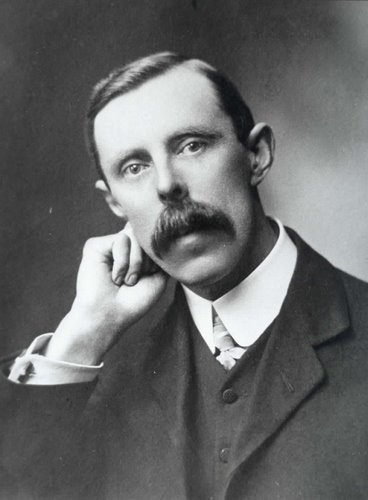
Frank William Boreham 1871-1959

Frank William Boreham 1871-1959
A photo F W Boreham took of himself in 1911

Friday, March 16, 2007

Boreham and the Lamplighter

The following is the text of an essay by F W Boreham that appeared in a brochure distributed by the British and Foreign Bible Society [now The Bible Society].

A LAMPLIGHTER

By the Rev. F. W. Boreham, D.D.

How heartily and incredulously Harry Walsh would have laughed if some little bird had whispered in his ear that, in centuries to come, men would speak of William Tindale as a grave and austere scholar, a stern and gloomy reformer, a severe and unbending controversialist! And Humphrey Monmouth would have felt very similarly. For Harry Walsh, a sunny little fellow of six, living at Little Sodbury, and Humphrey Monmouth, an alderman and well-known merchant of the city of London, knew Mr. Tindale as one of the most winsome, one of the most genial and one of the most lovable of men. Their happiest hours were spent in his society. Harry was the elder son of Sir John Walsh, a knight of Gloucestershire, and Mr. Tindale was his private tutor. Here they are, sitting together beside a stile under a giant chestnut tree, surveying from this green and graceful hillside the quaint little hamlet nestling in the hollow! Harry, in all the bravery of his trim velvet suit, with silk stockings and silver buckles, is perched on the top of the stile. His tutor, a young man of thirty, of well-knit frame and thoughtful but pleasant face, with nut-brown hair and deep-set hazel eyes, is seated on the foot-step below him. A little brown squirrel eyes them suspiciously from a branch overhead and a cuckoo is calling from the copse near by. Harry carries an armful of bluebells.

"What wonderful times we are living in" exclaims Mr. Tindale, his eyes sparkling with enthusiasm. "Why, you and I ought to thank God every day, Harry, that he has sent us into the world just now! Every morning brings news of some fresh wonder!"

It was no exaggeration. The air literally tingled with sensation and romance. The world was being made all over again. The very planet was assuming a fresh shape. It was an age of thrills! One day Bartholomew Diaz gave Africa to the world; the next, Columbus presented it with America, and then Vasco da Gama unveiled India! Continents were springing up like mushrooms! And, whilst Columbus was discovering a new world in the West, Copernicus was discovering a new universe in the skies, and William Caxton was introducing a new age with his printing presses! It was the age, too, of the Renaissance and the Reformation!

"What wonderful times we are living in!" exclaimed Mr. Tindale, partly to himself and partly to his young charge perched on the rustic stile. Harry's golden hours are the hours that he spends rambling across the fields or through the woods in Mr. Tindale's delightful company. For he knows that, as soon as they warm to their stride, his tutor will tell him the latest wonder of which the coach from London had brought word.

He goes to London
All things come to an end, however, as Harry discovers to his sorrow. As long as he lived he always declared that the deepest shadow that darkened his happy boyhood was his tutor's resignation. He never forgot the evening on which Mr. Tindale told him that he must leave Little Sodbury.

The candles having been lit, Mr. Tindale, as is his custom, read to the two boys—Harry and Richard—a few verses from his Greek Testament, translating and commenting as he goes along.

"We must read our favourite verses tonight," he had said, with a smile of singular sweetness in which, however, a suspicion of sadness seemed to linger. The boys know exactly the passage to which he refers. They know how dear to him are the verses that he has taught them, too, to love.
"You are of God, little children," he begins, and reads on till he comes to the words We love Him because He first loved us." Those words, he used to tell the boys, were the pearly gate through which be entered the kingdom.
"I used to think," he said, "that salvation was not for me, since I did not love God; but those precious words showed me that God does not love us because we first loved Him. No, no; we love Him because He first loved us. It makes all the difference!"
The familiar passage having been read once more, Mr. Tindale tells them that he is leaving them. The boys are soon in tears and the tutor's voice is husky.

“But why,” demands Richard, in a passion of childish grief, "why must you go?" He draws them to him and attempts to explain.
“I must go," he says quietly, "because I have found the work that God has sent me into the world to do. You have heard the things that have been said at dinner. Great and wise men, even preachers and prelates of the Church, come to dine with your father and mother, and say things that they could not possibly say if they knew aught of the Scriptures. If learned doctors and eloquent preachers are so ignorant of the Divine Word, is it any wonder that the people are it in darkness? A new day is dawning, the people are reading and thinking , it is time they had the Bible in their own tongue; and so, as I told your father and Doctor Hampton at dinner last night, I have resolved that, if God spare my life, I will cause every ploughboy in England to know the Scriptures better than the priests and prelates know them now; but it cannot be done here. I must go to London, and there, I trust, Bishop Tunstall will counsel and assist me." And so, after taking a sorrowful farewell of the household at Little Sodhury, Mr. Tindale turns his face towards London.

He becomes an Exile
But London receives him with a scowl. He soon discovers that he has poked his hand into a hornet's nest. On his first appearance at the palace, the Bishop gives him the cold shoulder; and, when he persists in his overtures, he is threatened with all the thunderbolts that the Church can hurl. By every ship that glides up the Thames, the writings of Martin Luther are being surreptitiously imported into England, and men are being hurried to prison and to death for reading them. The disappointed young tutor never dreams that, in centuries to come, his statue will hold a place of honour on the Victoria Embankment, and that, at its unveiling, princes and peers will bare their heads in reverence to his illustrious memory

And yet, while Church and State frown upon his project and eye him with suspicion, those who come into intimate touch with him are captivated by his charm. From his old employer at Little Sodbury he brings letters of introduction to some of the merchant princes of the metropolis, and in their homes he soon becomes a loved and honoured guest. With Alderman Humphrey Monmouth he stayed for more than six months. On week days he worked quietly at his translation. "But," as an old chronicler says, "when Sunday came, then went he to some merchant's house or other, whither came many other merchants, and unto them would he read some one parcel of Scripture, the which proceeded so sweetly, gently and fruitfully from him that it was a heavenly comfort to the audience to hear him read the Scriptures. He particularly loved the writings of St. John." Harry and Richard Walsh must have smiled knowingly if that last sentence ever came under their notice: "He particularly loved the writings of St. John." They would see again the glowing face of their old tutor and hear him repeat with rapture the words: We love Him because He first loved us.

Two things, however, are now clear. The first is that the people of England are hungry for the Word of God in their mother tongue; the second is that it is out of the question to attempt such a publication in London. This being so, he must brace himself for another painful wrench. Tearing himself from the homes in which so many delightful hours have been spent, he sets sail for the Continent.

He Translates the Scriptures into English
And on the Continent he knows of at least one kindred spirit. Martin Luther is hard at work translating the Scriptures. "Would to God," Luther cried, "that this book were in every language and in every home!" Mr. Tindale decides to hasten to Wittenberg and talk things over with the man who was shaking the very foundations of Europe. It is a pity that we have no classical painting of their historic meeting.

Luther and Tindale! The German Bible of today is the most enduring and most glorious monument to Martin Luther; the English Bible of today is the most enduring and most glorious monument to William Tindale! And here, in 1524, we see the two men spending a few memorable days together!

The rest of the story is well known. We have all chuckled over the way in which Tindale outwitted his old antagonist, the Bishop of London. The New Testament in English is at last complete. But how is it to reach England? The ports are closed against it! The book is contraband! Yet, in crates and casks and cases, in boxes and barrels and bales, in rolls of cloth and sacks of flour and bundles of merchandise, the Testaments come pouring into the country!

“Very well!" retorts the Bishop, "if we cannot ban the books, we'll buy the books and burn them!" He does so, only to discover, as soon as the flames of his famous fire have died down, that, in buying them, he has provided Tindale with the wherewithal to print a larger and better edition!

We have all experienced the thrill of this brave adventurous career. He was harassed; he was excommunicated; he was driven from pillar to post; he was hunted from country to country; he was shipwrecked he was betrayed; he was imprisoned; he was tortured; and, at last, he was sentenced to a shameful death.

And we have all felt the pathos of that last letter of his. He is still in the prime of life; but he is worn out and decrepit. Lying in his damp cell at Vilvorde, awaiting the stroke that is to emancipate his soul for ever, he reminds his friends that the date of his execution has not been fixed and that winter is coming on. "Bring me," he begs, "a warmer cap, something to patch my leggings, a woollen shirt, and, above all, my Hebrew Bible!"
"Above all, my Bible!

The words are eminently characteristic. He lived for the Bible; he died for the Bible; and he mounted the scaffold, and, looking forward into the future, he saw the time when the Bible would be read in every city, town and village throughout the land.

Tindale died a martyr's death on 6th October, 1536, and at the four hundredth anniversary of his passing we do well to honour his glorious memory.

BRITISH AND FOREIGN BIBLE SOCIETY
146 QUEEN VICTORIA ST., L.C. 4
GREAT BRITAIN
No. 686 June 1938

Source: This essay is a slight adaptation of F. W. Boreham's ‘William Tyndale’s Text’, A Temple of Topaz (London: The Epworth Press, 1928), 262-272. [Tyndale is the spelling used in this essay while the brochure uses Tindale].

Image on pamphlet: The Manor House, Little Sodbury, where Tindale was tutor.

Thanks to Michael Dalton for sending me a copy of this pamphlet.

Wednesday, March 14, 2007

Boreham Book Contest

Your Chance
Here’s you chance to win a free, postage-paid copy of Lover of Life: F. W. Boreham’s Tribute to His Mentor. This is the new book published by John Broadbanks Publishing.

John Broadbanks publisher, Michael Dalton says: “The word “romance” comes to mind when I think of Boreham’s writings. He has such a wonderful and fanciful way of expressing himself. Though this might be considered a religious book, I think that anyone could appreciate the winsome spirit in which he writes.”

“This is a story of how one man played a pivotal role in the life of a young minister starting out. There are lessons here for everyone.”

Your Task
All you have to do to win a copy is tell the publisher in your own words what books or authors have meant the most to you and why. If you are familiar with Boreham’s writings, let us know what they have meant to you. Anyone can enter.

The entry (or entries) we like the most get a free copy of the new Boreham book.

Timetable
Just submit your entry by the end of March. Our favorite entries may be posted on line along with the name of the winner (or winners) at The Official F. W. Boreham Blog Site: http://fwboreham.blogspot.com/.

You can send your entries directly to:

Mike Dalton
2163 Fern Street
Eureka, CA 95503
Email address: dalton.michael@sbcglobal.net

Boreham and The Total Eclipse

I am grateful to Jeff Cranston who has sent me his reflection on a recent television program which recalled for him, F. W. Boreham’s essay on The Total Eclipse [this follows].

The Discovery Channel recently stepped into the realm of the fantastic, claiming through its recent broadcast, The Lost Tomb of Jesus, that the graves of Jesus Christ and his family have been uncovered.

The program was watched by over four million viewers, the highest ratings for the network since September 2005.[1] The New York Times stated in a review entitled, Leaning on Theory, Colliding with Faith:

“The documentary, which carries the seal of approval from its executive producer James Cameron (‘Titanic’), has already caused some ado, however, with bold assertions that clash with conventional Christian doctrine. Jesus was married to Mary Magdalene and had a son, Judah, according to the filmmakers. And all three were laid to rest in a family tomb that is now buried deep beneath a Jerusalem apartment complex. And, of course, the filmmakers’ claim that they identified the burial remains of Jesus of Nazareth — including traces of DNA — suggests that he was not bodily resurrected, after all.”[2]

In recent days the propositions of these claims have been met with skepticism and opposition from scholars of all stripes. Historians and archeologists, Christian and non-Christian, have called into question everything surrounding the fanciful assertions of the producers.

Dr. Jodi Magness, an archaeologist at the University of North Carolina at Chapel Hill (USA), expressed irritation that the claims were made at a news conference rather than in a peer-reviewed scientific article. By going directly to the media, she said, the filmmakers "have set it up as if it's a legitimate academic debate, when the vast majority of scholars who specialize in archaeology of this period have flatly rejected this," she said.[3]


This reminds me of F. W. Boreham’s essay, “A Total Eclipse” in his book Dreams at Sunset. He relates a fictional story about a man caught in a web of financial bondage who treks off to the Middle East, purportedly discovering a tomb containing the words of Joseph of Arimathea which relate that he took Jesus' body and hid it in the tomb. In a matter of weeks, the resurrection of Christ is soon pronounced a hoax. The indebted man has created this hoax to pay off his debt to a powerful man who wanted to destroy Christianity. As the news spread around the world, Boreham wrote, "Those whose religion is of the formal, superficial kind abandon it; the bubble has burst; they feel ashamed of their gullibility.”


Similar sentiments have been echoed in recent days as many read about the find of the ossuary supposedly containing the bones of Christ. Someone once said, “The more things change, the more they stay the same.” As we face yet another heresy storming the gates of Faith, Boreham’s essay reminds us that the Scriptural account of Christ’s’ resurrection is an anvil that has worn our yet another hammer.


A Total Eclipse by F. W. Boreham

AMONG the minor sensations of the nineteenth century were the thrillers of Guy Thorne. His most dynamic and explosive production, When It Was Dark, was proclaimed as the most daring and original novel of the period, and enjoyed the distinction of being glowingly commended by the Bishop of London from the pulpit of Westminster Abbey.

I

It tells how Constantine Schuabe, a millionaire, loathing Christianity with a venomous hatred, resolves, at any cost, to destroy it. Discovering that Professor Sir Robert Llwellyn, the most brilliant antiquarian and archaeologist of his day, is leading a double life and is up to his ears in debt, Schuabe cultivates his acquaintance, lends him fourteen thousand pounds, and, shortly afterwards, demands repayment under penalty of having the whole vile story of Llwellyn's private life exposed.

Whilst Llwellyn is grovelling at the feet of the plutocrat, begging for time, Schuabe startles him by remarking that it would be easy for him to wipe out the debt and become a wealthy man. How? Schuabe tells Llwellyn that he must, on the excuse of ill-health, get a year's leave from the British Museum; he must then go to Palestine and discover that the record of the Resurrection is just a pious fraud.

Backed by his unimpeachable reputation, his verdict will be readily accepted, and Christianity will be an exploded myth. What could be more simple?

II

A few months later the world learns with speechless amazement that a new cave has been unearthed in the Holy Land. It contains a slab inscribed, 'I, Joseph of Arimathea, took the body of Jesus from the tomb and hid it in this place.' On a ledge nearby a slight mould is spread, probably all that remains of a decomposed body.

The announcement creates a sensation such as the nation has never previously known. Llwellyn's name carries weight. Press, Parliament and people are alike dumbfounded. Stocks and shares collapse. With the decline of public confidence, commerce is reduced to stagnation and industry is paralysed. Bankruptcy and unemployment become the order of the day. Depression reigns everywhere.

When Cyril Hands, whom Llwellyn had employed to do the spadework of the expedition, returns to England, he is overwhelmed by remorse. A servant finds his body on the hearth rug: a newspaper, with its terrifying columns of wretchedness, desolation and ruin, is clutched in his dead hand.

Those whose religion is of the formal, superficial kind, abandon it: the bubble has burst: they feel ashamed of their own gullibility. But there are others. In churches, chapels and mission—halls up and down the country, there are thousands of simple souls whose personal experience of the Saviour's transforming grace has been so vivid, so profound and so convincing that the wave of unbelief fails to affect them.


Among these immovable optimists is Gertrude Hunt, the pretty dancing-girl with whom Sir Robert Llwellyn had become involved. Just before Llwellyn's departure for Palestine, she was taken ill. To Sir Robert Llwellyn's ineffable disgust, Basil Gortre, a young curate visited her, leading her to repentance and faith.

Later on, her sickness having taken a more serious turn, she confronts the bombshell in the newspaper. But it makes no difference. How, with a life as radically changed as hers had been, can she possibly doubt?

Later still, strange thoughts occur to her. Llwellyn was given leave to go to Palestine on the grounds of failing health; yet she, who knew him so intimately, saw no signs of weakness. Why, too, did he brag, before going, that he would startle the world by his discoveries? And why, instead of worrying about his debts, as he used to do, was he now so affluent and reckless of expense?

Moved by a sudden inspiration, she goes to him, pretends that she is tired of being good, and wants everything to be as it once was.

In the surprise of this unexpected denouement, he flings to the winds the forebodings that have increasingly oppressed him, and, in a burst of half-drunken confidence, tells her everything.

As soon as Gertrude leaves him, Llwellyn realizes the enormity of his indiscretion. To relieve his own mind of the intolerable agony, he rushes to Schuabe, the millionaire, and confesses his incredible folly. The two men stare aghast at one another. What is to be done? Nothing can be done: for Gertrude has gone straight to Basil Gortre, the curate who had been the instrument of her regeneration, and put it in his power to hurl into the world a second bombshell.

The general relief is indescribable. Humanity is emancipated. But in the universal rejoicing the principal actors in the drama have no share. Gertrude dies of the malady that has so long afflicted her. Llwellyn, wretched beyond words, completely collapses and passes away whilst confessing to his wife his sordid infidelity. And Schuabe, his immense fortune wrecked by the depression that he has himself created, loses his reason and vanishes from sight. But the world at large is once more bathed in the brightness of the Easter triumph.

F. W. Boreham, ‘A Total Eclipse,’ Dreams at Sunset (London: The Epworth Press, 1954), 27-30.


Image: Total eclipse of the sun.

[1] TV Week.com, James Hibberd, March 8, 2007.
[2] The New York Times, Alessandra Stanley, March 3, 2007.
[3] The Washington Post, Alan Cooperman, February 28, 2007.

Tuesday, March 06, 2007

Boreham on The Lightning and the Dawn

I love what my friend, Paul Windsor, had to say on his blog this week (March 5, 2007) about The Lightning and the Dawn.

I did not pick up on his title as one inspired by F. W. Boreham but when I wrote to thank him for his thoughts he replied:

“You will be interested in the fact that the lightning/dawn idea was a Boreham one (I think). I am quite sure I read that ‘dawn’ idea in one of his books and experienced a burden lifted as I did so.”

I, too, have been greatly liberated by this thought that sometimes revelation comes to us as a Damascus Rd. experience and at other times it comes as it did to those on the Emmaus Rd. Being myself part of the Emmaus Rd. fraternity I have found this helpful, particularly at testimony time when it often seems that the only way God works is with lightning bolts that blind us and knock us off our horses.

If you’d like to read the entire Boreham essay and sermon here it is:

-------------------------------

THE LIGHTNING AND THE DAWN

By F. W. Boreham

JUST as, in many homes, there hang companion pictures, so Jesus loved to present His parables in pairs. The Parable of the Mustard-seed and the Parable of the Leaven are obviously twins.
The kingdom is like mustard-seed which a man took... . The kingdom is like leaven which a woman took... .

Both point, in different ways, the same truth. Similarly, the Parable of the Treasure and the Parable of the Pearls are a pair, and both grew out of the selfsame custom. In the old days, before banks were dreamed of, an oriental magnate divided his wealth into three parts. The first part he secreted in some safe place, so that if he lost the other parts, it would still be available; with the second part he purchased diamonds or pearls, so that, if he were suddenly driven from his home, his possessions would be easily portable; and the third part he invested. The first and second of these partitions of wealth explain this pair of parables.

I


These two men—the man who found the treasure in the field and the man who sought the goodly pearls—represent two familiar types of character.

We all know these men—know them even by name. The one is Mr. Stay-at-Home: the other is Mr. Gad-about. The one finds his treasure in his own field: the other wanders over the world in search of his. They stand in striking contrast the one to the other; yet each is excellent in his own way. The one cleaves to the centre: the other reaches out to the circumference.

We all love the man who finds his sweetest happiness at home. His field, as in this case, may be only a rented field: the man in the parable has to sell all that he possesses to make it legally his own: but, to him, there is no place like it. He loves every blade of grass that grows there.

He represents the men who have no desire to wander. He goes through life crooning to himself that there is no place like home. No woman like his wife; no children like his children; no village like his village; no farm like his farm; no church like his church; no minister like his minister. We smile at his frailty; but it is a very lovable frailty; and, as in the parable, it invariably rewards him with wondrous treasure.

Moreover, it has meant much to the world at large. It is the foundation of all the finest patriotism. Civilization is based on the attachment of the peasant to the soil. An Englishman's love of England is, first of all, his love for that little bit of England in which he was born. Lecky, Macaulay, and all the great historians insist that the most heroic and chivalrous virtues have been displayed by men who were moved, not primarily by their devotion to an empire, but by their passionate fondness for a certain city or town. Men died for Athens rather than for Greece; for Florence rather than for Italy. All these men found their treasure in their own fields.

But the man who travels widely in search of his pearls also represents a type. If the first man represents a divine content, this man represents an equally divine discontent. He is the father of all adventurers, all discoverers, all inventors, all explorers. Take Livingstone, for example. It is just as well that most men are content to settle down to the task that lies nearest to them, working out their modest destinies without bothering their heads about the distant and the unexplored. But it is also well that each age contains a few adventurous spirits who feel themselves taunted and challenged and dared by the great unknown. They are restless and ill at ease as long as there is a sea uncharted, a mountain unclimbed, a desert uncrossed or a forest untracked. It is the most sublime form that curiosity ever assumes.

From the moment of his landing on African soil, Livingstone was haunted, night and day, by visions and voices that came to him from out of the undiscovered. He tried hard, and he tried repeatedly, to settle down to the life of an ordinary mission station. But it was impossible. The lure of the wilds fascinated him. He built three houses and left each of them as soon as it was built. The stories that the natives told of vast inland seas and of wild, tumultuous waters tantalized him beyond endurance. The instincts of the hydrographer tingled within him. He saw the three great rivers—the Nile, the Congo, and the Zambesi—emptying themselves into three separate oceans; and he convinced himself that the man who could solve the riddle of their sources would open up a new continent to the commerce and civilization of mankind. Like the merchant-man who sought the goodly pearls, he therefore became a nomad, a wanderer, a gipsy. The world has been wonderfully enriched by the lives of men who, like the man who found his treasure in his own field, have made the most of what they already have; but it also owes an incalculable debt to the men who, turning their backs on all that has been acquired, set out in search of fresh realms to conquer.

II

These two men represent two types of spiritual experience. The man who found his treasure in the field represents the people who enter the Kingdom of God without seeking it: the man who found the pearl of great price represents the people who enter the Kingdom as a result of a long and patient and tireless quest. The man who turned up the gold with his ploughshare had never once thought of treasure; the man who wandered about the world in search of pearls had thought of nothing else.

The first of these men represents the class to which Paul belonged. Whilst, in persecuting mood, he made his way to Damascus, `suddenly there shined round about him a light from heaven and he fell to the earth and heard a voice saying' And so on. It came upon him as abruptly as a flash of lightning. It is often so. Men plough their common fields as ploughmen should, and the hidden gold appears! Shepherds are watching sheep as shepherds should; and, suddenly, they hear the angels sing! Scientists are watching stars as scientists should, and all at once they see the star that leads to the Light of the World! Fishermen are fishing as fishermen should, when, all unexpectedly, a Stranger comes down to the shore who bids them leave their nets and fish for men! A Customs officer goes down to his office, and, whilst seated at his desk, hears the resistless challenge of discipleship, the clarion call of destiny! The man who faithfully follows his allotted path may at any moment find other worlds impinging upon this! He may turn a bend of the dusty road and find himself face to face with the glory ineffable! Like crocuses that peep up through the snow, life's golden romances burst through our most frigid commonplaces! In the most unlikely places the hidden hoards lie buried.

The second of these men represents the class to which Bunyan belonged. Both in The Pilgrim's Progress and in Grace Abounding the way of salvation is a long and tortuous one. Mr. Spurgeon used to tell of an old fish-wife who, staggering home with her load of fish, was confronted by a youthful evangelist who saw an opportunity of dropping a word in season. 'Ah!' he exclaimed, `here you are coming along with your burden on your back; let me ask you if you have got another burden, a spiritual burden.' `What!' she asked, `do you mean that burden in John Bunyan's Pilgrim's Progress? Because if you do, young man, I got rid of it many years ago, probably before you were born. But I went a better way to work than the pilgrim did. The evangelist that John Bunyan talks about was one of your parsons that did not preach the Gospel, for he said, "Keep that light in thine eye, and run to the wicket gate." Why, man alive! that was not the place for him to run to. He should have said, "Do you see that Cross? Run there at once!" But instead of that, he sent the poor pilgrim to the wicket gate first, and much good he got by going there. He got tumbling into the dough, and was like to have been killed by it.' `But did not you,' the young man asked, `go through any slough of despond?' `Yes, I did, but I found it a great deal easier going through with my burden off than with it on my back.'

In telling the story, Mr. Spurgeon used to say that `the old woman was quite right. John Bunyan put the getting rid of the burden too far off from the commencement of the pilgrimage. If he meant to show what usually happens, he was right; but if he meant to show what ought to have happened, he was wrong'. That is precisely the point. There are those to whom salvation comes like a flash of lightning and there are those to whom it comes like a gradual dawn. And the two men in this pair of companion parables represent those two classes.

III


These two men represent two types of conversion.

In the one case there is the joy of a great surprise. I do not know how long it took to make the world. I only know that it can be made all over again in twenty seconds. If you have any doubt about it, ask this man—the hero of the Master's treasure story. You should have seen him just ten seconds before the ploughshare scattered the coins all over the freshly turned furrow; and you should have seen him ten seconds afterwards. Ten seconds before, life was as drab as drab could be. He was pursuing the same old round, following the same old dreary routine. Same old field; same old furrows; same old oxen; same old plough! Up and down, round and round; it was as monotonous as anything could be. And then, just as he was wondering how much longer it must last, there was a jolt and a swirl and a glint and a glitter, and the soft brown sods were all sprinkled with gleaming gold! He stoops and finds that there is more and more and more! So swiftly does the romantic emerge upon the commonplace!

In the other case there is the rapture of ultimate success. The long, long quest is over: the pearl of great price has been found!

In one respect they are both alike. Each sells all that he has—the one to buy the field, and the other to buy the pearl. And each parts joyfully with his old possessions. Augustine tells how, in the days before his conversion, he surveyed all the delights that he would be compelled to surrender if he became a Christian: and then he describes the ecstasy with which, on finding the Saviour, he parted with them all. It is true that, in order to enjoy the Father's home, the prodigal must surrender his husks; it is true that, in order to enjoy the life of a free man, the prisoner must give up his chains. But, amidst the gladness of his home-coming, what prodigal ever sighed for the poor satisfactions of the far country? And, amidst the luxuries of liberty, what prisoner hankers for his cell? The treasure found in the field, and the pearl of great price, compensate a thousand-fold for all that must be sacrificed in order to secure them.

F.W. Boreham, ‘The Lightning and The Dawn,’ Boulevards of Paradise (London: The Epworth Press, 1944), 172-177.


Image: Photo taken by FWB at Wedge Bay, Tasmania. In the moonlight. Approaching the dawn.

Boreham Imbibing Liquid Spirituality

I was just making a cup of tea (pictured) and I remem-bered what Dr. Boreham’s son told me on one of my many visits to his home.

Frank Boreham (jnr) said:

“My father was a great tea-drinker. He always loved to drink two big cups of tea and he would pour the two of them out at the same time and put the saucer over the second cup, rather than letting the tea continue to stew in the pot.”

This remembrance may not have much value but it reminds us that FWB, like many writers, was an avid tea drinker. His proper processing of the tea rather than using tea bags (they were available then but not so popular) suggests how refined a person he really was!

It’s interesting the details that flow to mind, especially when you are a tea drinker and a tea collector!

Further reflections on Boreham and tea, while you are waiting for your tea to draw, can be found at Boreham and the God of the Cup of Tea and for more, do a search (top left of the blog) on all the references on the Boreham site to ‘tea’.

Geoff Pound

Image: Time for a cuppa!

Boreham Continues to Inspire

It is interesting the number of people who continue to draw on the writings of F. W. Boreham in their own writing and reflection.

Check out the recent article by Dr. Andrew Corbett, who is based in Boreham’s old stamping ground of Tasmania, Australia.

The web reference is Andrew Corbett: The Discipline of Art.

Thanks Andrew for permission to make this posting.

Geoff Pound

Image: FWB taking time out from reading and study to be with his wife, Stella.

Monday, March 05, 2007

Boreham and the Doke Connection

Readers of Frank Boreham’s newly republished book, Lover of Life, will get to know the story of his mentor, J.J. Doke. After establishing this friendship in New Zealand, Doke went to South Africa.

The New Zealand Baptist Union in 1962 invited Doke’s daughter, Olive Doke to visit and tell her story. In this article she shares some fascinating glimpses of F W Boreham, her father and her own adventures in Africa:

Like Coming Home
My first words must be those of grateful thanks and praise to God for all His goodness to me in bringing me to this land again. Here I have been so warmly welcomed by Christian friends that I feel it is like coming home. It may be of interest to hear something of the happenings of the intervening years.

It was during my father's pastorate at Oxford Terrace that I gave my heart to the Lord at one of the Rev F. W. Boreham's missions, and even at that early age dedicated my life to missionary service. Shortly after this we went as a family back to England, where in 1903 my father had a "call" to the Grahamstown Church in South Africa and later to the Central Church in Johannesburg.

Pioneeering
My missionary call came whilst here to serve in Central Africa, and in 1916 I joined my brother Clement at Kafulafuta in the Ndola district of Northern Rhodesia, then as yet unopened up. He had already been there two years, having been sent up as the first missionary of the South African Baptist Missionary Society (who had taken over the work from the pioneer Nyasaland Industrial Mission), after the death of my father, the Rev J. J. Doke, following a journey to investigate the possibilities for the S.A.B.M.S, to extend their missionary programme. The work was still in the pioneer stages, and a great deal of "trekking" had to be done, involving long journeys of hundreds of miles on foot through the African forest infested by wild animals of every description. It was still the days of primitive travel with native porters carrying the necessary camp equipment and barter goods. One had to depend on one's rifle to secure meat for the pot, as well as to buy meal for the carriers. The country inhabited by the Lamba tribe, extended over 30,000 square miles of forest—and this was our parish!

The Language
The first thing was to learn the language and as there was no written one it had to be reduced to writing by the early missionaries. Journeys were invaluable for language, being out amongst the people. The Message was delivered, falteringly at first, in every village passed through, and as time went on there were little groups of converts, or rather those who were willing to hear more, with whom we stayed longer on subsequent journeys to teach and help them on the way.

As soon as we had sufficient grasp f the language, translation work was tackled and in 1921 the first edition of the New Testament was in print. From the beginning we had a boarding school on the station for the teaching of reading and writing. This work later grew to big proportions with out-schools dotted all over the country preparing the folk to be able to read for themselves the Word of Life. Translation on the whole Bible was finished in 1957 and in 1960 we were able to put it into the hands of the people with humble praise and thanksgiving that we had been privileged to complete this great and responsible work.

The Church
Meanwhile there was the gradual building up of the Lamba Church as the Holy Spirit worked in the lives of these people. There have been wonderful trophies of grace and strong and dedicated leaders have emerged who are now able to shepherd the flock. A New Testament Church is established under the leadership of the Nationals whom God has called out; and it in turn is going out to others. Church government and finance is in the hand of the African himself, and God is blessing the work. There has been medical work going on through all the years, sometimes under most difficult circumstances, but now on the two European stations there are hospitals with trained staff, yet the need is greater than we can cope with. Work among the lepers will be more efficiently done when the leper station is established.

Education and Evangelism
A boarding school for girls functions at Kafulafuta and for boys at Fiwale Hill—these are invaluable for the training of the future generation of leaders. The evangelistic work in the villages is now carried on by the African evangelists themselves and much more effectively than can be done by the European. Our task is in the Bible school teaching the leaders and workers how to use the sword of the spirit, which is the Word of God. The two ordained ministers are doing a grand work as they have the oversight of the many village churches. They still need much teaching and the Bible school is to some extent meeting this need with its 30 students doing a three-year course. As on every field, increased staff is needed—may He thrust out labourers into His harvest field.

His Power
It has been a wonderful experience to see the gradual working of the power of God through His Holy Spirit in the lives of those with darkened minds and hearts, and to witness their awakening. To God be the glory, great things He hath done. "Not I, but Christ."

O. C. DOKE. M.B.E

P.S.—It has been a great experience to have the fellowship of the Baptist Assembly and to meet the Baptist stalwarts of New Zealand, and I thank you all for the way in which you have included me in your company and made me feel one of you.

Source: N.Z. BAPTIST—JANUARY, 4 1963 page 4.

Image: “long journeys of hundreds of miles on foot through the African forest.”

Sunday, March 04, 2007

An Interview with F. W.Boreham

This article is the result of an interview by J. S. A. Worboys with F. W. Boreham in 1923. It was first published in London’s Sunday at Home Magazine.

We are privileged to print in most numbers of THE SUNDAY AT HOME an article by F. W. Boreham. Mr. Boreham is one of the most brilliant of living essayists, and his work, as we know, has been of great help and stimulus to many of our readers. Collected in due course into volumes, these articles are ministering to ever - widening circles of admiring and grateful readers. Mr. Boreham, though English-born, left these shores twenty-eight years ago, and has lived throughout that period in New Zealand, Tasmania, and Australia, and his personality, except through his articles and books, is not familiar to us on this side. On these grounds we are confident that the article which follows will be welcomed by our readers. Ed.

NO sooner had we touched the latch of the garden-gate of Wroxton Lodge than the front door opened, and, hastening down the garden path, smiling welcome and right good-will, came my friend and former "chief" the Rev. F. W. Boreham.

It was characteristic—that welcome! To all his friends Mr. Boreham is a friend, full-hearted, unconventional, self-forgetful, the soul of friendship and courtesy. Popularity and fame have not made him one inch taller than he is! (True sign of a big man.) He may have traveled far ahead of his friends on the road of achievement, but he walks with them side by side on the road of friendship.

About ten years ago it was my privilege to be associated with Mr. Boreham in Tasmania as assistant minister. I was then not much more than a boy, quite inexperienced, a 'prentice hand at every part of a minister’s work. Now I suppose there is nothing which shows up more quickly and surely the weakness or strength of a man's character than his dealings with his subordinate. Well, from the first, Mr. Boreham treated me as a colleague and friend, and never once was I made to feel the "assistant" part of the relationship in the odious sense of that word.

I have by me a gift-copy of The Luggage of Life, which is inscribed as follows: "To my colleague and friend ... as a slight memento of a year's happy comradeship." "Colleague and friend"—that was how he treated his assistant and understudy! “A year’s happy comradeship”—that was what he made our relationship to be. I went to his home again the other day, after nine years' absence, and found him unchanged—a man with a genius for friendship, one of God's, own gentlemen.

As Mr. Boreham came down the garden walk, I caught sight of the inevitable button-hole of flowers. Morning, noon or night, weekdays or Sundays, at home or at church, reading, writing or preaching, it matters not when or where you see him Mr. Borcham always wears a button-hole! There seems to be but one exception—when he goes to a photographic studio. That exception is a mystery and an offence that his friends find it impossible to explain and difficult to forgive, If, for no other reason than that they invariably show the button-hole, I prefer snapshots of Mr.Boreham to the most finished studio portraits.

After tea we retreated to the study. It was there that I acquainted Mr. Boreham with the fact that the editor of THE SUNDAY AT HOME had commissioned me to interview him with a view to this article.

“I don't envy you your job!" was Mr. Boreham's laughing reply. "You won’t have much to write about! I wish you had a better subject."

The interviewer, however, did not feel in the slightest degree in need of sympathy on that score. The wealth of material is his only embarrassment.

"Well, there are the bare facts!" Mr. Boreham, at last convinced that I was in earnest, handed me a biographical portrait of himself, printed in an English paper some years ago. "The bare facts!" They were very bare. It only proved that a man is infinitely bigger and more interesting than his biography. But still, the bare facts, however bare, are facts, and make at any rate a sort of frame in which to put the living picture of the man.

“The bare facts" are that Mr. Boreham was born at Tunbridge Wells, Kent, England—the eldest son of a large family. His parents were both devout members of the Church of England (as indeed they still are) and Mr. Boreham cherishes the memory of the days when, as a boy, the family pew at church used to be filled every Sunday. He still possesses the Prayer Book he used to use in those early days. In season and out of season he speaks with gratitude of his father and mother: it was to them that his first book was dedicated.

From Tunbridge Wells, Mr. Boreham went up to London to launch out, as he then thought, upon a commercial career. But while in London he became associated as a lay-helper with the London City Mission, and, responding to the call to the ministry, was admitted to the Pastor’s College in 1892 as a student for the Baptist ministry. Mr. Boreham cherishes the conviction that he was perhaps the very last student whose admission to the college was decided by the college founder himself, the late C. H. Spurgeon.

In 1894, on the recommendation of the Rev. Thomas Spurgeon, Mr. Boreham left England to take the oversight of the church at Mosgiel, New Zealand. His pastorate at Mosgiel extended over twelve years and was in every way eminently successful. Mr. Boreham himself is never tired of acknowledging the debt that he owes to Mosgiel. In all his books there are stories of Mosgiel things and Mosgiel people.

"The little place," he says in one of them," must always be to me a riot of memory. I have sometimes wondered whether, during the twelve years that I spent there, I missed any strange experience that might conceivably have come my way. In looking back across the past at that first pastorate of mine, it really seems to me that, from being summoned to attend a shuddering felon on the gallows to being commissioned by a bashful lover with the responsibility of proposing to a blushing maid on his behalf, I tasted every pain and pleasure, sounded every deep and shallow, of the ministerial life."

In the quiet manse among the farms Mr. Boreham made his first literary ventures. He conducted a weekly column in the local paper and another in the city paper a few miles away. In 1896 [it was 1899-1906] he became editor of the denominational journal; and many of the essay's that are now appearing in his books were first drafted in those secluded days. He was Mosgiel’s first minister and they were his first people. "I spent twelve happy years among these simple but sturdy souls," he says, "learning at their hands to be a minister of the Everlasting Gospel." In 1902 he was called to the chair of the New Zealand Baptist Union, and in 1903, with his wife and children, visited Great Britain.

From New Zealand, Mr. Boreham went to Tasmania to become the minister of the Hobart Baptist Church, the leading Baptist church in the island. As secretary of the Free Church Council for Hobart and President for the whole of Tasmania, Mr. Boreham served a great ministry beyond the limits of his own denomination, of which also he became President in 1910.

It was while at Hobart that Mr. Boreham began to publish those volumes of essays which have made his name so widely known not only through the Commonwealth, but, also in England and America. Up to the present there are eleven volumes in the series: The Luggage of Life, Mountains in the Mist, The Golden Milestone, Mushrooms on the Moor, Faces in the Fire, The Other Side of the Hill, The Silver Shadow, The Uttermost Star, A Reel of Rainbow, The Home of the Echoes, and Shadows on the Wall. Two other volumes by Mr. Boreham, A Bunch of Everlastings, and A Handful of Stars are of a distinct character, dealing with great Bible texts in a unique way.

With the later ones of these volumes we come across Bass Strait from Tasmania to Melbourne, where, for the past six years Mr. Boreham has been the minister of the Armadale Baptist Church.

So much then for the bare facts. It is time we got nearer to the man himself. But first a peep into his home! In his home Mr. Boreham is singularly happy. He won his wife in his student days and she—a lassie in her teens—voyaged alone from her village home in Epping Forest to the remote solitudes of New Zealand to be the mistress of the newly-erected Mosgiel manse. She loves to talk of Grannie, Wullie, Peggy, and all the other Mosgiel folk with whom her husband has familiarised his readers. The people at Mosgiel, Hobart and Armadale have all been very fond of her. The latest published report of the Armadale Church says that "the prestige of the manse has been faithfully preserved by Mrs. Boreham, who always has a smile for young and old, and is ever ready to do with her might what her hands find to do." It is easy to see at a glance that to Mr. Boreham himself her comradeship is one of life’s choicest joys. They have five children—four girls and a boy.

Everybody who knows anything at all about Mr. Boreham knows that he is not only an author, but a bookman. His own books disclose the fact quite plainly. In his essays the whole realm of literature is put under tribute. There is scarcely a corner of the field of books left ungleaned. It was natural then, that our conversation should turn to the subject of books and reading. “To buy and read at least one book a week” has been Mr. Boreham’s unbroken rule for many years. If he reads a borrowed book, which he rarely does, he immediately adds a copy of it to his library. The reason, I believe, is mainly utilitarian. Every book is read, not only for pleasure, but also with an eye open for illustrations and ideas. These are noted in the margin and carefully indexed for future use.

In a confidential manner Mr. Boreham showed me a pile of notes representing suggestions and material for several hundreds of articles and addresses waiting only to be written up! In addition to these unwritten articles, I was also shown finished essays ready for the press at the rate of one a week for at least two years.

“I still keep on writing,” explained Mr. Boreham, “at the rate of one essay a week: but nothing I am writing now will go into print in any form for at least two years. You see I keep a long way ahead of myself. There is no imperative need, of course, to keep at it so regularly, but it is all in the line of my work, and I get a lot of fun out of it. It also gives me ample time to revise and polish the manuscripts before they are published."

A question as to his plans for the future in the way of book publication led to a further surprising revelation of Mr. Boreham’s amazing fertility and productiveness. He opened another drawer and produced the finished and revised manuscripts of new volumes to he published at the rate of one a year for the next six years.

It must not he supposed, however, that these are written off at great speed, with machine-like ease. The subject and scheme of every essay are carefully thought out, and not a line is written until, after long brooding over the theme, expression comes inevitably and spontaneously as a tiring joyful process. But even then there is nothing quick or easy about it. "The essay, throughout, as a literary form is the product of careful, artistic, workmanship. Illustrations are selected; phrases coined and polished; words—especially adjectives—chosen with all insight and discrimination which makes them pictorial; time and care taken to give just the right turn to an expression, and to let the light shine upon the truth at just the right angle to reveal its beauty. Every essay is read many times—once, at least, aloud, before it is permitted to leave the author’s hands. In all these things we see genius taking pains.

But with all their polish and finish these essays are true essays—“expressions of personal emotion.” They are intensely personal documents, and alive. They are a revelation of the writer’s own character and spirit. His chivalry, his love of fun, his joie de vivre, his instinct for the centre of things which never forsakes him even at the circumference, his spirituality and sympathy, his personal loyalty to Jesus Christ, his passion for souls—these things in the writer's rich, many-sided personality are manifest in every page of the author's works.

It must also be remembered that nearly all these articles are also addresses, and were written with a congregation in view. They are not the mere literary exercises, literary hobby or literary "side-line" of a Christian minister. They are on the main line of his work. Prepared with the pulpit in view as well as the press, conceived and executed with a direct view to ministering to the full human and spiritual needs of a present day congregation, they give voice to the soul of a preacher and pastor, speak the words of a Gospel, and find their way surely to the conscience and the heart.

"How did you come to adopt your own particular style of essay?” was a- question which seemed to surprise Mr. Boreham, and one which he seemed to consider a rather extraordinary question to ask.

When he was quite satisfied as to what exactly I wanted to know, he answered: “Well, how does anyone come to write in his own particular way? I sat down to write and this is how the words came. It was my way; it fitted my thought; I enjoyed it; my readers seemed to approve of it, and so I kept on writing in that way. That is all there is to be said."

In the course of our conversation I ventured to ask, "Is it as a writer or preacher, an author or rninister, that you find the greater joy?” Without any hesitation Mr. Boreham answered, “As a preacher and minister. Of course," he added, "it is like asking a man which of his two children he loves best. I glory in my pulpit—the greatest moments of my life have been spent there—but I am scarcely less fond of my pen. I do not like to choose between them. I want to be a preacher and a scribbler to the end of the chapter."

Mr. Boreham, as I have mentioned, is the minister of the Armadale Baptist Church, one of the leading Baptist Churches in Australia. The fact of crowded congregations, drawn from all parts of the city, testify to his popularity and power as a preacher. For many years Mr. Boreham has made a practice of preaching alternating series of Sunday evening addresses during the winter months. These are always of a most striking and original character. Take for example the current series. The first is called "A Parcel of Personalities" and the second "A Casket of Cameos." The “Parcel of Personalities” contains addresses to a new-born babe, a youth just entering life, a bride and a bride-groom, a young father and a young mother, a man in the thick of things, a master and a man, a mistress and a maid, a grandfather and a grandmother. The “Casket of Cameos" is a series of biographical studies dealing with the faith of a pioneer (David Brainerd), a noblewoman (Countess of Huntingdon), a statesman (John Bright), a reformer (Lord Shaftesbury), a nun (sister Teresa), a Puritan (John Hampden), an evangelist (George Whitefield), and a merchant (George Moore.).

On Sunday mornings Mr. Boreham takes more strictly Biblical themes, but handles them in his own unique way. Some recent courses have been "The Romance of the Infant Church" (studies in the Acts of the Apostles), "The Making of a Prophet" (story of Elijah), and "The Ancient Mandate and the Modern Man" (the Ten Commandments up-to-date).

A consideration of these subjects alone gives an insight into Mr. Boreham’s popular appeal as a preacher. All the qualities that charm us in the essays are brought into the pulpit, intensified and enriched by the living presence of the preacher. In his hand; the Bible becomes a living, human, modern document, with a Divine message eternally significant and up-to-date. Throughout all his messages there is the "blood-streak" of life and experience; the truth of Christ and Scripture is shown alive in authentic illustrations drawn from real life, and the preacher himself manifestly believes what he says, feels it, knows it, lives in it.

J. S. A.Worboys, ‘F. W. Boreham: An Interview and an Appreciation,’ Sunday at Home, 111-114.

Image: Photo of first page and photo of this article.

Grateful thanks to Jeff Cranston for making this article available and Lynn Swanson for doing the scanning.

Saturday, March 03, 2007

Boreham Writings into Chinese?

I have discovered this week through Read/WriteWeb that the Chinese web site, YeeYan, translates articles from English language blogs into Chinese so that Chinese language readers can enjoy and make comments.

The goal of YeeYan is “to discover valuable contents in foreign languages and to provide high quality Chinese translations for them.”

Calling Chinese Readers
I am aware that some of the readers of The Official F.W. Boreham Blogsite are from China, Singapore, Malaysia and Taiwan. I wonder if there is a demand and an interest for articles on this web site to be translated into the Chinese language.

F. W. Boreham Publications into Chinese?
I haven’t had time to discuss this matter with my John Broadbanks Publishing partner, Michael Dalton (he is so busy responding to people’s orders for Lover of Life, which is hot off the press).

I wonder if translating Boreham's 55 books into the main Chinese languages might be the next step for taking Boreham into a new dimension?

Do let me know if you are interested in seeing (and helping to get!) Boreham books translated into Chinese.

Geoff Pound

Image: YeeYan logo

Boreham: 'One of the Best Preachers Ever'

Admirers of the preaching of F. W. Boreham might be interested to read a reference to him and other great preachers on Rowland Croucher's posting on this the birthday of FWB.


Click on this link:


http://victoriaconcordiacrescit.blogspot.com/index.html


Thanks Rowland for your stimulating and resourceful articles.


Geoff Pound


Image: A photo of F W Boreham in his early days of preaching when a preacher's coat was the order of the day.

Boreham: So It's Your Birthday!

Today, the 3rd March, is the birthday of F. W. Boreham. Without making any reference to the fact, Dr. Boreham, submitted this editorial to the Hobart Mercury, on one 3rd March and later it was published in a collection of his essays and sermons.


This is one of the essays that will be included in the forthcoming book of Boreham essays entitled The Chalice of Life, a collection in which F W Boreham deals with life at its various stages.


Every day is somebody's birthday. It is reasonable to suppose that, here in Australia, about twenty thousand people are celebrating the great event today. In every city, town and settlement in the Commonwealth:

This is somebody's birthday,
Just as sure as fate;
Some little twins are exactly two—
Some little girl is eight.
Someone is eating his birthday cake
And laughing over the plums;
Someone is counting her birthday dolls
On all her fingers and thumbs.
Someone is bouncing his birthday ball,
Or winding his birthday watch,
Someone is not too wise or tall
For birthday butter-scotch.

To all such, the birthday is a notable occasion. However long we live, we never quite lose the romance of the birthday fuss and frolic. And the very fact that each of us, of whatever age or rank, is susceptible to the birthday sentiment, forges a bond of sympathy between us all. One touch of Nature makes the whole world kin. A birthday represents that element of essential humanness which unites a monarch on her throne with the lowliest of her subjects. Each of us has a birthday once a year: each has but one; kings and queens can have no more.

Yet, when all is said and done, birthdays are mere records of time, not registers of distance. They are chronometers, not speedometers. They tell us how long we have been upon the road, not how far we have travelled.

The distinction is fundamental. It will never do to judge of our progress by the time we have taken. It will never do to suppose that because we have been many days on the highway, we have therefore covered an enormous stretch of country. It is possible, like the tortoise, to go a very short distance in a very long while.

The fact is that the soul has milestones of its own. It declines to measure its advance by any of our artificial standards. The importance that is attached to birthdays, for example, implies that my pilgrimage began at birth, and that all my progress is to be reckoned from that point. But that is ridiculous upon the face of it. The soul laughs at such an absurd method of calculation. We might as well tell a man to walk from London to Edinburgh, and begin to count his progress from York. For the soul reckons that it has got over the worst and most ticklish bit of the road by the time that birth comes about.

I am well on my way when I am born. Oh, the thrilling adventures and the hair-breadth escapes that befell me on that first stretch of the road! When I come to think of all the loves and the hates, the births and the deaths, the comedies and the tragedies, that had to take place through the long agony of the ages in order to produce me, I am astounded that I did not lose my way along that difficult and dangerous stretch of the road. When I think of what might have happened if some old forebear of mine, away back in the age of the cave-men, had taken it into his head to marry the woman whom he murdered, or to murder the women whom he married, it seems to me a perfect miracle that I got here.

When I read of the barbarous ages of slaughter and carnage and brutality through which my long line of ancestors threaded its fearsome way, it is perfectly astounding to me that not one of them got stabbed or clubbed or shot until they had duly taken their places in that long genealogical list. When I think of the wars and famines and pestilences through which those forebears of mine came unscathed, I catch my breath.

In view of all this, you will never convince me that birth was merely a starting-place. It was my first milestone; and I had got over by far the roughest and most perilous stretch of the road when I had safely passed it.

I cannot leave this subject of birthdays without reminding myself that life presents every person with two supreme and indispensable imperatives. It says: You must be born! and it says: You must be born again!
Unless he be born, he simply is not: there is nothing more to be said about him.

And, unless, having been born, he is born again, he cannot hope to see the Kingdom of God. It is the milestone that must be passed: there is no other way Home. To make the attempt would be to court the fate of poor Ignorance, who, from the heights of heaven, was hurled into the depths of hell. He had never been to the Cross; had never seen the three shining ones; had never known the rapture of being loosed of his burden. `Except you be converted and become as little children, you shall not enter into the kingdom of heaven.'

Paul never forgot the milestone that he passed on the road to Damascus. Augustine never forgot that wonderful day in his garden at Milan. Hugh Latimer never forgot that talk with little Bilney in the confessional box. Luther never forgot that scene on Pilate's staircase. Bunyan never forgot the four poor women sitting in the sun. Wesley never forgot how his heart was `strangely warmed' at Aldersgate Street. Mr Spurgeon never forgot the little chapel at Artillery Street, Colchester.

The man who has passed such a milestone is more than half-way Home, however many years he may yet spend upon the road.

F W Boreham, ‘So It’s Your Birthday!’ The Tide Comes In (London: The Epworth Press, 1958), 14-16.

Image: Birthday Blessing.

Friday, March 02, 2007

New Boreham Book Now Available!

Read the letter from Michael Dalton that so many of us have been longing for.

Click on the following link:

New Books of F. W. Boreham.

Geoff Pound

Thursday, March 01, 2007

Thou Shalt Not Steal Boreham's Sermons

In an article in 1944, J J North, the New Zealand Baptist leader, proclaimed these thoughts about the stealing of sermons and other ‘intellectual property’.

"Thou Shalt Not Steal."
That was one of the ten precepts written on granite and intended to bind in social peace the chosen people. It is the commandment that defends private property. It confronts the cattle raider, the sneak thief, the commercial thief—thieves, in short, of every breed and brood. It is very lately, indeed, that another sort of property was declared by international law to be sacred against thieves. Shakespeare has his piece about the man who steals a purse and who steals trash. He suffered himself from literary thieves who pinched his plays and told the drolleries as though their own wit had begotten them. But at long last a preacher's sermon, a poet's hymn, an author's novel argument are all alike "property." So says the law.

The Victorian writers were shamefully robbed by the Yankees. America refused to recognise literary property as property at all. When Dickens went to America with not too much money in his pockets, he found that twenty publishers had printed "Pickwick Papers," and "Boz" and the rest of his prodigious novels, and had sold hundreds of thousands of them without paying him a dollar. He invoked Sinai and called them a pack of thieves—which they were. But the law has now been tightened up, and it is international. Look at your hymnbook and see that permission was given, or secured by payment, for the publication of the best and specially of the newest hymns. Look at recent books and remark that for every long quotation from another author permission to quote has been asked for and often paid for.

Ministers have been shameless thieves. C. H. Spurgeon's penny sermons circulated by the 100,000. But local preachers and bankrupt regular preachers read them from hundreds of pulpits without a thank you. That can't be done now. Occasionally it is done.

We remember when Morrison was the last pulpit sensation that a minister of a large church gave one of his sermons verbatim. One of his elders went home, reached down the book, and was too ashamed of his minister to look up.

We have heard of Boreham being actually used by a preacher who was detected by one who was fond of our gentle friend who actually read his books. This of course is a crime. Men have been unfrocked for it. We can't expect and never get absolute originality. All people borrow from other writers. What is expected is that they shall digest what they read and treat it from their own, and not from their neighbour's standpoint.

Tell me what I knew before
But paint the prospect from thy door.

A person preaching another person’s sermon is David waddling about in Saul's armour. It never fits.

Source: J.J.North, New Zealand Baptist, May 1944, 99

Image: J. J. North. This picture is from the front cover of the New Zealand Baptist, November 1949, the time of North's retirement as editor of the Baptist.

Ruth Graham Visits Borehamland


This is a photo of Ruth Graham visiting Mosgiel in 1969. Published in the New Zealand Baptist, here is the brief report:


MRS RUTH GRAHAM (right), wife of the American evangelist, Dr Billy Graham, paid a brief visit to Mosgiel on March 8, to inspect the Baptist Church. Mrs Graham is a reader of books by the late Dr F. W. Boreham, the first Baptist pastor at Mosgiel, and she expressed the wish to visit his old church while in Dunedin.

After spending some time at the church, Mrs Graham was taken for a drive around the town. Here she is shown with a member of the church, Mrs M. McLennan (left), and Mrs
Grady Wilson, wife of Dr Graham's associate minister.

Source: New Zealand Baptist, May 1969, 11.

Boreham's Embarrassment in the Desert

F W Boreham tells this story from his travels through the Arabian desert:

One incident of the drive across the desert comes forcefully to mind today. For its water supply Arabia is largely dependent upon sea water—salt water that has been condensed. Out beside the desert road we saw the great works in which the condensing is done, with the mountains of salt standing near by. I looked at those heaps of salt and wondered. Our driver was an Arab; but fortunately he could speak English well.

‘I suppose,' I said, leaning forward and addressing him, 'I suppose that this is salt of a crude kind to be used for agricultural purposes, or something of the kind?'

‘No,' he replied, looking quite pained, 'it's beautiful salt; what's wrong with it.’

I felt very humiliated and half resolved to drop the subject; but I was still puzzled, and decided to venture once more. ‘This salt,' I said, 'will probably have to go through several processes yet before it is ready to be shipped away as table salt?'

‘No,' he answered, looking even more hurt than before, 'it's perfect. What's wrong with it?'

I felt crushed but eventually made up my mind to make one more attempt to satisfy my curiosity. ‘You must really forgive me,’ I pleaded, humbly, ‘but if this salt is such beautiful salt, how do you account for its strange browny colour?’

And then my wife, whom I always carry with me to deliver me from such embarrassments, nudged me gently, and enquired, ‘Have you forgotten that you are wearing those amber glasses?’

Indeed I had! Before setting out across the desert a friend had warned me that the glare of the sun would blind me unless I wore coloured glasses. He gave me his. They fitted so perfectly that I had forgotten that they were there; and so the salt, that was really as white as driven snow, looked brown and unclean in my sight.

And ever since that drive across the desert, whenever I hear people complaining that there is something wrong with the world, or the _____________ (fill in the gap), I have remembered my own experience with the amber glasses, and have thought my own thoughts."

Source: F. W. Boreham, Arrows of Desire.

Image: Salt in the desert

Wednesday, February 28, 2007

Boreham and His Ordination

The distinguished New Zealand Baptist leader, J. J. North, wrote this article about the ordination of F W Boreham on the fiftieth anniversary of the occasion. His article that appeared in the NZ Baptist is entitled, ‘Dunedin Fifty Years Ago and a Certain Event’:

Fifty to sixty years ago, Dunedin was the largest and most impressive city in what was then a colony. Most of the mercantile houses had their headquarters there. Earthquakes prevented their flitting to Wellington. Auckland was isolated and still stunned by Maori wars. Yet Dunedin was a small town of rough streets and horse trams and very dull street lamps, lit by men carrying poles, as R.L.S.'s Edinburgh also was.

On an afternoon in March 50 years ago there was a trek of Dunedin Baptists to their shabby railway station, en route for Mosgiel. In the group, and leading it, was the Hanover Street minister, Alfred North, that sage and evergreen H. H. Driver, a rising lawyer. A. S. Adams, and, we think, J. G. Fraser, George Calder, H. Fawcett, and William Ings were there.

The occasion was the induction of a "Spurgeon man" to the Mosgiel pastorate. He was the first Spurgeon man (we think) to invade the religious placidity of Otago. The ministers of the city were of other colleges. H.H., of course, had been a Spurgeon man. and he was very elated (we remember) by the occasion. It was a lovely autumn day, and the Taieri Plains were carpeted in the gold of harvest. The humble little church had never had a minister before. All sorts of folk drove out on Sunday mornings, behind a lamentable horse, to preach. But now a minister had come. C.H.S., the unmitred Bishop of the Baptist world, had sent F. W. Boreham, raw and untried, yet full of an adventurous faith.[1]

On the evening of March 15, 1895 the newcomer was ordained. The writer of these lines was a student in his last year, and a very curious spectator of the proceedings. We did not know, we could not know, that we were making history and that the neophyte, by reason of an adroit pencil and an observant curiosity was to write and preach his way into widespread fame. But such has been the case.

He saw what no one else saw, all sorts of poetry in Mosgiel and its folk and of course, in the Bible, and wrote it all into 20 volumes of very much appreciated essays.[2] Indeed, so popular did some of them become that wholesale thefts have occurred. We heard of an F.W.B. sermon given by an Auckland minister over IYA [radio station] without any acknowledgment at all. That, of course, might be argued as a compliment to our friend, but it was also shameless theft.

But to go back to March 15, 1895. We remember the vestry door opening and in the midst of a long array of the black-coated fraternity there strode the new man. He seemed to us to be very tall, for he was arrayed in a full dress coat, and he had a very unusual and very placid face, a face that became and becomes very animated in speech. We re-read in an old file the searching ordination address by the Rev. Alfred North, and a very competent word to the people by the Rev. M. J. B. Bennett. We still remember, though it is not in print, the eager and modest reply. People passed toward the station at the meeting's end feeling that the beginnings were most promising. So they were, and so they continued, till on an evil day for us the minister transported himself to the Continent, where the bulk of his ministry has been spent.

Our readers will be interested to know that the lady of his choice followed him from England and is still blooming. He has a son and four daughters, most of whom, naturally enough, are married. He has, therefore, grandchildren.

He sends affectionate greetings to New Zealand friends, but wrote us that John Dicker and John Outram were the only remaining officers of his first church. Alas, before the letter came, John Dicker had gone into the land o' the leal.

Dr Boreham was honoured by MacMaster University with his title. For six years now he has given dinner hour addresses to the business men of his city. We thank God at every remembrance of him. His heart has always lain in a pool of honey. Was he ever involved in a controversy? Once in Mosgiel with the Presbyterians, but never again so far as we know. He has a matchless courtesy and "wears without reproach the good old name of gentleman." We are not writing his obituary, and hope we never shall.

Source: J. J. North, New Zealand Baptist, March 1945, 51

Image: A more recent aerial view of Mosgiel with the township in the foreground and Saddle Hill (often mentioned by FWB) in the background.

[1] In the next edition (April 1945, 75) of the NZ Baptist, the editor, J J North, makes this amendment: “In our last issue we credited C. H. S. with directing F. W. B. to New Zealand. But C. H. S. died in 1892, and F. W. B. sailed for New Zealand in 1895. It was under the impulse of Pastor Thomas Spurgeon that Boreham came. . .”
[2] The editor also notes (April 1945, 75) this change: “F. W. B. pleads guilty to writing 40, not a mere 20, books, as we said. A man who does that sort of thing has something to answer for. . .

Monday, February 26, 2007

Boreham on Surprise Power

In writing about a certain lack in many sermons, F W Boreham says:

"Half the art of life lies in possessing effective explosives and in knowing how to use them.

Surprise in the Wild
In the best of his books, Jack London tells us that the secret of White Fang's success in fighting other dogs was his power of surprise. `When dogs fight there are usually preliminaries—snarlings and bristlings, and stiff-legged struttings. But White Fang omitted these. He gave no warning of his intention. He rushed in and snapped and slashed on the instant, without notice, before his foe could prepare to meet him. Thus he exhibited the value of surprise. A dog taken off its guard, its shoulder slashed open, or its ear ripped in ribbons before it knew what was happening, was a dog half whipped.'

Power to Startle
Here is the strategy of surprise in the wild. Has it nothing to teach me? I think it has. I remember going for a walk one evening in New Zealand, many years ago, with a minister whose name was at one time famous throughout the world. I was just beginning then, and was hungry for ideas. I shall never forget that, towards the close of our conversation, my companion stopped, looked me full in the face, and exclaimed with tremendous emphasis, 'Keep up your surprise-power, my dear fellow; the pulpit must never, never lose its power of startling people!' I have very often since recalled that memorable walk; and the farther I leave the episode across the years behind me the more the truth of that fine saying gains upon my heart.

Lacking Sting
Let me suggest a really great question. Is it enough for a preacher to preach the truth? In a place where I was quite unknown, I turned into a church one day and enjoyed the rare luxury of hearing another man preach. But, much as I appreciated the experience, I found, when I came out, that the preacher had started a rather curious line of thought. He was a very gracious man; it was a genuine pleasure to have seen and heard him. And yet there seemed to be a something lacking. The sermon was absolutely without surprise. Every sentence was splendidly true, and yet not a single sentence startled me. There was no sting in it. I seemed to have heard it all over and over and over again; I could even see what was coming. Surely it is the preacher's duty to give the truth such a setting, and present it in such a way, that the oldest truths will appear newer than the latest sensations. He must arouse me from my torpor; he must compel me to open my eyes and pull myself together; he must make me sit up and think. `Keep up your surprise-power, my dear fellow,' said my companion that evening in the bush, speaking out of his long and rich experience. ‘The pulpit,' he said, 'must never, never lose its power of startling people!' The preacher, that is to say, must keep up his stock of explosives. The Bishop of London declared the other day that the Church is suffering from too much 'dearly beloved brethren.' She would be better judiciously to mix it with a few bombshells.

Recapturing Wonder
If only I can renew the romance of my childhood, and recapture that early sense of wonder, the world will suddenly become as marvellous as the prince's palace in the fairy stories, and the ministry of the Church will become life's most sensational sensation."

F W Boreham, ‘The Baby Among the Bombshells’, Faces in the Fire (London: Charles H Kelly, 1916), 20-23.


Image: Explosions.

Sunday, February 25, 2007

Boreham the Romantic Minister

Contribution to the Boreham Biography
J J North was a contemporary of F W Boreham and they shared many things in common. Their personalities were very different. North could be caustic and cutting while Boreham was kindness and peace personified. J J North was never lavish in throwing out the bouquets and these reflections on F W Boreham are brimming with insight. They were published in the New Zealand Baptist newspaper in 1943:


Unknown Minister in Crude Colony
The late years of the nineteenth century are as far away from us as the flood. Three wars have intervened since our letter headings registered 1900. Hoary empires have crumbled. A hermit nation has become the pest of the East. Napoleon has been outmoded. All things are strangely different. They have undergone and are undergoing a "sea change." It was in those distant and somnulent years that an unknown minister landed at Port Chalmers, and looked with some astonishment at a very crude colony, scarcely out of its swaddling clothes. He had been sent from "Spurgeons" to be minister of an insignificant church situate on the margin of the Taieri Plain.

Request to Spurgeon’s College
It was rather a custom in those distant days for small churches to appeal to that unmitred bishop of the Baptists, C. H. S., for young and fervent ministers to lead them withal. [It was Charles Spurgeon’s son, Thomas, who received most of the requests for the NZ churches]. Spurgeon had encouraged "Son Tom" to settle in Auckland. He also sent Dallaston to Christchurch. Some of his sendings made no mark at all on Church life in the colony: but these made history, and to them must be added F. W. Boreham.

Crude Colonial Church
Mosgiel was a queer little rectangular church, on which not a penny had been spent for reasonable adornment—cottage windows, a square porch, and uncomfortable seats for 150 people at a squeeze. Its people were a mixture, basically Scotch, with a tincture from Yorkshire mill towns. They sang vociferously in their graceless synagogue, and they prayed the fervent prayers of saintly men. They put their faith in "Spurgeons" to find them a minister. They put down money enough to bring out a bachelor, and they provided £150 a year for his keep and asked help of no benevolent Union. In the providence of God their faith was honoured. The strange young man who stepped ashore did not turn up his nose, as some have done, at colonial crudity and poverty. He did not book a return passage to the Motherland, He brought with him a romantic mind.

"The poem hangs on the berry bush where comes the poet's eye,
And the whole street is a masquerade when Shakespeare passes by."

Possessing the Poet’s Eye
Boreham had the poet's eye. That is an endowment few share. We make no claims at all in such high matters. We were very well acquainted with Mosgiel before Boreham was heard of. Many a painful journey we made, as a raw student, in a one-horse dray, shared with the Methodist "local" to preach to its people. We never dreamed that romance lived on those plains. Nothing had ever happened at Mosgiel. There had been no Maori war. The natives had vanished before the Scotch pioneers drove in their stakes. The sturdy people had merely transferred Scotch farm life to the large freedom of the Presbyterian settlement. Life was simple, and as flat as the plains they ploughed. It was a New Zealand "Thrums," a New Zealand "Drumtochty." F. W. B. was an understudy of Barrie and Maclaren, from whom no doubt he learned his craft. Be that as it may, that obscure hamlet acquired fame both in the Mother Country and in the U.S.A. entirely through the penwork of this strange young minister.

Dud or Gem?
We happened on him, we seem to remember, on the day of his arrival, for he was a guest in the Dunedin Manse. We certainly went over the hill to his induction service. We marked his goodly stature, exaggerated by his clerical attire, and his very unusual eyes. We can still see that untried colt showing his paces to those farm folk. He lifted a soft, persuasive voice and said his first say to the people who had brought him over seven seas. They sat tight, appraising their import and reflecting that "Spurgeons" had played the game and sent, not a dud, but a gem to be ground and polished in a life of service in the very young colony.

Congregation Shaped Pastor
That certainly is what happened. They altered him. For they were angular and sometimes raspy. He transfigured them, as his quality shone out under the discipline of the pastorate. In a way, what happened in England in Spurgeon's early days happened there. His young preachers came to stodgy towns and into rutty churches as flashes of light and bearers of confidence. So was F. W. B. in his first adventure. Mosgiel was not used to such lithe preaching, it heard from him amazingly little about the old shibboleths, and a great deal about the living Christ and about the actualities of life. Conversions happened and baptisms, which sometimes perturbed the Presbyterians, with whom otherwise he was always on good terms. His ugly little church was made even more ungainly by an addition. It was something to hear a man fresh from London town who could preach on the inner meaning of test matches and hit your middle wicket, who, as the Boer war came on, could give a series on David's valiant men who slew bears in pits on snowy days.

Rumours of Romance
Then presently rumours were afoot that someone else was facing the seven seas, bound for Mosgiel. A very young, and, we always thought, a very beautiful English girl reached Wellington after a lonesome journey. Marriage followed almost at once. We very well remember a very frosty day on the Canterbury plains, when with J. J. Doke, who was afterwards a dear friend of Gandhi, whose life he saved, we drove in a high perched dogcart to Kaiapoi. There was no publicity, a handful of folk stood in a small drawing room. I stood at Boreham's right hand and found the ring, and J. J. Doke pronounced them man and wife. One of the romantic weddings was so consummated.

In the Making
To say that marriage made our friend might be exaggeration. It certainly released a great deal. We have recently glanced over one or two of his early literary ventures, and found them dull, and long-worded. The terse Boreham had not arrived. He soon did. He came to New Zealand very poorly equipped in scholarship. He brought one of the poorest collection of books we remember on a minister's shelves. But he felt a spur. Whether his lady applied it or not he may care to say. He began to read voraciously, and to collate what he read industriously.

Editor and Editorialist
The Denomination asked him to edit the New Zealand Baptist. High brows were more than a little concerned by his tone. They preferred heavy footed stuff that hides poverty in the robes of solemnity. But F. W. B. made hits in his chatty accounts of Union Conferences. Then he very astutely got on the literary staff of the "Daily Times," and wrote them leaders often fashioned on Gibbon, and on the anniversary of great men and great battles. It was Kipling's day of a fervent Imperialism.

Loss and Gain
His departure from New Zealand was a heavy loss to us. Certain churches which should have called him failed to call him, and as his term on the Taieri drew to a close he looked overseas and responded to Tasmania. What he has meant to Australian church life, Australians will be forward to say. He developed the essay habit with great zest additionally to fervent preaching and pastoral work. Mosgiel, seen across the Tasman waters, became increasingly romantic.

Artistic not Photographic
The figures drawn by him are artistic and not photographic. The blend of what ought to be with what actually was is often very pronounced. Bewildered people saw themselves "in a mirror darkly." They did not know themselves, and sometimes resented the publicity accorded them. John Broadbanks and the Silverstream manse have never been identified. They never actually existed, but they did ideally and have been welcomed accordingly. Fame and a competency came to him through his 25 books, but he has never lost his modesty. His welcome, both in England and Scotland, was astonishing, and specially in Scotland, for his Scotch was borrowed from his Mosgiel parishioners, and was not native to the soil of his life. Barrie could do it, Maclaren could do it, it was in their blood as it could not be in the blood of this Englishman.

Modest, Gentle and Courteous
In his early days he was famed for losing things. He was once at our manse in Christchurch, en route for a conference
and armed with his pencil and writing pad. He strode away to catch his tram. The lady of the manse found his pyjamas under the pillow, and his Sunday go-to-meetings in the wardrobe, and shaving apparatus in the bathroom. We understand that the guard in the Mosgiel train made regular collections of the left behinds. But whatever this embryo poet lost he certainly never lost his head. It has remained in its place and his hat is the old size. So modest and gentle, and so engagingly courteous is this great Australian figure, that we feel we shall never look on his likes again.

Source: J J North, NZ Baptist, April, 1943, 81.


Image: J J North.

Saturday, February 24, 2007

Boreham Blogsite: Treasury for Preachers

It is great to discover that this Official F W Boreham Blog Site is the Link of the Week on the popular preacher’s resource site, Preaching.Com.

Welcome to those who have reached this site from Preaching.Com.

That site in its introduction says:

LINK OF THE WEEK
The March-April issue of Preaching will contain a Past Masters feature on the great Australian preacher (by way of Britain and New Zealand) F.W. Boreham. If you'd like to dig a bit deeper into all things Boreham, a good starting point is The Official F.W. Boreham Blog Site managed by Geoff Pound, an Australian preacher and Boreham scholar. You'll find the site at:
http://fwboreham.blogspot.com/

Some popular postings from this site for preachers include:
Jeff Cranston’s (10 short installment) overview entitled So, This is Boreham. Start with the Introduction to Jeff Cranston.
List of Books by F W Boreham
Boreham’s Call to Connect with Ordinary Life
An example of F W Boreham’s popular biographical sermons is Adoniram Judson’s Text
Warren Wiersbe’s Rap on Boreham

Geoff Pound

Image: Preaching.Com Banner