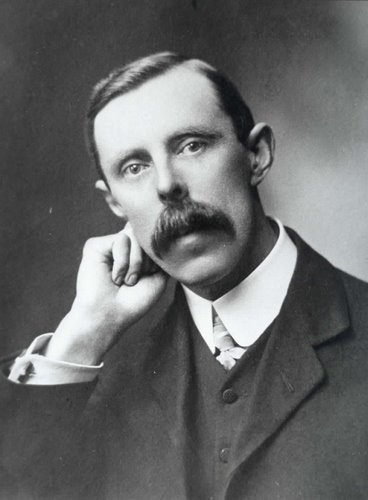
Frank William Boreham 1871-1959

Frank William Boreham 1871-1959
A photo F W Boreham took of himself in 1911

Sunday, June 17, 2007

Boreham on Robert Murray McCheyne

This is the last in this series on ‘the saints’ that F W Boreham wrote about. This does not exhaust this theme as five of his books are devoted to addressing the lives of people and the texts that were influential in their transformation.

The exact book that FWB refers to in this article is in the F W Boreham Heritage Section in the Whitley College library. Look out for it and other Boreham memorabilia if you are going to Melbourne, Australia.

There’s a wealth of insight in this wonderful paragraph that I have extracted from the following article:

“I believe in the immortality of the soul! How can I doubt it when, in books like this, I actually hold palpitating fellowship with the man whose body was committed to the grave a hundred years ago? To read the
Life of Francis Xavier is to be infected by his missionary passion; to read the Journal of Mr. Wesley is to be caught in the hot flame of his evangelistic fervor: whilst to read the Memoir of Robert Murray McCheyne is to share the heavenly glow of his radiant and beautiful soul.”


As I approach my task this morning I find, on the left-hand side of my desk, a well-worn book that I greatly prize, and, on the right-hand side, a pair of photographs of almost equal value. The book is the Memoir of the Rev. Robert Murray McCheyne, by his intimate friend, Dr. Andrew Bonar. I bought it and read it in the early days of my Mosgiel ministry: I have read it many times since; and, in view of the fact that the world is just now celebrating the centenary of McCheyne, I have read it yet once more during the past few days. There are very few books that will bear frequent perusal; but, in this case, each re-reading has proved more stimulating and more profitable than any of its predecessors.

The greatest tribute ever paid to the book is recorded by Dr. James Stalker. Dr. Stalker says that he was once chatting with a survivor of that select group of Scottish ministers to which McCheyne belonged. They were discussing the circumstance that McCheyne died at twenty-nine. `Ah!' exclaimed Dr. Stalker's companion, who had known both McCheyne and Bonar, `but it was far better for McCheyne to die young, and to be embalmed in the glowing pages of Bonar's biography, than to have lived out the full span of human existence and to have missed that privilege!' So much for the book on my left: now for the photographs!

Many years ago, after preaching at Aberdeen overnight, I left in the morning for Dundee. We arrived at midday. As the train drew into the station, two or three gentlemen stepped forward to welcome us.

`You are to preach this afternoon,' they explained, `and again this evening, with a tea and a reception in between; and then your train for the South leaves early tomorrow morning; so that, if there's anything in Dundee that YOU particularly wish to see, your only chance is to go straight away!'

'My dear sir,' I replied, `I would far rather go without my meals whilst I'm here than miss the chance of visiting St. Peter's! I want to see Mr. McCheyne's church and his vestry and his pulpit and his tomb and anything that still exists that is in any way related to him!'

'Good!' my new friends replied; `then we'll go now!' And off we went. I have paid many such pilgrimages in my time, but I have seldom been as deeply moved as by that one. Next morning, one of the gentlemen who had met us at the station, and accompanied us to St. Peter's, again rushed on to the railway platform just as our train was leaving.

`Seeing your interest in Mr. McCheyne and St. Peter's,' he explained, `I tried yesterday afternoon to get you some picture postcards: but I could not satisfy myself; so I had these photographs taken. It has been a little difficult to get them finished in time; but here they are!' And he very kindly presented me with these portraits of the church and the tomb that lie at this moment on my desk.

I

I believe in the immortality of the soul! How can I doubt it when, in books like this, I actually hold palpitating fellowship with the man whose body was committed to the grave a hundred years ago? To read the Life of Francis Xavier is to be infected by his missionary passion; to read the Journal of Mr. Wesley is to be caught in the hot flame of his evangelistic fervor: whilst to read the Memoir of Robert Murray McCheyne is to share the heavenly glow of his radiant and beautiful soul.

His personality is a gem of many glittering facets. Notwithstanding a certain physical frailty, he was an athlete: his death was hastened by the snapping of his vaulting-pole in a jumping contest. He was a scholar, qualified to speak with authority on matters of geology and natural history; his Hebrew served him in good stead when conversing with learned European Jews; he appreciated the finer points of Greek translation; and, when he wished to secure the entries in his diary from curious eyes, he dropped into Latin and made his notes in that ancient tongue with perfect facility and ease.

He was a musician, too, skilled in the use of several instruments and possessing, withal, a rich and pleasing singing voice. As a poet, he poured his choicest inspirations and most poignant emotions into tuneful stanzas, some of which, like When this passing world is done, have found a permanent place in the hymnals of all the Churches. He was an artist, clever at sketching every interesting object or picturesque scene that enchanted his wide-open eyes. A preacher of' culture, persuasiveness and passion, he was the valued companion of men like Thomas Guthrie, James Hamilton, Alexander Somerville, Robert Macdonald, Moody Stuart, and Andrew and Horatius Bonar.

And, although he himself never for a moment suspected it, he was, in the best sense of the word, a saint. One historian has said that it is the unique distinction of Robert Murray McCheyne that he has been canonized, not by any papal mandate or ecclesiastical court, but by popular acclaim. Those who were privileged to luxuriate in his perfect friendship, and those of a later generation who have breathed the fragrance of his life in the pages of his biography, have alike felt the magnetism and charm of his sheer, downright goodness. `If ever there was a saint,' you say to yourself, 'Murray McCheyne was one!' Yet he wist not that the skin of his face did shine.

How it all began, nobody knows. McCheyne himself did not know. He could never fix any particular date as the date of his conversion or recall the exact circumstances that precipitated the spiritual crisis. When Robert was eighteen, his brother David, eight years older than himself, suddenly died. David was Robert's hero, his beau-ideal of perfect manhood. The melancholy event left an indelible impression on the delicate mind of the susceptible youth. It took place on July 8, 1831, and, to the end of his life, Robert kept that day as sacred. Each year, in his journal, he refers to it in terms of fond recollection and renewed consecration. In 1842, for example, he remarks that `this day, eleven years ago, I lost my holy and loving brother and began to seek the Saviour'.

Shortly after his brother's death, I find him debating with himself as to whether or not he should take the Communion. In terms as terrible as any used by Bunyan or Newton, he describes the hideous depravity of his own heart. He decides at length to approach the sacred table, not in spite of his sins, but because of them. It is his sins that drive him to the Saviour whose body was broken and whose blood was shed for the likes of him. `Much peace!' he records, on the evening of that Communion feast; and, a few days later, he is wondering if it will be possible for him to go as a missionary to India or some other land.

It was shortly after this, and as a record of this, that he wrote his first hymn—Jehovah Tsidkenu, the Lord our Righteousness:

I once was a stranger to grace and to God;
I knew not my danger and felt not my load;
Though friends spoke in rapture of Christ on the tree,
'Jehovah Tsidkenu' was nothing to me.

When free grace awoke me by light from on high,
Then legal fears shook me, I trembled to die;
No refuge, no safety, in self could I see;
'Jehovah Tsidkenu' my Saviour must be.

My terrors all vanished before the sweet name;
My guilty fears banished, with boldness I came
To drink at the fountain, life-giving and free;
`Jehovah Tsidkenu' is all things to me.

II

His dream of becoming a foreign missionary haunted him to the end; though, in his heart of hearts, he knew perfectly well that the hardships of such a life, and the ravages of a tropical climate, would overtax his slender powers of physical endurance. In this dilemma, he consulted Dr. Chalmers, who had just created a profound sensation by relinquishing his glorious public ministry in order, within the cloistral seclusion of a university, to fire the imagination of divinity students with the vision of the world's tremendous need. Chalmers advised him, whilst yet a student, to seek missionary experience among the slums of Edinburgh. He adopted the suggestion with characteristic rest; visited among the poorest of the poor; and, to his dying day, kept in touch with some of the unpromising characters with whom he was then brought into contact.

After a short but memorable period of service as assistant to Rev. John Bonar, in the parish of Larbert and Dunipace, near Stirling, he was called, at the age of twenty-three, to St. Peter's, Dundee, and commenced that brief but famous ministry which, in a land of noble ministries, is still regarded as a model and an inspiration.

Strangely enough, the outstanding event of Mr. McCheyne's historic ministry at Dundee was his long absence from his charge in 1839. From 1836 until 1839 he had laboured among his people at St. Peter's with exemplary fidelity, with intense devotion, but with no sensational success. He drew congregations of about a thousand people: he visited his parishioners with the utmost diligence and solicitude: he laid great stress on meetings for prayer and on systematic Bible study; and, however busy or however tired, he was always available to anybody seeking guidance or comfort or help. He was exceedingly happy in his work: he made everybody very fond of him: he was encouraged by a fair number of conversions: the Communion seasons at St. Peter's were times of wonderful grace and refreshment: and many larger and wealthier churches tried in vain to allure the young minister to other fields. But that was as far as it went.

In 1839, however, McCheyne being then twenty-six and in the third year of his ministry at Dundee, his health began to cause his friends much anxiety. Chancing to meet Dr. Candlish one day in Princes Street, Edinburgh, the doctor was shocked at the young minister's emaciated appearance. A sudden idea flashed into his mind. The Church had recently resolved to send a Commission, consisting of a little band of carefully-selected ministers, to the Jews in Palestine and Eastern Europe. Mr. McCheyne would be the very man! He possessed all the essential qualities of heart and mind; and the voyage might re-establish his health into the bargain!

He went, and revelled in the experience. It gave him at least a taste of that foreign missionary adventure for which he had always hungered. Luxuriating in his contact with the Jewish people in many lands, he earnestly sought to learn all that they had to teach and to impart all that he could persuade them to receive. Competent authorities have declared that the printed report of the Commission is one of the best books on the Holy Land ever written, because, together with its vivid descriptions of the country illustrated by McCheyne's own sketches, it is saturated in the spirit of the sublime happenings that lend a sacred lustre to every landscape.

The Mission stimulated or inspired much of the evangelistic work that has subsequently been undertaken among the Jews. Incidentally, it was the means of the conversion of Dr. Adolph Saphir and Dr. Alfred Edersheim. And, according to Dr. Stalker, it fastened upon the Scottish mind an entirely new conception of the Hebrew people, `For whereas', he says, `the Jew is regarded in all other countries as a Shylock, oppressed and oppressing, hateful and hating, the Jew of the Scottish imagination is an ideal being, surrounded with affection and reverence, a child of that race to which pertain the adoption and the glory and the covenants.'
But what of St. Peter's during this long absence? St. Peter's was on fire! A revival had broken out there which moved the whole of Scotland. Mr. McCheyne had entrusted his pulpit to the Rev. W. C. Burns, afterwards the apostle to the Chinese people. Even then, as a very young man, he was consumed by a passionate longing for the salvation of his fellow men. Almost as soon as Mr. McCheyne's back was turned, the wonderful work began. On weekdays and on Sundays, people of all ages and of all classes, some from the immediate vicinity and some from the surrounding countryside, flocked to the church; and hundreds of men and women, under deep emotion, sought and found the Saviour. Every sermon was punctuated by the groans and sobs and tears of the crowded congregations.


Mr. McCheyne heard of all this with profound gratitude and yearned to be back in Dundee to share the joy of the abundant harvest. And his people longed to have him back. He arrived on a Thursday; went down to St. Peter's in the evening to meet anybody who might be there; and, to his astonishment, found that so many people had come to the church on the chance of seeing him that the building was crowded to its utmost capacity. Aisles and stairways were packed. Mr. McCheyne, went to the pulpit and poured out his heart, not concerning his travels, but concerning the work of God among his people at Dundee. For more than an hour he preached Christ with all his old intensity and charm. It was a night that the people never forgot. After the, meeting was over, he could scarcely force his way through the throng that pressed upon him to welcome him home and tell of their delight.

The revival continued during the three years that remained to him. The novelty wore off and the excitement subsided; but the reaping continued and a steady stream of penitents passed through Mr. McCheyne's vestry. Then, early in 1843, typhus broke out in Dundee. The young minister’s entire time and strength were devoted to visiting the dying and burying the dead. The inevitable happened. He himself contracted the dread scourge, and, after a brief struggle, passed triumphantly away. When his friend, Andrew Bonar, heard the news a few hours later, he hurried across to St. Peter's. Slipping into the church, he found hundreds of people there, weeping as though their hearts would break; and, early in the following week, the entire city gave itself up to lamentation on the occasion of his burial. A massive monument marks the tomb, which is much visited by tourists, whilst the sweetness and chivalry of his character have woven themselves into the most cherished traditions of the North.

It would be pleasant, if space permitted, to say a few words concerning Mr. McCheyne's part in the Disruption. He died a few weeks before that memorable event took place. Yet, in a sense, he was one of the leaders and walked out side by side with Chalmers. He had no taste for controversy; yet, when a matter of public debate stilted his conscience, he did not hesitate to speak his mind, quietly, persuasively, and convincingly. The very fact that Mr. McCheyne was in sympathy with Chalmers drew to the cause all those who had felt the gracious influence of the revival. It secured the allegiance of thousands of the most devout, the most godly, and the most spiritually-minded folk in Scotland; and it imparted to the Disruption movement an indefinable aroma that sweetened the atmosphere and reduced to a minimum the bitterness of the fray.

What was his secret? It was simply this: he walked with God. He knew from the first that his course would be a brief one. His earliest letters bear the seal The Night Cometh. He felt that, in order to make the most of his meagre span of years, he must dwell in the secret place and abide under the shadow. God was always closer to him than breathing, nearer than hands or feet. I find him, in the course of his Jewish mission in a crowded foreign city. `How real God is!' he says to himself. 'He is the only person I can talk to!' On the very next page, I find him, by way of contrast, in the solitudes of the desert, not a soul in sight. `How near God seems!' he remarks. He used to say that, even in days of sickness and depression, he could never really doubt, for God had given him such overwhelming manifestations of His presence when in the pulpit that he could live on the memory of those rapturous experiences in drearier and darker days.

His life was hid with Christ in God. It was in rapt communion with the unseen that he became infected by his Master's insatiable hunger for the souls of men. He wept over Dundee as Jesus wept over Jerusalem. A few years after his death, a young English minister visited St. Peter's to discover, as he explained, the secret of Mr. McCheyne's amazing influence. The sexton, who had served under Mr. McCheyne, took the youthful inquirer into the vestry, and pointed to some of McCheyne's books still lying on the table.
`Sit down here,' said the canny old sexton, leading his visitor to the chair in which McCheyne used to sit.
`Now put your elbows on the table!' The visitor obeyed. `Now put your face in your hands!' The visitor did so.
`Now let the tears flow! That was the way Mr. McCheyne used to do!'

The sexton led his guest to the pulpit; and gave him a fresh series of instructions.
`Put your elbows down into the pulpit!' He put his elbows down.
`Now put your face in your hands!' He did so.
'Now let the tears flow! That was the way Mr. McCheyne used to do!'

Yes, that was the way; and it is not an easy way. It is an art that can only be acquired at the feet of the Divine Master from whom Mr. McCheyne learned it.

All his converts agree that it was not so much what he said as the spirit in which he said it, that lured them into the kingdom. In his biography of Mr. McCheyne, Dr. Andrew Bonar tells how Mrs. Bonar, before her marriage, was affected by Mr. McCheyne's presence. It was at a meeting at St. Andrew's Church, Edinburgh, a few months before Mr. McCheyne's death. `It was neither his matter nor his manner that struck me,' she says, `it was the impression of his likeness to Christ—a picture so lovely that I felt that I would have given all the world to be as he was!' One of Dr. Bonar's own parishioners was talking to him about Mr. McCheyne. `Before he so much as opened his lips', this man said, `there was something about him that sorely affected me.' And Dr. Bonar tells of many of Mr. McCheyne's converts who testified that it was not his words that broke them down; but the fact that he appeared to them to be standing in the immediate presence of the Most High, whilst, when he prayed, he seemed to be looking into the very eyes of God and talking with Him face to face.

`When he spoke of my being alienated from God by my sins,' one woman declared, `it seemed so terrible that I felt that hell itself would be some relief from the horror of it!'

`When, in his prayer, I heard him say, “O Lord, Thou knowest that we love Thee!" I felt that I would gladly give all that I ever hoped to possess to be able to say that to the Saviour!' another woman exclaimed.

Thus, literally, he was a living epistle. As people interpret, in a letter, the mind of the writer, so people read in him the very mind of Christ. And, as a letter need not be a long letter in order to be a love-letter, so, within the compass of his brief span of existence, he communicated to the hearts of all whom he met the sense of his Lord's everlasting love and pity and grace. It was said of Keats that he `ensphered himself in thirty perfect years and died, not young'. The lovely tribute is even more fitting in the case of Robert Murray McCheyne.

F W Boreham, ‘The Secret of Murray McCheyne,’ A Late Lark Singing (London: The Epworth Press, 1945), 58-67.

Image: Robert Murray McCheyne.

Saturday, June 16, 2007

F W Boreham: A Story About Marjorie

This is a further addition to the short series of postings on this site on the saints of the Christian faith. This is another essay on a person who is not commonly known as it is the story of someone that FWB met in the course of his ministry. Essays like this give a revealing glimpse into Boreham’s pastoral ministry. They highlight the way his pastoral work enriched his preaching and writing ministry.

There are some sentences in this article that underscore that pastoral visitation is not one way—a wise pastor bestowing insights and encouragement to those young in the faith. Underline this wonderful sentence:

“I set out the very next day, little dreaming that so very ordinary a mission was destined to bring into my life so wealthy an enrichment. Very abruptly sometimes life's casual ministries unlock for us the gates of gold. We turn a bend in a dusty road, and catch a glimpse of Paradise. We reach unexpectedly the brow of a hill, and obtain a vision of infinity. So was it with me that day.”


MARJORIE is ninety-two, although you would never suspect it. Her hair is as black as it was when, more than seventy years ago, her tall young lover first stroked it. Marjorie is English—as English as English can be. The fact stares you in the face as soon as you put your hand to the latch of her gate. For the little front garden is the condensed essence of England. It is as English as the garden of a Kentish cottage. You inhale the scent-laden English air as you walk down the path to Marjorie's door. You drink in the fragrance of the roses and the wallflowers, the sweet-peas and the jasmine, the carnations and the gillyflowers, the musk and mignonette; and then, as you pause for a moment in the porch, awaiting the opening of the door, the soft petals of the honeysuckle brush against your face. They must all be flowers of rich perfume to be of any use to Marjorie now, for Marjorie is blind. I had been in conversation with her for some time before I realized that the eyes that seemed to look so wistfully into mine were unable to convey any impression to her alert and hungry mind. Her sightless eyes and the slight stoop at the shoulders are the only indications that she gives you of her heavy burden of years. She cannot see the pictures on the wall, representing the scenes of her childhood—the village street with its comfortable inn and its odd medley of stores; the thickly wooded lane in which she so often found nuts and blackberries; the (folds of golden buttercups; and the village green with its rustic seats and shady grove of oaks. She cannot see these pictures now; but she says that the scenes all come back to her, as clearly as if she had visited them yesterday, when she sits out in the porch, luxuriating in the fragrance of the flowers, listening to the droning of the bees, and enjoying the song of the thrush who sings to her from his perch in the lilac by the side of the house.

Even if I, like Marjorie, live to be ninety-two, I shall never forget that first visit that I paid her. It came about very simply. `I wish,' said a gentleman, as he left the service on Sunday morning, `I wish you could find time to call on my old mother. She would appreciate it.' He gave me the address, and I set out the very next day, little dreaming that so very ordinary a mission was destined to bring into my life so wealthy an enrichment. Very abruptly sometimes life's casual ministries unlock for us the gates of gold. We turn a bend in a dusty road, and catch a glimpse of Paradise. We reach unexpectedly the brow of a hill, and obtain a vision of infinity. So was it with me that day.

As I sat in the cosy little parlour awaiting the old lady's entrance, I expected that I should have to make the conversation, and I wondered how I could best secure that it should serve some profitable end. I smile now at the ignorance that led me into such a line of cogitation. I had not then met Marjorie. When she entered the room, the conversation made itself. I had simply nothing to do with it. I came to minister; but I found myself being ministered to.

Not for a moment do I suggest that Marjorie was what Bunyan would call a brisk talker on matters of religion. She was far too reverent and far too modest for that. I mean rather that she had something really great to say, and she said it really greatly. Hers was the grand style, glorified by transparent sincerity. Her speech was dignified and stately, whilst her voice was tremulous with deep emotion. There was a majesty about her very diction. She employed phrases that are never now heard, and that are only to be found in the mellow pages of a school that is never now read. Outside a second-hand bookshop you may often see a box into which the desperate dealer has thrown all his rubbish, offering it to an unappreciative public at a nominal price of a penny a volume. To turn over this ill-assorted collection of literary flotsam and jetsam is as interesting and pathetic as to wander through the casual ward of a workhouse. No two cases are alike, yet all have come to this! Here in the box is a Spanish grammar, badly torn; there, too, is the second part of a three-volume novel. Like Euclid's ideal circle, it is without beginning and without ending. Yonder is the guide-book to a long-forgotten exhibition. Such a higgledy-piggledy box! But if you delve a little more deeply, you will be sure to come upon some old volumes of eighteenth-century sermons. The leather backs are badly broken, and the leaves are yellow with age. But if you will sacrifice the necessary penny and go to the trouble of carrying one of these old volumes home, you will find the very vocabulary to which I listened as I sat that day in Marjorie's pretty little parlour. Yet, as this dead language fell from Marjorie's lips, it came to life again! It was full of energy and vigour; it was instinct with spiritual significance and with holy passion. It throbbed and quivered and glowed and flashed. It was as if some ancestral castle that had stood deserted and gloomy for a century had been suddenly inhabited, and was now ablaze with light and vibrant with shouts and laughter. The antique phrases simply sparkled with vitality as they tripped from her tongue. It was, as I say, a great story greatly told. Marjorie had been buffeted in a long, stern struggle; she had known heart-break and agony and tears yet her memory remained at ninety-two absolutely unclouded, and her lip retained its power of forceful utterance. And sitting there in her cosy parlour, whilst the breath of the garden came pouring in through the open window, did Marjorie unfold to me the treasures of her rich experience.

`Ah, yes,' she replied, with a smile, when I made some reference to the remarkable length of her pilgrimage, 'I was only a girl when I entered into the sweetness of religion.' The phrase, illumined by that bright though sightless smile, and interpreted by accents so full of feeling, fastened upon my memory at once. 'The sweetness of religion.' 'I was only a girl when entered into the sweetness of religion!’ And then she went on to tell me of the rapture of her first faith. Seventy-five years earlier, religion had come into her life like a great burst of song. Amidst the sunshine of an English summer-time, whilst the fields were redolent of clover and of new-mown hay, her girlish soul had sought and found the Saviour. Instantly the whole world had stood transfigured. Her tongue seemed to catch fire as she told me of the radiant experiences, of those never-to-be-forgotten days. I saw, as I listened, that the soul has a rhetoric of its own, an eloquence with which no acquired oratory can compare. She told of the joy that she found in her own secret communion with the Lord, sometimes in the quietude of her little room—the room with the projecting lattice window from which she loved to watch the mists rising from the hollow as the sun came up over the hills; sometimes down among the alders along the banks of the stream, sitting so still that the rabbits would scurry up and down the green banks without taking the slightest notice of her; sometimes in long delicious rambles across the open park, rambles in which she was only disturbed by the swish of a frightened pheasant or the tramp of fallow deer; and sometimes amidst the leafy seclusion of the primrosed woods. And often, at sunset, when Dapple and Brownie had been milked, and the tea-things put away, she would take her knitting and saunter down the dusty old road. And as, one by one, the stars peeped out, and the nightingale called from the woods in the valley, and glowworms shone in the grass under the hedge, and a bat flapped and fluttered in its queer flight round her head, it seemed as though the miracle of Emmaus were repeated, and Jesus came and walked with her.

She spoke of the wonders that, under such conditions, broke upon her spirit like a light from heaven. Her Bible became a new book to her; and an unspeakable glory fell upon the village sanctuary, the dearest spot on earth to her in those days of long ago. A wave of happy recollection swept over her as she told of the walks along the lanes and across the fields, in the company of a group of kindred spirits, to attend those simple but memorable services. The path led through a tossing sea of harebells and cowslips; the lane was redolent of hawthorn and sweet-brier. As they made their way to the church that peeped shyly through the foliage of the clump of elms on the hill, the solemn monotone of its insistent bell mingled with the chatter of the finches in the hedges and the blither note of the lark high tip in the blue. Marjorie's blind eyes almost shone as she recalled, and, with glowing tongue, recounted, all these precious and beautiful memories. 'I was only a girl,' she said, `when I entered into the sweetness of religion!'
`But,' I interjected, 'you speak of the sweetness of religion as though it were a thing of long ago. Do you mean that it became exhausted? Did that happy phase of your Christian experience fade away?'
A cloud passed over her face like the shadow that, on a summer's afternoon, will sometimes float over the corn.
`Oh, well, you know,' she replied, after a thoughtful pause, 'the tone of one's life changes with the years. I left my girlhood behind me. I married; children came to our home in quick succession; life became a battle rather than a frolic; and sometimes the struggle was almost grim. Then troubles fell thick and fast upon me. In one dreadful week I buried two of my boys, one on the Tuesday and the other on the Friday. Then, last of all, my husband, the soul of my soul, the best man I have ever known, was snatched rudely from my side.'
Marjorie hid her face for a moment in her hands. At last my impatience compelled me to break the silence.
'And do you mean,' I inquired, 'do you mean that, under the stress of all this sorrow, you lost the sweetness of religion?'
'Well,' she replied thoughtfully, 'under such conditions you would scarcely speak of sweetness. I would rather say that, during those sterner years, I entered into the power of religion.'
A ring, almost of triumph, came into her voice.
'Yes,' she said, 'in those years I entered into the power of religion. Only once did my faith really stagger. It was on the night of that second funeral—that second funeral within a single week! I was kneeling in my own room on the spot on which I had knelt, morning and evening, through all the years. But I could not pray. I felt that God had failed and forsaken me. My shrine was empty, and I burst into tears. And then, all at once, a Hand seemed laid gently upon my shoulder and a Voice sounded in my car. "Am I a man that I should lie?" it said. I was startled. I felt chastened and rebuked. I had treated Him as though He were no wiser than I, and as though He had broken His Word. Then, through my tears, I prayed as I had never been able to pray before. A great peace soothed my broken spirit. I was ashamed of my distrust. It was the only time my faith had wavered. No; I should not speak of s sweetness as I recall those years of bitter sorrow and sore struggle. In those days I entered into the power of religion!'

`But now look, Marjorie,' I pleaded 'You tell me that, as a girl, you entered into the sweetness of religion, and that, in the graver years that followed, you entered into the power of religion. But your girlhood and your struggle have both passed now, and here you are in this quiet little cottage looking back across the intervening years at those far-away periods. Would you say that you now enjoy the sweetness or the power?'
Her face shone; it was almost seraphic. Her whole being became suddenly animated and luminous. She reached out her hands towards me as though she held something in each of them.
‘I have them both!' she cried in a perfect transport of delight. 'I have them both! The sweetness that I knew in my English girlhood has come back to me in the days of my old age; and the power that came to me in the years of trial and loss has never since forsaken me. I have them both; oh, bless His holy Name, I have them both!'

It was too much for her. Overcome by the rush of recollection and the tempest of exultant emotion, she sank back in her chair and lapsed into silence.

`Why, Marjorie,' I said, 'you have given me the very thing I wanted. As I walked along the road I was wondering what I should preach about on Sunday. But I know now. I shall preach on those words from the swan-song of Moses in which the old leader, in laying down his charge, bears grateful witness to God's goodness to Israel. "He made him," he says, "to suck honey out of the rock." I was reading in a book of travel only yesterday that in the Orient the wild bees store their honey in the crevices among the cliffs, and on a hot day you may see it trickling down the face of the granite in shining streams of sweetness! As a girl, you say, you entered into the sweetness of religion. As a girl, girl-like, you gave little thought to the rock itself, but you loved to taste the sweetness of the honey. You entered into the sweetness of religion! But, as a woman, in the turmoil and tussle of life, buffeted and storm-beaten, you forgot the honey that oozed from the cracks and fissures, and were glad to feel the massive strength of the rock itself beneath your feet. You entered into the power of religion! And now, the fury of the storm all overpast, you tell me that you still rest upon the great rock, rejoicing in its firmness; and, as in your earlier days, you once more enjoy the honey that exudes from its recesses. You enjoy both the strength and the sweetness; you have them both!" With honey out of the rock, have I satisfied you!" I shall certainly preach on that text on Sunday!’
And I did.

F W Boreham, ‘Marjorie’, The Uppermost Star (London: The Epworth Press, 1919), 38-48.

Image: “You drink in the fragrance of the … sweet-peas.”

Thursday, June 14, 2007

Tribute to Ruth Graham: Remembering Her Friendship with F W Boreham

On the day of her death (14 June 2007), this blog site records a tribute to Ruth Graham and extends our loving sympathy to Dr Billy Graham and his family.

Billy and Ruth Graham often acknowledged the influence of F W Boreham on their lives. On their visit to Melbourne in 1959 to conduct those famous crusades at the Melbourne Cricket Ground (and set the record for the highest number of people at the MCG), Billy and Ruth visited Dr Boreham. You can read about their conversation below.

Ruth Graham was one of the few people who had a complete set of the Boreham books, such is the love that she had for F W Boreham and his writings.

On the Official F W Boreham Blog Site Rowland Croucher has left this comment about Ruth and Billy Graham:


"Ruth Graham has one of the best Boreham collections in the world. When I was a 'Boreham Trading Post' trader of Boreham books, I sold several rare titles to her. In addition to Ravi Zacharias she and her husband Billy Graham have probably done more to popularize FW Boreham in the U.S. than anyone else.Rowland Croucher http://jmm.aaa.net.au/"

It is fitting on this day of sadness and joy to record the Boreham—Graham connection.

Here are some of the articles that describe this important link.

Boreham’s Influence on Billy and Ruth Graham

Boreham and that Chair that Billy and Ruth Graham Wanted

Ruth Graham’s Visit to Borehamland (Mosgiel, NZ)

Geoff Pound

Image: Ruth and Billy Graham in earlier days.

Boreham on John Greenleaf Whittier

This is a further article by Frank Boreham in a short series on some of the great saints of the Christian faith.

A YEAR or two back it was my good fortune to spend a few delightful days amidst the green hills and pleasant water-courses of New England. And nothing that I there experienced impressed me more than the reverent affection with which the name of John Greenleaf Whittier, the Quaker poet, is always mentioned there. In New England he was born; in New England he lived and labored and wrote; in New England he died: and in his chaste and tuneful minstrelsy, more than anywhere else, the essential spirit of New England has become articulate.

A farm boy, he was poorly educated. His father held that too much book-learning was bad for young people. It made them turn up their noses at the plough, the reaping hook and the milk cans. He insisted that the cultivated field, the green woods and the open air can teach everything that a young farmer really needs to know.

If the circumscribed life to which the youth was thus restricted seems severely narrow, it was by no means unhappy. In his Snowbound, Whittier has given us a vivid and colorful delineation of these early days of his; and the poem stands as one of the most beautiful descriptions of domestic felicity in the English language. It is at many points reminiscent of Burns' Cotter’s Saturday Night—a poem that very possibly influenced its composition. Who that has once read Whittier's exquisite stanzas can ever forget those winter evenings in the snow-bound farmhouse? The roaring fire; the babel of irresponsible chatter; the peals of laughter; the books and needlework and games; the music and the story-telling; what nights of romance those were! Eyes sparkled and cheeks flushed as the father unfolded narratives of adventure belonging to the rough old pioneering days; whilst even the demure little Quaker mother could sometimes make them hold their breath with tense excitement:

Our mother, while she turned her wheel
Or run the new-knit stocking-heel,
Told how the Indian hordes came down
At midnight on Cochecho town,
And how her own great-uncle bore
His cruel scalp-mark to fourscore,
Recalling, in her fitting phrase,
So rich and picturesque and free
(The common unrhymed poetry
Of simple life and country ways)
The story of her early days.

It was in this idyllic atmosphere that Whittier spent his boyhood; and nothing would have surprised him more than to be told that, whilst still a youth, he was destined to pass from it into a life of publicity, conflict and fame.

Two events, neither of them appearing momentous at the time, shattered the tranquility of the farm-lad's career. A wandering pedlar arrived one evening at the door of the homestead, and, in keeping with the traditional hospitality of the Whittiers, was invited to stay the night. After supper he delighted the family by singing some of the songs of Robert Burns. John sat spellbound: the Scottish bard captivated his youthful fancy at once. Shortly afterwards the village schoolmaster, Joshua Coffin, dropped in one night, and, to John's unbounded delight, brought a copy of Burns with him. The boy borrowed it, devoured it hungrily, and, in its pages, made a sensational and epoch-making discovery. `I found', he says, `that the things out of which poems came were not, as I had always imagined, somewhere far off in a world of life lying outside our own sky. They were right here about my feet and among the people I knew!' The first few hours after opening that book were among the most memorable in his life.

How oft that day, with fond delay, I sought the maple's shadow,
And sang with Burns the hours away, forgetful of the meadow.
New light on home-seen Nature beamed, new glory over woman;
And daily life and duty seemed no longer poor and common.

This was the first of the two events that fashioned his destiny; and the second arose naturally out of it. For the thought suggested itself to his eager mind that it might be possible for him to do for New England what Burns had done for Scotland. In odd moments he scrawled his jingles on any fugitive scraps of paper that he could gather together. Whether he would ever have found courage to seek the publication of these rough-and-ready verses can never be determined; for the issue was taken entirely out of his hands.

On the arrival at the farm one day of the local paper, he was dumbfounded at beholding one of his own poems in all the bravery of type. He had no idea that his sister, Mary, always one of his warmest admirers, had found the penciled lines, had fallen in love with them, and, without consulting anybody, had forwarded them to the Editor. This Editor chanced to be a youth named Lloyd Garrison, still in his teens, but destined to become the prime mover in the agitation that led to the emancipation of the American slaves.

At the earliest possible moment, Lloyd Garrison drove over to the Whittier farm to see his new contributor, then aged sixteen. `The rustic bard', he tells us, `came into the room with shrinking diffidence, unable to speak, and blushing like a girl.' Lloyd Garrison urged the boy to seek an ampler education; but the elder Whittier, scenting all kinds of dangers, told the young Editor bluntly to mind his own business and not to come putting notions into boys' heads!

During the years that followed, Whittier cut a great figure in his country's history. Nature and self-culture combined to endow him with a striking and commanding appearance. He was tall, dark, handsome, with raven hair and black, flashing eyes. He had, as one of his colleagues put it, `the reticence and presence of an Arab chief and the eye of an eagle'. At the, age of twenty-eight he entered the Legislature of Massachusetts; and, during the fevered years in which America was convulsed by the question as to whether the slaves should, or should not, be freed, Lloyd Garrison and the champions of emancipation found no ally more staunch, more able or more effective than Whittier.

He became one of the most attractive, one of the most honored, and one of the most beloved figures in the public life of the Western world. Strangely enough, he never married. He loved all pretty things—pretty girls particularly. He tells us how he reveled in admiring the charms of face and figure in the women who passed him on the street. `They go flitting by me', he says, `like aerial creatures just stooping down to our dull earth. I delight in their graceful movements, notice the brilliancy of their fine eyes and observe the delicate flush stealing over their cheeks; yet my heart is untouched—cold and motionless as a Jutland lake in the moonlight. I always did love a pretty girl. Heaven grant there is no harm in it!' To the end of his days—and he lived to be eighty-five—he treated all women with the utmost courtliness and reverence; he understood women as few men can claim to do; women admired and ministered to him; whilst the majority of his intimate friends were of the gentler sex. Yet, although he often expressed to those who were most deeply in his confidence an earnest desire for marriage, its felicities persistently evaded him.

To most of us Whittier will always represent the articulation of all that is simplest and sweetest in our faith. In how many thousands of churches, every Sunday, do devout hearts raise his beautiful Dear Lord and Father of Mankind?

Drop Thy still dews of quietness,
Till all our strivings cease;
Take from our souls the strain and stress,
And let our ordered lives confess
The beauty of Thy peace.

Breathe through the heats of our desire
Thy coolness and Thy balm;
Let sense be dumb, let flesh retire;
Speak through the earthquake; Wind and fire,
O still small voice of calm!

Who, more vividly than Whittier, has made us feel the reality and the virtue of the presence of our living Lord?

The healing of His seamless dress
Is by our beds of pain;
We touch Him in life's throng and press
And we are whole again.

Through Him the first fond prayers are said
Our lips of childhood frame;
The last low whispers of our dead
Are burdened with His name.

O Lord and Saviour of us all,
Whate'er our name or sign,
We own Thy sway, we hear Thy call,
And form our lives by Thine.

Thus the Quaker becomes the Priest—the Priest of the Presence—the Priest who leads us into those holy places in which we touch the intangible, sense the incomprehensible, hear the inaudible, see the invisible, and bow penitently and adoringly in the silence ineffable.

His later years were marked by the ripening and mellowing of those chivalrous qualities that had adorned his entire career. Sir Edmund Gosse visited him as he neared the end, and was impressed by his gentle sweetness and dignified courtesy: his spirit was gay and cheerful; his language fluid and graceful. He spent his last days feasting his eyes on the sparkling waters of the Merrimac. He reveled in the vision of the green hills, the blue sky, the abundance of flowers and the ships in the distance. To this charming retreat there came the most notable social and literary figures of the day, all anxious to offer their homage to one whose name, in his own lifetime, had become a cherished and luminous tradition.

Here he passed quietly away, exclaiming, as he gently raised his hand at the last, `Love . . . love to all the world!' According to Quaker custom, a plain slab marks his resting-place, exactly similar to the stones erected to the memory of the other Whittiers near by. Of that unpretentious monument Oliver Wendell Holmes wrote:

Lift from its quarried edge a flawless stone,
Smooth the green turf and bid the tablet rise,
And on its snow-white surface carve alone
These words—he needs none other—
HERE WHITTIER LIES!

Up among the malarial bogs of the African jungle, David Livingstone, in his last lonely days, reveled in the poetry of John Greenleaf Whittier; and, in so doing, he becomes the distinguished representative of that great host who love to offer the tribute of their homage at that Quaker shrine.

F W Boreham, ‘A Melodious Quaker’, I Forgot to Say (London: The Epworth Press, 1939), 190-196.

Image: John Greenleaf Whittier.

Wednesday, June 13, 2007

Boreham on Granny of Mosgiel

This is a further article in a series on some of the saints of the church by F W Boreham.

In a real sense he believed that all followers of Jesus are saints and the term should not be reserved for those who are framed in stained glass in hallowed places. Such glass lets the light shine through and this might be a better description of a saint—a person who receives and lets the light of Christ shine through their lives. This saint is just known as ‘Granny’.

GRANNY was a pioneer with a vengeance. When the Free Church of Scotland first announced its intention of establishing a colony in far-away New Zealand, she, her husband, and her young family were among the very first emigrants to be enrolled. Brave little woman! For in those days New Zealand was thought of as the happy hunting-ground of wild barbarians.

And good little woman! No finer testimony could be produced to the excellent character that Granny then bore. For the Free Church was determined to send out only men and women of unimpeachable integrity ; and a most searching scrutiny was made into the character of each proposed emigrant. Granny and her guid man stood the test; and, by the very first ship that sailed for the strange southern land, away they went!

After a voyage of nearly six months, the Philip Lang cast anchor off the New Zealand coast. She had been becalmed in the tropics, and had been tumbled in mountainous seas about the Cape; but she reached her haven at last. I have often looked at New Zealand from the scene of that historic anchorage, and have tried to conjure up the land as Granny first saw it. No streets; no houses; no shops; no anything! Virgin bush right down to the water's edge! What a gorgeous riot of emerald forestry! The newcomers must hew down for themselves the trees from which their first rude cabins must be built. And I like to remember that, before an axe was raised or a spade lifted, those heroic pioneers and pathfinders kneeled together on the shore and sought grace to lay the foundations of a new nation in the love of righteousness and in the fear of God. Granny was a young woman then, plump and bonny, with her husband by her side and her children at her skirts. If peace hath her victories no less renowned than war, she has her heroes too. And heroines. And surely a Scottish lassie who could accompany her brawny young husband as he carved a path through an untrodden antipodean forest, in order that they might found for themselves a home in the silent and uninhabited interior, has earned a Victoria Cross!

Granny and her husband paused at last on the summit of a mountain, overlooking the blue, blue sea on the one side and a silvery lake on the other. There on the crest of the hill they resolved to build for themselves a home, and to seek their bread by cultivating the bush-clad slopes around.

Fifty years later it was often my delight to visit her. I was always dragged up the mountain track on a pair-horse sledge. And I never climbed that steep ascent without thinking of those early days when poor Granny, with no track made for her and no horse to help her, fought her way up the difficult slope as best she could. And I doubt not that she bore her bairnies much of the way, or how could they have clambered through the bush to the summit? Those first colonists were made of iron. Up there, on the mountain-top, a home was soon built. It was very rough, but it did. The bush was burned and the first crops were sown. And the great lake on which, in those first days, Granny looked down, was drained by companion settlers, and converted into one of the most fertile plains on the face of the earth. It was out on the bed of that old lake that my manse was built for me.

I cherish amongst my richest treasure-trove the memory of my first visit to Granny. She had been recently widowed. Her sons and her grandsons farmed the fertile hill-sides all around her. And they had built for her special comfort a dainty little cottage at the back of the old homestead. The picture is indelible. There she stands in the rose-covered doorway of the quaint little cabin, like a pretty old painting, exquisitely framed! I can still see her wrinkled face buried in the wavy depths of her lilac sun-bonnet. Her little plaid shawl is neatly crossed over her breast and fastened behind her back. Her Scottish accent was so pronounced and her brogue so broad that I cannot pretend to have caught every word that she uttered; but for all that it was a treat to hear her. There is music in the murmur of the waves, though we know not what they are saying. And at any rate, if poor Granny's speech was too subtle for prosaic southern ears, her eyes were always eloquent enough. They seemed to glow with the very joy of living; and as she stands there, framed in her cottage portal, her hands seem always outstretched to welcome her minister. I wish that every man could share my rare privilege in passing straight from college to such a school as Granny kept for me! When, nowadays, I find sleep coy and difficult to woo, I just lie still and think of Granny as I used to see her at her cabin-door in those first days of my ministry in Maoriland.

What times they were! 'What tales she told me as we sat together in her wee but cosy `but and ben '! The pathos of her early exile; her insufferable home-sickness as she sat, on quiet and lonely Sabbaths, her face in her hands and her elbows on her knees, peering over the wilds and the waters, dreaming fondly of the auld land and the auld kirk. How tenderly she told of the patient struggles of those first days of colonization: the infinite labour of building their home on the summit; the long and perilous tramps in search of every simplest requisite; the heavy burdens that had to be carried on their own backs in the days before horses and cattle were to be had; the prosperity that responded to toil; and the ease that came with the years! Of all these she chatted easily, cheerfully, gratefully.

And when, after awhile, I saw her tall young grandson pass the open door on his way to the stable to harness the horses to my sledge, I used to reach for her old Bible. It had accompanied her through all the days of her pilgrimage. The covers had been more than once repaired. Every page was brown with age and wear. How fondly she eyed it as I opened its mellow leaves! I read to her passages that were like music to her soul. She always chose them, and her face simply gleamed as I read. She had learned every word of those stately chapters by heart before I was born, and, had I stumbled, would have instantly detected the slip; but she enjoyed the passage none the less on that account. And then we kneeled together in the Presence that was very real; and somehow I always felt that prayer was wonderfully easy in the perfumed atmosphere of that little room.

I heard one day that Granny was dying! It was raining in torrents! There was no way of arranging for the mountain-sledge. I drove to the foot of the track, and then commenced the ascent. It was the only time that I ever walked it. And I even felt glad that it was raining. It would have seemed a horrid incongruity if the sun had been shining and the birds singing when old Granny was dying!

To my joy, I arrived in time! Granny was lying dreadfully still and perfectly prostrate in her tiny room. The watchers thoughtfully slipped out and left us, as we had so often been, alone together. I stroked the wrinkled brow about which the snowy curls were tumbled now. Her eyes spoke to me in reply, and I understood. For the last time I reached for her Bible. I knew what to read. If for her great countryman there was 'only one Book' at such a time, for Granny there was only one chapter. `In my Father's house are many mansions.' Even as I gave utterance to the beautiful and rhythmic cadences, the rain ceased to beat upon the little window-pane, and I read on amidst a silence that was like the threshold of another world. It was like the hush of the Presence-chamber, the anteroom of the Eternal. I could see that Granny drank in every syllable, and it was as the wine of the kingdom of heaven to her taste. And then I prayed—or tried to—for the last time! When I rose from my knees by her bedside, the setting sun had struggled through the rain-clouds. It streamed gloriously through her little western window. It transfigured her wan face and wandering hair as it fell upon her snowy pillow. I quietly rose to leave. I was about to take her hand in mine when a thing happened that I think I shall remember when all things else have been forgotten.

To my amazement, Granny rose, and sat bolt upright! In the glory of the setting sun, she seemed almost more than human. `Doon!' she exclaimed, 'doon!' and motioned me to kneel once more by her bedside. I obeyed her. And, as I knelt, I felt her thin, worn hands on my head, and I heard her clear Scotch accent once more. `The Lord bless ye,' she said in slow and solemn tones; `the Lord bless ye and keep ye! The Lord bless ye in your youth and in your auld age! The Lord bless ye in your basket and in your store! The Lord bless ye in your kirk and in your hame! The Lord bless ye in your guid wife and in your wee bairns! The Lord bless ye in your gaeings out and in your comings in frae this time forth and even for evermair!'

I have bowed my head to many benedictions, but I have never known another like that. The frail form was completely exhausted, and poor Granny sank back heavily upon her pillow. In a very little while she had passed beyond the reach of my poor ministries. But I often feel her thin fingers in my hair; and that last benediction will abide, like the breath of heaven, upon my spirit till I shall see her radiant face once more.

F W Boreham, ‘Granny’, Mountains in the Mist (London: Charles H Kelly, 1914), 203-210.

Image: Map of the New Zealand province, Otago which was settled by many (like Granny) who came from Scotland. Click for enlargement.

Tuesday, June 12, 2007

F W Boreham on Thomas à Kempis: Take Two

Yesterday’s posting was an article about Thomas à Kempis and The Imitation of Christ. F W Boreham, ‘the great recycler’, reworked many of his essays and this posting represents a revised edition of the earlier essay. Why not rework articles when you are contributing for fifty years!?

The word limit for newspaper editorials kicked in so Boreham’s articles in the 1950s were only about 500-700 words, compared with 1500 when he commenced as an editorialist. This essay, which is just under 1,000 words, has some new elements but the first line containing a reference to an anniversary is the telltale sign that it was used as a newspaper article. It was posted in the Hobart
Mercury on Saturday 24 July 1948. I have taken it from Boreham’s book that was published posthumously, The Last Milestone. Even if you read yesterday’s posting, read this one also and let TAK ‘grip you’ as he gripped FWB.

Tomorrow marks the anniversary of the death, in 1471, of the author of one of the most extraordinary books ever written. Thomas à Kempis was born in 1380. His masterpiece was published in the year in which he died, so he tasted nothing of fame. Yet, during the four centuries that followed, over 6,000 separate editions appeared, and, today, translated into every known language, it is being reprinted and distributed in every part of the world.

The first English version was, at the command of Margaret, mother of Henry VII, prepared by Canon Atkinson in 1502. For some strange reason that is more easy to trace than to explain, the book has appealed to all sorts and conditions of people. Equally appreciated by Protestants and Catholics, as well as by those who stand attached to neither faith, it gathers into itself, as Dean Milman says, all that is elevating, passionate and profound in the older mystics, and touches real life at almost every point.

Unhappily, very little is known about the author. Entering the old Augustinian monastery at Agnetenberg, in the Netherlands, at the age of twenty-seven, he lived there a life that was singularly colorless and uneventful. He describes himself as a lover of books and quiet corners. Although Europe was a cloud of dust, convulsed in storm and tumult, with wars raging and thrones tottering, he lived his patient life of introspection and contemplation.

He was, Prof. T. M. Lindsay says, a little fresh-colored man, with soft brown eyes, who had a way of stealing away to his silent cell whenever the conversation became too lively. Normally, his frame was bowed and bent, but he had a habit of standing bolt upright when the psalms were being chanted, and, under stress of spiritual elation, he would even rise on tiptoe till he appeared almost tall.

Lovers of The Mill on the Floss are not likely to forget George Eliot's description of the sensational experience that came to Maggie Tulliver at a most critical moment in her career. The chapter is appropriately entitled `A Voice from the Past'. Maggie is in desperate straits. Her mind is in torture; her faith flags and almost fails. Woman-like, she attempts to steady her nerves by an orgy of tidying-up. In a high cupboard, long neglected, she chances upon a pile of musty-fusty old books, coated with dust and yellow with age. Picking one at random, Maggie finds it is a well worn copy of The Imitation of Christ, by Thomas à Kempis. It has the corners turned down at many places, while every here and there passages are marked, underlined and annotated. The ink has turned brown with the passing of the years, but is still clear.

George Eliot says a strange thrill shot through Maggie's frame as she read these marked sentences, as if she had been wakened in the night by a strain of solemn music, telling of beings whose souls had been astir while hers was lost in stupor. Oblivious of time, oblivious of everything, Maggie passed from one brown mark to another, as the quiet hand pointed, hardly conscious that she was reading. She seemed to be simply listening to some still, small voice whispering to her out of the eternities. The words met her case and wonderfully soothed and fortified her broken spirit. She felt that, in company with some sturdy ancestor of her own, who had possibly slumbered in his grave for 100 years or more, she had been sitting at the feet of this devout old monk who, in the peaceful hush of his cloister, had conceived these gracious thoughts and committed them to paper half a thousand years ago.

This episode from George Eliot is typical. For the really extraordinary thing about The Imitation is its ability to appeal to men and women of such vastly different types. In his Sacred and Profane Love, Arnold Bennett pays tribute to the penetrating influence of the book upon the strange life of his beautiful heroine, Carlotta Peel. Ian Maclaren has testified to its hold on Scotland, and Mr. Wesley was deeply moved by it.

General Gordon, too, made Thomas à Kempis his constant companion. However light he was compelled to travel, he would never leave The Imitation behind. And we all like to remember that, during those bleak October days of 1915, when Nurse Edith Cavell languished in her wretched prison at Brussels, awaiting execution, she cherished as her greatest solace her little copy of à Kempis. In her last moments she begged that, after her death, it might be sent to her cousin, Mr. E. D. Cavell, who received it three years later.

How are we to account for this universal appeal? Why is it, George Eliot asks, that this small, old-fashioned book, for which you need only pay sixpence, works miracles in human lives, turning bitter water into sweetness, while expensive volumes, newly issued, leave all things as they were before? `It is,' she says, 'because it was written by a hand that waited for the heart's promptings. It is the chronicle of a solitary, hidden anguish with its struggle, its trust, and its triumph. It was not written on velvet cushions to teach endurance to those who are treading with bleeding feet life's jagged stones.'

And just because it sprang from the throbbing depths of a noble soul, it will touch the hearts of all who read it as long as the world stands. The placid, kindly, fresh-colored old man who wrote his book before Columbus discovered the Western world never dreamed that the songs of the birds in the trees around his fifteenth-century convent would be broadcast through its pages to all the continents and islands, nor that the perfume of the flowers of his monastery garden would, by means of his manuscript, be wafted about the world till earth's last sun shall set.

F W Boreham, ‘A Lover of Quiet Corners,’ The Last Milestone (London: The Epworth Press, 1961), 99-101.

Image: Portrait of Thomas à Kempis, author of The Imitation of Christ.

Monday, June 11, 2007

Boreham on ‘The Imitation of Christ’ by Thomas à Kempis

This is the first of several articles that F W Boreham wrote on the saints of the church. It is fascinating for several reasons. FWB writes about the way that The Imitation of Christ did not grip him at first but then later it impressed itself on him. FWB also writes with some detail about his pastoral ministry and this essay is one that lifts the veil on this aspect of Boreham’s ministry. What FWB says about the preoccupation with one's soul, to the neglect of wider mission is very interesting.

Lovers of The Mill on the Floss are not likely to forget George Eliot's description of the sensational experience that came to Maggie Tulliver at a most critical moment in her career. The chapter is appropriately entitled A Voice from the Past.

Maggic is in desperate straits. Her mind is in torture; her faith flags and almost fails. Woman-like, she attempts to steady her nerves by an orgy of tidying-up. In a high cupboard, long neglected, she chances upon a pile of musty-fusty old books, thickly coated with dust and yellow with age. Picking up one of them at random, Maggie finds that it is a well-worn copy of that choicest classic of the medieval monasteries—The Imitation of Christ, by Thomas à Kempis. It has the corners turned down at many places, and every here and there passages are marked, underlined and annotated. The ink has turned brown with the passing of the years, but their significance is still clear.

George Eliot says that a strange thrill of awe passed through Maggie when she read these marked sentences, as if she had been wakened in the night by a strain of solemn music, telling of beings whose souls had been astir whilst hers was lost in stupor. Oblivious of time, oblivious of everything, Maggie passed from one brown mark to another, as the quiet hand pointed, hardly conscious that she was reading; she seemed rather to be listening to some still, small voice whispering to her out of the eternities.

The words exactly met her case and wonderfully soothed and fortified her broken spirit. She felt that, in company with some sturdy ancestor of her own, who had possibly slumbered in his village grave for a hundred years or more, she had been sitting at the feet of this devout old monk who, in the peaceful seclusion of his cloister, had conceived these gracious thoughts and committed them to paper half a thousand years ago. A reviving and revitalizing tremor ran through Maggie's frame. She felt that she had been rescued from unbelief and darkness and despair by having forged this golden link, and established this precious bond of living fellowship, with two brave and saintly spirits who had walked the earth long, long ago.

I

It is pleasant to pass from the idyllic romance of an English village to the rugged romance of a Scottish glen. The most astonishing literary revelation of the nineteenth century was the exposure of the essential sentimentality of Scotsmen. Until then, the Scot had indignantly repudiated any tendency to softness. The world had innocently accepted him at his own valuation. He was, he said, dour and canny. Other men—Irishmen particularly—might be emotional, impressionable, sentimental; but not he! No, most emphatically, not he! His heart, he pretended, was made of granite; he was rugged, crabbed, austere, passionless and stern: there was never a catch in his breath, a lump in his throat or a tear in his eye. But, a couple of generations back, this myth was exploded. As the nineteenth century began to grow old, writers like J. M. Barrie, Ian Maclaren and S. R. Crockett took the world by storm. And in that welter of vigorous emotionalism there are few things finer than the farewell scene between Geordie Howe, the most brilliant young scholar that Drumtochty had produced, and his early dominie. Ian Maclaren lays the scene in Marget Howe's old-fashioned garden, among the pinks and daisies and forget-me-nots, with sweet-smelling wallflowers and thyme and moss roses. Geordie was really too ill to be carried there; but there was no spot that he loved so well.

`Maister Jamieson,' he said feebly to the old schoolmaster, drawing a book from under his pillow, 'Maister Jamieson, ye hae been a gude freend tae me, the best I ever had aifrer my mither and faither. Will ye tak this bulk for a keepsake o' yir grateful scholar? It's a Latin copy of The Imitation, by Thomas à Kempis, Dominie, and it's bonnie printin'. Wull ye read it, Dominie, for my sake, and maybe ye'll come to se--------- [This is 'Beside the Bonnie Brier Brush' (Hodder & Stoughton)] but Geordie could not find words for more. And the dominie, who understood, promised that Thomas à Kempis should be his companion to the day of his own departure.

II

Thus fiction, and fiction in two very different moods, pays eloquent tribute to one who was as remote from the world of fiction as a man could very well be. Unhappily, we know very little about him. His real name, it is generally assumed, was Thomas Hammerken, and he was probably born in 1379. Entering the old Augustinian monastery at Agnetenberg, in the Netherlands, at the age of twenty-seven, he lived there a secluded and uneventful life until his death on 25th July 1471. He describes himself as a lover of books and quiet corners. Although Europe was a cloud of dust, convulsed in storm and tumult, with wars raging and thrones tottering, he lived his patient life of introspection and contemplation, casting into pearl-like sentences the thoughts that will be treasured as long as the race endures.

He was, Professor T. M. Lindsay says, a little fresh-coloured man, with soft brown eyes, who had a way of stealing off to his lonely cell whenever the conversation became too lively. Normally his frame was bowed and bent; but he had a habit of standing bolt upright when the psalms were being chanted; and, under stress of spiritual clarion, he would even rise on tiptoe till he appeared almost tall. Of pleasant disposition, he was genial, but shy, and yielded to but one vice—the perpetration of puns.

He had an odd way, in conversation, of holding his companion's hand or of laying his own hand on his friend's shoulder. He seemed to feel that there is some spiritual virtue in physical contact, and I really believe that there is. In the course of a long life, a considerable proportion of which has been spent in advising the perplexed and visiting the sick, I have discovered that there is a peculiar magic in the human touch. The secret is of special value when the minister enters the chamber of death. A man in the act of leaving this life is like a ship that has broken from its moorings and is drifting farther and farther out to sea. The voices on the shore, in the case of the ship, and the voices round the bed, in the case of the patient, seem strangely faint and distant; it is difficult to catch and comprehend them. To the dying man, the minister, even if recognized, seems hundreds of miles away.

You may repeat to him the beautiful cadences of the Twenty-third Psalm, or recite the Master's immortal saying about the many mansions, but he is too far gone to take it in. But if you take the precaution to establish actual physical contact with him by holding his hand or stroking his forehead whilst you speak, your very touch will generate an atmosphere of nearness; and the light in his face will show that he is able to interpret, under the impact of that warm, human gesture, the divine message that, apart from that factor, would be lost upon him.

Thomas à Kempis—to return from this unpardonable digression—was once elected prefect of the monastery, but was found to be too absent-minded for the responsibilities of the position and was deposed. `This', says Professor Lindsay, `is the placid, kindly, fresh-coloured old man who wrote a book that has been translated into more languages than any other book save the Bible, and which has moved the hearts of men of all nations, characters and conditions of life.'

III

My personal experience of The Imitation may be worth recording. I confess, not without shame, that, in the early days of my pilgrimage and ministry, I made many attempts to read Thomas à Kempis, but, explain it how you will, he simply failed to grip me. Then, after an interval of many years, I tried again. This time every sentence flamed with sacred fire. I have seldom been so deeply moved. A sense of sadness filled my heart when I reached the last chapter; so I turned back, and read it all over again, enjoying the second reading even more than the first.

The only criticism of the book that one can offer arises out of the conditions under which it was written. Thomas à Kempis lived long before Christopher Columbus and Captain Cook. Europe had not awakened to a sense of world-consciousness. America and Australia had not been discovered; Asia and Africa were hardly known. It is scarcely surprising, therefore, that The Imitation lacks the missionary note. It was Captain Cook's Journal that fired the fancy of William Carey. Thomas à Kempis had no such inspiration. To read The Imitation is to discover how self-centred the very best Christian thinking really was until the new day broke. A man's supreme and almost exclusive concern was the salvation and culture of his own soul.

The extraordinary thing about The Imitation is its ability to appeal to men and women of such vastly different types. Here, for example, is John Newton, a profligate and blasphemous sailor, giving an account of his conversion. `Among the few books that we had on board', he says, 'was the Imitation of Christ, by Thomas à Kempis. I carelessly took it up, as I had often done before, to pass away the time. But whilst I was reading it this time I suddenly asked myself, "What if these things be true?" I could not bear the force of the inference as it related to myself.' And so the good work began, and Newton was led to the Saviour.

General Gordon, too, made Thomas à Kempis his constant companion. Although in China and Africa it was often necessary to travel light, he would never consent to leave The Imitation behind. And we all like to remember that, during those bleak October days of 1915, when Nurse Edith Cavell languished in her wretched prison at Brussels, awaiting execution, she cherished as her greatest solace her precious little copy of à Kempis. In her last moments she begged that, after her death, it might be sent to her cousin. Mr. E. D. Cavell, who received it three years later.

How are we to account for this universal appeal? To answer that question we have to return to George Eliot, in whose company we set out. 'I suppose', she says, in reflecting on Maggie Tulliver’s memorable experience, 'I suppose this is the reason why the, small old-fashioned book, for which you need only pay sixpence at a bookstall, works miracles to this day, turning bitter water into sweetness, whilst expensive volumes, newly issued, leave all things as they were before. It was written by a hand that waited for the heart's prompting; it is the chronicle of a solitary, hidden anguish with its struggle, its trust and its triumph. It was not written on velvet cushions to teach endurance to those who are treading with bleeding feet life's jagged stones.' And just because it sprang from the throbbing depths of a great heart, it will touch the hearts of all who read it as long as literature endures.

And thus the songs of the birds in the trees around that fifteenth-century convent are being broadcast across all the continents and islands of the world to this very hour, whilst the perfume of the flowers in that monastery garden will, by means of these pages, be wafted about the world till earth's last sun shall set.

F W Boreham, ‘From a Monastery Garden,’ Cliffs of Opal (London: Epworth Press, 1948), 6-12.

Image: A page from the original Imitatio Christi.

To read The Imitation of Christ online or get it by a PDF file or other versions.

To listen to the audio of The Imitation of Christ.

Sunday, June 10, 2007

Boreham on Johann Sebastian Bach

IF ever a massive and mountainous personality bestrode this narrow world like a colossus, his name was Sebastian Bach. Few could resist his magnetism. Those who met him on the street instinctively turned to enjoy a second and more leisurely glance. Wherever he came, he conquered. Frederick the Great collected celebrities and notabilities as some men collect birds' eggs, sea-shells and postage stamps. In 1747, he commanded the composer to visit him at Potsdam. Bach, who was sixty-two, regarded the invitation as the climax of his renown. `Here comes old Bach!' exclaimed the king, under his breath, as the gallant figure was being ushered into his presence. But a day or two later, having cultivated his guest's acquaintance and been held spellbound by his artistry, he shouted amidst his applause: `There is only one Bach! There is only one Bach!' The episode is typical of the impression that the eminent organist invariably created.

I

The most colourful and satisfying portrait of Bach has been given us by Esther Meyncll in her Little Chronicle of Magdalena Bach. Mrs. Meynell confesses that, in her vivid and convincing delineation of her hero, she has occasionally given rein to her imagination. But anybody familiar with the life of Bach will find it difficult to place his finger on any passage in her attractive chronicle that cannot be substantiated by a reference to the more sombre and pretentious biographies.

The fictional lapses can only consist of splashes of colour introduced to give to the total impression its just and realistic effect. Macaulay argues that Sir Walter Scott's novels are better entitled to be regarded as history than many of the forbidding volumes that consist of continents of facts and oceans of figures. `The perfect historian,' he maintains, `is he in whose work the character and spirit of an age is exhibited in miniature.' That being so, Mrs. Meynell deserves to be saluted as a queen of biographers. Her flesh-and-blood chronicle has certainly endeared Sebastian Bach to readers who, to their own sorrow, have little or no ear for his music.
II

Bach was a gigantic human. He loved life; he loved men and women; he loved boys and girls; he loved congenial company, convivial conversation, hearty laughter, woodland scenery, fragrant gardens, and he dearly loved a good square meal. It goes without saying that he loved music. He was drenched in it. Coming of a long line of musicians, sweet sounds were to him the light of his eyes and the breath of his nostrils. He thought musically; he talked musically; he walked through this world to the music of some world unseen.

He was essentially a home-bird. Twice married, he had seven children by his first wife and thirteen by the second. As was usual in those days of prodigious families, many of the youngsters died; but their father dearly loved and cherished the survivors. One or two of them involved him in heartache and heart-break; but his affection never wavered. His golden hours were the hours in which he sat with them at meals: chatted with them by the fireside; played and sang with them in their domestic concerts; or picnicked with them in the woods.
Although the image of gravity and even severity on serious occasions, he secretly overflowed with fun. When he married Magdalena, his second wife, she begged him to teach her music, that her life might be more perfectly attuned to his. 'My dear,' he replied, 'there's nothing to learn. You merely strike the right note in the right way at the right time and the organ does the rest.'

Sometimes his sense of humour invaded his art, as in the Coffee Cantata. It is based on the story of a girl who was so addicted to coffee that her father swore that he would never consent to her marriage till she gave it up, a threat to which the daughter replied by saying that she would never accept a proposal unless her lover promised that she should still have her coffee. And, in the home, Sebastian composed all sorts of quodlibets, gay little minuets and catchy snatches of nonsense-songs for the delectation of the bairns.

As a teacher, he was a benevolent tyrant. He knew how to be stern. A student rejected his advice. `I think it sounds better this way,' the youth explained. `Sir,' Bach replied, 'thou art too advanced for my teaching: we must part. And they did. But he also knew how to be gentle. If he found a student doing his best, but doing it badly, he would say: `My son, suppose you were to try it this way!' And he would play it himself with the air of a fellow-learner who was making a modest suggestion. Is it any wonder that his students worshipped him? `Master,' burst out one of them, when I hear you play, I feel that I cannot do anything wrong for at least a week!'

III

An intensely devout man, his great religious masterpieces were the natural outpourings of his inmost soul. `Deep down in his great heart,' we read in the Little Chronicle, 'he always carried his Lord Crucified, and his noblest music is his secret cry for a dearer vision of the risen Christ. In his lullaby in the Christmas Cantata he could write music tender enough for the Babe of Bethlehem; in the Crucifixion of his Great Mass he could find strains grand enough for the Saviour of Calvary. At the end of his earlier scores he always inscribed the letters S.D.G.-To God be the glory!' It mirrored the motive of the man.

One of the most fascinating realms of biographical conjecture is presented by the speculation as to what would have happened if Bach and Handel had met and formed each other's friendship. Born within a month of one another, their lives ran along parallel lines. They were moved by the same lofty ideals; each admired the other's work; both became blind and both were operated upon by the same surgeon.

Bach did even more than Handel to lay the foundations on which much of our modern music securely rests. Masters like Mendelssohn, Schumann, Wagner and Brahms have gratefully acknowledged the incalculable debt that they owed to that lovable creator of a million harmonics who, amidst the tears of his admiring contemporaries, died suddenly of apoplexy two hundred years ago.

F W Boreham, ‘The Music Master’, Dreams at Sunset (London: The Epworth Press, 1954), 85-88.

Image: Johann Sebastian Bach.

Saturday, June 09, 2007

Boreham on Music and Memory

I

The experience that befell me last evening was of so commonplace a character that I am half ashamed to mention it, yet somehow it sent my mind whirling along a train of thought that was entirely new to me. It was one of those voluptuous evenings that occasionally surprise us in the autumn. Summer has vanished, and we have come to regard the luxury of warm delicious evenings as a thing of the past. We have already felt the nip of winter in the air; and have reconciled ourselves to the arrival of colder weather; indeed, we have already spent one or two evenings by the fireside. And then, like a friend who is loath to go, and who steps back into the room after having once wished us good-bye, the warm weather suddenly returns. So it was yesterday. And in the evening, so far from needing a fire, it seemed a pity to be sitting indoors at all. We sauntered on to the verandah, and, whilst chatting there, caught the soft strains of distant music.
`Oh, it's the band playing in the park. What do you say if we jump on a car and slip down?'

The evening seemed specially made for that sort of thing, so I readily consented; and a few minutes later we were strolling among the grassy lawns, the shady avenues, and the artificial waters of Coniston Park, enjoying the music which, just before, we had heard from afar. The best of a band is its unselfishness. It does not monopolize your attention. Even in a drawing-room, you feel guilty of discourtesy if you engage in conversation whilst a pianoforte solo is in progress. But with a band you have no such scruples. You can talk, laugh, do what you will, without in the least degree disturbing the band or lessening your own enjoyment of its music. Indeed, as a matter of fact, the band, by imparting an unwonted stimulus to the mind, loosens the tongue and renders conversa­tion the more animated and vivacious. Yet, all the while, at the back of your mind, however engrossing may be the discussion, you are thoroughly enjoying the music, and are sorry when it stops.

II

Nor is this the only respect in which a band enables you to do two things at the same time. In the course of the evening, I became separated from my companions, and found myself listening in solitude to the music. And I suddenly discovered that I was not merely listening to music; I was looking at pictures. What memories these tunes revived! The first time that I heard that particular air was at a school treat in England, years and years ago. How it all came back to me like a cinematographic film, as I heard the inspiring strains again last night! I could see the procession, the banner, the field ablaze with buttercups, the games, the races, the scrambles, the olddominie, the teachers, and the old familiar faces.

Where are they all now? I really believe that some of these faces have never recurred to my mind from that day to this; but that old tune has unlocked some secret door in the chambers of my memory, and this wealthy store of old-time recollections has been suddenly released. A second tune reminds me of a fete to which I was once taken. Here are the tents and the side-shows, with all their gaudy accessories, once more vividly before me! The giants and the dwarfs, the freaks and the monstrosities, the performing dogs and the tame snakes, the wax-works and the merry-go-rounds, how they all rush back to mind! I can see again the highly coloured daubs that proclaimed to all and sundry the marvels to be witnessed on the other side of the canvas; I can hear again the strident voices of the showmen; I can even smell the sawdust that so plentifully besprinkled the grassy floor of each tent. That tune, I very well remember, was being played as the balloon ascended; and the thrill of seeing the huge sphere shoot up into cloudland comes back upon me as I hear those strains again.

A third tune, a selection from a popular opera, I first heard at a county cricket match. It was between Kent and Middlesex, and the premiership for the year depended upon it. Whilst this very tune was being played, a young Kent amateur—one of the idols of my boyhood—brought off a most amazing and sensational catch, imparting to the game a totally new complexion. The ground as it appeared at that moment; the astonished and applauding crowd; the retiring batsman; the feeling that the match had entered upon a new phase; all through the years these things have never once recurred so clearly to my mind as they did when listening to that tune in the park last night.

Here again, then, the band is helping me to do two things at the same time. I am enjoying the music and I am luxuriating in a feast of memory. Other music—considered as music—might have been just as beautiful: but it could not have been as enjoyable to me. For these old and well-remembered tunes unlock the secret treasures of the heart, and, beneath the magic of their touch, memory outpours her precious hoard.

That is the beauty of it. One hears a few strains of a band, or a few notes on the piano, and, in a flash, the imagination is transported to some scene, it may be on the other side of the world, and very possibly half a lifetime away, at which one heard that same tune first or heard it last. A haunting tune or a catchy chorus comes to its own in the first place by virtue of its direct appeal to the fancy; but it grows in sacredness and value as the passing years encrust it with a wealthy cluster of associations.

III

I really believe that for many of us—especially those of us who are not musically constructed—this constitutes music's greatest and most imperishable charm. It is not, of course, the only one. The fact that I remember the tune, and recognize it when I hear it again, proves in itself that the music captivated me and made an indelible impression upon my mind when I heard it for the first time. A good tune has an intrinsic value of its own; the associations that gather about it are simply a noble tribute to its worth.

We all know the story of the way in which, after a long agony of misfortune, Sparta applied to Athens for a leader. They expected a tall and stalwart soldier. To their disgust, they received a lame little schoolmaster, one Tyrtaeus. They soon discovered, however, that the odd little man could make music that set every soul on fire. And, inspired by his patriotic songs, the armies of Sparta were soon marching once more from victory to victory. Music has this primary virtue.

Its secondary virtue is scarcely less vital. Carlyle has shown that, when the stirring chords of the `Marseillaise' fell upon the ears of the grim and silent revolutionists for the first time, the effect was instantaneous and electrical. But today those chords are invested with historic significance, and to that supplementary fact they owe much of their extraordinary influence. The thoughts that have become interwoven with the stirring strains make such an appeal to the hearts of Frenchmen that they will, with that music ringing in their ears, dare any death or make any sacrifice. 'The sound of the "Marseillaise,"' says Carlyle, 'will make the blood tingle in men's veins, and whole armies and assemblies will sing it, with eyes weeping and burning, with hearts defiant of Death, Despot, and Devil.'

In a later chapter he gives a concrete illustration. He describes the perilous position in which the French army found itself in the struggle with Austria. `Dumouriez is swept back on this wing, and swept back on that, and is like to be swept back utterly, when he rushes up in person, speaks a prompt word or two, and uplifts the "Hymn of the Marseillaise." Every heart leaps at the sound; they rally, they advance, they rush, death-defying, man-devouring; carry batteries, redoubts, whatsoever is to be carried; and, like the fire-whirlwind, sweep all manner of Austrians from the scene of action.'

It was like Orpheus, Carlyle says, building the walls of Thebes by the mere sound of his lyre. And, reverting to the matter in his essay on Natural Supernaturalism, he avers that not only was Thebes built by the music of an Orpheus, but that without the music of some inspired Orpheus was no city ever built; without it no work in which man glories was ever done.

IV

There is a mystic and priceless virtue in anything that brings the soul into immediate touch with the golden traditions of its glorious past. I remember sitting one evening at sunset on the cliffs overlooking the ocean at Piripiki Gorge in New Zealand. As I sat there, an old Maori, with whom I had spent many a pleasant hour, came down through the bush and joined me. As the twilight faded he beguiled my fancy by telling me some of the lovely legends of his dusky race. He told of the fancies that cluster about the famous tomb of Maniapatu, the heroic warrior-chief, who sleeps on the summit of a rugged and picturesque hill overlooking the Bay of Islands. Shrewd in council, astute in strategy, masterful in authority, and an utter stranger to fear, Maniapatu figures with an almost Homeric splendour in the battle-epics of his race. And when, full of years and honours, he died, and was buried on the crest of the splintered hill, his resting-place became a place of pilgrimage, and it was said that cowards could be made brave, and brave men still braver, by a visit to that romantic spot. Among the countless traditions that attach to that lonely sepulchre is the legend of Hoakura. Hoakura was a young warrior of high spirit and dauntless courage, as handsome as he was brave. In one of the bloodthirsty feuds which marked his time, he turned the failing fortunes of a desperate day by a display of extraordinary valour at a critical juncture; but, in achieving his amazing triumph, he fell, pierced by a score of spears. As a tribute to his prowess it was ordained that he should be buried in the ancient tomb of Maniapatu, and—so the myth declares—as soon as his dead body touched the bones of his illustrious predecessor, he started to fresh life and became the leader of his tribe on many a fiercely contested field.

The story that my Maori friend told me in the twilight on the cliff comes back to my mind today. It is a mere legend, grotesque and fantastic as such legends usually are; but it embalms a truth of abiding value and significance. There is a sublime virtue in anything that brings us into vital touch with the glorious past; and, as we have already seen, that is precisely the service that the ministry of music is peculiarly fitted to render us.

V

Is it any wonder, then, that the Church recognized, very early in her history, the magic spell that music placed at her disposal? The world knew little of music until the angels sang over the fields of Bethlehem. `I do not believe that the ancients ever indulged in simultaneous harmony,' says Charles Burney in his History of Music. `Greek music was confined to twanging gut-strings and blowing reeds,' says Mehaffy in his Rambles and Studies in Greece. `The tibia and the lyre seem to have been the only instruments in use among the Romans,' says Sir John Hawkins in his General History of the Science and Practice of Music. But, as Dr. Storrs has shown in one of his excellent lectures, when Christianity broke forth upon the world, the spirit of man had to find a richer voice for richer feeling. The laws of harmony appeared. Little by little, instruments were introduced, until the organ—the triumph of the mediaeval monks—was perfected. `And so,' as Dr. Storrs says, music became ever richer and grander, in anthem, mass, and mighty oratorio, in the passionate wail of the Miserere, the exultant chords of the Jubilate, in the Gloria in Excelsis, the Benedicite, the Magnificat, and the Te Deum.' `Behold,' sang the angel at Bethlehem, `I bring you good tidings of great joy!' And Dr. Storrs holds that it was the rich and lofty spiritual joy that poured into the world that day that awoke the sublime minstrelsy that marked the ages that followed.

VI

But what has all this to do with the strains of last night's band? A great deal. We have seen that music—music of any kind—exerts a magical and potent influence upon the memory. Half a dozen bars will bring vividly to the mind's eye a sequence of scenes that it would take hours adequately to describe. Nobody who, having heard some snatch of an old melody, has been swept off his feet by a sudden wave of recollection and emotion will seriously doubt the possibility of effects like these. The Church must use this subtle faculty for all it is worth. There is no music like her music: there are no songs like her songs. The melodies of the sanctuary are silken bonds that connect each individual worshipper with all the most sacred experiences of a lifetime.

Here, on my desk, lies a copy of Frank Bullen's With Christ at Sea. Now how did this young sailor find the Saviour of whom he writes so warmly? His book reveals two pivotal experiences. The first is when, standing on the deck of his ship in Sydney Harbour, he hears the church bells on a Sunday morning. They are playing 'Sicilian Mariners,' and the music starts `a dull ache at his heart, a longing for something, he knows not what.'

The second is when, at Port Chalmers, he hears the tune `Hollingside.' 'I was reduced,' he says, 'to blind dumbness. The pent-up feelings of years broke loose; scalding tears ran down my cheeks; and something stuck in my throat like a ball. I knew that tune so well, and I had not heard it sung since those happy days in the Old Lock Chapel in Harrow Road, which seemed to belong to another life.' And, on the crest of that wave of emotion, Frank Bullen entered the kingdom!

And thus music revives, as nothing else can do, the tender grace of a day that is dead. And it is at least possible that the higher harmonies of heaven, by reviving the holiest associations of earth, will prove the most effective link between the life that now is and the life that is to be.

F W Boreham, ‘The Band’, The Blue Flame (London: The Epworth Press, 1930), 56-65.

Image: A band.

Friday, June 08, 2007

New Review of Boreham Book on Mentoring

Long time reader of Boreham books, Michael Haykin, has written an interesting review of the new F W Boreham volume, Lover of Life: F W Boreham’s Tribute to His Mentor. [Check this link for purchasing details]

The link to Michael Haykin’s site and review is: Historia Ecclesiastica, 4 June 2007.

Geoff Pound

Image: Front cover, Lover of Life.

Boreham on Worship, Choirs and Singing

The choir is not an invention; it is a creation. Let that be distinctly understood. The reason for its existence lies embedded in the eternal nature of things. God said, `Let there be light!' And there was light. He had no need to say, 'Let there be song!' because He Was; and, since He Was, the morning stars sang together. Whenever and wherever created things have stood face to face with their Creator, they have straightway burst into melody. The instinct is as old as the world, as true as the Bible, and as strong as death. There is something strikingly beautiful and suggestive about the existence of the choir. Men may go to other houses, but they will not sing there. Or, if they sing, their melody will be accidental, fortuitous, arbitrary, individual; prompted, it may be, by the whim or caprice of the moment. But when men go to this house—to the House of the Lord—they know beforehand that they will want to sing, and that they will all want to sing, and that they will all want to sing their very best; and therefore they set aside their most finished singers to lead them in their song, so that the great burst of harmony may rise with reverence as well as with rejoicing to the Throne invisible. Yes, the choir is a creation.

God is its author, and not man: He laid
The key-note of all harmonies; He planned
All perfect combinations, and He made
Us so that we could hear and understand.

And, as with all the rest of creation, God saw that it was very good. And we ministers have fallen in love with this part of creation as with other parts. Those sacred moments which preacher and singers spend together just before they enter the church are of incalculable worth. Even the business of arranging every detail of the coming service is of unspeakable value. I often think that it is like the felling of the trees in the forests of Lebanon, and the hewing of the stones in the quarries of Judea, preparatory to the building of the Temple. Everything that savoured of noise and dust and confusion was arranged away back, out of sight. 'And the house, when it was in building, was built of stone made ready before it was brought thither; so that there was neither hammer nor axe nor any tool of iron heard in the house while it was in building.' The tall columns, the heavy beams, the enormous stones, the massive buttresses all rose in awful silence.

No hammer fell, no ponderous axes rung;
Like some tall palm the mystic fabric sprung.
Majestic stillness!

It is very beautiful to have every tiniest detail perfectly arranged beforehand, out of sight of the worshippers, and for the minister and the choir to go to their places feeling that they perfectly understand one another, and will need no other signals or communications of any kind. And this delightful camaraderie is, in itself, of immense worth. A spirit of partnership, of sympathy, of oneness, is created which blends every part of the service into one perfect and harmonious whole; and which leads both minister and minstrels to feel that they are acting, not as separate units, but as helpers the one of the other. And when minister and singers bow together for one hushed and holy moment and afresh consecrate the powers they are about to employ to the divine service, and seek upon that service the divine blessing, each goes to his pulpit or his place feeling that he has been called to a task that angels might envy, and the triumph of the day is already more than half won. Any minister who enjoys such delightful experiences knows how greatly they enrich his ministry.

But the choir is not by any means confined to the church. When I was a small boy I used occasionally to relieve the tedium of a specially lengthy sermon by reading the private paragraphs in the Prayer-book. And I was particularly perplexed, I remember, by the notification that 'In Quires and Places where they sing, here followeth the Anthem.' The reference to 'quires' was perfectly intelligible, but what were the other `places where they sing'? But I have found out since. I said just now that whenever and wherever created things have stood face to face with their Creator, they have straightway burst into melody. That is actually so, and I call Mr. Standish O'Grady to bear witness. He is writing in The Irish Review on 'An Irish Sunrise.' He watches it from the slope of the Wicklow mountains, looking eastward over the Irish Sea, beyond which, faintly outlined, the Welsh hills swim in mist. He says that, as he watched darkness give place to dawn, and dawn to day, it really seemed to him as though God was creating His world all over again. And he goes on to say that 'through those few hours of luminous shadow there was silence; and yet not silence; for the grouse were talking in the heather, and the night-jar reeling, for ever reeling as he wheeled; a reed-warbler sang; and then, always, our little mountain streams kept tinkling, playing with liquid tender fingers upon their stony lyres. I distinguished the separate notes of three of them—the sweet innocents.' Then, as the grey streaks stole over the eastern hills, the lark soared into the sky, and the brave blackbird and the cheerful thrush lifted up their sweet, blithe voices. And, at last, 'so heralded, so welcomed by glad singings, pouring forth out of millions of innocent throats, the bird peoples of the earth, the silver-skirted fleeting dawn advanced, and soon the flaming cause of all that vanguard of music and beauty arose in his glory, pouring forth over all his creatures the boundless floods of his light and fire!' `Let there be light!' God said on that first day, and, when the light flashed forth, the morning stars—the first of choirs—sang joyfully together. And, from that day down to this, whenever Jehovah has clothed Himself with light as with a garment and appeared robed in the splendours of the dawn, the birds of the air have seen to it that a choir to welcome Him was not wanting.

No reader of English history can have failed to notice how strikingly the principle I have tried to set down here is illustrated on those impressive pages. Whenever and wherever, I said, created things have stood face to face with their Creator, they have straightway burst into melody. Now England has many times stood face to face with God, but twice especially. I am thinking, of course, of the Reformation and of the Methodist Revival of the eighteenth century. Those are the two greatest religious experiences that the nation has ever known. And the striking thing is that these two great religious revivals were followed by the two greatest bursts of song in the history of our English literature. The Reformation, so far as England is concerned, culminated in the defeat of the Spanish Armada in 1588. The great religious movement was complete, and the great poetic movement immediately began. England, to use John Richard Green's fine phrase, became `a nest of singing birds.' The ships that took part in the great fight with the Armada had scarcely sheltered in their quiet havens when Edmund Spenser landed at Bristol from his Irish retreat and published The Faerie Queen. The great poem became at once 'the delight of every gentleman, the model of every poet, and the solace of every soldier.' While the nation was still in its ecstasies over the work of Spenser, the first-fruits of the genius of Shakespeare made their appearance. Shakespeare is instantly followed by Jonson, and Jonson by a host of others. England had known nothing like it. The country became a choir. Within fifty years there arose fifty poets, many of the first order, and two centuries of silence was gloriously broken by an unprecedented outburst of song. It was exactly like the wakening of the grove to the sunrise. Through the night the gloomy trees were wrapped in sombre silence broken only by an occasional flutter when the wind sways the branches and disturbs a drowsy bird on his supple perch. But the sun rises and the great avenue is choral with an almost ear-splitting burst of melody.

It is no mere coincidence that led to a precise repetition of the same set of circumstances at the close of the eighteenth century. John Wesley had made that century peculiarly his own. He had gone through the land again and again until he had set England ablaze with religious fervour from end to end. As Mr. Augustine Birrell says in his Miscellanies, `John Wesley contested three kingdoms in the cause of Christ. He did it for the most part on horseback. He paid more turnpikes than any man who ever bestrode a beast. Eight thousand miles was his annual record for many a long year, during each of which he seldom preached less frequently than a thousand times. No man ever lived nearer the centre than John Wesley, neither Clive nor Pitt, neither Mansfield nor Johnson. You cannot cut him out of our national life. No single figure influenced so many minds, no single voice touched so many hearts. No other man did such a life's work for England.' Here again, then, you have a great and deep religious awakening. Here again England stands face to face with God. And I said that whenever and wherever created things have stood face to face with their Creator, they have straightway burst into melody. See what happened as a direct outcome of this movement that shook England. The nation became choral with song. Once more the country became a nest of singing birds. Even whilst Wesley was dying, Coleridge and Wordsworth and Southey and Lamb were brooding over the masterpieces that, a year or two later, delighted the nation. Sir Walter Scott and Thomas Moore, James Hogg and Lord Byron, George Crabbe and Percy Shelley, Thomas Campbell and Walter Savage Landor, Leigh Hunt and John Keats are all names that belong to that extraordinary period. It is no wonder that when, a few years after the death of Wesley, the poet-laureate died the Government of the day were embarrassed by the wealth of their riches and knew not whom to appoint. The fact is that the dawn had stolen over the hills, and all the birds awoke to greet it. I have sometimes heard shallow critics comparing the work of the preacher with the work of the singer. Nothing could be more ridiculous. Each has his place in the firmament, and it is a great place. But you cannot compare them. `There is one glory of the sun; and another glory of the moon; and another glory of the stars; for one star differeth from another star in glory.' The minister has a place all his own. It has pleased God to make him the world's evangelist. The New Testament ascribes to the preacher of the gospel a place unparalleled and supreme. He is an ambassador, a witness, a prophet, and a herald, all in one. He stands day and night between the living and the dead. His work is first, and there is no second. To institute a comparison is to introduce a confusion. But the singer also has his place. His ministry is a most gracious and sacred and beautiful one. Song has a power of its own. George Gissing tells, in Born in Exile, of the strange influence of sacred music on his sceptical hero. 'Notwithstanding his profound hatred and contempt, Godwin could never hear the union of many voices in song but his breast heaved and a choking warmth rose in his throat. Even where prejudice wrought most strongly with him, it had to give way before this rush of emotion. He entered the churchyard and found the leafy nook with a tombstone where he had often rested. And as he listened to the rude chanting of verse after verse, tears fell upon his cheeks.' But, subtle and potent as this is, the appeal of the singer, unlike the appeal of the preacher, is not an original appeal. A song may reach the heart, and, to the preacher's great delight, it often does. But the song only reaches the heart because the work of the sermon has been done so well. The song revives old associations, sacred memories, and holy impressions, and brings back, with a rush of emotion, the most precious thoughts of earlier years. The song needs that background, and is ineffective without it. It would have been useless for Paul to have stood up on Mars Hill and sung a solo. It would be ridiculous for a missionary to rely upon the singing of hymns among the palm-groves of the South Sea Islands or amidst the crowds of inland China. The moving magic of sacred song can only be effective if the work of the preacher has already been done. Song is like sunshine. But the sunshine will never woo the golden harvest from the stubborn soil unless the sower has first scattered the precious seed.

But, as against this, the singer has his compensations. If the work of the preacher is basic, fundamental, paramount, supreme, it is also true that the song of the minstrel haunts the memory longest. I have shown that a great religious awakening is always accompanied by a glorious burst of song. And the song always lingers. When Luther was journeying towards the Diet of Worms, at which he made his epoch-making stand for truth and righteousness, he suddenly caught sight of the bell-towers of the city in the distance. He rose like one inspired and chanted the great song whose words and music he had composed two days before:

A mighty fortress is our God,
A bulwark never failing;
Our Helper He, amid the flood
Of mortal ills prevailing.
For still our ancient foe
Doth seek to work his woe;
His craft and power are great,
And armed with cruel hate—
On earth is not his equal.

Nobody nowadays reads Luther's writings, but we all sing Luther's hymn. It was the most natural thing in the world that Charles Wesley and his songs should arise side by side with John Wesley and his sermons. Yet none but Methodist students read John Wesley's sermons nowadays—and even they do not read them from choice—but we all sing Charles Wesley's hymns. Moody's sermons are forgotten; but Sankey's hymns are all over the world. The sower does his work and leaves the field; but the sunshine plays with the growing crop till harvest-time. The song lingers; let that be the joy of the singer. And let all preachers and all singers clasp hands in happiest fellowship, and hold each other in deathless affection, till their voices blend in the perfect minstrelsy of the choir invisible.

F W Boreham, ‘A Nest of Singing Birds’ The Golden Milestone (London: Charles H Kelly, 1915), 78-89.

Image: Nest of singing birds